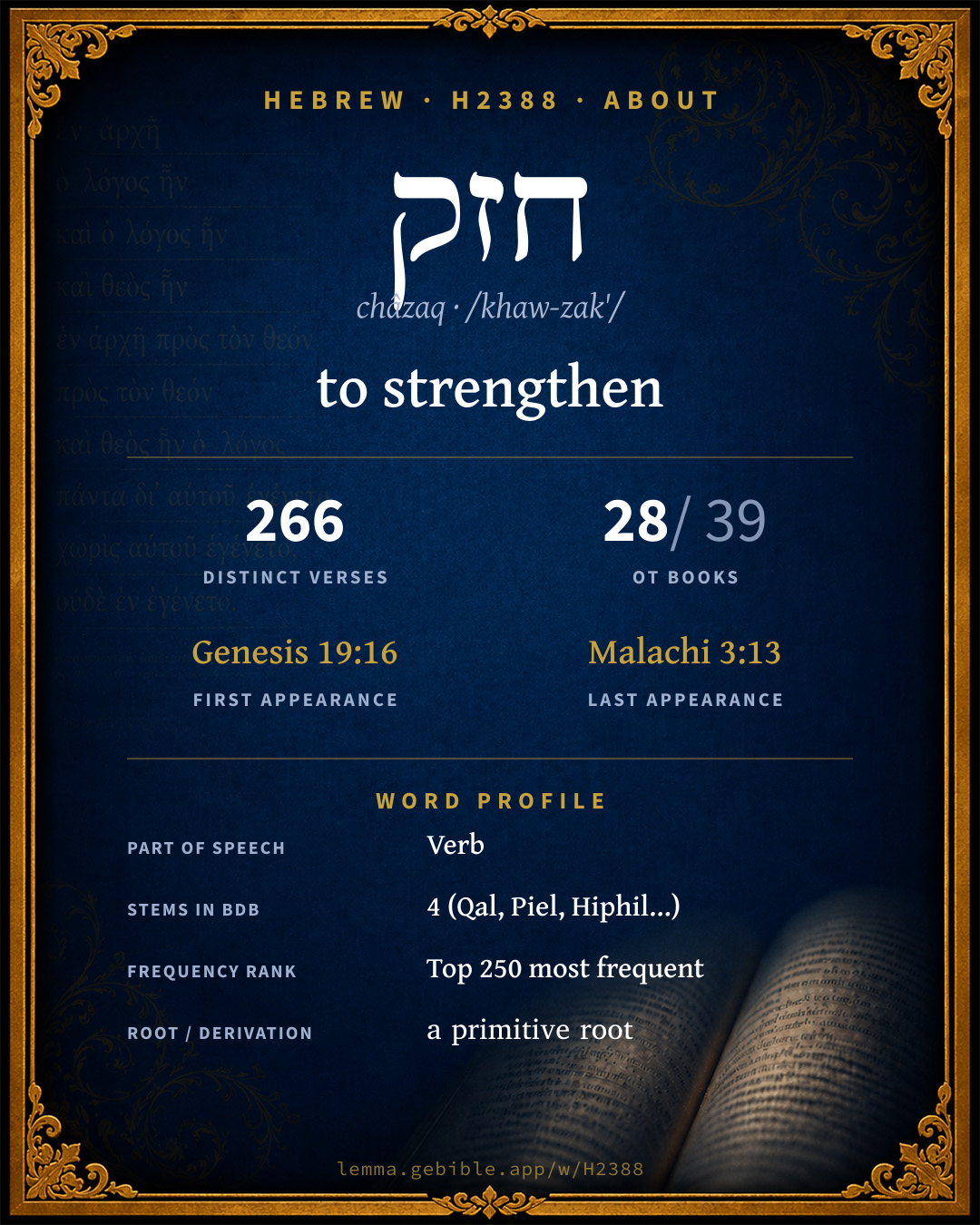
חָזַק
to strengthen
also: prevail, harden, be strong, become strong fuller range ↓
Full lexicon entry — Brown-Driver-Briggs (BDB)
From Brown-Driver-Briggs (BDB)
Where this word appears
See every Hiphil verb in the Hebrew Bible →
Grammar key — what these labels mean
Part of speech
- Verb
- An action or state-of-being word.
Stem
- Hiphil
- The causative active stem (“he caused / brought about”). Here: ‘make strong’
- Qal
- The basic, simple active stem — the plain form of the verb (“he wrote”). Here: ‘intrans. be or grow strong’
- Piel
- An intensive or resultative active stem. Here: ‘make strong’
- Hithpael
- The reflexive or reciprocal stem (the subject acts on itself). Here: ‘strengthen oneself 2 S 3’
Form
- Perfect
- A completed action or state — Hebrew marks aspect (completeness) more than strict tense (“he wrote”).
- Imperative
- A direct command (“write!”).
- Sequential Imperfect
- An imperfect with prefixed waw — the standard past-narrative form (waw-consecutive imperfect).
- Infinitive Construct
- A bound verbal noun, frequently with prepositions (“to write / in writing”).
- Participle Active
- A verbal adjective expressing ongoing or characteristic action (“writing / one who writes”).
- Imperfect
- An incomplete, ongoing, or future action (“he will / would write”).
- Sequential Perfect
- A perfect with prefixed waw continuing a preceding imperfect or command (waw-consecutive perfect).
- Cohortative
- A first-person volitional form expressing wish or resolve (“let me / let us write”).
- Jussive
- A third- or second-person volitional form expressing wish or command (“let him write”).
State
- Absolute
- The independent form of a noun, not bound to a following word.
- Construct
- A noun bound to a following noun in a possessive / “of” relationship (the construct chain).
Person
- 3rd Person
- The one spoken about (“he / she / it / they”).
- 2nd Person
- The one addressed (“you”).
- 1st Person
- The speaker (“I / we”).
Gender
- Masculine
- Grammatically masculine.
- Common
- Either gender — not distinguished for this form.
- Feminine
- Grammatically feminine.
Number
- Singular
- One.
- Plural
- More than one (in Hebrew, generally three or more).
Grammatical forms 72 distinct
- Verb, Hiphil, Perfect, 3rd Person, Masculine, Singular 30 times (10%)
- Verb, Qal, Imperative, 2nd Person, Masculine, Singular 21 times (7%)
- Verb, Piel, Sequential Imperfect, 3rd Person, Masculine, Singular 17 times (6%)
- Verb, Qal, Sequential Imperfect, 3rd Person, Masculine, Singular 16 times (6%)
- Verb, Piel, Infinitive Construct 13 times (4%)
- Verb, Hiphil, Perfect, 3rd Person, Common, Plural 11 times (4%)
- Verb, Hithpael, Sequential Imperfect, 3rd Person, Masculine, Singular 10 times (3%)
- Verb, Hiphil, Participle Active, Masculine, Singular, Absolute 10 times (3%)
+64 more forms (162 occurrences)
Parsed forms decoded from the imported morphology (morphhb / Westminster Leningrad Codex — WLC text public domain, morphhb tagging CC BY 4.0), counted across 290 parsed occurrences — not distinct verses.
Page 1 of 2 — showing verses 1–200 of 266 distinct verses where H2388 appears, across 28 books. Click any verse to open its interlinear word-by-word view. Verse text shown in the World English Bible for context — . Each verse’s Hebrew form is shown with its reference; the English is not keyword-highlighted, since the data carries no word-level English alignment. Use “Compare translations” on any verse to read it across multiple English versions. This concordance covers the Hebrew Bible; Septuagint (Greek Old Testament) occurrences are not indexed here.
Genesis 6 verses
- Genesis 19:16 וַ/יַּחֲזִ֨קוּ conj + Hiphil wimpf 3mp But he lingered; and the men laid hold on his hand, and on the hand of his wife, and on the hand of his two daughters, Yahweh being merciful to him; and they took him out, and set him outside of the city.
- Genesis 21:18 וְ/הַחֲזִ֥יקִי conj + Hiphil impv 2fs Get up, lift up the boy, and hold him in your hand. For I will make him a great nation."
- Genesis 41:56 וַ/יֶּחֱזַ֥ק conj + Qal wimpf 3ms The famine was over all the surface of the earth. Joseph opened all the store-houses, and sold to the Egyptians. The famine was severe in the land of Egypt.
- Genesis 41:57 חָזַ֥ק Qal pf 3ms All countries came into Egypt, to Joseph, to buy grain, because the famine was severe in all the earth.
- Genesis 47:20 חָזַ֥ק Qal pf 3ms So Joseph bought all the land of Egypt for Pharaoh, for the Egyptians sold every man his field, because the famine was severe on them, and the land became Pharaoh's.
- Genesis 48:2 וַ/יִּתְחַזֵּק֙ conj + Hithpael wimpf 3ms Someone told Jacob, and said, "Behold, your son Joseph comes to you," and Israel strengthened himself, and sat on the bed.
Exodus 15 verses
- Exodus 4:4 וַ/יַּ֣חֲזֶק conj + Hiphil wimpf 3ms Yahweh said to Moses, "Put forth your hand, and take it by the tail." He put forth his hand, and laid hold of it, and it became a rod in his hand.
- Exodus 4:21 אֲחַזֵּ֣ק Piel impf 1cs Yahweh said to Moses, "When you go back into Egypt, see that you do before Pharaoh all the wonders which I have put in your hand, but I will harden his heart and he will not let the people go.
- Exodus 7:13 וַ/יֶּחֱזַק֙ conj + Qal wimpf 3ms Pharaoh's heart was hardened, and he didn't listen to them; as Yahweh had spoken.
- Exodus 7:22 וַ/יֶּחֱזַ֤ק conj + Qal wimpf 3ms The magicians of Egypt did in like manner with their enchantments; and Pharaoh's heart was hardened, and he didn't listen to them; as Yahweh had spoken.
- Exodus 8:19 וַ/יֶּחֱזַ֤ק conj + Qal wimpf 3ms Then the magicians said to Pharaoh, "This is the finger of God:" and Pharaoh's heart was hardened, and he didn't listen to them; as Yahweh had spoken.
- Exodus 9:2 מַחֲזִ֥יק Hiphil ptcp.act ms For if you refuse to let them go, and hold them still,
- Exodus 9:12 וַ/יְחַזֵּ֤ק conj + Piel wimpf 3ms Yahweh hardened the heart of Pharaoh, and he didn't listen to them, as Yahweh had spoken to Moses.
- Exodus 9:35 וַֽ/יֶּחֱזַק֙ conj + Qal wimpf 3ms The heart of Pharaoh was hardened, and he didn't let the children of Israel go, just as Yahweh had spoken through Moses.
- Exodus 10:20 וַ/יְחַזֵּ֥ק conj + Piel wimpf 3ms But Yahweh hardened Pharaoh's heart, and he didn't let the children of Israel go.
- Exodus 10:27 וַ/יְחַזֵּ֥ק conj + Piel wimpf 3ms But Yahweh hardened Pharaoh's heart, and he wouldn't let them go.
- Exodus 11:10 וַ/יְחַזֵּ֤ק conj + Piel wimpf 3ms Moses and Aaron did all these wonders before Pharaoh, and Yahweh hardened Pharaoh's heart, and he didn't let the children of Israel go out of his land.
- Exodus 12:33 וַ/תֶּחֱזַ֤ק conj + Qal wimpf 3fs The Egyptians were urgent with the people, to send them out of the land in haste, for they said, "We are all dead men."
- Exodus 14:4 וְ/חִזַּקְתִּ֣י conj + Piel wpf 1cs I will harden Pharaoh's heart, and he will follow after them; and I will get honor over Pharaoh, and over all his host; and the Egyptians shall know that I am Yahweh." They did so.
- Exodus 14:8 וַ/יְחַזֵּ֣ק conj + Piel wimpf 3ms Yahweh hardened the heart of Pharaoh king of Egypt, and he pursued after the children of Israel; for the children of Israel went out with a high hand.
- Exodus 14:17 מְחַזֵּק֙ Piel ptcp.act ms I, behold, I will harden the hearts of the Egyptians, and they shall go in after them: and I will get myself honor over Pharaoh, and over all his host, over his chariots, and over his horsemen.
Leviticus 1 verse
Numbers 1 verse
Deuteronomy 9 verses
- Deuteronomy 1:38 חַזֵּ֔ק Piel impv 2ms Joshua the son of Nun, who stands before you, he shall go in there: encourage you him; for he shall cause Israel to inherit it.
- Deuteronomy 3:28 וְ/חַזְּקֵ֣/הוּ conj + Piel impv 2ms + sfx pers 3ms But charge Joshua, and encourage him, and strengthen him; for he shall go over before this people, and he shall cause them to inherit the land which you shall see.
- Deuteronomy 11:8 תֶּחֶזְק֗וּ Qal impf 2mp Therefore shall you keep all the commandment which I command you this day, that you may be strong, and go in and possess the land, where you go over to possess it;
- Deuteronomy 12:23 חֲזַ֗ק Qal impv 2ms Only be sure that you don't eat the blood: for the blood is the life; and you shall not eat the life with the flesh.
- Deuteronomy 22:25 וְ/הֶחֱזִֽיק conj + Hiphil wpf 3ms But if the man find the lady who is pledged to be married in the field, and the man force her, and lie with her; then the man only who lay with her shall die:
- Deuteronomy 25:11 וְ/הֶחֱזִ֖יקָה conj + Hiphil wpf 3fs When men strive together one with another, and the wife of the one draws near to deliver her husband out of the hand of him who strikes him, and puts forth her hand, and takes him by the secrets;
- Deuteronomy 31:6 חִזְק֣וּ Qal impv 2mp Be strong and of good courage, don't be afraid, nor be scared of them: for Yahweh your God, he it is who does go with you; he will not fail you, nor forsake you.
- Deuteronomy 31:7 חֲזַ֣ק Qal impv 2ms Moses called to Joshua, and said to him in the sight of all Israel, Be strong and of good courage: for you shall go with this people into the land which Yahweh has sworn to their fathers to give them; and you shall cause them to inherit it.
- Deuteronomy 31:23 חֲזַ֣ק Qal impv 2ms He gave Joshua the son of Nun a charge, and said, Be strong and of good courage; for you shall bring the children of Israel into the land which I swore to them: and I will be with you.
Joshua 8 verses
- Joshua 1:6 חֲזַ֖ק Qal impv 2ms Be strong and of good courage; for you shall cause this people to inherit the land which I swore to their fathers to give them.
- Joshua 1:7 חֲזַ֨ק Qal impv 2ms Only be strong and very courageous, to observe to do according to all the law, which Moses my servant commanded you: don't turn from it to the right hand or to the left, that you may have good success wherever you go.
- Joshua 1:9 חֲזַ֣ק Qal impv 2ms Haven't I commanded you? Be strong and of good courage; don't be afraid, neither be dismayed: for Yahweh your God is with you wherever you go.
- Joshua 1:18 חֲזַ֥ק Qal impv 2ms Whoever he be who shall rebel against your commandment, and shall not listen to your words in all that you command him, he shall be put to death: only be strong and of good courage.
- Joshua 10:25 חִזְק֣וּ Qal impv 2mp Joshua said to them, Don't be afraid, nor be dismayed; be strong and of good courage: for thus shall Yahweh do to all your enemies against whom you fight.
- Joshua 11:20 לְ/חַזֵּ֣ק prep + Piel inf.cs For it was of Yahweh to harden their hearts, to come against Israel in battle, that he might utterly destroy them, that they might have no favor, but that he might destroy them, as Yahweh commanded Moses.
- Joshua 17:13 חָֽזְקוּ֙ Qal pf 3cp It happened, when the children of Israel had grown strong, that they put the Canaanites to forced labor, and didn't utterly drive them out.
- Joshua 23:6 וַ/חֲזַקְתֶּ֣ם conj + Qal wpf 2mp Therefore be you very courageous to keep and to do all that is written in the book of the law of Moses, that you not turn aside from it to the right hand or to the left;
Judges 12 verses
- Judges 1:28 חָזַ֣ק Qal pf 3ms It happened, when Israel had grown strong, that they put the Canaanites to forced labor, and did not utterly drive them out.
- Judges 3:12 וַ/יְחַזֵּ֨ק conj + Piel wimpf 3ms The children of Israel again did that which was evil in the sight of Yahweh: and Yahweh strengthened Eglon the king of Moab against Israel, because they had done that which was evil in the sight of Yahweh.
- Judges 7:8 הֶֽחֱזִ֑יק Hiphil pf 3ms So the people took food in their hand, and their trumpets; and he sent all the men of Israel every man to his tent, but retained the three hundred men: and the camp of Midian was beneath him in the valley.
- Judges 7:11 תֶּחֱזַ֣קְנָה Qal impf 3fp and you shall hear what they say; and afterward shall your hands be strengthened to go down into the camp. Then went he down with Purah his servant to the outermost part of the armed men who were in the camp.
- Judges 7:20 וַ/יַּחֲזִ֤יקוּ conj + Hiphil wimpf 3mp The three companies blew the trumpets, and broke the pitchers, and held the torches in their left hands, and the trumpets in their right hands with which to blow; and they cried, The sword of Yahweh and of Gideon.
- Judges 9:24 חִזְּק֥וּ Piel pf 3cp that the violence done to the seventy sons of Jerubbaal might come, and that their blood might be laid on Abimelech their brother, who killed them, and on the men of Shechem, who strengthened his hands to kill his brothers.
- Judges 16:26 הַ/מַּחֲזִ֣יק ptcl def.art + Hiphil ptcp.act ms and Samson said to the boy who held him by the hand, Allow me that I may feel the pillars whereupon the house rests, that I may lean on them.
- Judges 16:28 וְ/חַזְּקֵ֨/נִי conj + Piel impv 2ms + sfx pers 1cs Samson called to Yahweh, and said, Lord Yahweh, remember me, Please, and strengthen me, Please, only this once, God, that I may be at once avenged of the Philistines for my two eyes.
- Judges 19:4 וַ/יֶּחֱזַק conj + Qal wimpf 3ms His father-in-law, the young lady's father, retained him; and he abode with him three days: so they ate and drink, and lodged there.
- Judges 19:25 וַ/יַּחֲזֵ֤ק conj + Hiphil wimpf 3ms But the men wouldn't listen to him: so the man laid hold on his concubine, and brought her forth to them; and they knew her, and abused her all the night until the morning: and when the day began to spring, they let her go.
- Judges 19:29 וַ/יַּחֲזֵ֣ק conj + Hiphil wimpf 3ms When he was come into his house, he took a knife, and laid hold on his concubine, and divided her, limb by limb, into twelve pieces, and sent her throughout all the borders of Israel.
- Judges 20:22 וַ/יִּתְחַזֵּ֥ק conj + Hithpael wimpf 3ms The people, the men of Israel, encouraged themselves, and set the battle again in array in the place where they set themselves in array the first day.
1 Samuel 6 verses
- 1 Samuel 4:9 הִֽתְחַזְּק֞וּ Hithpael impv 2mp Be strong, and behave yourselves like men, O you Philistines, that you not be servants to the Hebrews, as they have been to you: quit yourselves like men, and fight.
- 1 Samuel 15:27 וַ/יַּחֲזֵ֥ק conj + Hiphil wimpf 3ms As Samuel turned about to go away, [Saul] laid hold on the skirt of his robe, and it tore.
- 1 Samuel 17:35 וְ/הֶחֱזַ֨קְתִּי֙ conj + Hiphil wpf 1cs I went out after him, and struck him, and delivered it out of his mouth; and when he arose against me, I caught him by his beard, and struck him, and killed him.
- 1 Samuel 17:50 וַ/יֶּחֱזַ֨ק conj + Qal wimpf 3ms So David prevailed over the Philistine with a sling and with a stone, and struck the Philistine, and killed him; but there was no sword in the hand of David.
- 1 Samuel 23:16 וַ/יְחַזֵּ֥ק conj + Piel wimpf 3ms Jonathan, Saul's son, arose, and went to David into the wood, and strengthened his hand in God.
- 1 Samuel 30:6 וַ/יִּתְחַזֵּ֣ק conj + Hithpael wimpf 3ms David was greatly distressed; for the people spoke of stoning him, because the soul of all the people was grieved, every man for his sons and for his daughters: but David strengthened himself in Yahweh his God.
2 Samuel 15 verses
- 2 Samuel 1:11 וַ/יַּחֲזֵ֥ק conj + Hiphil wimpf 3ms Then David took hold on his clothes, and tore them; and likewise all the men who were with him:
- 2 Samuel 2:7 תֶּחֱזַ֣קְנָה Qal juss 3fp Now therefore let your hands be strong, and be you valiant; for Saul your lord is dead, and also the house of Judah have anointed me king over them.
- 2 Samuel 2:16 וַֽ/יַּחֲזִ֜קוּ conj + Hiphil wimpf 3mp They caught everyone his fellow by the head, and [thrust] his sword in his fellow's side; so they fell down together: therefore that place was called Helkath Hazzurim, which is in Gibeon.
- 2 Samuel 3:6 מִתְחַזֵּ֖ק Hithpael ptcp.act ms It happened, while there was war between the house of Saul and the house of David, that Abner made himself strong in the house of Saul.
- 2 Samuel 3:29 וּ/מַחֲזִ֥יק conj + Hiphil ptcp.act ms let it fall on the head of Joab, and on all his father's house; and let there not fail from the house of Joab one who has an issue, or who is a leper, or who leans on a staff, or who falls by the sword, or who lacks bread.
- 2 Samuel 10:11 תֶּחֱזַ֤ק יֶחֱזְק֣וּ Qal impf 3fs Qal impf 3mp He said, If the Syrians be too strong for me, then you shall help me; but if the children of Ammon be too strong for you, then I will come and help you.
- 2 Samuel 10:12 חֲזַ֤ק וְ/נִתְחַזַּק֙ Qal impv 2ms conj + Hithpael coh 1cp Be of good courage, and let us play the man for our people, and for the cities of our God: and Yahweh do that which seems him good.
- 2 Samuel 11:25 הַחֲזֵ֨ק וְ/חַזְּקֵֽ/הוּ Hiphil impv 2ms conj + Piel impv 2ms + sfx pers 3ms Then David said to the messenger, Thus shall you tell Joab, Don't let this thing displease you, for the sword devours one as well as another; make your battle more strong against the city, and overthrow it: and encourage you him.
- 2 Samuel 13:11 וַ/יַּֽחֲזֶק conj + Hiphil wimpf 3ms When she had brought them near to him to eat, he took hold of her, and said to her, Come, lie with me, my sister.
- 2 Samuel 13:14 וַ/יֶּחֱזַ֤ק conj + Qal wimpf 3ms However he would not listen to her voice; but being stronger than she, he forced her, and lay with her.
- 2 Samuel 13:28 חִזְק֖וּ Qal impv 2mp Absalom commanded his servants, saying, Mark you now, when Amnon's heart is merry with wine; and when I tell you, Smite Amnon, then kill him; don't be afraid; haven't I commanded you? be courageous, and be valiant.
- 2 Samuel 15:5 וְ/הֶחֱזִ֥יק conj + Hiphil wpf 3ms It was so, that when any man came near to do him obeisance, he put forth his hand, and took hold of him, and kissed him.
- 2 Samuel 16:21 וְ/חָ֣זְק֔וּ conj + Qal wpf 3cp Ahithophel said to Absalom, Go in to your father's concubines, that he has left to keep the house; and all Israel will hear that you are abhorred of your father: then will the hands of all who are with you be strong.
- 2 Samuel 18:9 וַ/יֶּחֱזַ֧ק conj + Qal wimpf 3ms Absalom happened to meet the servants of David. Absalom was riding on his mule, and the mule went under the thick boughs of a great oak, and his head caught hold of the oak, and he was taken up between the sky and earth; and the mule that was under him went on.
- 2 Samuel 24:4 וַ/יֶּחֱזַ֤ק conj + Qal wimpf 3ms Notwithstanding, the king's word prevailed against Joab, and against the captains of the host. Joab and the captains of the host went out from the presence of the king, to number the people of Israel.
1 Kings 8 verses
- 1 Kings 1:50 וַֽ/יַּחֲזֵ֖ק conj + Hiphil wimpf 3ms Adonijah feared because of Solomon; and he arose, and went, and caught hold on the horns of the altar.
- 1 Kings 2:2 וְ/חָזַקְתָּ֖ conj + Qal wpf 2ms I am going the way of all the earth: be you strong therefore, and show yourself a man;
- 1 Kings 2:28 וַֽ/יַּחֲזֵ֖ק conj + Hiphil wimpf 3ms The news came to Joab; for Joab had turned after Adonijah, though he didn't turn after Absalom. Joab fled to the Tent of Yahweh, and caught hold on the horns of the altar.
- 1 Kings 9:9 וַֽ/יַּחֲזִ֨קוּ֙ conj + Hiphil wimpf 3mp and they shall answer, Because they forsook Yahweh their God, who brought forth their fathers out of the land of Egypt, and laid hold on other gods, and worshiped them, and served them: therefore has Yahweh brought all this evil on them.
- 1 Kings 16:22 וַ/יֶּחֱזַ֤ק conj + Qal wimpf 3ms But the people who followed Omri prevailed against the people who followed Tibni the son of Ginath: so Tibni died, and Omri reigned.
- 1 Kings 20:22 הִתְחַזַּ֔ק Hithpael impv 2ms The prophet came near to the king of Israel, and said to him, Go, strengthen yourself, and mark, and see what you do; for at the return of the year the king of Syria will come up against you.
- 1 Kings 20:23 חָזְק֣וּ נֶחֱזַ֖ק Qal pf 3cp Qal impf 1cp The servants of the king of Syria said to him, Their god is a god of the hills; therefore they were stronger than we: but let us fight against them in the plain, and surely we shall be stronger than they.
- 1 Kings 20:25 נֶחֱזַ֖ק Qal impf 1cp and number you an army, like the army that you have lost, horse for horse, and chariot for chariot; and we will fight against them in the plain, and surely we shall be stronger than they. He listened to their voice, and did so.
2 Kings 15 verses
- 2 Kings 2:12 וַֽ/יַּחֲזֵק֙ conj + Hiphil wimpf 3ms Elisha saw it, and he cried, My father, my father, the chariots of Israel and the horsemen of it! He saw him no more: and he took hold of his own clothes, and tore them in two pieces.
- 2 Kings 3:26 חָזַ֥ק Qal pf 3ms When the king of Moab saw that the battle was too severe for him, he took with him seven hundred men who drew sword, to break through to the king of Edom; but they could not.
- 2 Kings 4:8 וַ/תַּחֲזֶק conj + Hiphil wimpf 3fs It fell on a day, that Elisha passed to Shunem, where was a great woman; and she constrained him to eat bread. So it was, that as often as he passed by, he turned in there to eat bread.
- 2 Kings 4:27 וַֽ/תַּחֲזֵ֖ק conj + Hiphil wimpf 3fs When she came to the man of God to the hill, she caught hold of his feet. Gehazi came near to thrust her away; but the man of God said, Let her alone: for her soul is vexed within her; and Yahweh has hid it from me, and has not told me.
- 2 Kings 12:5 יְחַזְּקוּ֙ Piel impf 3mp let the priests take it to them, every man from his acquaintance; and they shall repair the breaches of the house, wherever any breach shall be found.
- 2 Kings 12:6 חִזְּק֥וּ Piel pf 3cp But it was so, that in the three and twentieth year of king Jehoash the priests had not repaired the breaches of the house.
- 2 Kings 12:7 מְחַזְּקִ֖ים Piel ptcp.act mp Then king Jehoash called for Jehoiada the priest, and for the [other] priests, and said to them, Why don't you repair the breaches of the house? now therefore take no [more] money from your acquaintance, but deliver it for the breaches of the house.
- 2 Kings 12:8 חַזֵּ֖ק Piel inf.cs The priests consented that they should take no [more] money from the people, neither repair the breaches of the house.
- 2 Kings 12:12 לְ/חַזֵּ֖ק prep + Piel inf.cs and to the masons and the stone cutters, and for buying timber and hewn stone to repair the breaches of the house of Yahweh, and for all that was laid out for the house to repair it.
- 2 Kings 12:14 וְ/חִזְּקוּ conj + Piel wpf 3cp for they gave that to those who did the work, and repaired therewith the house of Yahweh.
- 2 Kings 14:5 חָזְקָ֥ה Qal pf 3fs It happened, as soon as the kingdom was established in his hand, that he killed his servants who had slain the king his father:
- 2 Kings 15:19 לְ/הַחֲזִ֥יק prep + Hiphil inf.cs There came against the land Pul the king of Assyria; and Menahem gave Pul one thousand talents of silver, that his hand might be with him to confirm the kingdom in his hand.
- 2 Kings 22:5 לְ/חַזֵּ֖ק prep + Piel inf.cs and let them deliver it into the hand of the workmen who have the oversight of the house of Yahweh; and let them give it to the workmen who are in the house of Yahweh, to repair the breaches of the house,
- 2 Kings 22:6 לְ/חַזֵּ֖ק prep + Piel inf.cs to the carpenters, and to the builders, and to the masons, and for buying timber and hewn stone to repair the house.
- 2 Kings 25:3 וַ/יֶּחֱזַ֥ק conj + Qal wimpf 3ms On the ninth day of the [fourth] month the famine was sore in the city, so that there was no bread for the people of the land.
1 Chronicles 10 verses
- 1 Chronicles 11:10 הַ/מִּתְחַזְּקִ֨ים ptcl def.art + Hithpael ptcp.act mp Now these are the chief of the mighty men whom David had, who shown themselves strong with him in his kingdom, together with all Israel, to make him king, according to the word of Yahweh concerning Israel.
- 1 Chronicles 19:12 תֶּחֱזַ֤ק יֶֽחֶזְק֥וּ Qal impf 3fs Qal impf 3mp He said, If the Syrians be too strong for me, then you shall help me; but if the children of Ammon be too strong for you, then I will help you.
- 1 Chronicles 19:13 חֲזַ֤ק וְ/נִֽתְחַזְּקָה֙ Qal impv 2ms conj + Hithpael coh 1cp Be of good courage, and let us play the man for our people, and for the cities of our God: and Yahweh do that which seems him good.
- 1 Chronicles 21:4 חָזַ֣ק Qal pf 3ms Nevertheless the king's word prevailed against Joab. Therefore Joab departed, and went throughout all Israel, and came to Jerusalem.
- 1 Chronicles 22:13 חֲזַ֣ק Qal impv 2ms Then shall you prosper, if you observe to do the statutes and the ordinances which Yahweh gave Moses concerning Israel. Be strong, and of good courage. Don't be afraid, neither be dismayed.
- 1 Chronicles 26:27 לְ/חַזֵּ֖ק prep + Piel inf.cs Out of the spoil won in battles did they dedicate to repair the house of Yahweh.
- 1 Chronicles 28:7 יֶחֱזַ֗ק Qal impf 3ms I will establish his kingdom forever, if he be constant to do my commandments and my ordinances, as at this day.
- 1 Chronicles 28:10 חֲזַ֥ק Qal impv 2ms Take heed now; for Yahweh has chosen you to build a house for the sanctuary: be strong, and do it.
- 1 Chronicles 28:20 חֲזַ֤ק Qal impv 2ms David said to Solomon his son, Be strong and of good courage, and do it: don't be afraid, nor be dismayed; for Yahweh God, even my God, is with you; he will not fail you, nor forsake you, until all the work for the service of the house of Yahweh is finished.
- 1 Chronicles 29:12 וּ/לְ/חַזֵּ֖ק conj + prep + Piel inf.cs Both riches and honor come of you, and you rule over all; and in your hand is power and might; and it is in your hand to make great, and to give strength to all.
2 Chronicles 38 verses
- 2 Chronicles 1:1 וַ/יִּתְחַזֵּ֛ק conj + Hithpael wimpf 3ms Solomon the son of David was strengthened in his kingdom, and Yahweh his God was with him, and magnified him exceedingly.
- 2 Chronicles 4:5 מַחֲזִ֣יק Hiphil ptcp.act ms It was a handbreadth thick; and the brim of it was worked like the brim of a cup, like the flower of a lily: it received and held three thousand baths.
- 2 Chronicles 7:22 וַֽ/יַּחֲזִ֨יקוּ֙ conj + Hiphil wimpf 3mp They shall answer, Because they forsook Yahweh, the God of their fathers, who brought them forth out of the land of Egypt, and laid hold on other gods, and worshiped them, and served them: therefore has he brought all this evil on them.
- 2 Chronicles 8:3 וַ/יֶּחֱזַ֖ק conj + Qal wimpf 3ms Solomon went to Hamath-zobah, and prevailed against it.
- 2 Chronicles 11:11 וַ/יְחַזֵּ֖ק conj + Piel wimpf 3ms He fortified the strongholds, and put captains in them, and stores of food, and oil and wine.
- 2 Chronicles 11:12 וַֽ/יְחַזְּקֵ֖/ם conj + Piel wimpf 3ms + sfx pers 3mp In every city [he put] shields and spears, and made them exceeding strong. Judah and Benjamin belonged to him.
- 2 Chronicles 11:17 וַֽ/יְחַזְּקוּ֙ conj + Piel wimpf 3mp So they strengthened the kingdom of Judah, and made Rehoboam the son of Solomon strong, three years; for they walked three years in the way of David and Solomon.
- 2 Chronicles 12:13 וַ/יִּתְחַזֵּ֞ק conj + Hithpael wimpf 3ms So king Rehoboam strengthened himself in Jerusalem, and reigned: for Rehoboam was forty-one years old when he began to reign, and he reigned seventeen years in Jerusalem, the city which Yahweh had chosen out of all the tribes of Israel, to put his name there: and his mother's name was Naamah the Ammonitess.
- 2 Chronicles 13:7 הִתְחַזַּ֖ק Hithpael pf 3ms There were gathered to him worthless men, base fellows, who strengthened themselves against Rehoboam the son of Solomon, when Rehoboam was young and tender-hearted, and could not withstand them.
- 2 Chronicles 13:8 לְ/הִתְחַזֵּק֙ prep + Hithpael inf.cs Now you think to withstand the kingdom of Yahweh in the hand of the sons of David; and you are a great multitude, and there are with you the golden calves which Jeroboam made you for gods.
- 2 Chronicles 13:21 וַ/יִּתְחַזֵּ֣ק conj + Hithpael wimpf 3ms But Abijah grew mighty, and took to himself fourteen wives, and became the father of twenty-two sons, and sixteen daughters.
- 2 Chronicles 15:7 חִזְק֔וּ Qal impv 2mp But be you strong, and don't let your hands be slack; for your work shall be rewarded.
- 2 Chronicles 15:8 הִתְחַזַּ֗ק Hithpael pf 3ms When Asa heard these words, and the prophecy of Oded the prophet, he took courage, and put away the abominations out of all the land of Judah and Benjamin, and out of the cities which he had taken from the hill-country of Ephraim; and he renewed the altar of Yahweh, that was before the porch of Yahweh.
- 2 Chronicles 16:9 לְ֠/הִתְחַזֵּק prep + Hithpael inf.cs For the eyes of Yahweh run back and forth throughout the whole earth, to show himself strong in the behalf of them whose heart is perfect toward him. Herein you have done foolishly; for from henceforth you shall have wars.
- 2 Chronicles 17:1 וַ/יִּתְחַזֵּ֖ק conj + Hithpael wimpf 3ms Jehoshaphat his son reigned in his place, and strengthened himself against Israel.
- 2 Chronicles 19:11 חִזְק֣וּ Qal impv 2mp Behold, Amariah the chief priest is over you in all matters of Yahweh; and Zebadiah the son of Ishmael, the ruler of the house of Judah, in all the king's matters: also the Levites shall be officers before you. Deal courageously, and Yahweh be with the good.
- 2 Chronicles 21:4 וַ/יִּתְחַזַּ֔ק conj + Hithpael wimpf 3ms Now when Jehoram was risen up over the kingdom of his father, and had strengthened himself, he killed all his brothers with the sword, and various also of the princes of Israel.
- 2 Chronicles 23:1 הִתְחַזַּ֣ק Hithpael pf 3ms In the seventh year Jehoiada strengthened himself, and took the captains of hundreds, Azariah the son of Jeroham, and Ishmael the son of Jehohanan, and Azariah the son of Obed, and Maaseiah the son of Adaiah, and Elishaphat the son of Zichri, into covenant with him.
- 2 Chronicles 24:5 לְ/חַזֵּ֣ק prep + Piel inf.cs He gathered together the priests and the Levites, and said to them, Go out to the cities of Judah, and gather of all Israel money to repair the house of your God from year to year; and see that you hasten the matter. However the Levites didn't hurry.
- 2 Chronicles 24:12 לְ/חַזֵּ֖ק prep + Piel inf.cs The king and Jehoiada gave it to such as did the work of the service of the house of Yahweh; and they hired masons and carpenters to restore the house of Yahweh, and also such as worked iron and brass to repair the house of Yahweh.
- 2 Chronicles 25:3 חָזְקָ֥ה Qal pf 3fs Now it happened, when the kingdom was established to him, that he killed his servants who had killed the king his father.
- 2 Chronicles 25:8 חֲזַ֣ק Qal impv 2ms But if you will go, do [valiantly], be strong for the battle: God will cast you down before the enemy; for God has power to help, and to cast down.
- 2 Chronicles 25:11 הִתְחַזַּ֔ק Hithpael pf 3ms Amaziah took courage, and led forth his people, and went to the Valley of Salt, and struck of the children of Seir ten thousand.
- 2 Chronicles 26:8 הֶחֱזִ֖יק Hiphil pf 3ms The Ammonites gave tribute to Uzziah: and his name spread abroad even to the entrance of Egypt; for he grew exceeding strong.
- 2 Chronicles 26:9 וַֽ/יְחַזְּקֵֽ/ם conj + Piel wimpf 3ms + sfx pers 3mp Moreover Uzziah built towers in Jerusalem at the corner gate, and at the valley gate, and at the turning [of the wall], and fortified them.
- 2 Chronicles 26:15 חָזָֽק Qal pf 3ms He made in Jerusalem engines, invented by skillful men, to be on the towers and on the battlements, with which to shoot arrows and great stones. His name spread far abroad; for he was marvelously helped, until he was strong.
- 2 Chronicles 27:5 וַ/יֶּחֱזַ֣ק conj + Qal wimpf 3ms He fought also with the king of the children of Ammon, and prevailed against them. The children of Ammon gave him the same year one hundred talents of silver, and ten thousand measures of wheat, and ten thousand of barley. So much did the children of Ammon render to him, in the second year also, and in the third.
- 2 Chronicles 27:6 וַ/יִּתְחַזֵּ֖ק conj + Hithpael wimpf 3ms So Jotham became mighty, because he ordered his ways before Yahweh his God.
- 2 Chronicles 28:15 וַ/יַּחֲזִ֣יקוּ conj + Hiphil wimpf 3mp The men who have been mentioned by name rose up, and took the captives, and with the spoil clothed all who were naked among them, and arrayed them, and shod them, and gave them to eat and to drink, and anointed them, and carried all the feeble of them on donkeys, and brought them to Jericho, the city of palm trees, to their brothers: then they returned to Samaria.
- 2 Chronicles 28:20 חֲזָקֽ/וֹ Qal pf 3ms + sfx pers 3ms Tilgath Pilneser king of Assyria came to him, and distressed him, but didn't strengthen him.
- 2 Chronicles 29:3 וַֽ/יְחַזְּקֵֽ/ם conj + Piel wimpf 3ms + sfx pers 3mp He in the first year of his reign, in the first month, opened the doors of the house of Yahweh, and repaired them.
- 2 Chronicles 29:34 וַֽ/יְּחַזְּק֞וּ/ם conj + Piel wimpf 3mp + sfx pers 3mp But the priests were too few, so that they could not flay all the burnt offerings: therefore their brothers the Levites helped them, until the work was ended, and until the priests had sanctified themselves; for the Levites were more upright in heart to sanctify themselves than the priests.
- 2 Chronicles 31:4 יֶחֶזְק֖וּ Qal impf 3mp Moreover he commanded the people who lived in Jerusalem to give the portion of the priests and the Levites, that they might give themselves to the law of Yahweh.
- 2 Chronicles 32:5 וַ/יִּתְחַזַּ֡ק וַ/יְחַזֵּ֥ק conj + Hithpael wimpf 3ms conj + Piel wimpf 3ms He took courage, and built up all the wall that was broken down, and raised [it] up to the towers, and the other wall outside, and strengthened Millo [in] the city of David, and made weapons and shields in abundance.
- 2 Chronicles 32:7 חִזְק֣וּ Qal impv 2mp Be strong and of good courage, don't be afraid nor dismayed for the king of Assyria, nor for all the multitude who is with him; for there is a greater with us than with him:
- 2 Chronicles 34:8 לְ/חַזֵּ֕ק prep + Piel inf.cs Now in the eighteenth year of his reign, when he had purged the land and the house, he sent Shaphan the son of Azaliah, and Maaseiah the governor of the city, and Joah the son of Joahaz the recorder, to repair the house of Yahweh his God.
- 2 Chronicles 34:10 וּ/לְ/חַזֵּ֖ק conj + prep + Piel inf.cs They delivered it into the hand of the workmen who had the oversight of the house of Yahweh; and the workmen who labored in the house of Yahweh gave it to mend and repair the house;
- 2 Chronicles 35:2 וַֽ/יְחַזְּקֵ֔/ם conj + Piel wimpf 3ms + sfx pers 3mp He set the priests in their offices, and encouraged them to the service of the house of Yahweh.
Ezra 5 verses
- Ezra 1:6 חִזְּק֣וּ Piel pf 3cp All those who were round about them strengthened their hands with vessels of silver, with gold, with goods, and with animals, and with precious things, besides all that was willingly offered.
- Ezra 6:22 לְ/חַזֵּ֣ק prep + Piel inf.cs and kept the feast of unleavened bread seven days with joy: for Yahweh had made them joyful, and had turned the heart of the king of Assyria to them, to strengthen their hands in the work of the house of God, the God of Israel.
- Ezra 7:28 הִתְחַזַּ֗קְתִּי Hithpael pf 1cs and has extended loving kindness to me before the king, and his counselors, and before all the king's mighty princes. I was strengthened according to the hand of Yahweh my God on me, and I gathered together out of Israel chief men to go up with me.
- Ezra 9:12 תֶּחֶזְק֗וּ Qal impf 2mp now therefore don't give your daughters to their sons, neither take their daughters to your sons, nor seek their peace or their prosperity forever; that you may be strong, and eat the good of the land, and leave it for an inheritance to your children forever.
- Ezra 10:4 חֲזַ֖ק Qal impv 2ms Arise; for the matter belongs to you, and we are with you: be of good courage, and do it.
Nehemiah 34 verses
- Nehemiah 2:18 וַ/יְחַזְּק֥וּ conj + Piel wimpf 3mp I told them of the hand of my God which was good on me, as also of the king's words that he had spoken to me. They said, Let us rise up and build. So they strengthened their hands for the good [work].
- Nehemiah 3:4 הֶחֱזִ֗יק הֶחֱזִ֔יק הֶֽחֱזִ֔יק Hiphil pf 3ms Hiphil pf 3ms Hiphil pf 3ms Next to them repaired Meremoth the son of Uriah, the son of Hakkoz. Next to them repaired Meshullam the son of Berechiah, the son of Meshezabel. Next to them repaired Zadok the son of Baana.
- Nehemiah 3:5 הֶחֱזִ֣יקוּ Hiphil pf 3cp Next to them the Tekoites repaired; but their nobles didn't put their necks to the work of their lord.
- Nehemiah 3:6 הֶחֱזִ֗יקוּ Hiphil pf 3cp The old gate repaired Joiada the son of Paseah and Meshullam the son of Besodeiah; they laid the beams of it, and set up the doors of it, and the bolts of it, and the bars of it.
- Nehemiah 3:7 הֶחֱזִ֜יק Hiphil pf 3ms Next to them repaired Melatiah the Gibeonite, and Jadon the Meronothite, the men of Gibeon, and of Mizpah, [that appertained] to the throne of the governor beyond the River.
- Nehemiah 3:8 הֶחֱזִ֗יק הֶחֱזִ֔יק Hiphil pf 3ms Hiphil pf 3ms Next to him repaired Uzziel the son of Harhaiah, goldsmiths. Next to him repaired Hananiah one of the perfumers, and they fortified Jerusalem even to the broad wall.
- Nehemiah 3:9 הֶחֱזִיק֙ Hiphil pf 3ms Next to them repaired Rephaiah the son of Hur, the ruler of half the district of Jerusalem.
- Nehemiah 3:10 הֶחֱזִ֛יק הֶחֱזִ֔יק Hiphil pf 3ms Hiphil pf 3ms Next to them repaired Jedaiah the son of Harumaph, over against his house. Next to him repaired Hattush the son of Hashabneiah.
- Nehemiah 3:11 הֶחֱזִיק֙ Hiphil pf 3ms Malchijah the son of Harim, and Hasshub the son of Pahath-moab, repaired another portion, and the tower of the furnaces.
- Nehemiah 3:12 הֶחֱזִ֗יק Hiphil pf 3ms Next to him repaired Shallum the son of Hallohesh, the ruler of half the district of Jerusalem, he and his daughters.
- Nehemiah 3:13 הֶחֱזִ֣יק Hiphil pf 3ms The valley gate repaired Hanun, and the inhabitants of Zanoah; they built it, and set up the doors of it, the bolts of it, and the bars of it, and one thousand cubits of the wall to the dung gate.
- Nehemiah 3:14 הֶחֱזִיק֙ Hiphil pf 3ms The dung gate repaired Malchijah the son of Rechab, the ruler of the district of Beth Haccherem; he built it, and set up the doors of it, the bolts of it, and the bars of it.
- Nehemiah 3:15 הֶ֠חֱזִיק Hiphil pf 3ms The spring gate repaired Shallun the son of Colhozeh, the ruler of the district of Mizpah; he built it, and covered it, and set up the doors of it, the bolts of it, and the bars of it, and the wall of the pool of Shelah by the king's garden, even to the stairs that go down from the city of David.
- Nehemiah 3:16 הֶחֱזִיק֙ Hiphil pf 3ms After him repaired Nehemiah the son of Azbuk, the ruler of half the district of Beth Zur, to the place over against the tombs of David, and to the pool that was made, and to the house of the mighty men.
- Nehemiah 3:17 הֶחֱזִ֥יקוּ הֶחֱזִ֗יק Hiphil pf 3cp Hiphil pf 3ms After him repaired the Levites, Rehum the son of Bani. Next to him repaired Hashabiah, the ruler of half the district of Keilah, for his district.
- Nehemiah 3:18 הֶחֱזִ֣יקוּ Hiphil pf 3cp After him repaired their brothers, Bavvai the son of Henadad, the ruler of half the district of Keilah.
- Nehemiah 3:19 וַ/יְחַזֵּ֨ק conj + Piel wimpf 3ms Next to him repaired Ezer the son of Jeshua, the ruler of Mizpah, another portion, over against the ascent to the armory at the turning [of the wall].
- Nehemiah 3:20 הֶחֱזִ֛יק Hiphil pf 3ms After him Baruch the son of Zabbai earnestly repaired another portion, from the turning [of the wall] to the door of the house of Eliashib the high priest.
- Nehemiah 3:21 הֶחֱזִ֗יק Hiphil pf 3ms After him repaired Meremoth the son of Uriah the son of Hakkoz another portion, from the door of the house of Eliashib even to the end of the house of Eliashib.
- Nehemiah 3:22 הֶחֱזִ֥יקוּ Hiphil pf 3cp After him repaired the priests, the men of the Plain.
- Nehemiah 3:23 הֶחֱזִ֧יק הֶחֱזִ֗יק Hiphil pf 3ms Hiphil pf 3ms After them repaired Benjamin and Hasshub over against their house. After them repaired Azariah the son of Maaseiah the son of Ananiah beside his own house.
- Nehemiah 3:24 הֶחֱזִ֗יק Hiphil pf 3ms After him repaired Binnui the son of Henadad another portion, from the house of Azariah to the turning [of the wall], and to the corner.
- Nehemiah 3:27 הֶחֱזִ֥יקוּ Hiphil pf 3cp After him the Tekoites repaired another portion, over against the great tower that stands out, and to the wall of Ophel.
- Nehemiah 3:28 הֶחֱזִ֨יקוּ֙ Hiphil pf 3cp Above the horse gate repaired the priests, everyone over against his own house.
- Nehemiah 3:29 הֶחֱזִ֛יק הֶחֱזִיק֙ Hiphil pf 3ms Hiphil pf 3ms After them repaired Zadok the son of Immer over against his own house. After him repaired Shemaiah the son of Shecaniah, the keeper of the east gate.
- Nehemiah 3:30 הֶחֱזִ֜יק הֶחֱזִ֗יק Hiphil pf 3ms Hiphil pf 3ms After him repaired Hananiah the son of Shelemiah, and Hanun the sixth son of Zalaph, another portion. After him repaired Meshullam the son of Berechiah over against his chamber.
- Nehemiah 3:31 הֶחֱזִ֗יק Hiphil pf 3ms After him repaired Malchijah one of the goldsmiths to the house of the Nethinim, and of the merchants, over against the gate of Hammiphkad, and to the ascent of the corner.
- Nehemiah 3:32 הֶחֱזִ֥יקוּ Hiphil pf 3cp Between the ascent of the corner and the sheep gate repaired the goldsmiths and the merchants.
- Nehemiah 4:16 מַחֲזִיקִים֙ Hiphil ptcp.act mp It happened from that time forth, that half of my servants worked in the work, and half of them held the spears, the shields, and the bows, and the coats of mail; and the rulers were behind all the house of Judah.
- Nehemiah 4:17 מַחֲזֶ֥קֶת Hiphil ptcp.act fs They all built the wall and those who bore burdens loaded themselves; everyone with one of his hands worked in the work, and with the other held his weapon;
- Nehemiah 4:21 מַחֲזִיקִים֙ Hiphil ptcp.act mp So we worked in the work: and half of them held the spears from the rising of the morning until the stars appeared.
- Nehemiah 5:16 הֶחֱזַ֔קְתִּי Hiphil pf 1cs Yes, also I continued in the work of this wall, neither bought we any land: and all my servants were gathered there to the work.
- Nehemiah 6:9 חַזֵּ֥ק Piel impv 2ms For they all would have made us afraid, saying, Their hands shall be weakened from the work, that it not be done. But now, [God], strengthen you my hands.
- Nehemiah 10:29 מַחֲזִיקִ֣ים Hiphil ptcp.act mp They joined with their brothers, their nobles, and entered into a curse, and into an oath, to walk in God's law, which was given by Moses the servant of God, and to observe and do all the commandments of Yahweh our Lord, and his ordinances and his statutes;
Job 7 verses
- Job 2:3 מַחֲזִ֣יק Hiphil ptcp.act ms Yahweh said to Satan, "Have you considered my servant Job? For there is none like him in the earth, a blameless and an upright man, one who fears God, and turns away from evil. He still maintains his integrity, although you incited me against him, to ruin him without cause."
- Job 2:9 מַחֲזִ֣יק Hiphil ptcp.act ms Then his wife said to him, "Do you still maintain your integrity? Renounce God, and die."
- Job 4:3 תְּחַזֵּֽק Piel impf 2ms Behold, you have instructed many, You have strengthened the weak hands.
- Job 8:15 יַחֲזִ֥יק Hiphil impf 3ms He shall lean on his house, but it shall not stand. He shall cling to it, but it shall not endure.
- Job 8:20 יַ֝חֲזִ֗יק Hiphil impf 3ms "Behold, God will not cast away a blameless man, Neither will he uphold the evil-doers.
- Job 18:9 יַחֲזֵ֖ק Hiphil impf 3ms A snare shall take him by the heel; A trap shall lay hold on him.
- Job 27:6 הֶ֭חֱזַקְתִּי Hiphil pf 1cs I hold fast to my righteousness, and will not let it go. My heart shall not reproach me so long as I live.
Psalms 5 verses
- Psalms 27:14 חֲ֭זַק Qal impv 2ms Wait for Yahweh. Be strong, and let your heart take courage. Yes, wait for Yahweh.
- Psalms 31:24 חִ֭זְקוּ Qal impv 2mp Be strong, and let your heart take courage, All you who hope in Yahweh.
- Psalms 35:2 הַחֲזֵ֣ק Hiphil impv 2ms Take hold of shield and buckler, And stand up for my help.
- Psalms 64:5 יְחַזְּקוּ Piel impf 3mp They encourage themselves in evil plans. They talk about laying snares secretly. They say, "Who will see them?"
- Psalms 147:13 חִ֭זַּק Piel pf 3ms For he has strengthened the bars of your gates. He has blessed your children within you.
Proverbs 4 verses
- Proverbs 3:18 לַ/מַּחֲזִיקִ֣ים prep det + Hiphil ptcp.act mp She is a tree of life to those who lay hold of her. Happy is everyone who retains her.
- Proverbs 4:13 הַחֲזֵ֣ק Hiphil impv 2ms Take firm hold of instruction. Don't let her go. Keep her, for she is your life.
- Proverbs 7:13 וְ/הֶחֱזִ֣יקָה conj + Hiphil wpf 3fs So she caught him, and kissed him. With an impudent face she said to him:
- Proverbs 26:17 מַחֲזִ֥יק Hiphil ptcp.act ms Like one who grabs a dog's ears Is one who passes by and meddles in a quarrel not his own.
Isaiah 20 verses
About this entry
At a glance — auto-summarized from this page’s data, not written by a person. Every figure links to its source below. This summary describes the numbers; it doesn’t interpret them.
חזק (châzaq) is a Hebrew verb most often rendered “to strengthen.” Older and newer Bibles part ways — “repaired” in the King James Version, “strengthened” (unfoldingWord Literal Text) in modern versions. See the renderings breakdown. It turns up in 266 verses across 28 books, a common footprint. Scripture first uses it in Genesis 19:16. Across 4 stems, its meaning turns on the binyan (Qal, Piel). For the data behind this summary, explore the sense tree and the renderings breakdown below.
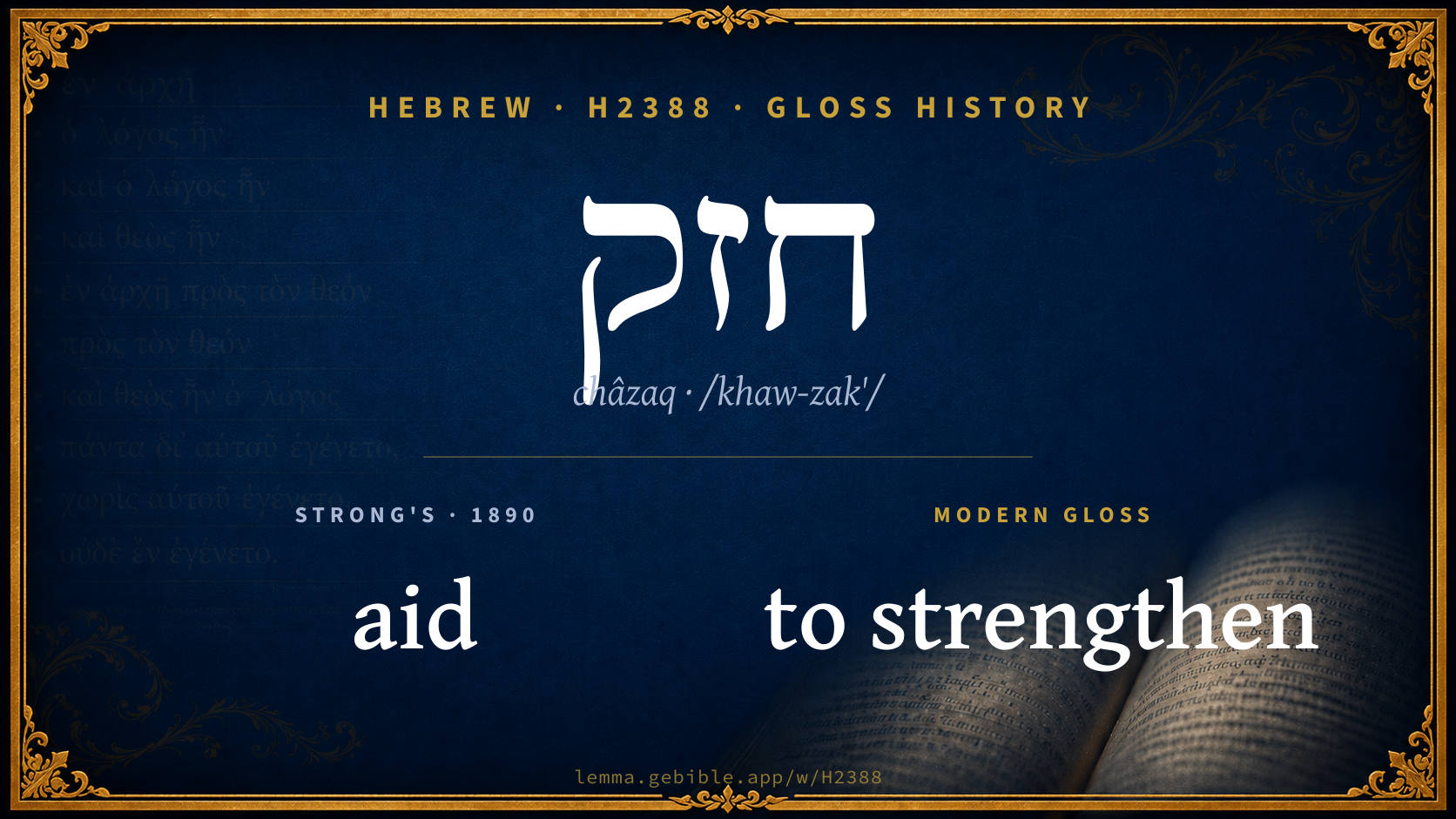
Gloss history
Strong's 1890 vs modern scholarship
About this word
Strong's H2388 catalogs a Hebrew word from the Hebrew Old Testament.
These counts are not copied from any lexicon or concordance. They are computed here, from the morphology-tagged Hebrew Old Testament. What Lemma adds →
- 266
- distinct verses
- The word appears in 266 distinct verses.
- 28 / 39
- OT books
- The word appears in 28 of 39 Old Testament books.
- #169
- by frequency
- Top 250 most frequent Hebrew words (rank 169 of 8,640 Hebrew words by occurrence).
View all 266 occurrences in the concordance →
Most concentrated in
- 2 Chronicles 38 verses 14%
- Nehemiah 34 verses 13%
- Isaiah 20 verses 8%
By section of the Old Testament
By traditional corpus
Conventional, traditional groupings — biblical authorship is debated, so this is a traditional corpus grouping, not an authorship claim. Each share is this word’s portion of its verses in that division of the Hebrew canon. Each figure is a share of the word’s 266 distinct verses.
- Prophets (Nevi'im) 122 verses · 46%
- Writings (Ketuvim) 112 verses · 42%
- Torah (Pentateuch) 32 verses · 12%
How translations render this word
Counts come from each version’s own published word-to-Strong’s tagging or interlinear alignment — an approximate guide to how each version renders this word, not a word-level alignment the data otherwise carries. Because each total is that version’s own tagged count, the per-version totals vary from one another and need not match the appearance or distinct-verse counts above. These counts may also differ from a printed concordance because Lemma counts each distinctly tagged rendering and does not collapse phrase taggings into a single head-word total. This is a fixed set of word-tagged versions (KJV, ASV, BSB, ULT) and does not change with the reading translation you choose elsewhere. Each version’s license is shown beside its name below (and on Sources).
- King James Version: Repaired 38×, Be strong 17×, Strengthened 10×
- American Standard Version: Repaired 36×, Be strong 15×, Strengthened 10×
- Berean Standard Bible: Be strong 28×, Made repairs 22×, Repaired 10×
- unfoldingWord Literal Text: Strengthened 45×, Be strong 30×, And 23×
King James Version Public Domain
Renders H2388 across 288 tagged occurrences — most commonly:
Plus other, less common renderings. Plus 126 renderings that appear only once — usually multi-word phrases or single function words the recovered tagging swept in, not distinct renderings. Not rendered by a distinct English word in 2 further occurrences.
American Standard Version Public Domain
Renders H2388 across 288 tagged occurrences — most commonly:
Plus other, less common renderings. Plus 134 renderings that appear only once — usually multi-word phrases or single function words the recovered tagging swept in, not distinct renderings.
Berean Standard Bible Public Domain
Renders H2388 across 289 tagged occurrences — most commonly:
Plus other, less common renderings. Plus 139 renderings that appear only once — usually multi-word phrases or single function words the recovered tagging swept in, not distinct renderings. Not rendered by a distinct English word in 2 further occurrences.
unfoldingWord Literal Text CC BY-SA 4.0
Renders H2388 across 328 tagged occurrences — most commonly:
Plus other, less common renderings. Plus 115 renderings that appear only once — usually multi-word phrases or single function words the recovered tagging swept in, not distinct renderings.
50 senses and sub-senses in the full BDB
Hebrew verbs can shift meaning by stem (binyan): Qal is the basic action, Niphal is often passive or reflexive, Piel often intensifies or makes it factitive, and Hiphil is typically causative. The senses below are grouped under the stem BDB assigns to each. This entry also uses Hithpael (reflexive or reciprocal).
What do BDB’s symbols mean?
BDB uses these scholarly abbreviations:
| Symbol | Meaning |
|---|---|
| 𝔊 | the Septuagint (the ancient Greek translation, LXX) |
| 𝔙 | the Vulgate (the Latin translation) |
| 𝔖 | the Syriac version (the Peshitta) |
| 𝔗 | the Targum (the Aramaic translation) |
| ψ | the Psalms |
| √ | root (the underlying root or stem) |
| ‖ | parallel passage (a synonymous or contrasted parallel) |
| † | the dagger: every passage where the word occurs is cited |
The 50 senses and sub-senses the full Brown-Driver-Briggs lexicon distinguishes for this word, in lexicon order (not ranked by frequency), with BDB’s own verbatim wording and sub-sense lettering. Shown in Hebrew script with BDB’s own scholarly abbreviations. The condensed entry is in the Lexicon Entry tab. See also the Forms in the corpus table below.
Qal
- Pf. ח׳ Gn 41:57 + 4 times; חָזָק֑ 2 Ch 26:15; sf. חֲזָקוֹ 2 Ch 28:20, etc.; Impf. יֶחֱזַק 2 Ch 28:7 (Baer) + 2 times; וַיֶּחֱזַק Gn 41:56 +; יֶחֶזְקוּ 2 S 10:11 + 2 times; יֶחְזְקוּ Is 28:22; Imv. חֲזַק Dt 12:23 +; חִזְקוּ Dt 31:6 +; Inf. cstr. לְחָזְקָה 2 K 12:13; sf. לְחָזְקָהּ Ez 30:21; Pt. חָזֵק Ex 19:19 2 S 3:1, etc.;— e.g. Genesis 41:57
- I. intrans. be or grow strong:—
- 1.
- a. of physical strength of hands Ju 7:11 2 S 2:7; 16:21 Ez 22:14 Zc 8:9, 13 (on Ez 3:14 v. infr.); of arm, sq. inf. Ez 30:21; used of recovery from illness Is 39:1; sq. מִן compar. over-power 1 S 17:50 (c. בְּ instr.), 2 S 13:14. e.g. Judges 7:11
- b. of people, army Dt 11:8 Jos 17:13 (JE), = Ju 1:28, Ezr 9:12; sq. מִן compar. be stronger than, too strong for, prevail against 2 S 10:11(×2) = 1 Ch 19:12(×2) 1 K 20:23, 25; id., sq. acc. 1 K 16:22, cf. of י׳ as prevailing over man Je 20:7 (‖ יָכֹל); sq. על 2 Ch 8:3; 27:5. e.g. Deuteronomy 11:8
- c. of royal power וְדָוִד הֹלֵךְ וְחָזֵק 2 S 3:1 (opp. הֹלְכִים וְדַלִּים); cf. 2 Ch 26:15 (‖ חֶזְקָה v 16), Dn 11:5a. e.g. 2 Samuel 3:1
- d. prevail over, upon, of word of king 2 S 24:4 (sq. אֶל־) = 1 Ch 21:4 (sq. עַל). e.g. 2 Samuel 24:4
- e. of bonds Is 28:22. e.g. Isaiah 28:22
- f. of sound of trumpet הוֹלֵךְ וְחָזֵק מְאֹד Ex 19:19 (E, cf. חָזָק v 16) it grew much louder and louder. e.g. Exodus 19:19
- 2. be firm, fast:—
- a. lit. be caught fast, of Absalom’s head 2 S 18:9 (sq. בְּ). e.g. 2 Samuel 18:9
- b. be firm, secure, of a kingdom 2 K 14:5 (+ בְּיָדוֹ) = 2 Ch 25:3 (+ עָלָיו). Oftener e.g. 2 Kings 14:5
- c. be firm = courageous, confident, especially Imv., usually ‖ אמץ (q.v.), Dt 31:6, 7, 23 Jos 1:6, 7, 9, 18; 10:25; 23:6 (all D), 2 S 10:12; 13:28 1 K 2:2 1 Ch 19:13 (‖ התחזק), 22:13; 28:10, 20 2 Ch 15:7; 19:11; 32:7 Ezr 10:4 ψ 27:14; 31:25 Is 35:4; 41:6 Hg 2:4(×3) Dn 10:19(×2); sq. לַמִּלְחָמָה 2 Ch 25:8. e.g. Deuteronomy 31:6
- d. hold firmly to, devote oneself to, sq. בְּ 2 Ch 31:4. e.g. 2 Chronicles 31:4
- e. sq. Inf. be firm not to eat blood, i.e. firmly refrain from it Dt 12:23, cf. 1 Ch 28:7. e.g. Deuteronomy 12:23
- 3. press, be urgent, sq. עַל + Inf. Ex 12:33 (E); sq. עַל of hand of י׳ in prophetic ecstasy Ez 3:14 (𝔊 Co read חֲזָקָה, adj., v. חָזָק). e.g. Exodus 12:33
- 4. in bad sense:
- a. grow stout, rigid, hard, with idea of perversity, of Pharaoh’s heart Ex 7:13, 22; 8:15 (all P), 9:35 (R); cf. חזקו עָלַי דבריכם Mal 3:13. e.g. Exodus 7:13
- b. be severe, grievous, of battle 2 K 3:26; of famine Gn 41:56, 57 (E), 47:20 (J; sq. על), 2 K 25:3 = Je 52:6. e.g. 2 Kings 3:26
- 1.
- II. transit. only לֹא חֲזָקוֹ 2 Ch 28:20 strengthened him not, but text very dub. (‖ וַיָּצַר לוֹ). e.g. 2 Chronicles 28:20
Piel
- Pf. חִזַּק ψ 147:13 +, etc.; Impf. וַיְחַזֵּק Ex 9:12 + 10 times, etc.; Imv. חַזֵּק Ne 6:9 + 2 times; fs. חַזְּקִי Na 3:14; חַזֵּ֑קִי Is 54:2 etc.; Inf. cstr. חַזֵּק 2 K 12:9 + 12 times; Pt. מְחַזֵּק Ex 14:17; מְחַזְּקִים 2 K 12:9;— e.g. Psalms 147:13
- 1. make strong (physically):
- a. sq. acc. pers. Ju 16:28; sq. על 3:12; sq. מָתְנַיִם Na 2:2 (‖ אַמֵּץ כֹּחַ; of personif. people). e.g. Judges 16:28
- b. = restore to strength Dn 10:18, 19; to health Ez 34:4, 16; c. לְ give strength to 1 Ch 29:12; so, sq. זְרוֹעֹתָם, Ho 7:15 Ez 30:24 (and v 25 Co, v. Hiph.) e.g. Daniel 10:18
- c. sq. acc. rei Is 41:7 Je 10:4 (both c. בְּ instr.; of manufacture of idols); of strengthening tent-pegs, in metaph. Is 54:4, cf. 33:23; sq. bars of gates ψ 147:13; often of making strong, fortifying a town, etc. Na 3:14 2 Ch 11:11, 12; 26:9; 32:5; = repair (wall, obj. not expr.) Ne 3:19 v. Hiph.; c. acc. of temple 2 K 12:6, 7, 15; 22:6 2 Ch 24:5, 12; 29:3; 34:8, cf. v 10 (‖ לִבְדּוֹק); sq. לְבית י׳ 1 Ch 26:27; obj. breaches (acc.) 2 K 12:8, 9, 13; 22:5. e.g. Isaiah 41:7
- d. of establishing kingdom 2 Ch 11:17. e.g. 2 Chronicles 11:17
- 2. strengthen the hands (acc.) of any one, i.e. sustain, encourage (opp. רִפָּה) Ju 9:24 Je 23:14 Ez 13:22 Is 35:3 Jb 4:3 Ezr 6:22 Ne 2:18; 6:9 2 Ch 29:34; וַיְח׳ ידו בֵּאלהים 1 S 23:16; sq. בְּ Ezr 1:6 (+ בְּ instr.) e.g. Judges 9:24
- 3. make strong = bold, encourage, c. acc. Dt 1:38; 3:28 2 S 15:5 Is 41:7; c. acc. pers. + לַעֲבֹדַת בֵּית י׳ 2 Ch 35:2. e.g. Deuteronomy 1:38
- 4. make firm:—
- a. c. 2 acc. וְאַבְנֵֽטְךָ אֲחַזְּקֶנּוּ Is 22:21 and with thy sash (of office) will I make him firm, i.e. bind it firmly about him (‖ הלבישׁ). e.g. 2 Chronicles 35:2
- b. make firm or fixed, = definitely adopt דָּבָר רָע יח׳־לָמוֹ ψ 64:6. e.g. Psalms 64:6
- 5. make rigid, hard, i.e. perverse, obstinate, harden (the heart of any one) Ex 4:21; 10:20, 27 (all E), 9:12; 11:10; 14:4, 8, 17 (all P), Jos 11:20 (D); v. also ח׳ פניהם מִסֶּלַע Je 5:3†. e.g. Exodus 4:21
Hiphil
- Pf. הֶחֱזִיק Ju 7:8 +; 3 fs. הֶחֱזִ֫יקָה Je 49:24 +; sf. הֶחֱזִקָ֑תְנִי Je 8:21; הֶחֱזַ֫קְתִּי Ne 5:16 + 3 times; וְהַחֲזַקְתִּ֫י Ez 30:25, etc.; Impf. יַחֲזִיק Jb 8:15 + 2 times; 1 s. וְאַחְזֵק Is 42:6; יַחֲזִיקוּ Je 6:23 + 2 times; יַחֲזִקוּ Dn 11:32, etc.; Imv. הַחֲזֵק 2 S 11:25 + 2 times, etc.; Inf. cstr. הַחֲזִיק 2 K 15:19 Is 64:6; sf. הֶחֱזִיקִי Je 31:32 (הַח׳ Cod. Petrop. v. RS JPh. xvi, 1888, 73); Pt. מַחֲזִיק Ex 9:2 + 9 times; sf. מַחֲזִקָהּ Dn 11:6; fs. מַחֲזֶקֶת Ne 4:11; pl. מַחֲזִיקִים Ne 4:10 + 5 times; cstr. מַחֲזִיקֵי Ez 27:9, 27;— e.g. Judges 7:8
- 1.
- a. make strong, strengthen Je 51:12. e.g. Jeremiah 51:12
- b. make firm, the kingdom 2 K 15:19 (+ בְּיָדוֹ). e.g. 2 Kings 15:19
- c. display strength (late) 2 Ch 26:8 (‖ וַיֵּלֶךְ שְׁמוֹ עַד וגו׳), Dn 11:32 (‖ וְעָשׂוּ). e.g. 2 Chronicles 26:8
- 2. make severe, of battle 2 S 11:25. e.g. 2 Samuel 11:25
- 3. sq. יד = support Ez 16:49; sq. זְרוֹעוֹת 30:25 (subj. י׳; but Co reads Pi. as v 24)†. e.g. Ezekiel 16:49
- 4. = repair, walls of Jerus., Ne 3:4(×3) + 31 times Ne 3; cf. (in gen.) pt. used substant. מחזיקי בדקך Ez 27:9, 27 of Tyre and her ships (‖ מַלָּחִים, etc.) e.g. Nehemiah 3:4
- 5. prevail, abs. Dn 11:7; sq. עַל Jb 18:9; prevail upon to הח׳ בּוֹ לֶאֱכֹל 2 K 4:8. e.g. Daniel 11:7
- 6. especially take or keep hold of, seize, grasp:
- a. take hold of, seize, catch, sq. בְּ Gn 19:4(J), 21:18(E), Ex 4:4 (J; ‖ אחז), Ju 7:20 1 S 15:27 2 S 1:11 1 K 1:50; 2:28 2 K 2:12; 4:27 Is 4:1 Zc 8:23(×2) Pr 7:13; 26:17, cf. also Ju 19:25, 29 2 Ch 28:15; with violence Dt 22:25; 25:11 1 S 17:35 (perhaps pf. consec. freq., v. Dr), 2 S 2:16; 13:11; sq. לְ 2 S 15:5; fig. take hold in order to lead one (subj. י׳) sq. בְּ Je 31:32, c. acc. Is 41:9, 13; cf. Is 51:18 (בְּ; ‖נֵהֵל); sq. acc. Na 3:14 take hold of the brick-mould, Je 6:23 = 50:42, Zc 14:13 (with violence), ψ 35:2 Ne 4:10, 11, seize the kingdom Dn 11:21; in metaph. Mi 4:9 (הֶחֱזִיקֵךְ חִיל), Je 6:24; 8:21; 49:24 (v. Gie), 50:43; of pious laying hold of י׳, sq. בְּ Is 64:6, cf. 27:5; 56:2, 4, 6; of other gods 1 K 9:9 = 2 Ch 7:22; laying hold of wisdom Pr 3:18, cf. 4:13 Jb 2:3, 9; 27:6 Je 8:5. e.g. Genesis 19:4
- b. have or keep hold of, sq. בְּ Ju 16:26 2 S 3:29 Je 50:33 Ne 4:15. e.g. Judges 16:26
- c. hold up, sq. בְּ, fig. = sustain, support Lv 25:35; of י׳ holding his servants Is 42:6; 45:1, cf. Jb 8:20; v. also pt. used substantively Dn 11:1 (‖ מָעוֹז), v 6 (‖ מֵבִיא, יֹלֵד); of Ne. holding fast to (בְּ) his work Ne 5:16; cf. of wicked, holding to his house Jb 8:15; cleave or cling to (על) one’s brethren Ne 10:30. hence e.g. Leviticus 25:35
- d. keep, retain, sq. בְּ Ex 9:2 (J), Ju 7:8; 19:4; so Ez 7:13 Sm Co (MT Hithp.); sq. anger (acc.) Mi 7:18. e.g. Exodus 9:2
- e. hence also hold, contain, sq. acc. 2 Ch 4:5. e.g. 2 Chronicles 4:5
Hithpael
- (especially Ch) Pf. הִתְחַזַּק 2 Ch 13:7 + 3 times, etc.; Impf. וַיִּתְחַזֵּק Gn 48:2 + 7 times; וַיִּתְחַזַּק 2 Ch 21:4; 32:5; יִתְחַזָּ֑קוּ Ez 7:13 (but Sm Co read Hiph.), etc.; Imv. הִתְחַזַּק 1 K 20:22; הִתְחַזְּקוּ 1 S 4:9; Inf. cstr. לְהִתְחַזֵּק 2 Ch 13:8; 16:9; Pt. מִתְחַזֵּק 2 S 3:6 Dn 10:21; pl. מִתְחַזְּקִים 1 Ch 11:10;— e.g. 2 Chronicles 13:7
- 1. strengthen oneself 2 S 3:6 1 K 20:22 2 Ch 1:1; 12:13; 13:21; 21:4; 23:1; 25:11; 27:6; sq. עַל against 2 Ch 17:1; gain strength Ezr 7:28 Dn 10:19, cf. הִתְח׳ ביהוה 1 S 30:6; fig. = take courage 2 Ch 15:8. e.g. 2 Samuel 3:6
- 2. put forth strength, use one’s strength Gn 48:2 (i.e. he exerted himself, he sat up by a great effort), Nu 13:20 Ju 20:22 1 S 4:9 2 S 10:12 1 Ch 19:13 2 Ch 32:5. e.g. Genesis 48:2
- 3. sq. לִפְנֵי withstand 2 Ch 13:7, 8. e.g. 2 Chronicles 13:7
- 4. sq. עִם hold strongly with 1 Ch 11:10 Dn 10:21, cf. of י׳, להתח׳ עִם לְבָבָם שָׁלֵם אֵלָיו 2 Ch 16:9.—For יִתְחַזָּ֑קוּ Ez 7:13 read Hiph., v. Sm Co Da. e.g. 1 Chronicles 11:10
Senses from the full Brown-Driver-Briggs lexicon (Brown, Driver, Briggs; Oxford 1906 — public domain), digitized via Sefaria, supplemented by the OpenScriptures HebrewLexicon (CC BY 4.0). Full attribution on Sources.
Word origin
vb. be or grow firm, strong, strengthen (NH id.; Aramaic ܚܙܰܩ, חֲזַק bind on or about, gird on, cf. Arabic حَزَقَ bind, squeeze)—
— Brown-Driver-Briggs (Oxford 1906, public domain), digitized via Sefaria, supplemented by the OpenScriptures HebrewLexicon (CC BY 4.0). See Sources.
Origin: a primitive root
Jastrow Dictionary
A second Hebrew/Aramaic lexicon for comparison, covering Aramaic and post-biblical (Talmudic, Targumic, Midrashic) usage that the biblical-Hebrew BDB does not. Matched by lemma rather than by Strong’s number, so a lemma may carry more than one Jastrow headword (shown separately below), and the entries cover usage well beyond the Bible.
חָזַק
- [to squeeze together,] (neut. verb) to be thick, solid; to be strong. Y. Ber. I, 2ᶜ bot. (ref. to Gen. I, 6) יֶחֱזַק הרקיע וכ׳ let the expanse become solidified, let it coagulate, congeal; Gen. R. s. 4; (Yalk. ib. 5 יתחזק, Hithpa.). e.g. Genesis 1:6
- to join, repair, tighten, strengthen. Snh. 94ᵃ (expl. חזקיה) שחי׳ את ישראל וכ׳ (Ms. M. שהחזיק, Hif.) he joined Israel to their Father &c. Ib. שחִזְּקוֹ יה the Lord strengthened him. Pes. 45ᵃ שעשוי לחַזֵּק Ms. M. where the dough in the cracks is put in for repairing the trough. Sabb. 146ᵇ (העשוי) לחַ׳ when the hole was filled up for making the vessel sound, opp. לשמר to prevent evaporation; a. fr.—Part. pass. מְחוּזָּק, pl. מְחוּזָּקִים. Sifré Num. 1 אין מְחַזְּקִים אלא המח׳ (ed. תמוחז׳) only the strong-minded it is worth while to strengthen (encourage).
- 1. same, v. supra.— same, v. supra.—ה׳ טובה ל־ to attach merit to, to account as merit, to be grateful. Ab. II, 8 אל תַּחֲזִיק ט׳ לעצמך do not claim credit for it (be not proud). Yoma 86ᵇ אלא שמַחֲזִיק לו ט׳ but He even gives him credit (for his sins when he repents). Men. 53ᵃ הַחֲזֵק לי וכ׳ give me credit for making Thee known &c. Keth. 68ᵃ, a. e. בואו ונַחֲזִיק וכ׳ let us be thankful to the fraudulent poor &c.; a. fr.
- 2. (with יד) to strengthen, to encourage, abet. Gitt. V, 9 לפי שאין מַחֲזִיקִין וכ׳ because we must not encourage (by favors) those who do wrong. Ib. ומחזיקין ידי עכו"ם וכ׳ we may encourage (greet with תחזקנה ידיכם, Zech. VIII, 9) gentiles at agricultural work in the Sabbatical year; a. fr. e.g. Zechariah 8:9
- 3. to hold, contain. Ib. 57ᵃ אין עורו מחזיק וכ׳ its skin (once flayed) can not again cover its entire body (it shrinks). Ib. (in Chald. dict.) אפי׳ שתין … לא מ׳ it would not have room even for sixty myriads of reeds. Par. VII, 8 בשביל שתַּחֲזִיק וכ׳ in order that it (the reservoir) might hold more water. Ukts. III, 12 לא מצא … מחזיק וכ׳ the Lord found no vessel so fit to contain all blessings as peace; Deut. R. s. 5 end; a. fr.
- 4. (with ב) to take a hold of, seize, take possession. Ḥull. 4ᵃ, a. e. כל מצוה שהֶחֱזִיקוּ וכ׳ whatever Jewish law the Samaritans have adopted &c., v. דִּקְדֵּק. B. Mets. I, 4 וה׳ בה and took a hold of it. B. Bath. III, 3 במַחֲזִיק when one is in possession (basing his claim on possession). Ib. המַ׳ בנכסי הגר he who takes possession of the estate of a convert (who has no heirs in law). Ib. 2 ויַחֲזִיק שנה that he may be in possession for one year, v. אִסְפַּמְיָא; a. fr.; v. חֲזָקָה.—Y. Ḥag. I, 76ᶜ, a. e. שלא הֶחֱזִיקוּ בשכר וכ׳ they did not cling to the duty of maintaining teachers &c.
- 5. (v. חֲזָקָה) to presume, to be under a certain impression, to be convinced. Y. Kidd. IV, 66ᵇ היו מַחֲזִיקִין בו שהוא בנו וכ׳ if people were under the impression that a certain person was their neighbor’s son, but in his dying hour he declared &c. Ib. היו מ׳ אותו שהוא וכ׳ if people took him to be a relation of his; a. e.—Ḥag. 19ᵃ, v. infra.
- (denom. of חֲזָקָה) to be presumed, be held for, be known for. Gitt. 14ᵃ בשה׳ כפרן when the man is known to be a liar. Shebu. 34ᵇ, a. fr. ה׳ כפרן (in such a case) he is considered a confirmed liar.—Y. Kidd. l. c. bot. הוּחְזְקוּ if they were generally assumed (to be husband and wife); a. fr.—Ḥag. 19ᵃ הטובל לחולין וה׳ לחולין if one takes an immersion for the purpose of being enabled to partake of ordinary food and is considered (by himself) to have immersed for that purpose. Ib. טבל ולא ה׳ if he did immerse but did not have a certain purpose in view. Ib. עודיהו … ה׳ לדבר קל מחזיק עצמו וכ׳ as long as he has one foot yet in the water, when he had had in view a minor purpose for his bath, he may still change it for a higher purpose. Ib. אם לא ה׳ מחזיק if he had had no particular object in view, he may on coming out define the object for which he has bathed.—Part. מוּחֲזָק
- 1. held in possession, adhered to. Bekh. VIII, 9 ולא בראוי כבמ׳ nor does he take a double share of what is coming due to the estate as he does of what is held in possession; B. Bath. 55ᵃ; a. fr.—Sabb. 130ᵃ עדיין היא מוּחֲזֶקֶת בידם it is still strongly adhered to, opp. מרופה, v. רָפָה.
- 2. being known, approved. Sifra K’dosh. Par. 3, ch. V במ׳ לך when he is known to thee (to be a proselyte); a. e.
- 3. being sure, convinced, knowing from experience. Keth. 25ᵇ מוּחֲזַקְנִי בזה וכ׳ (= מ׳ אני) I know this man to be a priest; a. e.—Sifré Num. 1, v. supra.
- 1. to become solid, strong. Yalk. Gen. 5 יִתְחַזֵּק, v. preced.
- 2. to feel encouraged, take courage. Ber. 32ᵃ נ׳ בתפלה became emboldened to pray.
חֲזַק
- 1. same.—Part. pass. חֲזִיק tied up, bandaged. Y. Ber. II, 4ᶜ top דהוה ח׳ רישיה when his head was tied up (with a turban); Pesik. R. s. 22 (not רישין, v. notes in ed. Fr.). Y. Pes. X, 37ᶜ וח׳ רישיה וכ׳ and his head was tied up (or he felt like having a bandage around his head) &c.; Y. Shek. III, 47ᶜ top והוה חזוק (read חזיק); וחזק (corr. acc.).
- 2. to take possession. B. Bath. 52ᵇ, sq. חֲזַק וקני take possession and acquire; a. fr.
- to fasten.—Lev. R. s. 21 [read] חַזֵּק כפתוי tighten his muzzle, v. כֵּיפְתָא.—Part. pass. מְחַזַּק. Targ. Y. Gen. L, 1.
- as preced. Hif.;
- 1. (with טיבו &c.) to give credit to. Y. Ber. II, 5ᵃ bot. אנא מַחֲזִיק טיבו לראשי וכ׳ I give credit to my head, which bends of itself &c. Bab. Ber. 19ᵃ לאַחֲזוּקֵי ליה וכ׳ that due credit for the preservation of Israel be given to Moses.
- 2. to presume. Shebu. 46ᵇ לאַחֲזוּקֵי אינש בגנבי לא מַחְזְקִינָן we must not put a person in the category of thieves (on the charge of one individual); a. e.
- 3. to adhere to, adopt. Ḥull. 4ᵃ כיון דאַחֲזִיקוּ בהו א׳ בהו since they (the Samaritans) have adopted it, they observe it (also for Israelites). Ib. אַחֲזוּק ולא א׳ וכ׳ as to their observance or non-observance of adopted unwritten customs for Israelites there are differences of opinion; a. fr.
- 4. to take possession, to claim possession. B. Bath. 29ᵇ כי היכי דלא תַחְזְקוּ אהדדי ed. (differ. in Ms. M., v. Rabb. D. S. a. l.) that you might not claim possession against one another. Ib. 36ᵃ האי מאן דא׳ וכ׳ if one claims a field on the ground of possession, if it lies outside &c., v. גּוּדָּא I. Ib. לא מַחְזְקֵי בן ולא מַחְזְקִינָן בהו they have no claim of possession against us (for one might have been afraid to disturb them), and they have no claim against us (for, being wealthy, they might not have cared to drive one out); a. fr.
- 5. to be strong, encouraged. Gitt. 62ᵃ אַחֲזוּקוּ ‘be strong’ (a greeting to field laborers, v. preced.).
- 1. to adhere to. Targ. Prov. IV, 13; a. e.
- 2. to be known, be under the presumption. Targ. Y. Lev. XIX, 33 (v. preced.).—Ḥull. 10ᵇ היכא דלא א׳ where no presumption (of leprosy) has as yet been formed. Snh. 89ᵇ דמִיתְחֲזַק וכ׳ Ms. M. (ed. מוחזק) where one is approved (as a righteous prophet), it is different.
A Dictionary of the Targumim, the Talmud Babli and Yerushalmi, and the Midrashic Literature (Marcus Jastrow; London, Luzac, 1903) — Public Domain. Digitized via Sefaria. Digitized via Sefaria. Full attribution on Sources.
Forms in the corpus
The 208 distinct written forms H2388 takes in the Hebrew Bible, most frequent first — each parse links to that stem’s occurrences in the concordance. Hebrew forms include their vowel points and cantillation, so a single lemma takes many written forms.
The 60 most common forms are shown; 148 rarer forms follow in the full concordance.
Same root — word family
Other BDB entries built from the same root as H2388, grouped by Strong’s listed origin. These share a root / origin per the lexicon — not necessarily a shared meaning. Each links to that word’s own entry.
Derived from this word
- חזק châzâq H2389 strong
- חזק châzêq H2390 stronger
- חזק chêzeq H2391 strength
- חזק chôzeq H2392 strength
Proper names from this root
People and places named from this root — a name, not an additional meaning of the word.
Compare all same-root words → Showing 4 of 8 — not the complete family. 3 of the same-root words are proper names (people or places). They share a root, not necessarily a meaning.
Septuagint verse parallels
This word appears in 223 verses that also exist in the Greek Old Testament (Septuagint), out of the 266 Hebrew verses it occurs in. You can read those verses in Greek by switching the Old Testament edition to the Septuagint.
Read these verses in the Septuagint
- Genesis 19:16
- Exodus 4:4
- Leviticus 25:35
- Numbers 13:20
- Deuteronomy 1:38
- Joshua 1:6
- Judges 1:28
- 1 Samuel 4:9
- 2 Samuel 1:11
- 1 Kings 1:50
- 2 Kings 2:12
- 1 Chronicles 11:10
This is a verse-level parallel only — the same verses exist in both the Hebrew and Greek Old Testaments. No word-level Hebrew↔Greek correspondence is claimed: the data carries no such alignment, so no Greek word is shown as this Hebrew word’s translation. Coverage is not total — the Septuagint omits the deuterocanon and renumbers the Psalms, so some Hebrew verses have no direct Greek parallel.