2 Chronicles 4:5

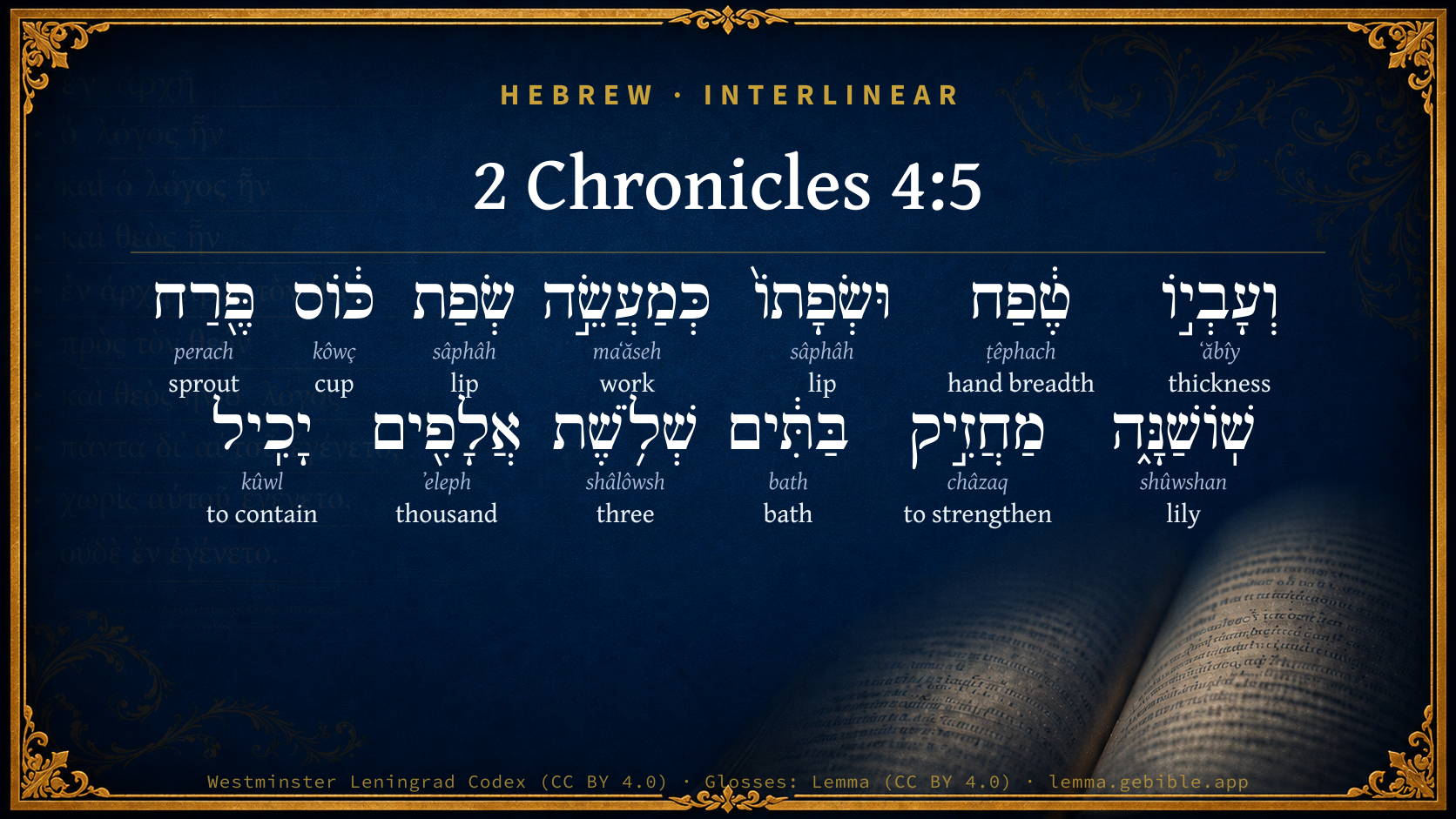
Hebrew (Westminster Leningrad Codex) 2 Chronicles 4:5 appears in the Hebrew Old Testament. The text above is from the Westminster Leningrad Codex. Each word links to its Strong’s number, a concise gloss, and parsing drawn from the Open Scriptures Hebrew Bible morphology. Click any word for its full Brown-Driver-Briggs (BDB) entry.
Download image
Cite this verse

2 Chronicles 4:5 (World English Bible). Public Domain. Lemma interlinear Bible study tool, https://lemma.gebible.app/v/2-chronicles/4/5.

Show BibTeX & RIS
BibTeX
RIS
English Translation
It was a handbreadth thick; and the brim of it was worked like the brim of a cup, like the flower of a lily: it received and held three thousand baths.
World English Bible · Public Domain
Download a study sheet

One document with this verse’s original text, its word-by-word gloss line, the meaning frame, cross-references with their text, attributed commentary, and full source and license credits — printable, and it pastes into notes with its structure intact.

This verse Autodidact and up

Study sheet (.html) Plain text (.txt)

A passage Seminary Student

Up to 50 verses in one chapter. A passage sheet keeps up to 6 commentary sources and 12 cross-references per verse, in the order this page ranks them, and says so on the sheet whenever that leaves anything out. Ask for a single verse and you get the Autodidact verse sheet above.

Everything on this page stays free to read, with no account — the sheet is a download of what is already on screen, not access to it.

Want to remove ads? Support Godless Engineer
Compare translations 3

The same verse in 3 English versions, stacked beneath the original-language interlinear above. Click any original word for its lexicon entry.

Each is an independent rendering of the whole verse — the interlinear is not word-aligned to these translations.

Highlighted words mark where these versions differ — a whole-verse word diff, not a word-by-word alignment.

  • World English Bible Public Domain
    It was a handbreadth thick; and the brim of it was worked like the brim of a cup, like the flower of a lily: it received and held three thousand baths.
  • King James Version Public Domain
    And the thickness of it was an handbreadth, and the brim of it like the work of the brim of a cup, with flowers of lilies; and it received and held three thousand baths.
  • unfoldingWord Literal Text CC BY-SA 4.0
    And its thickness was a span, and its edge like a work of an edge of a cup, a bud of a lily, taking hold, 3,000 baths it could contain.

unfoldingWord Literal Text — © unfoldingWord, licensed CC BY-SA 4.0. Word-aligned USFM3 via Door43 (git.door43.org/unfoldingWord/en_ult).

Versions to compare (up to 4)

3 of 4 selected

Show all 18 translations

Every available English version of this verse, each an independent rendering of the whole verse.

  • World English Bible Public Domain
    It was a handbreadth thick; and the brim of it was worked like the brim of a cup, like the flower of a lily: it received and held three thousand baths.
  • Berean Standard Bible Public Domain
    It was a handbreadth thick, and its rim was fashioned like the brim of a cup, like a lily blossom. It could hold three thousand baths.
  • Majority Standard Bible Public Domain
    It was a handbreadth thick, and its rim was fashioned like the brim of a cup, like a lily blossom. It could hold three thousand baths.
  • King James Version Public Domain
    And the thickness of it was an handbreadth, and the brim of it like the work of the brim of a cup, with flowers of lilies; and it received and held three thousand baths.
  • American Standard Version (1901) Public Domain
    And it was a handbreadth thick; and the brim thereof was wrought like the brim of a cup, like the flower of a lily: it received and held three thousand baths.
  • Revised Version (1885) Public Domain
    And it was an handbreadth thick; and the brim thereof was wrought like the brim of a cup, like the flower of a lily: it received and held three thousand baths.
  • Geneva Bible (1599) Public Domain
    And the thickenesse thereof was an hande breadth, and the brim thereof was like the worke of the brim of a cuppe with floures of lilies: it conteined three thousand baths.
  • Douay-Rheims (1899) Public Domain
    And the oxen were cast: and the sea itself was set upon the twelve oxen, three of which looked toward the north, and other three toward the west: and other three toward the south, and the other three that remained toward the east, and the sea stood upon them: and the hinder parts of the oxen were in- ward under the sea.
  • Young's Literal Translation Public Domain
    And its thickness `is' a handbreadth, and its lip as the work of the lip of a cup flowered with lilies; taking hold -- baths three thousand it containeth.
  • Literal Standard Version CC BY-SA 4.0
    And its thickness [is] a handbreadth, and its lip as the work of the lip of a cup flowered with lilies; holding [within]—it contains three thousand baths.
  • Unlocked Literal Bible CC BY-SA 4.0
    “The Sea” was as thick as the width of a hand, and its brim was forged like the brim of a cup, like a lily blossom. “The Sea” held three thousand baths of water.
  • unfoldingWord Literal Text CC BY-SA 4.0
    And its thickness was a span, and its edge like a work of an edge of a cup, a bud of a lily, taking hold, 3,000 baths it could contain.
  • Darby Bible Public Domain
    And its thickness was a hand-breadth, and its brim like the work of the brim of a cup, with lily-blossoms; in capacity it held three thousand baths.
  • World Messianic Bible Public Domain
    It was a handbreadth thick. Its brim was made like the brim of a cup, like the flower of a lily. It received and held three thousand baths.
  • Webster's Bible Public Domain
    And the thickness of it was a hand-breadth, and the brim of it like the work of the brim of a cup, with flowers of lilies; and it received and held three thousand baths.
  • Free Bible Version CC BY-SA 4.0
    It was as thick as the width of a hand, and its edge was like the flared edge of a cup or a lily flower. It held three thousand baths.
  • Bible in Basic English Public Domain
    It was as thick as a man's open hand, and the edge of it was curved like the edge of a cup, like a lily flower; it would take three thousand baths.
  • JPS Tanakh (1917) Public Domain
    And it was a handbreadth thick; and the brim thereof was wrought like the brim of a cup, like the flower of a lily: it received and held three thousand baths.

Literal Standard Version (2020), Covenant Press — licensed CC BY-SA 4.0. Text via the HelloAO Bible API (eBible.org). Unlocked Literal Bible (unfoldingWord) — licensed CC BY-SA 4.0. Text via the HelloAO Bible API (eBible.org). unfoldingWord Literal Text — © unfoldingWord, licensed CC BY-SA 4.0. Word-aligned USFM3 via Door43 (git.door43.org/unfoldingWord/en_ult). Free Bible Version, Dr. Jonathan Gallagher — licensed CC BY-SA 4.0. Text via the HelloAO Bible API (eBible.org).

Word by word

More ways to search: Search by grammar → Find every occurrence → Compare this word →

Practice this passage: Drill this verse → Learn its vocabulary →

וְעָבְי֣וֹ
ʻăbîy
H5672
“and · thickness · his”
Conjunction + Noun, Common, Masculine, Singular, Construct + Suffix, Personal, 3rd Person, Masculine, Singular
Part of Speech
Conjunction + Noun
Type
Common
Gender
Masculine
Number
Singular
State
Construct
Full BDB Definition

Origin: from H5666

TWOT: 1554a

thickness
  1. טֶ֔פַח ṭêphach H2947 “hand breadth” Noun, Common, Masculine, Singular, Absolute
  2. וּשְׂפָתוֹ֙ sâphâh H8193 “and · lip · his” Conjunction + Noun, Common, Feminine, Singular, Construct + Suffix, Personal, 3rd Person, Masculine, Singular
  3. כְּמַעֲשֵׂ֣ה maʻăseh H4639 “like/as · work of” Preposition + Noun, Common, Masculine, Singular, Construct
  4. שְׂפַת sâphâh H8193 “lip of” Noun, Common, Feminine, Singular, Construct
  5. כּ֔וֹס kôwç H3563 “cup” Noun, Common, Feminine, Singular, Absolute
  6. פֶּ֖רַח perach H6525 “sprout of” Noun, Common, Masculine, Singular, Construct
  7. שֽׁוֹשַׁנָּ֑ה shûwshan H7799 “lily” Noun, Common, Both, Singular, Absolute
  8. מַחֲזִ֣יק châzaq H2388 “strengthening” Verb, Hiphil, Participle Active, Masculine, Singular, Absolute
  9. בַּתִּ֔ים bath H1324 “baths” Noun, Common, Both, Plural, Absolute
  10. שְׁלֹ֥שֶׁת shâlôwsh H7969 “three” Adjective, Cardinal number, Masculine, Singular, Construct
  11. אֲלָפִ֖ים ʼeleph H505 “thousand” Adjective, Cardinal number, Both, Plural, Absolute
  12. יָכִֽיל kûwl H3557 “to contain” Verb, Hiphil, Imperfect, 3rd Person, Masculine, Singular

About this verse

These counts appear in no published source. They are computed here, from the morphology-tagged text and Lemma’s own curated glosses. What Lemma adds →

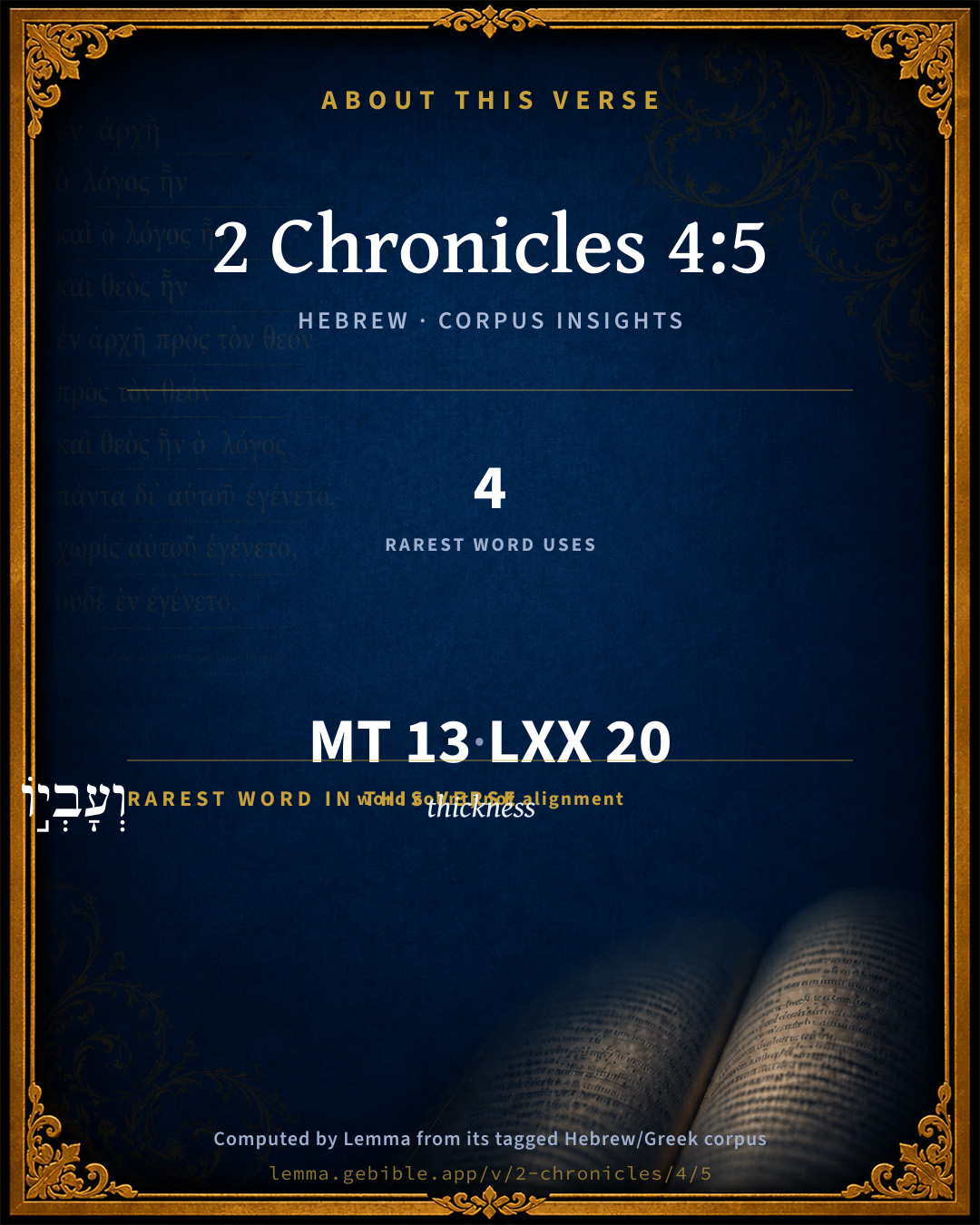
13
words
12
distinct lemmas
Historical
section

Notable vocabulary

The rarest word here is וְעָבְי֣וֹ thickness H5672 — appearing just 4 times in the whole Hebrew Bible.

Shared distinctive vocabulary

וְעָבְי֣וֹ thickness H5672 occurs in 4 verses of the Hebrew Bible. Also found in:

Grammatical profile

  • 2 verbs
  • 9 nouns
  • 2 adjectives

Verb forms

  • מַחֲזִ֣יק Hiphil · Participle Active
  • יָכִֽיל Hiphil · Imperfect

Repetition

A word recurs within this verse — often emphatic in Hebrew:

  • וּשְׂפָתוֹ֙ lip H8193 ×2

Hebrew & Septuagint length

In English translation the verse runs 31 words from the Hebrew and 28 from the Septuagint (LXX English) — closely comparable.

A rough comparison of the two English renderings, which tokenize alike — not a word-level alignment.

Word counts can differ between the Hebrew and the Greek without any difference in meaning — e.g. the Hebrew direct-object marker אֵת has no separate Greek word, and Greek often adds the article ὁ.

In the original languages it is 13 Hebrew tokens and 20 Greek tokens — but the two are counted differently (Hebrew bundles its prefixes and suffixes into one token; the Greek is in lemma form), so that isn’t a like-for-like length.

Cross-references

1

Topical passages linked to 2 Chronicles 4:5 in the Treasury of Scripture Knowledge — connected by theme and wording, ordered by reader-vote popularity; previews shown in the World English Bible.

  • 1 Kings 7:26 It was a handbreadth thick: and the brim of it was worked like the brim of a cup, like the flower of a lily: it held two thousand baths.

Cross-references courtesy of OpenBible.info (CC BY 4.0).

Hebrew and Greek witnesses Masoretic Hebrew ↔ Greek Septuagint

The same verse in the two great witnesses to the Old Testament, shown verse-for-verse.

These are two independent witnesses, not word-aligned to each other, and the Septuagint is shown in lemma (dictionary) form.

Hebrew 2 Chronicles 4:5 Masoretic · Westminster Leningrad Codex

וְעָבְי֣וֹ טֶ֔פַח וּשְׂפָתוֹ֙ כְּמַעֲשֵׂ֣ה שְׂפַת כּ֔וֹס פֶּ֖רַח שֽׁוֹשַׁנָּ֑ה מַחֲזִ֣יק בַּתִּ֔ים שְׁלֹ֥שֶׁת אֲלָפִ֖ים יָכִֽיל

It was a handbreadth thick; and the brim of it was worked like the brim of a cup, like the flower of a lily: it received and held three thousand baths.

World English Bible · Public Domain

Greek LXX 2 Chronicles 4:5 Septuagint · lemma form

καί ὁ πάχος αὐτός παλαιστή καί ὁ χεῖλος αὐτός ὡς χεῖλος ποτήριον διαγλύφω βλαστός κρίνον χωρέω μετρητής τρισχίλιοι καί ἐκτελέω

And its thickness was a hand-breadth, and its brim as the brim of a cup, graven with flowers of lilies, holding three thousand measures: and he finished it.

LXX2012 (modern English Septuagint) · Public Domain

On this verse, Ellicott's Commentary for English Readers discusses the Septuagint’s reading. Read the note in Commentary ↓

Hebrew: Westminster Leningrad Codex (CC BY 4.0). Greek: Septuagint (public domain); English from LXX2012 (modern English Septuagint) (Public Domain). How the Septuagint differs from the Hebrew →

Commentary

Notes on 2 Chronicles 4:5 from classic Christian and Jewish commentators (each source and its license shown beneath its notes). The classic Christian expositions comment on the surrounding passage and are grouped to its opening verse, so a note may address several verses; the Jewish commentaries on the Tanakh (Rashi and others) are per-verse, so they appear only where the commentator wrote on this verse.

Lemma curates 59 commentaries, every one of them public domain or Creative Commons licensed, each selected and text-cleaned for this edition rather than reprinted as found. About our sources →

Trapp's Complete Commentary

John Trapp

2Ch 4:5 And the thickness of it [was] an handbreadth, and the brim of it like the work of the brim of a cup, with flowers of lilies; [and] it received and held three thousand baths.

Ver. 5. Three thousand baths.] See on 1Ki 7:26. There it is said "two thousand baths": Dicendum hic addi, &c., salth Vatablus. This prophet addeth what is wanting in the other; ea enim est mens autheris huius libri, for that is the design of this our author.

John Trapp, A Commentary or Exposition upon All the Books of the Old and New Testament (1647–1656) — public domain. Text from a community e-Sword module.

Geneva Bible (1599)

Geneva Bible translators

Or, flower delices.

In 1 Kings 7:26, mention is only made of two thousand, but the less number was taken there, and here according as the measures proved afterward, is declared.

Geneva Bible (1599) marginal notes — public domain. Text via Bolls.life.

Adam Clarke's Commentary

Verse 5. It - held three thousand baths.] In 1Kg 7:26, it is said to hold only two thousand baths. As this book was written after the Babylonish captivity, it is very possible that reference is here made to the Babylonish bath which might have been less than the Jewish. We have already seen that the cubit of Moses, or of the ancient Hebrews, was longer than the Babylonish by one palm; see on 2Ch 3:3. It might be the same with the measures of capacity; so that two thousand of the ancient Jewish baths might have been equal to three thousand of those used after the captivity. The Targum cuts the knot by saying, "It received three thousand baths of dry measure, and held two thousand of liquid measure."

Adam Clarke's Commentary on the Bible (1810–1826) — public domain. Text from a community e-Sword/MySword module.

Ellicott's Commentary for English Readers

(5) And the thickness . . . a cup.—Identical with 1Ki_7:26.

With flowers of lilies.—See margin. “Lily” here is shôshannâh; in Kings, shôshân. LXX., “graven with lily buds.” Syriac and Arabic, “and it was very beautiful.” Vulg., “like the lip of a cup, or of an open lily.”

And it received and held three thousand baths.—Literally, holding (whole) baths: three thousand would it contain. The bath was the largest of Hebrew liquid measures. Perhaps the true reading is, “holding three thousand baths,” the last verb being a gloss borrowed from Kings. So Vulg. Syriac and Arabic omit the clause. The LXX. had the present reading. 1Ki_7:26 reads, two thousand baths would it contain. Most critics assume this to be correct. Some scribe may have read ’alâphîm, “thousands,” instead of ‘alpayim, “two thousand,” and then have added “three” (shĕlôsheth) under the influence of the last verse. But it is more likely that the numeral “three” having been inadvertently omitted from the text of Kings, the indefinite word “thousands” was made definite by turning it into the dual “two thousand” Either mistake would be possible, because in the unpointed text ‘alâphîm and ’alpayim are written alike. The Syriac has the curious addition, “And he made ten poles, and put five on the right and five on the left, and bare with them the altar of burnt offerings.” Similarly the Arabic version.

A Bible Commentary for English Readers, edited by Charles John Ellicott (1878–1897) — public domain. Text from a community e-Sword module.

The Cambridge Bible for Schools and Colleges

gen. ed. J. J. S. Perowne

5. the brim of it like the work of the brim of a cup, with flowers of lilies] R.V. the brim thereof was wrought like the brim of a cup, like the flower of a lily.

three thousand baths] In 1Ki_7:26, two thousand baths. Whether the textual corruption is to be attributed to 1 Kin. or to Chron. cannot be determined. The bath was a measure for liquids equal to about 8¼ gallons.

The Cambridge Bible for Schools and Colleges (gen. ed. J. J. S. Perowne; Cambridge University Press, 1878–1918) — public domain. Text from a community e-Sword module.

Albert Barnes' Notes on the Bible

Three thousand baths - See 1Ki 7:23 note. It is quite possible that either here or in Kings the text may have been accidentally corrupted.

Albert Barnes' Notes on the Bible (1834–1885) — public domain. Text from a community e-Sword/MySword module.

Haydock's Catholic Bible Commentary

Three. 3 Kings two, may specify the usual quantity that was contained, though the vessel would absolutely hold a thousand measures, or baths, more. (Haydock)

George Leo Haydock (1774–1849), Haydock's Catholic Family Bible and Commentary, 1859 edition — public domain. Excludes Psalms (Douay-Rheims chapter numbering differs from Protestant) and Deuterocanonical books (Catholic canon only).

The Pulpit Commentary

A handbreadth. Not tr,z, "a span" (nevertheless tabled by Conder, "Handbook to the Bible," 2nd edit., p. 79, as a handbreadth, and put at eight digits, two palms, or 5.33 inches), but jpf, "the palm of the open hand," the breadth of the four fingers, which Thenius puts at 3.1752 inches, but Conder"s table at 2.66 inches. It received and held should be translated, it was able to hold. Three thousand baths. The parallel has two thousand baths, and this latter is the likelier reading. It is, however, conceivable that the statement of Kings may purport to give the quantity of water used, and that of Chronicles the quantity which the vessel at its fullest could accommodate. As to the real capacity of the bath, we are hopelessly at sea. Josephus"s estimate of it is about eight gallons and a half, that of the rabbinists about four gallons and a half (see Smith"s "Dictionary of the Bible," 3:1742), and Conder, in the "Handbook to the Bible," p. 80, a fractional quantity above six gallons. The largest bowls on the Assyrian bas-reliefs, the silver bowl of Croesus, and the bronze bowl in Scythia (Herodotus, 1:51; 4:81), did not, under the lowest estimate of the bath, hold as much as one-half of the contents of this vast sea of brass of Solomon. The use of this vessel was, as we read in the next verse, for the priests to wash in, or, as some would read, to wash at. (Exo_30:18-20)

The Pulpit Commentary (1880–1919), ed. H.D.M. Spence-Jones & Joseph S. Exell — public domain. Text from a community e-Sword module.

Rashi

Rabbi Shlomo Yitzchaki (Rashi)

And its thickness was a handbreadth [i.e.] its bottom and its walls, but at its mouth it was thin, spread out and flattened.

like the work of the brim of a cup used for drinking, upon which is depicted a lily flower.

it contained three thousand It contained this amount, but in I Kings (7:26) it is written: “It contained two thousand baths.” The heaped measure was a third, for a bath is three seah, as is said: (Ezek. 45:11): “The ephah and the bath shall have one volume.” Thus you have six thousand seah. This equals a hundred and fifty purifying pools for four thousand seah equal a hundred mikvaoth. And we find also for the remaining two thousand seah fifty mikvaoth, and even if you divide the vessel according to the measure that the Rabbis computed, namely a cubit by a cubit by the height of three cubits for a mikvah, you will find the same: for the height of three cubits, which was square, and which was ten by ten from its brim to its brim, are a hundred mikvaoth, and for the height of two cubits, where it was round, ten by ten from its brim to its brim around equal fifty mikvaoth, because a square is a fourth more than a circle.

Rashi on the Tanakh — English translations: “The Judaica Press complete Tanach with Rashi, translated by A. J. Rosenberg” (CC BY 4.0); “Pentateuch with Rashi's commentary by M. Rosenbaum and A.M. Silbermann, 1929-1934” (public domain); “The Metsudah Tanach series, Lakewood, N.J” (CC BY 4.0); and “The Book of Joshua, Metsudah Publications, 1997” (CC BY 4.0). Text via Sefaria.

Lesson kit

Teaching starters — assembled from the data on this page, not authored interpretation. Every prompt links to the verse data it draws on. Edit before teaching.

2 Chronicles, in the Historical, opens this verse with 13 words (12 distinct Hebrew lemmas). Its most distinctive word is ʻăbîy (“thickness”). A historical commentator’s framing appears above. Read the whole chapter for the surrounding context.

Discussion questions

  1. What does “thickness” (ʻăbîy) contribute to the verse as a whole?
  2. How does 1 Kings 7:26, which shares the word «thickness», read alongside this verse?
  3. What does the repetition of “lip” (2× in this one verse) do in this verse?
  4. These translations render this verse differently. What is at stake in choosing one wording over another?
  5. «מַחֲזִ֣יק» is a Hiphil Participle Active verb. How does that grammatical form shape the action described?
  6. Compare how Trapp's Complete Commentary and Geneva Bible (1599) read this verse. Where do they agree or differ?

Things to notice

Reading settings

Reading text

Shown beneath each verse's original-language words.

Old Testament
Old Testament edition

Read the OT as the Masoretic Hebrew (MT) or the Greek Septuagint (LXX).

English shown for the Greek Septuagint (in the Hebrew ↔ Greek comparison).

Comparing translations? Open the Compare panel on any verse page to stack up to four side by side.