

2 Chronicles 24:5

Hebrew (Westminster Leningrad Codex) 2 Chronicles 24:5 appears in the Hebrew Old Testament. The text above is from the Westminster Leningrad Codex. Each word links to its Strong’s number, a concise gloss, and parsing drawn from the Open Scriptures Hebrew Bible morphology. Click any word for its full Brown-Driver-Briggs (BDB) entry.
Download image
Cite this verse

2 Chronicles 24:5 (World English Bible). Public Domain. Lemma interlinear Bible study tool, https://lemma.gebible.app/v/2-chronicles/24/5.

Show BibTeX & RIS
BibTeX
RIS
English Translation
He gathered together the priests and the Levites, and said to them, Go out to the cities of Judah, and gather of all Israel money to repair the house of your God from year to year; and see that you hasten the matter. However the Levites didn't hurry.
World English Bible · Public Domain
Download a study sheet

One document with this verse’s original text, its word-by-word gloss line, the meaning frame, cross-references with their text, attributed commentary, and full source and license credits — printable, and it pastes into notes with its structure intact.

This verse Autodidact and up

Study sheet (.html) Plain text (.txt)

A passage Seminary Student

Up to 50 verses in one chapter. A passage sheet keeps up to 6 commentary sources and 12 cross-references per verse, in the order this page ranks them, and says so on the sheet whenever that leaves anything out. Ask for a single verse and you get the Autodidact verse sheet above.

Everything on this page stays free to read, with no account — the sheet is a download of what is already on screen, not access to it.

Want to remove ads? Support Godless Engineer
Compare translations 3

The same verse in 3 English versions, stacked beneath the original-language interlinear above. Click any original word for its lexicon entry.

Each is an independent rendering of the whole verse — the interlinear is not word-aligned to these translations.

Highlighted words mark where these versions differ — a whole-verse word diff, not a word-by-word alignment.

  • World English Bible Public Domain
    He gathered together the priests and the Levites, and said to them, Go out to the cities of Judah, and gather of all Israel money to repair the house of your God from year to year; and see that you hasten the matter. However the Levites didn't hurry.
  • King James Version Public Domain
    And he gathered together the priests and the Levites, and said to them, Go out unto the cities of Judah, and gather of all Israel money to repair the house of your God from year to year, and see that ye hasten the matter. Howbeit the Levites hastened it not.
  • unfoldingWord Literal Text CC BY-SA 4.0
    And he gathered the priests and the Levites, and he said to them, “Go out to the cities of Judah and gather from all Israel enough money to make strong the house of your God year by year. And you all yourselves, hasten to the matter.” But the Levites did not hasten.

unfoldingWord Literal Text — © unfoldingWord, licensed CC BY-SA 4.0. Word-aligned USFM3 via Door43 (git.door43.org/unfoldingWord/en_ult).

Versions to compare (up to 4)

3 of 4 selected

Show all 18 translations

Every available English version of this verse, each an independent rendering of the whole verse.

  • World English Bible Public Domain
    He gathered together the priests and the Levites, and said to them, Go out to the cities of Judah, and gather of all Israel money to repair the house of your God from year to year; and see that you hasten the matter. However the Levites didn't hurry.
  • Berean Standard Bible Public Domain
    So he gathered the priests and Levites and said, “Go out to the cities of Judah and collect the money due annually from all Israel, to repair the house of your God. Do it quickly.” The Levites, however, did not make haste.
  • Majority Standard Bible Public Domain
    So he gathered the priests and Levites and said, “Go out to the cities of Judah and collect the money due annually from all Israel, to repair the house of your God. Do it quickly.” The Levites, however, did not make haste.
  • King James Version Public Domain
    And he gathered together the priests and the Levites, and said to them, Go out unto the cities of Judah, and gather of all Israel money to repair the house of your God from year to year, and see that ye hasten the matter. Howbeit the Levites hastened it not.
  • American Standard Version (1901) Public Domain
    And he gathered together the priests and the Levites, and said to them, Go out unto the cities of Judah, and gather of all Israel money to repair the house of your God from year to year; and see that ye hasten the matter. Howbeit the Levites hastened it not.
  • Revised Version (1885) Public Domain
    And he gathered together the priests and the Levites, and said to them, Go out unto the cities of Judah, and gather of all Israel money to repair the house of your God from year to year, and see that ye hasten the matter. Howbeit the Levites hastened it not.
  • Geneva Bible (1599) Public Domain
    And he assembled the Priests and the Leuites, and said to them, Goe out vnto the cities of Iudah, and gather of all Israel money to repaire the house of your God, from yeere to yeere, and haste the thing: but the Leuites hasted not.
  • Douay-Rheims (1899) Public Domain
    And he assembled the priests, and the Levites, and said to them: Go out to the cities of Juda, and gather of all Israel money to repair the temple of your God, from year to year: and do this with speed: but the Levites were negligent.
  • Young's Literal Translation Public Domain
    and he gathereth the priests and the Levites, and saith to them, `Go out to the cities of Judah, and gather from all Israel money to strengthen the house of your God sufficiently year by year, and ye, ye do haste to the matter;' and the Levites have not hasted.
  • Literal Standard Version CC BY-SA 4.0
    and he gathers the priests and the Levites, and says to them, “Go out to the cities of Judah, and gather money from all Israel to strengthen the house of your God sufficiently year by year, and you, hurry to the matter”; and the Levites have not hurried.
  • Unlocked Literal Bible CC BY-SA 4.0
    He gathered together the priests and the Levites, and he said to them, “Go out every year to the cities of Judah and gather from all Israel money to repair the house of your God. Make sure that you start right away.” The Levites did nothing at first.
  • unfoldingWord Literal Text CC BY-SA 4.0
    And he gathered the priests and the Levites, and he said to them, “Go out to the cities of Judah and gather from all Israel enough money to make strong the house of your God year by year. And you all yourselves, hasten to the matter.” But the Levites did not hasten.
  • Darby Bible Public Domain
    And he gathered together the priests and the Levites, and said to them, Go out to the cities of Judah and collect of all Israel money for the repair of the house of your God from year to year, and ye shall hasten the matter. But the Levites hastened it not.
  • World Messianic Bible Public Domain
    He gathered together the priests and the Levites, and said to them, “Go out to the cities of Judah, and gather money to repair the house of your God from all Israel from year to year. See that you expedite this matter.” However the Levites didn’t do it right away.
  • Webster's Bible Public Domain
    And he convened the priests and the Levites, and said to them, Go out to the cities of Judah, and gather from all Israel money to repair the house of your God from year to year, and see that ye hasten the matter. But the Levites hastened it not.
  • Free Bible Version CC BY-SA 4.0
    He summoned the priests and Levites and told them, “Go to the towns of Judah and collect the yearly dues from everyone in Israel to repair the Temple of your God. Do it right away.” But the Levites did not go right away.
  • Bible in Basic English Public Domain
    And getting together the priests and Levites, he said to them, Go out into the towns of Judah year by year, and get from all Israel money to keep the house of your God in good condition; and see that this is done without loss of time. The Levites, however, were slow in doing so.
  • JPS Tanakh (1917) Public Domain
    And he gathered together the priests and the Levites, and said to them: 'Go out unto the cities of Judah, and gather of all Israel money to repair the house of your God from year to year, and see that ye hasten the matter.' Howbeit the Levites hastened it not.

Literal Standard Version (2020), Covenant Press — licensed CC BY-SA 4.0. Text via the HelloAO Bible API (eBible.org). Unlocked Literal Bible (unfoldingWord) — licensed CC BY-SA 4.0. Text via the HelloAO Bible API (eBible.org). unfoldingWord Literal Text — © unfoldingWord, licensed CC BY-SA 4.0. Word-aligned USFM3 via Door43 (git.door43.org/unfoldingWord/en_ult). Free Bible Version, Dr. Jonathan Gallagher — licensed CC BY-SA 4.0. Text via the HelloAO Bible API (eBible.org).

Word by word

More ways to search: Search by grammar → Find every occurrence → Compare this word →

Practice this passage: Drill this verse → Learn its vocabulary →

מִדֵּ֤י
day
H1767
“from · enough of”
Preposition + Noun, Common, Masculine, Singular, Construct
Part of Speech
Preposition + Noun
Type
Common
Gender
Masculine
Number
Singular
State
Construct
Full BDB Definition

Origin: of uncertain derivation

TWOT: 425

sufficiency, enough - enough - for, according to the abundance of, out of the abundance of, as often as
  1. וַיִּקְבֹּץ֮ qâbats H6908 “and · to gather” Conjunction + Verb, Qal, Sequential Imperfect, 3rd Person, Masculine, Singular
  2. אֶת ʼêth H853 “-” Particle, Direct Object
  3. הַכֹּהֲנִ֣ים kôhên H3548 “the · priests” Particle, Definite Article + Noun, Common, Masculine, Plural, Absolute
  4. וְהַלְוִיִּם֒ Lêvîyîy H3881 “and · the · Levites” Conjunction + Particle, Definite Article + Noun, Gentilic, Masculine, Plural, Absolute
  5. וַיֹּ֣אמֶר ʼâmar H559 “and · to say” Conjunction + Verb, Qal, Sequential Imperfect, 3rd Person, Masculine, Singular
  6. צְא֣וּ yâtsâʼ H3318 “go out” Verb, Qal, Imperative, 2nd Person, Masculine, Plural
  7. לְעָרֵ֪י ʻîyr H5892 “to/for · cities of” Preposition + Noun, Common, Feminine, Plural, Construct
  8. יְהוּדָ֟ה Yᵉhûwdâh H3063 “Judah” Noun, Proper
  9. וְקִבְצוּ֩ qâbats H6908 “and · gather” Conjunction + Verb, Qal, Imperative, 2nd Person, Masculine, Plural
  10. מִכָּל kôl H3605 “from · all of” Preposition + Noun, Common, Masculine, Singular, Construct
  11. יִשְׂרָאֵ֨ל Yisrâʼêl H3478 “Israel” Noun, Proper
  12. כֶּ֜סֶף keçeph H3701 “silver” Noun, Common, Masculine, Singular, Absolute
  13. לְחַזֵּ֣ק châzaq H2388 “to strengthen” Preposition + Verb, Piel, Infinitive Construct
  14. אֶת ʼêth H853 “-” Particle, Direct Object
  15. בֵּ֣ית bayith H1004 “house of” Noun, Common, Masculine, Singular, Construct
  16. אֱלֹֽהֵיכֶ֗ם ʼĕlôhîym H430 “God(s) · your” Noun, Common, Masculine, Plural, Construct + Suffix, Personal, 2nd Person, Masculine, Plural
  17. שָׁנָה֙ shâneh H8141 “year” Noun, Common, Feminine, Singular, Absolute
  18. בְּשָׁנָ֔ה shâneh H8141 “in/at · year” Preposition + Noun, Common, Feminine, Singular, Absolute
  19. וְאַתֶּ֖ם ʼattâh H859 “and · you” Conjunction + Pronoun, Personal, 2nd Person, Masculine, Plural
  20. תְּמַהֲר֣וּ mâhar H4116 “to hasten” Verb, Piel, Imperfect, 2nd Person, Masculine, Plural
  21. לַדָּבָ֑ר dâbâr H1697 “to/for the · word” Preposition, Determined + Noun, Common, Masculine, Singular, Absolute
  22. וְלֹ֥א lôʼ H3808 “and · not” Conjunction + Particle, Negative
  23. מִֽהֲר֖וּ mâhar H4116 “to hasten” Verb, Piel, Perfect, 3rd Person, Common, Plural
  24. הַֽלְוִיִּֽם Lêvîyîy H3881 “the · Levites” Particle, Definite Article + Noun, Gentilic, Masculine, Plural, Absolute

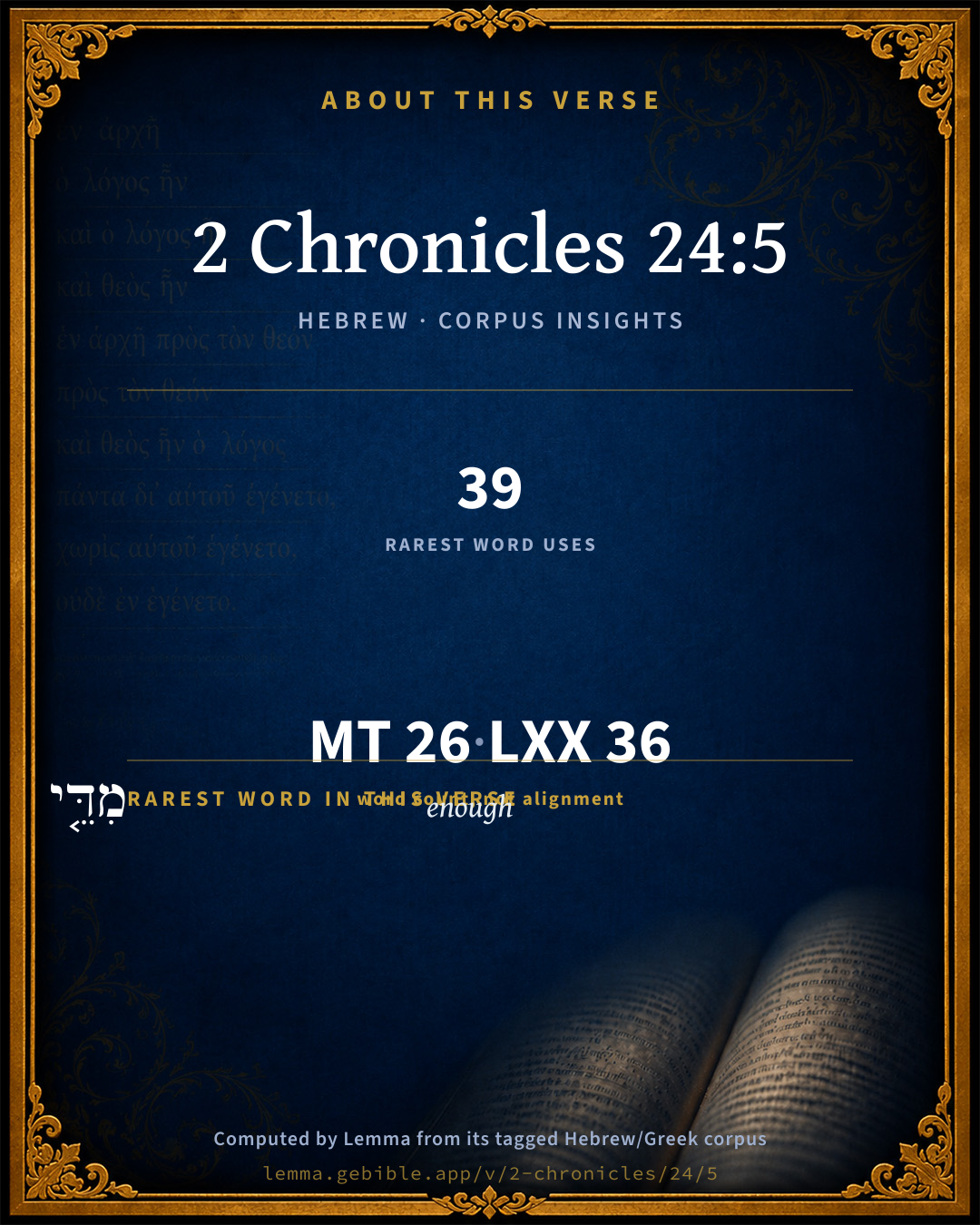
About this verse

These counts appear in no published source. They are computed here, from the morphology-tagged text and Lemma’s own curated glosses. What Lemma adds →

26
words
20
distinct lemmas
Historical
section

Shared distinctive vocabulary

מִדֵּ֤י enough H1767 occurs in 35 verses of the Hebrew Bible. Also found in:

Grammatical profile

  • 7 verbs
  • 14 nouns
  • 1 pronoun
  • 1 preposition
  • 3 particles

Verb forms

  • וַיִּקְבֹּץ֮ Qal · Sequential Imperfect
  • וַיֹּ֣אמֶר Qal · Sequential Imperfect
  • צְא֣וּ Qal · Imperative
  • וְקִבְצוּ֩ Qal · Imperative
  • לְחַזֵּ֣ק Piel · Infinitive Construct
  • תְּמַהֲר֣וּ Piel · Imperfect
  • מִֽהֲר֖וּ Piel · Perfect

Repetition

Words recur within this verse — often emphatic in Hebrew:

  • וַיִּקְבֹּץ֮ to gather H6908 ×2
  • וְהַלְוִיִּם֒ Levite H3881 ×2
  • שָׁנָה֙ year H8141 ×2
  • תְּמַהֲר֣וּ to hasten H4116 ×2

Hebrew & Septuagint length

In English translation the verse runs 48 words from the Hebrew and 48 from the Septuagint (LXX English) — the same length.

A rough comparison of the two English renderings, which tokenize alike — not a word-level alignment.

Word counts can differ between the Hebrew and the Greek without any difference in meaning — e.g. the Hebrew direct-object marker אֵת has no separate Greek word, and Greek often adds the article ὁ.

In the original languages it is 26 Hebrew tokens and 36 Greek tokens — but the two are counted differently (Hebrew bundles its prefixes and suffixes into one token; the Greek is in lemma form), so that isn’t a like-for-like length.

Cross-references

4

Topical passages linked to 2 Chronicles 24:5 in the Treasury of Scripture Knowledge — connected by theme and wording, ordered by reader-vote popularity; previews shown in the World English Bible.

  • 2 Kings 12:4–7 Jehoash said to the priests, All the money of the holy things that is brought into the house of Yahweh, in current money, the money of the persons for whom each man is rated, and all the money that it comes into any man's heart to bring into the house of Yahweh,
  • 2 Chronicles 21:2 He had brothers, the sons of Jehoshaphat: Azariah, and Jehiel, and Zechariah, and Azariah, and Michael, and Shephatiah; all these were the sons of Jehoshaphat king of Israel.
  • 2 Chronicles 29:3 He in the first year of his reign, in the first month, opened the doors of the house of Yahweh, and repaired them.
  • 2 Chronicles 34:8–9 Now in the eighteenth year of his reign, when he had purged the land and the house, he sent Shaphan the son of Azaliah, and Maaseiah the governor of the city, and Joah the son of Joahaz the recorder, to repair the house of Yahweh his God.

Cross-references courtesy of OpenBible.info (CC BY 4.0).

Hebrew and Greek witnesses Masoretic Hebrew ↔ Greek Septuagint

The same verse in the two great witnesses to the Old Testament, shown verse-for-verse.

These are two independent witnesses, not word-aligned to each other, and the Septuagint is shown in lemma (dictionary) form.

Hebrew 2 Chronicles 24:5 Masoretic · Westminster Leningrad Codex

וַיִּקְבֹּץ֮ אֶת הַכֹּהֲנִ֣ים וְהַלְוִיִּם֒ וַיֹּ֣אמֶר לָהֶ֡ם צְא֣וּ לְעָרֵ֪י יְהוּדָ֟ה וְקִבְצוּ֩ מִכָּל יִשְׂרָאֵ֨ל כֶּ֜סֶף לְחַזֵּ֣ק אֶת בֵּ֣ית אֱלֹֽהֵיכֶ֗ם מִדֵּ֤י שָׁנָה֙ בְּשָׁנָ֔ה וְאַתֶּ֖ם תְּמַהֲר֣וּ לַדָּבָ֑ר וְלֹ֥א מִֽהֲר֖וּ הַֽלְוִיִּֽם

He gathered together the priests and the Levites, and said to them, Go out to the cities of Judah, and gather of all Israel money to repair the house of your God from year to year; and see that you hasten the matter. However the Levites didn't hurry.

World English Bible · Public Domain

Greek LXX 2 Chronicles 24:5 Septuagint · lemma form

καί συνἄγω ὁ ἱερεύς καί ὁ λευείτης καί εἶπον αὐτός ἐκἔρχομαι εἰς ὁ πόλις ἰουδά καί συνἄγω ἀπό πᾶς ἰσραήλ ἀργύριον καταἰσχύω ὁ οἶκος κύριος ἐνιαυτός κατά ἐνιαυτός καί σπεύδω λαλέω καί οὐ σπεύδω ὁ λευείτης

And he gathered the priests and the Levites, and said to them, Go out into the cities of Juda, and collect money of all Israel to repair the house of the Lord from year to year, and make haste to speak of it. But the Levites hasted not.

LXX2012 (modern English Septuagint) · Public Domain

Hebrew: Westminster Leningrad Codex (CC BY 4.0). Greek: Septuagint (public domain); English from LXX2012 (modern English Septuagint) (Public Domain). How the Septuagint differs from the Hebrew →

Commentary

Notes on 2 Chronicles 24:5 from classic Christian and Jewish commentators (each source and its license shown beneath its notes). The classic Christian expositions comment on the surrounding passage and are grouped to its opening verse, so a note may address several verses; the Jewish commentaries on the Tanakh (Rashi and others) are per-verse, so they appear only where the commentator wrote on this verse.

Lemma curates 59 commentaries, every one of them public domain or Creative Commons licensed, each selected and text-cleaned for this edition rather than reprinted as found. About our sources →

Trapp's Complete Commentary

John Trapp

2Ch 24:5 And he gathered together the priests and the Levites, and said to them, Go out unto the cities of Judah, and gather of all Israel money to repair the house of your God from year to year, and see that ye hasten the matter. Howbeit the Levites hastened [it] not.

Ver. 5. Howbeit the Levites hastened it not.] See on 2Ki 12:6.

John Trapp, A Commentary or Exposition upon All the Books of the Old and New Testament (1647–1656) — public domain. Text from a community e-Sword module.

Joseph Benson's Commentary

2Ch 24:5. Gather of all Israel — Not only of the tribes of Judah and Benjamin, but of all the Israelites, belonging to any of the ten tribes, who are now resident in my kingdom: money to repair, &c., from year to year — That is, either, 1st, To repair part of it every year till the reparations were perfected: or, 2d, The money was to be gathered from year to year, till they got such a sum as might suffice for the work.

Joseph Benson's Commentary on the Old and New Testaments (1811–1818) — public domain. Text from a community e-Sword module.

Geneva Bible (1599)

Geneva Bible translators

He meaneth not the ten tribes, but only the two tribes of Judah and Benjamin.

Geneva Bible (1599) marginal notes — public domain. Text via Bolls.life.

Adam Clarke's Commentary

Verse 5. Gather of all Israel money] As the temple was the property of the whole nation, and the services performed in it were for the salvation of the people at large, it was right that each should come forward on an occasion of this kind, and lend a helping hand. This is the first instance of such a general collection for building or repairing a house of God.

From year to year] It must have been in a state of great dilapidation, when it required such annual exertions to bring it into a thorough state of repair.

Adam Clarke's Commentary on the Bible (1810–1826) — public domain. Text from a community e-Sword/MySword module.

Ellicott's Commentary for English Readers

(5) Go out unto the cities of Judah, and gather of all Israel money.—This is the chronicler’s interpretation of “Let the priests take it to themselves, each from his own acquaintance” (Kings). The priests and Levites of the different districts were to collect the moneys due to the sanctuary, each in his own neighbourhood.

And see that ye hasten the matter.—Literally, and, for your part, hasten ye in regard to the matter (comp. 2Ch_18:8); and the Levites hastened not. This agrees with the statement in 2Ki_12:6; 2Ki_12:9 : “And it was so, that in the three and twentieth year of king Jehoash the priests had not repaired the breaches of the house.” The remissness of the priestly order is evidently inferable from these words.

A Bible Commentary for English Readers, edited by Charles John Ellicott (1878–1897) — public domain. Text from a community e-Sword module.

The Cambridge Bible for Schools and Colleges

gen. ed. J. J. S. Perowne

5. and the Levites] Not in Kings; cp. 2Ch_23:2 (note).

Go out unto the cities of Judah] Nothing is said in Kings about collecting money outside Jerusalem, but the restoration fund was to consist of a poll tax (paid at the Temple at the Great Feasts, Exo_23:14-17) and of free-will offerings paid in money.

hastened it not] In Kings, “in the three and twentieth year of king Jehoash the priests had not repaired the breaches of the house.”

The Cambridge Bible for Schools and Colleges (gen. ed. J. J. S. Perowne; Cambridge University Press, 1878–1918) — public domain. Text from a community e-Sword module.

John Gill's Exposition

And the king called for Jehoiada the chief,.... Who was either the high priest, or the head of his course, or, however, the chief of the priests and Levites concerned in this affair, and, indeed, was the chief or prime minister of state:

and said unto him, why hast thou not required of the Levites to bring in out of Judah, and out of Jerusalem, the collection; the money to repair the house they were ordered to collect, Ch2 25:6 according to the commandment

of Moses the servant of the Lord and of the congregation of Israel, for the tabernacle of witness? for the repair of it, such as Moses required, and the people used to pay, referring to the half shekel; or to a freewill offering of the people, Moses enjoined or directed to.

John Gill's Exposition of the Whole Bible (1746–1763) — public domain (CC PDM 1.0). Text via the HelloAO Bible API.

Haydock's Catholic Bible Commentary

Money. The half sicle, (Ex. xxx. 13., and 4 K. xii. 4.; C.) which at first was required for the tabernacle, and afterwards for the repairs of the temple. W.

George Leo Haydock (1774–1849), Haydock's Catholic Family Bible and Commentary, 1859 edition — public domain. Excludes Psalms (Douay-Rheims chapter numbering differs from Protestant) and Deuterocanonical books (Catholic canon only).

Matthew Poole's English Annotations

Gather of all Israel, i.e. of all the Israelites that were in the kingdom of Judah. See 2Ch 15:17; 21:2. To repair the house of your God from year to year; either,

1. Repair part of it every year till the reparations be perfected; or,

2. Gather it from year to year, till you get such a sum as may suffice for the work; for he supposed one or two years’ collection would not suffice for the work, whether it were that collection of half a shekel for every man, of which see Exo 30:12,13; 2Ki 12:14; or a voluntary contribution required for the present exigence of the temple by virtue of the command and example of Moses, who made such a collection for the building of the tabernacle, Exo 35:5; see also Neh 10:32; which he thought would not be any great sum, because of the great iniquity and impiety which yet had reigned for many years, and yet continued in the generality of the people of the land, the Levites not excepted, as the last clause of this verse shows.

Matthew Poole's English Annotations on the Holy Bible (1683–1685) — public domain. Text from a community e-Sword/MySword module.

The Pulpit Commentary

To repair. The idea of this verb (qzj) is that of making strong. From year to year. The compound adverbial expression yDej; here used for "from," era-braces the idea of" unfailingly from year to year." The command given here to the priests and Levites is expressed very differently, though in no degree contadictorily, in the parallel (see its vers. 4, 5). The addition is there found, "every man of his acquaintance;" this expression may glance at the very supposable circumstance that the priest and Levite collecting deputations would naturally go respectively to the towns and cities where they had been located beforetime. A slight ambiguity is perhaps occasioned by the impression that the fourth verse (in the parallel) produces that the priests and Levites should wait to receive, e.g. , in Jerusalem. This, however, is,sot what is said, and need not, therefore, be made into a difficulty. Howbeit the Levites hastened not. We are not told why this delay was, nor does the subsequent narrative seem to elucidate it, further than this that the delay somehow seemed to rest with Jehoiada, as the king appealed to him for explanation.

The Pulpit Commentary (1880–1919), ed. H.D.M. Spence-Jones & Joseph S. Exell — public domain. Text from a community e-Sword module.

Rashi

Rabbi Shlomo Yitzchaki (Rashi)

and gather money from all Israel i.e., Gather the money that the Israelites were accustomed to giving yearly, as it is written (Exod. 30:14): “Each one included in the census,” and in II Kings (12: 5): “All money of the hallowed things that is brought to the House of the Lord, in current money, etc.” There were three types of money: (1) the money of all those counted in the census, viz. the shekels for every year, as it is said (Exod. 30:14): “Each one included in the census,” lit., “[the money of anyone] who passes,” reminiscent of “each one who passes.” (2) Personal donations - money donated by individuals to reflect the value of their souls, like one who says, “My value shall be incumbent upon me to donate.” (3) All donations inspired by a person’s heart for the repairs of the Temple.

and hasten to the matter,” but the Levites did not hasten It is explained in II Kings (12:6f.) that the king said, “Let the priests take [the money] for themselves, each one from his acquaintance,” but they neglected to impose upon their acquaintances, and when the king saw this, he said to them, (ibid. verse 8): “Do not take money from your acquaintances [any longer], but deliver it for the repairs of the House.” This is what is written here: “’and hasten to the matter,’ but the Levites did not hasten.”

Rashi on the Tanakh — English translations: “The Judaica Press complete Tanach with Rashi, translated by A. J. Rosenberg” (CC BY 4.0); “Pentateuch with Rashi's commentary by M. Rosenbaum and A.M. Silbermann, 1929-1934” (public domain); “The Metsudah Tanach series, Lakewood, N.J” (CC BY 4.0); and “The Book of Joshua, Metsudah Publications, 1997” (CC BY 4.0). Text via Sefaria.

Lesson kit

Teaching starters — assembled from the data on this page, not authored interpretation. Every prompt links to the verse data it draws on. Edit before teaching.

2 Chronicles, in the Historical, opens this verse with 26 words (20 distinct Hebrew lemmas). Its most distinctive word is day (“enough”). A historical commentator’s framing appears above. Read the whole chapter for the surrounding context.

Discussion questions

  1. The word day carries the sense “enough.” How does it shape the verse?
  2. How does Exodus 36:5, which shares the word «enough», read alongside this verse?
  3. What does the repetition of “to gather” (2× in this one verse) do in this verse?
  4. The translations on this page render this verse differently — a whole-verse word diff, not a word-by-word alignment. What might account for the different wordings?
  5. «וַיִּקְבֹּץ֮» is a Qal Sequential Imperfect verb. How does that grammatical form shape the action described?
  6. Compare how Trapp's Complete Commentary and Joseph Benson's Commentary read this verse. Where do they agree or differ?

Things to notice

Reading settings

Reading text

Shown beneath each verse's original-language words.

Old Testament
Old Testament edition

Read the OT as the Masoretic Hebrew (MT) or the Greek Septuagint (LXX).

English shown for the Greek Septuagint (in the Hebrew ↔ Greek comparison).

Comparing translations? Open the Compare panel on any verse page to stack up to four side by side.