
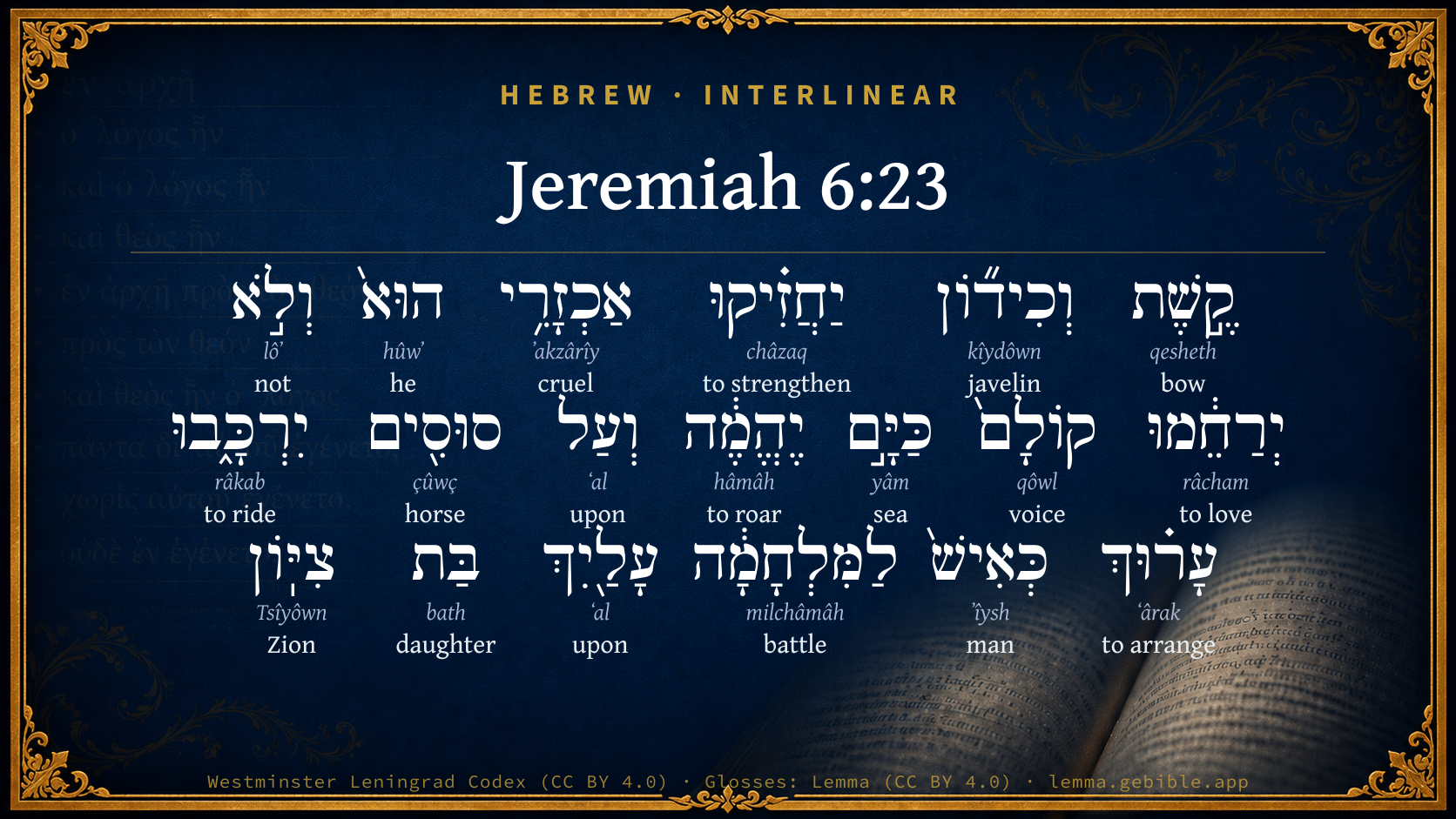
Jeremiah 6:23

Hebrew (Westminster Leningrad Codex) Jeremiah 6:23 appears in the Hebrew Old Testament. The text above is from the Westminster Leningrad Codex. Each word links to its Strong’s number, a concise gloss, and parsing drawn from the Open Scriptures Hebrew Bible morphology. Click any word for its full Brown-Driver-Briggs (BDB) entry.
Download image
Cite this verse

Jeremiah 6:23 (World English Bible). Public Domain. Lemma interlinear Bible study tool, https://lemma.gebible.app/v/jeremiah/6/23.

Show BibTeX & RIS
BibTeX
RIS
English Translation
They lay hold on bow and spear; they are cruel, and have no mercy; their voice roars like the sea, and they ride on horses, everyone set in array, as a man to the battle, against you, daughter of Zion.
World English Bible · Public Domain
Download a study sheet

One document with this verse’s original text, its word-by-word gloss line, the meaning frame, cross-references with their text, attributed commentary, and full source and license credits — printable, and it pastes into notes with its structure intact.

This verse Autodidact and up

Study sheet (.html) Plain text (.txt)

A passage Seminary Student

Up to 50 verses in one chapter. A passage sheet keeps up to 6 commentary sources and 12 cross-references per verse, in the order this page ranks them, and says so on the sheet whenever that leaves anything out. Ask for a single verse and you get the Autodidact verse sheet above.

Everything on this page stays free to read, with no account — the sheet is a download of what is already on screen, not access to it.

Want to remove ads? Support Godless Engineer
Compare translations 3

The same verse in 3 English versions, stacked beneath the original-language interlinear above. Click any original word for its lexicon entry.

Each is an independent rendering of the whole verse — the interlinear is not word-aligned to these translations.

Highlighted words mark where these versions differ — a whole-verse word diff, not a word-by-word alignment.

  • World English Bible Public Domain
    They lay hold on bow and spear; they are cruel, and have no mercy; their voice roars like the sea, and they ride on horses, everyone set in array, as a man to the battle, against you, daughter of Zion.
  • King James Version Public Domain
    They shall lay hold on bow and spear; they are cruel, and have no mercy; their voice roareth like the sea; and they ride upon horses, set in array as men for war against thee, O daughter of Zion.
  • unfoldingWord Literal Text CC BY-SA 4.0
    They hold bows and spears. They cruel and they are not compassionate. Their sound roars like the sea, and they ride on horses, arranged like men for battle against you, daughter of Zion.’” ts\*

unfoldingWord Literal Text — © unfoldingWord, licensed CC BY-SA 4.0. Word-aligned USFM3 via Door43 (git.door43.org/unfoldingWord/en_ult).

Versions to compare (up to 4)

3 of 4 selected

Show all 18 translations

Every available English version of this verse, each an independent rendering of the whole verse.

  • World English Bible Public Domain
    They lay hold on bow and spear; they are cruel, and have no mercy; their voice roars like the sea, and they ride on horses, everyone set in array, as a man to the battle, against you, daughter of Zion.
  • Berean Standard Bible Public Domain
    They grasp the bow and spear; they are cruel and merciless. Their voice roars like the sea, and they ride upon horses, lined up like men in formation against you, O Daughter of Zion.”
  • Majority Standard Bible Public Domain
    They grasp the bow and spear; they are cruel and merciless. Their voice roars like the sea, and they ride upon horses, lined up like men in formation against you, O Daughter of Zion.”
  • King James Version Public Domain
    They shall lay hold on bow and spear; they are cruel, and have no mercy; their voice roareth like the sea; and they ride upon horses, set in array as men for war against thee, O daughter of Zion.
  • American Standard Version (1901) Public Domain
    They lay hold on bow and spear; they are cruel, and have no mercy; their voice roareth like the sea, and they ride upon horses, every one set in array, as a man to the battle, against thee, O daughter of Zion.
  • Revised Version (1885) Public Domain
    They lay hold on bow and spear; they are cruel, and have no mercy; their voice roareth like the sea, and they ride upon horses; every one set in array, as a man to the battle, against thee, O daughter of Zion.
  • Geneva Bible (1599) Public Domain
    With bowe and shield shall they be weaponed: they are cruell and will haue no compassion: their voyce roareth like the sea, and they ride vpon horses, well appointed, like men of warre against thee, O daughter Zion.
  • Douay-Rheims (1899) Public Domain
    They shall lay hold on arrow and shield: they are cruel, and will have no mercy. Their voice shall roar like the sea: and they shall mount upon horses, prepared as men for war, against thee, O daughter of Sion.
  • Young's Literal Translation Public Domain
    Bow and javelin they take hold of, Fierce it `is', and they have no mercy, Their voice as a sea doth sound, And on horses they ride, set in array as a man of war, Against thee, O daughter of Zion.
  • Literal Standard Version CC BY-SA 4.0
    They take hold of bow and javelin, || It [is] fierce, and they have no mercy, || Their voice sounds as a sea, || And they ride on horses, || Set in array as a man of war, || Against you, O daughter of Zion.”
  • Unlocked Literal Bible CC BY-SA 4.0
    They will pick up bows and spears. They are cruel and have no compassion. Their sound is like the sea roar, and they are riding on horses, set out in order as men for battle, against you, daughter of Zion.'”
  • unfoldingWord Literal Text CC BY-SA 4.0
    They hold bows and spears. They cruel and they are not compassionate. Their sound roars like the sea, and they ride on horses, arranged like men for battle against you, daughter of Zion.’” ts\*
  • Darby Bible Public Domain
    They lay hold on bow and spear; they are cruel, and have no mercy; their voice roareth like the sea; and they ride upon horses, set in array as a man for the battle, against thee, daughter of Zion.
  • World Messianic Bible Public Domain
    They take hold of bow and spear. They are cruel, and have no mercy. Their voice roars like the sea, and they ride on horses, everyone set in array, as a man to the battle, against you, daughter of Zion.”
  • Webster's Bible Public Domain
    They shall lay hold on bow and spear; they are cruel, and have no mercy; their voice roareth like the sea; and they ride upon horses, set in array as men for war against thee, O daughter of Zion.
  • Free Bible Version CC BY-SA 4.0
    They pick up their bows and spears. They are cruel and show no mercy. Their war cries are like the sea roaring, and they ride horses lined up ready to attack you, Daughter of Zion.
  • Bible in Basic English Public Domain
    Bows and spears are in their hands; they are cruel and have no mercy; their voice is like the thunder of the sea, and they go on horses; everyone in his place like men going to the fight, against you, O daughter of Zion.
  • JPS Tanakh (1917) Public Domain
    They lay hold on bow and spear, they are cruel, and have no compassion; their voice is like the roaring sea, and they ride upon horses; set in array, as a man for war, against thee, O daughter of Zion.

Literal Standard Version (2020), Covenant Press — licensed CC BY-SA 4.0. Text via the HelloAO Bible API (eBible.org). Unlocked Literal Bible (unfoldingWord) — licensed CC BY-SA 4.0. Text via the HelloAO Bible API (eBible.org). unfoldingWord Literal Text — © unfoldingWord, licensed CC BY-SA 4.0. Word-aligned USFM3 via Door43 (git.door43.org/unfoldingWord/en_ult). Free Bible Version, Dr. Jonathan Gallagher — licensed CC BY-SA 4.0. Text via the HelloAO Bible API (eBible.org).

Word by word

More ways to search: Search by grammar → Find every occurrence → Compare this word →

Practice this passage: Drill this verse → Learn its vocabulary →

אַכְזָרִ֥י
ʼakzârîy
H394
“cruel”
Adjective, Adjective, Masculine, Singular, Absolute
Part of Speech
Adjective
Type
Adjective
Gender
Masculine
Number
Singular
State
Absolute
Full BDB Definition

Origin: from H393

TWOT: 971b

cruel
  1. קֶ֣שֶׁת qesheth H7198 “bow” Noun, Common, Feminine, Singular, Absolute
  2. וְכִיד֞וֹן kîydôwn H3591 “and · javelin” Conjunction + Noun, Common, Masculine, Singular, Absolute
  3. יַחֲזִ֗יקוּ châzaq H2388 “to strengthen” Verb, Hiphil, Imperfect, 3rd Person, Masculine, Plural
  4. הוּא֙ hûwʼ H1931 “he” Pronoun, Personal, 3rd Person, Masculine, Singular
  5. וְלֹ֣א lôʼ H3808 “and · not” Conjunction + Particle, Negative
  6. יְרַחֵ֔מוּ râcham H7355 “to love” Verb, Piel, Imperfect, 3rd Person, Masculine, Plural
  7. קוֹלָם֙ qôwl H6963 “voice · their” Noun, Common, Masculine, Singular, Construct + Suffix, Personal, 3rd Person, Masculine, Plural
  8. כַּיָּ֣ם yâm H3220 “like/as the · sea” Preposition, Determined + Noun, Common, Masculine, Singular, Absolute
  9. יֶהֱמֶ֔ה hâmâh H1993 “to roar” Verb, Qal, Imperfect, 3rd Person, Masculine, Singular
  10. וְעַל ʻal H5921 “and · upon” Conjunction + Preposition
  11. סוּסִ֖ים çûwç H5483 “horses” Noun, Common, Masculine, Plural, Absolute
  12. יִרְכָּ֑בוּ râkab H7392 “to ride” Verb, Qal, Imperfect, 3rd Person, Masculine, Plural
  13. עָר֗וּךְ ʻârak H6186 “arranged” Verb, Qal, Participle Passive, Masculine, Singular, Absolute
  14. כְּאִישׁ֙ ʼîysh H376 “like/as · man” Preposition + Noun, Common, Masculine, Singular, Absolute
  15. לַמִּלְחָמָ֔ה milchâmâh H4421 “to/for the · battle” Preposition, Determined + Noun, Common, Feminine, Singular, Absolute
  16. עָלַ֖יִךְ ʻal H5921 “upon · you” Preposition + Suffix, Personal, 2nd Person, Feminine, Singular
  17. בַּת bath H1323 “daughter of” Noun, Common, Feminine, Singular, Construct
  18. צִיּֽוֹן Tsîyôwn H6726 “Zion” Noun, Proper

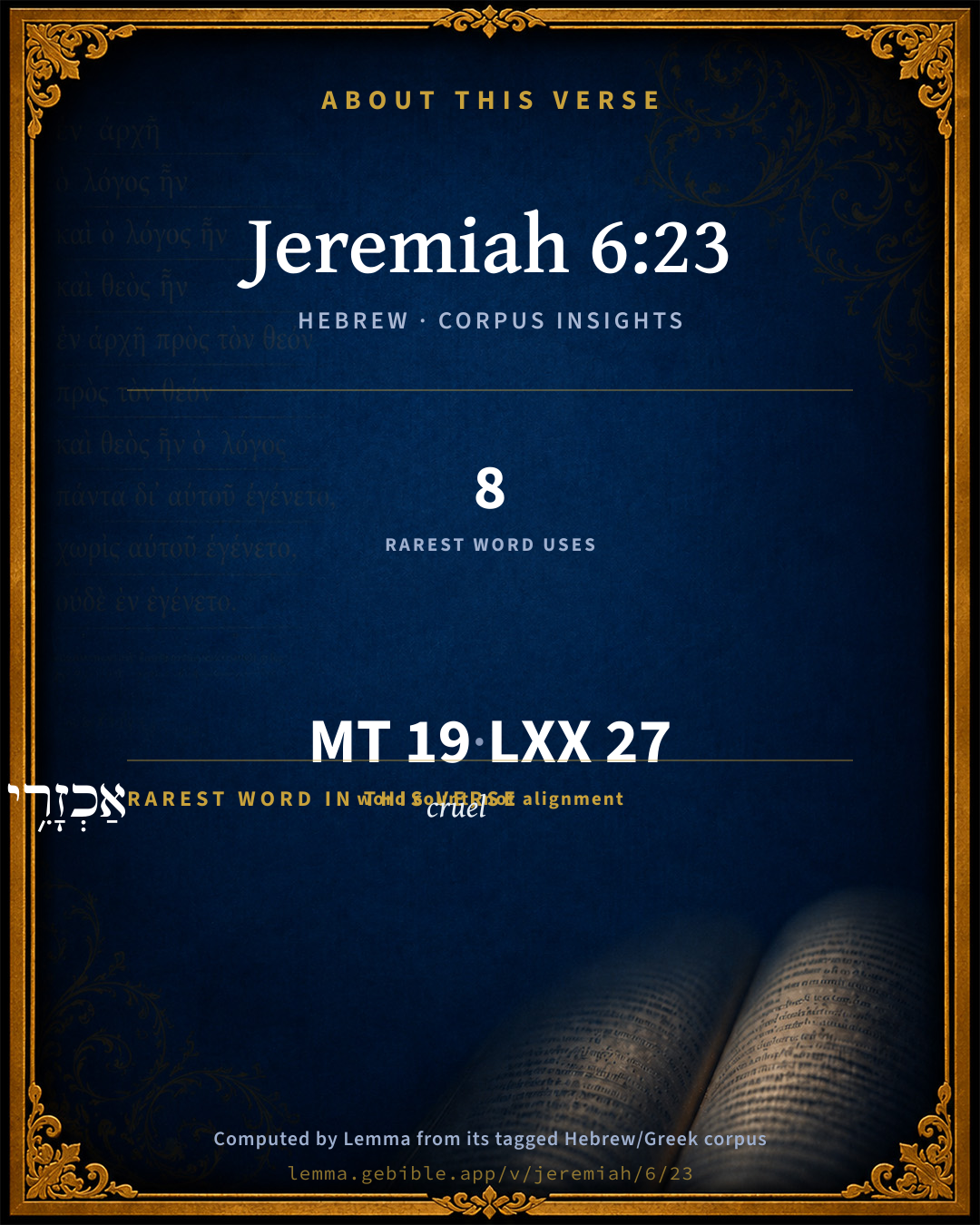
About this verse

These counts appear in no published source. They are computed here, from the morphology-tagged text and Lemma’s own curated glosses. What Lemma adds →

19
words
18
distinct lemmas
Prophets
section

Notable vocabulary

The rarest word here is אַכְזָרִ֥י cruel H394 — appearing just 8 times in the whole Hebrew Bible.

Shared distinctive vocabulary

אַכְזָרִ֥י cruel H394 occurs in 8 verses of the Hebrew Bible. Also found in:

Grammatical profile

  • 5 verbs
  • 9 nouns
  • 1 adjective
  • 1 pronoun
  • 2 prepositions
  • 1 particle

Verb forms

  • יַחֲזִ֗יקוּ Hiphil · Imperfect
  • יְרַחֵ֔מוּ Piel · Imperfect
  • יֶהֱמֶ֔ה Qal · Imperfect
  • יִרְכָּ֑בוּ Qal · Imperfect
  • עָר֗וּךְ Qal · Participle Passive

Repetition

A word recurs within this verse — often emphatic in Hebrew:

  • וְעַל upon H5921 ×2

Hebrew & Septuagint length

In the original languages it is 19 Hebrew tokens and 27 Greek tokens — but the two are counted differently (Hebrew bundles its prefixes and suffixes into one token; the Greek is in lemma form), so that isn’t a like-for-like length.

Cross-references

11

Topical passages linked to Jeremiah 6:23 in the Treasury of Scripture Knowledge — connected by theme and wording, ordered by reader-vote popularity; previews shown in the World English Bible.

  • Isaiah 13:18 [Their] bows shall dash the young men in pieces; and they shall have no pity on the fruit of the womb; their eye shall not spare children.
  • Jeremiah 50:42 They lay hold on bow and spear; they are cruel, and have no mercy; their voice roars like the sea; and they ride on horses, everyone set in array, as a man to the battle, against you, daughter of Babylon.
  • Isaiah 5:26–30 He will lift up a banner to the nations from far, And he will whistle for them from the end of the earth. Behold, they will come speedily and swiftly.
  • Isaiah 19:4 I will give over the Egyptians into the hand of a cruel lord; and a fierce king shall rule over them, says the Lord, Yahweh of Hosts.
  • Jeremiah 4:13 Behold, he shall come up as clouds, and his chariots [shall be] as the whirlwind: his horses are swifter than eagles. Woe to us! for we are ruined.
  • Jeremiah 4:29 Every city flees for the noise of the horsemen and archers; they go into the thickets, and climb up on the rocks: every city is forsaken, and not a man dwells therein.
  • Jeremiah 5:16 Their quiver is an open tomb, they are all mighty men.
  • Jeremiah 30:14 All your lovers have forgotten you; they don't seek you: for I have wounded you with the wound of an enemy, with the chastisement of a cruel one, for the greatness of your iniquity, because your sins were increased.
  • Ezekiel 23:22–25 Therefore, Oholibah, thus says the Lord Yahweh: Behold, I will raise up your lovers against you, from whom your soul is alienated, and I will bring them against you on every side:
  • Habakkuk 1:6–10 For, behold, I raise up the Chaldeans, that bitter and hasty nation, that march through the breadth of the earth, to possess dwelling places that are not theirs.
  • Luke 21:25–26 There will be signs in the sun, moon, and stars; and on the earth anxiety of nations, in perplexity for the roaring of the sea and the waves;

Cross-references courtesy of OpenBible.info (CC BY 4.0).

Hebrew and Greek witnesses Masoretic Hebrew ↔ Greek Septuagint

The same verse in the two great witnesses to the Old Testament, shown verse-for-verse.

These are two independent witnesses, not word-aligned to each other, and the Septuagint is shown in lemma (dictionary) form.

Hebrew Jeremiah 6:23 Masoretic · Westminster Leningrad Codex

קֶ֣שֶׁת וְכִיד֞וֹן יַחֲזִ֗יקוּ אַכְזָרִ֥י הוּא֙ וְלֹ֣א יְרַחֵ֔מוּ קוֹלָם֙ כַּיָּ֣ם יֶהֱמֶ֔ה וְעַל סוּסִ֖ים יִרְכָּ֑בוּ עָר֗וּךְ כְּאִישׁ֙ לַמִּלְחָמָ֔ה עָלַ֖יִךְ בַּת צִיּֽוֹן

They lay hold on bow and spear; they are cruel, and have no mercy; their voice roars like the sea, and they ride on horses, everyone set in array, as a man to the battle, against you, daughter of Zion.

World English Bible · Public Domain

Greek LXX Structure differs

In the Septuagint, Jeremiah is about an eighth shorter than the Hebrew and arranges its material differently — the Oracles Against the Nations (Hebrew chapters 46–51) appear in the middle of the Greek book, after 25:13. Because the chapter and verse boundaries do not line up, a verse-for-verse comparison with the Hebrew is not shown.

A verse-for-verse comparison isn’t shown here because the chapters and verses don’t line up. Switch to the LXX edition with the MT / LXX toggle above to read the Greek directly.

On this verse, Matthew Poole's English Annotations discusses the Septuagint’s reading. Read the note in Commentary ↓

Hebrew: Westminster Leningrad Codex (CC BY 4.0). Greek: Septuagint (public domain); English from a public-domain English Septuagint. How the Septuagint differs from the Hebrew →

Targum (Aramaic paraphrase)

1

The Targum is the ancient Jewish Aramaic paraphrase of the Hebrew Scriptures — an interpretive translation, not the Hebrew text itself. Onkelos (literal) and Pseudo-Jonathan (expansive) render the Torah, and Jonathan the Prophets. Coverage is partial: where no permissively-licensed English translation exists for a verse, only the Aramaic is shown. This is verse-level text, not a word-by-word alignment to the Hebrew.

  1. Targum Jonathan Prophets (Joshua–Malachi)
    קַשְׁתָּן וּתְרֵיסִין אֲחִידִין אַכְזְרְאִין אִינוּן וְלֵית לְהוֹן רַחֲמִין קָלְהוֹן כְּיַמָא בְּאִתְרְגוֹשֵׁיהּ וְעַל סוּסְוָתָא רְכֵיבִין מְסַדְרִין אִינוּן כִּגְבַר עָבֵיד קְרָבִין עֲלָךְ כְּנִשְׁתָּא דְצִיוֹן:

    (no public-domain English translation for this verse)

    Targum Jonathan — Aramaic: “Mikraot Gedolot” (public domain). English: “Sefaria Community Translation” (CC0 1.0 (public-domain dedication)); “London "Chaldee Paraphrase," 1871” (public domain). Text via Sefaria.

Commentary

Notes on Jeremiah 6:23 from classic Christian and Jewish commentators (each source and its license shown beneath its notes). The classic Christian expositions comment on the surrounding passage and are grouped to its opening verse, so a note may address several verses; the Jewish commentaries on the Tanakh (Rashi and others) are per-verse, so they appear only where the commentator wrote on this verse.

Lemma curates 59 commentaries, every one of them public domain or Creative Commons licensed, each selected and text-cleaned for this edition rather than reprinted as found. About our sources →

Trapp's Complete Commentary

John Trapp

Jer 6:23 They shall lay hold on bow and spear; they [are] cruel, and have no mercy; their voice roareth like the sea; and they ride upon horses, set in array as men for war against thee, O daughter of Zion.

Ver. 23. They shall lay hold on bow and spear.] To destroy et eminus et comminus, both afar off and at hand.

Their voice roareth like the sea.] Which is so dreadful, that the horrible shriekings of the devils are set out by it {Jas 2:19). {a} They who would not hear the prophet’s sweet words, shall hear the enemies roaring in the midst of their congregations. {Psa 74:4}

{a} φρισσουσι.

John Trapp, A Commentary or Exposition upon All the Books of the Old and New Testament (1647–1656) — public domain. Text from a community e-Sword module.

Jamieson, Fausset & Brown

Robert Jamieson, A. R. Fausset & David Brown

like the sea-- (Isa 5:30).

as men for war--not that they were like warriors, for they were warriors; but "arrayed most perfectly as warriors" [MAURER].

Jamieson, Fausset & Brown — Commentary Critical and Explanatory on the Whole Bible (1871) — public domain (CC PDM 1.0). Text via the HelloAO Bible API.

Adam Clarke's Commentary

Verse 23. They shall lay hold on bow and spear] Still pointing out the Chaldeans: or according to Dahler, the Scythians, who had before their invasion of Palestine overrun many parts of Asia, and had spread consternation wherever their name was heard.

Adam Clarke's Commentary on the Bible (1810–1826) — public domain. Text from a community e-Sword/MySword module.

John Calvin's Commentaries

He adds other particulars, in order more fully to render the Chaldeans objects of dread: They shall lay hold, he says, on the bow and the lance They who render the last word shield, do not sufficiently attend to the design of the Prophet. For there is no mention here made of defense; but it is the same as though the Prophet had said, that they would come furnished with bows and spears, that they might shoot at a distance. The word כידון, kidun, means a spear and a lance; and it means also a shield: but in this place the Prophet, I doubt not, means a spear; as though he had said, “They will strike at a distance, or near at hand.”

He afterwards adds, that they would be cruel, according to what Isaiah says, when he speaks of the Persians and Medes,

“They will covet neither gold nor silver,” (Isaiah 13:17)

and yet they were a rapacious people. This is indeed true; but the Prophet meant both these things, that as the Persians and Medes were to be the executioners of divine vengeance, they would come with a new disposition and character, despising gold and silver, and other kinds of spoil, and seeking only blood. And they will shew, he says, no mercy; and then he adds, their voice shall make an uproar, or sound, like the sea He touches, I have no doubt, on the stupor of the people in not attending to the voice of God; for the teaching of Jeremiah had for many years sounded in their ears: Isaiah and others had preceded him; but the people had continued deaf. He says now, “Ye shall hereafter hear other teachers; they will not warn you, nor give you counsel, nor be satisfied with reproofs and threatenings, but they will come like a tempest on the sea; their voice shall make an uproar ”

He adds, Ascend shall they on horses, and be set in order as a man for war; that is, “Thou, Jerusalem, shalt find that thou wilt have to do with military men.” The Prophet means, in short, that the Jews most foolishly trusted in their own strength, and thus heedlessly despised the threatenings of the prophets. But as their security was of this kind, he says that they would at length really find out how stupid they had been, for the Chaldeans would come with dreadful violence, prepared for war — against whom? Against thee, he says, O daughter of Sion I cannot proceed further, on account of some other business.

John Calvin's Commentaries (1540-1563) — public domain. Text from the Calvin Translation Society English edition (1840s-50s) via the Christian Classics Ethereal Library (ccel.org). Calvin's coverage is partial (roughly two-thirds of the Bible); uncommented books and verses are honest gaps, never fabricated. The 19th-century editor's footnotes and remarks are omitted so the notes are faithfully Calvin's own voice.

Ellicott's Commentary for English Readers

(23) Bow and spear.—As before (Jer_5:16), the special weapons of the Chaldæans. The “spear” was a javelin, shot or hurled against the enemy.

Cruel.—The ferocity of the Chaldæans seems to have been exceptional. Prisoners impaled, or flayed alive, or burnt in the furnace (Jer_29:22; Dan_3:11), were among the common incidents of their wars and sieges.

They ride upon horses.—This appears to have been a novelty to the Israelites, accustomed to the war-chariots of Egypt and their own kings rather than to actual cavalry. (Comp. Jer_8:16; Job_39:21-25; Hab_1:8; Isa_30:16.) Both archers and horsemen appear as prominent in the armies of Gog and Magog, i.e., of the Scythians, in Eze_38:4; Eze_39:3.

Set in array . . .—The Hebrew is singular, and implies a new clause. It (the army of bowmen and riders) is set in array as a warrior, for war against thee.

A Bible Commentary for English Readers, edited by Charles John Ellicott (1878–1897) — public domain. Text from a community e-Sword module.

The Cambridge Bible for Schools and Colleges

gen. ed. J. J. S. Perowne

23. set in array, as a man to the battle] equipped as a man for war.

23, 24. A large part of ch. 50 reads as an expansion of these vv.

The Cambridge Bible for Schools and Colleges (gen. ed. J. J. S. Perowne; Cambridge University Press, 1878–1918) — public domain. Text from a community e-Sword module.

John Gill's Exposition

They shall lay hold on bow and spear,.... That is, everyone of them should be furnished with both these pieces of armour, that they might be able to fight near and afar off; they had bows to shoot arrows at a distance, and spears to strike with when near. The Targum renders it bows and shields. "They are cruel, and have no mercy"; this is said, to strike terror into the hearts of the hardened Jews:

their voice roareth like the sea; the waves of it, which is terrible, Luk 21:25,

and they ride upon horses; which still made them more formidable, as well as suggests that their march would be quick and speedy, and they would soon be with them:

set in array as men for war; prepared with all sorts of armour for battle: or, "as a man" (a); as one man, denoting their conjunction, ardour, and unanimity; being not only well armed without, but inwardly, resolutely bent, as one man, to engage in battle, and conquer or die; see Jdg 20:8,

against thee, O daughter of Zion; the design being against her, and all the preparation made on her account; which had a very dreadful appearance, and threatened with ruin, and therefore filled her with terror and distress, as follows.

(a) "tanquam vir", Pagninus; "ut vir", Schmidt; "quam unus vir", Grotius.

John Gill's Exposition of the Whole Bible (1746–1763) — public domain (CC PDM 1.0). Text via the HelloAO Bible API.

Albert Barnes' Notes on the Bible

Spear - Properly, a javelin for hurling at the enemy (see 1Sa 17:6 note): an ordinary weapon of the Babylonians.

Cruel - ruthless, inhuman. In the Assyrian monuments warriors put the vanquished to death; rows of impaled victims hang round the walls of the besieged towns; and men collect in heaps hands cut from the vanquished.

Horses, set in array - A full stop should be put after horses. It - the whole army, and not the cavalry only - is “set in array.”

As men for war against thee - Rather, as a warrior for battle “against thee.”

Albert Barnes' Notes on the Bible (1834–1885) — public domain. Text from a community e-Sword/MySword module.

Matthew Poole's English Annotations

They shall lay hold on bow and spear; or, They shall carry; they shall not want military ammunition of all sorts for the despatch of this great work; synecdochically expressed for all sorts of weapons. So Psa 35:2,3.

Have no mercy; see Jer 50:42; not be entreated, or have any pity to sex or age, poor or rich, Jer 21:7. See the like Isa 13:17,18. And this was as duly executed as here prophesied, 2Ch 36:17.

Their voice roareth like the sea; which, as it is very violent, so it causeth great consternation by its noise, compared to the roaring of the devils, Jam 2:19. Possibly it may intimate, they would not hearken to the voice of his prophets, now they shall hear the terrifying noise of armies, like the roaring of the sea.

They ride upon horses; which is a creature in especial manner adapted by God for war, as he is described. Job 9:19,20, &c.; implying their speed, strength, and fierceness, Jer 50:42.

Set in array; the whole nation set as it were in battalia against them, that they may perceive they have to do with soldiers. The LXX. reading אש esh, fire, for איש ish, man, render it, as fire to the war.

O daughter of Zion, or Jerusalem; for these two titles are promiscuously used for the same place; and the term daughter is often given to cities and countries, as Psa 45:12; 137:8; Isa 23:12; 47:1.

Matthew Poole's English Annotations on the Holy Bible (1683–1685) — public domain. Text from a community e-Sword/MySword module.

Whedon's Commentary on the Bible

Daniel D. Whedon

23. Spear — Rather, javelin. These bows and javelins are abundantly illustrated in the Assyrian monuments. And these monuments fully justify the epithet cruel, as applied to these peoples.

Daniel D. Whedon (gen. ed.), Commentary on the Old and New Testaments (1874–1909) — public domain. Text from a community e-Sword module.

The Pulpit Commentary

Spear; rather, javelin (or, lance). They are cruel. The cruelty of the Assyrians and Babylonians seems to have spread general dismay. Nahum calls Nineveh "the city of bloodshed"; (Nah_3:1) Habakkuk styles the Chaldeans "bitter and vehement, terrible and dreadful". (Hab_1:6, Hab_1:7) The customs brought out into view m the monuments justify this most amply, though Professor Rawlinson thinks we cannot call the Assyrians (with whom the Babylonians may of course be coupled) naturally hard. hearted. "The Assyrian listens to the enemy who asks for quarter; he prefers making prisoners go slaying.; he is very terrible in the battle and the assault, but afterwards he forgives and spares" ("Ancient Monarchies," 1:243). Their voice roareth. The horrid roar of the advancing hosts seems to have greatly struck the Jews. (comp. Isa_5:30 Isa_17:12, Isa_17:13)

The Pulpit Commentary (1880–1919), ed. H.D.M. Spence-Jones & Joseph S. Exell — public domain. Text from a community e-Sword module.

unfoldingWord translationNotes

Door43 World Missions Community

They will pick up bows and spears

"The soldiers will carry bows and spears"

Their sound is like the sea roar

The loud noise that the soldiers make is compared to the loud noise of the ocean. AT: "The sound that they make is very loud, like the sound of the ocean" (See: Simile)

they are riding on horses, set out in order as men for battle

The phrase "set out in order" means that they have organized themselves and are riding in rows. The phrase "as men for battle" indicates that they are ready to fight. AT: "they are riding on horses in their assigned rows, and they are ready to fight against you" (See: Assumed Knowledge and Implicit Information)

We have heard

The word "We" probably refers to Jeremiah and the people of Judah.

our hands fall limp in distress

"our hands are weak because we are anxious"

Anguish seizes us

Feeling great anguish is spoken of as if the anguish grabs them. AT: "We feel terrible anguish" (See: Metaphor)

as a woman giving birth

The anguish that they feel because the enemy coming to attack them is compared to the anguish that a woman feels when she is about to give birth to a baby. AT: "like a woman who is about to give birth" (See: Simile)

translationWords

bow and arrow

spear

compassion

horse

daughter of Zion

anguish

unfoldingWord translationNotes — © Distant Shores Media and the Door43 World Missions Community, licensed CC BY-SA 4.0. Source: git.door43.org/Door43/en_tn.

Rashi

Rabbi Shlomo Yitzchaki (Rashi)

They will grasp Heb. יחזיקו, they will take. Comp. (Exodus 4:4) “And he stretched out his hand and took it (ויחזק).” Comp. also (infra verse 24) “trouble grasped us (החזיקתנוּ) held us.”

Rashi on the Tanakh — English translations: “The Judaica Press complete Tanach with Rashi, translated by A. J. Rosenberg” (CC BY 4.0); “Pentateuch with Rashi's commentary by M. Rosenbaum and A.M. Silbermann, 1929-1934” (public domain); “The Metsudah Tanach series, Lakewood, N.J” (CC BY 4.0); and “The Book of Joshua, Metsudah Publications, 1997” (CC BY 4.0). Text via Sefaria.

Lesson kit

Teaching starters — assembled from the data on this page, not authored interpretation. Every prompt links to the verse data it draws on. Edit before teaching.

Jeremiah, in the Prophets, opens this verse with 19 words (18 distinct Hebrew lemmas). Its most distinctive word is ʼakzârîy (“cruel”). A historical commentator’s framing appears above. Read the whole chapter for the surrounding context.

Discussion questions

  1. What does “cruel” (ʼakzârîy) contribute to the verse as a whole?
  2. Proverbs 5:9 shares the word «cruel» with this verse. How do the two illuminate each other?
  3. “upon” occurs 2× in this one verse. What is the effect of the repetition?
  4. The translations on this page render this verse differently — a whole-verse word diff, not a word-by-word alignment. What might account for the different wordings?
  5. The verb «יַחֲזִ֗יקוּ» is Hiphil Imperfect. How does its form color the action?
  6. Reading how Trapp's Complete Commentary and Jamieson, Fausset & Brown read this verse, where do the two commentators agree and where do they part?

Things to notice

Reading settings

Reading text

Shown beneath each verse's original-language words.

Old Testament
Old Testament edition

Read the OT as the Masoretic Hebrew (MT) or the Greek Septuagint (LXX).

English shown for the Greek Septuagint (in the Hebrew ↔ Greek comparison).

Comparing translations? Open the Compare panel on any verse page to stack up to four side by side.