
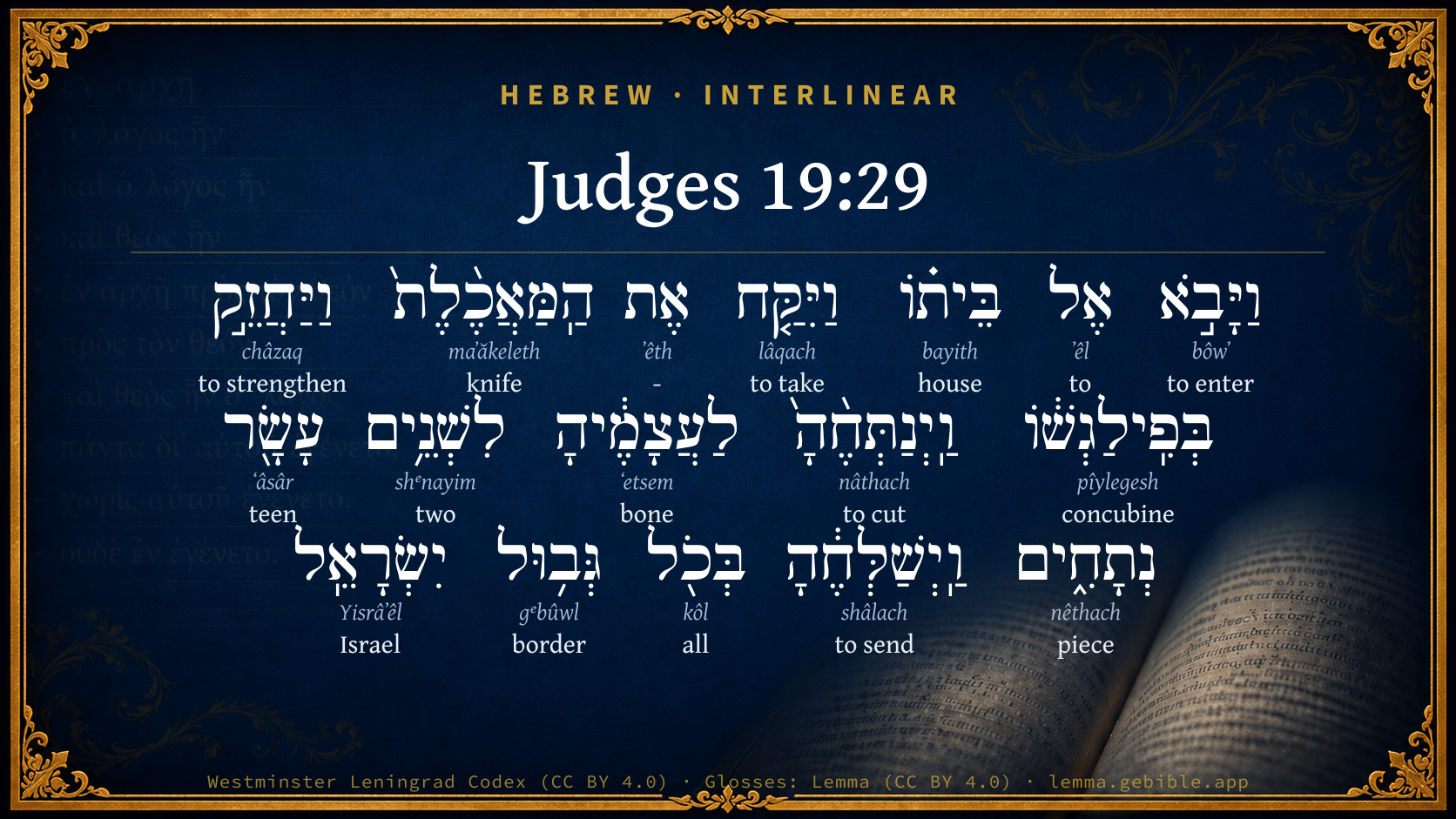
Judges 19:29

Hebrew (Westminster Leningrad Codex) Judges 19:29 appears in the Hebrew Old Testament. The text above is from the Westminster Leningrad Codex. Each word links to its Strong’s number, a concise gloss, and parsing drawn from the Open Scriptures Hebrew Bible morphology. Click any word for its full Brown-Driver-Briggs (BDB) entry.
Download image
Cite this verse

Judges 19:29 (World English Bible). Public Domain. Lemma interlinear Bible study tool, https://lemma.gebible.app/v/judges/19/29.

Show BibTeX & RIS
BibTeX
RIS
English Translation
When he was come into his house, he took a knife, and laid hold on his concubine, and divided her, limb by limb, into twelve pieces, and sent her throughout all the borders of Israel.
World English Bible · Public Domain
Download a study sheet

One document with this verse’s original text, its word-by-word gloss line, the meaning frame, cross-references with their text, attributed commentary, and full source and license credits — printable, and it pastes into notes with its structure intact.

This verse Autodidact and up

Study sheet (.html) Plain text (.txt)

A passage Seminary Student

Up to 50 verses in one chapter. A passage sheet keeps up to 6 commentary sources and 12 cross-references per verse, in the order this page ranks them, and says so on the sheet whenever that leaves anything out. Ask for a single verse and you get the Autodidact verse sheet above.

Everything on this page stays free to read, with no account — the sheet is a download of what is already on screen, not access to it.

Want to remove ads? Support Godless Engineer
Compare translations 3

The same verse in 3 English versions, stacked beneath the original-language interlinear above. Click any original word for its lexicon entry.

Each is an independent rendering of the whole verse — the interlinear is not word-aligned to these translations.

Highlighted words mark where these versions differ — a whole-verse word diff, not a word-by-word alignment.

  • World English Bible Public Domain
    When he was come into his house, he took a knife, and laid hold on his concubine, and divided her, limb by limb, into twelve pieces, and sent her throughout all the borders of Israel.
  • King James Version Public Domain
    And when he was come into his house, he took a knife, and laid hold on his concubine, and divided her, together with her bones, into twelve pieces, and sent her into all the coasts of Israel.
  • unfoldingWord Literal Text CC BY-SA 4.0
    And he came to his house, and he took a knife, and he seized his concubine, and he cut her to her bones, into 12 pieces, and he sent her into all of the border of Israel.

unfoldingWord Literal Text — © unfoldingWord, licensed CC BY-SA 4.0. Word-aligned USFM3 via Door43 (git.door43.org/unfoldingWord/en_ult).

Versions to compare (up to 4)

3 of 4 selected

Show all 18 translations

Every available English version of this verse, each an independent rendering of the whole verse.

  • World English Bible Public Domain
    When he was come into his house, he took a knife, and laid hold on his concubine, and divided her, limb by limb, into twelve pieces, and sent her throughout all the borders of Israel.
  • Berean Standard Bible Public Domain
    When he reached his house, he picked up a knife, took hold of his concubine, cut her limb by limb into twelve pieces, and sent her throughout the territory of Israel.
  • Majority Standard Bible Public Domain
    When he reached his house, he picked up a knife, took hold of his concubine, cut her limb by limb into twelve pieces, and sent her throughout the territory of Israel.
  • King James Version Public Domain
    And when he was come into his house, he took a knife, and laid hold on his concubine, and divided her, together with her bones, into twelve pieces, and sent her into all the coasts of Israel.
  • American Standard Version (1901) Public Domain
    And when he was come into his house, he took a knife, and laid hold on his concubine, and divided her, limb by limb, into twelve pieces, and sent her throughout all the borders of Israel.
  • Revised Version (1885) Public Domain
    And when he was come into his house, he took a knife, and laid hold on his concubine, and divided her, limb by limb, into twelve pieces, and sent her throughout all the borders of Israel.
  • Geneva Bible (1599) Public Domain
    And whe he was come to his house, he took a knife, and laid hand on his concubine, and deuided her in pieces with her bones into twelue parts, and sent her through all quarters of Israel.
  • Douay-Rheims (1899) Public Domain
    And when he was come home he took a sword, and divided the dead body of his wife with her bones into twelve parts, and sent the pieces into all the borders of Israel.
  • Young's Literal Translation Public Domain
    and cometh in unto his house, and taketh the knife, and layeth hold on his concubine, and cutteth her in pieces to her bones -- into twelve pieces, and sendeth her into all the border of Israel.
  • Literal Standard Version CC BY-SA 4.0
    and comes into his house, and takes the knife, and lays hold on his concubine, and cuts her in pieces to her bones—into twelve pieces, and sends her into all the border of Israel.
  • Unlocked Literal Bible CC BY-SA 4.0
    When the Levite came to his house, he took a knife, and he took hold of his concubine, and cut her up, limb by limb, into twelve pieces, and sent the pieces everywhere throughout Israel.
  • unfoldingWord Literal Text CC BY-SA 4.0
    And he came to his house, and he took a knife, and he seized his concubine, and he cut her to her bones, into 12 pieces, and he sent her into all of the border of Israel.
  • Darby Bible Public Domain
    And when he entered his house, he took a knife, and laying hold of his concubine he divided her, limb by limb, into twelve pieces, and sent her throughout all the territory of Israel.
  • World Messianic Bible Public Domain
    When he had come into his house, he took a knife and cut up his concubine, and divided her, limb by limb, into twelve pieces, and sent her throughout all the borders of Israel.
  • Webster's Bible Public Domain
    And when he was come into his house, he took a knife, and laid hold on his concubine, and divided her, with her bones, into twelve pieces, and sent her into all the borders of Israel.
  • Free Bible Version CC BY-SA 4.0
    When he got home he took a knife, and holding onto his concubine, cut her up, limb by limb, into twelve pieces, and sent these pieces of her to every part of Israel.
  • Bible in Basic English Public Domain
    And when he had come to his house, he got his knife, and took the woman, cutting her up bone by bone into twelve parts, which he sent through all Israel.
  • JPS Tanakh (1917) Public Domain
    And when he was come into his house, he took a knife, and laid hold on his concubine, and divided her, limb by limb, into twelve pieces, and sent her throughout all the borders of Israel.

Literal Standard Version (2020), Covenant Press — licensed CC BY-SA 4.0. Text via the HelloAO Bible API (eBible.org). Unlocked Literal Bible (unfoldingWord) — licensed CC BY-SA 4.0. Text via the HelloAO Bible API (eBible.org). unfoldingWord Literal Text — © unfoldingWord, licensed CC BY-SA 4.0. Word-aligned USFM3 via Door43 (git.door43.org/unfoldingWord/en_ult). Free Bible Version, Dr. Jonathan Gallagher — licensed CC BY-SA 4.0. Text via the HelloAO Bible API (eBible.org).

Word by word

More ways to search: Search by grammar → Find every occurrence → Compare this word →

Practice this passage: Drill this verse → Learn its vocabulary →

הַֽמַּאֲכֶ֨לֶת֙
maʼăkeleth
H3979
“the · knife”
Particle, Definite Article + Noun, Common, Feminine, Singular, Absolute
Part of Speech
Particle + Noun
Type
Common
Gender
Feminine
Number
Singular
State
Absolute
Full BDB Definition

Origin: from H398

TWOT: 85e

knife
  1. וַיָּבֹ֣א bôwʼ H935 “and · to enter” Conjunction + Verb, Qal, Sequential Imperfect, 3rd Person, Masculine, Singular
  2. אֶל ʼêl H413 “to” Preposition
  3. בֵּית֗וֹ bayith H1004 “house · his” Noun, Common, Masculine, Singular, Construct + Suffix, Personal, 3rd Person, Masculine, Singular
  4. וַיִּקַּ֤ח lâqach H3947 “and · to take” Conjunction + Verb, Qal, Sequential Imperfect, 3rd Person, Masculine, Singular
  5. אֶת ʼêth H853 “-” Particle, Direct Object
  6. וַיַּחֲזֵ֣ק châzaq H2388 “and · to strengthen” Conjunction + Verb, Hiphil, Sequential Imperfect, 3rd Person, Masculine, Singular
  7. בְּפִֽילַגְשׁ֔וֹ pîylegesh H6370 “in/at · concubine · his” Preposition + Noun, Common, Feminine, Singular, Construct + Suffix, Personal, 3rd Person, Masculine, Singular
  8. וַֽיְנַתְּחֶ֨הָ֙ nâthach H5408 “and · to cut · her” Conjunction + Verb, Piel, Sequential Imperfect, 3rd Person, Masculine, Singular + Suffix, Personal, 3rd Person, Feminine, Singular
  9. לַעֲצָמֶ֔יהָ ʻetsem H6106 “to/for · bones · her” Preposition + Noun, Common, Feminine, Plural, Construct + Suffix, Personal, 3rd Person, Feminine, Singular
  10. לִשְׁנֵ֥ים shᵉnayim H8147 “to/for · two” Preposition + Adjective, Cardinal number, Masculine, Dual, Absolute
  11. עָשָׂ֖ר ʻâsâr H6240 “teen” Adjective, Cardinal number, Masculine, Singular, Absolute
  12. נְתָחִ֑ים nêthach H5409 “pieces” Noun, Common, Masculine, Plural, Absolute
  13. וַֽיְשַׁלְּחֶ֔הָ shâlach H7971 “and · to send · her” Conjunction + Verb, Piel, Sequential Imperfect, 3rd Person, Masculine, Singular + Suffix, Personal, 3rd Person, Feminine, Singular
  14. בְּכֹ֖ל kôl H3605 “in/at · all of” Preposition + Noun, Common, Masculine, Singular, Construct
  15. גְּב֥וּל gᵉbûwl H1366 “border of” Noun, Common, Masculine, Singular, Construct
  16. יִשְׂרָאֵֽל Yisrâʼêl H3478 “Israel” Noun, Proper

About this verse

These counts appear in no published source. They are computed here, from the morphology-tagged text and Lemma’s own curated glosses. What Lemma adds →

17
words
17
distinct lemmas
Historical
section

Notable vocabulary

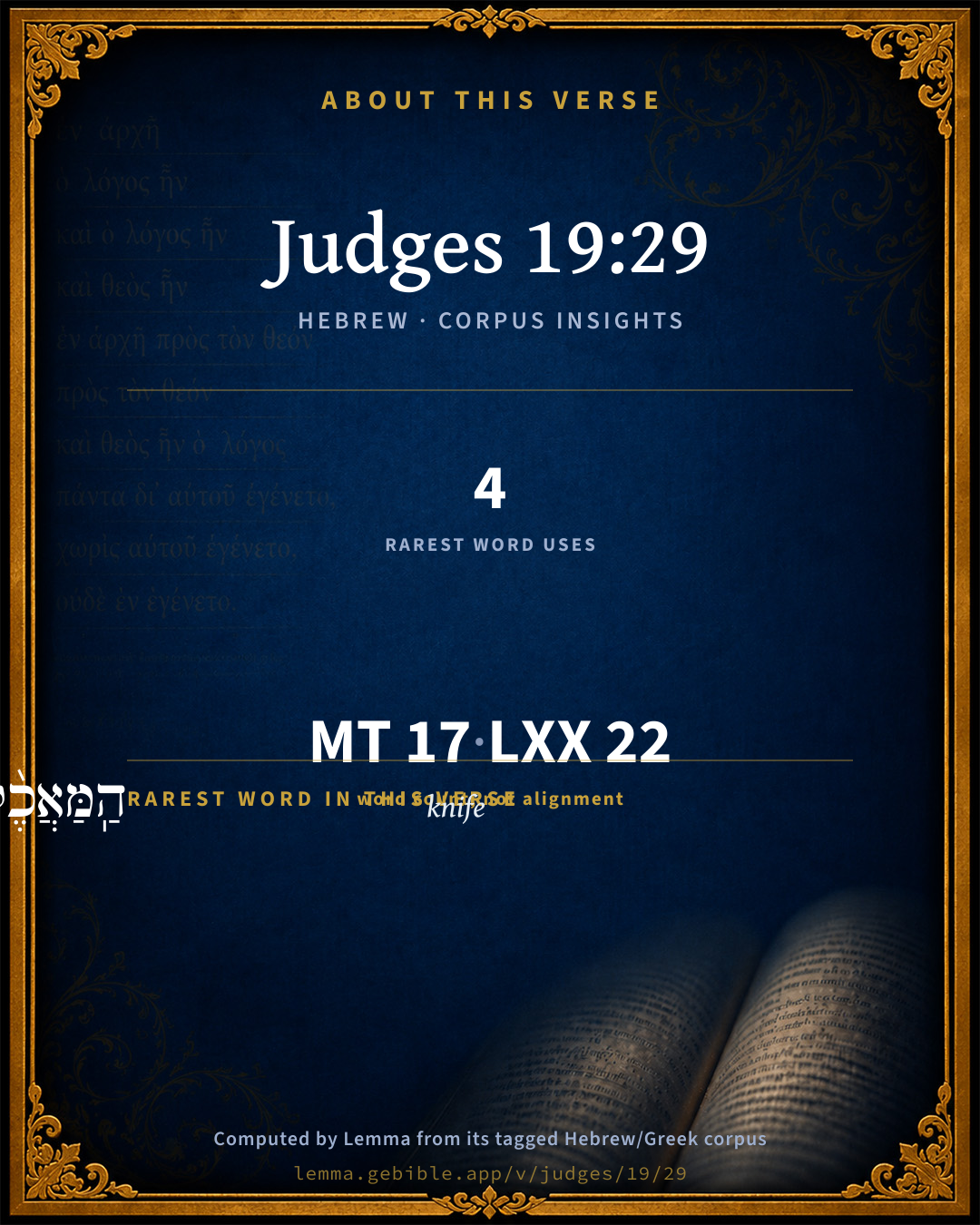
The rarest word here is הַֽמַּאֲכֶ֨לֶת֙ knife H3979 — appearing just 4 times in the whole Hebrew Bible.

Shared distinctive vocabulary

הַֽמַּאֲכֶ֨לֶת֙ knife H3979 occurs in 4 verses of the Hebrew Bible. Also found in:

Grammatical profile

  • 5 verbs
  • 8 nouns
  • 2 adjectives
  • 1 preposition
  • 1 particle

Verb forms

  • וַיָּבֹ֣א Qal · Sequential Imperfect
  • וַיִּקַּ֤ח Qal · Sequential Imperfect
  • וַיַּחֲזֵ֣ק Hiphil · Sequential Imperfect
  • וַֽיְנַתְּחֶ֨הָ֙ Piel · Sequential Imperfect
  • וַֽיְשַׁלְּחֶ֔הָ Piel · Sequential Imperfect

Hebrew & Septuagint length

In English translation the verse runs 35 words from the Hebrew and 25 from the Septuagint (LXX English) — the Septuagint runs noticeably shorter here. See the side-by-side →

A rough comparison of the two English renderings, which tokenize alike — not a word-level alignment.

Word counts can differ between the Hebrew and the Greek without any difference in meaning — e.g. the Hebrew direct-object marker אֵת has no separate Greek word, and Greek often adds the article ὁ.

In the original languages it is 17 Hebrew tokens and 22 Greek tokens — but the two are counted differently (Hebrew bundles its prefixes and suffixes into one token; the Greek is in lemma form), so that isn’t a like-for-like length.

Cross-references

4

Topical passages linked to Judges 19:29 in the Treasury of Scripture Knowledge — connected by theme and wording, ordered by reader-vote popularity; previews shown in the World English Bible.

  • Judges 20:6–7 I took my concubine, and cut her in pieces, and sent her throughout all the country of the inheritance of Israel; for they have committed lewdness and folly in Israel.
  • 1 Samuel 11:7 He took a yoke of oxen, and cut them in pieces, and sent them throughout all the borders of Israel by the hand of messengers, saying, Whoever doesn't come forth after Saul and after Samuel, so shall it be done to his oxen. The dread of Yahweh fell on the people, and they came out as one man.
  • Deuteronomy 21:22–23 If a man have committed a sin worthy of death, and he be put to death, and you hang him on a tree;
  • Romans 10:2 For I testify about them that they have a zeal for God, but not according to knowledge.

Cross-references courtesy of OpenBible.info (CC BY 4.0).

Hebrew and Greek witnesses Masoretic Hebrew ↔ Greek Septuagint

The same verse in the two great witnesses to the Old Testament, shown verse-for-verse.

Here the Septuagint runs noticeably shorter than the Hebrew — LXX2012 (modern English Septuagint) 25 words vs World English Bible 35. A rough length comparison of the two English translations, not a word-level alignment — read both below.

These are two independent witnesses, not word-aligned to each other, and the Septuagint is shown in lemma (dictionary) form.

Hebrew Judges 19:29 Masoretic · Westminster Leningrad Codex

וַיָּבֹ֣א אֶל בֵּית֗וֹ וַיִּקַּ֤ח אֶת הַֽמַּאֲכֶ֨לֶת֙ וַיַּחֲזֵ֣ק בְּפִֽילַגְשׁ֔וֹ וַֽיְנַתְּחֶ֨הָ֙ לַעֲצָמֶ֔יהָ לִשְׁנֵ֥ים עָשָׂ֖ר נְתָחִ֑ים וַֽיְשַׁלְּחֶ֔הָ בְּכֹ֖ל גְּב֥וּל יִשְׂרָאֵֽל

When he was come into his house, he took a knife, and laid hold on his concubine, and divided her, limb by limb, into twelve pieces, and sent her throughout all the borders of Israel.

World English Bible · Public Domain

Greek LXX Judges 19:29 Septuagint · lemma form

καί λαμβάνω ὁ ῥομφαία καί κρατέω ὁ παλλακή αὐτός καί μελίζω αὐτός εἰς δώδεκα μέλος καί ἀποστέλλω αὐτός ἐν πᾶς ὅριον ἰσραήλ

And he took his sword, and laid hold of his concubine, and divided her into twelve parts, and sent them to every coast of Israel.

LXX2012 (modern English Septuagint) · Public Domain

On this verse, The Cambridge Bible for Schools and Colleges discusses the Septuagint’s reading. Read the note in Commentary ↓

Hebrew: Westminster Leningrad Codex (CC BY 4.0). Greek: Septuagint (public domain); English from LXX2012 (modern English Septuagint) (Public Domain). How the Septuagint differs from the Hebrew →

Targum (Aramaic paraphrase)

1

The Targum is the ancient Jewish Aramaic paraphrase of the Hebrew Scriptures — an interpretive translation, not the Hebrew text itself. Onkelos (literal) and Pseudo-Jonathan (expansive) render the Torah, and Jonathan the Prophets. Coverage is partial: where no permissively-licensed English translation exists for a verse, only the Aramaic is shown. This is verse-level text, not a word-by-word alignment to the Hebrew.

  1. Targum Jonathan Prophets (Joshua–Malachi)
    וַאֲתָא לְבֵיתֵיהּ וּנְסִיב יַת סַכִּינָא וְאַתְקֵיף בִּלְחֵינָתֵיהּ וְהַדְמָה לְאֵיבְרָהָא לִתְרֵי עֲשַׂר אֵיבָרִין וְשַׁלְחָהּ בְּכָל תְּחוּם אֲרַע דְיִשְׂרָאֵל:

    (no public-domain English translation for this verse)

    Targum Jonathan — Aramaic: “Mikraot Gedolot” (public domain). English: “Sefaria Community Translation” (CC0 1.0 (public-domain dedication)); “London "Chaldee Paraphrase," 1871” (public domain). Text via Sefaria.

Commentary

Notes on Judges 19:29 from classic Christian and Jewish commentators (each source and its license shown beneath its notes). The classic Christian expositions comment on the surrounding passage and are grouped to its opening verse, so a note may address several verses; the Jewish commentaries on the Tanakh (Rashi and others) are per-verse, so they appear only where the commentator wrote on this verse.

Lemma curates 59 commentaries, every one of them public domain or Creative Commons licensed, each selected and text-cleaned for this edition rather than reprinted as found. About our sources →

Trapp's Complete Commentary

John Trapp

Jdg 19:29 And when he was come into his house, he took a knife, and laid hold on his concubine, and divided her, [together] with her bones, into twelve pieces, and sent her into all the coasts of Israel.

Ver. 29. Laid hold on his concubine, and divided her.] Hoc Levitae factum singulare est, et illegitimum, saith Junius; this deed of the Levite was singular and unlawful, as being against the public and common rights of humanity and honesty, in a husband especially. Others think the Levite did well herein, being moved with a zeal for God’s glory, and for the promoting of justice, that such a horrible villany might be punished, and God’s heavy judgments prevented.

And sent her into all the coasts of Israel.] Into Benjamin also. See a like practice of Saul in 1Sa 11:7

John Trapp, A Commentary or Exposition upon All the Books of the Old and New Testament (1647–1656) — public domain. Text from a community e-Sword module.

Joseph Benson's Commentary

Jdg 19:29. He took a knife, &c. — As the Levite expected no justice from the elders of Gibeah, and there was no supreme head over all the tribes at that time, he had recourse to the elders of each respective tribe; and to move them the more, and stir them up to punish the offender, he sent a part of the body to each of them, preserved undoubtedly by some means from putrefaction. And, undoubtedly, he instructed those he sent with it to relate particularly the circumstances of the unparalleled and barbarous fact.

Joseph Benson's Commentary on the Old and New Testaments (1811–1818) — public domain. Text from a community e-Sword module.

Jamieson, Fausset & Brown

Robert Jamieson, A. R. Fausset & David Brown

divided her . . . into twelve pieces--The want of a regular government warranted an extraordinary step; and certainly no method could have been imagined more certain of rousing universal horror and indignation than this terrible summons of the Levite.

Next: Judges Chapter 20

Jamieson, Fausset & Brown — Commentary Critical and Explanatory on the Whole Bible (1871) — public domain (CC PDM 1.0). Text via the HelloAO Bible API.

Adam Clarke's Commentary

Verse 29. Divided her - into twelve pieces] There is no doubt that with the pieces he sent to each tribe a circumstantial account of the barbarity of the men of Gibeah; and it is very likely that they considered each of the pieces as expressing an execration, "If ye will not come and avenge my wrongs, may ye be hewn in pieces like this abused and murdered woman!"

It was a custom among the ancient Highlanders in Scotland, when one clan wished to call all the rest to avenge its wrongs, to take a wooden cross, dip it in blood, and send it by a special messenger through all the clans. This was called the fire cross, because at sight of it each clan lighted a fire or beacon, which gave notice to all the adjoining clans that a general rising was immediately to take place.

Adam Clarke's Commentary on the Bible (1810–1826) — public domain. Text from a community e-Sword/MySword module.

Ellicott's Commentary for English Readers

(29) Divided her.—We see again that the narrative is taking us back to wild times, when the passions of men expressed themselves in wild and fierce expedients. A similar method of arousing a nation, but different in its details, is narrated in 1Sa_11:7, when Saul sends round the pieces of an ox, as was done by the ancient Scythians (Lucian, Toxaris, chap. 48). Many analogous customs existed among the ancient Highlanders, and have been repeated even in recent days among the Arab tribes (Stanley, i. 301).

With her bones.—Literally, according to her bone.

Into twelve pieces.—One for each tribe. Benjamin was probably thus appealed to as well as the other tribes. It is needless to suppose that one was sent to Eastern Manasseh or to Levi.

A Bible Commentary for English Readers, edited by Charles John Ellicott (1878–1897) — public domain. Text from a community e-Sword module.

The Cambridge Bible for Schools and Colleges

gen. ed. J. J. S. Perowne

29. and divided her … and sent her throughout all the borders of Israel] The same words in 1Sa_11:7, possibly implying that the present description has been copied from the other. But the two accounts differ in meaning: Saul’s summons was intended to convey a threat, the Levite’s to call forth horror. Divided is the regular term for cutting up a sacrificial victim, Exo_29:17, Lev_1:6; Lev_1:12, 1Ki_18:23; 1Ki_18:33.

twelve pieces] Not necessarily referring to the number of the tribes (LXX. cod A); the twelve-fold division of Israel belongs to the later historical theory which finds expression in chs. 20, 21.

The Cambridge Bible for Schools and Colleges (gen. ed. J. J. S. Perowne; Cambridge University Press, 1878–1918) — public domain. Text from a community e-Sword module.

John Gill's Exposition

And when he was come into his house,.... Having taken the dead body of his wife from off the ass, and brought it in thither, and laid it in a proper place and order:

he took a knife; a carving knife, such as food is cut with, as the word signifies; the Targum is, a sword:

and laid hold on his concubine, and divided her, together with her bones, into twelve pieces; cut off her limbs at the joints of her bones, and made twelve pieces of them, according to the number of the tribes of Israel:

and sent her into all the coasts of Israel; that is, to every tribe, as Josephus says (y): there was now no supreme magistrate to apply unto for justice, nor the court of seventy elders, and therefore he took this strange and unheard of method to acquaint each of the tribes with the fact committed; this he did not out of disrespect to his wife, but to express the vehement passion he was in on account of her death, in the way it was, and to raise their indignation at the perpetrators of it. Ben Gersom thinks he did not send to the tribe of Benjamin, where the evil was done; but Abarbinel is of another mind, and as Levi was not a tribe that lay together in one part of the land, but was scattered in it, pieces might be sent to the two half tribes of Manasseh, as the one lay on the one side Jordan, and the other on the other, and so there were twelve for the twelve pieces to be sent unto. So Ptolemy king of Egypt killed his eldest son, and divided his members, and put them in a box, and sent them to his mother on his birthday (z). Chytraeus (a) writes, that about A. C. 140, a citizen of Vicentia, his daughter being ravished by the governor Carrarius, and cut to pieces, who had refused to send her to him, being sent back again, he put up the carcass in a vessel, and sent it to the senate of Venice, and invited them to punish the governor, and seize upon the city.

(y) Ut supra. (Antiqu. l. 5. c. 2. sect. 8.) (z) Justia. e Trogo, l. 38. c. 8. (a) Apud Quistorp. in loc.

John Gill's Exposition of the Whole Bible (1746–1763) — public domain (CC PDM 1.0). Text via the HelloAO Bible API.

Albert Barnes' Notes on the Bible

A knife - Rather, “the” “knife”. The single household implement used, not like our knives at our meals, but for slaughtering and cutting up the animals into joints for eating Gen 22:6, Gen 22:10; Pro 30:14.

Together with her bones ... - Rather, “into her bones”, or “bone by bone, into twelve pieces”. The “pieces” are synonymous with the “bones” (compare Eze 24:4-5). There is something truly terrible in the stern ferocity of grief and indignation which dictated this desperate effort to arouse his countrymen to avenge his wrong. Compare 1Sa 11:7.

Albert Barnes' Notes on the Bible (1834–1885) — public domain. Text from a community e-Sword/MySword module.

Haydock's Catholic Bible Commentary

Israel. One part, like an epistle, written with blood, to every tribe. (Salien) --- Some, without reason, think that Benjamin was neglected: but they were to be summoned, to bring their guilty brethren (Calmet) to condign punishment, or to share in their fate, as accomplices of the crime. (Haydock) --- The state of the republic authorized the Levite to take this extraordinary method of rousing all to a sense of horror for what had been done. (Calmet) --- His brethren, dispersed through the country, would no doubt take part in his grief.

George Leo Haydock (1774–1849), Haydock's Catholic Family Bible and Commentary, 1859 edition — public domain. Excludes Psalms (Douay-Rheims chapter numbering differs from Protestant) and Deuterocanonical books (Catholic canon only).

Matthew Poole's English Annotations

Together with her bones, or, according to her bones, according to the joints of her body, for there he made a division. This might seem to be a barbarous and inhuman act in itself; but may seem excusable, if it be considered that the sadness of the spectacle did highly contribute to stir up the zeal of all the Israelites to avenge his concubine’s death, and to execute justice upon such profligate offenders; and was necessary, especially in this time of anarchy and general corruption, Jdg 17:6, to awaken them out of that lethargy in which all the tribes lay.

Into twelve pieces; that one piece might be sent to every tribe; whereof none to Levi because they would meet with it in every tribe, being dispersed among them; but one to Benjamin; for he might well presume, that they would as much abhor so villainous an action, though done by some of their own tribe, as any of the rest.

Sent her into all the coasts of Israel, by several messengers, by whom also he sent a particular relation of the fact.

Matthew Poole's English Annotations on the Holy Bible (1683–1685) — public domain. Text from a community e-Sword/MySword module.

Whedon's Commentary on the Bible

Daniel D. Whedon

29. Together with her bones — Rather, According to her bones, that is, severing her limbs, as he would those of an animal, according to the joints of the bones.

Twelve pieces — One for each tribe in Israel. Compare Saul’s similar act in 1Sa_11:7.

Sent her into all the coasts — The messengers who bore these pieces doubtless told the shocking story in all the coasts through which they passed.

Daniel D. Whedon (gen. ed.), Commentary on the Old and New Testaments (1874–1909) — public domain. Text from a community e-Sword module.

The Pulpit Commentary

Compare 1Sa_11:8.

The Pulpit Commentary (1880–1919), ed. H.D.M. Spence-Jones & Joseph S. Exell — public domain. Text from a community e-Sword module.

John Wesley's Explanatory Notes

Sent - By several messengers, with a relation of the fact.

John Wesley, Explanatory Notes Upon the Whole Bible (1754–1765) — public domain. Text via the GEBible commentary corpus.

unfoldingWord translationNotes

Door43 World Missions Community

limb by limb

"section by section." The author uses this graphic description of how the Levite cut up her body into specific pieces to emphasize what he did. "Limbs" refers to a person's arms and legs. If there is not a similar phrase in your language, this description may be left out of the translation. (See: Idiom)

twelve pieces

"12 pieces" (See: Numbers)

sent the pieces everywhere throughout Israel

This means that he sent sent the different pieces to twelve different areas of Israel. AT: "sent each piece to a different place throughout Israel" (See: Assumed Knowledge and Implicit Information)

translationWords

Levi

concubine

Israel

people group

Egypt

advice

unfoldingWord translationNotes — © Distant Shores Media and the Door43 World Missions Community, licensed CC BY-SA 4.0. Source: git.door43.org/Door43/en_tn.

Lesson kit

Teaching starters — assembled from the data on this page, not authored interpretation. Every prompt links to the verse data it draws on. Edit before teaching.

Judges, in the Historical, opens this verse with 17 words (17 distinct Hebrew lemmas). Its most distinctive word is maʼăkeleth (“knife”). The Greek Septuagint runs shorter here. A historical commentator’s framing appears above. Read the whole chapter for the surrounding context.

Discussion questions

  1. How does “knife” (maʼăkeleth) shape what this verse is saying?
  2. How does Genesis 22:6, which shares the word «knife», read alongside this verse?
  3. The Septuagint runs shorter here than the Hebrew. What might account for the difference?
  4. These translations render this verse differently; the difference is in the English rendering, not the original. What questions does that raise?
  5. «וַיָּבֹ֣א» is a Qal Sequential Imperfect verb. How does that grammatical form shape the action described?
  6. Compare how Trapp's Complete Commentary and Joseph Benson's Commentary read this verse. Where do they agree or differ?

Things to notice

Reading settings

Reading text

Shown beneath each verse's original-language words.

Old Testament
Old Testament edition

Read the OT as the Masoretic Hebrew (MT) or the Greek Septuagint (LXX).

English shown for the Greek Septuagint (in the Hebrew ↔ Greek comparison).

Comparing translations? Open the Compare panel on any verse page to stack up to four side by side.