

Job 8:20

Hebrew (Westminster Leningrad Codex) Job 8:20 appears in the Hebrew Old Testament. The text above is from the Westminster Leningrad Codex. Each word links to its Strong’s number, a concise gloss, and parsing drawn from the Open Scriptures Hebrew Bible morphology. Click any word for its full Brown-Driver-Briggs (BDB) entry.
Download image
Cite this verse

Job 8:20 (World English Bible). Public Domain. Lemma interlinear Bible study tool, https://lemma.gebible.app/v/job/8/20.

Show BibTeX & RIS
BibTeX
RIS
English Translation
"Behold, God will not cast away a blameless man, Neither will he uphold the evil-doers.
World English Bible · Public Domain
Download a study sheet

One document with this verse’s original text, its word-by-word gloss line, the meaning frame, cross-references with their text, attributed commentary, and full source and license credits — printable, and it pastes into notes with its structure intact.

This verse Autodidact and up

Study sheet (.html) Plain text (.txt)

A passage Seminary Student

Up to 50 verses in one chapter. A passage sheet keeps up to 6 commentary sources and 12 cross-references per verse, in the order this page ranks them, and says so on the sheet whenever that leaves anything out. Ask for a single verse and you get the Autodidact verse sheet above.

Everything on this page stays free to read, with no account — the sheet is a download of what is already on screen, not access to it.

Want to remove ads? Support Godless Engineer
Compare translations 3

The same verse in 3 English versions, stacked beneath the original-language interlinear above. Click any original word for its lexicon entry.

Each is an independent rendering of the whole verse — the interlinear is not word-aligned to these translations.

Highlighted words mark where these versions differ — a whole-verse word diff, not a word-by-word alignment.

  • World English Bible Public Domain
    "Behold, God will not cast away a blameless man, Neither will he uphold the evil-doers.
  • King James Version Public Domain
    Behold, God will not cast away a perfect man, neither will he help the evil doers:
  • unfoldingWord Literal Text CC BY-SA 4.0
    Behold, God will not reject the innocent, but he will not hold the hand of evildoers.

unfoldingWord Literal Text — © unfoldingWord, licensed CC BY-SA 4.0. Word-aligned USFM3 via Door43 (git.door43.org/unfoldingWord/en_ult).

Versions to compare (up to 4)

3 of 4 selected

Show all 18 translations

Every available English version of this verse, each an independent rendering of the whole verse.

  • World English Bible Public Domain
    "Behold, God will not cast away a blameless man, Neither will he uphold the evil-doers.
  • Berean Standard Bible Public Domain
    Behold, God does not reject the blameless, nor will He strengthen the hand of evildoers.
  • Majority Standard Bible Public Domain
    Behold, God does not reject the blameless, nor will He strengthen the hand of evildoers.
  • King James Version Public Domain
    Behold, God will not cast away a perfect man, neither will he help the evil doers:
  • American Standard Version (1901) Public Domain
    Behold, God will not cast away a perfect man, Neither will he uphold the evil-doers.
  • Revised Version (1885) Public Domain
    Behold, God will not cast away a perfect man, neither will he uphold the evil-doers.
  • Geneva Bible (1599) Public Domain
    Behold, God will not cast away an vpright man, neither will he take the wicked by the hand,
  • Douay-Rheims (1899) Public Domain
    God will not cast away the simple, nor reach out his hand to the evildoer:
  • Young's Literal Translation Public Domain
    Lo, God doth not reject the perfect, Nor taketh hold on the hand of evil doers.
  • Literal Standard Version CC BY-SA 4.0
    Behold, God does not reject the perfect, || Nor takes hold on the hand of evildoers.
  • Unlocked Literal Bible CC BY-SA 4.0
    See, God will not cast away an innocent man; neither will he take the hand of evildoers.
  • unfoldingWord Literal Text CC BY-SA 4.0
    Behold, God will not reject the innocent, but he will not hold the hand of evildoers.
  • Darby Bible Public Domain
    Behold, ùGod will not cast off a perfect man, neither will he take evil-doers by the hand.
  • World Messianic Bible Public Domain
    “Behold, God will not cast away a blameless man, neither will he uphold the evildoers.
  • Webster's Bible Public Domain
    Behold, God will not cast away a perfect man, neither will he help the evil doers:
  • Free Bible Version CC BY-SA 4.0
    Look, God doesn't reject someone who is innocent, and he doesn't support those who are guilty.
  • Bible in Basic English Public Domain
    Truly, God will not give up him who is without sin, and will not take evil-doers by the hand.
  • JPS Tanakh (1917) Public Domain
    Behold, God will not cast away an innocent man, neither will He uphold the evil-doers;

Literal Standard Version (2020), Covenant Press — licensed CC BY-SA 4.0. Text via the HelloAO Bible API (eBible.org). Unlocked Literal Bible (unfoldingWord) — licensed CC BY-SA 4.0. Text via the HelloAO Bible API (eBible.org). unfoldingWord Literal Text — © unfoldingWord, licensed CC BY-SA 4.0. Word-aligned USFM3 via Door43 (git.door43.org/unfoldingWord/en_ult). Free Bible Version, Dr. Jonathan Gallagher — licensed CC BY-SA 4.0. Text via the HelloAO Bible API (eBible.org).

Word by word

More ways to search: Search by grammar → Find every occurrence → Compare this word →

Practice this passage: Drill this verse → Learn its vocabulary →

About this verse

These counts appear in no published source. They are computed here, from the morphology-tagged text and Lemma’s own curated glosses. What Lemma adds →

9
words
8
distinct lemmas
Wisdom
section

Notable vocabulary

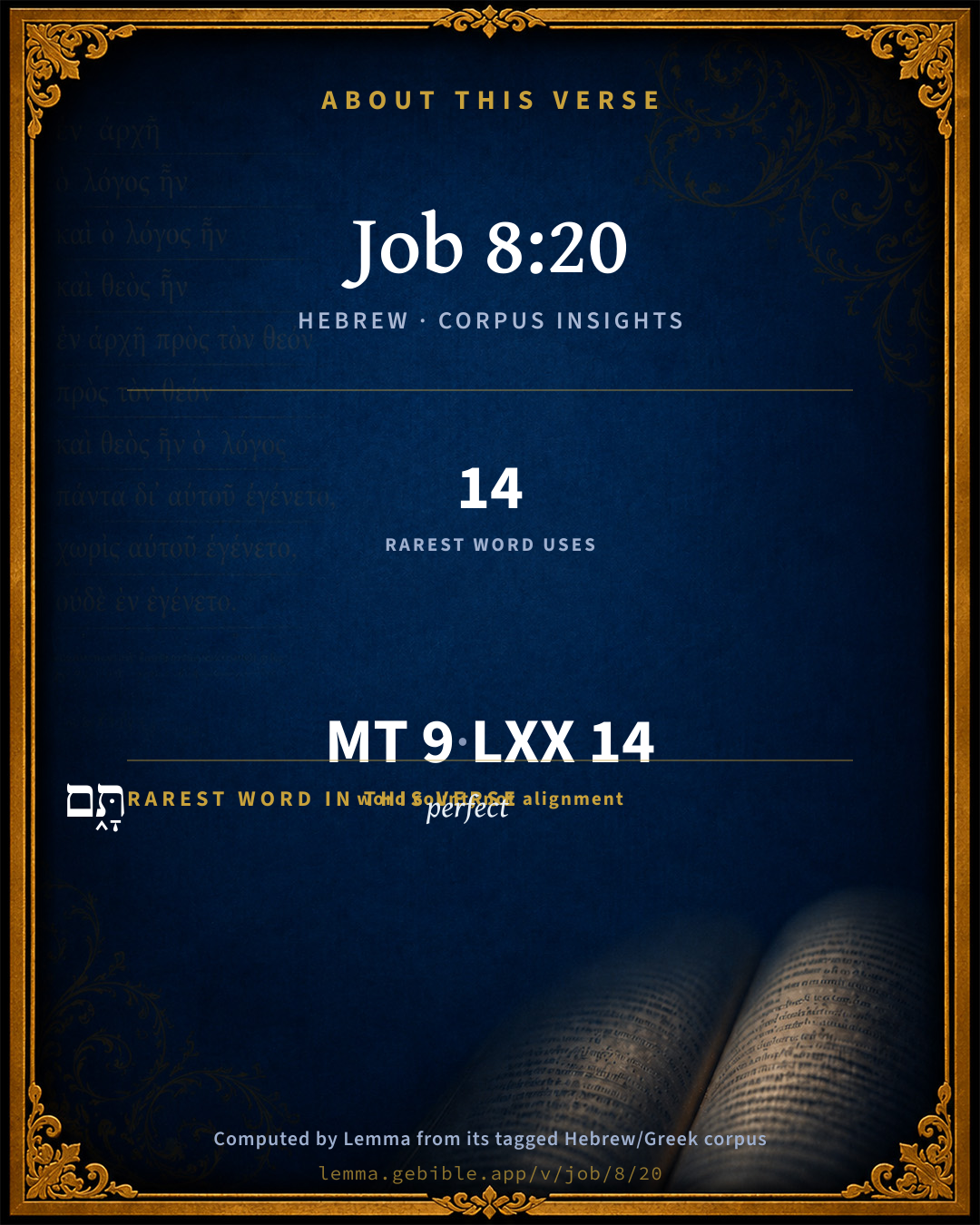
The rarest word here is תָּ֑ם perfect H8535 — appearing just 14 times in the whole Hebrew Bible.

Shared distinctive vocabulary

תָּ֑ם perfect H8535 occurs in 14 verses of the Hebrew Bible. Also found in:

Grammatical profile

  • 3 verbs
  • 2 nouns
  • 1 adjective
  • 3 particles

Verb forms

  • יִמְאַס Qal · Imperfect
  • יַ֝חֲזִ֗יק Hiphil · Imperfect
  • מְרֵעִֽים Hiphil · Participle Active

Repetition

A word recurs within this verse — often emphatic in Hebrew:

Hebrew & Septuagint length

In English translation the verse runs 15 words from the Hebrew and 21 from the Septuagint (LXX English) — the Septuagint runs noticeably longer here. See the side-by-side →

A rough comparison of the two English renderings, which tokenize alike — not a word-level alignment.

Word counts can differ between the Hebrew and the Greek without any difference in meaning — e.g. the Hebrew direct-object marker אֵת has no separate Greek word, and Greek often adds the article ὁ.

In the original languages it is 9 Hebrew tokens and 14 Greek tokens — but the two are counted differently (Hebrew bundles its prefixes and suffixes into one token; the Greek is in lemma form), so that isn’t a like-for-like length.

Cross-references

7

Topical passages linked to Job 8:20 in the Treasury of Scripture Knowledge — connected by theme and wording, ordered by reader-vote popularity; previews shown in the World English Bible.

  • Job 4:7 "Remember, now, whoever perished, being innocent? Or where were the upright cut off?
  • Psalms 37:37 Mark the perfect man, and see the upright, For there is a future for the man of peace.
  • Psalms 37:24 Though he stumble, he shall not fall, For Yahweh holds him up with his hand.
  • Isaiah 45:1 Thus says Yahweh to his anointed, to Cyrus, whose right hand I have held, to subdue nations before him, and I will loose the loins of kings; to open the doors before him, and the gates shall not be shut:
  • Psalms 94:14 For Yahweh won't reject his people, Neither will he forsake his inheritance.
  • Job 21:30 That the evil man is reserved to the day of calamity? That they are led forth to the day of wrath?
  • Job 9:22 "It is all the same. Therefore I say, He destroys the blameless and the wicked.

Cross-references courtesy of OpenBible.info (CC BY 4.0).

Hebrew and Greek witnesses Masoretic Hebrew ↔ Greek Septuagint

The same verse in the two great witnesses to the Old Testament, shown verse-for-verse.

Here the Septuagint runs noticeably longer than the Hebrew — LXX2012 (modern English Septuagint) 21 words vs World English Bible 15. A rough length comparison of the two English translations, not a word-level alignment — read both below.

These are two independent witnesses, not word-aligned to each other, and the Septuagint is shown in lemma (dictionary) form.

Hebrew Job 8:20 Masoretic · Westminster Leningrad Codex

הֶן אֵ֭ל לֹ֣א יִמְאַס תָּ֑ם וְלֹֽא יַ֝חֲזִ֗יק בְּיַד מְרֵעִֽים

"Behold, God will not cast away a blameless man, Neither will he uphold the evil-doers.

World English Bible · Public Domain

Greek LXX Job 8:20 Septuagint · lemma form

ὁ γάρ κύριος οὐ μή ἀποποιέω ὁ ἄκακος πᾶς δέ δῶρον ἀσεβής οὐ δέχομαι

For the Lord will by no means reject the harmless man; but he will not receive any gift of the ungodly.

LXX2012 (modern English Septuagint) · Public Domain

On this verse, Trapp's Complete Commentary discusses the Septuagint’s reading. Read the note in Commentary ↓

Hebrew: Westminster Leningrad Codex (CC BY 4.0). Greek: Septuagint (public domain); English from LXX2012 (modern English Septuagint) (Public Domain). How the Septuagint differs from the Hebrew →

Commentary

Notes on Job 8:20 from classic Christian and Jewish commentators (each source and its license shown beneath its notes). The classic Christian expositions comment on the surrounding passage and are grouped to its opening verse, so a note may address several verses; the Jewish commentaries on the Tanakh (Rashi and others) are per-verse, so they appear only where the commentator wrote on this verse.

Lemma curates 59 commentaries, every one of them public domain or Creative Commons licensed, each selected and text-cleaned for this edition rather than reprinted as found. About our sources →

Matthew Henry's Commentary

Bildad here, in the close of his discourse, sums up what he has to say in a few words, setting before Job life and death, the blessing and the curse, assuring him that as he was so he should fare, and therefore they might conclude that as he fared so he was. 1. On the one hand, if he were a perfect upright man, God would not cast him away, Job 8:20. Though now he seemed forsaken of God, he would yet return to him, and by degrees would turn his mourning into dancing (Psa 30:11) and comforts should flow in upon him so plentifully that his mouth should be filled with laughing, Job 8:21. So affecting should the happy change be, Psa 126:2. Those that loved him would rejoice with him; but those that hated him, and had triumphed in his fall, would be ashamed of their insolence, when they should see him restored to his former prosperity. Now it is true that God will not cast away an upright man; he may be cast down for a time, but he shall not be cast away for ever. It is true that, if not in this world, yet in another, the mouth of the righteous shall be filled with rejoicing. Though their sun should set under a cloud, yet it shall rise again clear, never more to be clouded; though they go mourning to the grave, that shall not hinder their entrance into the joy of their Lord. It is true that the enemies of the saints will be clothed with shame when they see them crowned with honour. But it does not therefore follow that, if Job were not perfectly restore to his former prosperity, he would forfeit the character of a perfect man. 2. On the other hand, if he were a wicked man and an evil-doer, God would not help him, but leave him to perish in his present distresses (Job 8:20), and his dwelling-place should come to nought, (Job 8:22). And here also it is true that God will not help the evil-doers; they throw themselves out of his protection, and forfeit his favour. He will not take the ungodly by the hand (so it is in the margin), will not have fellowship and communion with them; for what communion can there be between light and darkness? He will not lend them his hand to pull them out of the miseries, the eternal miseries, into which they have plunged themselves; they will then stretch out their hand to him for help, but it will be too late: he will not take them by the hand. Between us and you there is a great gulf fixed. It is true that the dwelling-place of the wicked, sooner or later, will come to nought. Those only who make God their dwelling-place are safe for ever, Psa 90:1; Psa 91:1. Those who make other things their refuge will be disappointed. Sin brings ruin on persons and families. Yet to argue (as Bildad, I doubt, slyly does) that because Job's family was sunk, and he himself at present seemed helpless, therefore he certainly was an ungodly wicked man, was neither just nor charitable, as long as there appeared no other evidence of his wickedness and ungodliness. Let us judge nothing before the time, but wait till the secrets of all hearts shall be made manifest, and the present difficulties of Providence be solved to universal and everlasting satisfaction, when the mystery of God shall be finished.

Matthew Henry's Commentary on the Whole Bible (1708–1710) — public domain (CC PDM 1.0). Text via the HelloAO Bible API.

Trapp's Complete Commentary

John Trapp

Job 8:20 Behold, God will not cast away a perfect [man], neither will he help the evil doers:

Ver. 20. Behold, God will not cast away a perfect man] Epilogus sermonis Bildad. This is the epilogue or close of Bildad’s speech to Job; and it hath been the tartness of a threatening mixed with the sweetness of the promise: sour and sweet, we say, make the best sauce (Mercer). The strong God will not use, or rather abuse, his power, to the rejecting or reprobating (as the Septuagint render it) of an upright person; but will help him by taking him by the hand, as it followeth in the next clause, and taking it ill if others do not so too, Isa 51:18. He will never leave them (or if sometimes he seem to leave them, yet), he will not forsake them, Heb 13:5 : forsake them he may in regard of vision, but not of union; desert them for a time (as he did Christ himself), but not disinherit them. "When they be in the land of their enemies" (and so may seem quite cast away) "I will not cast them away, neither will I abhor them to destroy them utterly, and to break my covenant with them, for I am the Lord their God," Lev 26:44. Lo, this is the portion of a perfect man. As for hypocrites (who are semiperfectae virtutis homines, as Philo calleth them; cakes half-baked, Hos 7:8; Christians almost, but not altogether, Act 26:29), my God will cast them away, because they did not hearken unto him, Hos 9:15.

Neither will he help the evildoers] Heb. He will not lay hold upon the hand, viz. to help them; or he will not take by the hand the evil doers that make a trade of sin: Non porriget manum malignis (Vulg.).; he will have no communion or commerce with such, he will not strike hands or join hands with them, but wash his hands of them for ever, shake them off with a Discedite, Depart ye, be packing: so should we. See David’s practice, Psa 26:4-5, and prayer, Job 8:9, "Gather not my soul with sinners," &c. It was once the prayer of a good gentlewoman, when she was to die, being in much trouble of conscience, O Lord, let me not go to hell, where the wicked are; for, Lord, thou knowest I never loved their company here.

John Trapp, A Commentary or Exposition upon All the Books of the Old and New Testament (1647–1656) — public domain. Text from a community e-Sword module.

The Biblical Illustrator

Joseph S. Exell

Job_8:20-22

Behold, God will not cast away a perfect man.

Moral character determines a mans destiny

I. The real condition of the good. By the real condition we mean the relation of the soul, not to the circumstantials and temporalities of existence.

1. It is a condition in which they will never be deserted of the eternal. God will not cast away a perfect man. Whatever may be the alternations in the life of the good, whoever may shun and reject them, the Great One will never forsake them. All men, said Paul, forsook me; notwithstanding, the Lord stood by me.

2. It is a condition in which God will inspire them with happiness. Till He fill thy mouth with laughing, and thy lips with rejoicing. He not only never deserts them, but He always blesses them. He fills them with joy and peace in believing. Although Bildad did not regard Job as a good man, but on the contrary considered him to be a great sinner and a great hypocrite, he here assures him that if he were good, his Maker would never desert him, but always be with him to inspire him with joy. Goodness is blessedness.

II. Thy real condition of the wicked. What is the true moral state of the ungodly? It is here given negatively and positively.

1. The negative form. Neither will He help the evildoers. They need help; they are involved in difficulties and exposed to dangers. But He will not help them.

2. The positive form. They that hate Thee shall be clothed with shame, and the dwelling place of the wicked shall come to nought. The wicked here even hated the godly, but the time comes when they shall be abashed and confounded on account of their enmity. They have frequently here grand dwelling places, mansions, and palaces as their homes, but all are temporary. They shall come to nought. (Homilist.)

.

The Biblical Illustrator, edited by Joseph S. Exell (c. 1880s–1900s) — public domain. Text from a community e-Sword module.

Joseph Benson's Commentary

Job 8:20. Behold, God will not cast away a perfect man — God, who will not help the evil doer, will not cast away a good man, though he may be cast down: yet it may be he will not be lifted up in this world; and therefore Bildad could not infer, that if Job was not restored to temporal prosperity he was not a good man. Let us judge nothing before the time, but wait till the secrets of all hearts are revealed, and the present difficulties of providence solved, to universal and everlasting satisfaction.

Joseph Benson's Commentary on the Old and New Testaments (1811–1818) — public domain. Text from a community e-Sword module.

Whedon's Commentary on the Bible

Daniel D. Whedon

The concluding short strophe gives an application of the wisdom of the ancients to the case of Job, Job_8:20-22.

Hirtzel substantially reads the moral thus: “The same law of cause and effect holds in the moral as in the physical world. The drying up of the waters is the cause of the quick withering of the plant; so alienation from God is the cause of quickly decaying earthly bliss.” This substantiates the doctrine of justice taught in the succeeding strophe, Job_8:20-22.

20. Help — Literally, Grasp the hand; that is, to protect evil doers against the consequences of their actions. The sentiment negatively expressed is that of Job_8:4.

Daniel D. Whedon (gen. ed.), Commentary on the Old and New Testaments (1874–1909) — public domain. Text from a community e-Sword module.

Keil & Delitzsch

C. F. Keil & F. Delitzsch

20 Behold! God despiseth not the perfect man,

And taketh not evil-doers by the hand.

21 While He shall fill thy mouth with laughing,

And thy lips with rejoicing,

22 They who hate thee shall be clothed with shame,

And the tent of the ungodly is no more.

"To take by the hand," i.e., ready to help as His own, as Isa 41:13; Isa 42:6. Instead of עד (Job 8:21), there is no great difficulty in reading עוד: again (as e.g., Psa 42:6) He will fill; but even עד is supportable; it signifies, like Job 1:18; Psa 141:10, while. On the form ימלּה, vid., Ges. 75, 21, b. This close of Bildad's speech sounds quite like the Psalms (comp. Psa 126:2 with Job 8:21; Psa 35:26; Psa 109:29; Psa 132:18, with Job 8:22). Bildad does all he can to win Job over. He calls the ungodly שׂנאיך, to show that he tries to think and expect the best of Job.

We have seen that Job in his second speech charges God with the appearance of injustice and want of compassion. The friends act as friends, by not allowing this to pass without admonition. After Job has exhausted himself with his plaints, Bildad enters into the discussion in the above speech. He defends the justice of God against Job's unbecoming words. His assertion that God does not swerve from the right, is so true that it would be blasphemy to maintain against him that God sometimes perverts the right. And Bildad seems also to make the right use of this truth when he promises a glorious issue to his suffering, as a substantial proof that God does not deal unjustly towards him; for Job's suffering does actually come to such an issue, and this issue in its accomplishment destroys the false appearance that God had been unjust or unmerciful towards him. Bildad expresses his main point still more prudently, and more in accordance with the case before him, when he says, "Behold! God does not act hostilely towards the godly, neither does He make common cause with the evil-doer" (Job 8:20), - a confession which he must allow is on both sides the most absolute truth. By the most telling figures he portrays the perishableness of the prosperity of those who forget God, and paints in glowing colours on this dark background the future which awaits Job. What is there in this speech of Bildad to censure, and how is it that it does not produce the desired cheering effect on Job?

It is true that nothing that God sends to man proceeds from injustice, but it is not true that everything that He sends to him comes from His justice. As God does not ordain suffering for the hardened sinner in order to improve him, because He is merciful, so He does not ordain suffering for the truly godly in order to punish him, because He is just. What we call God's attributes are only separate phases of His indivisible holy being, - ad extra, separate modes of His operation in which they all share, - of which, when in operation, one does not act in opposition to another; they are not, however, all engaged upon the same object at one time. One cannot say that God's love manifests itself in action in hell, nor His anger in heaven; nor His justice in the afflictions of the godly, and His mercy in the sufferings of the godless.

Herein is Bildad's mistake, that he thinks his commonplace utterance is sufficient to explain all the mysteries of human life. We see from his judgment of Job's children how unjust he becomes, since he regards the matter as the working out of divine justice. He certainly speaks hypothetically, but in such a way that he might as well have said directly, that their sudden death was the punishment of their sin. If he had found Job dead, he would have considered him as a sinner, whom God had carried off in His anger. Even now he has no pleasure in promising Job help and blessing; accordingly from his point of view he expresses himself very conditionally: If thou art pure and upright. We see from this that his belief in Job's uprightness is shaken, for how could the All-just One visit Job with such severe suffering, if he had not deserved it! Nevertheless אתה וישׁר זך אם (Job 8:6) shows that Bildad thinks it possible that Job's heart may be pure and upright, and consequently his present affliction may not be peremptory punishment, but only disciplinary chastisement. Job just - such is Bildad's counsel - give God glory, and acknowledge that he deserves nothing better; and thus humbling himself beneath the just hand of God, he will be again made righteous, and exalted.

Job cannot, however, comprehend his suffering as an act of divine justice. His own fidelity is a fact, his consciousness of which cannot be shaken: it is therefore impossible for him to deny it, for the sake of affirming the justice of God; for truth is not to be supported by falsehood. Hence Bildad's glorious promises afford Job no comfort. Apart from their being awkwardly introduced, they depend upon an assumption, the truth of which Job cannot admit without being untrue to himself. Consequently Bildad, though with the best intention, only urges Job still further forward and deeper into the conflict.

But does, then, the confession of sin on the part of constantly sinful man admit of his regarding the suffering thus appointed to him not merely not as punishment, but also not as chastisement? If a sufferer acknowledges the excessive hideousness of sin, how can he, when a friend bids him regard his affliction as a wholesome chastisement designed to mortify sin more and more, - how can he receive the counsel with such impatience as we see in the case of Job? The utterances of Job are, in fact, so wild, inconsiderate, and unworthy of God, and the first speeches of Eliphaz and Bildad on the contrary so winning and appropriate, that if Job's affliction ought really to be regarded from the standpoint of chastisement, their tone could not be more to the purpose, nor exhortation and comfort more beautifully blended. Even when one knows the point of the book, one will still be constantly liable to be misled by the speeches of the friends; it requires the closest attention to detect what is false in them. The poet's mastery of his subject, and the skill with which he exercises it, manifests itself in his allowing the opposition of the friends to Job, though existing in the germ from the very beginning, to become first of all in the course of the controversy so harsh that they look upon Job as a sinner undergoing punishment from God, while in opposition to them he affirms his innocence, and challenges a decision from God.

The poet, however, allows Bildad to make one declaration, from which we clearly see that his address, beautiful as it is, rests on a false basis, and loses its effect. Bildad explains the sudden death of Job's children as a divine judgment. He could not have sent a more wounding dart into Job's already broken heart; for is it possible to tell a man anything more heart-rending that that his father, his mother, or his children have died as the direct punishment of their sins? One would not say so, even if it should seem to be an obvious fact, and least of all to a father already sorely tried and brought almost to the grave with sorrow. Bildad, however, does not rely upon facts, he reasons only priori. He does not know that Job's children were godless; the only ground of his judgment is the syllogism: Whoever dies a fearful, sudden death must be a great sinner; God has brought Job's children to such a death; ergo, etc. Bildad is zealously affected for God, but without understanding. He is blind to the truth of experience, in order not to be drawn away from the truth of his premiss. He does not like to acknowledge anything that furnishes a contradiction to it. It is this same rationalism of superstition or credulity which has originated the false doctrine of the decretum absolutum. With the same icy and unfeeling rigorism with which Calvinism refers the divine rule, and all that happens upon earth, to the one principle of absolute divine will and pleasure, in spite of all the contradictions of Scripture and experience, Bildad refers everything to the principle of the divine justice, and indeed, divine justice in a judicial sense.

There is also another idea of justice beside this judicial one. Justice, צדקה or צדק, is in general God's dealings as ruled by His holiness. Now there is not only a holy will of God concerning man, which says, Be ye holy, for I am holy; but also a purpose for the redemption of unholy man springing from the holy love of God to man. Accordingly justice is either the agreement of God's dealings with the will of His holiness manifest in the demands of the law, apart from redemption, or the agreement of His dealings with the will of His love as graciously manifested in the gospel; in short, either retributive or redemptive. If one, as Bildad, in the first sense says, God never acts unjustly, and glaringly maintains it as universally applicable, the mystery of the divine dispensations is not made clear thereby, but destroyed. Thus also Job's suffering is no longer a mystery: Job suffers what he deserves; and if it cannot be demonstrated, it is to be assumed in contradiction to all experience. This view of his affliction does not suffice to pacify Job, in spite of the glorious promises by which it is set off. His conscience bears him witness that he has not merited such incomparably heavy affliction; and if we indeed suppose, what we must suppose, that Job was in favour with God when this suffering came upon him, then the thought that God deals with him according to his works, perhaps according to his unacknowledged sins, must be altogether rejected.

God does not punish His own; and when He chastises them, it is not an act of His retributive justice, but of His disciplinary love. This motive of love, indeed, belongs to chastisement in common with trial; and the believer who clearly discerns this love will be able to look upon even the severest affliction as chastisement without being led astray, because he knows that sin has still great power in him; and the medicine, if it is designed to heal him, must be bitter. If, therefore, Bildad had represented Job's affliction as the chastisement of divine love, which would humble him in order the more to exalt him, then Job would have humbled himself, although Bildad might not be altogether in the right. But Bildad, still further than Eliphaz from weakening the erroneous supposition of a hostile God which had taken possession of Job's mind, represents God's justice, to which he attributes the death of his children, instead of His love, as the hand under which Job is to humble himself. Thereby the comfort which Job's friend offers becomes to him a torture, and his trial is made still greater; for his conscience does not accuse him of any sins for which he should now have an angry instead of a gracious God.

But we cannot even here withhold the confession that the composition of such a drama would not be possible under the New Testament. The sight of the suffering of Christ and the future crown has a power in calming the mind, which makes such an outburst of sorrow as that of Job impossible even under the strongest temptation. "If the flesh should murmur and cry out, as Christ even cried out and was feeble," says Luther in one of his consolatory letters (Rambach, Kleine Schriften Luthers, S. 627), "the spirit nevertheless is ready and willing, and with sighings that cannot be uttered will cry: Abba, Father, it is Thou; Thy rod is hard, but Thou art still Father; I know that of a truth." And since the consciousness of sin is as deep as the consciousness of grace, the Christian will not consider any suffering so severe but that he may have deserved severer on account of his sins, even though in the midst of his cross he be unable clearly to recognise the divine love. Even such uncharitable, cold-hearted consolation as that of Eliphaz and Bildad, which bids him regard the divine trial as divine chastisement, cannot exasperate him, since he is conscious of the need for even severer divine chastisement; he need not therefore allow the uncharitableness of the friend to pass without loving counter-exhortations.

Hengstenberg observes, in the Excursus to his Commentary on the Psalms, that the righteousness on which the plea to be heard is based in the Psalms, like Psa 17:1-15; Psa 18:21., Psa 44:18-23, is indeed a righteousness of conduct resting on righteousness by faith, and also this again is only to be considered as the righteousness of endeavour; that moreover their strong tone does not sound altogether becoming, according to our consciousness. We should expect each time, as it happens sometimes urgently (e.g., Psa 143:2), the other side, - that human infirmity which still clings to the righteous should be made prominent, and divine forgiveness for it implored, instead of the plea for deliverance being based on the incongruity of the affliction with the sufferer's consciousness of righteousness towards God. We cannot altogether adopt such psalms and passages of the Psalms as expressive of our Christian feeling; and we are scarcely able to read them in public without hesitation when we attempt it. Whence is this? Hengstenberg replied, "The Old Testament wanted the most effectual means for producing the knowledge of sin - the contemplation of the sufferings of Christ. The New Testament, moreover, possesses a more powerful agency of the Spirit, which does not search more into the depths of the divine nature than it lays open the depths of sin. Hence in Christian songs the sense of sin, as it is more independent of outward occasions than formerly, so it is also more openly disclosed and more delicate in itself; its ground is felt to lie deeper, and also the particular manifestations. It was good that under the Old Covenant the cords of sinful conviction were not strung too rightly, as the full consolation was still not to be found. The gulph closed up again when the sufferings were gone."

(Note: Vid., Hengstenberg's Commentary on the Psalms, iii., Appendix. p. lxiii. Clark's Foreign Theological Library. 1654.)

Such is the actual connection. And this development of the work of redemption in the history of mankind is repeated in the individual experience of every believer. As the individual, the further he progresses in the divine life, becomes the more deeply conscious of the natural depravity of man, and acquires a keener and still keener perception of its most subtle working; so in the New Testament, with the disclosure of actual salvation, a deeper insight into sin is also given. When the infinite depth and extent of the kingdom of light is unveiled, the veil is for the first time removed from the abyss of the kingdom of darkness. Had the latter been revealed without the former in the dispensation before Christ, the Old Testament would have been not only what it actually was in connection with the then painful consciousness of sin and death, - a school of severe discipline preparatory to the New Testament, a school of ardent longing for redemption, - but would have become an abyss of despair.

Keil & Delitzsch — Biblical Commentary on the Old Testament (1861–1891) — public domain (CC PDM 1.0). Text via the HelloAO Bible API. (Old Testament only.)

Jamieson, Fausset & Brown

Robert Jamieson, A. R. Fausset & David Brown

Bildad regards Job as a righteous man, who has fallen into sin.

God will not cast away a perfect man--(or godly man, such as Job was), if he will only repent. Those alone who persevere in sin God will not help (Hebrew, "take by the hand," Psa 73:23; Isa 41:13; Isa 42:6) when fallen.

Jamieson, Fausset & Brown — Commentary Critical and Explanatory on the Whole Bible (1871) — public domain (CC PDM 1.0). Text via the HelloAO Bible API.

Adam Clarke's Commentary

Verse 20. Behold, God will not cast away a perfect man] This is another of the maxims of the ancients, which Bildad produces: "As sure as he will punish and root out the wicked, so surely will he defend and save the righteous."

Adam Clarke's Commentary on the Bible (1810–1826) — public domain. Text from a community e-Sword/MySword module.

The Cambridge Bible for Schools and Colleges

gen. ed. J. J. S. Perowne

20–22. Finally Bildad repeats his general principle and augurs from the one side of it a happy and brilliant future for Job.

cast away a perfect man] This word “perfect” is the title given to Job by the Author, and acknowledged due to him by God, see on ch. Job_1:1. The phrase, God will not cast off a “perfect” man, becomes almost the text of Job’s reply, cf. ch. Job_9:20-21; Job_10:3.

help the evil doers] lit. hold by the hand of evil-doers, cf. Isa_41:13; Isa_42:6.

The Cambridge Bible for Schools and Colleges (gen. ed. J. J. S. Perowne; Cambridge University Press, 1878–1918) — public domain. Text from a community e-Sword module.

John Gill's Exposition

Till he fill thy mouth with laughing, and thy lips with rejoicing. Directing himself to Job; and suggesting, that if he was a perfect, sincere, and upright man. God would not cast him away utterly, but help him out of his present circumstances, and restore him to prosperity; and not leave him until he had filled his heart with so much joy, that his mouth and lips, being also full of it, should break forth in strong expressions of it, and in the most exulting strains, as if it was a time of jubilee with him; see Psa 126:2; but Bildad tacitly insinuates that Job was not a perfect and good man but an evil doer, whom God had cast away and would not help; and this he concluded from the distressed circumstances he was now in; which was no rule of judgment, and a very unfair way of reasoning, since love and hatred are not to be known by outward prosperity and adversity, Ecc 9:1. Bar Tzemach interprets "laughing" as at his own goodness, and "rejoicing" as at the evil of the wicked.

Job 8:22

John Gill's Exposition of the Whole Bible (1746–1763) — public domain (CC PDM 1.0). Text via the HelloAO Bible API.

Albert Barnes' Notes on the Bible

Behold, God will not cast away a perfect man - On the meaning of the word perfect, see the note at Job 1:1. The sentiment of Bildad, or the inference which he draws from the whole argument is, that God will be the friend of the pious, but that he will not aid the wicked. This accords with the general sentiment maintained in the argument of the friends of Job.

Neither will he help the evil doers - Margin, “Take the ungodly by the hand.” This is in accordance with the Hebrew. The figure is that of taking one by the hand in order to assist him; see Isa 42:6.

Albert Barnes' Notes on the Bible (1834–1885) — public domain. Text from a community e-Sword/MySword module.

Matthew Poole's English Annotations

Heb. God will not despise or reject, i.e. he will not deny them his help, as appears by the opposite and following branch of the verse; he will not suffer them to be utterly lost. Help, i.e. deliver them out of their troubles. Hence it may seem that thou, O Job, art not a perfect or upright man, but an evil-doer. But this is certain, if for the future thy heart and way be not perfect, and thou dost not cease to do evil, thou wilt be utterly and irrecoverably lost; as, on the contrary, if thou dost repent and reform, he will help and deliver thee, and restore thee to thy former glory and happiness; which promise, though it be not here expressed, is sufficiently implied in the contrary threatening, as is evident from the following words, which plainly suppose it, and have a reference to it; such ellipses of contraries being not unusual in Scripture, as we shall see hereafter, especially in the Book of the Proverbs.

Matthew Poole's English Annotations on the Holy Bible (1683–1685) — public domain. Text from a community e-Sword/MySword module.

The Pulpit Commentary

Behold, God will not cast away a perfect man. Bildad winds up with words of apparent trust in, and good will towards, Job. God is absolutely just, and will neither forsake the righteous man nor uphold the wicked one. If Job is, as he says, true to God, upright, and (humanly speaking) "perfect," then he has only to go on trusting God; God will not leave him "till he fill his mouth with laughing, and his lips with rejoicing" (ver. 21); then "they that irate him shall be clothed with shame, and their dwelling-place shall come to nought" (ver. 22); but if, as we feel instinctively that Bildad believes, Job is not "perfect," but "an evil-doer," then he must expect no relief, no lull in his sufferings; he is obnoxious to all the threatenings which have formed the bulk of Bildad"s discourse (vers. 8-20) be may look to being cut off, like the rush and the flag (vers. 11, 12), crushed like the spider"s web (ver. 14), destroyed, and forgotten, like the rapidly growing gourd (Vers. 16-19); he must look for no help from God (ver. 20); but must be contented to pass away and make room for men of a better stamp (ver. 19). Neither will he help the evil-doers; literally, neither will he grasp the hand of evil-doers; i.e. though he may support them for a while, he will not maintain them firmly and constantly.

Vers. 20-22. God"s care of the perfect man.

To the Book of Job may all sufferers turn for consolation; for though Job is both covertly and openly reproached by his friends, yet through their words there shine many clear statements of truth, and many just reflections on the wisdom, the goodness, and the wise government of God. The Divine care of the upright is very strikingly affirmed. God"s care of the perfect man is

I TENDER. God does not "cast away" nor despise him, but gently leads him by the hand, as he will not the evil-doers, helping him as none other can help. To that care we have learnt that we may commit ourselves, forasmuch as he careth for us. The Divine, pitiful, compassionate aid is given to meet the need of the frail man. Not therefore, rudely, or with rough and harsh, but with tender, treatment does help the perfect man. The Divine care for the upright is

II CONTINUOUS. He is faithful to them who put their trust in him He disappoints the hope of the ungodly, but not that of the righteous. As the hypocrite trusted to a spider"s web which had no strength, and to the unwatered flag which withered, so the perfect man finds in God a Rock of refuge, steadfast and unchangeable. He ever abides. The immutability of the Divine Name is one of the truest sources of consolation to the weary, the troubled, and sad at heart.

III The Divine care for the perfect man is further A TRUE CAUSE OF JOY AND GLADNESS. He fills the "mouth with laughing" and the "lips with rejoicing." God gives songs in the dark night of affliction, and brings the true consolation to the sufferer, causing him to shout aloud for very joy. He is a Hiding-place and a Refuge. He is a Spring of water and a Shadow from the heat of the day. He inspires strength to the soul, as with bread he nourishes the body; and comfort to the spirit, as with wine he revives the drooping.

IV The Divine care for the perfect man, in its retributive judgments, CASTS SHAME UPON HIS ENEMIES. Vindicating the character of his faithful one against the aspersion of his wicked foes, he causes "the dwelling-place" of that wicked one to "come to nought," and the wicked one himself to "be clothed with shame." Thus the Divine care is tender towards his befriended one the poor, frail, but faithful son of man crowning him with honour and glory, making his crown to flourish, while clothing his enemies with shame and confusion of face. R.G.

The Pulpit Commentary (1880–1919), ed. H.D.M. Spence-Jones & Joseph S. Exell — public domain. Text from a community e-Sword module.

John Wesley's Explanatory Notes

Behold - God who will not help the evildoer, will not cast away a good man, tho he may be cast down. Yet it may be, he will not be lifted up in this world: and therefore Bildad could not infer, that if Job was not restored to temporal prosperity, he was not a good man. Let us judge nothing before the time, but wait 'till the secrets of all hearts are revealed, and the present difficulties of providence solved, to universal and everlasting satisfaction.

John Wesley, Explanatory Notes Upon the Whole Bible (1754–1765) — public domain. Text via the GEBible commentary corpus.

Rashi

Rabbi Shlomo Yitzchaki (Rashi)

Behold God will not reject the innocent and He will not uphold your enemies who are harming you, until He returns to grant you clemency, and [then] He will fill your mouth with laughter.

Rashi on the Tanakh — English translations: “The Judaica Press complete Tanach with Rashi, translated by A. J. Rosenberg” (CC BY 4.0); “Pentateuch with Rashi's commentary by M. Rosenbaum and A.M. Silbermann, 1929-1934” (public domain); “The Metsudah Tanach series, Lakewood, N.J” (CC BY 4.0); and “The Book of Joshua, Metsudah Publications, 1997” (CC BY 4.0). Text via Sefaria.

Lesson kit

Teaching starters — assembled from the data on this page, not authored interpretation. Every prompt links to the verse data it draws on. Edit before teaching.

Job, in the Wisdom, opens this verse with 9 words (8 distinct Hebrew lemmas). Its most distinctive word is tâm (“perfect”). The Greek Septuagint runs longer here. A historical commentator’s framing appears above. Read the whole chapter for the surrounding context.

Discussion questions

  1. The word tâm carries the sense “perfect.” How does it shape the verse?
  2. How does Genesis 25:27, which shares the word «perfect», read alongside this verse?
  3. What does the repetition of “not” (2× in this one verse) do in this verse?
  4. The Septuagint runs longer here than the Hebrew. What might account for the difference?
  5. These translations render this verse differently. What is at stake in choosing one wording over another?
  6. «יִמְאַס» is a Qal Imperfect verb. How does that grammatical form shape the action described?
  7. Compare how Matthew Henry's Commentary and Trapp's Complete Commentary read this verse. Where do they agree or differ?

Things to notice

Reading settings

Reading text

Shown beneath each verse's original-language words.

Old Testament
Old Testament edition

Read the OT as the Masoretic Hebrew (MT) or the Greek Septuagint (LXX).

English shown for the Greek Septuagint (in the Hebrew ↔ Greek comparison).

Comparing translations? Open the Compare panel on any verse page to stack up to four side by side.