
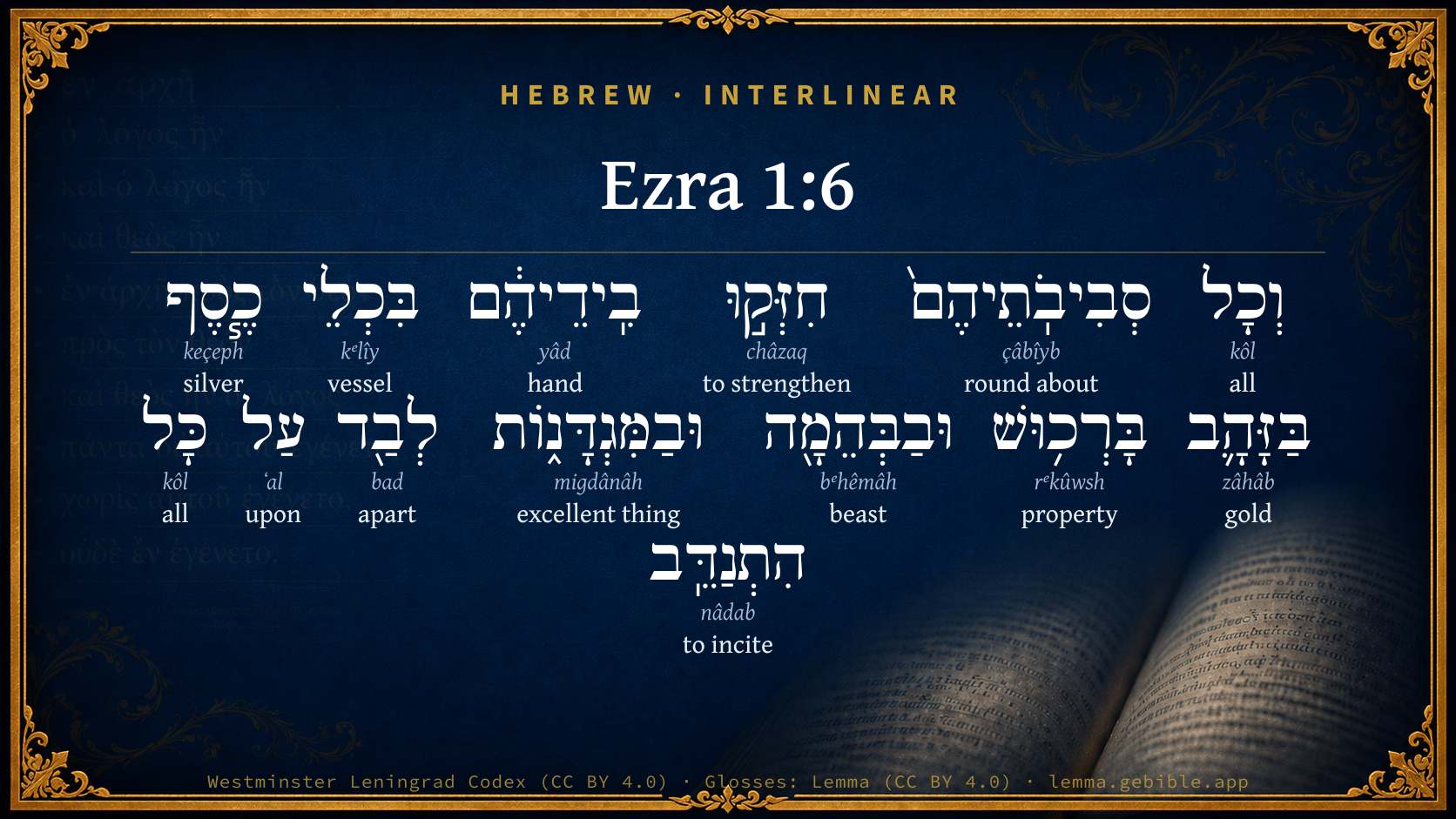
Ezra 1:6

Hebrew (Westminster Leningrad Codex) Ezra 1:6 appears in the Hebrew Old Testament. The text above is from the Westminster Leningrad Codex. Each word links to its Strong’s number, a concise gloss, and parsing drawn from the Open Scriptures Hebrew Bible morphology. Click any word for its full Brown-Driver-Briggs (BDB) entry.
Download image
Cite this verse

Ezra 1:6 (World English Bible). Public Domain. Lemma interlinear Bible study tool, https://lemma.gebible.app/v/ezra/1/6.

Show BibTeX & RIS
BibTeX
RIS
English Translation
All those who were round about them strengthened their hands with vessels of silver, with gold, with goods, and with animals, and with precious things, besides all that was willingly offered.
World English Bible · Public Domain
Download a study sheet

One document with this verse’s original text, its word-by-word gloss line, the meaning frame, cross-references with their text, attributed commentary, and full source and license credits — printable, and it pastes into notes with its structure intact.

This verse Autodidact and up

Study sheet (.html) Plain text (.txt)

A passage Seminary Student

Up to 50 verses in one chapter. A passage sheet keeps up to 6 commentary sources and 12 cross-references per verse, in the order this page ranks them, and says so on the sheet whenever that leaves anything out. Ask for a single verse and you get the Autodidact verse sheet above.

Everything on this page stays free to read, with no account — the sheet is a download of what is already on screen, not access to it.

Want to remove ads? Support Godless Engineer
Compare translations 3

The same verse in 3 English versions, stacked beneath the original-language interlinear above. Click any original word for its lexicon entry.

Each is an independent rendering of the whole verse — the interlinear is not word-aligned to these translations.

Highlighted words mark where these versions differ — a whole-verse word diff, not a word-by-word alignment.

  • World English Bible Public Domain
    All those who were round about them strengthened their hands with vessels of silver, with gold, with goods, and with animals, and with precious things, besides all that was willingly offered.
  • King James Version Public Domain
    And all they that were about them strengthened their hands with vessels of silver, with gold, with goods, and with beasts, and with precious things, beside all that was willingly offered.
  • unfoldingWord Literal Text CC BY-SA 4.0
    And all those around them strengthened their hands with vessels of silver, with gold, with goods, and with livestock, and with precious gifts, apart from all that was freely offered.

unfoldingWord Literal Text — © unfoldingWord, licensed CC BY-SA 4.0. Word-aligned USFM3 via Door43 (git.door43.org/unfoldingWord/en_ult).

Versions to compare (up to 4)

3 of 4 selected

Show all 18 translations

Every available English version of this verse, each an independent rendering of the whole verse.

  • World English Bible Public Domain
    All those who were round about them strengthened their hands with vessels of silver, with gold, with goods, and with animals, and with precious things, besides all that was willingly offered.
  • Berean Standard Bible Public Domain
    And all their neighbors supported them with articles of silver and gold, with goods and livestock, and with valuables, in addition to all their freewill offerings.
  • Majority Standard Bible Public Domain
    And all their neighbors supported them with articles of silver and gold, with goods and livestock, and with valuables, in addition to all their freewill offerings.
  • King James Version Public Domain
    And all they that were about them strengthened their hands with vessels of silver, with gold, with goods, and with beasts, and with precious things, beside all that was willingly offered.
  • American Standard Version (1901) Public Domain
    And all they that were round about them strengthened their hands with vessels of silver, with gold, with goods, and with beasts, and with precious things, besides all that was willingly offered.
  • Revised Version (1885) Public Domain
    And all they that were round about them strengthened their hands with vessels of silver, with gold, with goods, and with beasts, and with precious things, beside all that was willingly offered.
  • Geneva Bible (1599) Public Domain
    And all they that were about them, strengthened their handes with vessels of siluer, with golde, with substance and with cattell, and with precious thinges, besides all that was willingly offred.
  • Douay-Rheims (1899) Public Domain
    And all they that were round about, helped their hands with vessels of silver, and gold, with goods, and with beasts, and with furniture, besides what they had offered on their own accord.
  • Young's Literal Translation Public Domain
    and all those round about them have strengthened `them' with their hands, with vessels of silver, with gold, with goods, and with beasts, and with precious things, apart from all that hath been offered willingly.
  • Literal Standard Version CC BY-SA 4.0
    and all those around them have strengthened [them] with their hands, with vessels of silver, with gold, with goods, and with beasts, and with precious things, apart from all that has been offered willingly.
  • Unlocked Literal Bible CC BY-SA 4.0
    Those around them supported their work with silver and gold objects, possessions, animals, valuables, and freewill offerings.
  • unfoldingWord Literal Text CC BY-SA 4.0
    And all those around them strengthened their hands with vessels of silver, with gold, with goods, and with livestock, and with precious gifts, apart from all that was freely offered.
  • Darby Bible Public Domain
    And all they that were about them strengthened their hands with articles of silver, with gold, with goods, and with beasts, and with precious things, besides all that was willingly offered.
  • World Messianic Bible Public Domain
    All those who were around them strengthened their hands with vessels of silver, with gold, with goods, with animals, and with precious things, in addition to all that was willingly offered.
  • Webster's Bible Public Domain
    And all they that were about them strengthened their hands with vessels of silver, with gold, with goods, and with beasts, and with precious things, besides all that was willingly offered.
  • Free Bible Version CC BY-SA 4.0
    All their neighbors supported them with gifts of silver and gold, with goods and livestock, and with other valuable items, in addition to all their voluntary donations.
  • Bible in Basic English Public Domain
    And all their neighbours gave them help with offerings of vessels of silver and gold and goods and beasts and things of great value, in addition to what was freely offered.
  • JPS Tanakh (1917) Public Domain
    And all they that were round about them strengthened their hands with vessels of silver, with gold, with goods, and with beasts, and with precious things, beside all that was willingly offered.

Literal Standard Version (2020), Covenant Press — licensed CC BY-SA 4.0. Text via the HelloAO Bible API (eBible.org). Unlocked Literal Bible (unfoldingWord) — licensed CC BY-SA 4.0. Text via the HelloAO Bible API (eBible.org). unfoldingWord Literal Text — © unfoldingWord, licensed CC BY-SA 4.0. Word-aligned USFM3 via Door43 (git.door43.org/unfoldingWord/en_ult). Free Bible Version, Dr. Jonathan Gallagher — licensed CC BY-SA 4.0. Text via the HelloAO Bible API (eBible.org).

Word by word

More ways to search: Search by grammar → Find every occurrence → Compare this word →

Practice this passage: Drill this verse → Learn its vocabulary →

וּבַמִּגְדָּנ֑וֹת
migdânâh
H4030
“and · in/at the · excellent things”
Conjunction + Preposition, Determined + Noun, Common, Feminine, Plural, Absolute
Part of Speech
Conjunction + Preposition + Noun
Type
Common
Gender
Feminine
Number
Plural
State
Absolute
Full BDB Definition

Origin: from the same as H4022

TWOT: 1144b

choice thing, excellent thing
  1. וְכָל kôl H3605 “and · all of” Conjunction + Noun, Common, Masculine, Singular, Construct
  2. סְבִיבֹֽתֵיהֶם֙ çâbîyb H5439 “surroundings · their” Noun, Common, Both, Plural, Construct + Suffix, Personal, 3rd Person, Masculine, Plural
  3. חִזְּק֣וּ châzaq H2388 “to strengthen” Verb, Piel, Perfect, 3rd Person, Common, Plural
  4. בִֽידֵיהֶ֔ם yâd H3027 “in/at · hands · their” Preposition + Noun, Common, Both, Dual, Construct + Suffix, Personal, 3rd Person, Masculine, Plural
  5. בִּכְלֵי kᵉlîy H3627 “in/at · vessels of” Preposition + Noun, Common, Masculine, Plural, Construct
  6. כֶ֧סֶף keçeph H3701 “silver” Noun, Common, Masculine, Singular, Absolute
  7. בַּזָּהָ֛ב zâhâb H2091 “in/at the · gold” Preposition, Determined + Noun, Common, Masculine, Singular, Absolute
  8. בָּרְכ֥וּשׁ rᵉkûwsh H7399 “in/at the · property” Preposition, Determined + Noun, Common, Masculine, Singular, Absolute
  9. וּבַבְּהֵמָ֖ה bᵉhêmâh H929 “and · in/at the · beast” Conjunction + Preposition, Determined + Noun, Common, Feminine, Singular, Absolute
  10. לְבַ֖ד bad H905 “to/for · apart” Preposition + Noun, Common, Masculine, Singular, Absolute
  11. עַל ʻal H5921 “upon” Preposition
  12. כָּל kôl H3605 “all of” Noun, Common, Masculine, Singular, Construct
  13. הִתְנַדֵּֽב nâdab H5068 “to incite” Verb, Hithpael, Infinitive Construct

About this verse

These counts appear in no published source. They are computed here, from the morphology-tagged text and Lemma’s own curated glosses. What Lemma adds →

14
words
13
distinct lemmas
Historical
section

Notable vocabulary

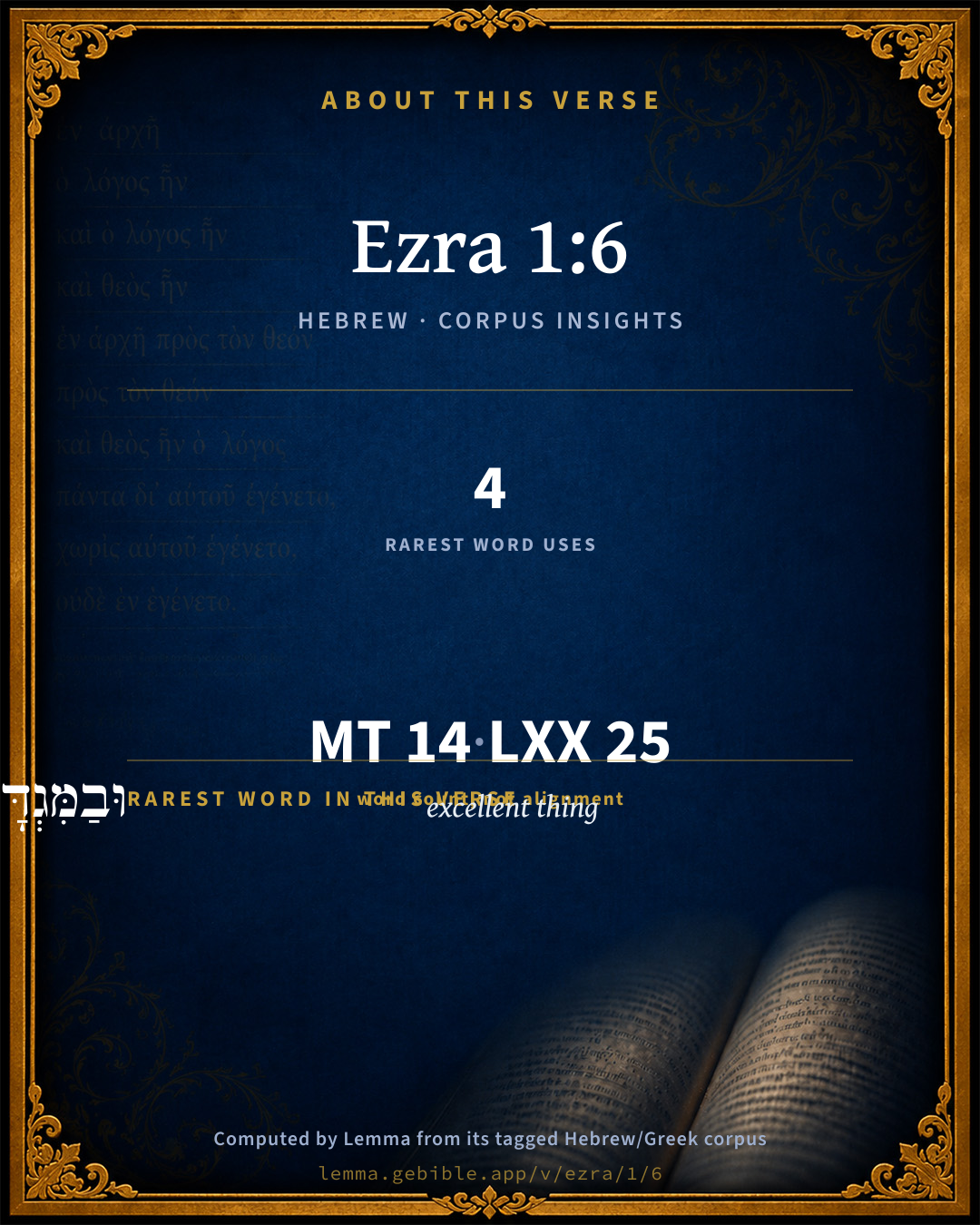
The rarest word here is וּבַמִּגְדָּנ֑וֹת excellent thing H4030 — appearing just 4 times in the whole Hebrew Bible.

Shared distinctive vocabulary

וּבַמִּגְדָּנ֑וֹת excellent thing H4030 occurs in 4 verses of the Hebrew Bible. Also found in:

Grammatical profile

  • 2 verbs
  • 11 nouns
  • 1 preposition

Verb forms

  • חִזְּק֣וּ Piel · Perfect
  • הִתְנַדֵּֽב Hithpael · Infinitive Construct

Repetition

A word recurs within this verse — often emphatic in Hebrew:

  • וְכָל all H3605 ×2

Hebrew & Septuagint length

In English translation the verse runs 31 words from the Hebrew and 27 from the Septuagint (LXX English) — closely comparable.

A rough comparison of the two English renderings, which tokenize alike — not a word-level alignment.

Word counts can differ between the Hebrew and the Greek without any difference in meaning — e.g. the Hebrew direct-object marker אֵת has no separate Greek word, and Greek often adds the article ὁ.

In the original languages it is 14 Hebrew tokens and 25 Greek tokens — but the two are counted differently (Hebrew bundles its prefixes and suffixes into one token; the Greek is in lemma form), so that isn’t a like-for-like length.

Cross-references

6

Topical passages linked to Ezra 1:6 in the Treasury of Scripture Knowledge — connected by theme and wording, ordered by reader-vote popularity; previews shown in the World English Bible.

  • Ezra 1:4 Whoever is left, in any place where he sojourns, let the men of his place help him with silver, and with gold, and with goods, and with animals, besides the freewill-offering for the house of God which is in Jerusalem.
  • 2 Corinthians 9:7 Let each man give according as he has determined in his heart; not grudgingly, or under compulsion; for God loves a cheerful giver.
  • Ezra 7:15–16 and to carry the silver and gold, which the king and his counselors have freely offered to the God of Israel, whose habitation is in Jerusalem,
  • Ezra 8:25–28 and weighed to them the silver, and the gold, and the vessels, even the offering for the house of our God, which the king, and his counselors, and his princes, and all Israel there present, had offered:
  • Ezra 8:33 On the fourth day the silver and the gold and the vessels were weighed in the house of our God into the hand of Meremoth the son of Uriah the priest; and with him was Eleazar the son of Phinehas; and with them was Jozabad the son of Jeshua, and Noadiah the son of Binnui, the Levite;
  • Psalms 110:3 Your people offer themselves willingly in the day of your power, in holy array. Out of the womb of the morning, you have the dew of your youth.

Cross-references courtesy of OpenBible.info (CC BY 4.0).

Hebrew and Greek witnesses Masoretic Hebrew ↔ Greek Septuagint

The same verse in the two great witnesses to the Old Testament, shown verse-for-verse.

These are two independent witnesses, not word-aligned to each other, and the Septuagint is shown in lemma (dictionary) form.

Hebrew Ezra 1:6 Masoretic · Westminster Leningrad Codex

וְכָל סְבִיבֹֽתֵיהֶם֙ חִזְּק֣וּ בִֽידֵיהֶ֔ם בִּכְלֵי כֶ֧סֶף בַּזָּהָ֛ב בָּרְכ֥וּשׁ וּבַבְּהֵמָ֖ה וּבַמִּגְדָּנ֑וֹת לְבַ֖ד עַל כָּל הִתְנַדֵּֽב

All those who were round about them strengthened their hands with vessels of silver, with gold, with goods, and with animals, and with precious things, besides all that was willingly offered.

World English Bible · Public Domain

Greek LXX Ezra 1:6 Septuagint · lemma form

καί πᾶς ὁ κυκλόθεν ἐνἰσχύω ἐν χείρ αὐτός ἐν σκεῦος ἀργύριον ἐν χρυσοῦς ἐν ἀποσκευή καί ἐν κτῆνος καί ἐν ξένιον πάρεξ ὁ ἐν ἑκούσιος

And all that were round about strengthened their hands with vessels of silver, with gold, with goods, and with cattle, and with presents, besides the voluntary offerings.

LXX2012 (modern English Septuagint) · Public Domain

In the Septuagint this is one book — Esdras B (2 Esdras): Ezra is chapters 1–10, Nehemiah 11–23.

On this verse, The Cambridge Bible for Schools and Colleges discusses the Septuagint’s reading. Read the note in Commentary ↓

Hebrew: Westminster Leningrad Codex (CC BY 4.0). Greek: Septuagint (public domain); English from LXX2012 (modern English Septuagint) (Public Domain). How the Septuagint differs from the Hebrew →

Commentary

Notes on Ezra 1:6 from classic Christian and Jewish commentators (each source and its license shown beneath its notes). The classic Christian expositions comment on the surrounding passage and are grouped to its opening verse, so a note may address several verses; the Jewish commentaries on the Tanakh (Rashi and others) are per-verse, so they appear only where the commentator wrote on this verse.

Lemma curates 59 commentaries, every one of them public domain or Creative Commons licensed, each selected and text-cleaned for this edition rather than reprinted as found. About our sources →

Trapp's Complete Commentary

John Trapp

Ezr 1:6 And all they that [were] about them strengthened their hands with vessels of silver, with gold, with goods, and with beasts, and with precious things, beside all [that] was willingly offered.

Ver. 6. And all they that were about them] Both their countrymen the Jews (that thought not good to themselves or not yet, till they should see further: there is none so wise as the sluggard, Pro 26:16), and others of the neighbourhood: for the Egyptians may lend jewels to the Israelites, dogs may lick Lazarus’s ulcers, and the earth may help the woman, by opening her mouth, and swallowing up the flood cast out after her by the dragon to drown her, Rev 12:16.

Strengthened their hands] Which else, for want of such support, would have hung down, and their feeble knees buckled under them, ere they had come to their own country; neither could they without such supplies have so comfortably carried on the work they went about. For, if wisdom be a defence, or a shadow, to those that have seen the sun (as in the former verse) and are scorched with the heat of it, so is money too, saith Solomon, Ecc 7:12; and though wisdom without wealth is good, yet it is better with inheritance, Ezr 1:11, which is not only an ornament, but an instrument of virtue. When men go on Virtute dace, comite fortuna, then it is well with them as it was with good Josiah, Jer 22:15-16. But Agur would not be poor, lest he should be put upon ill courses, Pro 30:9, put to his shifts. Poor Hagar, when the water was spent in the bottle, cast the child under the shrubs, Gen 21:15.

With vessels of silver, with gold, with goods, and with beasts] See the note on Ezr 1:4. These are things that men do not usually so easily part with to others till they needs must. Euclio in the comedian sits abrood upon his heaps and hoards, and will not be drawn off. Shall Nabal take his bread and his flesh, and give it to those he knows not? 1Sa 25:23-31 Misers will as soon part with their blood as their gold; whence the Chaldees call their money dam, that is, blood. Many a man shows himself like the Cornish crow, which will steal a piece of money, and hiding it in some hole, will never help herself or any other with it afterwards. Hermocrates, being loth that any man should enjoy his goods after him, made himself, by his will, heir of his own goods. Athenaeus telleth of one, that at his death devoured many pieces of gold, and sewed the rest in his coat, commanding that they should be all buried with him. But these in the text seem to have been of the race of those Persians spoken of, Isa 13:17, which regarded not silver, and as for gold, they cared not much for it. Or if they were proselytes to the Church, then they had learned (with Tyrus, now also converted) to give over heaping and hoarding of wealth, and therewith to feed and clothe God’s poor saints; and so to furnish them for their journey to their Father’s house, that they may eat sufficiently, and have durable clothing, Isa 23:18. This was God’s work upon their hearts; and Quando Christus magister, quam cito discitur quod decatur? (Augustin.) Whereunto may be added, that Cyrus, who set forth this edict, as he was an absolute sovereign (and so his word went for a law), so he was a gracious and courteous prince, ita ut Patris nomen meruerit, so that he merited the name and title of Father of his Country, and might command anything of them.

And with precious things] Even the very best of the best they had. The word signifieth praestantissimum et pretiosissimum in quocunque genere fructuum, metallorum, gemmarum, vestium, the choicest and chiefest of all kind of commodities. Such as Eliezer gave to Rebekah and her brother, Gen 24:53, and as Jehoshaphat gave his younger son, 2Ch 21:3. For the purchase of the pearl of price, the wise merchant makes a thorough sale of all. Barnabas parteth with his lands, Zaccheus with his goods, Matthew with his meat, the centurion with his money, to build those synagogues that wicked Antiochus had thrown down; and these in the text, with their most precious things, to refurnish that temple that Nebuchadnezzar had burnt.

Beside all that was willingly offered] A freewill offering then there was {Ezr 1:4} brought in by God’s willing people, Psa 110:3, that wait for God’s law, as Isa 42:8-9, and hold with that ancient, that it is nimis augusta innocentia ad legem bonum esse, to do no more service to God than needs must, to get so much grace only as will keep life and soul together (that is, soul and hell asunder), this they judge to be a low and unworthy strain of some good people. David voweth freewill offerings often, and could beteem God a great deal more love and service than he is able to perform to him, Psa 5:6 1Ch 29:8-9. Those good souls, Zec 8:21, call upon themselves and one another to be continually going before the Lord, and to seek the Lord of hosts: I (saith each for himself) will go also. Hannah went up with her husband every year to the feast, 1Sa 1:4; 1Sa 1:21; so did the Virgin Mary to the passover with her son Jesus, Luk 2:41-42; yet none were expressly commanded so to do but males, and those also nothing under twenty years of age, as fit to be numbered, Exo 30:14. So those among us that hear weekday sermons, as Mary did, Luk 10:42, and many other good people in our Saviour’s days, Luk 19:47-48; Luk 21:37-38. Hereby we shall show our love, and do a service highly accepted in heaven.

John Trapp, A Commentary or Exposition upon All the Books of the Old and New Testament (1647–1656) — public domain. Text from a community e-Sword module.

Joseph Benson's Commentary

Ezr 1:6. All that were about them strengthened their hands — Some of them, probably, because they had embraced, or at least favoured, the Jewish religion, concerning which they had been instructed by the Israelites, who had now for a long time dwelt among them; and others, that they might hereby gratify the king, and procure his favour, perceiving him to be friendly to the Jews, and forward and hearty in the work of helping them. Thus God, when he pleases, can incline the hearts of strangers to be kind to his people; yea, make those strengthen their hands, who formerly weakened them.

Joseph Benson's Commentary on the Old and New Testaments (1811–1818) — public domain. Text from a community e-Sword module.

Geneva Bible (1599)

Geneva Bible translators

The Babylonians and Chaldeans gave them these presents: thus rather than the children of God should want for their necessities, he would stir up the heart of the very infidels to help them.

Geneva Bible (1599) marginal notes — public domain. Text via Bolls.life.

Adam Clarke's Commentary

Verse 6. Vessels of silver] Articles of silver, gold, &c.

Adam Clarke's Commentary on the Bible (1810–1826) — public domain. Text from a community e-Sword/MySword module.

The Cambridge Bible for Schools and Colleges

gen. ed. J. J. S. Perowne

6. And all they that were about them] R.V. round about them. A general expression which would include both the heathen neighbours, alluded to (in Ezr_1:3) by the edict, and the Jewish neighbours, not contemplated in the edict, who preferred to remain in the land of the Captivity.

strengthened their hands] The use of this expression differs slightly in the grammar of the original from such passages as Neh_2:18, ‘So they strengthened their hands for the good work’; Jer_23:14, ‘they strengthen the hands of evil doers’. In those passages the idea is simply that of ‘invigorating’ and ‘adding strength’. Here the employment of a preposition introduces a shade of variety into the metaphor. The idea is that of ‘grasping’, ‘laying firm hold on the hand with the view of strengthening or supporting’. The Jews who sought to return were like a convalescent essaying to walk and needing assistance. Cf. Isa_51:18, ‘There is none that taketh her by the hand of all the sons that she hath brought up’.

vessels of silver, with gold] we should expect ‘with vessels of gold’, cf. Ezr_1:9.

with goods] see Ezr_1:4.

and with precious things] A rare word in the original, ‘migdânoth’. It occurs in 2Ch_21:3 = A.V. and R.V. precious things, 2Ch_32:23 = A.V. presents, R.V. precious things. And in a well-known passage, Gen_24:53 = A.V. and R.V. precious things. The Latin here ‘in supellectili’ is a mere guess. The LXX. rendering ‘ἐν ξενίοις’ = with gifts agrees with their rendering δῶρα in Gen., and δόματα in 2 Chronicles 32. In 2Ch_21:3 they render by ὅπλα.

beside all that was willingly offered] i.e. these gifts were over and above the free-will offerings. The clause in the original is peculiar, ‘beside over and above all one willingly offered’. The relative is omitted as in Ezr_1:4, but is implied in ‘all’. The verb is active in meaning (cf. Ezr_2:68, Ezr_3:5) and is here used impersonally.

The Cambridge Bible for Schools and Colleges (gen. ed. J. J. S. Perowne; Cambridge University Press, 1878–1918) — public domain. Text from a community e-Sword module.

John Gill's Exposition

And all they that were about them,.... Their neighbours, the Chaldeans:

strengthened their hands with vessels of silver, with gold, with goods, and with beasts, and with precious things; which they either did of themselves at their own motion, or by the direction and example of Cyrus, Ezr 1:4 and perhaps many of them to ingratiate themselves into the favour of their new monarch:

besides all that was willingly offered: by the rich Jews, who thought fit, at least for the present, to remain in Babylon.

John Gill's Exposition of the Whole Bible (1746–1763) — public domain (CC PDM 1.0). Text via the HelloAO Bible API.

Matthew Poole's English Annotations

Strengthened their hands; either because they had embraced, or at least favoured the Jewish religion, concerning which they were instructed by the Israelites that had now for a long time dwelt among them; or rather, that they might hereby gratify the king’s humour, and purchase his favour; for they perceived him to be hearty and forward in the work.

Matthew Poole's English Annotations on the Holy Bible (1683–1685) — public domain. Text from a community e-Sword/MySword module.

Whedon's Commentary on the Bible

Daniel D. Whedon

6. All they that were about them — That is, the neighbours and friends of those exiles who rose up to return, especially the wealthier Jews, who, as Patrick says, “being well settled at Babylon, did not think fit to stir till they saw how these would succeed.”

Strengthened their hands — That is, as the margin explains, helped them; assisted and cheered them by the presents and provisions immediately named. This was done in accordance with Cyrus’s decree.

Besides all that was willingly offered — The presents previously named were given by order of the king; but besides these gifts others of the same or similar nature were contributed spontaneously by persons who, unable to go themselves, were anxious to encourage and help those who did go.

Daniel D. Whedon (gen. ed.), Commentary on the Old and New Testaments (1874–1909) — public domain. Text from a community e-Sword module.

The Pulpit Commentary

All they that were about them. i.e. all their neighbours. Strengthened their hands. This is the literal rendering. The margin gives the right meaning them." With precious things. Migdanoth , a rare word, only used here, in Gen_24:53, and in 2Ch_21:3; always connected with silver and gold: derived from meged, which means precious. " Besides all that was willingly offered (comp. ver. 4). The gold, silver, precious things, etc. previously mentioned were free gifts to individual Jews, and were additional to certain offerings which were intrusted to them for conveyance to Jerusalem. On the value attached by the Persians to offerings made in Jerusalem to Jehovah, see below, Ezr_6:10, and Ezr_7:17.

THE RESTORATION OF THE SACRED VESSELS BY CYRUS (vers. 7-11). Following the ordinary custom of the early Oriental conquerors, Nebuchadnezzar, long before he destroyed the Jewish temple, had carried off from it, partly as trophies of victory, partly as articles of value, many of the sacred vessels used in the temple service. (see 2Ch_36:10; Jer_27:19, Jer_27:20; Dan_1:2) At his final capture and destruction of Jerusalem he bore off the remainder. (2Ki_25:14, 2Ki_25:15) These he deposited at Babylon in the temple of Merodach (or Bel), the god whom he chiefly worshipped, (Dan_1:2) where they probably remained until Belshazzar had them brought out and desecrated at his great banquet (ibid. 5:2). A religious instinct now prompted the Persian king to give the vessels back, in order that they might revert to their original use. The careful enumeration of them (vers. 9-11) is characteristic of Ezra, who is very minute and exact in his details, and fond of making lists or catalogues.

The Pulpit Commentary (1880–1919), ed. H.D.M. Spence-Jones & Joseph S. Exell — public domain. Text from a community e-Sword module.

John Wesley's Explanatory Notes

Strengthened their hands - God can, when he pleases, incline the hearts of strangers to be kind to his people; yea, make those strengthen their hands, who formerly weakened them.

John Wesley, Explanatory Notes Upon the Whole Bible (1754–1765) — public domain. Text via the GEBible commentary corpus.

Rashi

Rabbi Shlomo Yitzchaki (Rashi)

And all those around them And all the nations who were Israel’s neighbors assisted and strengthened the hands of the Jews with gold and silver and all these gifts in order that they be able to ascend to Jerusalem.

besides all that was donated All this the neighbors of the Jews did, besides what they [the Jews] themselves donated for the building of the Temple.

Rashi on the Tanakh — English translations: “The Judaica Press complete Tanach with Rashi, translated by A. J. Rosenberg” (CC BY 4.0); “Pentateuch with Rashi's commentary by M. Rosenbaum and A.M. Silbermann, 1929-1934” (public domain); “The Metsudah Tanach series, Lakewood, N.J” (CC BY 4.0); and “The Book of Joshua, Metsudah Publications, 1997” (CC BY 4.0). Text via Sefaria.

Lesson kit

Teaching starters — assembled from the data on this page, not authored interpretation. Every prompt links to the verse data it draws on. Edit before teaching.

Ezra, in the Historical, opens this verse with 14 words (13 distinct Hebrew lemmas). Its most distinctive word is migdânâh (“excellent thing”). A historical commentator’s framing appears above. Read the whole chapter for the surrounding context.

Discussion questions

  1. What does “excellent thing” (migdânâh) contribute to the verse as a whole?
  2. How does Genesis 24:53, which shares the word «excellent thing», read alongside this verse?
  3. What does the repetition of “all” (2× in this one verse) do in this verse?
  4. These translations render this verse differently; the difference is in the English rendering, not the original. What questions does that raise?
  5. «חִזְּק֣וּ» is a Piel Perfect verb. How does that grammatical form shape the action described?
  6. Compare how Trapp's Complete Commentary and Joseph Benson's Commentary read this verse. Where do they agree or differ?

Things to notice

Reading settings

Reading text

Shown beneath each verse's original-language words.

Old Testament
Old Testament edition

Read the OT as the Masoretic Hebrew (MT) or the Greek Septuagint (LXX).

English shown for the Greek Septuagint (in the Hebrew ↔ Greek comparison).

Comparing translations? Open the Compare panel on any verse page to stack up to four side by side.