
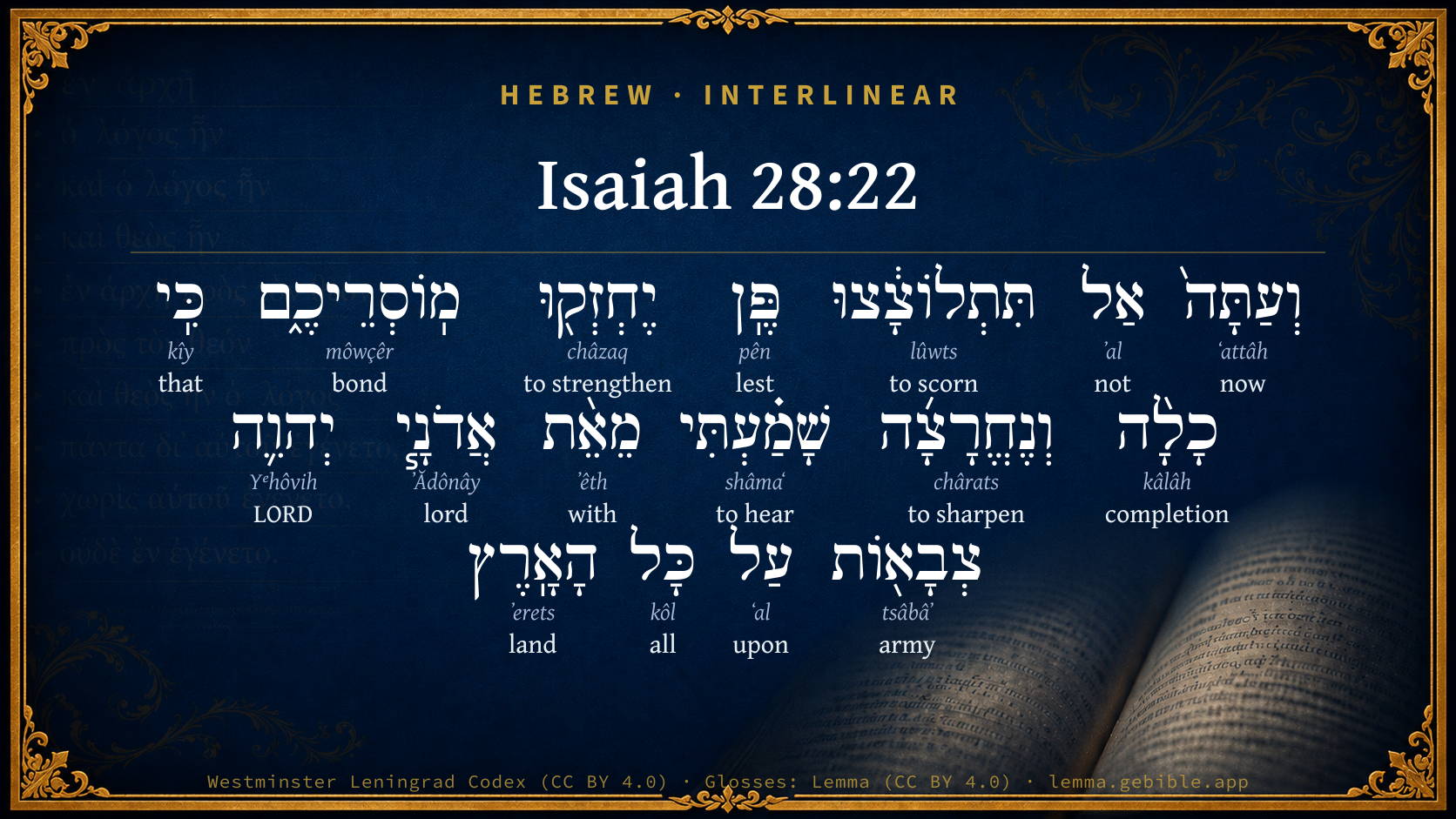
Isaiah 28:22

Hebrew (Westminster Leningrad Codex) Isaiah 28:22 appears in the Hebrew Old Testament. The text above is from the Westminster Leningrad Codex. Each word links to its Strong’s number, a concise gloss, and parsing drawn from the Open Scriptures Hebrew Bible morphology. Click any word for its full Brown-Driver-Briggs (BDB) entry.
Download image
Cite this verse

Isaiah 28:22 (World English Bible). Public Domain. Lemma interlinear Bible study tool, https://lemma.gebible.app/v/isaiah/28/22.

Show BibTeX & RIS
BibTeX
RIS
English Translation
Now therefore don't you be scoffers, lest your bonds be made strong; for a decree of destruction have I heard from the Lord, Yahweh of Hosts, on the whole earth.
World English Bible · Public Domain
Download a study sheet

One document with this verse’s original text, its word-by-word gloss line, the meaning frame, cross-references with their text, attributed commentary, and full source and license credits — printable, and it pastes into notes with its structure intact.

This verse Autodidact and up

Study sheet (.html) Plain text (.txt)

A passage Seminary Student

Up to 50 verses in one chapter. A passage sheet keeps up to 6 commentary sources and 12 cross-references per verse, in the order this page ranks them, and says so on the sheet whenever that leaves anything out. Ask for a single verse and you get the Autodidact verse sheet above.

Everything on this page stays free to read, with no account — the sheet is a download of what is already on screen, not access to it.

Want to remove ads? Support Godless Engineer
Compare translations 3

The same verse in 3 English versions, stacked beneath the original-language interlinear above. Click any original word for its lexicon entry.

Each is an independent rendering of the whole verse — the interlinear is not word-aligned to these translations.

Highlighted words mark where these versions differ — a whole-verse word diff, not a word-by-word alignment.

  • World English Bible Public Domain
    Now therefore don't you be scoffers, lest your bonds be made strong; for a decree of destruction have I heard from the Lord, Yahweh of Hosts, on the whole earth.
  • King James Version Public Domain
    Now therefore be ye not mockers, lest your bands be made strong: for I have heard from the Lord GOD of hosts a consumption, even determined upon the whole earth.
  • unfoldingWord Literal Text CC BY-SA 4.0
    And now, may you not mock, lest your bonds strengthen. For destruction is decreed— I have heard from the Lord, Yahweh of Armies— over all of the earth. q1

unfoldingWord Literal Text — © unfoldingWord, licensed CC BY-SA 4.0. Word-aligned USFM3 via Door43 (git.door43.org/unfoldingWord/en_ult).

Versions to compare (up to 4)

3 of 4 selected

Show all 18 translations

Every available English version of this verse, each an independent rendering of the whole verse.

  • World English Bible Public Domain
    Now therefore don't you be scoffers, lest your bonds be made strong; for a decree of destruction have I heard from the Lord, Yahweh of Hosts, on the whole earth.
  • Berean Standard Bible Public Domain
    So now, do not mock, or your shackles will become heavier. Indeed, I have heard from the Lord GOD of Hosts a decree of destruction against the whole land.
  • Majority Standard Bible Public Domain
    So now, do not mock, or your shackles will become heavier. Indeed, I have heard from the Lord GOD of Hosts a decree of destruction against the whole land.
  • King James Version Public Domain
    Now therefore be ye not mockers, lest your bands be made strong: for I have heard from the Lord GOD of hosts a consumption, even determined upon the whole earth.
  • American Standard Version (1901) Public Domain
    Now therefore be ye not scoffers, lest your bonds be made strong; for a decree of destruction have I heard from the Lord, Jehovah of hosts, upon the whole earth.
  • Revised Version (1885) Public Domain
    Now therefore be ye not scorners, lest your bands be made strong: for a consummation, and that determined, have I heard from the Lord, the LORD of hosts, upon the whole earth.
  • Geneva Bible (1599) Public Domain
    Nowe therefore be no mockers, least your bondes increase: for I haue heard of the Lord of hostes a consumption, euen determined vpon the whole earth.
  • Douay-Rheims (1899) Public Domain
    And now do not mock, lest your bonds be tied strait. For I have heard of the Lord the God of hosts a consumption and a cutting short upon all the earth.
  • Young's Literal Translation Public Domain
    And now, show not yourselves scorners, Lest strong be your bands, For a consumption, that is determined, I have heard, by the Lord, Jehovah of Hosts, `Is' for all the land.
  • Literal Standard Version CC BY-SA 4.0
    And now, do not show yourselves scorners, || Lest your bands are strong, || For a consumption, that is determined, || I have heard, by the Lord, YHWH of Hosts, || [Is] for all the land.
  • Unlocked Literal Bible CC BY-SA 4.0
    Now therefore do not mock, or your bonds will be tightened. I have heard from the Lord Yahweh of hosts, a decree of destruction on the earth.
  • unfoldingWord Literal Text CC BY-SA 4.0
    And now, may you not mock, lest your bonds strengthen. For destruction is decreed— I have heard from the Lord, Yahweh of Armies— over all of the earth. q1
  • Darby Bible Public Domain
    Now therefore be ye not scorners, lest your bonds be made strong; for I have heard from the Lord Jehovah of hosts a consumption, and [one] determined, upon the whole land.
  • World Messianic Bible Public Domain
    Now therefore don’t be scoffers, lest your bonds be made strong; for I have heard a decree of destruction from the Lord, GOD of Hosts, on the whole earth.
  • Webster's Bible Public Domain
    Now therefore be ye not mockers, lest your bands be made strong: for I have heard from the Lord GOD of hosts a consumption, even determined upon the whole earth.
  • Free Bible Version CC BY-SA 4.0
    So don't mock, or your imprisonment will be even worse, for the Lord, the Lord Almighty, has explained to me his decision to destroy the whole country.
  • Bible in Basic English Public Domain
    And now, take care that you do not make sport of him, or your bands will be made strong; for I have had word from the Lord, the Lord of armies, of an end, of a complete end, which is to come on all the land.
  • JPS Tanakh (1917) Public Domain
    Now therefore be ye not scoffers, lest your bands be made strong; for an extermination wholly determined have I heard from the Lord, the GOD of hosts, upon the whole land.

Literal Standard Version (2020), Covenant Press — licensed CC BY-SA 4.0. Text via the HelloAO Bible API (eBible.org). Unlocked Literal Bible (unfoldingWord) — licensed CC BY-SA 4.0. Text via the HelloAO Bible API (eBible.org). unfoldingWord Literal Text — © unfoldingWord, licensed CC BY-SA 4.0. Word-aligned USFM3 via Door43 (git.door43.org/unfoldingWord/en_ult). Free Bible Version, Dr. Jonathan Gallagher — licensed CC BY-SA 4.0. Text via the HelloAO Bible API (eBible.org).

Word by word

More ways to search: Search by grammar → Find every occurrence → Compare this word →

Practice this passage: Drill this verse → Learn its vocabulary →

מֽוֹסְרֵיכֶ֑ם
môwçêr
H4147
“bonds · your”
Noun, Common, Both, Plural, Construct + Suffix, Personal, 2nd Person, Masculine, Plural
Part of Speech
Noun
Type
Common
Gender
Both
Number
Plural
State
Construct
Full BDB Definition

Origin: from H3256

TWOT: 141f

band, bond
  1. וְעַתָּה֙ ʻattâh H6258 “and · now” Conjunction + Adverb
  2. אַל ʼal H408 “not” Particle, Negative
  3. תִּתְלוֹצָ֔צוּ lûwts H3887 “to scorn” Verb, Hithpolel, Jussive, 2nd Person, Masculine, Plural
  4. פֶּֽן pên H6435 “lest” Conjunction
  5. יֶחְזְק֖וּ châzaq H2388 “to strengthen” Verb, Qal, Imperfect, 3rd Person, Masculine, Plural
  6. כִּֽי kîy H3588 “that” Conjunction
  7. כָלָ֨ה kâlâh H3617 “completion” Noun, Common, Feminine, Singular, Absolute
  8. וְנֶחֱרָצָ֜ה chârats H2782 “and · sharpening” Conjunction + Verb, Niphal, Participle Active, Feminine, Singular, Absolute
  9. שָׁמַ֗עְתִּי shâmaʻ H8085 “to hear” Verb, Qal, Perfect, 1st Person, Common, Singular
  10. מֵאֵ֨ת ʼêth H854 “from · with” Preposition + Preposition
  11. אֲדֹנָ֧י ʼĂdônây H136 “Lord · my” Noun, Common, Masculine, Plural, Construct + Suffix, Personal, 1st Person, Common, Singular
  12. יְהוִ֛ה Yᵉhôvih H3069 “LORD” Noun, Proper
  13. צְבָא֖וֹת tsâbâʼ H6635 “armies” Noun, Common, Both, Plural, Absolute
  14. עַל ʻal H5921 “upon” Preposition
  15. כָּל kôl H3605 “all of” Noun, Common, Masculine, Singular, Construct
  16. הָאָֽרֶץ ʼerets H776 “the · land” Particle, Definite Article + Noun, Common, Both, Singular, Absolute

About this verse

These counts appear in no published source. They are computed here, from the morphology-tagged text and Lemma’s own curated glosses. What Lemma adds →

17
words
17
distinct lemmas
Prophets
section

Notable vocabulary

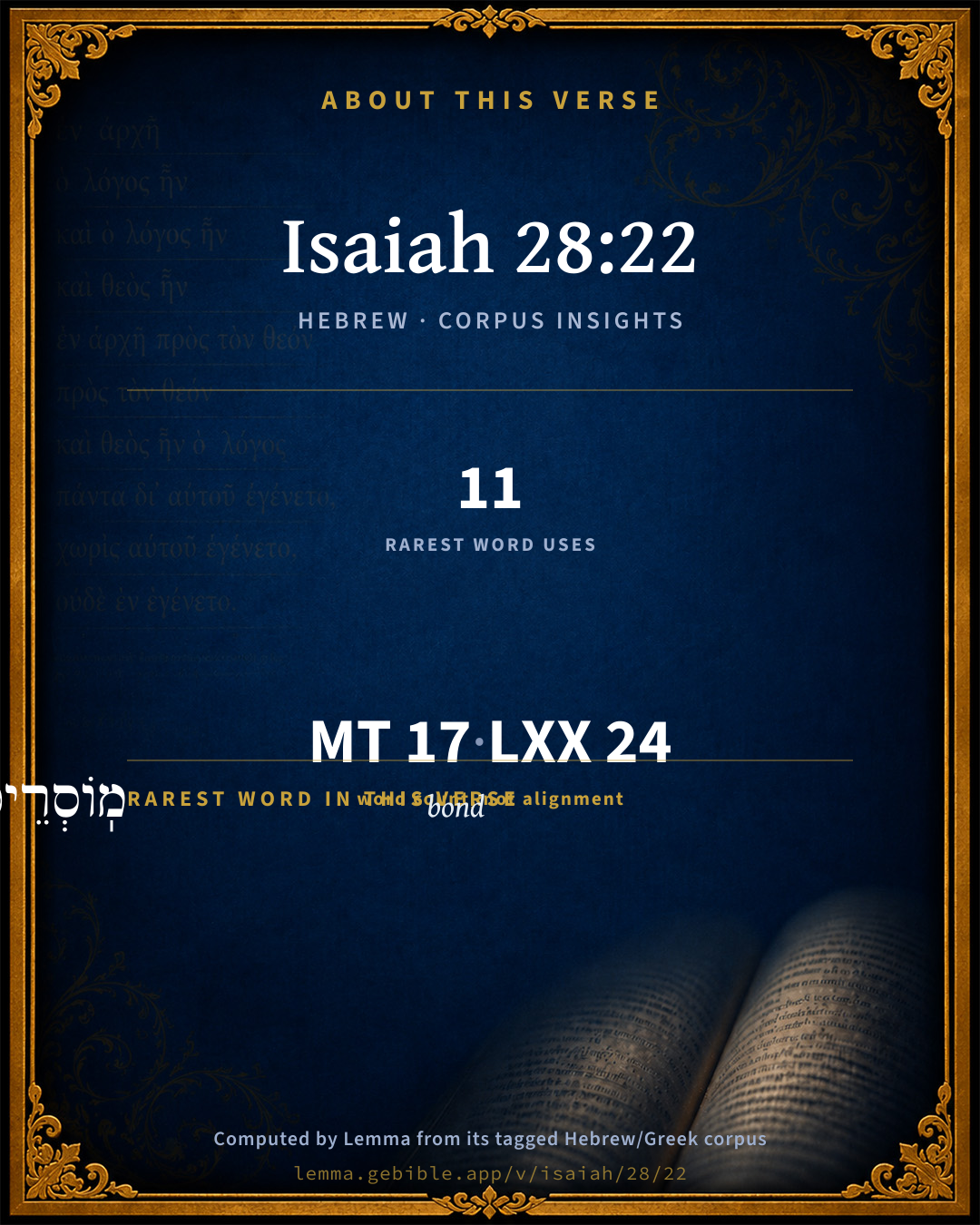
The rarest word here is מֽוֹסְרֵיכֶ֑ם bond H4147 — appearing just 11 times in the whole Hebrew Bible.

Shared distinctive vocabulary

מֽוֹסְרֵיכֶ֑ם bond H4147 occurs in 11 verses of the Hebrew Bible. Also found in:

Grammatical profile

  • 4 verbs
  • 7 nouns
  • 2 prepositions
  • 2 conjunctions
  • 1 adverb
  • 1 particle

Verb forms

  • תִּתְלוֹצָ֔צוּ Hithpolel · Jussive
  • יֶחְזְק֖וּ Qal · Imperfect
  • וְנֶחֱרָצָ֜ה Niphal · Participle Active
  • שָׁמַ֗עְתִּי Qal · Perfect

Hebrew & Septuagint length

In English translation the verse runs 30 words from the Hebrew and 35 from the Septuagint (LXX English) — closely comparable.

A rough comparison of the two English renderings, which tokenize alike — not a word-level alignment.

Word counts can differ between the Hebrew and the Greek without any difference in meaning — e.g. the Hebrew direct-object marker אֵת has no separate Greek word, and Greek often adds the article ὁ.

In the original languages it is 17 Hebrew tokens and 24 Greek tokens — but the two are counted differently (Hebrew bundles its prefixes and suffixes into one token; the Greek is in lemma form), so that isn’t a like-for-like length.

Cross-references

20

Topical passages linked to Isaiah 28:22 in the Treasury of Scripture Knowledge — connected by theme and wording, ordered by reader-vote popularity; previews shown in the World English Bible.

  • Isaiah 10:22–23 For though your people, Israel, be as the sand of the sea, [only] a remnant of them shall return: a destruction [is] determined, overflowing with righteousness.
  • Isaiah 24:1–23 Behold, Yahweh makes the earth empty, and makes it waste, and turns it upside down, and scatters abroad the inhabitants of it.
  • 2 Chronicles 30:10 So the posts passed from city to city through the country of Ephraim and Manasseh, even to Zebulun: but they ridiculed them, and mocked them.
  • 2 Chronicles 36:16 but they mocked the messengers of God, and despised his words, and scoffed at his prophets, until the wrath of Yahweh arose against his people, until there was no remedy.
  • Psalms 107:16 For he has broken the gates of brass, And cut through bars of iron.
  • Isaiah 28:14–15 Why hear the word of Yahweh, you scoffers, that rule this people that is in Jerusalem:
  • Isaiah 32:12–14 They shall strike on the breasts for the pleasant fields, for the fruitful vine.
  • Jeremiah 15:17 I didn't sit in the assembly of those who make merry, nor rejoiced; I sat alone because of your hand; for you have filled me with indignation.
  • Jeremiah 20:7 Yahweh, you have persuaded me, and I was persuaded; you are stronger than I, and have prevailed: I am become a laughing-stock all the day, every one mocks me.
  • Jeremiah 25:11 This whole land shall be a desolation, and an astonishment; and these nations shall serve the king of Babylon seventy years.
  • Jeremiah 39:7 Moreover he put out Zedekiah's eyes, and bound him in fetters, to carry him to Babylon.
  • Lamentations 1:14 The yoke of my transgressions is bound by his hand; They are knit together, they are come up on my neck; he has made my strength to fail: The Lord has delivered me into their hands, against whom I am not able to stand.
  • Daniel 9:26–27 After the sixty-two weeks the Anointed One shall be cut off, and shall have nothing: and the people of the prince who shall come shall destroy the city and the sanctuary; and the end of it shall be with a flood, and even to the end shall be war; desolations are determined.
  • Matthew 27:39 Those who passed by blasphemed him, wagging their heads,
  • Matthew 27:44 The robbers also who were crucified with him cast on him the same reproach.
  • Luke 21:24 They will fall by the edge of the sword, and will be led captive into all the nations. Jerusalem will be trampled down by the Gentiles, until the times of the Gentiles are fulfilled.
  • Acts 13:40–41 Beware therefore, lest that come on you which is spoken in the prophets:
  • Acts 17:32 Now when they heard of the resurrection of the dead, some mocked; but others said, "We want to hear you again concerning this."
  • Revelation 22:18–19 I testify to everyone who hears the words of the prophecy of this book, if anyone adds to them, may God add to him the plagues which are written in this book.
  • 2 Chronicles 33:11 Therefore Yahweh brought on them the captains of the host of the king of Assyria, who took Manasseh in chains, and bound him with fetters, and carried him to Babylon.

Cross-references courtesy of OpenBible.info (CC BY 4.0).

Hebrew and Greek witnesses Masoretic Hebrew ↔ Greek Septuagint

The same verse in the two great witnesses to the Old Testament, shown verse-for-verse.

These are two independent witnesses, not word-aligned to each other, and the Septuagint is shown in lemma (dictionary) form.

Hebrew Isaiah 28:22 Masoretic · Westminster Leningrad Codex

וְעַתָּה֙ אַל תִּתְלוֹצָ֔צוּ פֶּֽן יֶחְזְק֖וּ מֽוֹסְרֵיכֶ֑ם כִּֽי כָלָ֨ה וְנֶחֱרָצָ֜ה שָׁמַ֗עְתִּי מֵאֵ֨ת אֲדֹנָ֧י יְהוִ֛ה צְבָא֖וֹת עַל כָּל הָאָֽרֶץ

Now therefore don't you be scoffers, lest your bonds be made strong; for a decree of destruction have I heard from the Lord, Yahweh of Hosts, on the whole earth.

World English Bible · Public Domain

Greek LXX Isaiah 28:22 Septuagint · lemma form

καί σύ μή εὐφραίνω μηδέ ἰσχύω σύ ὁ δεσμός διότι συντελέω καί συντέμνω πρᾶγμα ἀκούω παρά κύριος σαβαωθ ὅς ποιέω ἐπί πᾶς ὁ γῆ

Therefore do not you⌃ rejoice, neither let your bands be made strong; for I have heard of works finished and cut short by the Lord of hosts, which he will execute upon all the earth.

LXX2012 (modern English Septuagint) · Public Domain

On this verse, Trapp's Complete Commentary discusses the Septuagint’s reading. Read the note in Commentary ↓

Hebrew: Westminster Leningrad Codex (CC BY 4.0). Greek: Septuagint (public domain); English from LXX2012 (modern English Septuagint) (Public Domain). How the Septuagint differs from the Hebrew →

Targum (Aramaic paraphrase)

1

The Targum is the ancient Jewish Aramaic paraphrase of the Hebrew Scriptures — an interpretive translation, not the Hebrew text itself. Onkelos (literal) and Pseudo-Jonathan (expansive) render the Torah, and Jonathan the Prophets. Coverage is partial: where no permissively-licensed English translation exists for a verse, only the Aramaic is shown. This is verse-level text, not a word-by-word alignment to the Hebrew.

  1. Targum Jonathan Prophets (Joshua–Malachi)
    וּכְעַן לָא תִתְרַשְׁעוּן דִלְמָא יִתְקְפוּן יְסוּרֵיכוֹן אֲרֵי גְמִירָא וְשֵׁיצָאָה שְׁמָעִית מִן קֳדָם יְיָ אֱלֹהִים צְבָאוֹת עַל כָּל יָתְבֵי אַרְעָא:

    But now deal not wickedly, lest your bands be made strong: for I have heard from the Lord, the God of hosts, a consummation, and an end, upon all the inhabitants of the land.

    Targum Jonathan — Aramaic: “Mikraot Gedolot” (public domain). English: “Sefaria Community Translation” (CC0 1.0 (public-domain dedication)); “London "Chaldee Paraphrase," 1871” (public domain). Text via Sefaria.

Commentary

Notes on Isaiah 28:22 from classic Christian and Jewish commentators (each source and its license shown beneath its notes). The classic Christian expositions comment on the surrounding passage and are grouped to its opening verse, so a note may address several verses; the Jewish commentaries on the Tanakh (Rashi and others) are per-verse, so they appear only where the commentator wrote on this verse.

Lemma curates 59 commentaries, every one of them public domain or Creative Commons licensed, each selected and text-cleaned for this edition rather than reprinted as found. About our sources →

Trapp's Complete Commentary

John Trapp

Isa 28:22 Now therefore be ye not mockers, lest your bands be made strong: for I have heard from the Lord GOD of hosts a consumption, even determined upon the whole earth.

Ver. 22. Now therefore be ye not mockers.] For those are the worst of men; {Isa 28:14} pests, the Septuagint commonly render them; abjects and castaways David calleth them, and yet they proudly disdain others, and far their betters, as thimbles full of dust, and the goodly braveries of their scorn. But shall they escape by this iniquity? - shall they carry it away so? In no wise. For

Their bands shall be made strong.] {a} "Their sorrows shall he multiplied," and they shall have more load of miseries and mischiefs laid upon them, though now they mock at God’s menaces as uttered in terrorem, only for fray-bugs, {b} and at his ministers as false prophets. Among many other memorable examples of God’s judgments upon such out of God’s blessed book, the Acts and Monuments of the Church, and other histories, Nicholas Hemingius relateth a story of a lewd fellow in Denmark, A.D. 1550, which usually made a mock at religion and the professors of it. And on a time coming into a church where a godly minister was preaching, by his countenance and gestures showed a great contempt against the Word; but as he passed out of the church, a tile fell upon his head and slew him in the place. How much more mercifully dealt almighty God with that miller in Leicestershire, who, sitting in an alehouse on a Sabbath day with one of his companions, said to him, I hear that bawling Hooker is come to town, let us go and hear him, we shall have excellent sport; and accordingly they went on purpose to jeer him. But it pleased God the sermon so wrought upon him, that, being pricked at the heart, he went to Mr Hooker, entreating him to tell him what he might do to be saved, and afterwards went with him to New England. {c} By sins men’s bands are made strong, as by repentance they are loosened. Videte ergo ut resipiscatis mature. {d}

{a} Ne vincula vestra invalescant.

{b} An object of fear; a bogy, spectre

{c} Mr Clark from Mr White.

{d} Jun.

John Trapp, A Commentary or Exposition upon All the Books of the Old and New Testament (1647–1656) — public domain. Text from a community e-Sword module.

The Biblical Illustrator

Joseph S. Exell

Isa_28:22

Be ye not mockers

A warning to mockers

Enough is recorded in the chapter before us to justify this serious admonition.

I. A SOLEMN WARNING. Be ye not mockers.

1. Are there no mockers in our religious assemblies Let us pursue the inquiry. God has given us His Word; but how is that Word regarded?

(1) The Word of God denounces threatenings. But if no rousing effect is produced, can it be that the awful sentence is believed? Faith invariably produces an effect corresponding with the nature of the truth it receives: a consolatory truth yields comfort, an alarming truth creates dread: if then by the threatenings of the Bible, you are not excited to flee from the wrath to come, and warned to escape the damnation of hell, how is it accounted for? Are ye not mockers?

(2) This Word is also enriched with promises. How are these promises regarded? When the message of grace is disregarded; when its joyful tidings are heard with unconcern; when no need of the Saviour is felt, no desire of His salvation indulged; what does it prove? Are ye not mockers!

(3) The Bible contains, likewise, a variety of precepts. But if unfeeling selfishness be the temper we cherish; if fraud and extortion be the practices we allow; if the lust of the flesh, the lust of the eyes and the pride of life he the element we love, are we not mockers?

(4) In this Holy Book sin is severely censured. But are there not persons to be found who make light of this malignant, destructive evil?

2. Who can utter the egregious folly of this? Fools mock, while God frowns. They mock at that which cast angels down from Heaven, which excluded Adam from paradise, and which spread disorder through all the works of creation. They mock at that which is the spring of all the miseries of man--at that which is their own disease and disgrace--at that which procures their own death, which kindles the flames of hell. As many as are guilty of this deepest folly mock at all the sorrows and suffering of the compassionate Redeemer. Can you wonder at this earnest expostulation, this solemn and faithful warning?

II. A POWERFUL ARGUMENT to enforce the warning. It is founded on the danger which evidently attends the indulgence of this evil, and is well adapted to interest and affect the mind. Be ye not mockers, lest your bands be made strong. It implies that mockers are in bands, already in a state of bondage. And what is this bondage? They are tied and bound with the chain of their sins. Now the danger is, perpetuating this bondage; so securing the cords, and riveting the fetters, as that destruction becomes inevitable. In tracing the fatal progress of this danger, observe--

1. The sin against which you are warned weakens every virtuous restraint.

2. The sin of mocking strengthens vicious propensities. This naturally results from the relaxing of restraints: as the one declines, the ether gains ground.

3. This sin gives great advantage to your worst enemies. Among these are improper companions. Every compliance you grant only emboldens their demands and facilitates their conquest. But there is a worse enemy than these: the spirit which now worketh in the children of disobedience. Resist him, and he will flee from you; but invite his attacks, by parleying with temptation, and you inevitably fall--your bands are made strong.

4. It exposes to peculiar marks of the displeasure of God.

5. It terminates in remediless ruin.

III. We attempt an IMPROVEMENT of the subject, by recommending the opposite of what is reproved in the text. (T. Kidd.)

Mocking

Mocking the messengers of the Lord was Jerusalems measure-filling sin. (M. Henry.)

Lest your bands be made strong

Growing bands

In the tropical forests of South America, where everything climbs, and everything seeks to overcome everything else, there is a curious class of plants, to which the natives give the name of lianas or bush ropes. They are creeping plants, and twine round large trees in order to be lifted up above the dense mass of vegetation into the pure air and bright sunshine overhead. The lianas do not belong to the same family of plants; often there are great differences between their leaves and flowers; but they have this peculiarity in common, that they all climb round certain trees to reach the full, unbroken sunshine above the billowy top of the forest. When the seed of one of them, say the one known to the natives as the Sipo Matador, or Murderer Liana, is dropped by the wind or by a bird at the foot of a tree that is suitable, it begins to grow at once. At first it sends forth a slender, thread-like stem, that leans upon the tree for support. At this stage it is soft and brittle, and looks like a vein of sap flowing and hardening as it flows, and a childs finger could snap it across with ease. But as it grows and lengthens it becomes thicker and tougher, and twines itself round the tree like a strongly twisted cable, composed of several strands. Its grasp of the tree becomes tighter the older it grows; and by and by the tree becomes strangled by its thick bands, which it would require an axe to cut. The leaves of the poor victim wither and fall off, the veins cannot circulate the sap through the branches, and thus it slowly dies and becomes a mere mass of dry, rotten wood, still clasped by its cruel enemy, which flourishes, green and vigorous, upon its decay. Ephraim was the noblest of the tribes of Israel But it suffered certain evil habits to grow around it. It indulged in idolatry, and covetousness, and drunkenness. And these evil habits, which might at first have been given up without any great difficulty, became at last so strong that they could not be broken, and completely bound and enslaved the people. (H. Macmillan, D. D.)

The Biblical Illustrator, edited by Joseph S. Exell (c. 1880s–1900s) — public domain. Text from a community e-Sword module.

Joseph Benson's Commentary

Isa 28:22. Now therefore be not mockers — For your own sakes do not make a mock of God’s word and threatenings, as you use to do. Lest your bands be made strong — Lest thereby you make the judgments of God, which are often compared to bands, more sure and unavoidable, and more severe and terrible, as bands are when they are tied faster and more strongly upon a prisoner. For I have heard from the Lord a consumption, &c. — God hath assured me that he will utterly root out the people of Israel, the kingdom of the ten tribes; as indeed he did in Hezekiah’s reign, and the Jews, the kingdom of the two tribes, in the reign of Zedekiah.

Joseph Benson's Commentary on the Old and New Testaments (1811–1818) — public domain. Text from a community e-Sword module.

The Preacher's Complete Homiletical Commentary

Joseph S. Exell (gen. ed.)

IRRELIGIOUS MOCKERY

Isa_28:22. Now, therefore, be ye not mockers, lest your bands be made strong.

The sense of the ludicrous is excited by words, ideas, images, or objects in which unexpected resemblances are seen in things previously considered incongruous, or in which incongruity is perceived where complete resemblance was supposed. The perception of the ludicrous varies. Where it exists in connection with the ability to convey the ludicrous idea in language, it is called wit. It is one of God’s gifts. There is no reason why it should not be exercised. The evil is in untimeliness and excess. It is dispiriting and sad to be with people who always and only see the dismal side of everything. It is equally pitiable to observe people who are ever in search of something laughable. The latter is a present-day danger. We have publications whose aim is to present the ludicrous side of everything. The popular taste encourages such writing. Even grand themes are not exempt from this kind of treatment. Some mock deliberately that they may injure; others thoughtlessly for the amusement of the moment. Of all wit it is the most gratuitous, the easiest, the most mischievous and dangerous.

I. THE OBJECTS BY WHICH IT IS EXCITED.

Religious persons; their peculiarities, especially their foibles. Christian ministers as to their style and manner. In their impatience of the warnings addressed to them by the prophet, the people of Judah mocked his teaching as characterised by the repetition that is only suitable to children (9–13). Some find food for mockery in the doctrines of the Gospel. Others in its demand of holiness (Pro_14:9). Others in the observances of worship. Others find the language of Scripture the most convenient point to their jests.

II. THE MOTIVES IN WHICH IT ORIGINATES.

Many do it from mere inconsiderateness. It is sometimes indulged in from the wish to please. Mockery of religious persons and things is so palatable to many that there is great temptation to it. More frequently it originates in the rooted hostility of the carnal mind against all earnest religion. Mockery is the most annoying form of attack; it is most keenly felt; it is most difficult to answer. It serves the purpose when argument fails. One grinning Voltaire may do more execution than many reasoning Humes. Many a time since the days of Nehemiah have Sanballat and his Samaritans mocked the builders of the wall of Jerusalem.

III. THE DANGERS WHICH IT INVOLVES.

1. To those who hear it. They become less susceptible of religious impression. If the head of a family habitually refer to religious persons and subjects in a mocking and disrespectful manner, his children will probably grow up with a dislike of religion.

2. To those who indulge in it. They lose their own respect for religion, if they had any, by associating it with ideas of a low and ludicrous nature. They lose the elevating mental influence of having their minds in earnest contact with its grand truths. They lose the spiritual improvement which might have been the result of such contact.

3. And the warning of the text points to direct punishment. The “consumption determined.” It points to the bands of captivity which would be more strong because of their unbelieving mockery. The mocker is preparing strong bands of distress for his conscience, if the day should ever come when he is awakened to a sense of sin and an earnest desire for salvation. How bitterly will he repent the injury his levities did to his own mind and the mind of others. Still more saddening is the thought that the mocker is likely so to harden his heart into insensibility to serious impression, that even on the bed of death, and with the solemnities of eternity before him, it will be impossible to awaken serious concern.

Follow the mocking soul to the bar of God where it must answer for its mockeries, and for all the state of mind which rendered it possible to mock. There will be no mockery in hell!

Do not brave these bands. Young men, do not sit in the seat of the scorner. Do not be among the mockers. Let the mocker hear the solemn warning of the text, and repent and seek mercy through the cross, and relinquish his folly.—J. Rawlinson.

The Preacher's Complete Homiletical Commentary (gen. ed. Joseph S. Exell; Funk & Wagnalls, c. 1892) — public domain (pre-1929). A full-Bible homiletical/sermon-outline anthology covering 65 of 66 books (2 John is absent from the source module). Text from a community e-Sword module.

Jamieson, Fausset & Brown

Robert Jamieson, A. R. Fausset & David Brown

mockers--a sin which they had committed (Isa 28:9-10).

bands--their Assyrian bondage (Isa 10:27); Judah was then tributary to Assyria; or, "lest your punishment be made still more severe" (Isa 24:22).

consumption--destruction (Isa 10:22-23; Dan 9:27).

Jamieson, Fausset & Brown — Commentary Critical and Explanatory on the Whole Bible (1871) — public domain (CC PDM 1.0). Text via the HelloAO Bible API.

Adam Clarke's Commentary

Verse 22. The Lord God] אדני יהוה Adonai Jehovah. Adonai is omitted by four of Kennicott's MSS., and in the Septuagint, Syriac, and Arabic.

Adam Clarke's Commentary on the Bible (1810–1826) — public domain. Text from a community e-Sword/MySword module.

Ellicott's Commentary for English Readers

(22) Now therefore be ye not mockers . . .—The rulers are warned that the scorn in which they indulge so freely will only make the fetters which already gall them tighter and heavier. In the words that follow the prophet reproduces his own language in Isa_10:23 (where see Notes), probably because they had been singled out as a special subject for derision.

A Bible Commentary for English Readers, edited by Charles John Ellicott (1878–1897) — public domain. Text from a community e-Sword module.

The Cambridge Bible for Schools and Colleges

gen. ed. J. J. S. Perowne

22. A final appeal to the “scoffers” (Isa_28:14), based on the irreversible decision of Jehovah.

be ye not mockers] do not play the scoffer.

lest your bands be made strong] i.e. “lest ye be firmly bound and delivered up for execution.”

a consumption, even determined] an extermination and a decisive work (as ch. Isa_10:23).

The Cambridge Bible for Schools and Colleges (gen. ed. J. J. S. Perowne; Cambridge University Press, 1878–1918) — public domain. Text from a community e-Sword module.

John Gill's Exposition

Give ye ear, and hear my voice,.... So said the prophet, as the Targum introduces the words; and because what he was about to say was of importance, and delivered in a parabolical manner, and required attention, he makes use of a variety of words to the same purpose, to engage their attention:

hearken, and hear my speech; now about to be made; listen to it, and get the understanding of it.

John Gill's Exposition of the Whole Bible (1746–1763) — public domain (CC PDM 1.0). Text via the HelloAO Bible API.

Albert Barnes' Notes on the Bible

Now therefore - In view of the certain judgment which God will bring upon you.

Be ye not mockers - This was the prevailing sin Isa 28:9-14, and on account of this sin in part the judgment of God was about to come upon the guilty nation.

Lest your bands be made strong - Lest your confinement should be more severe and protracted. God would punish them according to their sins, and if they now ceased to mock and deride him it would greatly mitigate the severity of their punishment (compare Isa 24:22).

For I have heard ... - I, the prophet, have heard Yahweh of hosts threaten a consumption.

A consumption ... - (see this phrase explained in the note at Isa 10:23)

Upon the whole earth - The whole land of Judea (see the note at Isa 24:1).

Albert Barnes' Notes on the Bible (1834–1885) — public domain. Text from a community e-Sword/MySword module.

Haydock's Catholic Bible Commentary

Earth. Nabuchodonosor will take a complete and speedy vengeance, chap. x. 22.

George Leo Haydock (1774–1849), Haydock's Catholic Family Bible and Commentary, 1859 edition — public domain. Excludes Psalms (Douay-Rheims chapter numbering differs from Protestant) and Deuterocanonical books (Catholic canon only).

Matthew Poole's English Annotations

Be ye not mockers; for your own sakes do not make a mock of God’s word and threatenings, as you use to do.

Lest your bands be made strong; lest thereby you make the judgments of God, which are oft compared to bands, as Psa 66:11; 73:4, and elsewhere, more sure and unavoidable, and more severe and terrible, as bands are when they are tied faster and more strongly upon a prisoner.

I have heard from the Lord God of hosts a consumption, even determined upon the whole earth; God hath assured me that he will utterly root out and destroy the people of Israel; as indeed he did in Hezekiah’s reign.

Matthew Poole's English Annotations on the Holy Bible (1683–1685) — public domain. Text from a community e-Sword/MySword module.

Whedon's Commentary on the Bible

Daniel D. Whedon

22. Yet he so loves his own people, and yearns over them, that this fearful “work” may be at least partially averted. Otherwise the prophet could not remonstrate in terms as follows:

Now therefore be ye not mockers — Repentance is still open. Change of base in your lives, policies, and teaching is yet possible. Pursue not your mockeries further, lest your fetters (bands) be strengthened. At present we are only tributary to Assyria. If we succeed, which we shall not, in gaining effective alliance with Egypt, a consumption, a judgment of destruction, is determined upon the whole earth. Upon the whole of the Lord’s land, as well as upon Egypt also.

Daniel D. Whedon (gen. ed.), Commentary on the Old and New Testaments (1874–1909) — public domain. Text from a community e-Sword module.

The Pulpit Commentary

Be ye not mockers. As they had shown themselves previously (vers. 9, 10). Lest your bands be made strong; or, lest your fetters grow strong. The prophet views Judah as still, to some extent, an Assyrian dependency, held in light bonds; and warns his countrymen that an attempt to break the light bonds may result in Assyria"s making them stronger and heavier. A consumption... determined upon the whole earth; rather, a consummation. (comp. Isa_10:22, Isa_10:23)

The Pulpit Commentary (1880–1919), ed. H.D.M. Spence-Jones & Joseph S. Exell — public domain. Text from a community e-Sword module.

John Wesley's Explanatory Notes

Lest - Lest thereby you make the judgments of God sure and unavoidable. For - God hath assured me, that he will utterly destroy the people of Israel.

John Wesley, Explanatory Notes Upon the Whole Bible (1754–1765) — public domain. Text via the GEBible commentary corpus.

Keil & Delitzsch

C. F. Keil & F. Delitzsch

But the possibility of repentance was still open to them, and at least a modification of what had been threatened was attainable. "And now drive ye not mockeries, lest your fetters be strengthened; for I have heard from the Lord, Jehovah of hosts, a judgment of destruction, and an irrevocable one, upon the whole earth." It is assumed that they are already in fetters, namely, the fetters of Asshur (Nah 1:13). Out of these fetters they wanted to escape by a breach of faith, and with the help of Egypt without Jehovah, and consequently they mocked at the warnings of the prophet. He therefore appeals to them at any rate to stop their mocking, lest they should fall out of the bondage in which they now ere, into one that would bind them still more closely, and lest the judgment should become even more severe than it would otherwise be. For it was coming without fail. It might be modified, and with thorough repentance they might even escape; but that it would come, and that upon the whole earth, had been revealed to the prophet by Jehovah of hosts. This was the shemū‛âh which the prophet had heard from Jehovah, and which he gave them to hear and understand, though hitherto he had only been scoffed at by their wine-bibbing tongues.

Keil & Delitzsch — Biblical Commentary on the Old Testament (1861–1891) — public domain (CC PDM 1.0). Text via the HelloAO Bible API. (Old Testament only.)

J. A. Alexander on Isaiah

Joseph Addison Alexander

“And now scoff not lest your bands be strong; for a consumption and decree (or even a decreed consumption) I have heard from the Lord Jehovah of Hosts, against (or upon) the whole earth.” Bands, (i.e., bonds or chains), is a common figure for afflictions and especially for penal sufferings. To strengthen these bands is to aggravate the suffering. The last clause represents the threatened judgments as inevitable, because determined and revealed by God himself. The form of expression is partly borrowed from Isa 10:23.

Joseph Addison Alexander, The Prophecies of Isaiah (1846–1847; New York: Scribner, 1870–1878) — public domain. Text from a community e-Sword module.

unfoldingWord translationNotes

Door43 World Missions Community

Now

This does not mean "at this moment," but is used to draw attention to the important point that follows.

your bonds will be tightened

Yahweh punishing the people even more severely is spoken of as if he would tighten their bonds. This can be stated in active form. AT: "Yahweh will tighten your bonds" or "Yahweh will punish you even more severely" (See: Metaphor and Active or Passive)

Yahweh of hosts

See how you translated this in Isaiah 1:9.

a decree of destruction on the earth

This can be reworded so that the abstract noun "destruction" is expressed as the verb "destroy." AT: "that he is going to destroy people throughout the land" (See: Abstract Nouns)

translationWords

mock

bind

Yahweh of hosts

decree

earth

unfoldingWord translationNotes — © Distant Shores Media and the Door43 World Missions Community, licensed CC BY-SA 4.0. Source: git.door43.org/Door43/en_tn.

Rashi

Rabbi Shlomo Yitzchaki (Rashi)

And now, do not scorn saying, “We have made a treaty with death.”

your pains (מוֹסְרֵיכֶם) your pains.

Rashi on the Tanakh — English translations: “The Judaica Press complete Tanach with Rashi, translated by A. J. Rosenberg” (CC BY 4.0); “Pentateuch with Rashi's commentary by M. Rosenbaum and A.M. Silbermann, 1929-1934” (public domain); “The Metsudah Tanach series, Lakewood, N.J” (CC BY 4.0); and “The Book of Joshua, Metsudah Publications, 1997” (CC BY 4.0). Text via Sefaria.

Ibn Ezra

Rabbi Abraham ibn Ezra

מוסרותיכם ═ מוסריכם Bands.

ונחרצה Even determined. Comp. חרצת thou hast decided (1 Kings 20:40)

Ibn Ezra on the Tanakh — English translations: “Sefaria Community Translation” (CC0 1.0 (public-domain dedication)); “Yalkut, Sifsei Chachomim Chumash, Metsudah Publications, 2009” (CC BY 4.0); and “Commentary of Ibn Ezra on Isaiah - trans. by M. Friedlander, 1873” (public domain). Text via Sefaria.

Lesson kit

Teaching starters — assembled from the data on this page, not authored interpretation. Every prompt links to the verse data it draws on. Edit before teaching.

Isaiah, in the Prophets, opens this verse with 17 words (17 distinct Hebrew lemmas). Its most distinctive word is môwçêr (“bond”). A historical commentator’s framing appears above. Read the whole chapter for the surrounding context.

Discussion questions

  1. How does “bond” (môwçêr) shape what this verse is saying?
  2. How does Job 39:5, which shares the word «bond», read alongside this verse?
  3. The translations on this page render this verse differently — a whole-verse word diff, not a word-by-word alignment. What might account for the different wordings?
  4. «תִּתְלוֹצָ֔צוּ» is a Hithpolel Jussive verb. How does that grammatical form shape the action described?
  5. Compare how Trapp's Complete Commentary and The Biblical Illustrator read this verse. Where do they agree or differ?

Things to notice

Reading settings

Reading text

Shown beneath each verse's original-language words.

Old Testament
Old Testament edition

Read the OT as the Masoretic Hebrew (MT) or the Greek Septuagint (LXX).

English shown for the Greek Septuagint (in the Hebrew ↔ Greek comparison).

Comparing translations? Open the Compare panel on any verse page to stack up to four side by side.