
2 Chronicles 28:15

Hebrew (Westminster Leningrad Codex) 2 Chronicles 28:15 appears in the Hebrew Old Testament. The text above is from the Westminster Leningrad Codex. Each word links to its Strong’s number, a concise gloss, and parsing drawn from the Open Scriptures Hebrew Bible morphology. Click any word for its full Brown-Driver-Briggs (BDB) entry.
Download image
Cite this verse

2 Chronicles 28:15 (World English Bible). Public Domain. Lemma interlinear Bible study tool, https://lemma.gebible.app/v/2-chronicles/28/15.

Show BibTeX & RIS
BibTeX
RIS
English Translation
The men who have been mentioned by name rose up, and took the captives, and with the spoil clothed all who were naked among them, and arrayed them, and shod them, and gave them to eat and to drink, and anointed them, and carried all the feeble of them on donkeys, and brought them to Jericho, the city of palm trees, to their brothers: then they returned to Samaria.
World English Bible · Public Domain
Highlights
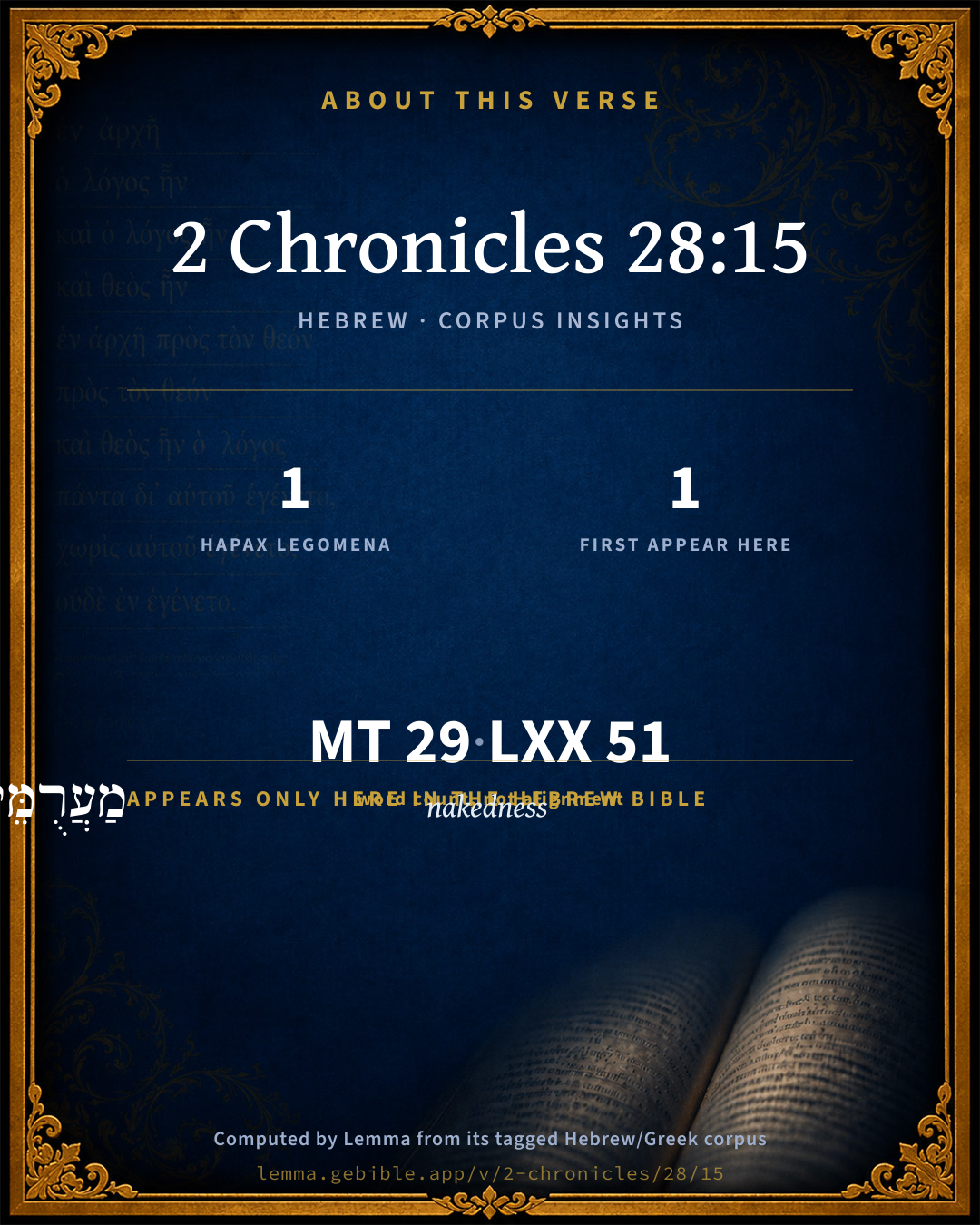
  • 1 hapax legomenon — only here in the Hebrew Bible
  • 1 first appearance in the Hebrew Bible
Full analysis ↓
Download a study sheet

One document with this verse’s original text, its word-by-word gloss line, the meaning frame, cross-references with their text, attributed commentary, and full source and license credits — printable, and it pastes into notes with its structure intact.

This verse Autodidact and up

Study sheet (.html) Plain text (.txt)

A passage Seminary Student

Up to 50 verses in one chapter. A passage sheet keeps up to 6 commentary sources and 12 cross-references per verse, in the order this page ranks them, and says so on the sheet whenever that leaves anything out. Ask for a single verse and you get the Autodidact verse sheet above.

Everything on this page stays free to read, with no account — the sheet is a download of what is already on screen, not access to it.

Want to remove ads? Support Godless Engineer
Compare translations 3

The same verse in 3 English versions, stacked beneath the original-language interlinear above. Click any original word for its lexicon entry.

Each is an independent rendering of the whole verse — the interlinear is not word-aligned to these translations.

Highlighted words mark where these versions differ — a whole-verse word diff, not a word-by-word alignment.

  • World English Bible Public Domain
    The men who have been mentioned by name rose up, and took the captives, and with the spoil clothed all who were naked among them, and arrayed them, and shod them, and gave them to eat and to drink, and anointed them, and carried all the feeble of them on donkeys, and brought them to Jericho, the city of palm trees, to their brothers: then they returned to Samaria.
  • King James Version Public Domain
    And the men which were expressed by name rose up, and took the captives, and with the spoil clothed all that were naked among them, and arrayed them, and shod them, and gave them to eat and to drink, and anointed them, and carried all the feeble of them upon asses, and brought them to Jericho, the city of palm trees, to their brethren: then they returned to Samaria.
  • unfoldingWord Literal Text CC BY-SA 4.0
    And the men who were marked by names rose and they grasped among the captives, and all their naked persons they clothed from the plunder. And they clothed them, and they gave them sandals. And they fed them, and they gave them drink. And they poured on them, and they led them on donkeys all who stumble. And they brought them to Jericho, the City of Palms, near their brothers. And they returned to Samaria.

unfoldingWord Literal Text — © unfoldingWord, licensed CC BY-SA 4.0. Word-aligned USFM3 via Door43 (git.door43.org/unfoldingWord/en_ult).

Versions to compare (up to 4)

3 of 4 selected

Show all 18 translations

Every available English version of this verse, each an independent rendering of the whole verse.

  • World English Bible Public Domain
    The men who have been mentioned by name rose up, and took the captives, and with the spoil clothed all who were naked among them, and arrayed them, and shod them, and gave them to eat and to drink, and anointed them, and carried all the feeble of them on donkeys, and brought them to Jericho, the city of palm trees, to their brothers: then they returned to Samaria.
  • Berean Standard Bible Public Domain
    Then the men who were designated by name arose, took charge of the captives, and provided from the plunder clothing for the naked. They clothed them, gave them sandals and food and drink, anointed their wounds, and put all the feeble on donkeys. So they brought them to Jericho, the City of Palms, to their brothers. Then they returned to Samaria.
  • Majority Standard Bible Public Domain
    Then the men who were designated by name arose, took charge of the captives, and provided from the plunder clothing for the naked. They clothed them, gave them sandals and food and drink, anointed their wounds, and put all the feeble on donkeys. So they brought them to Jericho, the City of Palms, to their brothers. Then they returned to Samaria.
  • King James Version Public Domain
    And the men which were expressed by name rose up, and took the captives, and with the spoil clothed all that were naked among them, and arrayed them, and shod them, and gave them to eat and to drink, and anointed them, and carried all the feeble of them upon asses, and brought them to Jericho, the city of palm trees, to their brethren: then they returned to Samaria.
  • American Standard Version (1901) Public Domain
    And the men that have been mentioned by name rose up, and took the captives, and with the spoil clothed all that were naked among them, and arrayed them, and shod them, and gave them to eat and to drink, and anointed them, and carried all the feeble of them upon asses, and brought them to Jericho, the city of palm-trees, unto their brethren: then they returned to Samaria.
  • Revised Version (1885) Public Domain
    And the men which have been expressed by name rose up, and took the captives, and with the spoil clothed all that were naked among them, and arrayed them, and shod them, and gave them to eat and to drink, and anointed them, and carried all the feeble of them upon asses, and brought them to Jericho, the city of palm trees, unto their brethren: then they returned to Samaria.
  • Geneva Bible (1599) Public Domain
    And the men that were named by name, rose vp and tooke the prisoners, and with the spoyle clothed all that were naked among them, and arayed them, and shod them, and gaue them meate, and gaue them drinke, and anoynted them, and caryed all that were feeble of them vpon asses, and brought them to Iericho the citie of Palme trees to their brethren: so they returned to Samaria.
  • Douay-Rheims (1899) Public Domain
    And the men, whom we mentioned above, rose up and took the captives, and with the spoils clothed all them that were naked: and when they had clothed and shed them, and refreshed them with meat and drink, and anointed them because of their labour, and had taken care of them, they set such of them as could not walk, and were feeble, upon beasts, and brought them to Jericho the city of palm trees to their brethren, and they returned to Samaria.
  • Young's Literal Translation Public Domain
    and the men who have been expressed by name rise and take hold on the captives, and all their naked ones they have clothed from the spoil, yea, they clothe them, and shoe them, and cause them to eat and drink, and anoint them, and lead them on asses, even every feeble one, and bring them in to Jericho, the city of palms, near their brethren, and turn back to Samaria.
  • Literal Standard Version CC BY-SA 4.0
    and the men who have been expressed by name rise and take hold on the captives, and they have clothed all their naked ones from the spoil, indeed, they clothe them, and shoe them, and cause them to eat and drink, and anoint them, and lead them on donkeys, even every feeble one, and bring them to Jericho, the city of palms, near their brothers, and return to Samaria.
  • Unlocked Literal Bible CC BY-SA 4.0
    The men who were assigned by name got up and took the prisoners, and clothed all who were naked among them with the plunder. They clothed them and gave them sandals. They gave them food to eat and drink. They treated their wounds and put the weak ones on donkeys. They took them back to their families in Jericho, (called the City of Palms). Then they returned to Samaria.
  • unfoldingWord Literal Text CC BY-SA 4.0
    And the men who were marked by names rose and they grasped among the captives, and all their naked persons they clothed from the plunder. And they clothed them, and they gave them sandals. And they fed them, and they gave them drink. And they poured on them, and they led them on donkeys all who stumble. And they brought them to Jericho, the City of Palms, near their brothers. And they returned to Samaria.
  • Darby Bible Public Domain
    And the men that have been expressed by name rose up, and took the captives, and with the spoil clothed all that were naked among them, and arrayed them, and shod them, and gave them to eat and to drink, and anointed them, and carried all the feeble of them on asses, and brought them to Jericho the city of palm-trees, to their brethren. And they returned to Samaria.
  • World Messianic Bible Public Domain
    The men who have been mentioned by name rose up and took the captives, and with the plunder clothed all who were naked among them, dressed them, gave them sandals, gave them something to eat and to drink, anointed them, carried all the feeble of them on donkeys, and brought them to Jericho, the city of palm trees, to their brothers. Then they returned to Samaria.
  • Webster's Bible Public Domain
    And the men who were expressed by name arose, and took the captives, and with the spoil clothed all that were naked among them, and arrayed them, and shod them, and gave them to eat and to drink, and anointed them, and carried all the feeble of them upon asses, and brought them to Jericho, the city of palm trees, to their brethren: then they returned to Samaria.
  • Free Bible Version CC BY-SA 4.0
    The men named above got up and took clothes from the plunder to those that had none, gave them sandals to wear, and food and drink, and put olive oil on their wounds. Those who couldn't walk any more they put on donkeys, and took them all to Jericho, the town of palms, to be close to the people of Judah.
  • Bible in Basic English Public Domain
    And those men who have been named went up and took the prisoners, clothing those among them who were uncovered, with things from the goods which had been taken in the war, and putting robes on them and shoes on their feet; and they gave them food and drink and oil for their bodies, and seating all the feeble among them on asses, they took them to Jericho, the town of palm-trees, to their people, and then went back to Samaria.
  • JPS Tanakh (1917) Public Domain
    And the men that have been mentioned by name rose up, and took the captives, and with the spoil clothed all that were naked among them, and arrayed them, and shod them, and gave them to eat and to drink, and anointed them, and carried all the feeble of them upon asses, and brought them to Jericho, the city of palm-trees, unto their brethren; then they returned to Samaria.

Literal Standard Version (2020), Covenant Press — licensed CC BY-SA 4.0. Text via the HelloAO Bible API (eBible.org). Unlocked Literal Bible (unfoldingWord) — licensed CC BY-SA 4.0. Text via the HelloAO Bible API (eBible.org). unfoldingWord Literal Text — © unfoldingWord, licensed CC BY-SA 4.0. Word-aligned USFM3 via Door43 (git.door43.org/unfoldingWord/en_ult). Free Bible Version, Dr. Jonathan Gallagher — licensed CC BY-SA 4.0. Text via the HelloAO Bible API (eBible.org).

Word by word

More ways to search: Search by grammar → Find every occurrence → Compare this word →

Practice this passage: Drill this verse → Learn its vocabulary →

מַעֲרֻמֵּיהֶם֮
maʻărôm
H4636
“naked ones · their”
Noun, Common, Masculine, Plural, Construct + Suffix, Personal, 3rd Person, Masculine, Plural
Part of Speech
Noun
Type
Common
Gender
Masculine
Number
Plural
State
Construct
Full BDB Definition

Origin: from H6191 , in the sense of stripping

TWOT: 1588d

naked thing, nakedness
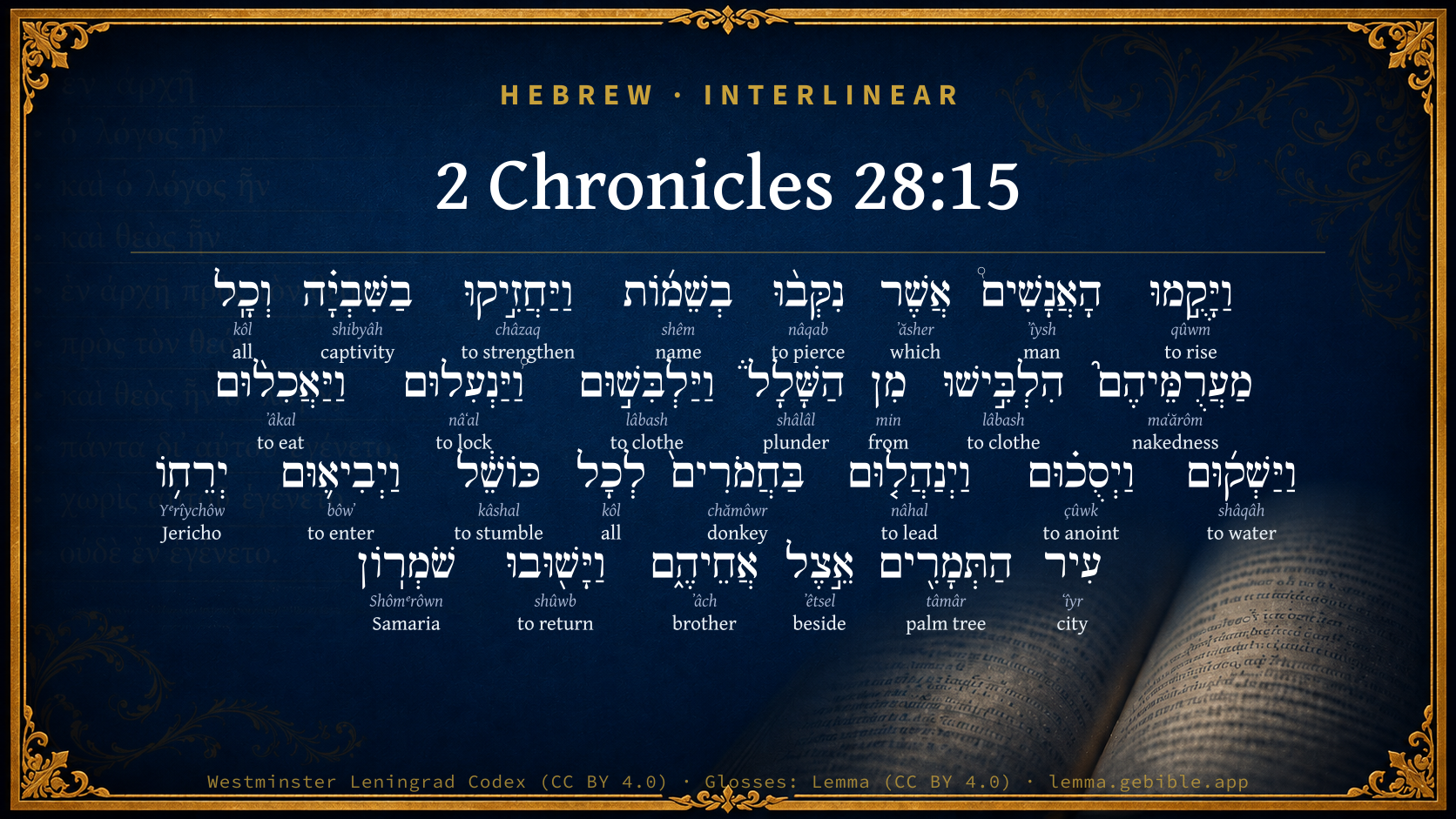
  1. וַיָּקֻ֣מוּ qûwm H6965 “and · to rise” Conjunction + Verb, Qal, Sequential Imperfect, 3rd Person, Masculine, Plural
  2. הָאֲנָשִׁים֩ ʼîysh H376 “the · men” Particle, Definite Article + Noun, Common, Masculine, Plural, Absolute
  3. אֲשֶׁר ʼăsher H834 “which” Particle, Relative
  4. נִקְּב֨וּ nâqab H5344 “to pierce” Verb, Niphal, Perfect, 3rd Person, Common, Plural
  5. בְשֵׁמ֜וֹת shêm H8034 “in/at · names” Preposition + Noun, Common, Masculine, Plural, Absolute
  6. וַיַּחֲזִ֣יקוּ châzaq H2388 “and · to strengthen” Conjunction + Verb, Hiphil, Sequential Imperfect, 3rd Person, Masculine, Plural
  7. בַשִּׁבְיָ֗ה shibyâh H7633 “in/at the · captivity” Preposition, Determined + Noun, Common, Both, Singular, Absolute
  8. וְכָֽל kôl H3605 “and · all of” Conjunction + Noun, Common, Masculine, Singular, Construct
  9. הִלְבִּ֣ישׁוּ lâbash H3847 “to clothe” Verb, Hiphil, Perfect, 3rd Person, Common, Plural
  10. מִן min H4480 “from” Preposition
  11. הַשָּׁלָל֒ shâlâl H7998 “the · plunder” Particle, Definite Article + Noun, Common, Masculine, Singular, Absolute
  12. וַיַּלְבִּשׁ֣וּם lâbash H3847 “and · to clothe · them” Conjunction + Verb, Hiphil, Sequential Imperfect, 3rd Person, Masculine, Plural + Suffix, Personal, 3rd Person, Masculine, Plural
  13. וַ֠יַּנְעִלוּם nâʻal H5274 “and · to lock · them” Conjunction + Verb, Hiphil, Sequential Imperfect, 3rd Person, Masculine, Plural + Suffix, Personal, 3rd Person, Masculine, Plural
  14. וַיַּאֲכִל֨וּם ʼâkal H398 “and · to eat · them” Conjunction + Verb, Hiphil, Sequential Imperfect, 3rd Person, Masculine, Plural + Suffix, Personal, 3rd Person, Masculine, Plural
  15. וַיַּשְׁק֜וּם shâqâh H8248 “and · to water · them” Conjunction + Verb, Hiphil, Sequential Imperfect, 3rd Person, Masculine, Plural + Suffix, Personal, 3rd Person, Masculine, Plural
  16. וַיְסֻכ֗וּם çûwk H5480 “and · to anoint · them” Conjunction + Verb, Qal, Sequential Imperfect, 3rd Person, Masculine, Plural + Suffix, Personal, 3rd Person, Masculine, Plural
  17. וַיְנַהֲל֤וּם nâhal H5095 “and · to lead · them” Conjunction + Verb, Piel, Sequential Imperfect, 3rd Person, Masculine, Plural + Suffix, Personal, 3rd Person, Masculine, Plural
  18. בַּחֲמֹרִים֙ chămôwr H2543 “in/at the · donkeys” Preposition, Determined + Noun, Common, Both, Plural, Absolute
  19. לְכָל kôl H3605 “to/for · all of” Preposition + Noun, Common, Masculine, Singular, Construct
  20. כּוֹשֵׁ֔ל kâshal H3782 “stumbling” Verb, Qal, Participle Active, Masculine, Singular, Absolute
  21. וַיְבִיא֛וּם bôwʼ H935 “and · to enter · them” Conjunction + Verb, Hiphil, Sequential Imperfect, 3rd Person, Masculine, Plural + Suffix, Personal, 3rd Person, Masculine, Plural
  22. יְרֵח֥וֹ Yᵉrîychôw H3405 “Jericho” Noun, Proper
  23. עִיר ʻîyr H5892 “city of” Noun, Common, Feminine, Singular, Construct
  24. הַתְּמָרִ֖ים tâmâr H8558 “the · palm trees” Particle, Definite Article + Noun, Common, Masculine, Plural, Absolute
  25. אֵ֣צֶל ʼêtsel H681 “beside” Preposition
  26. אֲחֵיהֶ֑ם ʼâch H251 “brothers · their” Noun, Common, Masculine, Plural, Construct + Suffix, Personal, 3rd Person, Masculine, Plural
  27. וַיָּשׁ֖וּבוּ shûwb H7725 “and · to return” Conjunction + Verb, Qal, Sequential Imperfect, 3rd Person, Masculine, Plural
  28. שֹׁמְרֽוֹן Shômᵉrôwn H8111 “Samaria” Noun, Proper

About this verse

These counts appear in no published source. They are computed here, from the morphology-tagged text and Lemma’s own curated glosses. What Lemma adds →

29
words
27
distinct lemmas
Historical
section

Notable vocabulary

1 hapax legomenon — a word that appears only here in the entire Hebrew Bible:

  • מַעֲרֻמֵּיהֶם֮ nakedness H4636

First appearance in Scripture

This word makes its first canonical appearance in the Hebrew Bible here:

  • מַעֲרֻמֵּיהֶם֮ nakedness H4636

Shared distinctive vocabulary

וַ֠יַּנְעִלוּם to lock H5274 occurs in 7 verses of the Hebrew Bible. Also found in:

Grammatical profile

  • 13 verbs
  • 13 nouns
  • 2 prepositions
  • 1 particle

Verb forms

  • וַיָּקֻ֣מוּ Qal · Sequential Imperfect
  • נִקְּב֨וּ Niphal · Perfect
  • וַיַּחֲזִ֣יקוּ Hiphil · Sequential Imperfect
  • הִלְבִּ֣ישׁוּ Hiphil · Perfect
  • וַיַּלְבִּשׁ֣וּם Hiphil · Sequential Imperfect
  • וַ֠יַּנְעִלוּם Hiphil · Sequential Imperfect
  • וַיַּאֲכִל֨וּם Hiphil · Sequential Imperfect
  • וַיַּשְׁק֜וּם Hiphil · Sequential Imperfect
  • וַיְסֻכ֗וּם Qal · Sequential Imperfect
  • וַיְנַהֲל֤וּם Piel · Sequential Imperfect
  • כּוֹשֵׁ֔ל Qal · Participle Active
  • וַיְבִיא֛וּם Hiphil · Sequential Imperfect
  • וַיָּשׁ֖וּבוּ Qal · Sequential Imperfect

Repetition

Words recur within this verse — often emphatic in Hebrew:

  • וְכָֽל all H3605 ×2
  • הִלְבִּ֣ישׁוּ to clothe H3847 ×2

Hebrew & Septuagint length

In English translation the verse runs 69 words from the Hebrew and 70 from the Septuagint (LXX English) — closely comparable.

A rough comparison of the two English renderings, which tokenize alike — not a word-level alignment.

Word counts can differ between the Hebrew and the Greek without any difference in meaning — e.g. the Hebrew direct-object marker אֵת has no separate Greek word, and Greek often adds the article ὁ.

In the original languages it is 29 Hebrew tokens and 51 Greek tokens — but the two are counted differently (Hebrew bundles its prefixes and suffixes into one token; the Greek is in lemma form), so that isn’t a like-for-like length.

Cross-references

17

Topical passages linked to 2 Chronicles 28:15 in the Treasury of Scripture Knowledge — connected by theme and wording, ordered by reader-vote popularity; previews shown in the World English Bible.

  • Deuteronomy 34:3 and the South, and the Plain of the valley of Jericho the city of palm trees, to Zoar.
  • Proverbs 25:21–22 If your enemy is hungry, give him food to eat; If he is thirsty, give him water to drink:
  • Judges 1:16 The children of the Kenite, Moses' brother-in-law, went up out of the city of palm trees with the children of Judah into the wilderness of Judah, which is in the south of Arad; and they went and lived with the people.
  • 2 Kings 6:22 He answered, You shall not strike them: would you strike those whom you have taken captive with your sword and with your bow? set bread and water before them, that they may eat and drink, and go to their master.
  • Job 31:15–23 Didn't he who made me in the womb make him? Didn't one fashion us in the womb?
  • Isaiah 58:7 Isn't it to deal your bread to the hungry, and that you bring the poor who are cast out to your house? when you see the naked, that you cover him; and that you not hide yourself from your own flesh?
  • Matthew 25:35–45 for I was hungry, and you gave me food to eat; I was thirsty, and you gave me drink; I was a stranger, and you took me in;
  • Luke 6:27 "But I tell you who hear: love your enemies, do good to those who hate you,
  • James 2:15–16 And if a brother or sister is naked and in lack of daily food,
  • 1 John 3:17–18 But whoever has the world's goods, and sees his brother in need, and closes his heart of compassion against him, how does the love of God remain in him?
  • 2 Chronicles 28:12 Then certain of the heads of the children of Ephraim, Azariah the son of Johanan, Berechiah the son of Meshillemoth, and Jehizkiah the son of Shallum, and Amasa the son of Hadlai, stood up against those who came from the war,
  • Luke 8:27 When Jesus stepped ashore, a certain man out of the city who had demons for a long time met him. He wore no clothes, and didn't live in a house, but in the tombs.
  • Luke 8:35 People went out to see what had happened. They came to Jesus, and found the man from whom the demons had gone out, sitting at Jesus' feet, clothed and in his right mind; and they were afraid.
  • Acts 9:39 Peter got up and went with them. When he had come, they brought him into the upper chamber. All the widows stood by him weeping, and showing the coats and garments which Dorcas had made while she was with them.
  • Romans 12:20–21 Therefore "If your enemy is hungry, feed him. If he is thirsty, give him a drink. For in doing so, you will heap coals of fire on his head."
  • Romans 15:1 Now we who are strong ought to bear the weaknesses of the weak, and not to please ourselves.
  • 1 Timothy 5:10 being approved by good works, if she has brought up children, if she has been hospitable to strangers, if she has washed the saints' feet, if she has relieved the afflicted, and if she has diligently followed every good work.

Cross-references courtesy of OpenBible.info (CC BY 4.0).

Hebrew and Greek witnesses Masoretic Hebrew ↔ Greek Septuagint

The same verse in the two great witnesses to the Old Testament, shown verse-for-verse.

These are two independent witnesses, not word-aligned to each other, and the Septuagint is shown in lemma (dictionary) form.

Hebrew 2 Chronicles 28:15 Masoretic · Westminster Leningrad Codex

וַיָּקֻ֣מוּ הָאֲנָשִׁים֩ אֲשֶׁר נִקְּב֨וּ בְשֵׁמ֜וֹת וַיַּחֲזִ֣יקוּ בַשִּׁבְיָ֗ה וְכָֽל מַעֲרֻמֵּיהֶם֮ הִלְבִּ֣ישׁוּ מִן הַשָּׁלָל֒ וַיַּלְבִּשׁ֣וּם וַ֠יַּנְעִלוּם וַיַּאֲכִל֨וּם וַיַּשְׁק֜וּם וַיְסֻכ֗וּם וַיְנַהֲל֤וּם בַּחֲמֹרִים֙ לְכָל כּוֹשֵׁ֔ל וַיְבִיא֛וּם יְרֵח֥וֹ עִיר הַתְּמָרִ֖ים אֵ֣צֶל אֲחֵיהֶ֑ם וַיָּשׁ֖וּבוּ שֹׁמְרֽוֹן

The men who have been mentioned by name rose up, and took the captives, and with the spoil clothed all who were naked among them, and arrayed them, and shod them, and gave them to eat and to drink, and anointed them, and carried all the feeble of them on donkeys, and brought them to Jericho, the city of palm trees, to their brothers: then they returned to Samaria.

World English Bible · Public Domain

Greek LXX 2 Chronicles 28:15 Septuagint · lemma form

καί ἀναἵστημι ἀνήρ ὅς ἐπικαλέω ἐν ὄνομα καί ἀντιλαμβάνω ὁ αἰχμαλωσία καί πᾶς ὁ γυμνός περιβάλλω ἀπό ὁ σκῦλον καί ἐνδύω αὐτός καί ὑποδέω αὐτός καί δίδωμι ἐσθίω καί ἀλείφω καί ἀντιλαμβάνω ἐν ὑποζύγιον πᾶς ἀσθενέω καί καταἵστημι αὐτός εἰς ιεριχω πόλις φοῖνιξ πρός ὁ ἀδελφός αὐτός καί ἐπιστρέφω εἰς σαμαρεία

And the men who were called by name rose up, and took hold of the prisoners, and clothed all the naked from the spoils, and gave them garments and shoes, and gave them food to eat, and oil to anoint themselves with, and they helped also every one that was weak with asses, and placed them in Jericho, the city of palm-trees, with their brethren; and they returned to Samaria.

LXX2012 (modern English Septuagint) · Public Domain

On this verse, John Gill's Exposition discusses the Septuagint’s reading. Read the note in Commentary ↓

Hebrew: Westminster Leningrad Codex (CC BY 4.0). Greek: Septuagint (public domain); English from LXX2012 (modern English Septuagint) (Public Domain). How the Septuagint differs from the Hebrew →

Commentary

Notes on 2 Chronicles 28:15 from classic Christian and Jewish commentators (each source and its license shown beneath its notes). The classic Christian expositions comment on the surrounding passage and are grouped to its opening verse, so a note may address several verses; the Jewish commentaries on the Tanakh (Rashi and others) are per-verse, so they appear only where the commentator wrote on this verse.

Lemma curates 59 commentaries, every one of them public domain or Creative Commons licensed, each selected and text-cleaned for this edition rather than reprinted as found. About our sources →

Trapp's Complete Commentary

John Trapp

2Ch 28:15 And the men which were expressed by name rose up, and took the captives, and with the spoil clothed all that were naked among them, and arrayed them, and shod them, and gave them to eat and to drink, and anointed them, and carried all the feeble of them upon asses, and brought them to Jericho, the city of palm trees, to their brethren: then they returned to Samaria.

Ver. 15. And anointed them, and carried all the feeble of them.] This was to "break off their iniquities by showing mercy to the poor, that there might be a lengthening of their tranquillity." {Dan 4:27} Clementia plus potest quam violentia. {a} Courtesy can do no more than cruelty, said Antigonus. Julius Caesar, Vespasian, Aurelian, and our Queen Elizabeth, are famous in history for showing mercy to their enemies.

{a} Plut.

John Trapp, A Commentary or Exposition upon All the Books of the Old and New Testament (1647–1656) — public domain. Text from a community e-Sword module.

Joseph Benson's Commentary

2Ch 28:15. The men expressed by name — Nominated and appointed by the heads of the people, to take care of the captives, and see them well treated, which they did even to a very high degree of humanity.

Joseph Benson's Commentary on the Old and New Testaments (1811–1818) — public domain. Text from a community e-Sword module.

Geneva Bible (1599)

Geneva Bible translators

Either for their wounds or weariness.

Whose name were rehearsed before, verse 12.

To them of the tribe of Judah.

Geneva Bible (1599) marginal notes — public domain. Text via Bolls.life.

Jamieson, Fausset & Brown

Robert Jamieson, A. R. Fausset & David Brown

the men which were expressed by name rose up--These were either the "heads of the children of Ephraim" (mentioned Ch2 28:12), or some other leading individuals chosen for the benevolent office. Under their kindly superintendence, the prisoners were not only released, but out of the spoils were comfortably relieved with food and clothing, and conveyed as far as Jericho on their way back to their own homes. This is a beautiful incident, and full of interest, as showing that even at this period of national decline, there were not a few who steadfastly adhered to the law of God.

Jamieson, Fausset & Brown — Commentary Critical and Explanatory on the Whole Bible (1871) — public domain (CC PDM 1.0). Text via the HelloAO Bible API.

Ellicott's Commentary for English Readers

(15) The men which . . . by name.—1Ch_12:31; 1Ch_16:41. Certain chiefs formally designated for the office, perhaps including those of 2Ch_28:12.

All that were naked.—Literally, and all their nakednesses they clad out of the spoil (ma’arummîm, “nakednesses,” here only).

(15) And arrayed . . . shod them.—And they clad them, and sandalled them. (For the miserable destitution of captives, see Isa_3:24; Isa_20:2; Isa_20:4, “naked and barefoot.”)

Anointed them (sûk, usually intransitive, e.g., 2Sa_14:2). (Comp. Luk_7:38.) A different word (mashah) was used to express the ceremonial anointing of kings and priests.

Carried all the feeble of them upon asses.—Literally, led them on he-asses, to wit, every stumbling one. There would be many such, as the captives were mostly women and children.

To.—Beside.

The writer dwells with manifest pleasure upon the kindness shown by their repentant foes of the northern kingdom to these Jewish captives. He may have intended to suggest a lesson to the Samaritans of his own age, whose bitter hostility had proved so damaging to the cause of the restored exiles (Neh_4:2; Neh_4:7-8; Neh_6:1-2 sqq.), and who, according to Rabbinical tradition, endeavoured to prejudice Alexander the Great against the commonwealth of Jerusalem (Talmud, Yoma, 69, A).

Some have supposed that our Lord had this passage in His mind when He uttered the parable of the Good Samaritan. The coincidences between the two stories are at any rate curious. (See Luk_10:30; Luk_10:33-34.)

The interposition of the Ephraite prophet Oded between the Ephraites and their Judæan captives is precisely parallel to that of the Judæan prophet Shemaiah between his people and the Ten Tribes, as related in 1Ki_12:22-24; and granting the truth of the one account, there can be no ground for suspecting the other.

A Bible Commentary for English Readers, edited by Charles John Ellicott (1878–1897) — public domain. Text from a community e-Sword module.

The Cambridge Bible for Schools and Colleges

gen. ed. J. J. S. Perowne

15. were expressed] R.V. have been expressed. The phrase is characteristic of the Chronicler; cp. 2Ch_31:19; 1Ch_12:31; 1Ch_16:41; Ezr_8:20.

took the captives] Render, took hold of the captives; i.e. succoured them; cp. Heb_2:16 (ἐπιλαμβάνεται = “he taketh hold of”).

to eat and to drink] Cp. 2Ki_6:23.

anointed them] Part of the host’s duty; cp. Luk_7:44-46.

to Jericho] Jericho perhaps belonged to the northern kingdom; cp. 1Ki_16:34; 2Ki_2:4. A road led to it from Mount Ephraim past ‘Ain ed-Duk, G. A. Smith, Hist. Geography, pp. 266 ff.

the city of palm trees] Cp. Deu_34:3. The phrase is an alternative name of Jericho; cp. Jdg_1:16; Jdg_3:13. Date palms were common in Jericho down to the seventh century of the Christian Era. Bädeker, p. 164.

to their brethren] Lit. “to the side of their brethren.” Jericho probably belonged to the northern kingdom; see above.

The Cambridge Bible for Schools and Colleges (gen. ed. J. J. S. Perowne; Cambridge University Press, 1878–1918) — public domain. Text from a community e-Sword module.

John Gill's Exposition

At that time did King Ahaz send to the kings of Assyria to help him. To Tiglathpileser, and his son, see Kg2 16:7, and the Septuagint, Vulgate Latin, Syriac, and Arabic versions, read in the singular, and so the Targum.

, and the Septuagint, Vulgate Latin, Syriac, and Arabic versions, read in the singular, and so the Targum.

2 Chronicles 28:17

ch2 28:17

ch2 28:17

ch2 28:17For again the Edomites had come,.... As in the days of Jehoshaphat, Ch2 20:10,

and smitten Judah, and carried away captives; taking the advantage of the weak and low condition Ahaz was in, and which was the reason of his sending to the king of Assyria.

John Gill's Exposition of the Whole Bible (1746–1763) — public domain (CC PDM 1.0). Text via the HelloAO Bible API.

Albert Barnes' Notes on the Bible

Jericho, which lies much farther from Samaria than many points of the territory of Judah, was perhaps selected because the captives had been carried off principally from this point; or because there may have been less danger of falling in with portions of Pekah’s army on this than on the direct route.

Albert Barnes' Notes on the Bible (1834–1885) — public domain. Text from a community e-Sword/MySword module.

Haydock's Catholic Bible Commentary

Above. Heb. "by name." They deserved to be immortalized. H. --- Anointed. This was very common, (M.) and refreshing. Celsus i. 3.

George Leo Haydock (1774–1849), Haydock's Catholic Family Bible and Commentary, 1859 edition — public domain. Excludes Psalms (Douay-Rheims chapter numbering differs from Protestant) and Deuterocanonical books (Catholic canon only).

Matthew Poole's English Annotations

Which were expressed by name; which were appointed to take care about the management of this business.

Matthew Poole's English Annotations on the Holy Bible (1683–1685) — public domain. Text from a community e-Sword/MySword module.

The Pulpit Commentary

The men which were expressed by name; Revised Version, which have been expressed by name. This is the probable, yet hardly certain, meaning of the clause. My name should be "by names." And the meaning may be that "the men who were now specified by names for the work rose up," etc. Under any aspect, it was likely enough these would embrace the four who had already spoken so piously and seasonably (2Ch_31:19; 1Ch_12:31 1Ch_16:41) The captives; Hebrew, hybvi literally, the captivity; i.e. of course, the body of captives (Deu_21:11 Deu_32:42) Clothed arrayed. These two renderings are both the same verb (vbl;), and even the same (hiph.) conjugation. The undisguised, apparent repetition in the Hebrew text, veiled and disguised in both the Authorized and Revised Versions, may perhaps be owing to the intentness of the narrative on saying, first, that all who were literally naked were clothed from their own captive spoil; and then, secondly, that all whosoever (dusty, dirty, tired, footsore) were clothed, in the sense of being fresh dressed. The eleven particulars of this verso are uncommonly graphic in the Hebrew text brevity of description. The verse may read thus: And the men appointed by their names rose up, and took the captives by the hand, and all of the naked of them they dressed from the very spoil, and dressed them (all), and shod them, and fed them, and gave them drink, and anointed them, and carried upon asses all the feeble ones, and brought them to Jericho, city of palms, to the very side of their brethren, and returned to Samaria. These made their own so far the blessedness of them of Mat_25:34-36. Jericho; i.e. well within their own land, to a fertile and shaded spot of it, with plenty of water, and whence probably all might most easily wend their ways to their own district and town, Jericho lay on the border of Benjamin. See Stanley"s most interesting account ("Sinai and Palestine," p. 805)

The Pulpit Commentary (1880–1919), ed. H.D.M. Spence-Jones & Joseph S. Exell — public domain. Text from a community e-Sword module.

John Wesley's Explanatory Notes

Were expressed - Who were appointed to take care about the management of this business.

John Wesley, Explanatory Notes Upon the Whole Bible (1754–1765) — public domain. Text via the GEBible commentary corpus.

Rashi

Rabbi Shlomo Yitzchaki (Rashi)

And the men who were mentioned by name arose above (verse 12). Who were they? Those men who were of the heads of the sons of Ephraim: Azariah the son of Jehohanan and his colleagues.

and all their nakedness - Heb. מַעֲרֻמֵּיהֶם, an expression of (Ezek. 15: “naked (עֵרם) and bare.”

Rashi on the Tanakh — English translations: “The Judaica Press complete Tanach with Rashi, translated by A. J. Rosenberg” (CC BY 4.0); “Pentateuch with Rashi's commentary by M. Rosenbaum and A.M. Silbermann, 1929-1934” (public domain); “The Metsudah Tanach series, Lakewood, N.J” (CC BY 4.0); and “The Book of Joshua, Metsudah Publications, 1997” (CC BY 4.0). Text via Sefaria.

Lesson kit

Teaching starters — assembled from the data on this page, not authored interpretation. Every prompt links to the verse data it draws on. Edit before teaching.

2 Chronicles, in the Historical, opens this verse with 29 words (27 distinct Hebrew lemmas). Its most distinctive word is maʻărôm (“nakedness”). A historical commentator’s framing appears above. Read the whole chapter for the surrounding context.

Discussion questions

  1. The word maʻărôm carries the sense “nakedness.” How does it shape the verse?
  2. This verse holds 1 word here found nowhere else in the Hebrew Bible. What might the rare word draw attention to?
  3. The word “nakedness” first appears here in Scripture. What is being introduced at this debut?
  4. Judges 3:23 shares the word «to lock» with this verse. How do the two illuminate each other?
  5. “all” occurs 2× in this one verse. What is the effect of the repetition?
  6. These translations render this verse differently; the difference is in the English rendering, not the original. What questions does that raise?
  7. The verb «וַיָּקֻ֣מוּ» is Qal Sequential Imperfect. How does its form color the action?
  8. Reading how Trapp's Complete Commentary and Joseph Benson's Commentary read this verse, where do the two commentators agree and where do they part?

Things to notice

  • 1 word in this verse appears nowhere else in the Hebrew Bible.
  • 1 word makes its first canonical appearance in Scripture here.
  • This verse counts 29 Hebrew ↔ 51 Greek words.
  • These translations choose different wording for 35 words in this verse.
  • “all” occurs 2× in this single verse.

Reading settings

Reading text

Shown beneath each verse's original-language words.

Old Testament
Old Testament edition

Read the OT as the Masoretic Hebrew (MT) or the Greek Septuagint (LXX).

English shown for the Greek Septuagint (in the Hebrew ↔ Greek comparison).

Comparing translations? Open the Compare panel on any verse page to stack up to four side by side.