
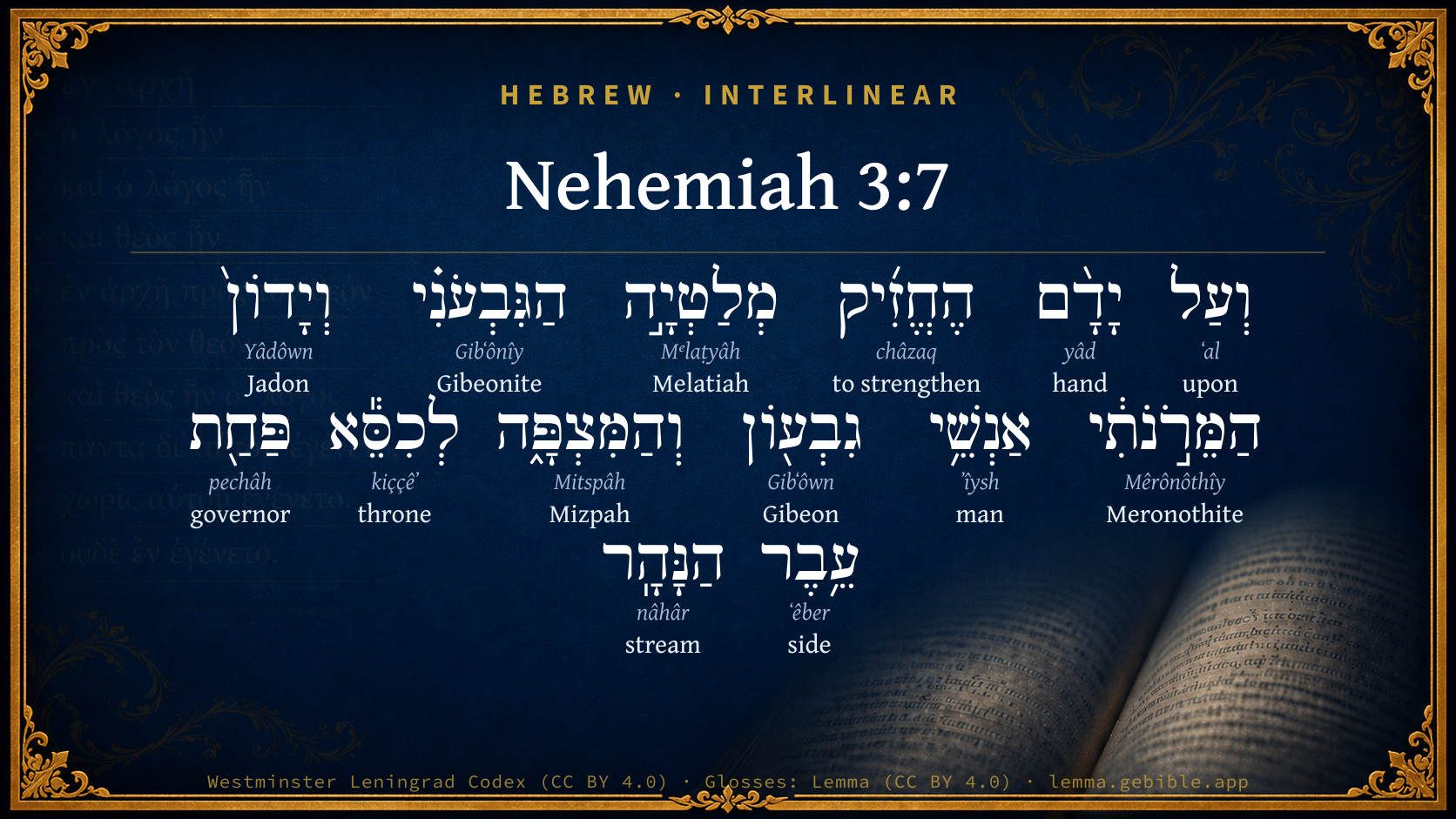
Nehemiah 3:7

Hebrew (Westminster Leningrad Codex) Nehemiah 3:7 appears in the Hebrew Old Testament. The text above is from the Westminster Leningrad Codex. Each word links to its Strong’s number, a concise gloss, and parsing drawn from the Open Scriptures Hebrew Bible morphology. Click any word for its full Brown-Driver-Briggs (BDB) entry.
Download image
Cite this verse

Nehemiah 3:7 (World English Bible). Public Domain. Lemma interlinear Bible study tool, https://lemma.gebible.app/v/nehemiah/3/7.

Show BibTeX & RIS
BibTeX
RIS
English Translation
Next to them repaired Melatiah the Gibeonite, and Jadon the Meronothite, the men of Gibeon, and of Mizpah, [that appertained] to the throne of the governor beyond the River.
World English Bible · Public Domain
Highlights
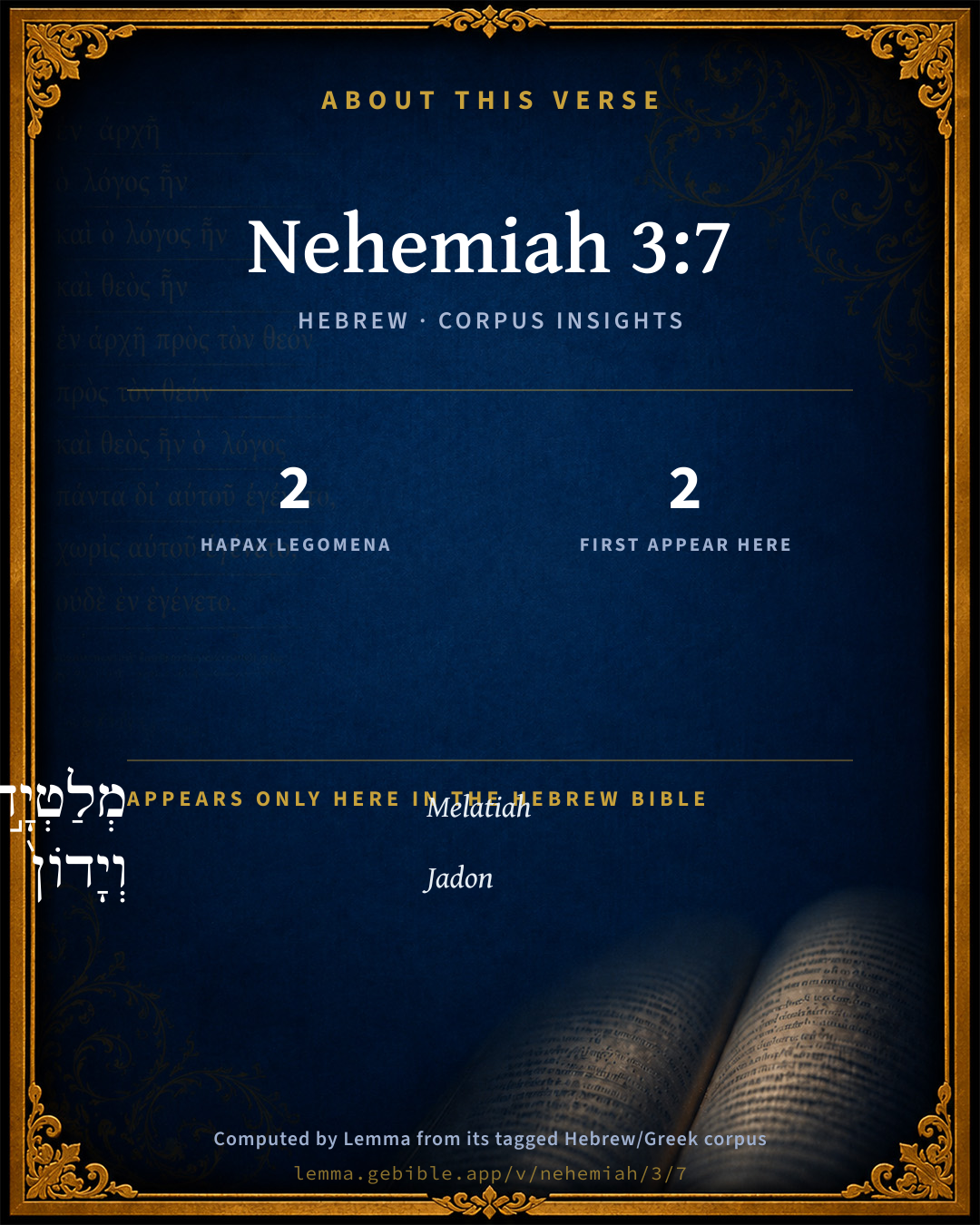
  • 2 hapax legomena — only here in the Hebrew Bible
  • 2 first appearances in the Hebrew Bible
Full analysis ↓
Download a study sheet

One document with this verse’s original text, its word-by-word gloss line, the meaning frame, cross-references with their text, attributed commentary, and full source and license credits — printable, and it pastes into notes with its structure intact.

This verse Autodidact and up

Study sheet (.html) Plain text (.txt)

A passage Seminary Student

Up to 50 verses in one chapter. A passage sheet keeps up to 6 commentary sources and 12 cross-references per verse, in the order this page ranks them, and says so on the sheet whenever that leaves anything out. Ask for a single verse and you get the Autodidact verse sheet above.

Everything on this page stays free to read, with no account — the sheet is a download of what is already on screen, not access to it.

Want to remove ads? Support Godless Engineer
Compare translations 3

The same verse in 3 English versions, stacked beneath the original-language interlinear above. Click any original word for its lexicon entry.

Each is an independent rendering of the whole verse — the interlinear is not word-aligned to these translations.

Highlighted words mark where these versions differ — a whole-verse word diff, not a word-by-word alignment.

  • World English Bible Public Domain
    Next to them repaired Melatiah the Gibeonite, and Jadon the Meronothite, the men of Gibeon, and of Mizpah, [that appertained] to the throne of the governor beyond the River.
  • King James Version Public Domain
    And next unto them repaired Melatiah the Gibeonite, and Jadon the Meronothite, the men of Gibeon, and of Mizpah, unto the throne of the governor on this side the river.
  • unfoldingWord Literal Text CC BY-SA 4.0
    And Melatiah the Gibeonite, and Jadon the Meronothite, men of Gibeon and the Mizpah, strengthened at their hand, to the seat of authority of the governor of Beyond-the-River.

unfoldingWord Literal Text — © unfoldingWord, licensed CC BY-SA 4.0. Word-aligned USFM3 via Door43 (git.door43.org/unfoldingWord/en_ult).

Versions to compare (up to 4)

3 of 4 selected

Show all 18 translations

Every available English version of this verse, each an independent rendering of the whole verse.

  • World English Bible Public Domain
    Next to them repaired Melatiah the Gibeonite, and Jadon the Meronothite, the men of Gibeon, and of Mizpah, [that appertained] to the throne of the governor beyond the River.
  • Berean Standard Bible Public Domain
    Next to them, repairs were made by Melatiah the Gibeonite, Jadon the Meronothite, and the men of Gibeon and Mizpah, who were under the authority of the governor of the region west of the Euphrates.
  • Majority Standard Bible Public Domain
    Next to them, repairs were made by Melatiah the Gibeonite, Jadon the Meronothite, and the men of Gibeon and Mizpah, who were under the authority of the governor of the region west of the Euphrates.
  • King James Version Public Domain
    And next unto them repaired Melatiah the Gibeonite, and Jadon the Meronothite, the men of Gibeon, and of Mizpah, unto the throne of the governor on this side the river.
  • American Standard Version (1901) Public Domain
    And next unto them repaired Melatiah the Gibeonite, and Jadon the Meronothite, the men of Gibeon, and of Mizpah, `that appertained' to the throne of the governor beyond the River.
  • Revised Version (1885) Public Domain
    And next unto them repaired Melatiah the Gibeonite, and Jadon the Meronothite, the men of Gibeon, and of Mizpah, which appertained to the throne of the governor beyond the river.
  • Geneva Bible (1599) Public Domain
    Next vnto them also fortified Melatiah the Gibeonite, and Iadon the Meronothite, men of Gibeon, and of Mizpah, vnto the throne of the Duke, which was beyond the Riuer.
  • Douay-Rheims (1899) Public Domain
    And next to them built Meltias the Gabaonite, and Jadon the Meronathite, the men of Gabaon and Maspha, for the governor that was in the country beyond the river.
  • Young's Literal Translation Public Domain
    And by their hand hath Melatiah the Gibeonite strengthened, and Jadon the Meronothite, men of Gibeon and of Mizpah, to the throne of the governor beyond the River.
  • Literal Standard Version CC BY-SA 4.0
    And by their hand Melatiah the Gibeonite has strengthened, and Jadon the Meronothite, men of Gibeon and of Mizpah, [belonging] to the throne of the governor beyond the River.
  • Unlocked Literal Bible CC BY-SA 4.0
    Next to them Melatiah the Gibeonite and Jadon the Meronothite, who were men from Gibeon and Mizpah, made repairs on the portion where the governor of the Province Beyond the River lived.
  • unfoldingWord Literal Text CC BY-SA 4.0
    And Melatiah the Gibeonite, and Jadon the Meronothite, men of Gibeon and the Mizpah, strengthened at their hand, to the seat of authority of the governor of Beyond-the-River.
  • Darby Bible Public Domain
    And next to them repaired Melatiah the Gibeonite, and Jadon the Meronothite, the men of Gibeon and of Mizpah, to the seat of the governor on this side the river.
  • World Messianic Bible Public Domain
    Next to them, Melatiah the Gibeonite and Jadon the Meronothite, the men of Gibeon and of Mizpah, repaired the residence of the governor beyond the River.
  • Webster's Bible Public Domain
    And next to them repaired Melatiah the Gibeonite, and Jadon the Meronothite, the men of Gibeon, and of Mizpah, to the throne of the governor on this side of the river.
  • Free Bible Version CC BY-SA 4.0
    Next were Melatiah the Gibeonite, Jadon the Meronothite, and the men of Gibeon and Mizpah, who were under the jurisdiction of the governor of the province west of the Euphrates.
  • Bible in Basic English Public Domain
    By their side were working Melatiah the Gibeonite and Jadon the Meronothite, the men of Gibeon and of Mizpah from the seat of the ruler across the river.
  • JPS Tanakh (1917) Public Domain
    And next unto them repaired Melatiah the Gibeonite, and Jadon the Meronothite, the men of Gibeon, and of Mizpah, for them that appertained to the throne of the governor beyond the River.

Literal Standard Version (2020), Covenant Press — licensed CC BY-SA 4.0. Text via the HelloAO Bible API (eBible.org). Unlocked Literal Bible (unfoldingWord) — licensed CC BY-SA 4.0. Text via the HelloAO Bible API (eBible.org). unfoldingWord Literal Text — © unfoldingWord, licensed CC BY-SA 4.0. Word-aligned USFM3 via Door43 (git.door43.org/unfoldingWord/en_ult). Free Bible Version, Dr. Jonathan Gallagher — licensed CC BY-SA 4.0. Text via the HelloAO Bible API (eBible.org).

Word by word

More ways to search: Search by grammar → Find every occurrence → Compare this word →

Practice this passage: Drill this verse → Learn its vocabulary →

מְלַטְיָ֣ה
Mᵉlaṭyâh
H4424
“Melatiah”
Noun, Proper
Part of Speech
Noun
Type
Proper
Full BDB Definition

Origin: from H4423 and H3050

TWOT: None

Melatiah = "Jehovah delivered" - a Gibeonite who assisted in rebuilding the wall of Jerusalem
  1. וְעַל ʻal H5921 “and · upon” Conjunction + Preposition
  2. יָדָ֨ם yâd H3027 “hand · their” Noun, Common, Both, Singular, Construct + Suffix, Personal, 3rd Person, Masculine, Plural
  3. הֶחֱזִ֜יק châzaq H2388 “to strengthen” Verb, Hiphil, Perfect, 3rd Person, Masculine, Singular
  4. הַגִּבְעֹנִ֗י Gibʻônîy H1393 “the · Gibeonite” Particle, Definite Article + Noun, Gentilic, Masculine, Singular, Absolute
  5. וְיָדוֹן֙ Yâdôwn H3036 “and · Jadon” Conjunction + Noun, Proper
  6. הַמֵּרֹ֣נֹתִ֔י Mêrônôthîy H4824 “the · Meronothite” Particle, Definite Article + Noun, Gentilic, Masculine, Singular, Absolute
  7. אַנְשֵׁ֥י ʼîysh H376 “men of” Noun, Common, Masculine, Plural, Construct
  8. גִבְע֖וֹן Gibʻôwn H1391 “Gibeon” Noun, Proper
  9. וְהַמִּצְפָּ֑ה Mitspâh H4709 “and · the · Mizpah” Conjunction + Particle, Definite Article + Noun, Proper
  10. לְכִסֵּ֕א kiççêʼ H3678 “to/for · throne of” Preposition + Noun, Common, Masculine, Singular, Construct
  11. פַּחַ֖ת pechâh H6346 “governor of” Noun, Common, Masculine, Singular, Construct
  12. עֵ֥בֶר ʻêber H5676 “side of” Noun, Common, Masculine, Singular, Construct
  13. הַנָּהָֽר nâhâr H5104 “the · stream” Particle, Definite Article + Noun, Common, Masculine, Singular, Absolute

About this verse

These counts appear in no published source. They are computed here, from the morphology-tagged text and Lemma’s own curated glosses. What Lemma adds →

14
words
14
distinct lemmas
Historical
section

Notable vocabulary

2 hapax legomena — words that appear only here in the entire Hebrew Bible:

  • מְלַטְיָ֣ה Melatiah H4424
  • וְיָדוֹן֙ Jadon H3036

First appearance in Scripture

These words make their first canonical appearance in the Hebrew Bible here:

  • מְלַטְיָ֣ה Melatiah H4424
  • וְיָדוֹן֙ Jadon H3036

Shared distinctive vocabulary

הַמֵּרֹ֣נֹתִ֔י Meronothite H4824 occurs in 2 verses of the Hebrew Bible. Also found in:

Grammatical profile

  • 1 verb
  • 12 nouns
  • 1 preposition

Verb forms

  • הֶחֱזִ֜יק Hiphil · Perfect

Cross-references

5

Topical passages linked to Nehemiah 3:7 in the Treasury of Scripture Knowledge — connected by theme and wording, ordered by reader-vote popularity; previews shown in the World English Bible.

  • 2 Samuel 21:2 The king called the Gibeonites, and said to them (now the Gibeonites were not of the children of Israel, but of the remnant of the Amorites; and the children of Israel had sworn to them: and Saul sought to kill them in his zeal for the children of Israel and Judah);
  • Joshua 9:3–27 But when the inhabitants of Gibeon heard what Joshua had done to Jericho and to Ai,
  • 2 Chronicles 16:6 Then Asa the king took all Judah; and they carried away the stones of Ramah, and the timber of it, with which Baasha had built; and he built therewith Geba and Mizpah.
  • Nehemiah 2:7–8 Moreover I said to the king, If it please the king, let letters be given me to the governors beyond the River, that they may let me pass through until I come to Judah;
  • Nehemiah 3:19 Next to him repaired Ezer the son of Jeshua, the ruler of Mizpah, another portion, over against the ascent to the armory at the turning [of the wall].

Cross-references courtesy of OpenBible.info (CC BY 4.0).

Hebrew and Greek witnesses Masoretic Hebrew ↔ Greek Septuagint

The same verse in the two great witnesses to the Old Testament, shown verse-for-verse.

These are two independent witnesses, not word-aligned to each other, and the Septuagint is shown in lemma (dictionary) form.

Hebrew Nehemiah 3:7 Masoretic · Westminster Leningrad Codex

וְעַל יָדָ֨ם הֶחֱזִ֜יק מְלַטְיָ֣ה הַגִּבְעֹנִ֗י וְיָדוֹן֙ הַמֵּרֹ֣נֹתִ֔י אַנְשֵׁ֥י גִבְע֖וֹן וְהַמִּצְפָּ֑ה לְכִסֵּ֕א פַּחַ֖ת עֵ֥בֶר הַנָּהָֽר

Next to them repaired Melatiah the Gibeonite, and Jadon the Meronothite, the men of Gibeon, and of Mizpah, [that appertained] to the throne of the governor beyond the River.

World English Bible · Public Domain

Greek LXX Structure differs

The Septuagint has no separate book of Nehemiah. Its Greek text is the second half of Esdras B (2 Esdras), chapters 11–23; Ezra is the first half (1–10).

A verse-for-verse comparison isn’t shown here because the chapters and verses don’t line up. Switch to the LXX edition with the MT / LXX toggle above to read the Greek directly.

On this verse, The Cambridge Bible for Schools and Colleges discusses the Septuagint’s reading. Read the note in Commentary ↓

Hebrew: Westminster Leningrad Codex (CC BY 4.0). Greek: Septuagint (public domain); English from a public-domain English Septuagint. How the Septuagint differs from the Hebrew →

Commentary

Notes on Nehemiah 3:7 from classic Christian and Jewish commentators (each source and its license shown beneath its notes). The classic Christian expositions comment on the surrounding passage and are grouped to its opening verse, so a note may address several verses; the Jewish commentaries on the Tanakh (Rashi and others) are per-verse, so they appear only where the commentator wrote on this verse.

Lemma curates 59 commentaries, every one of them public domain or Creative Commons licensed, each selected and text-cleaned for this edition rather than reprinted as found. About our sources →

Trapp's Complete Commentary

John Trapp

Neh 3:7 And next unto them repaired Melatiah the Gibeonite, and Jadon the Meronothite, the men of Gibeon, and of Mizpah, unto the throne of the governor on this side the river.

Ver. 7. Unto the throne of the governor] i.e. Of the king of Persia’s viceroy, who had there his throne, or tribunal. But to what a height of pride were the bishops grown, that sat in thrones, and from on high despised their fellow servants! this was their ruin, God putts down the mighty from their throne, and exalts them of low degree, Luk 1:52.

John Trapp, A Commentary or Exposition upon All the Books of the Old and New Testament (1647–1656) — public domain. Text from a community e-Sword module.

Joseph Benson's Commentary

Neh 3:7. Unto the throne of the governor on this side the river — Unto the place where the governor of the country on this side Euphrates, under the Persian kings, sometimes had a palace or throne.

Joseph Benson's Commentary on the Old and New Testaments (1811–1818) — public domain. Text from a community e-Sword module.

Tyndale Open Study Notes

Tyndale Open Resources

3:7 Gibeon and Mizpah were about six miles (10 kilometers) north of Jerusalem.

Tyndale Open Study Notes — © Tyndale Open Resources, licensed CC BY-SA 4.0. Text via the HelloAO Bible API.

Geneva Bible (1599)

Geneva Bible translators

Unto the place where the Duke was wont to sit in judgment, who governed the country in their absence.

Geneva Bible (1599) marginal notes — public domain. Text via Bolls.life.

Adam Clarke's Commentary

Verse 7. The throne of the governor] His house, and the place where he dispensed justice and judgment. Previously to the days of Nehemiah, Jerusalem was governed by a deputy from the Persian king; (see Ne 5:15;) but after this time they were governed by governors and judges chosen from among themselves.

Adam Clarke's Commentary on the Bible (1810–1826) — public domain. Text from a community e-Sword/MySword module.

Ellicott's Commentary for English Readers

(7) Unto the throne.—Unto the seat of the pechah of the whole district this side the Euphrates: his residence when he came to Jerusalem.

A Bible Commentary for English Readers, edited by Charles John Ellicott (1878–1897) — public domain. Text from a community e-Sword module.

The Cambridge Bible for Schools and Colleges

gen. ed. J. J. S. Perowne

7. Melatiah the Gibeonite, and Jadon the Meronothite, the men of Gibeon, and of Mizpah] In this arrangement of names it is natural to see the names of two leaders followed by the description of their respective followers. Melatiah is thus at the head of the Gibeonites, Jadon at the head of the men of Mizpah. But as the latter is called ‘the Meronothite’ (see also 1Ch_27:30), we conclude that Meronoth, his native place, must have been a village in the immediate neighbourhood of Mizpah.

The men of Gibeon are included in Neh_7:25 among those who returned with Zerubbabel (see the parallel passage, Ezr_2:20).

Mizpah, about 3½ miles N. of Jerusalem, the modern Nebi-Samwil. Rulers of Mizpah are further on mentioned as concerned in the restoration of other portions of the wall (Neh_3:15; Neh_3:19). The men of Mizpah referred to in this verse may have been under different control (see next note).

unto the throne of the governor on this side the river] R.V. which appertained to the throne of the governor beyond the river.

This obscure clause has occasioned great difficulty. (a) According to the rendering of the A.V., it denotes the limit of the restoration undertaken by the men mentioned in this verse. ‘The throne of the governor, &c.’ will then be the official residence of the Persian satrap or the actual throne in which he sate dispensing justice. The preposition ‘unto’ may be understood to mean, either that the governor’s house was built on the wall, and that the restoration mentioned in this verse reached this point; or that the governor’s ‘throne’ was in the vicinity, and the restoration was carried on to a point over against it.

The chief objection to this rendering is the use of the word ‘throne.’ But it is more simple than the alternative rendering given below. And the supposition is very natural, that an official spot, close to the chief northern gate of the city (Neh_3:6), should become a recognised landmark. The visit of the satrap of the country W. of the Euphrates to the provincial capitals would be a rare event; and the spot which symbolised his dignity would receive a distinctive name.

(b) According to the rendering of the R.V., the clause is added by way of limitation after the mention of Mizpah. Mizpah it is supposed was partly under Jewish rulers (Neh_3:15; Neh_3:19), partly under the rule of the Persian provincial governor. The boundary passed through the district of Mizpah. ‘The men of Mizpah,’ mentioned here, represented the portion under Persian rule, in which perhaps the village of Maronoth was included. By the indulgence of the Persian rulers (cf. Neh_2:7) a contingent was permitted to render aid to their brethren.

The phrase ‘the throne of the governor beyond the river’ will then be a technical term of authority in vogue among the Jews during the Persian supremacy. ‘Throne’ in the sense of ‘rule’ is poetical, cf. Psa_89:29; Psa_89:36.

There is nothing to be said in favour of another proposed rendering ‘in the name of the governor, &c.’ The Vulgate renders ‘pro duce,’ the LXX. ἕως θρόνου τοῦ ἄρχοντος.

The Cambridge Bible for Schools and Colleges (gen. ed. J. J. S. Perowne; Cambridge University Press, 1878–1918) — public domain. Text from a community e-Sword module.

John Gill's Exposition

And next unto them repaired Melatiah the Gibeonite, and Jadon the Meronothite, the men of Gibeon and Mizpah,.... Which places were both in the tribe of Benjamin, Jos 18:25 and one of these men was of the one place, and the other of the other:

unto the throne of the governor on this side the river; where the governor of those parts under the king of Persia had his seat, and now Nehemiah; but, according to Aben Ezra, Cisse, rendered "throne", is the name of a man who was the governor.

John Gill's Exposition of the Whole Bible (1746–1763) — public domain (CC PDM 1.0). Text via the HelloAO Bible API.

Albert Barnes' Notes on the Bible

Unto the throne ... - The meaning is thought to be “the men of Gibeon and Mizpah, who, though they worked for Nehemiah, were not under his government, but belonged to the jurisdiction of the governor on this side the river.”

Albert Barnes' Notes on the Bible (1834–1885) — public domain. Text from a community e-Sword/MySword module.

Haydock's Catholic Bible Commentary

For the. Hebrew, "for (Calmet; or) unto the throne of the governor on this side of the river." (Protestants) (Haydock) --- These people worked near the palace, which had been built for the Persian governor, who came to administer justice, till the time of Esdras, chap. v. 15., and 1 Esdras vii. 25. Perhaps the governor of Syria had (Haydock) assisted the Jews, unless Nehemias himself be meant. (Menochius)

George Leo Haydock (1774–1849), Haydock's Catholic Family Bible and Commentary, 1859 edition — public domain. Excludes Psalms (Douay-Rheims chapter numbering differs from Protestant) and Deuterocanonical books (Catholic canon only).

Matthew Poole's English Annotations

i.e. Unto the place where the governor of the country on this side the river Euphrates, for and under the Persian kings, sometimes had a palace or throne, to which all persons living in the adjacent parts were to resort for judgment.

Matthew Poole's English Annotations on the Holy Bible (1683–1685) — public domain. Text from a community e-Sword/MySword module.

Whedon's Commentary on the Bible

Daniel D. Whedon

7. Meronothite — A native or inhabitant of Meronoth, but no place of this name is now known. Compare 1Ch_27:30.

Unto the throne of the governor — The official residence of the Persian governor of Jerusalem. The governor of Jerusalem was one of the several officers of like character and authority on the west of the Euphrates. Comp. Neh_2:7. The throne is to be understood of the seat or tribunal where the governor sat to hear cases and dispense justice, and seems to have been somewhere along or against the northern wall.

Daniel D. Whedon (gen. ed.), Commentary on the Old and New Testaments (1874–1909) — public domain. Text from a community e-Sword module.

The Pulpit Commentary

Gibeon and Mispah lay due north of Jerusalem, at the distance respectively of about 5.5 and 4.5 miles The inhabitants were set to repair the middle part of the north wall. Unto the throne of the governor on this side the river. So the Septuagint; and, among moderns, Michaelis, Pool, and A. Clarke. Others translate men of Gibeon and Mizpah, who belonged to the jurisdiction of the governor across the river." But this can scarcely have been the fact, since Gibeon is mentioned among the reoccupied cities in Neh_7:25, and if Bethel was Jewish, as we know that it was from Neh_11:31, Gibeon and Mizpah, which were nearer Jerusalem, cannot have remained Syrian. Altogether, there is no reason to dispute the commonly received rendering, since Nehemiah again uses l for d in ver. 32, and the governor of Syria may well have had a "throne," or tribunal, at Jerusalem, which was usually under his jurisdiction, though exempted from his authority under the existing regime.

The Pulpit Commentary (1880–1919), ed. H.D.M. Spence-Jones & Joseph S. Exell — public domain. Text from a community e-Sword module.

John Wesley's Explanatory Notes

The throne - Unto the place where the governor of the country on this side Euphrates, under the Persian kings, sometimes had a palace or throne.

John Wesley, Explanatory Notes Upon the Whole Bible (1754–1765) — public domain. Text via the GEBible commentary corpus.

Rashi

Rabbi Shlomo Yitzchaki (Rashi)

a throne for the governor of the land beyond the river The [people of] the land beyond the river built a throne for the governor of the land beyond the river to sit upon.

Rashi on the Tanakh — English translations: “The Judaica Press complete Tanach with Rashi, translated by A. J. Rosenberg” (CC BY 4.0); “Pentateuch with Rashi's commentary by M. Rosenbaum and A.M. Silbermann, 1929-1934” (public domain); “The Metsudah Tanach series, Lakewood, N.J” (CC BY 4.0); and “The Book of Joshua, Metsudah Publications, 1997” (CC BY 4.0). Text via Sefaria.

Lesson kit

Teaching starters — assembled from the data on this page, not authored interpretation. Every prompt links to the verse data it draws on. Edit before teaching.

Nehemiah, in the Historical, opens this verse with 14 words (14 distinct Hebrew lemmas). Its most distinctive word is Mᵉlaṭyâh (“Melatiah”). A historical commentator’s framing appears above. Read the whole chapter for the surrounding context.

Discussion questions

  1. How does “Melatiah” (Mᵉlaṭyâh) shape what this verse is saying?
  2. 2 words here appear nowhere else in the Hebrew Bible. Why might the author reach for such rare wording?
  3. 2 words make their first appearance in Scripture here. What does this debut establish?
  4. How does 1 Chronicles 27:30, which shares the word «Meronothite», read alongside this verse?
  5. These translations render this verse differently. What is at stake in choosing one wording over another?
  6. «הֶחֱזִ֜יק» is a Hiphil Perfect verb. How does that grammatical form shape the action described?
  7. Compare how Trapp's Complete Commentary and Joseph Benson's Commentary read this verse. Where do they agree or differ?

Things to notice

  • 2 words in this verse appear nowhere else in the Hebrew Bible.
  • 2 words make their first canonical appearance in Scripture here.
  • These translations choose different wording for 12 words in this verse.
  • 14 distinct Hebrew lemmas span 14 words in this verse.

Reading settings

Reading text

Shown beneath each verse's original-language words.

Old Testament
Old Testament edition

Read the OT as the Masoretic Hebrew (MT) or the Greek Septuagint (LXX).

English shown for the Greek Septuagint (in the Hebrew ↔ Greek comparison).

Comparing translations? Open the Compare panel on any verse page to stack up to four side by side.