
Proverbs 3:18

Hebrew (Westminster Leningrad Codex) Proverbs 3:18 appears in the Hebrew Old Testament. The text above is from the Westminster Leningrad Codex. Each word links to its Strong’s number, a concise gloss, and parsing drawn from the Open Scriptures Hebrew Bible morphology. Click any word for its full Brown-Driver-Briggs (BDB) entry.
Download image
Cite this verse

Proverbs 3:18 (World English Bible). Public Domain. Lemma interlinear Bible study tool, https://lemma.gebible.app/v/proverbs/3/18.

Show BibTeX & RIS
BibTeX
RIS
English Translation
She is a tree of life to those who lay hold of her. Happy is everyone who retains her.
World English Bible · Public Domain
Download a study sheet

One document with this verse’s original text, its word-by-word gloss line, the meaning frame, cross-references with their text, attributed commentary, and full source and license credits — printable, and it pastes into notes with its structure intact.

This verse Autodidact and up

Study sheet (.html) Plain text (.txt)

A passage Seminary Student

Up to 50 verses in one chapter. A passage sheet keeps up to 6 commentary sources and 12 cross-references per verse, in the order this page ranks them, and says so on the sheet whenever that leaves anything out. Ask for a single verse and you get the Autodidact verse sheet above.

Everything on this page stays free to read, with no account — the sheet is a download of what is already on screen, not access to it.

Want to remove ads? Support Godless Engineer
Compare translations 3

The same verse in 3 English versions, stacked beneath the original-language interlinear above. Click any original word for its lexicon entry.

Each is an independent rendering of the whole verse — the interlinear is not word-aligned to these translations.

Highlighted words mark where these versions differ — a whole-verse word diff, not a word-by-word alignment.

  • World English Bible Public Domain
    She is a tree of life to those who lay hold of her. Happy is everyone who retains her.
  • King James Version Public Domain
    She is a tree of life to them that lay hold upon her: and happy is every one that retaineth her.
  • unfoldingWord Literal Text CC BY-SA 4.0
    She a tree of life to the ones who take hold of her, and those who grasp her happy.

unfoldingWord Literal Text — © unfoldingWord, licensed CC BY-SA 4.0. Word-aligned USFM3 via Door43 (git.door43.org/unfoldingWord/en_ult).

Versions to compare (up to 4)

3 of 4 selected

Show all 18 translations

Every available English version of this verse, each an independent rendering of the whole verse.

  • World English Bible Public Domain
    She is a tree of life to those who lay hold of her. Happy is everyone who retains her.
  • Berean Standard Bible Public Domain
    She is a tree of life to those who embrace her, and those who lay hold of her are blessed.
  • Majority Standard Bible Public Domain
    She is a tree of life to those who embrace her, and those who lay hold of her are blessed.
  • King James Version Public Domain
    She is a tree of life to them that lay hold upon her: and happy is every one that retaineth her.
  • American Standard Version (1901) Public Domain
    She is a tree of life to them that lay hold upon her: And happy is every one that retaineth her.
  • Revised Version (1885) Public Domain
    She is a tree of life to them that lay hold upon her: and happy is every one that retaineth her.
  • Geneva Bible (1599) Public Domain
    She is a tree of life to them that lay holde on her, and blessed is he that retaineth her.
  • Douay-Rheims (1899) Public Domain
    She is a tree of life to them that lay hold on her: and he that shall retain her is blessed.
  • Young's Literal Translation Public Domain
    A tree of life she `is' to those laying hold on her, And whoso is retaining her `is' happy.
  • Literal Standard Version CC BY-SA 4.0
    She [is] a tree of life to those laying hold on her, || And whoever is retaining her [is] blessed.
  • Unlocked Literal Bible CC BY-SA 4.0
    She is a tree of life to those who take hold of it, those who hold on to it are happy.
  • unfoldingWord Literal Text CC BY-SA 4.0
    She a tree of life to the ones who take hold of her, and those who grasp her happy.
  • Darby Bible Public Domain
    She is a tree of life to them that lay hold upon her; and happy is he that retaineth her.
  • World Messianic Bible Public Domain
    She is a tree of life to those who lay hold of her. Happy is everyone who retains her.
  • Webster's Bible Public Domain
    She is a tree of life to them that lay hold upon her: and happy is every one that retaineth her.
  • Free Bible Version CC BY-SA 4.0
    Wisdom is a tree of life to everyone who embraces her, blessing those who accept her.
  • Bible in Basic English Public Domain
    She is a tree of life to all who take her in their hands, and happy is everyone who keeps her.
  • JPS Tanakh (1917) Public Domain
    She is a tree of life to them that lay hold upon her, and happy is every one that holdest her fast.

Literal Standard Version (2020), Covenant Press — licensed CC BY-SA 4.0. Text via the HelloAO Bible API (eBible.org). Unlocked Literal Bible (unfoldingWord) — licensed CC BY-SA 4.0. Text via the HelloAO Bible API (eBible.org). unfoldingWord Literal Text — © unfoldingWord, licensed CC BY-SA 4.0. Word-aligned USFM3 via Door43 (git.door43.org/unfoldingWord/en_ult). Free Bible Version, Dr. Jonathan Gallagher — licensed CC BY-SA 4.0. Text via the HelloAO Bible API (eBible.org).

Word by word

More ways to search: Search by grammar → Find every occurrence → Compare this word →

Practice this passage: Drill this verse → Learn its vocabulary →

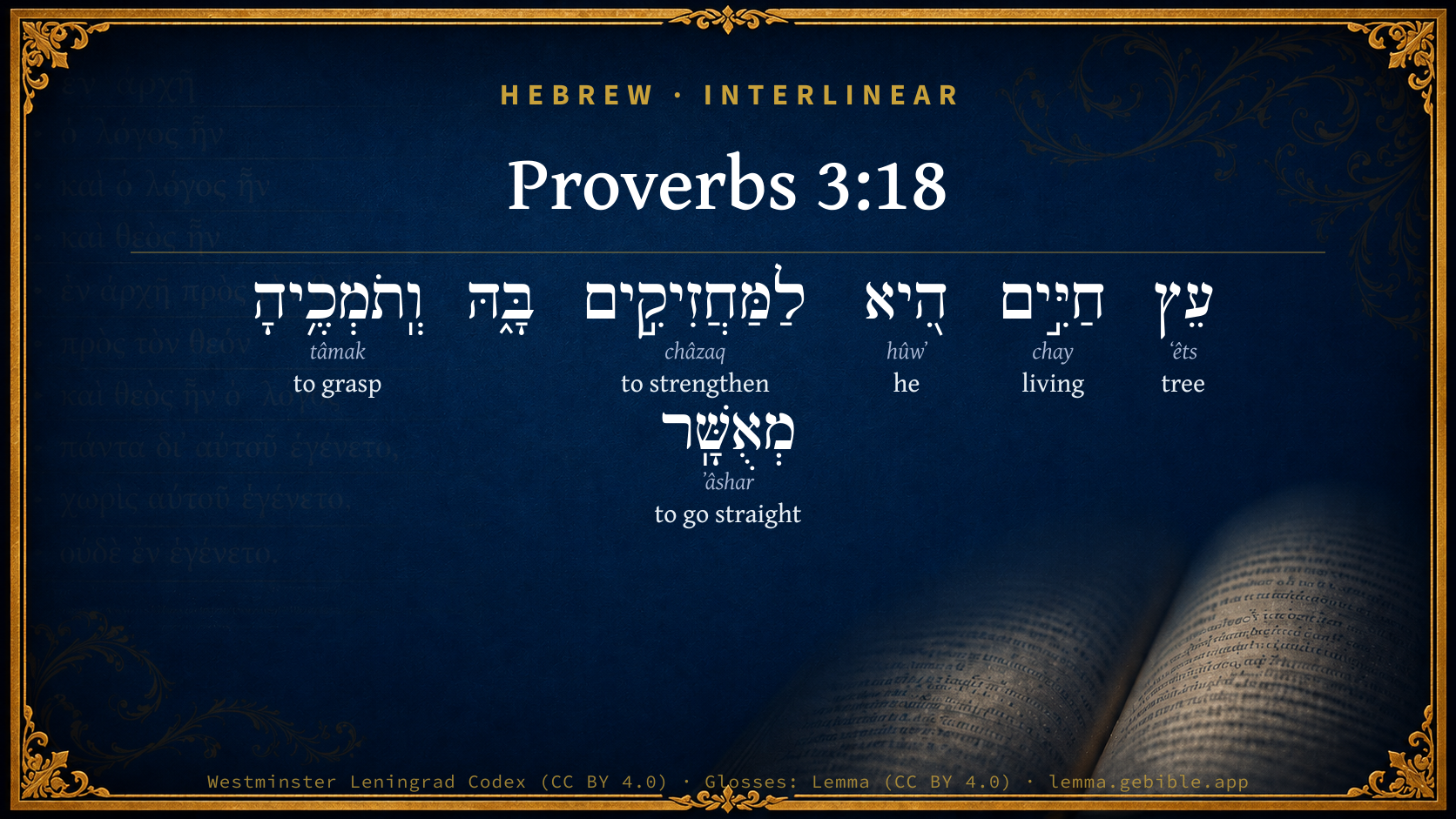
מְאֻשָּֽׁר
ʼâshar
H833
“gone straight”
Verb, Pual, Participle Passive, Masculine, Singular, Absolute
Part of Speech
Verb
Stem
Pual
Form
Participle Passive
Gender
Masculine
Number
Singular
State
Absolute
Full BDB Definition

Origin: a primitive root

TWOT: 183

to go straight, walk, go on, advance, make progress - (Qal) to go straight on, make progress - (Piel) - to go straight on, advance - to lead on (causative) - to set right, righten - to pronounce happy, call blessed - (Pual) - to be advanced, be led on - to be made happy, be blessed
  1. עֵץ ʻêts H6086 “tree of” Noun, Common, Masculine, Singular, Construct
  2. חַיִּ֣ים chay H2416 “living things” Noun, Common, Masculine, Plural, Absolute
  3. הִ֭יא hûwʼ H1931 “he” Pronoun, Personal, 3rd Person, Feminine, Singular
  4. לַמַּחֲזִיקִ֣ים châzaq H2388 “to/for the · strengthening” Preposition, Determined + Verb, Hiphil, Participle Active, Masculine, Plural, Absolute
  5. וְֽתֹמְכֶ֥יהָ tâmak H8551 “and · grasping · her” Conjunction + Verb, Qal, Participle Active, Masculine, Plural, Construct + Suffix, Personal, 3rd Person, Feminine, Singular

About this verse

These counts appear in no published source. They are computed here, from the morphology-tagged text and Lemma’s own curated glosses. What Lemma adds →

7
words
6
distinct lemmas
Wisdom
section

Notable vocabulary

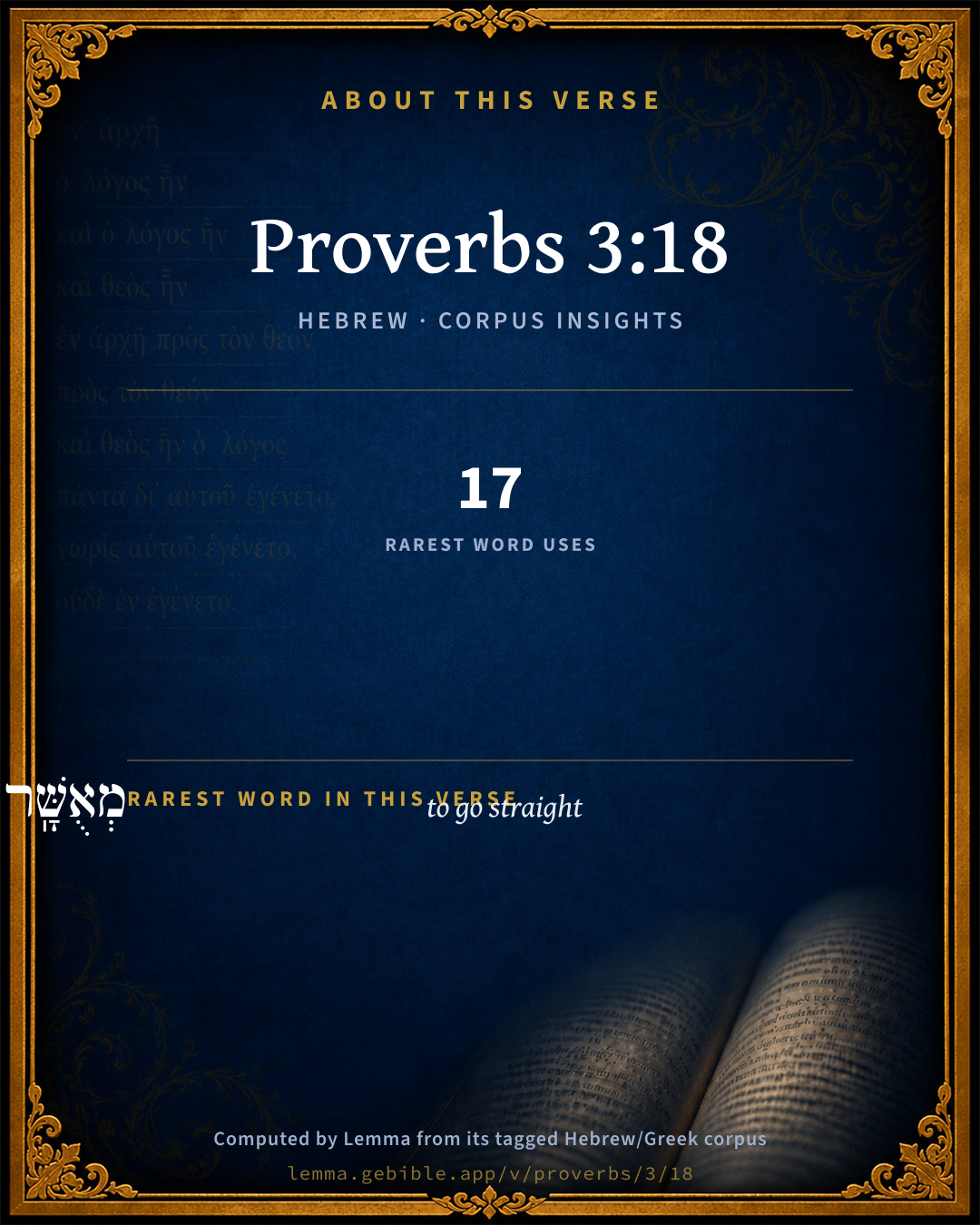
The rarest word here is מְאֻשָּֽׁר to go straight H833 — appearing just 17 times in the whole Hebrew Bible.

Shared distinctive vocabulary

מְאֻשָּֽׁר to go straight H833 occurs in 15 verses of the Hebrew Bible. Also found in:

Grammatical profile

  • 3 verbs
  • 2 nouns
  • 1 pronoun
  • 1 preposition

Verb forms

  • לַמַּחֲזִיקִ֣ים Hiphil · Participle Active
  • וְֽתֹמְכֶ֥יהָ Qal · Participle Active
  • מְאֻשָּֽׁר Pual · Participle Passive

Hebrew & Septuagint length

In English translation the verse runs 19 words from the Hebrew and 30 from the Septuagint (LXX English) — the Septuagint runs noticeably longer here. See the side-by-side →

A rough comparison of the two English renderings, which tokenize alike — not a word-level alignment.

Word counts can differ between the Hebrew and the Greek without any difference in meaning — e.g. the Hebrew direct-object marker אֵת has no separate Greek word, and Greek often adds the article ὁ.

Cross-references

7

Topical passages linked to Proverbs 3:18 in the Treasury of Scripture Knowledge — connected by theme and wording, ordered by reader-vote popularity; previews shown in the World English Bible.

  • Proverbs 11:30 The fruit of the righteous is a tree of life. He who is wise wins souls.
  • Proverbs 15:4 A gentle tongue is a tree of life, But deceit in it crushes the spirit.
  • Revelation 2:7 He who has an ear, let him hear what the Spirit says to the assemblies. To him who overcomes I will give to eat of the tree of life, which is in the Paradise of my God.
  • Genesis 2:9 Out of the ground Yahweh God made every tree to grow that is pleasant to the sight, and good for food; the tree of life also in the midst of the garden, and the tree of the knowledge of good and evil.
  • Genesis 3:22 Yahweh God said, "Behold, the man has become like one of us, knowing good and evil. Now, lest he put forth his hand, and also take of the tree of life, and eat, and live forever..."
  • Proverbs 13:12 Hope deferred makes the heart sick, But when longing is fulfilled, it is a tree of life.
  • Revelation 22:2 in the middle of its street. On this side of the river and on that was the tree of life, bearing twelve kinds of fruits, yielding its fruit every month. The leaves of the tree were for the healing of the nations.

Cross-references courtesy of OpenBible.info (CC BY 4.0).

Hebrew and Greek witnesses Masoretic Hebrew ↔ Greek Septuagint

The same verse in the two great witnesses to the Old Testament, shown verse-for-verse.

Here the Septuagint runs noticeably longer than the Hebrew — LXX2012 (modern English Septuagint) 30 words vs World English Bible 19. A rough length comparison of the two English translations, not a word-level alignment — read both below.

These are two independent witnesses, not word-aligned to each other, and the Septuagint is shown in lemma (dictionary) form.

Hebrew Proverbs 3:18 Masoretic · Westminster Leningrad Codex

עֵץ חַיִּ֣ים הִ֭יא לַמַּחֲזִיקִ֣ים בָּ֑הּ וְֽתֹמְכֶ֥יהָ מְאֻשָּֽׁר

She is a tree of life to those who lay hold of her. Happy is everyone who retains her.

World English Bible · Public Domain

Greek LXX Proverbs 3:18 Septuagint · lemma form

ξύλον ζωή εἰμί πᾶς ὁ ἀντιἔχω αὐτός καί ὁ ἐπιἐρείδω ἐπί αὐτός ὡς ἐπί κύριος ἀσφαλής

She is a tree of life to all that lay hold upon her; and she is a secure help to all that stay themselves on her, as on the Lord.

LXX2012 (modern English Septuagint) · Public Domain

On this verse, The Pulpit Commentary discusses the Septuagint’s reading. Read the note in Commentary ↓

Hebrew: Westminster Leningrad Codex (CC BY 4.0). Greek: Septuagint (public domain); English from LXX2012 (modern English Septuagint) (Public Domain). How the Septuagint differs from the Hebrew →

Commentary

Notes on Proverbs 3:18 from classic Christian and Jewish commentators (each source and its license shown beneath its notes). The classic Christian expositions comment on the surrounding passage and are grouped to its opening verse, so a note may address several verses; the Jewish commentaries on the Tanakh (Rashi and others) are per-verse, so they appear only where the commentator wrote on this verse.

Lemma curates 59 commentaries, every one of them public domain or Creative Commons licensed, each selected and text-cleaned for this edition rather than reprinted as found. About our sources →

Trapp's Complete Commentary

John Trapp

Pro 3:18 She [is] a tree of life to them that lay hold upon her: and happy [is every one] that retaineth her.

Ver. 18. She is a tree of life.] A tree that giveth life and quickeneth: or, as one interprets it, a most assured sign of eternal life; whatsoever it is, he alludeth, no doubt, to the tree mentioned in Gen 2:9; Gen 3:22. {See Trapp "Gen 2:9"} {See Trapp "Gen 3:22"}

And happy is every one that retaineth her.] Though despised by the world as a poor sneak, a contemptible capative. We usually call a poor man a poor soul; a poor soul may be a rich Christian; as Roger, surnamed Paupere censu, was son to Roger Bishop of Salisbury, who made him Chancellor of England. {a}

{a} Goodwin’s Catal., p. 388.

John Trapp, A Commentary or Exposition upon All the Books of the Old and New Testament (1647–1656) — public domain. Text from a community e-Sword module.

Tyndale Open Study Notes

Tyndale Open Resources

3:18 The tree of life alludes to the original tree in the Garden of Eden (Gen 2:9).

Tyndale Open Study Notes — © Tyndale Open Resources, licensed CC BY-SA 4.0. Text via the HelloAO Bible API.

Geneva Bible (1599)

Geneva Bible translators

Which bringeth forth such fruit that they that eat thereof have life: and he alludeth to the tree of life in paradise.

Geneva Bible (1599) marginal notes — public domain. Text via Bolls.life.

Jamieson, Fausset & Brown

Robert Jamieson, A. R. Fausset & David Brown

Wisdom allegorized as

a tree of life-- (Gen 2:9; Gen 3:22) whose fruit preserves life, gives all that makes living a blessing.

Jamieson, Fausset & Brown — Commentary Critical and Explanatory on the Whole Bible (1871) — public domain (CC PDM 1.0). Text via the HelloAO Bible API.

Adam Clarke's Commentary

Verse 18. She is a tree of life] עץ חיים ets chaiyim, "the tree of lives," alluding most manifestly to the tree so called which God in the beginning planted in the garden of Paradise, by eating the fruit of which all the wastes of nature might have been continually repaired, so as to prevent death for ever. This is an opinion which appears probable enough. The blessings which wisdom-true religion-gives to men, preserve them in life, comfort them through life, cause them to triumph in death, and ensure them a glorious immortality.

Adam Clarke's Commentary on the Bible (1810–1826) — public domain. Text from a community e-Sword/MySword module.

Ellicott's Commentary for English Readers

(18) A tree of life.—Evidently an allusion to Genesis 2, 3. No mention is made of it except in Proverbs (Pro_11:30; Pro_13:12; Pro_15:4) and Revelation (Pro_2:7; Pro_22:2).

A Bible Commentary for English Readers, edited by Charles John Ellicott (1878–1897) — public domain. Text from a community e-Sword module.

The Cambridge Bible for Schools and Colleges

gen. ed. J. J. S. Perowne

18. a tree of life] The tree of life, Genesis 2, 3 is referred to again in this Book (Pro_11:30, Pro_13:12, Pro_15:4), and only besides in the Bible in Rev_2:7; Rev_22:2. The tree of the knowledge of good and evil was a tree of death: “in the day that thou eatest thereof, thou shalt surely die.” The tree of Wisdom is a tree of life.

Pro_3:19-20. And the wisdom which is thus profitable to man, is none other than that by which God erected the firm fabric of earth and heaven, and furnished it with such storehouses of force and fertility, as “the waters that are under, and the waters that are above the firmament.”

In our present Hebrew text a new paragraph begins here, and here only in this chapter. But, as has been said, the argument is in reality continuous throughout.

The Cambridge Bible for Schools and Colleges (gen. ed. J. J. S. Perowne; Cambridge University Press, 1878–1918) — public domain. Text from a community e-Sword module.

John Gill's Exposition

She is a tree of life,.... Or "lives" (b); so Christ is called, Rev 2:7; in allusion to the tree of life in the garden of Eden, Gen 2:9; he being the author of life, natural, spiritual, and eternal; which souls may come at, and pluck and eat of the fruit which is upon him in great plenty and variety, even all the blessings of grace and glory;

to them that lay hold upon her; which is expressive of an act of faith on Christ, Heb 6:18; faith lays hold on the person of Christ as a Saviour, and will have him and no other; it comes to the blood of Christ, and deals with it for pardon and purification; it lays hold on his skirt, who is a Jew, on the robe of his righteousness, and puts it on; it lays hold on his strength, and goes forth in it, in the exercise of grace and discharge of duty; it lays hold on his covenant, the blessings and promises of it, and takes them to itself: and this act supposes danger without him, safety in him, a view of suitable provisions for food and clothing with him; some strength of grace, and some degree of resolution; also condescension on Christ's part to suffer himself to be handled by them; and likewise that he first took hold on them and brought them out of a state of nature to himself: great encouragement there is for sensible sinners to lay hold on Christ; he is set before them in the Gospel to be laid hold on; he never discourages any from so doing, nor casts out any that come to him; he is able to bear the stress of their salvation they lay upon him; multitudes of lost sinners have been saved by him: and he is a tree of life, as the text says, to such persons; they have spiritual life, and the support and comfort of it, from him now, and may expect everlasting life from him hereafter;

and happy is everyone that retaineth her; or "holds her fast" (c); see Sol 3:4; as such may be said to do who constantly apply to him for fresh communications of grace; who walk on in him as they have received him, and hold fast the profession of their faith in him. The phrase is expressive of great affection to him, and strong faith in him; faith keeps its hold of Christ through great darkness and many difficulties; oftentimes the soul walks in darkness, and yet stays itself on Christ, and, Abraham-like, believes in hope against hope. Faith is sometimes very low, and yet lets not go its hold; it fails not, through the prevalent intercession of Christ; it cannot so let go its hold as that there is a parting; a partial departing there may be, but not a total one: however, it is sometimes very difficult for faith to keep fast hold of the Redeemer; it is for the honour and comfort of believers so to do; and it is their mercy that interest in Christ, and salvation by him, do not depend on acts of faith; for, though "we believe not, yet he abides faithful", Ti2 2:13; nevertheless happy are they that retain him, or are steadfast in their faith on him; they have much communion with him now, and shall live with him for evermore hereafter.

(b) "lignum vitarum", Montanus. (c) "significatur hoc verbo, firmitas et constantia in tonendo", Michaelis; so Mercerus.

John Gill's Exposition of the Whole Bible (1746–1763) — public domain (CC PDM 1.0). Text via the HelloAO Bible API.

Albert Barnes' Notes on the Bible

This and the other references in Proverbs Pro 11:30; Pro 13:12; Pro 15:4 are the only allusions in any book of the Old Testament, after Genesis, to the “tree” itself, or to its spiritual significance. Further, there is the tendency to a half-allegorizing application of that history. “The tree of life” which Adam was not to taste lies open to his children. Wisdom is the “tree of life,” giving a true immortality. The symbol entered largely into the religious imagery. of Assyria, Egypt, and Persia. Philo, going a step further, found in the two trees the ideal representatives of speculative knowledge and moral wisdom; and the same image subserves a higher purpose in the promises and the visions of Rev 2:7; Rev 22:2.

Albert Barnes' Notes on the Bible (1834–1885) — public domain. Text from a community e-Sword/MySword module.

Haydock's Catholic Bible Commentary

Life. Like that planted in paradise, Genesis ii. 9.

George Leo Haydock (1774–1849), Haydock's Catholic Family Bible and Commentary, 1859 edition — public domain. Excludes Psalms (Douay-Rheims chapter numbering differs from Protestant) and Deuterocanonical books (Catholic canon only).

Matthew Poole's English Annotations

She is a tree of life; she is a certain pledge and mean of everlasting life and happiness. He alludes to that tree of life, Gen 2:9; 3:22; which if eaten by man in Paradise before his fall, should have perpetually preserved him in life, and health, and rigour; and intimates that this is the only restorer of that life which we have lost by sin.

That lay hold upon her; that eagerly pursue after her, and when they overtake her do greedily and gladly apprehend and embrace her, as the Hebrew word signifies.

That retaineth her; that holdeth her fast, and is constantly resolved not to forsake her.

Matthew Poole's English Annotations on the Holy Bible (1683–1685) — public domain. Text from a community e-Sword/MySword module.

Whedon's Commentary on the Bible

Daniel D. Whedon

18. Tree of life — Well paraphrased by Patrick: “In short, wisdom leads into a paradise, and supplies the place of the tree of life, (Gen_2:9; Gen_3:22,) from which our first parents were banished: that is, gives not only a present but an immortal satisfaction to all those who strongly apprehend and retain her precepts; and, therefore, I again pronounce him happy above all other men, and above all expression, who constantly and firmly adheres to them.”

Retaineth her — Hardly strong enough. Better, holdeth her fast. Comp. Pro_11:30; Pro_13:12; Pro_15:4; Rev_2:7; Rev_22:2.

This, and Pro_11:30; Pro_13:12; Pro_15:4, are the only allusions in the Old Testament to the spiritual significance of the tree of life; indeed, the only references of any sort exclusive of those in Genesis.

Daniel D. Whedon (gen. ed.), Commentary on the Old and New Testaments (1874–1909) — public domain. Text from a community e-Sword module.

The Pulpit Commentary

A tree of life (ets-khayyim); Vulgate, lignum vitae; LXX, xulon zwhv . This expression obviously refers to "the tree of life" (etshakayyim), which was placed in the midst of the garden of Eden, and conferred immortality on those who ate of its fruit. (Gen_2:9 Gen_3:22) So Wisdom becomes equally life giving to those who lay hold on her, who taste of her fruit. She communicates life in its manifold fulness and richness (so the plural "lives" indicates) to those who seize her firmly. What is predicated of Wisdom here is predicated in other passages (Pro_11:30 Pro_13:12 Pro_15:4) of the fruit of the righteous, the fulfilment of desire, and a wholesome tongue. Each of these, the teacher says, is "a tree of life." Elster denies that there is any reference to "the tree of life," and classes the expression among those other figurative expressions a "fountain of life," in Pro_13:4 and Pro_14:27, and a "well of life." in Pro_10:11; but if it be once admitted that there is such a reference, and it be remembered also that Wisdom is the same as "the fear of the Lord," the point insisted on in the Proverbs and in Job, it seems difficult to deny that the teacher has in view the blessed immortality of which the tree of life in Paradise as the symbol. In this higher sense the term is used in the Revelation. (Rev_2:7 Rev_22:2, Rev_22:14) Wisdom restores to her worshippers the life which was lost in Adam (Cartwright). It is remarkable that the imagery here employed is confined to these two hooks. After the historical record in Genesis, no other sacred writers refer to the tree of life. Old ecclesiastical writers saw in the expression a reference to Christ"s redeeming work. "The tree of life is the cross of Christ," lignum vitae crux Christi (quoted by Delitzsch). The symbol, Plumptre remarks, entered largely into the religious imagery of Assyria, Egypt, and Persia. To them that lay hold upon (lam-makhazikim, hiph. participle); Vulgate, his, qui apprehenderint; LXX, toiv antecomenoiv . The Hebrew verb qzj (khazak), "to tie fast," is in hiph. with B (b)," to take hold of," "to seize any one." Happy is every one that retaineth her. In the original, the participle, "they retaining her" (tom"keyah), is plural, and the predicate, "happy" or "blessed" (m"ushshar ), is singular. The latter is used distributively, and the construction is common. (cf. Pro_15:22)

The Authorized Version aptly renders the original. The necessity for "retaining" as well as "laying hold" of Wisdom is pointed out. The verb (tamak) is "to hold fast something taken." Such will be blessed who hold Wisdom tenaciously and perseveringly.

The Pulpit Commentary (1880–1919), ed. H.D.M. Spence-Jones & Joseph S. Exell — public domain. Text from a community e-Sword module.

John Wesley's Explanatory Notes

A tree - A pledge of everlasting life. He alludes to the tree of life, and intimates, that this is the only restorer of that life which we have lost by sin.

John Wesley, Explanatory Notes Upon the Whole Bible (1754–1765) — public domain. Text via the GEBible commentary corpus.

Rashi

Rabbi Shlomo Yitzchaki (Rashi)

for those who grasp it Heb. למחזיקים for those who hold onto it, as in (Ex. 4:4): “and he extended his hand and grasped (ויחזק) it.”

and those who draw near it are fortunate Heb. ותמכיה, those who draw near it. Likewise, every expression of תמיכה in this Book means that he holds onto it.

Rashi on the Tanakh — English translations: “The Judaica Press complete Tanach with Rashi, translated by A. J. Rosenberg” (CC BY 4.0); “Pentateuch with Rashi's commentary by M. Rosenbaum and A.M. Silbermann, 1929-1934” (public domain); “The Metsudah Tanach series, Lakewood, N.J” (CC BY 4.0); and “The Book of Joshua, Metsudah Publications, 1997” (CC BY 4.0). Text via Sefaria.

Lesson kit

Teaching starters — assembled from the data on this page, not authored interpretation. Every prompt links to the verse data it draws on. Edit before teaching.

Proverbs, in the Wisdom, opens this verse with 7 words (6 distinct Hebrew lemmas). Its most distinctive word is ʼâshar (“to go straight”). The Greek Septuagint runs longer here. A historical commentator’s framing appears above. Read the whole chapter for the surrounding context.

Discussion questions

  1. What does “to go straight” (ʼâshar) contribute to the verse as a whole?
  2. How does Genesis 30:13, which shares the word «to go straight», read alongside this verse?
  3. The Septuagint runs longer here than the Hebrew. What might account for the difference?
  4. These translations render this verse differently; the difference is in the English rendering, not the original. What questions does that raise?
  5. «לַמַּחֲזִיקִ֣ים» is a Hiphil Participle Active verb. How does that grammatical form shape the action described?
  6. Compare how Trapp's Complete Commentary and Tyndale Open Study Notes read this verse. Where do they agree or differ?

Things to notice

Reading settings

Reading text

Shown beneath each verse's original-language words.

Old Testament
Old Testament edition

Read the OT as the Masoretic Hebrew (MT) or the Greek Septuagint (LXX).

English shown for the Greek Septuagint (in the Hebrew ↔ Greek comparison).

Comparing translations? Open the Compare panel on any verse page to stack up to four side by side.