
Deuteronomy 11:8

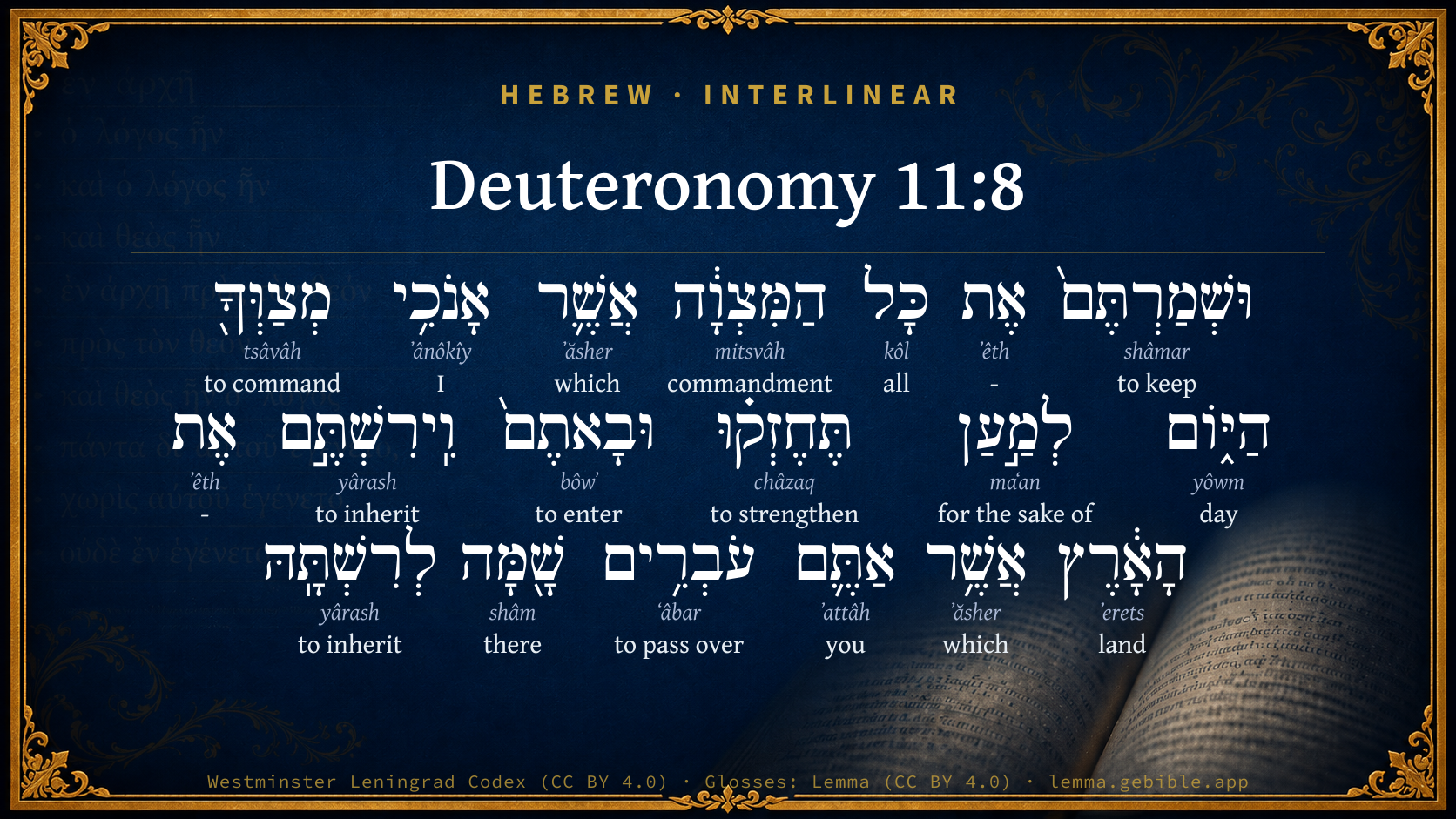
Hebrew (Westminster Leningrad Codex) Deuteronomy 11:8 appears in the Hebrew Old Testament. The text above is from the Westminster Leningrad Codex. Each word links to its Strong’s number, a concise gloss, and parsing drawn from the Open Scriptures Hebrew Bible morphology. Click any word for its full Brown-Driver-Briggs (BDB) entry.
Download image
Cite this verse

Deuteronomy 11:8 (World English Bible). Public Domain. Lemma interlinear Bible study tool, https://lemma.gebible.app/v/deuteronomy/11/8.

Show BibTeX & RIS
BibTeX
RIS
English Translation
Therefore shall you keep all the commandment which I command you this day, that you may be strong, and go in and possess the land, where you go over to possess it;
World English Bible · Public Domain
Download a study sheet

One document with this verse’s original text, its word-by-word gloss line, the meaning frame, cross-references with their text, attributed commentary, and full source and license credits — printable, and it pastes into notes with its structure intact.

This verse Autodidact and up

Study sheet (.html) Plain text (.txt)

A passage Seminary Student

Up to 50 verses in one chapter. A passage sheet keeps up to 6 commentary sources and 12 cross-references per verse, in the order this page ranks them, and says so on the sheet whenever that leaves anything out. Ask for a single verse and you get the Autodidact verse sheet above.

Everything on this page stays free to read, with no account — the sheet is a download of what is already on screen, not access to it.

Want to remove ads? Support Godless Engineer
Compare translations 3

The same verse in 3 English versions, stacked beneath the original-language interlinear above. Click any original word for its lexicon entry.

Each is an independent rendering of the whole verse — the interlinear is not word-aligned to these translations.

Highlighted words mark where these versions differ — a whole-verse word diff, not a word-by-word alignment.

  • World English Bible Public Domain
    Therefore shall you keep all the commandment which I command you this day, that you may be strong, and go in and possess the land, where you go over to possess it;
  • King James Version Public Domain
    Therefore shall ye keep all the commandments which I command you this day, that ye may be strong, and go in and possess the land, whither ye go to possess it;
  • unfoldingWord Literal Text CC BY-SA 4.0
    And you shall keep all the commandments that I am commanding you today so that you may be strong and go in and possess the land to which you are going over to possess it

unfoldingWord Literal Text — © unfoldingWord, licensed CC BY-SA 4.0. Word-aligned USFM3 via Door43 (git.door43.org/unfoldingWord/en_ult).

Versions to compare (up to 4)

3 of 4 selected

Show all 17 translations

Every available English version of this verse, each an independent rendering of the whole verse.

  • World English Bible Public Domain
    Therefore shall you keep all the commandment which I command you this day, that you may be strong, and go in and possess the land, where you go over to possess it;
  • Berean Standard Bible Public Domain
    You shall therefore keep every commandment I am giving you today, so that you may have the strength to go in and possess the land that you are crossing the Jordan to possess,
  • Majority Standard Bible Public Domain
    You shall therefore keep every commandment I am giving you today, so that you may have the strength to go in and possess the land that you are crossing the Jordan to possess,
  • King James Version Public Domain
    Therefore shall ye keep all the commandments which I command you this day, that ye may be strong, and go in and possess the land, whither ye go to possess it;
  • American Standard Version (1901) Public Domain
    Therefore shall ye keep all the commandment which I command thee this day, that ye may be strong, and go in and possess the land, whither ye go over to possess it;
  • Revised Version (1885) Public Domain
    Therefore shall ye keep all the commandment which I command thee this day, that ye may be strong, and go in and possess the land, whither ye go over to possess it;
  • Geneva Bible (1599) Public Domain
    Therefore shall ye keepe all the commandements, which I commaund you this day, that ye may be strong, and go in and possesse the land whither ye goe to possesse it:
  • Young's Literal Translation Public Domain
    and ye have kept all the command which I am commanding thee to-day, so that ye are strong, and have gone in, and possessed the land whither ye are passing over to possess it,
  • Literal Standard Version CC BY-SA 4.0
    And you have kept all the command which I am commanding you today, so that you are strong, and have gone in, and possessed the land to where you are passing over to possess it,
  • Unlocked Literal Bible CC BY-SA 4.0
    Therefore keep all the commandments that I am commanding you today, that you may be strong, and go in and possess the land where you are going over to possess it,
  • unfoldingWord Literal Text CC BY-SA 4.0
    And you shall keep all the commandments that I am commanding you today so that you may be strong and go in and possess the land to which you are going over to possess it
  • Darby Bible Public Domain
    Keep then all the commandment which I command you this day, that ye may be strong, and enter in and possess the land, whither ye pass over to possess it;
  • World Messianic Bible Public Domain
    Therefore you shall keep the entire commandment which I command you today, that you may be strong, and go in and possess the land that you go over to possess;
  • Webster's Bible Public Domain
    Therefore shall ye keep all the commandments which I command you this day, that ye may be strong, and go in and possess the land, whither ye go to possess it;
  • Free Bible Version CC BY-SA 4.0
    So you must keep every commandment I am giving you today That way you will have the strength to enter and take over the country that you are crossing the Jordan to have as your own,
  • Bible in Basic English Public Domain
    So keep all the orders which I give you today, so that you may be strong, and go in and take the land which is to be your heritage;
  • JPS Tanakh (1917) Public Domain
    Therefore shall ye keep all the commandment which I command thee this day, that ye may be strong, and go in and possess the land, whither ye go over to possess it;

Literal Standard Version (2020), Covenant Press — licensed CC BY-SA 4.0. Text via the HelloAO Bible API (eBible.org). Unlocked Literal Bible (unfoldingWord) — licensed CC BY-SA 4.0. Text via the HelloAO Bible API (eBible.org). unfoldingWord Literal Text — © unfoldingWord, licensed CC BY-SA 4.0. Word-aligned USFM3 via Door43 (git.door43.org/unfoldingWord/en_ult). Free Bible Version, Dr. Jonathan Gallagher — licensed CC BY-SA 4.0. Text via the HelloAO Bible API (eBible.org).

Word by word

More ways to search: Search by grammar → Find every occurrence → Compare this word →

Practice this passage: Drill this verse → Learn its vocabulary →

הַמִּצְוָ֔ה
mitsvâh
H4687
“the · commandment”
Particle, Definite Article + Noun, Common, Feminine, Singular, Absolute
Part of Speech
Particle + Noun
Type
Common
Gender
Feminine
Number
Singular
State
Absolute
Full BDB Definition

Origin: from H6680

TWOT: 1887b

commandment - commandment (of man) - the commandment (of God) - commandment (of code of wisdom)
  1. וּשְׁמַרְתֶּם֙ shâmar H8104 “and · to keep” Conjunction + Verb, Qal, Sequential Perfect, 2nd Person, Masculine, Plural
  2. אֶת ʼêth H853 “-” Particle, Direct Object
  3. כָּל kôl H3605 “all of” Noun, Common, Masculine, Singular, Construct
  4. אֲשֶׁ֛ר ʼăsher H834 “which” Particle, Relative
  5. אָנֹכִ֥י ʼânôkîy H595 “I” Pronoun, Personal, 1st Person, Common, Singular
  6. מְצַוְּךָ֖ tsâvâh H6680 “commanding · you” Verb, Piel, Participle Active, Masculine, Singular, Construct + Suffix, Personal, 2nd Person, Masculine, Singular
  7. הַיּ֑וֹם yôwm H3117 “the · day” Particle, Definite Article + Noun, Common, Masculine, Singular, Absolute
  8. לְמַ֣עַן maʻan H4616 “for the sake of” Preposition
  9. תֶּחֶזְק֗וּ châzaq H2388 “to strengthen” Verb, Qal, Imperfect, 2nd Person, Masculine, Plural
  10. וּבָאתֶם֙ bôwʼ H935 “and · to enter” Conjunction + Verb, Qal, Sequential Perfect, 2nd Person, Masculine, Plural
  11. וִֽירִשְׁתֶּ֣ם yârash H3423 “and · to inherit” Conjunction + Verb, Qal, Sequential Perfect, 2nd Person, Masculine, Plural
  12. אֶת ʼêth H853 “-” Particle, Direct Object
  13. הָאָ֔רֶץ ʼerets H776 “the · land” Particle, Definite Article + Noun, Common, Both, Singular, Absolute
  14. אֲשֶׁ֥ר ʼăsher H834 “which” Particle, Relative
  15. אַתֶּ֛ם ʼattâh H859 “you” Pronoun, Personal, 2nd Person, Masculine, Plural
  16. עֹבְרִ֥ים ʻâbar H5674 “passing over” Verb, Qal, Participle Active, Masculine, Plural, Absolute
  17. שָׁ֖מָּה shâm H8033 “there · toward” Adverb + Suffix, Demonstrative
  18. לְרִשְׁתָּֽהּ yârash H3423 “to inherit · her” Preposition + Verb, Qal, Infinitive Construct + Suffix, Personal, 3rd Person, Feminine, Singular

About this verse

These counts appear in no published source. They are computed here, from the morphology-tagged text and Lemma’s own curated glosses. What Lemma adds →

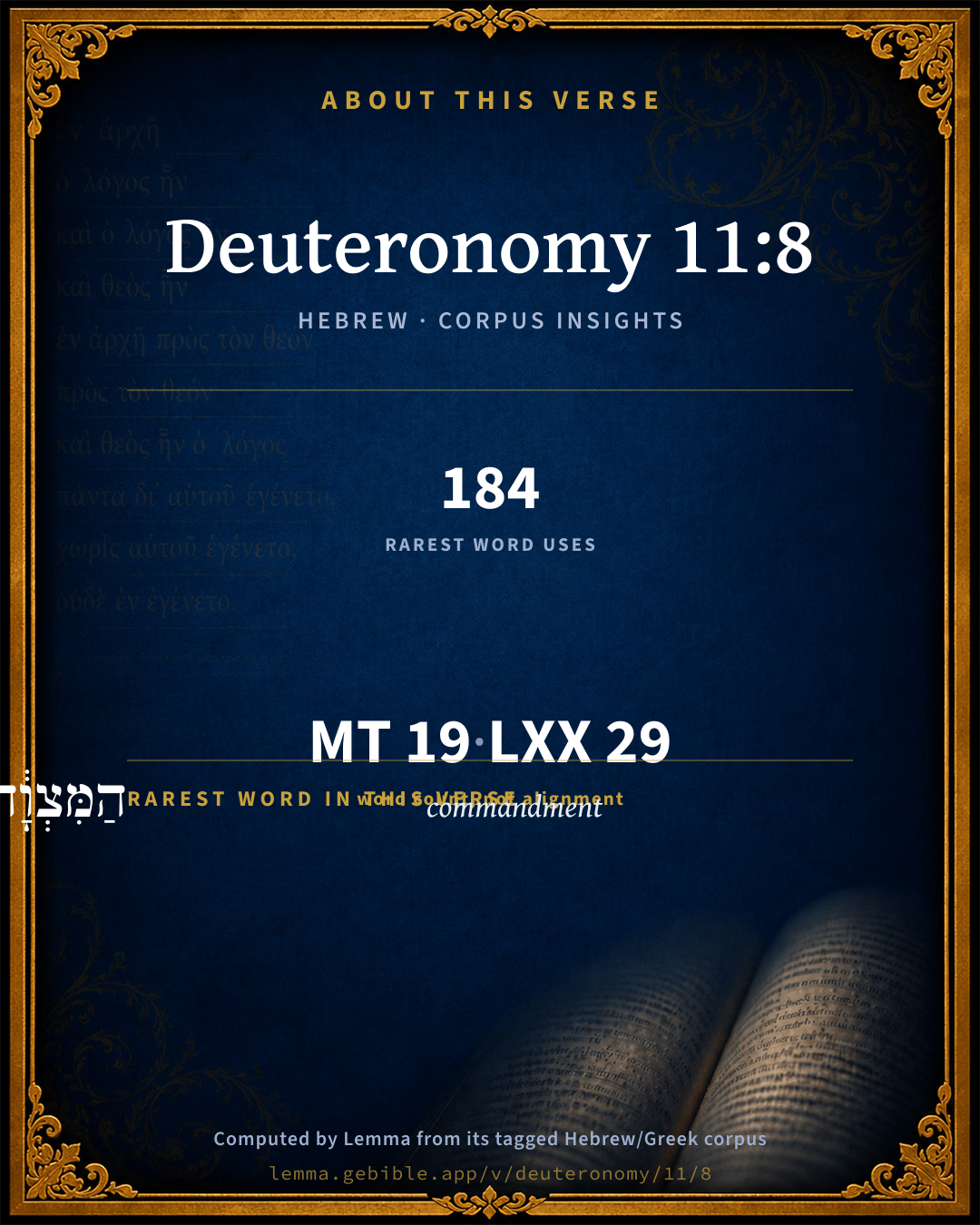
19
words
16
distinct lemmas
Pentateuch
section

Grammatical profile

  • 7 verbs
  • 4 nouns
  • 2 pronouns
  • 1 preposition
  • 1 adverb
  • 4 particles

Verb forms

  • וּשְׁמַרְתֶּם֙ Qal · Sequential Perfect
  • מְצַוְּךָ֖ Piel · Participle Active
  • תֶּחֶזְק֗וּ Qal · Imperfect
  • וּבָאתֶם֙ Qal · Sequential Perfect
  • וִֽירִשְׁתֶּ֣ם Qal · Sequential Perfect
  • עֹבְרִ֥ים Qal · Participle Active
  • לְרִשְׁתָּֽהּ Qal · Infinitive Construct

Repetition

Words recur within this verse — often emphatic in Hebrew:

  • וִֽירִשְׁתֶּ֣ם to inherit H3423 ×2
  • אֲשֶׁ֛ר which H834 ×2

Hebrew & Septuagint length

In English translation the verse runs 32 words from the Hebrew and 40 from the Septuagint (LXX English) — closely comparable.

A rough comparison of the two English renderings, which tokenize alike — not a word-level alignment.

Word counts can differ between the Hebrew and the Greek without any difference in meaning — e.g. the Hebrew direct-object marker אֵת has no separate Greek word, and Greek often adds the article ὁ.

In the original languages it is 19 Hebrew tokens and 29 Greek tokens — but the two are counted differently (Hebrew bundles its prefixes and suffixes into one token; the Greek is in lemma form), so that isn’t a like-for-like length.

Cross-references

16

Topical passages linked to Deuteronomy 11:8 in the Treasury of Scripture Knowledge — connected by theme and wording, ordered by reader-vote popularity; previews shown in the World English Bible.

  • Joshua 1:6–7 Be strong and of good courage; for you shall cause this people to inherit the land which I swore to their fathers to give them.
  • Ephesians 6:10 Finally, be strong in the Lord, and in the strength of his might.
  • Ephesians 3:16 that he would grant you, according to the riches of his glory, that you may be strengthened with power through his Spirit in the inward man;
  • Philippians 4:13 I can do all things through Christ, who strengthens me.
  • Deuteronomy 31:23 He gave Joshua the son of Nun a charge, and said, Be strong and of good courage; for you shall bring the children of Israel into the land which I swore to them: and I will be with you.
  • 2 Corinthians 12:9–10 He has said to me, "My grace is sufficient for you, for my power is made perfect in weakness." Most gladly therefore I will rather glory in my weaknesses, that the power of Christ may rest on me.
  • Deuteronomy 8:10–11 You shall eat and be full, and you shall bless Yahweh your God for the good land which he has given you.
  • Psalms 138:3 In the day that I called, you answered me. You encouraged me with strength in my soul.
  • Deuteronomy 10:12–15 Now, Israel, what does Yahweh your God require of you, but to fear Yahweh your God, to walk in all his ways, and to love him, and to serve Yahweh your God with all your heart and with all your soul,
  • Deuteronomy 26:16–19 This day Yahweh your God commands you to do these statutes and ordinances: you shall therefore keep and do them with all your heart, and with all your soul.
  • Deuteronomy 28:47 Because you didn't serve Yahweh your God with joyfulness, and with gladness of heart, by reason of the abundance of all things;
  • Deuteronomy 31:6–7 Be strong and of good courage, don't be afraid, nor be scared of them: for Yahweh your God, he it is who does go with you; he will not fail you, nor forsake you.
  • Psalms 116:12–16 What will I give to Yahweh for all his benefits toward me?
  • Daniel 10:19 He said, "Greatly beloved man, don't be afraid: peace be to you, be strong, yes, be strong." When he spoke to me, I was strengthened, and said, "Let my lord speak; for you have strengthened me."
  • Colossians 1:11 strengthened with all power, according to the might of his glory, for all endurance and perseverance with joy;
  • Isaiah 40:31 but those who wait for Yahweh shall renew their strength; they shall mount up with wings as eagles; they shall run, and not be weary; they shall walk, and not faint.

Cross-references courtesy of OpenBible.info (CC BY 4.0).

Hebrew and Greek witnesses Masoretic Hebrew ↔ Greek Septuagint

The same verse in the two great witnesses to the Old Testament, shown verse-for-verse.

These are two independent witnesses, not word-aligned to each other, and the Septuagint is shown in lemma (dictionary) form.

Hebrew Deuteronomy 11:8 Masoretic · Westminster Leningrad Codex

וּשְׁמַרְתֶּם֙ אֶת כָּל הַמִּצְוָ֔ה אֲשֶׁ֛ר אָנֹכִ֥י מְצַוְּךָ֖ הַיּ֑וֹם לְמַ֣עַן תֶּחֶזְק֗וּ וּבָאתֶם֙ וִֽירִשְׁתֶּ֣ם אֶת הָאָ֔רֶץ אֲשֶׁ֥ר אַתֶּ֛ם עֹבְרִ֥ים שָׁ֖מָּה לְרִשְׁתָּֽהּ

Therefore shall you keep all the commandment which I command you this day, that you may be strong, and go in and possess the land, where you go over to possess it;

World English Bible · Public Domain

Greek LXX Deuteronomy 11:8 Septuagint · lemma form

καί φυλάσσω πᾶς ὁ ἐντολή αὐτός ὅσος ἐγώ ἐντέλλομαι σύ σήμερον ἵνα ζάω καί πολυπλασιάζω καί εἰςἔρχομαι κληρονομέω ὁ γῆ εἰς ὅς σύ διαβαίνω ὁ ἰορδάνης ἐκεῖ κληρονομέω αὐτός

And you⌃ shall keep all his commandments, as many as I command you today, that you⌃ may live, and be multiplied, and that you⌃ may go in and inherit the land, into which you⌃ go across Jordan to inherit it:

LXX2012 (modern English Septuagint) · Public Domain

On this verse, The Cambridge Bible for Schools and Colleges discusses the Septuagint’s reading. Read the note in Commentary ↓

Hebrew: Westminster Leningrad Codex (CC BY 4.0). Greek: Septuagint (public domain); English from LXX2012 (modern English Septuagint) (Public Domain). How the Septuagint differs from the Hebrew →

Targum (Aramaic paraphrase)

2

The Targum is the ancient Jewish Aramaic paraphrase of the Hebrew Scriptures — an interpretive translation, not the Hebrew text itself. Onkelos (literal) and Pseudo-Jonathan (expansive) render the Torah, and Jonathan the Prophets. Coverage is partial: where no permissively-licensed English translation exists for a verse, only the Aramaic is shown. This is verse-level text, not a word-by-word alignment to the Hebrew.

  1. Targum Onkelos Torah (Genesis–Deuteronomy)
    וְתִטְרוּן יָת כָּל תַּפְקֶדְתָּא דִי אֲנָא מְפַקְדָךְ יוֹמָא דֵין בְּדִיל דְתִתְקְפוּן וְתֵעֲלוּן וְתֵירְתוּן יָת אַרְעָא דִי אַתּוּן עָבְרִין תַּמָן לְמֵירְתַהּ

    (no public-domain English translation for this verse)

    Targum Onkelos — Aramaic: “Onkelos Genesis” (public domain); “Onkelos Exodus” (public domain); “Onkelos Leviticus” (public domain); “Onkelos Numbers” (public domain); “Onkelos Deuteronomy” (public domain). English: “Sefaria Community Translation” (CC0 1.0 (public-domain dedication)); “J.W. Etheridge. The Targums of Onkelos and Jonathan Ben Uzziel on the Pentateuch. London: Longmans, Green, 1862” (public domain). Text via Sefaria.

  2. Targum Pseudo-Jonathan Torah (Genesis–Deuteronomy)
    וְתִנְטְרוּן יַת כָּל תַּפְקֵידְתָּא דַּאֲנָא מְפַקֵיד לְכוֹן יוֹמָא דֵין מִן בִּגְלַל דְּתִתְקְפוּן וְתֵיעֲלוּן וְתֵירְתוּן יַת אַרְעָא דְאַתּוּן עָבְרִין לְתַמָּן לְמֵירְתָהּ

    Therefore shall you keep all the precepts which I command you this day, that you may be strengthened, and go in, and inherit the land to possess which you go over;

    Targum Pseudo-Jonathan — Aramaic: “Targum Jonathan on Genesis” (public domain); “Targum Jonathan on Exodus” (public domain); “Targum Jonathan on Leviticus” (public domain); “Targum Jonathan on Numbers” (public domain); “Targum Jonathan on Deuteronomy” (public domain). English: “The Targum of Jonathan ben Uzziel, trans. J. W. Etheridge, London, 1862” (public domain). Text via Sefaria.

Commentary

Notes on Deuteronomy 11:8 from classic Christian and Jewish commentators (each source and its license shown beneath its notes). The classic Christian expositions comment on the surrounding passage and are grouped to its opening verse, so a note may address several verses; the Jewish commentaries on the Tanakh (Rashi and others) are per-verse, so they appear only where the commentator wrote on this verse.

Lemma curates 59 commentaries, every one of them public domain or Creative Commons licensed, each selected and text-cleaned for this edition rather than reprinted as found. About our sources →

Matthew Henry's Commentary

Still Moses urges the same subject, as loth to conclude till he had gained his point. "If thou wilt enter into life, if thou wilt enter into Canaan, a type of that life, and find it a good land indeed to thee, keep the commandments: Keep all the commandments which I command you this day; love God, and serve him with all your heart."

I. Because this was the way to get and keep possession of the promised land. 1. It was the way to get possession (Deu 11:8): That you may be strong for war, and so go in and possess it. So little did they know either of hardship or hazard in the wars of Canaan that he does not say they should go in and fight for it; no, they had nothing in effect to do but go in and possess it. He does not go about to teach them the art of war, how to draw the bow, and use the sword, and keep ranks, that they might be strong, and go in and possess the land; no, but let them keep God's commandments, and their religion, while they are true to it, will be their strength, and secure their success. (2.) It was the way to keep possession (Deu 11:9): That you may prolong your days in this land that your eye is upon. Sin tends to the shortening of the days of particular persons and to the shortening of the days of a people's prosperity; but obedience will be a lengthening out of their tranquillity.

II. Because the land of Canaan, into which they were going, had a more sensible dependence upon the blessing of heaven than the land of Egypt had, Deu 11:10-12. Egypt was a country fruitful enough, but it was all flat, and was watered, not as other countries with rain (it is said of Egypt, Zac 14:18, that it has no rain), but by the overflowing of the river Nile at a certain season of the year, to the improving of which there was necessary a great deal of the art and labour of the husbandman, so that in Egypt a man must bestow as much cost and pains upon a field as upon a garden of herbs. And this made them the more apt to imagine that the power of their own hands got them this wealth. But the land of Canaan was an uneven country, a land of hills and valleys, which not only gave a more pleasing prospect to the eye, but yielded a greater variety of soils for the several purposes of the husbandman. It was a land that had no great rivers in it, except Jordan, but drank water of the rain of heaven, and so, 1. Saved them a great deal of labour. While the Egyptians were ditching and guttering in the fields, up to the knees in mud, to bring water to their land, which otherwise would soon become like the heath in the wilderness, the Israelites could sit in their houses, warm and easy, and leave it to God to water their land with the former and the latter rain, which is called the river of God (Psa 65:9), perhaps in allusion to, and contempt of, the river of Egypt, which that nation was so proud of. Note, The better God has provided, by our outward condition, for our ease and convenience, the more we should abound in his service: the less we have to do for our bodies the more we should do for God and our souls. 2. So he directed them to look upwards to God, who giveth us rain form heaven and fruitful seasons (Act 14:17), and promised to be himself as the dew unto Israel, Hos 14:5. Note, (1.) Mercies bring with them the greatest comfort and sweetness when we see them coming from heaven, the immediate gifts of divine Providence. (2.) The closer dependence we have upon God the more cheerful we should be in our obedience to him. See how Moses here magnifies the land of Canaan above all other lands, that the eyes of God were always upon it, that is, they should be so, to see that nothing was wanting, while they kept close to God and duty; its fruitfulness should be not so much the happy effect of its soil as the immediate fruit of the divine blessing; this may be inferred from its present state, for it is said to be at this day, now that God has departed from it, as barren a spot of ground as perhaps any under heaven. Call it not Naomi: call it Marah.

III. Because God would certainly bless them with an abundance of all good things if they would love him and serve him (Deu 11:13-15): I will give you the rain of your land in due season, so that they should neither want it when the ground called for it nor have it in excess; but they should have the former rain, which fell at seed-time, and the latter rain, which fell before the harvest, Amo 4:7. This represented all the seasonable blessings which God would bestow upon them, especially spiritual comforts, which should come as the latter and former, rain, Hos 6:3. And the earth thus watered produced, 1. Fruits for the service of man, corn and wine, and oil, Psa 104:13-15. 2. Grass for the cattle, that they also might be serviceable to man, that he might eat of them and be full, Deu 11:15. Godliness hath here the promise of the life that now is; but the favour of God shall put gladness into the heart, more than the increase of corn, and wine, and oil will.

IV. Because their revolt from God to idols. would certainly be their ruin: Take heed that your hearts be not deceived, Deu 11:16, Deu 11:17. All that forsake God to set their affection upon, or pay their devotion to, any creature, will find themselves wretchedly deceived to their own destruction; and this will aggravate it that it was purely for want of taking heed. A little care would have prevented their being imposed upon by the great deceiver. To awaken them to take heed, Moses here tells them plainly that if they should turn aside to other gods, 1. They would provoke the wrath of God against them; and who knows the power of that anger? 2. Good things would be turned away from them; the heaven would withhold its rain, and then of course the earth would not yield its fruit. 3. Evil things would come upon them; they would perish quickly form off this good land. And the better the land was the more grievous it would be to perish from it. The goodness of the land would not be their security, when the badness of the inhabitants had made them ripe for ruin.

Matthew Henry's Commentary on the Whole Bible (1708–1710) — public domain (CC PDM 1.0). Text via the HelloAO Bible API.

Tyndale Open Study Notes

Tyndale Open Resources

11:8-32 Moses here appends to the covenant stipulations (chs 5–11) a list of curses and blessings similar to those that follow the whole covenant text in chs 27–28.

Tyndale Open Study Notes — © Tyndale Open Resources, licensed CC BY-SA 4.0. Text via the HelloAO Bible API.

Geneva Bible (1599)

Geneva Bible translators

Because ye have felt both his chastisements and his benefits.

Geneva Bible (1599) marginal notes — public domain. Text via Bolls.life.

Adam Clarke's Commentary

Verse 8. Therefore shall ye keep all the commandments] Because God can execute such terrible judgments, and because he has given such proofs of his power and justice; and because, in similar provocations, he may be expected to act in a similar way; therefore keep his charge, that he may keep you unto everlasting life.

Adam Clarke's Commentary on the Bible (1810–1826) — public domain. Text from a community e-Sword/MySword module.

Ellicott's Commentary for English Readers

(8) The commandments.—Literally, the commandment. It is one course of action rather than many details which is enjoined.

Go in and possess—i.e., complete the conquest in detail, so as to enjoy the whole profit of the land.

A Bible Commentary for English Readers, edited by Charles John Ellicott (1878–1897) — public domain. Text from a community e-Sword module.

The Cambridge Bible for Schools and Colleges

gen. ed. J. J. S. Perowne

8. On such recognition (Deu_11:2 But know ye) of the awful discipline of God the discourse now bases another of its many appeals to the people to observe the Law, with the usual promise of consequent benefits. That the appeal and promise are composed in the usual deuteronomic phrases is no ground, by itself, for considering that the verse is an editorial addition. (So Steuern., who finds the immediate continuation of Deu_11:7 in Deu_11:16.) Nor are the phrases all repetitions; that ye may be strong is new.

keep all the commandment] Again the Miṣwah of Deu_11:31 q.v., Deu_6:1 and Deu_7:11.

which I command thee this day] The one Sg. clause in the section. Sam. and LXX codd. A etc. have Pl., LXX cod. Vat. agrees with the Heb. Sg. It is a good illustration of how many are the possible explanations of these smaller and sporadic changes of address. Either the Sg. is a clerical error which has slipped into the Heb. text and is to be corrected by the Versions; or it is original, and the readings of these are harmonistic, as in A.V. Or, if the Sg. is the correct reading it may be either a mere inadvertence on the part of the original writer, or the clause may have been inserted by an editor with the echo of Deu_7:11 in his ear. This last seems to the present writer the most probable explanation. But any of the others is possible.

that ye may be strong, and go in] only here; cp. Deu_4:1, that ye may live and go in.

and go in and possess the land] Cp. the variation in the Sg. Deu_9:5, go in to possess their land.

whither ye go over to possess it] a phrase peculiar to Pl.; see on Deu_6:1.

The Cambridge Bible for Schools and Colleges (gen. ed. J. J. S. Perowne; Cambridge University Press, 1878–1918) — public domain. Text from a community e-Sword module.

John Gill's Exposition

For the land whither thou goest in to possess it,.... The land of Canaan they were about to take possession of:

is not as the land of Egypt, from whence ye came out; either the whole land of Egypt, or that part of it, Rameses, in which Israel dwelt, and which was the best of it, as Jarchi observes, and yet Canaan exceeded that; though the design of this passage is not so much to set forth the superior excellency and fertility of the land of Canaan to that of Egypt, which was certainly a very fruitful country; see Gen 13:10 but to observe some things in which they differed, whereby they both became fruitful, and in which Canaan had the advantage:

where thou sowedst thy seed, and wateredst it with thy foot, as a garden of herbs; as a gardener when he has sowed his seed, or planted his plants, waters them that they may grow, by carrying his water pot from bed to bed, which requires much labour and toil. In Egypt rain seldom fell, especially in some places it was very rare, though that there was none at all is a vulgar mistake; See Gill on Zac 14:18 (e). To supply the want of it the river Nile overflowed once a year, which not only moistened the earth, but left mud or slime upon it, which made it fruitful; but this was not sufficient, for what through the river not overflowing enough sometimes, and so as to reach some places, and through the heat of the sun hardening the earth again, it was found necessary to cut canals from it, and by water from thence to water it, as a gardener waters his seed and plants; and it is to this watering that respect is here had, not to the overflowing of the Nile, for that was before the seed was sown; but to the watering of it out of the canals, which was done after it was sown; the former was without any trouble of theirs, the latter with much labour; the manner in which it is done is expressed by the phrase "with thy foot", which the Targum explains "by thyself", by their own labour and industry. Jarchi is more particular; "the land of Egypt had need to "have water brought from the Nile with thy foot; he seems to have understood the phrase to signify carrying water on foot from the Nile to the place where it was wanted; but the custom still in use in Egypt, when they water their fields, plantations, or gardens, will give us a clear understanding of this phrase; as a late traveller informs us (f), the water is drawn out of the river (Nile) by instruments, and lodged in capacious cisterns; when plants require to be refreshed, they strike out the plugs that are fixed in the bottoms of the cisterns, and then the water gushing out, is conducted from one rill to another by the gardener, who is always ready as occasion requires to stop and divert the torrent by turning the earth against it "with his foot", and opening at the same time with his mattock a new trench to receive it: and to the same purpose another learned person (g) has observed, that at other times (than the flowing of the Nile) they are obliged to have recourse to art, and to raise the water out of the river and some deep pits by the help of machines, which water is afterwards directed in its course by channels cut in the ground, which convey the water to those places where it is wanted; and when one part of the ground is sufficiently watered, they then stop that channel, by thrusting some earth into the entrance of it "with their foot", and then also "with their foot" open a passage into the next channel, and so on: and Philo the Jew (h) speaks of a machine with which they used to water fields, and was worked with the feet by going up the several steps within, which gave motion to it.

(e) See also Vansleb's Relation of a Voyage to Egypt, p. 213. who speaks of large rains in Egypt. (f) Shaw's Travels, p. 408. (g) Clayton's Chronology of the Hebrew Bible, p. 478. (h) De Confusione Ling p. 325.

John Gill's Exposition of the Whole Bible (1746–1763) — public domain (CC PDM 1.0). Text via the HelloAO Bible API.

Haydock's Catholic Bible Commentary

That. Fear might stimulate them to observe God’s command, lest they should be overtaken by a similar chastisement. (Haydock)

George Leo Haydock (1774–1849), Haydock's Catholic Family Bible and Commentary, 1859 edition — public domain. Excludes Psalms (Douay-Rheims chapter numbering differs from Protestant) and Deuterocanonical books (Catholic canon only).

The Pulpit Commentary

Vers. 8, 9. Obedience leads to prolonged possession.

We may learn here

I THAT COMMANDS MAY CARRY A SUPREME OBLIGATION, THOUGH SPOKEN BY MAN.

II THAT OBEDIENCE IS VAIN, UNLESS IT COVERS THE WHOLE AREA OF DUTY.

III THAT COMPLETE OBEDIENCE IMPARTS STRENGTH TO THE WHOLE MAN.

IV THAT SUCH STRENGTH PRESSES INTO THE POSSESSION OF NEW KINGDOMS.

V THAT THE OATH OF GOD, AND THE DEVOUT ACTIVITY OF MAN, CO-OPERATE FOR THE HIGHEST ACQUISITIONS. D.

The Pulpit Commentary (1880–1919), ed. H.D.M. Spence-Jones & Joseph S. Exell — public domain. Text from a community e-Sword module.

Keil & Delitzsch

C. F. Keil & F. Delitzsch

And this knowledge was to impel them to keep the law, that they might be strong, i.e., spiritually strong (Deu 1:38), and not only go into the promised land, but also live long therein (cf. Deu 4:26; Deu 6:3). - In Deu 11:10-12 Moses adduces a fresh motive for his admonition to keep the law with fidelity, founded upon the peculiar nature of the land. Canaan was a land the fertility of which was not dependent, like that of Egypt, upon its being watered by the hand of man, but was kept up by the rain of heaven which was sent down by God the Lord, so that it depended entirely upon the Lord how long its inhabitants should live therein. Egypt is described by Moses as a land which Israel sowed with seed, and watered with its foot like a garden of herbs. In Egypt there is hardly any rain at all (cf. Herod. ii. 4, Diod. Sic. i. 41, and other evidence in Hengstenberg's Egypt and the Books of Moses, pp. 217ff.). The watering of the land, which produces its fertility, is dependent upon the annual overflowing of the Nile, and, as this only lasts for about 100 days, upon the way in which this is made available for the whole year, namely, by the construction of canals and ponds throughout the land, to which the water is conducted from the Nile by forcing machines, or by actually carrying it in vessels up to the fields and plantations.

(Note: Upon the ancient monuments we find not only the draw-well with the long rope, which is now called Shaduf, depicted in various ways (see Wilkinson, i. p. 35, ii. 4); but at Beni-Hassan there is a representation of two men carrying a water-vessel upon a pole on their shoulders, which they fill from a draw-well or pond, and then carry to the field (cf. Hengstenberg, Egypt and the Books of Moses, pp. 220-1).)

The expression, "with thy foot," probably refers to the large pumping wheels still in use there, which are worked by the feet, and over which a long endless rope passes with pails attached, for drawing up the water (cf. Niebuhr, Reise, i. 149), the identity of which with the ἕλιξ described by Philo as ὑδρηλὸν ὄργανον (de confus. ling. i. 410) cannot possibly be called in question; provided, that is to say, we do not confound this ἕλιξ with the Archimedean water-screw mentioned by Diod. Sic. i. 34, and described more minutely at v. 37, the construction of which was entirely different (see my Archaeology, ii. pp. 111-2). - The Egyptians, as genuine heathen, were so thoroughly conscious of this peculiar characteristic of their land, which made its fertility far more dependent upon the labour of human hands than upon the rain of heaven or divine providence, that Herodotus (ii. 13) represents them as saying, "The Greeks, with their dependence upon the gods, might be disappointed in their brightest hopes and suffer dreadfully from famine." The land of Canaan yielded no support to such godless self-exaltation, for it was "a land of mountains and valleys, and drank water of the rain of heaven" (ל before מטר, to denote the external cause; see Ewald, 217, d.); i.e., it received its watering, the main condition of all fertility, from the rain, by the way of the rain, and therefore through the providential care of God.

Keil & Delitzsch — Biblical Commentary on the Old Testament (1861–1891) — public domain (CC PDM 1.0). Text via the HelloAO Bible API. (Old Testament only.)

unfoldingWord translationNotes

Door43 World Missions Community

General Information:

Moses continues speaking to the people of Israel.

possess the land

"take the land"

where you are going over to possess it

The phrase "are going over" is used because the people of Israel will have to cross the Jordan River to enter into Canaan.

prolong your days

Long days are a metaphor for a long life. See how you translated these words in Deuteronomy 4:26. AT: "be able to live a long time" (See: Metaphor)

a land flowing with milk and honey

This is an idiom. See how you translated this in Deuteronomy 6:3. AT: "a land where plenty of milk and honey flow" or "a land that is excellent for cattle and farming" (See: Idiom)

translationWords

command

possess

Yahweh

oath

ancestor

descend

honey

unfoldingWord translationNotes — © Distant Shores Media and the Door43 World Missions Community, licensed CC BY-SA 4.0. Source: git.door43.org/Door43/en_tn.

Lesson kit

Teaching starters — assembled from the data on this page, not authored interpretation. Every prompt links to the verse data it draws on. Edit before teaching.

Deuteronomy, in the Pentateuch, opens this verse with 19 words (16 distinct Hebrew lemmas). Its most distinctive word is mitsvâh (“commandment”). A historical commentator’s framing appears above. Read the whole chapter for the surrounding context.

Discussion questions

  1. How does “commandment” (mitsvâh) shape what this verse is saying?
  2. How does Joshua 1:6–7, which shares this passage’s theme, read alongside this verse?
  3. What does the repetition of “to inherit” (2× in this one verse) do in this verse?
  4. These translations render this verse differently; the difference is in the English rendering, not the original. What questions does that raise?
  5. «וּשְׁמַרְתֶּם֙» is a Qal Sequential Perfect verb. How does that grammatical form shape the action described?
  6. Compare how Matthew Henry's Commentary and Tyndale Open Study Notes read this verse. Where do they agree or differ?

Things to notice

Reading settings

Reading text

Shown beneath each verse's original-language words.

Old Testament
Old Testament edition

Read the OT as the Masoretic Hebrew (MT) or the Greek Septuagint (LXX).

English shown for the Greek Septuagint (in the Hebrew ↔ Greek comparison).

Comparing translations? Open the Compare panel on any verse page to stack up to four side by side.