
Ezekiel 16:49

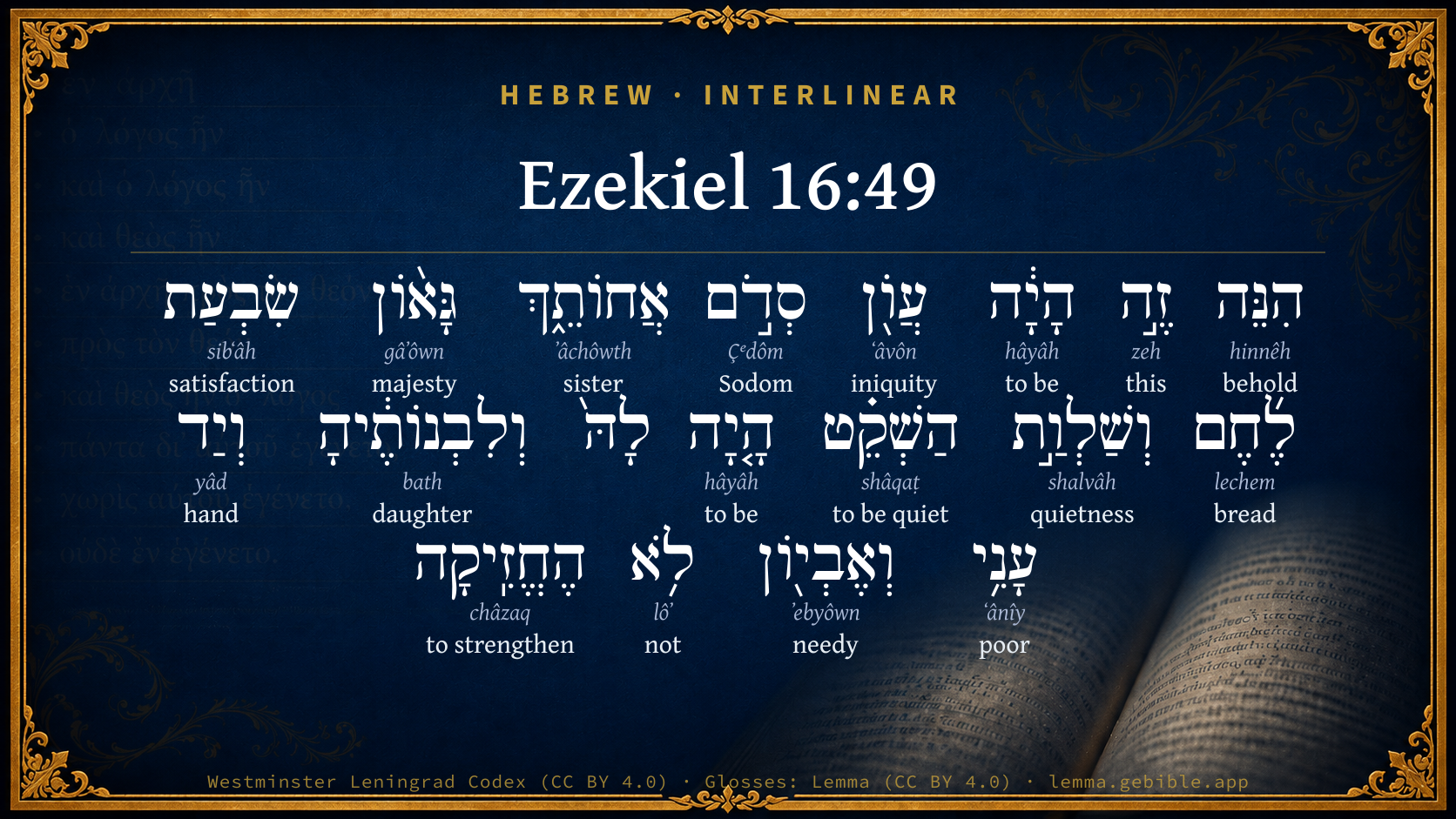
Hebrew (Westminster Leningrad Codex) Ezekiel 16:49 appears in the Hebrew Old Testament. The text above is from the Westminster Leningrad Codex. Each word links to its Strong’s number, a concise gloss, and parsing drawn from the Open Scriptures Hebrew Bible morphology. Click any word for its full Brown-Driver-Briggs (BDB) entry.
Download image
Cite this verse

Ezekiel 16:49 (World English Bible). Public Domain. Lemma interlinear Bible study tool, https://lemma.gebible.app/v/ezekiel/16/49.

Show BibTeX & RIS
BibTeX
RIS
English Translation
Behold, this was the iniquity of your sister Sodom: pride, fullness of bread, and prosperous ease was in her and in her daughters; neither did she strengthen the hand of the poor and needy.
World English Bible · Public Domain
Highlights
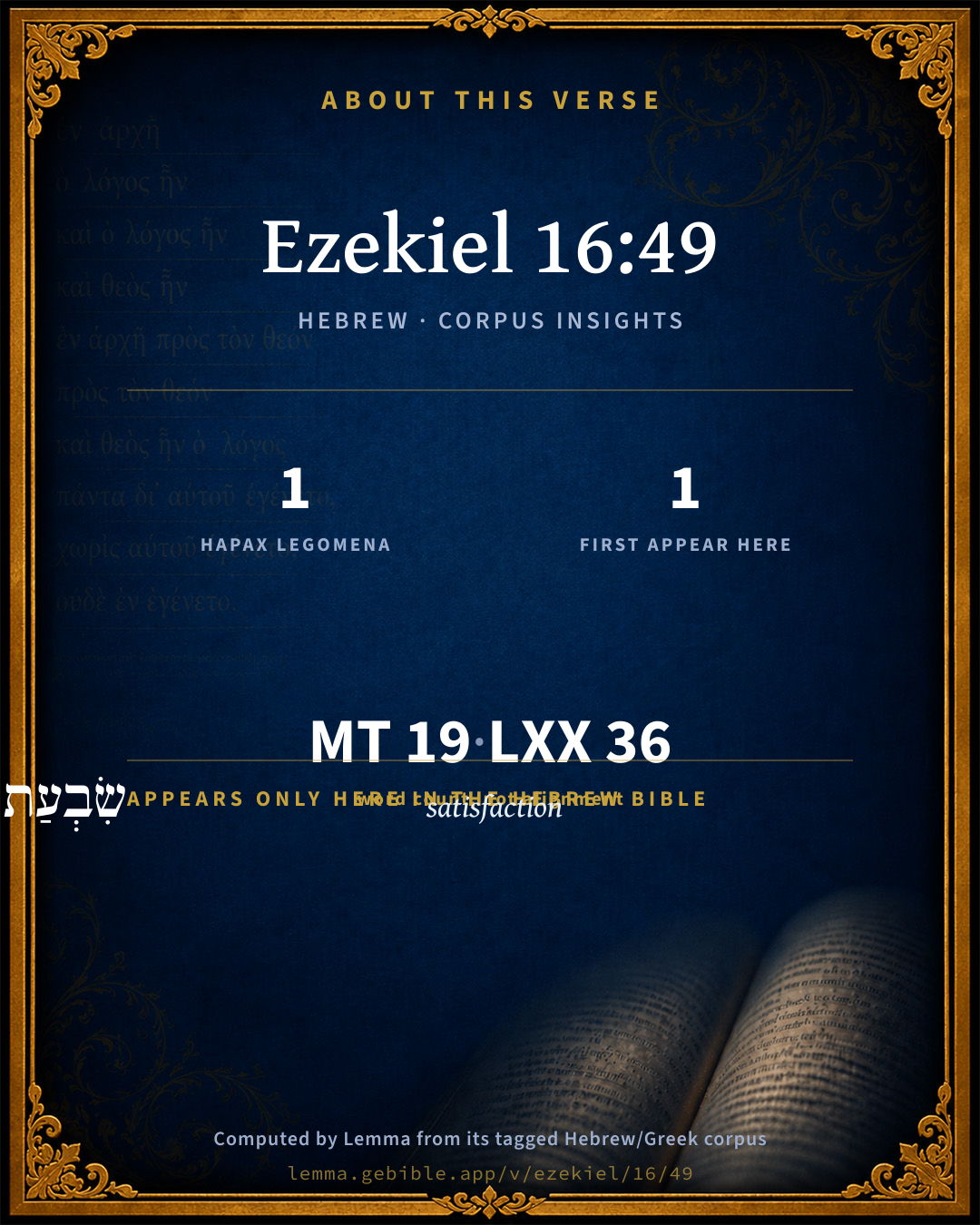
  • 1 hapax legomenon — only here in the Hebrew Bible
  • 1 first appearance in the Hebrew Bible
Full analysis ↓
Download a study sheet

One document with this verse’s original text, its word-by-word gloss line, the meaning frame, cross-references with their text, attributed commentary, and full source and license credits — printable, and it pastes into notes with its structure intact.

This verse Autodidact and up

Study sheet (.html) Plain text (.txt)

A passage Seminary Student

Up to 50 verses in one chapter. A passage sheet keeps up to 6 commentary sources and 12 cross-references per verse, in the order this page ranks them, and says so on the sheet whenever that leaves anything out. Ask for a single verse and you get the Autodidact verse sheet above.

Everything on this page stays free to read, with no account — the sheet is a download of what is already on screen, not access to it.

Want to remove ads? Support Godless Engineer
Compare translations 3

The same verse in 3 English versions, stacked beneath the original-language interlinear above. Click any original word for its lexicon entry.

Each is an independent rendering of the whole verse — the interlinear is not word-aligned to these translations.

Highlighted words mark where these versions differ — a whole-verse word diff, not a word-by-word alignment.

  • World English Bible Public Domain
    Behold, this was the iniquity of your sister Sodom: pride, fullness of bread, and prosperous ease was in her and in her daughters; neither did she strengthen the hand of the poor and needy.
  • King James Version Public Domain
    Behold, this was the iniquity of thy sister Sodom, pride, fulness of bread, and abundance of idleness was in her and in her daughters, neither did she strengthen the hand of the poor and needy.
  • unfoldingWord Literal Text CC BY-SA 4.0
    Behold! This was the sin of your sister Sodom that she was arrogant in her leisure, careless and unconcerned about anything. She did not strengthen the hands of the poor and needy people.

unfoldingWord Literal Text — © unfoldingWord, licensed CC BY-SA 4.0. Word-aligned USFM3 via Door43 (git.door43.org/unfoldingWord/en_ult).

Versions to compare (up to 4)

3 of 4 selected

Show all 18 translations

Every available English version of this verse, each an independent rendering of the whole verse.

  • World English Bible Public Domain
    Behold, this was the iniquity of your sister Sodom: pride, fullness of bread, and prosperous ease was in her and in her daughters; neither did she strengthen the hand of the poor and needy.
  • Berean Standard Bible Public Domain
    Now this was the iniquity of your sister Sodom: She and her daughters were arrogant, overfed, and complacent; they did not help the poor and needy.
  • Majority Standard Bible Public Domain
    Now this was the iniquity of your sister Sodom: She and her daughters were arrogant, overfed, and complacent; they did not help the poor and needy.
  • King James Version Public Domain
    Behold, this was the iniquity of thy sister Sodom, pride, fulness of bread, and abundance of idleness was in her and in her daughters, neither did she strengthen the hand of the poor and needy.
  • American Standard Version (1901) Public Domain
    Behold, this was the iniquity of thy sister Sodom: pride, fulness of bread, and prosperous ease was in her and in her daughters; neither did she strengthen the hand of the poor and needy.
  • Revised Version (1885) Public Domain
    Behold, this was the iniquity of thy sister Sodom; pride, fulness of bread, and prosperous ease was in her and in her daughters; neither did she strengthen the hand of the poor and needy.
  • Geneva Bible (1599) Public Domain
    Beholde, this was the iniquitie of thy sister Sodom, Pride, fulnesse of bread, and aboundance of idlenesse was in her, and in her daughters: neither did shee strengthen the hande of the poore and needie.
  • Douay-Rheims (1899) Public Domain
    Behold this was the iniquity of Sodom thy sister, pride, fulness of bread, and abundance, and the idleness of her, and of her daughters: and they did not put forth their hand to the needy, and to the poor.
  • Young's Literal Translation Public Domain
    Lo, this hath been the iniquity of Sodom thy sister, Arrogancy, fulness of bread, and quiet ease, Have been to her and to her daughters, And the hand of the afflicted and needy She hath not strengthened.
  • Literal Standard Version CC BY-SA 4.0
    Behold, this has been the iniquity of your sister Sodom, || Arrogancy, fullness of bread, and quiet ease, || Have been to her and to her daughters, || And the hand of the afflicted and needy || She has not strengthened.
  • Unlocked Literal Bible CC BY-SA 4.0
    Behold! This was the sin of your sister Sodom that she was arrogant in her leisure, careless and unconcerned about anything. She did not strengthen the hands of the poor and needy people.
  • unfoldingWord Literal Text CC BY-SA 4.0
    Behold! This was the sin of your sister Sodom that she was arrogant in her leisure, careless and unconcerned about anything. She did not strengthen the hands of the poor and needy people.
  • Darby Bible Public Domain
    Behold, this was the iniquity of thy sister Sodom: pride, fulness of bread, and careless ease was in her and in her daughters, but she did not strengthen the hand of the poor and needy.
  • World Messianic Bible Public Domain
    “‘“Behold, this was the iniquity of your sister Sodom: pride, fullness of bread, and prosperous ease was in her and in her daughters. She also didn’t strengthen the hand of the poor and needy.
  • Webster's Bible Public Domain
    Behold, this was the iniquity of thy sister Sodom, pride, fullness of bread, and abundance of idleness was in her and in her daughters, neither did she strengthen the hand of the poor and needy.
  • Free Bible Version CC BY-SA 4.0
    The sins of your sister Sodom were these: She and her daughters were proud, greedy, and lazy. They didn't help the poor and those in need.
  • Bible in Basic English Public Domain
    Truly, this was the sin of your sister Sodom: pride, a full measure of food, and the comforts of wealth in peace, were seen in her and her daughters, and she gave no help to the poor or to those in need.
  • JPS Tanakh (1917) Public Domain
    Behold, this was the iniquity of thy sister Sodom: pride, fulness of bread, and careless ease was in her and in her daughters; neither did she strengthen the hand of the poor and needy.

Literal Standard Version (2020), Covenant Press — licensed CC BY-SA 4.0. Text via the HelloAO Bible API (eBible.org). Unlocked Literal Bible (unfoldingWord) — licensed CC BY-SA 4.0. Text via the HelloAO Bible API (eBible.org). unfoldingWord Literal Text — © unfoldingWord, licensed CC BY-SA 4.0. Word-aligned USFM3 via Door43 (git.door43.org/unfoldingWord/en_ult). Free Bible Version, Dr. Jonathan Gallagher — licensed CC BY-SA 4.0. Text via the HelloAO Bible API (eBible.org).

Word by word

More ways to search: Search by grammar → Find every occurrence → Compare this word →

Practice this passage: Drill this verse → Learn its vocabulary →

שִׂבְעַת
sibʻâh
H7653
“satisfaction of”
Noun, Common, Feminine, Singular, Construct
Part of Speech
Noun
Type
Common
Gender
Feminine
Number
Singular
State
Construct
Full BDB Definition

Origin: from H7647

TWOT: 2231b

satisfaction, satiety, one's fill
  1. הִנֵּה hinnêh H2009 “behold” Particle, Demonstrative
  2. זֶ֣ה zeh H2088 “this” Pronoun, Demonstrative, Masculine, Singular
  3. הָיָ֔ה hâyâh H1961 “to be” Verb, Qal, Perfect, 3rd Person, Masculine, Singular
  4. עֲוֺ֖ן ʻâvôn H5771 “iniquity of” Noun, Common, Both, Singular, Construct
  5. סְדֹ֣ם Çᵉdôm H5467 “Sodom” Noun, Proper
  6. אֲחוֹתֵ֑ךְ ʼâchôwth H269 “sister · your” Noun, Common, Feminine, Singular, Construct + Suffix, Personal, 2nd Person, Feminine, Singular
  7. גָּא֨וֹן gâʼôwn H1347 “majesty” Noun, Common, Masculine, Singular, Absolute
  8. לֶ֜חֶם lechem H3899 “bread” Noun, Common, Both, Singular, Absolute
  9. וְשַׁלְוַ֣ת shalvâh H7962 “and · quietness of” Conjunction + Noun, Common, Feminine, Singular, Construct
  10. הַשְׁקֵ֗ט shâqaṭ H8252 “to be quiet” Verb, Hiphil, Infinitive Absolute
  11. הָ֤יָה hâyâh H1961 “to be” Verb, Qal, Perfect, 3rd Person, Masculine, Singular
  12. וְלִבְנוֹתֶ֔יהָ bath H1323 “and · to/for · daughters · her” Conjunction + Preposition + Noun, Common, Feminine, Plural, Construct + Suffix, Personal, 3rd Person, Feminine, Singular
  13. וְיַד yâd H3027 “and · hand of” Conjunction + Noun, Common, Both, Singular, Construct
  14. עָנִ֥י ʻânîy H6041 “poor” Adjective, Adjective, Masculine, Singular, Absolute
  15. וְאֶבְי֖וֹן ʼebyôwn H34 “and · needy” Conjunction + Adjective, Adjective, Masculine, Singular, Absolute
  16. לֹ֥א lôʼ H3808 “not” Particle, Negative
  17. הֶחֱזִֽיקָה châzaq H2388 “to strengthen” Verb, Hiphil, Perfect, 3rd Person, Feminine, Singular

About this verse

These counts appear in no published source. They are computed here, from the morphology-tagged text and Lemma’s own curated glosses. What Lemma adds →

19
words
17
distinct lemmas
Prophets
section

Notable vocabulary

1 hapax legomenon — a word that appears only here in the entire Hebrew Bible:

  • שִׂבְעַת satisfaction H7653

First appearance in Scripture

This word makes its first canonical appearance in the Hebrew Bible here:

  • שִׂבְעַת satisfaction H7653

Shared distinctive vocabulary

וְשַׁלְוַ֣ת quietness H7962 occurs in 8 verses of the Hebrew Bible. Also found in:

Grammatical profile

  • 4 verbs
  • 9 nouns
  • 2 adjectives
  • 1 pronoun
  • 1 preposition
  • 2 particles

Verb forms

  • הָיָ֔ה Qal · Perfect
  • הַשְׁקֵ֗ט Hiphil · Infinitive Absolute
  • הָ֤יָה Qal · Perfect
  • הֶחֱזִֽיקָה Hiphil · Perfect

Repetition

A word recurs within this verse — often emphatic in Hebrew:

  • הָיָ֔ה to be H1961 ×2

Hebrew & Septuagint length

In English translation the verse runs 34 words from the Hebrew and 42 from the Septuagint (LXX English) — closely comparable.

A rough comparison of the two English renderings, which tokenize alike — not a word-level alignment.

Word counts can differ between the Hebrew and the Greek without any difference in meaning — e.g. the Hebrew direct-object marker אֵת has no separate Greek word, and Greek often adds the article ὁ.

In the original languages it is 19 Hebrew tokens and 36 Greek tokens — but the two are counted differently (Hebrew bundles its prefixes and suffixes into one token; the Greek is in lemma form), so that isn’t a like-for-like length.

Cross-references

34

Topical passages linked to Ezekiel 16:49 in the Treasury of Scripture Knowledge — connected by theme and wording, ordered by reader-vote popularity; previews shown in the World English Bible.

  • Genesis 13:10 Lot lifted up his eyes, and saw all the plain of the Jordan, that it was well watered every where, before Yahweh destroyed Sodom and Gomorrah, like the garden of Yahweh, like the land of Egypt, as you go to Zoar.
  • Psalms 138:6 For though Yahweh is high, yet he looks after the lowly; But the proud, he knows from afar.
  • Ezekiel 28:2 Son of man, tell the prince of Tyre, Thus says the Lord Yahweh: Because your heart is lifted up, and you have said, I am a god, I sit in the seat of God, in the midst of the seas; yet you are man, and not God, though you did set your heart as the heart of God;-
  • Luke 12:16–20 He spoke a parable to them, saying, "The ground of a certain rich man brought forth abundantly.
  • Proverbs 18:12 Before destruction the heart of man is proud, But before honor is humility.
  • Isaiah 3:9 The look of their faces testify against them. They parade their sin like Sodom. They don't hide it. Woe to their soul! For they have brought disaster upon themselves.
  • Ezekiel 18:12 has wronged the poor and needy, has taken by robbery, has not restored the pledge, and has lifted up his eyes to the idols, has committed abomination,
  • Ezekiel 18:16 neither has wronged any, has not taken anything to pledge, neither has taken by robbery, but has given his bread to the hungry, and has covered the naked with a garment;
  • Daniel 5:23 but have lifted up yourself against the Lord of heaven; and they have brought the vessels of his house before you, and you and your lords, your wives and your concubines, have drunk wine from them; and you have praised the gods of silver and gold, of brass, iron, wood, and stone, which don't see, nor hear, nor know; and the God in whose hand your breath is, and whose are all your ways, you have not glorified.
  • Genesis 19:9 They said, "Stand back!" They said, "This one fellow came in to live as a foreigner, and he appoints himself a judge. Now will we deal worse with you, than with them!" They pressed hard on the man, even Lot, and drew near to break the door.
  • Deuteronomy 32:15 But Jeshurun grew fat, and kicked: You have grown fat, you are grown thick, you are become sleek; Then he forsook God who made him, Lightly esteemed the Rock of his salvation.
  • Proverbs 16:5 Everyone who is proud in heart is an abomination to Yahweh: They shall assuredly not be unpunished.
  • Proverbs 16:18 Pride goes before destruction, And a haughty spirit before a fall.
  • Proverbs 21:4 A high look, and a proud heart, The lamp of the wicked, is sin.
  • Proverbs 21:13 Whoever stops his ears at the cry of the poor, He will also cry out, but shall not be heard.
  • Isaiah 3:14–15 Yahweh will enter into judgment with the elders of his people, And their leaders: "It is you who have eaten up the vineyard. The spoil of the poor is in your houses.
  • Isaiah 16:6 We have heard of the pride of Moab, [that] he is very proud; even of his arrogance, and his pride, and his wrath; his boastings are nothing.
  • Ezekiel 28:9 Will you yet say before him who kills you, I am God? but you are man, and not God, in the hand of him who wounds you.
  • Ezekiel 28:17 Your heart was lifted up because of your beauty; you have corrupted your wisdom by reason of your brightness: I have cast you to the ground; I have laid you before kings, that they may see you.
  • Daniel 4:30 The king spoke and said, Is not this great Babylon, which I have built for the royal dwelling-place, by the might of my power and for the glory of my majesty?
  • Amos 5:11–12 Forasmuch therefore as you trample on the poor, And take taxes from him of wheat: You have built houses of hewn stone, But you will not dwell in them. You have planted pleasant vineyards, But you shall not drink their wine.
  • Obadiah 1:3 The pride of your heart has deceived you, you who dwell in the clefts of the rock, whose habitation is high, who says in his heart, 'Who will bring me down to the ground?'
  • Micah 3:2–4 You who hate the good, And love the evil; Who tear off their skin, And their flesh from off their bones;
  • Luke 16:19–21 "Now there was a certain rich man, and he was clothed in purple and fine linen, living in luxury every day.
  • Luke 17:28 Likewise, even as it happened in the days of Lot: they ate, they drank, they bought, they sold, they planted, they built;
  • 1 Peter 5:5 Likewise, you younger ones, be subject to the elder. Yes, all of you gird yourselves with humility, to subject yourselves to one another; for "God resists the proud, but gives grace to the humble."
  • Genesis 18:20 Yahweh said, "Because the cry of Sodom and Gomorrah is great, and because their sin is very grievous,
  • Isaiah 22:13–14 and behold, joy and gladness, killing oxen and killing sheep, eating flesh and drinking wine: let us eat and drink, for tomorrow we shall die.
  • Ezekiel 18:7 and has not wronged any, but has restored to the debtor his pledge, has taken nothing by robbery, has given his bread to the hungry, and has covered the naked with a garment;
  • Ezekiel 29:3 speak, and say, Thus says the Lord Yahweh: Behold, I am against you, Pharaoh king of Egypt, the great monster that lies in the midst of his rivers, that has said, My river is my own, and I have made it for myself.
  • Daniel 4:37 Now I, Nebuchadnezzar, praise and extol and honor the King of heaven; for all his works are truth, and his ways justice; and those who walk in pride he is able to abase.
  • Amos 6:3–6 Those who put far away the evil day, And cause the seat of violence to come near;
  • Amos 8:4–6 Hear this, you who desire to swallow up the needy, And cause the poor of the land to fail,
  • Luke 21:34 "So be careful, or your hearts will be loaded down with carousing, drunkenness, and cares of this life, and that day will come on you suddenly.

Cross-references courtesy of OpenBible.info (CC BY 4.0).

Hebrew and Greek witnesses Masoretic Hebrew ↔ Greek Septuagint

The same verse in the two great witnesses to the Old Testament, shown verse-for-verse.

These are two independent witnesses, not word-aligned to each other, and the Septuagint is shown in lemma (dictionary) form.

Hebrew Ezekiel 16:49 Masoretic · Westminster Leningrad Codex

הִנֵּה זֶ֣ה הָיָ֔ה עֲוֺ֖ן סְדֹ֣ם אֲחוֹתֵ֑ךְ גָּא֨וֹן שִׂבְעַת לֶ֜חֶם וְשַׁלְוַ֣ת הַשְׁקֵ֗ט הָ֤יָה לָהּ֙ וְלִבְנוֹתֶ֔יהָ וְיַד עָנִ֥י וְאֶבְי֖וֹן לֹ֥א הֶחֱזִֽיקָה

Behold, this was the iniquity of your sister Sodom: pride, fullness of bread, and prosperous ease was in her and in her daughters; neither did she strengthen the hand of the poor and needy.

World English Bible · Public Domain

Greek LXX Ezekiel 16:49 Septuagint · lemma form

πλήν οὗτος ὁ ἀνόμημα σοδομα ὁ ἀδελφή σύ ὑπερηφανία ἐν πλησμονή ἄρτος καί ἐν εὐθηνία οἶνος σπαταλάω αὐτός καί ὁ θυγάτηρ αὐτός οὗτος ὑποἄρχω αὐτός καί ὁ θυγάτηρ αὐτός καί χείρ πτωχός καί πένης οὐ ἀντιλαμβάνω

Moreover this was the sin of your sister Sodom, pride: she and her daughters lived in pleasure, in fullness of bread and in abundance: this belonged to her and her daughters, and they helped not the hand of the poor and needy.

LXX2012 (modern English Septuagint) · Public Domain

Hebrew: Westminster Leningrad Codex (CC BY 4.0). Greek: Septuagint (public domain); English from LXX2012 (modern English Septuagint) (Public Domain). How the Septuagint differs from the Hebrew →

Targum (Aramaic paraphrase)

1

The Targum is the ancient Jewish Aramaic paraphrase of the Hebrew Scriptures — an interpretive translation, not the Hebrew text itself. Onkelos (literal) and Pseudo-Jonathan (expansive) render the Torah, and Jonathan the Prophets. Coverage is partial: where no permissively-licensed English translation exists for a verse, only the Aramaic is shown. This is verse-level text, not a word-by-word alignment to the Hebrew.

  1. Targum Jonathan Prophets (Joshua–Malachi)
    הָא דֵין הֲוָה חוֹב סְדוֹם אֲחָתִיךְ גַאוְתָנִין סָבְעִין לַחֲמָא וּשְׁלֵיוָא וּשְׁדוּכַיָא הֲוָה לָהּ וּלְכַפְרָנָהָא וְיַד מִסְכֵּן וַחֲשׁוֹךְ לָא אַתְקֵיפַת:

    (no public-domain English translation for this verse)

    Targum Jonathan — Aramaic: “Mikraot Gedolot” (public domain). English: “Sefaria Community Translation” (CC0 1.0 (public-domain dedication)); “London "Chaldee Paraphrase," 1871” (public domain). Text via Sefaria.

Commentary

Notes on Ezekiel 16:49 from classic Christian and Jewish commentators (each source and its license shown beneath its notes). The classic Christian expositions comment on the surrounding passage and are grouped to its opening verse, so a note may address several verses; the Jewish commentaries on the Tanakh (Rashi and others) are per-verse, so they appear only where the commentator wrote on this verse.

Lemma curates 59 commentaries, every one of them public domain or Creative Commons licensed, each selected and text-cleaned for this edition rather than reprinted as found. About our sources →

Trapp's Complete Commentary

John Trapp

Eze 16:49 Behold, this was the iniquity of thy sister Sodom, pride, fulness of bread, and abundance of idleness was in her and in her daughters, neither did she strengthen the hand of the poor and needy.

Ver. 49. Behold, this was the iniquity of thy sister Sodom, pride,] i.e., Haughty mindedness and high conceitedness of their own surpassing excellence and stable felicity. This was the first firebrand that set Sodom on fire.

Fulness of bread.] Gourmandise and surquedry. This fulness bred forgetfulness, and this saturity security.

“ Luxuriant animi rebus plerumque secundis:

Nec facile est aequa commoda mente pati. ”

And abundance of idleness.] Tranquillitas tranquillitatis, rest of rest; and this abused to idleness, deep idleness, which is the devil’s pillow, and the mother of many mischiefs; for he shall not but do naughtily that does nothing.

Neither did she strengthen the hand of the poor.] Inhospitable they were, and unmerciful. The two angels might have lain in the streets for them; neither would they let them rest when Lot had lodged them.

John Trapp, A Commentary or Exposition upon All the Books of the Old and New Testament (1647–1656) — public domain. Text from a community e-Sword module.

Joseph Benson's Commentary

Eze 16:49-50. Behold, this was the iniquity of Sodom, pride, fulness of bread, &c. — The inhabitants of Sodom “abused that plenty which God gave them to pride and idleness, which gave rise to those enormities that they afterward were guilty of. The Scripture takes notice of the fruitfulness of the soil where Sodom stood,” Gen 13:10. — Lowth. Such is the depravity of human nature, that plenty, and a freedom from toil and danger, often prove people’s ruin; and therefore, if we were truly wise, we should be as much afraid of prosperity as we are of any of those supposed evils which are the frequent objects of our fears. Neither did she strengthen the hand of the poor and needy — Pride and luxury make men expensive in their way of living, and regardless of the wants and miseries of others. And they were haughty — Hebrew, ותגבהינה, they were high, lofty, arrogant in their deportment toward good men, vexing Lot’s righteous soul, toward the angels, whom they assaulted in his house, and toward God himself, all whose laws they trampled under foot, Gen 13:13; and before whom they committed abominations of the most heinous and detestable kind; arriving by degrees to the height of impiety and wickedness. And, indeed, when pride has got the ascendency in a man he is in the high road to all abominations. And therefore I took them away as I saw good — Destroyed their cities, people, and country, by a most tremendous, unexpected, and unexampled judgment.

Joseph Benson's Commentary on the Old and New Testaments (1811–1818) — public domain. Text from a community e-Sword module.

Geneva Bible (1599)

Geneva Bible translators

He allegeth these four vices, pride, excess, idleness and contempt of the poor, as four principal causes of such abomination, wherefore they were so horribly punished, Gen. 19:24.

Geneva Bible (1599) marginal notes — public domain. Text via Bolls.life.

Jamieson, Fausset & Brown

Robert Jamieson, A. R. Fausset & David Brown

pride--inherited by Moab, her offspring (Isa 16:6; Jer 48:26), and by Ammon (Jer 49:4). God, the heart-searcher, here specifies as Sodom's sin, not merely her notorious lusts, but the secret spring of them, "pride" flowing from "fullness of bread," caused by the fertility of the soil (Gen 13:10), and producing "idleness."

abundance of idleness--literally, "the secure carelessness of ease" or idleness.

neither did she strengthen . . . the poor--Pride is always cruel; it arrogates to itself all things, and despises brethren, for whose needs it therefore has no feeling; as Moab had not for the outcast Jews (Isa 16:3-4; Jer 48:27; Luk 16:19-21; Jam 5:1-5).

Jamieson, Fausset & Brown — Commentary Critical and Explanatory on the Whole Bible (1871) — public domain (CC PDM 1.0). Text via the HelloAO Bible API.

Adam Clarke's Commentary

Verse 49. This was the iniquity of thy sister Sodom] If we are to take this place literally, Sodom was guilty of other crimes besides that for which she appears to have been especially punished; in addition to her unnatural crime, She is charged with pride, luxury, idleness, and uncharitableness; and these were sufficient to sink any city to the bottomless pit.

Adam Clarke's Commentary on the Bible (1810–1826) — public domain. Text from a community e-Sword/MySword module.

John Calvin's Commentaries

Here God begins to show the reason why he extenuated the wickedness of Sodom in comparison with that of his own people: for if he had spoken generally, without explaining the counsel of God, his language would have been incredible, and so would have been ineffectual. But now God shows that he did not pronounce rashly what we heard before, namely, that the Jews were worse than the Sodomites. How so? for this was the iniquity of Sodom thy sister, says he, first pride, then fullness of bread, and luxury in which they were in the habit of indulging, and of drowning themselves in ease to enjoy a long peace; afterwards, they did not seize the hand of the poor. Now he adds —

John Calvin's Commentaries (1540-1563) — public domain. Text from the Calvin Translation Society English edition (1840s-50s) via the Christian Classics Ethereal Library (ccel.org). Calvin's coverage is partial (roughly two-thirds of the Bible); uncommented books and verses are honest gaps, never fabricated. The 19th-century editor's footnotes and remarks are omitted so the notes are faithfully Calvin's own voice.

Ellicott's Commentary for English Readers

(49) Pride, fulness of bread, and abundance of idleness.—The description strikes at the causes rather than the overt acts of sin, and the unnatural crimes which are always associated in our minds with the name of Sodom are not mentioned. It is noticeable, however, that the distinct sin which is mentioned in this passage is the negative one too common in all ages, “neither did she strengthen the hand of the poor and needy.”

A Bible Commentary for English Readers, edited by Charles John Ellicott (1878–1897) — public domain. Text from a community e-Sword module.

The Cambridge Bible for Schools and Colleges

gen. ed. J. J. S. Perowne

49. abundance of idleness] prosperous ease, as R.V., lit. prosperity of quiet. Sodom lived in security and suffered no calamities, as Jer_48:11 says of Moab, “Moab has been at ease from his youth, and he hath settled on his lees; he hath not been emptied from vessel to vessel, neither hath he gone into captivity.” On “fulness of bread” and consequent pride and forgetfulness of God cf. Deu_32:15; Hos_13:6; Pro_30:7.

strengthen the hand] Or, take hold of the hand, i.e. to help or rescue. Prosperity led to pride and inhumanity and then to abominations (Eze_16:50).

The Cambridge Bible for Schools and Colleges (gen. ed. J. J. S. Perowne; Cambridge University Press, 1878–1918) — public domain. Text from a community e-Sword module.

John Gill's Exposition

And they were haughty,.... Sodom and her daughters, the inhabitants of that place, and the cities adjacent; they lifted up themselves above God and man; they were above regarding the poor and needy; and were elated and swelled with their plenty and prosperity, and behaved very insolently, both to fellow citizens and strangers; see Gen 19:4;

and committed abomination before me; perhaps referring to that sin, which has its name from them; a sin abominable to God, and scandalous to human nature; and which they committed openly and publicly, neither fearing God, nor regarding men; and are said to be sinners before the Lord, Gen 13:13;

therefore I took them away as I saw good; both as to time and manner, as he in his sovereignty thought most fit and proper, by raining fire and brimstone on them, and setting them forth as an example of the vengeance of eternal fire: or, "when I saw" (c); their sin and wickedness, as soon as he saw it; see Gen 18:20. The Vulgate Latin and Arabic versions render it, "as thou sawest", or "hast seen"; appealing to the Jews themselves, who were very well acquainted with the fact; for the destruction of Sodom was notorious and flagrant.

(c) "cum vidi", Cocceius; so some in Vatablus; "postea quam", Tigurine version, Piscator, Starckius.

John Gill's Exposition of the Whole Bible (1746–1763) — public domain (CC PDM 1.0). Text via the HelloAO Bible API.

Haydock's Catholic Bible Commentary

Sodom, &c. That is, these were the steps by which the Sodomites came to fall into those abominations for which they were destroyed. For pride, gluttony, and idleness, are the high road to all kinds of lust; especially when they are accompanied with a neglect of the works of mercy. (Challoner) --- These crimes alone are great enough; (Luke xvi. 19.) and the prophets never accuse the Jews of unnatural lust. Hence Ezechiel takes no notice of it here, as he probably refers to the manners of the Moabites, &c., who were then living, Isaias xvi. 6. (Calmet) --- Abundance and idleness produce crimes; temperance and labour bring forth good fruit. (Worthington)

George Leo Haydock (1774–1849), Haydock's Catholic Family Bible and Commentary, 1859 edition — public domain. Excludes Psalms (Douay-Rheims chapter numbering differs from Protestant) and Deuterocanonical books (Catholic canon only).

Matthew Poole's English Annotations

The iniquity; iniquity, either for iniquities, or the fountain and occasion of all amongst the Sodomites.

Pride; a haughty mind, swelled with the excellency, beauty, and grandeur of their state, and vaunting of it above their neighbours.

Fulness of bread, i.e. luxury, and riotous excess in eating and drinking: their plenty was not their sin, but they made it occasion of sin to themselves; they were very intemperate in their diet.

Abundance of idleness; every thing so plentiful, that they little regarded to employ themselves, but were idle and slothful, or deeply secure in their peace, plenty, and honour, neither feared God’s wrath or man’s sword; the first was the fault of particular sinners, the latter was the sin and fault of the community.

Neither did she strengthen the hand of the poor and needy; she refused to help strangers, as appeareth in the history of the angels’ entertainment, Ge 19; nor was she mindful of helping the poor with counsel and defence; they were unmerciful and hard-hearted toward the poor amongst them. This was a great sin to those that abounded in wealth, as the Sodomites did.

Matthew Poole's English Annotations on the Holy Bible (1683–1685) — public domain. Text from a community e-Sword/MySword module.

Whedon's Commentary on the Bible

Daniel D. Whedon

49, 50. This was the iniquity of thy sister Sodom — Pride, and wealth, and abundance of idleness (R.V., “prosperous ease”), indifference to the poor and haughtiness (religious bravado) toward God — this was her iniquity, and for this the Sodomites were destroyed “when I saw it” (Gen_18:21); or “according to what I saw.” — Plumptre. But Jehovah was never “married” to Sodom as to Jerusalem. Sodom never deserted a divine husband whose kindness had exalted her to heaven. Even Sodom was not guilty of that.

Daniel D. Whedon (gen. ed.), Commentary on the Old and New Testaments (1874–1909) — public domain. Text from a community e-Sword module.

The Pulpit Commentary

Vers. 49, 50. It is noticeable that what we commonly speak of as the specific sin of the cities of the plain is not mentioned here. The prophet fixes on the point which made Sodom a luxurious and sensual city, the graver evil being just hinted at in the word abominations, and as the outcome of the evil tendencies. So in like manner the special sin of Samaria, the worship of the calves, is not named, but taken for granted. (For fulness of bread, see Pro_30:9: Hos_13:6; Deu_8:12) Prosperity and luxury in her case, as in that of other wealthy cities, hardened the hearts of men against the poor and needy. There was probably a sufficient reason for the omission which has been pointed out. It was wiser to dwell on the sins which were common to the two cities rather than on the vice which, though it existed in Jerusalem, (2Ki_23:7) was probably not prevalent there. As I saw good; better, according to what I saw. The word "good" is not in the Hebrew, and the words apparently refer to Gen_18:21.

The Pulpit Commentary (1880–1919), ed. H.D.M. Spence-Jones & Joseph S. Exell — public domain. Text from a community e-Sword module.

John Wesley's Explanatory Notes

This was - The fountain and occasion of all. Fulness of bread - Excess in eating and drinking. Strengthen - She refused to help strangers.

John Wesley, Explanatory Notes Upon the Whole Bible (1754–1765) — public domain. Text via the GEBible commentary corpus.

unfoldingWord translationNotes

Door43 World Missions Community

General Information:

Yahweh continues to speak about Jerusalem as if the city were his unfaithful wife. The city represents the people who live there. (See: Metaphor and Metonymy)

arrogant in her leisure, careless and unconcerned about anything

Yahweh describes Sodom as a rich woman who has more than enough food and lives in security. (See: Metaphor)

She did not strengthen the hands of the poor and needy people

Here the word "hands" represents the people who work with their hands. The words "poor" and "needy" emphasize that these are people who cannot help themselves. AT: "She did not help the people who could not help themselves" (See: Synecdoche and Doublet)

translationWords

sin

Sodom

arrogant

unfoldingWord translationNotes — © Distant Shores Media and the Door43 World Missions Community, licensed CC BY-SA 4.0. Source: git.door43.org/Door43/en_tn.

Lesson kit

Teaching starters — assembled from the data on this page, not authored interpretation. Every prompt links to the verse data it draws on. Edit before teaching.

Ezekiel, in the Prophets, opens this verse with 19 words (17 distinct Hebrew lemmas). Its most distinctive word is sibʻâh (“satisfaction”). A historical commentator’s framing appears above. Read the whole chapter for the surrounding context.

Discussion questions

  1. How does “satisfaction” (sibʻâh) shape what this verse is saying?
  2. 1 word here appears nowhere else in the Hebrew Bible. Why might the author reach for such rare wording?
  3. This is the first place “satisfaction” appears in Scripture (first appears here). What does its debut here establish?
  4. How does Psalms 122:7, which shares the word «quietness», read alongside this verse?
  5. What does the repetition of “to be” (2× in this one verse) do in this verse?
  6. These translations render this verse differently; the difference is in the English rendering, not the original. What questions does that raise?
  7. «הָיָ֔ה» is a Qal Perfect verb. How does that grammatical form shape the action described?
  8. Compare how Trapp's Complete Commentary and Joseph Benson's Commentary read this verse. Where do they agree or differ?

Things to notice

  • 1 word in this verse appears nowhere else in the Hebrew Bible.
  • 1 word makes its first canonical appearance in Scripture here.
  • This verse counts 19 Hebrew ↔ 36 Greek words.
  • These translations choose different wording for 21 words in this verse.
  • “to be” occurs 2× in this single verse.

Reading settings

Reading text

Shown beneath each verse's original-language words.

Old Testament
Old Testament edition

Read the OT as the Masoretic Hebrew (MT) or the Greek Septuagint (LXX).

English shown for the Greek Septuagint (in the Hebrew ↔ Greek comparison).

Comparing translations? Open the Compare panel on any verse page to stack up to four side by side.