
Proverbs 26:17

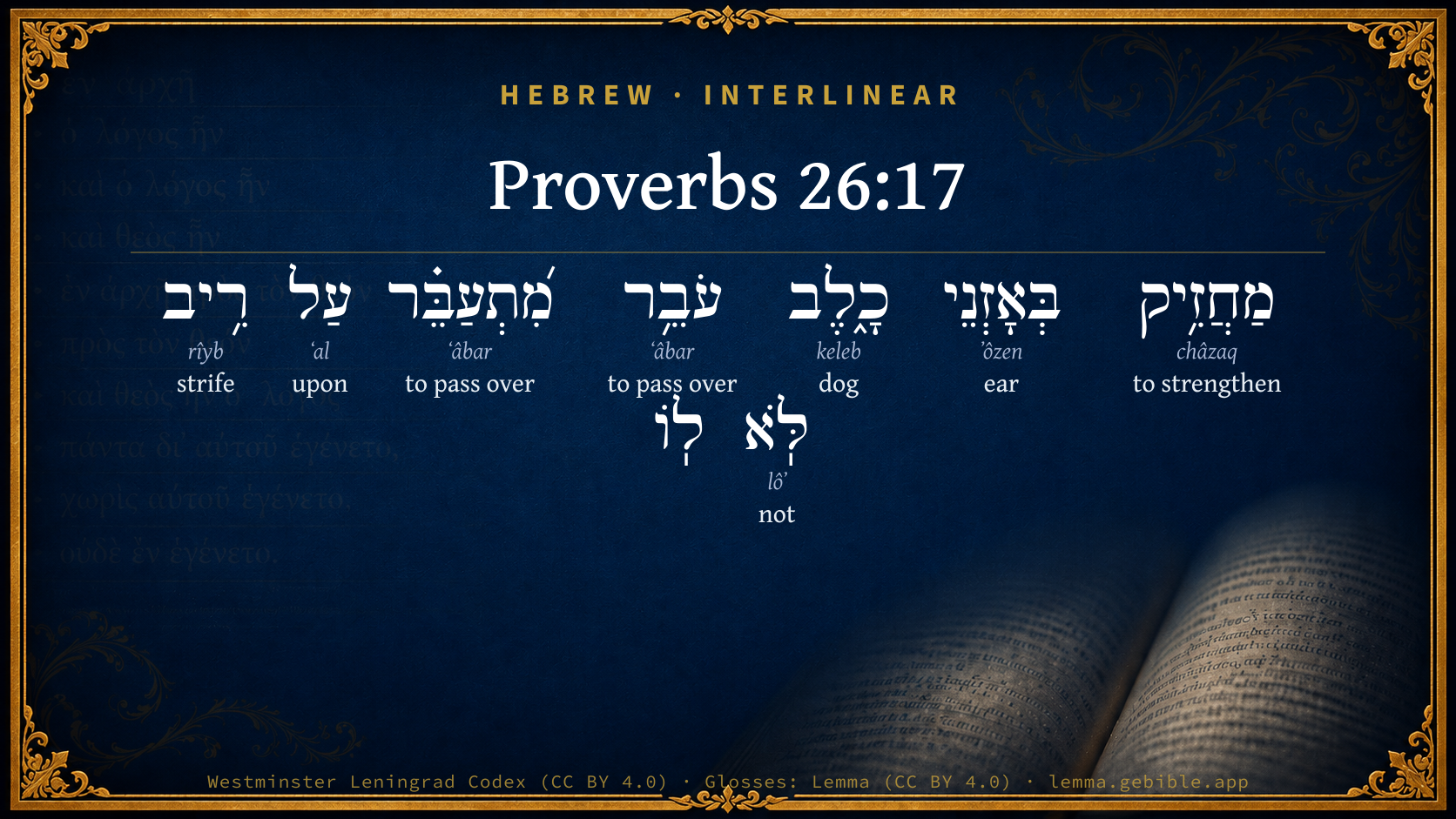
Hebrew (Westminster Leningrad Codex) Proverbs 26:17 appears in the Hebrew Old Testament. The text above is from the Westminster Leningrad Codex. Each word links to its Strong’s number, a concise gloss, and parsing drawn from the Open Scriptures Hebrew Bible morphology. Click any word for its full Brown-Driver-Briggs (BDB) entry.
Download image
Cite this verse

Proverbs 26:17 (World English Bible). Public Domain. Lemma interlinear Bible study tool, https://lemma.gebible.app/v/proverbs/26/17.

Show BibTeX & RIS
BibTeX
RIS
English Translation
Like one who grabs a dog's ears Is one who passes by and meddles in a quarrel not his own.
World English Bible · Public Domain
Download a study sheet

One document with this verse’s original text, its word-by-word gloss line, the meaning frame, cross-references with their text, attributed commentary, and full source and license credits — printable, and it pastes into notes with its structure intact.

This verse Autodidact and up

Study sheet (.html) Plain text (.txt)

A passage Seminary Student

Up to 50 verses in one chapter. A passage sheet keeps up to 6 commentary sources and 12 cross-references per verse, in the order this page ranks them, and says so on the sheet whenever that leaves anything out. Ask for a single verse and you get the Autodidact verse sheet above.

Everything on this page stays free to read, with no account — the sheet is a download of what is already on screen, not access to it.

Want to remove ads? Support Godless Engineer
Compare translations 3

The same verse in 3 English versions, stacked beneath the original-language interlinear above. Click any original word for its lexicon entry.

Each is an independent rendering of the whole verse — the interlinear is not word-aligned to these translations.

Highlighted words mark where these versions differ — a whole-verse word diff, not a word-by-word alignment.

  • World English Bible Public Domain
    Like one who grabs a dog's ears Is one who passes by and meddles in a quarrel not his own.
  • King James Version Public Domain
    He that passeth by, and meddleth with strife belonging not to him, is like one that taketh a dog by the ears.
  • unfoldingWord Literal Text CC BY-SA 4.0
    One grabbing the ears of a dog passing by one infuriating himself over a dispute not for him.

unfoldingWord Literal Text — © unfoldingWord, licensed CC BY-SA 4.0. Word-aligned USFM3 via Door43 (git.door43.org/unfoldingWord/en_ult).

Versions to compare (up to 4)

3 of 4 selected

Show all 18 translations

Every available English version of this verse, each an independent rendering of the whole verse.

  • World English Bible Public Domain
    Like one who grabs a dog's ears Is one who passes by and meddles in a quarrel not his own.
  • Berean Standard Bible Public Domain
    Like one who grabs a dog by the ears is a passerby who meddles in a quarrel not his own.
  • Majority Standard Bible Public Domain
    Like one who grabs a dog by the ears is a passerby who meddles in a quarrel not his own.
  • King James Version Public Domain
    He that passeth by, and meddleth with strife belonging not to him, is like one that taketh a dog by the ears.
  • American Standard Version (1901) Public Domain
    He that passeth by, `and' vexeth himself with strife belonging not to him, Is `like' one that taketh a dog by the ears.
  • Revised Version (1885) Public Domain
    He that passeth by, and vexeth himself with strife belonging not to him, is like one that taketh a dog by the ears.
  • Geneva Bible (1599) Public Domain
    He that passeth by and medleth with the strife that belongeth not vnto him, is as one that taketh a dog by the eares.
  • Douay-Rheims (1899) Public Domain
    As he that taketh a dog by the ears, so is he that passeth by in anger, and meddleth with another man's quarrel.
  • Young's Literal Translation Public Domain
    Laying hold on the ears of a dog, `Is' a passer-by making himself wrath for strife not his own.
  • Literal Standard Version CC BY-SA 4.0
    Laying hold on the ears of a dog, || [Is] a passer-by making himself wrath for strife [that is] not his own.
  • Unlocked Literal Bible CC BY-SA 4.0
    Like one who takes hold of the ears of a dog, is a passerby who becomes angry at a dispute that is not his own.
  • unfoldingWord Literal Text CC BY-SA 4.0
    One grabbing the ears of a dog passing by one infuriating himself over a dispute not for him.
  • Darby Bible Public Domain
    He that passing by vexeth himself with strife belonging not to him, is [like] one that taketh a dog by the ears.
  • World Messianic Bible Public Domain
    Like one who grabs a dog’s ears is one who passes by and meddles in a quarrel not his own.
  • Webster's Bible Public Domain
    He that passeth by, and meddleth with strife belonging not to him, is like one that taketh a dog by the ears.
  • Free Bible Version CC BY-SA 4.0
    Interfering in someone else's quarrel is like grabbing a stray dog by the ears.
  • Bible in Basic English Public Domain
    He who gets mixed up in a fight which is not his business, is like one who takes a dog by the ears while it is going by.
  • JPS Tanakh (1917) Public Domain
    He that passeth by, and meddleth with strife not his own, is like one that taketh a dog by the ears.

Literal Standard Version (2020), Covenant Press — licensed CC BY-SA 4.0. Text via the HelloAO Bible API (eBible.org). Unlocked Literal Bible (unfoldingWord) — licensed CC BY-SA 4.0. Text via the HelloAO Bible API (eBible.org). unfoldingWord Literal Text — © unfoldingWord, licensed CC BY-SA 4.0. Word-aligned USFM3 via Door43 (git.door43.org/unfoldingWord/en_ult). Free Bible Version, Dr. Jonathan Gallagher — licensed CC BY-SA 4.0. Text via the HelloAO Bible API (eBible.org).

Word by word

More ways to search: Search by grammar → Find every occurrence → Compare this word →

Practice this passage: Drill this verse → Learn its vocabulary →

About this verse

These counts appear in no published source. They are computed here, from the morphology-tagged text and Lemma’s own curated glosses. What Lemma adds →

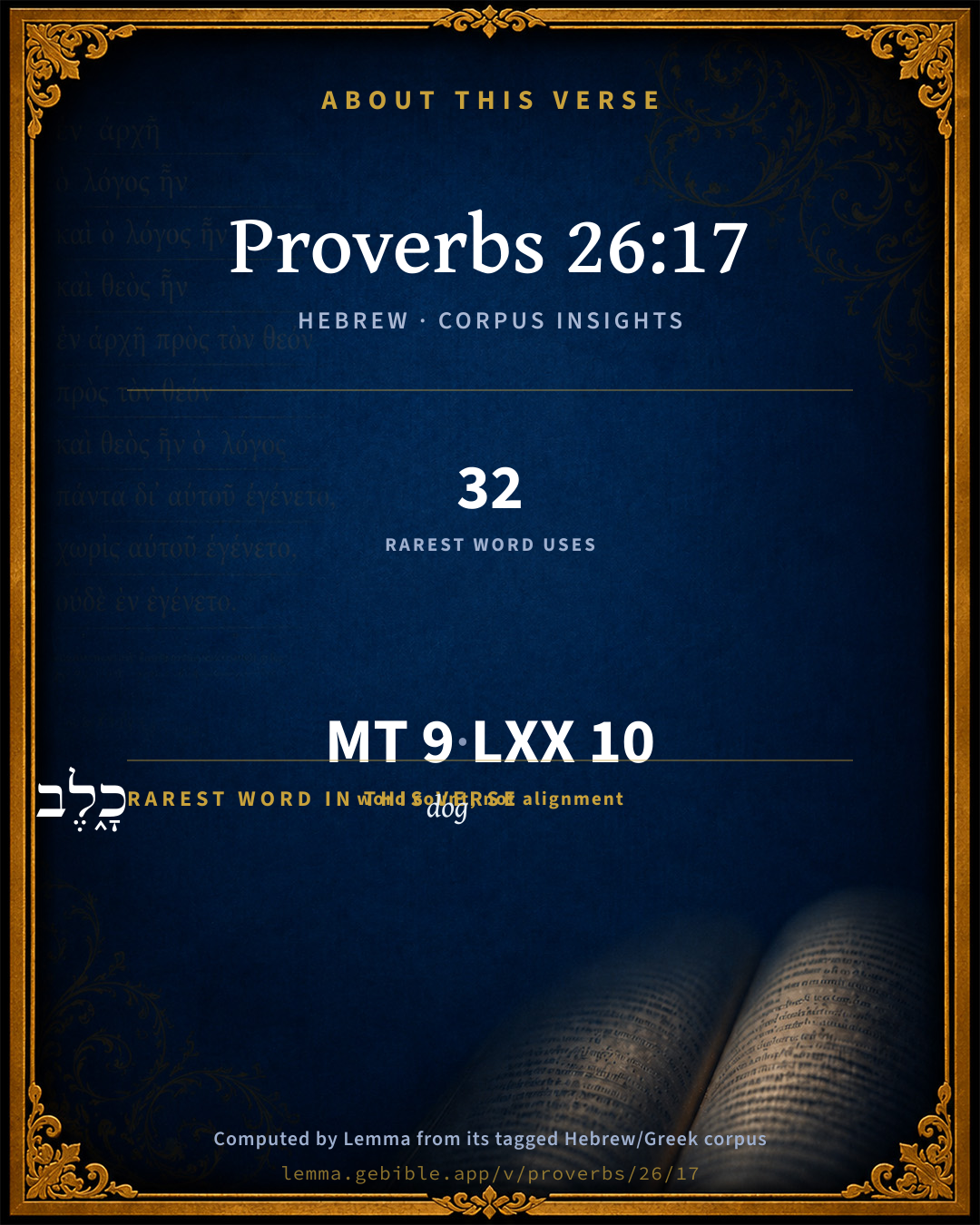
9
words
7
distinct lemmas
Wisdom
section

Shared distinctive vocabulary

כָ֑לֶב dog H3611 occurs in 31 verses of the Hebrew Bible. Also found in:

Grammatical profile

  • 3 verbs
  • 3 nouns
  • 2 prepositions
  • 1 particle

Verb forms

  • מַחֲזִ֥יק Hiphil · Participle Active
  • עֹבֵ֥ר Qal · Participle Active
  • מִ֝תְעַבֵּ֗ר Hithpael · Participle Active

Repetition

A word recurs within this verse — often emphatic in Hebrew:

  • עֹבֵ֥ר to pass over H5674 ×2

Hebrew & Septuagint length

In English translation the verse runs 20 words from the Hebrew and 20 from the Septuagint (LXX English) — the same length.

A rough comparison of the two English renderings, which tokenize alike — not a word-level alignment.

Word counts can differ between the Hebrew and the Greek without any difference in meaning — e.g. the Hebrew direct-object marker אֵת has no separate Greek word, and Greek often adds the article ὁ.

In the original languages it is 9 Hebrew tokens and 10 Greek tokens — but the two are counted differently (Hebrew bundles its prefixes and suffixes into one token; the Greek is in lemma form), so that isn’t a like-for-like length.

Cross-references

5

Topical passages linked to Proverbs 26:17 in the Treasury of Scripture Knowledge — connected by theme and wording, ordered by reader-vote popularity; previews shown in the World English Bible.

  • Proverbs 20:3 It is an honor for a man to keep aloof from strife; But every fool will be quarreling.
  • 2 Timothy 2:23–24 But refuse foolish and ignorant questionings, knowing that they generate strife.
  • Proverbs 18:6 A fool's lips come into strife, And his mouth invites beatings.
  • Luke 12:14 But he said to him, "Man, who made me a judge or an arbitrator over you?"
  • Proverbs 17:11 An evil man seeks only rebellion; Therefore a cruel messenger shall be sent against him.

Cross-references courtesy of OpenBible.info (CC BY 4.0).

Hebrew and Greek witnesses Masoretic Hebrew ↔ Greek Septuagint

The same verse in the two great witnesses to the Old Testament, shown verse-for-verse.

These are two independent witnesses, not word-aligned to each other, and the Septuagint is shown in lemma (dictionary) form.

Hebrew Proverbs 26:17 Masoretic · Westminster Leningrad Codex

מַחֲזִ֥יק בְּאָזְנֵי כָ֑לֶב עֹבֵ֥ר מִ֝תְעַבֵּ֗ר עַל רִ֥יב לֹּֽא לֽוֹ

Like one who grabs a dog's ears Is one who passes by and meddles in a quarrel not his own.

World English Bible · Public Domain

Greek LXX Proverbs 26:17 Septuagint · lemma form

ὥσπερ ὁ κρατέω κέρκος κύων οὕτως ὁ προἵστημι ἀλλότριος κρίσις

As he that lays hold of a dog's tail, so is he that makes himself the champion of another's cause.

LXX2012 (modern English Septuagint) · Public Domain

On this verse, The Cambridge Bible for Schools and Colleges discusses the Septuagint’s reading. Read the note in Commentary ↓

Hebrew: Westminster Leningrad Codex (CC BY 4.0). Greek: Septuagint (public domain); English from LXX2012 (modern English Septuagint) (Public Domain). How the Septuagint differs from the Hebrew →

Commentary

Notes on Proverbs 26:17 from classic Christian and Jewish commentators (each source and its license shown beneath its notes). The classic Christian expositions comment on the surrounding passage and are grouped to its opening verse, so a note may address several verses; the Jewish commentaries on the Tanakh (Rashi and others) are per-verse, so they appear only where the commentator wrote on this verse.

Lemma curates 59 commentaries, every one of them public domain or Creative Commons licensed, each selected and text-cleaned for this edition rather than reprinted as found. About our sources →

Trapp's Complete Commentary

John Trapp

Pro 26:17 He that passeth by, [and] meddleth with strife [belonging] not to him, [is like] one that taketh a dog by the ears.

Ver. 17. He that passeth by and meddleth, &c.] Two kind of studies have I always hated, saith one: Studium partium, et studium novarum forum. Study of parts, and study of new markets. They that enter strife without calling, saith another, do commonly hazard themselves into trouble without comfort. This was Jehoshaphat’s folly at Jabeshgilead, and, as some think, Josiah’s when he went up against Pharaohnecho, thinking thereby to ingratiate with the Assyrian, Pharaoh’s professed enemy. It is from idleness usually that men are thus busy in other men’s matters without thank or other benefit, {1Ti 5:13 1Th 4:11} and therefore this proverb fitly follows the former. Howbeit this is not always true, for charity may move men to interpose for a right understanding and a good accord between disagreeing parties. Neither in this case must a man affect to be held no meddler, since "blessed are the peace makers." And though it be for most part a thankless office - for if a man have two friends he oft loseth one of them - yet our reward is with God; and if, by seeking to part the scuffle, we derive some blows upon ourselves, yet the Euge of a good conscience will salve that well enough. That which is here forbidden is for a man to make himself a party, and maintain one side against another. And yet where it is for God and his truth this may be done too; as when Queen Elizabeth not only sat as umpire between the Spaniard, French, and Hollanders {a} - so as she might well have taken up that saying of her father, Cui adhaereo, praeest, He whom I side with carries it - but afterwards, when she saw her time, undertook the protection of the Netherlanders against the Spaniard, wherein all princes admired her fortitude, and the King of Sweden said that she had now taken the diadem from her head, and set it upon the doubtful chance of war. This was done Anno 1585. {b}

Is like else that taketh a dog by the ears.] Where he loves not to be handled, but about the neck rather. The Dutch have a like proverb, - To take a dog by the tail. The Greeks, - To take a lion by the beard, or a bear by the tooth - to thrust one’s hand into a wasp’s nest - to stir up a scorpion, &c. {c}

{a} Camden’s Elizab., 196.

{b} Ibid.

{c} τον λεοντα ξυραθαι. σφηκας ερεθιζειν

John Trapp, A Commentary or Exposition upon All the Books of the Old and New Testament (1647–1656) — public domain. Text from a community e-Sword module.

The Biblical Illustrator

Joseph S. Exell

Pro_26:17-22

He that passeth by, and meddleth with strife.

Mischievous citizens

I. The meddler (Pro_26:17).

1. His conduct defined.

2. His mischief indicated. Renders himself liable to the anger of one, if not both, of the contending parties.

II. The liar (Pro_26:18-19).

1. By his false representations he involves his neighbour in some embarrassment, contention, or pain, and then excuses himself by saying, It is in sport. A lie is no less a lie because spoken in the spirit of frolic and jest.

2. Many a practical jester does the maniacs mischief without the maniacs excuse.

III. The querulous (Pro_26:21). He is a social incendiary.

IV. The talebearer (Pro_26:22).

1. He maintains strife. As the microscopic sting of a little insect sometimes poisons the blood and influences the body of a strong man, the mere whisper of a talebearer will kindle the fire of discord in a whole community.

2. He infects with poison; his words destroy the mental peace of him to whom they are uttered, the reputation of him of whom they are uttered, and the social happiness of both. (D. Thomas, D. D.)

The Biblical Illustrator, edited by Joseph S. Exell (c. 1880s–1900s) — public domain. Text from a community e-Sword module.

Joseph Benson's Commentary

Pro 26:17. He that passeth by — Who is going on the way about his business; and meddleth with strife, &c. — In which he is not concerned, nor any way obliged to meddle; is like one that taketh a dog by the ears — Exposes himself to great and needless hazard, as a man that unnecessarily provoketh a mastiff dog against himself.

Joseph Benson's Commentary on the Old and New Testaments (1811–1818) — public domain. Text from a community e-Sword module.

The Preacher's Complete Homiletical Commentary

Joseph S. Exell (gen. ed.)

CRITICAL NOTES.—

Pro_26:17. Meddleth, rather, “is excited.”

Pro_26:21. Coals to burning coals—i.e., “black coals to burning,” etc.

Pro_26:22. A repetition of chap. Pro_18:8. (See on that verse.)

MAIN HOMILETICS OF Pro_26:17

NEEDLESS INTERFERENCE

The wise man may here be regarded as passing from one extreme of character to the other—from the man who is too indolent to mind his own affairs, to one whose activity is so great that it leads him to unnecessary interference with his neighbour’s business. Or he may intend to suggest that indolence and meddling are very closely allied—that he who is not usefully occupied in doing his own work will be very apt to interfere impertinently with the concerns of others.

I. Such a meddler brings trouble upon himself. It is a dangerous thing to take a strange dog by the ears, and he who does it will be very likely to suffer for it in his own person, for the creature will probably wound him. But he who meddles impertinently with those who are at strife has to deal, not with one angry brute, but with two angry men or women, and will very likely bring down the wrath of both upon his own head. For it is to be noted that the strife with which it is mischievous to intermeddle is that “which belongeth not to” a man—a quarrel in which an outsider has no right to take a part.

II. He may do harm to others. To take a dog by the ears is at least a foolish and useless act, and will certainly not increase the comfort or peace of anybody. But it may so enrage the beast as to make him a general disturber of the public peace and safety. And the same holds good in relation to meddlers; the mischief that they do may extend far beyond themselves, and their action may form a centre of a wide circle of mental disquietude and moral mischief.

OUTLINES AND SUGGESTIVE COMMENTS

A wide difference is made between “suffering as a busy-body, and suffering as a Christian.” It is alarming to those who have no adequate sense of the criminality to find the apostle classify the one with “murderers, and thieves, and evil-doers.”—Bridges.

For Homiletics on Pro_26:18-22, see on chap. Pro_17:14, page 513, and on chap. Pro_18:6-8, page 539.

The Preacher's Complete Homiletical Commentary (gen. ed. Joseph S. Exell; Funk & Wagnalls, c. 1892) — public domain (pre-1929). A full-Bible homiletical/sermon-outline anthology covering 65 of 66 books (2 John is absent from the source module). Text from a community e-Sword module.

Tyndale Open Study Notes

Tyndale Open Resources

26:17 The wise avoid getting involved in other people’s arguments (cp. 26:21).

Tyndale Open Study Notes — © Tyndale Open Resources, licensed CC BY-SA 4.0. Text via the HelloAO Bible API.

Matthew Henry's Commentary

1. That which is here condemned is meddling with strife that belongs not to us. If we must not be hasty to strive in our own cause (Pro 25:8), much less in other people's, especially theirs that we are no way related to or concerned in, but light on accidentally as we pass by. If we can be instrumental to make peace between those that are at variance we must do it, though we should thereby get the ill-will of both sides, at least while they are in their heat; but to make ourselves busy in other men's matters, and parties in other men's quarrels, is not only to court our own trouble, but to thrust ourselves into temptation. Who made me a judge? Let them end it, as they began it, between themselves. 2. We are cautioned against it because of the danger it exposes us to; it is like taking a snarling cur by the ears, that will snap at you and bite you; you had better have let him alone, for you cannot get clear of him when you would, and must thank yourselves if you come off with a wound and dishonour. He that has got a dog by the ears, if he lets him go he flies at him, if he keeps his hold, he has his hands full, and can do nothing else. Let every one with quietness work and mind his own business, and not with unquietness quarrel and meddle with other people's business.

Matthew Henry's Commentary on the Whole Bible (1708–1710) — public domain (CC PDM 1.0). Text via the HelloAO Bible API.

Jamieson, Fausset & Brown

Robert Jamieson, A. R. Fausset & David Brown

meddleth--as in Pro 20:19; Pro 24:21; as either holding a dog by the ears or letting him go involves danger, so success in another man's strife or failure involves a useless risk of reputation, does no good, and may do us harm.

Jamieson, Fausset & Brown — Commentary Critical and Explanatory on the Whole Bible (1871) — public domain (CC PDM 1.0). Text via the HelloAO Bible API.

Adam Clarke's Commentary

Verse 17. He that passeth by] This proverb stands true ninety-nine times out of a hundred, where people meddle with domestic broils, or differences between men and their wives.

Adam Clarke's Commentary on the Bible (1810–1826) — public domain. Text from a community e-Sword/MySword module.

Ellicott's Commentary for English Readers

(17) Meddleth with strife.—Rather, that is excited with strife. If quarrelling and taking revenge on our own account are forbidden (Rom_12:18-19), how much more is the mixing up of ourselves in the disputes of other persons.

Like one that taketh a dog by the ears.—Who deserves to be bitten for his pains, the usual result of interfering in quarrels.

A Bible Commentary for English Readers, edited by Charles John Ellicott (1878–1897) — public domain. Text from a community e-Sword module.

The Cambridge Bible for Schools and Colleges

gen. ed. J. J. S. Perowne

17. meddleth] Rather, vexeth himself, R.V. See Pro_20:2, where the same word is rendered, provoketh to anger, A.V. and R.V. text, or angereth himself against, R.V. marg. Of course in this place the “meddling” is implied as the consequence of his “vexing himself.” He is provoked to interfere.

By neglecting the Heb. accents the word rendered passeth by is transferred in R.V. margin to the dog: “a passing dog.” But the force of the proverb lies in the fact that the man who is provoked to interfere is a mere passer by; the strife in no way belongs to him.

the ears] The LXX. substitute, the tail: ὁ κρατῶν κέρκον κυνός. The meaning in either case is, he deserves to be bitten for his pains. “The Latin proverbial phrase, ‘auribus lupum tenere,’ may be noticed for its curious parallelism.” Speaker’s Comm.

The Cambridge Bible for Schools and Colleges (gen. ed. J. J. S. Perowne; Cambridge University Press, 1878–1918) — public domain. Text from a community e-Sword module.

John Gill's Exposition

He that passeth by, and meddleth with strife belonging not to him,.... One that going along the streets, and passing by the door, where two or more persons are quarrelling, and he thrusts himself in and intermeddles in the affair he has no concern in; and interests himself in the cause of the quarrel he has nothing to do with, on account of acquaintance, relation, or office; and especially when, instead of being a mediator and peacemaker, he takes on one side, and acts the angry part, as Aben Ezra interprets the word rendered "meddleth"; blows things up into a greater flame, and enrages the one against the other. Such a man

is like one that taketh a dog by the ears; which are short, and difficult to be held, and tender; and therefore cannot bear to be held by them, especially to be pulled and lugged by them, and which is very provoking; and as such a man has work enough to do to hold him, so he is in danger of being bitten by him, at least when he is forced to let go his hold: and so it is with a man that interferes in a quarrel in a furious manner; it is much if one or other of the contending parties do not fall upon him and abuse him. The Septuagint and Arabic versions render it, "as he that holdeth the tail of a dog."

John Gill's Exposition of the Whole Bible (1746–1763) — public domain (CC PDM 1.0). Text via the HelloAO Bible API.

Haydock's Catholic Bible Commentary

Anger. Hebrew, "passeth by, and meddleth with a quarrel not ot him" pertaining. (Haydock) --- Such expose themselves foolishly to danger. Great discretion is requisite to reconcile those at variance.

George Leo Haydock (1774–1849), Haydock's Catholic Family Bible and Commentary, 1859 edition — public domain. Excludes Psalms (Douay-Rheims chapter numbering differs from Protestant) and Deuterocanonical books (Catholic canon only).

Matthew Poole's English Annotations

He that passeth by; who is going upon the way, and about his business. But this word is by some referred to the last clause, is like

one that taketh a dog by the ears as he is passing by him, without any thought of doing him harm; which agrees very well both with the order of the words in the Hebrew text, and with the matter of the other clause, to which this similitude is referred.

Belonging not to him; in which he is not concerned, nor any way obliged to meddle.

Is like one that taketh a dog by the ears; exposeth himself to great and needless hazards, as a man that causelessly provoketh a mastiff dog against himself.

Matthew Poole's English Annotations on the Holy Bible (1683–1685) — public domain. Text from a community e-Sword/MySword module.

Whedon's Commentary on the Bible

Daniel D. Whedon

17. Taketh a dog by the ears — Septuagint: “By the tail.” This is a striking metaphor, representing a difficulty which we cannot get out of without danger and injury. A very forcible caution against unnecessarily intermeddling with other people’s contentions, especially with family quarrels. The Oriental dogs, the most of which have no masters, but run at large, are irritable and fierce. Instead of meddleth with Zockler renders, “Is excited by strife that is not his own.” Conant: “Gets angry.” Stuart: “Rushes into.” Compare Pro_20:3, and note there.

Daniel D. Whedon (gen. ed.), Commentary on the Old and New Testaments (1874–1909) — public domain. Text from a community e-Sword module.

The Pulpit Commentary

Vers. 17-28. A series of proverbs connected more or less with peacefulness and its opposite.

He that passeth by, and meddleth with strife belonging not to him. "Meddleth with strife" should be "vexes, excites himself, with a quarrel." Is like one that taketh a dog by the ears, and thus needlessly provokes him to bark and bite. Regarding the position of the two participles in this verse, without any connecting link, Delitzsch takes "passing by" as attributed to the dog, thus: "He seizes by the ears a dog passing by, who is excited by a strife that concerns him not." The stray dog corresponds to the quarrel with which one has nothing to do. The present accentuation does not support this view; otherwise it is suitable and probable. Septuagint, "As he who lays hold of a dog"s tail, so is he who sets himself forth as champion in another"s cause." Ecc_11:9, "Strive not in a matter that concerns thee not." Says a Greek gnome Polupragmonein tatria mh boulou kaka .

Our English proverb says, "He that intermeddles with all things may go shoe the goslings." The Telugu compares such interference to a monkey holding a snake in his paw; it is hard to hold, dangerous to let go (Lane).

Vers. 17-19. Wanton petulance.

I MEDDLING IN OTHERS" QUARRELS. (Ver. 17) By a very homely image the folly of this is marked. To interfere in disputes which do not concern one is to get hurt one"s self. No doubt the proverb admits of a very selfish application. We may excuse indifference to right on such a plea. But a true instinct of Christian justice and love will find a middle course. We should be sure of our call to act before we meddle in others" affairs. It is rare that it can be our duty to volunteer the office of judge. Benevolent neutrality is generally our most helpful attitude.

II MAKING SPORT OF MISCHIEF. (Vers. 18, 19) There is an ape-like line of mischief in human nature that needs to be watched. Amusing in trifling matters, it may, if encouraged, fly at high game. He that purposely deceives his neighbour under colour of a jest is no less prejudicial to him than a lunatic that cloth wrong out of frenzy and distraction (Bishop Hall). The habit of teasing should be corrected in children. What seems comparatively harmless in itself at first may readily become a habit and harden into a vice. It is in the little delicacies of daily life, no less than in the greatest matters, that we are called to practise the golden rule. We must consider the effect, as well as the intention , of our actions; for, as in the old fable, what is sport to us may be grievous hurt to another. J.

The Pulpit Commentary (1880–1919), ed. H.D.M. Spence-Jones & Joseph S. Exell — public domain. Text from a community e-Sword module.

John Wesley's Explanatory Notes

He - Who is going upon the way. With strife - In which he is not concerned, nor any way obliged to meddle. That taketh - Exposes himself to needless hazard.

John Wesley, Explanatory Notes Upon the Whole Bible (1754–1765) — public domain. Text via the GEBible commentary corpus.

Keil & Delitzsch

C. F. Keil & F. Delitzsch

A series of proverbs which recommend the love of peace, for they present caricatures of the opposite:

17 He seizeth by the ears of a dog passing by,

Who is excited by a strife which concerns him not.

According to the accentuation in the text, the proverb is to be translated with Fleischer: Qualis est qui prehendit aures canis, talis est qui forte transiens ira abripitur propter rixam alienam (eique temere se immiscent). Since he is cautioned against unwarranted interference, the expression מתערב בּדין might have been used (Pro 14:10), according to which the Syr. translates; but על־ריב substantiates the originality of מתעבּר (vid., Pro 14:16; Pro 20:2). On the other hand, the placing together, without any connection of the two participles, is perplexing; why not עבר וּמתעבּר? For it is certainly not meant, that falling into a passion he passes by; but that passing by, he falls into a passion; for he stands to this object. The Targumist, feeling this also, renders עבר in the sense of being angry, but contrary to the usus loq. Wherefore the conjecture of Euchel and Abramsohn commends itself, that עבר belongs to כלב - the figure thereby becomes more distinct. To seize one's own dog by the ear is not dangerous, but it is not advisable to do this with a strange dog. Therefore עבר belongs as a necessary attribute to the dog. The dog accidentally passing by corresponds to the strife to which one stands in no relation (ריב לא־ול, vid., regarding the Makkeph, Baer's Genesis, p. 85, not. 9). Whoever is excited to passion about a strife that does not belong to him, is like one who lays hold by the ears (the lxx arbitrarily: by the tail) of a dog that is passing by - to the one or to the other it happens right when he brings evil upon himself thereby.

Keil & Delitzsch — Biblical Commentary on the Old Testament (1861–1891) — public domain (CC PDM 1.0). Text via the HelloAO Bible API. (Old Testament only.)

Bridges on Proverbs

Charles Bridges

If we would honor our God in our Christian path, we must take time at every step, for prayer, and for the exercise of a sound judgment. Else we shall often rush on unbidden to our loss. To take a dog by the ears will bring good reason to repent of our folly. To meddle with strife belonging not to us will surely bring its trouble (1Ki 22:4, 1Ki 22:32 ) — its own cross, not our Master’s. A wide difference is made between "suffering as a busy-body, and suffering as a Christian." It is alarming to those who have no adequate sense of the criminality to find the Apostle classify the one with "murderers, and thieves, and evil-doers." In striking contrast to the other he gives the dignified exhortation — "Let him glorify God on this behalf." (1Pe 4:16 .) If we must not "go forth hastily to strive" (Pro 25:8 ) in our own cause, still less in our neighbor’s. This is "entering into contention" — the wantonness of the fool. (Pro 18:6 ; Pro 20:3 .)

Even with Christian intentions many of us are too fond of meddling with strife not belonging to us. We constitute ourselves too readily judges of our neighbor’s conduct. Neutrality is often the plain dictate of prudence. Uncalled-for interference seldom avails with the contending parties; while the well-meaning mediator involves himself in the strife to his own mischief. Our blessed Master reads us a lesson of godly wisdom. He healed the contentions in his own family. But, when called to meddle with strife belonging not to him, he gave answer — "Who made me a judge or a divider over you?"†1

Must we then "suffer sin upon our brother"? (Lev 19:17 .) Certainly not. But we should ponder carefully the most effectual mode of restraining his sin. Think of the special "blessing to the peace-makers." (Mat 5:9 .) But the true peace-maker, while he deplores the strife, well knows, that interference in the moment of irritation will kindle rather than extinguish, the fire. Yet his self-control is not indifference. He commits the matter to Him, whose wisdom he so greatly needs. He will seize the first moment for favorable remonstrance; "and a word spoken in due season, how good is it!" (Pro 15:23 .) Indeed the common intercourse of life much requires that "wisdom, which dwelleth with prudence." (Pro 8:12 .) "Who is a wise man, and endued with knowledge among you? Let him shew out of a good conversation his works with meekness of wisdom." (Jas 3:13 .)

Footnotes:

†1 Mat 18:1-6. Mat 20:24-28, with Luk 12:13-14 .

Charles Bridges, An Exposition of the Book of Proverbs (1846) — public domain. Text from a community e-Sword module.

Kretzmann's Popular Commentary

Paul E. Kretzmann

Concerning Busybodies

v. 17. He that passeth by and meddleth with strife belonging not to him, becoming excited over a dispute which is really none of his business, is like one that taketh a dog by the ears, deliberately provoking trouble for himself.

v. 18. As a madman who casteth fire-brands, or fiery darts, arrows, and death, deadly missiles of all kinds,

v. 19. so is the man that deceiveth his neighbor, using craft against him, deliberately hurting him with bitter speeches, and saith, Am not I in sport? Gentle teasing and irony may well be permissible, but there is a limit to everything, and joking must never become pointed raillery with a personal sting.

v. 20. Where no wood is, there the fire goeth out, for want of fuel; so where there is no talebearer, whose slanderous remarks always add further fuel for quarrels, the strife ceaseth, it is quieted for want of material to keep it going.

v. 21. As coals are to burning coals and wood to fire, keeping the blaze steady, so is a contentious man to kindle strife, always to stir it up anew.

v. 22. The words of a talebearer are as wounds, and they go down into the innermost parts of the belly. cf Pro 18:8.

v. 23. Burning lips, such as are fervent with demonstrations of regard, and a wicked heart, showing that the glow of the lips is repulsive hypocrisy, are like a potsherd covered with silver dross, impure silver covering an earthen vessel, the comparison serving to bring out the falseness of such actions.

v. 24. He that hateth, dissembleth with his lips, or, "With his lips the hater dissembleth," and layeth up deceit within him;

v. 25. when he speaketh fair, making his voice and speech pleasant, believe him not; for there are seven abominations in his heart, hateful and loathsome plans and projects engage his attention, Mat 12:45.

v. 26. Whose hatred is covered by deceit, since he has managed to keep it secret for a while, his wickedness shall be showed before the whole congregation, exposed before the entire assembly convened for judgment.

v. 27. Whoso diggeth a pit shall fall therein, this being the form which the punishment of God will take; and he that rolleth a stone, with the intention of harming another, it will return upon him, in just retribution.

v. 28. A lying tongue hateth those that are afflicted by it, it is not a case of merely repeating a slander in a thoughtless manner, but a deliberate expression of hatred; and a flattering mouth worketh ruin, for if men are duped by flattery, it brings misfortune upon them. Careful uprightness is required of every true child of God.

Paul E. Kretzmann, Popular Commentary of the Bible (1921–1924) — public domain. Text from a community e-Sword module.

unfoldingWord translationNotes

Door43 World Missions Community

Like one who takes hold of the ears of a dog, is a passerby who becomes angry at a dispute that is not his own

This can be reordered. AT: "A passerby who becomes angry at some other people's dispute is like a person who grabs hold of a dog's ears" (See: Simile)

Like one who takes hold of the ears of a dog

The implied information is that the dog will get angry and bite the person. AT: "Like a person who angers a dog by grabbing its ears" or "Like a person who grabs a dog's ears and is bitten by the dog" (See: Assumed Knowledge and Implicit Information)

is a passerby who becomes angry at a dispute that is not his own

The implied information is that the passerby will start arguing, and the people who were fighting will get angry with him and hurt him. (See: Assumed Knowledge and Implicit Information)

translationWords

anger

unfoldingWord translationNotes — © Distant Shores Media and the Door43 World Missions Community, licensed CC BY-SA 4.0. Source: git.door43.org/Door43/en_tn.

Rashi

Rabbi Shlomo Yitzchaki (Rashi)

one who grabs a dog by its ears One who passes by and becomes embroiled in a quarrel that is not his is like one who grabs a dog by his ears, who causes him to bite him for no reason.

Rashi on the Tanakh — English translations: “The Judaica Press complete Tanach with Rashi, translated by A. J. Rosenberg” (CC BY 4.0); “Pentateuch with Rashi's commentary by M. Rosenbaum and A.M. Silbermann, 1929-1934” (public domain); “The Metsudah Tanach series, Lakewood, N.J” (CC BY 4.0); and “The Book of Joshua, Metsudah Publications, 1997” (CC BY 4.0). Text via Sefaria.

Lesson kit

Teaching starters — assembled from the data on this page, not authored interpretation. Every prompt links to the verse data it draws on. Edit before teaching.

Proverbs, in the Wisdom, opens this verse with 9 words (7 distinct Hebrew lemmas). Its most distinctive word is keleb (“dog”). A historical commentator’s framing appears above. Read the whole chapter for the surrounding context.

Discussion questions

  1. How does “dog” (keleb) shape what this verse is saying?
  2. How does Exodus 11:7, which shares the word «dog», read alongside this verse?
  3. What does the repetition of “to pass over” (2× in this one verse) do in this verse?
  4. These translations render this verse differently. What is at stake in choosing one wording over another?
  5. «מַחֲזִ֥יק» is a Hiphil Participle Active verb. How does that grammatical form shape the action described?
  6. Compare how Trapp's Complete Commentary and The Biblical Illustrator read this verse. Where do they agree or differ?

Things to notice

Reading settings

Reading text

Shown beneath each verse's original-language words.

Old Testament
Old Testament edition

Read the OT as the Masoretic Hebrew (MT) or the Greek Septuagint (LXX).

English shown for the Greek Septuagint (in the Hebrew ↔ Greek comparison).

Comparing translations? Open the Compare panel on any verse page to stack up to four side by side.