2 Kings 12:8

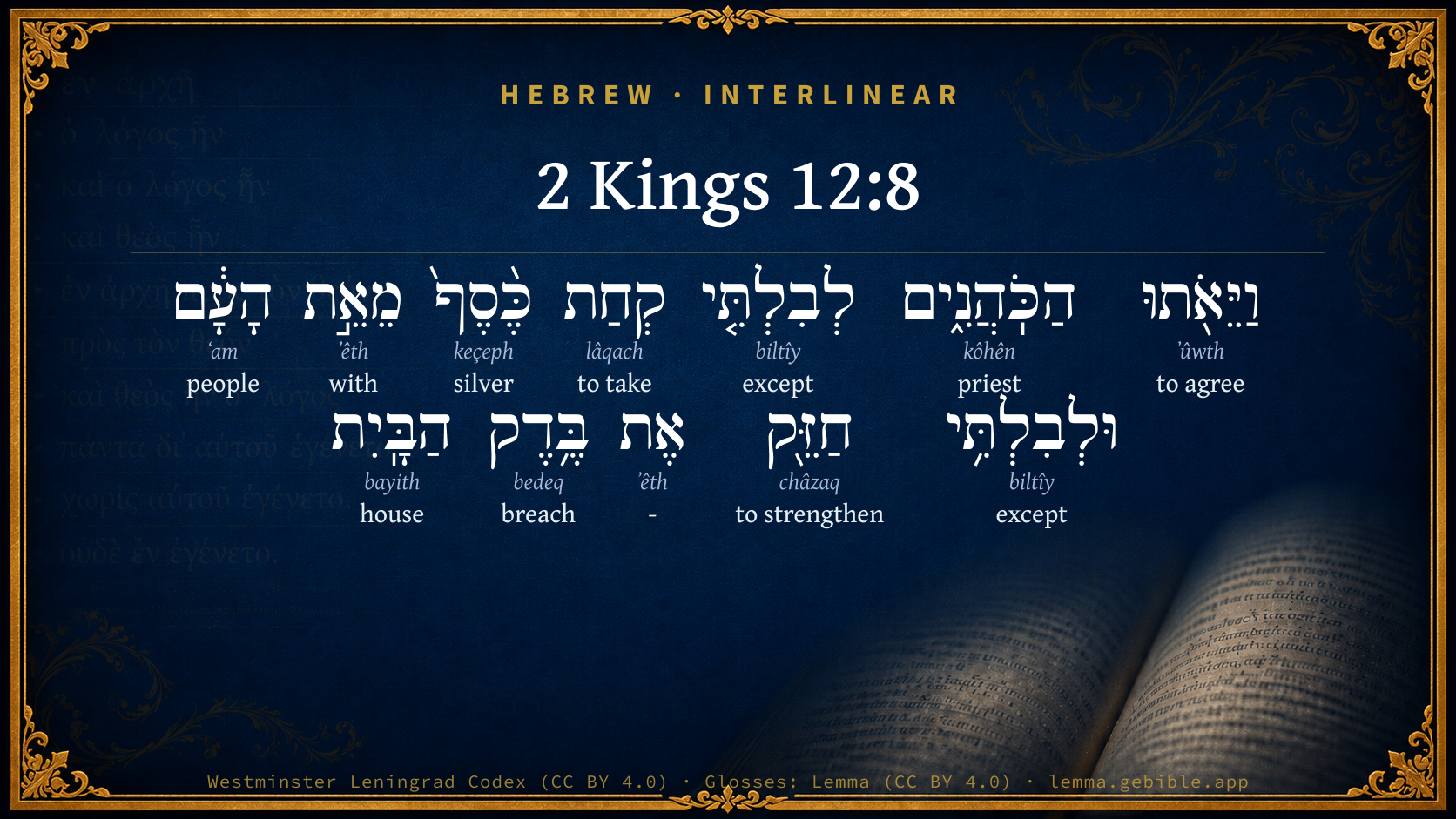
Hebrew (Westminster Leningrad Codex) 2 Kings 12:8 appears in the Hebrew Old Testament. The text above is from the Westminster Leningrad Codex. Each word links to its Strong’s number, a concise gloss, and parsing drawn from the Open Scriptures Hebrew Bible morphology. Click any word for its full Brown-Driver-Briggs (BDB) entry.
Download image
Cite this verse

2 Kings 12:8 (World English Bible). Public Domain. Lemma interlinear Bible study tool, https://lemma.gebible.app/v/2-kings/12/8.

Show BibTeX & RIS
BibTeX
RIS
English Translation
The priests consented that they should take no [more] money from the people, neither repair the breaches of the house.
World English Bible · Public Domain
Download a study sheet

One document with this verse’s original text, its word-by-word gloss line, the meaning frame, cross-references with their text, attributed commentary, and full source and license credits — printable, and it pastes into notes with its structure intact.

This verse Autodidact and up

Study sheet (.html) Plain text (.txt)

A passage Seminary Student

Up to 50 verses in one chapter. A passage sheet keeps up to 6 commentary sources and 12 cross-references per verse, in the order this page ranks them, and says so on the sheet whenever that leaves anything out. Ask for a single verse and you get the Autodidact verse sheet above.

Everything on this page stays free to read, with no account — the sheet is a download of what is already on screen, not access to it.

Want to remove ads? Support Godless Engineer
Compare translations 3

The same verse in 3 English versions, stacked beneath the original-language interlinear above. Click any original word for its lexicon entry.

Each is an independent rendering of the whole verse — the interlinear is not word-aligned to these translations.

Highlighted words mark where these versions differ — a whole-verse word diff, not a word-by-word alignment.

  • World English Bible Public Domain
    The priests consented that they should take no [more] money from the people, neither repair the breaches of the house.
  • King James Version Public Domain
    And the priests consented to receive no more money of the people, neither to repair the breaches of the house.
  • unfoldingWord Literal Text CC BY-SA 4.0
    And the priests agreed not to accept silver from the people and not to strengthen the damage of the house.

unfoldingWord Literal Text — © unfoldingWord, licensed CC BY-SA 4.0. Word-aligned USFM3 via Door43 (git.door43.org/unfoldingWord/en_ult).

Versions to compare (up to 4)

3 of 4 selected

Show all 18 translations

Every available English version of this verse, each an independent rendering of the whole verse.

  • World English Bible Public Domain
    The priests consented that they should take no [more] money from the people, neither repair the breaches of the house.
  • Berean Standard Bible Public Domain
    So the priests agreed that they would not receive money from the people and that they would not repair the temple themselves.
  • Majority Standard Bible Public Domain
    So the priests agreed that they would not receive money from the people and that they would not repair the temple themselves.
  • King James Version Public Domain
    And the priests consented to receive no more money of the people, neither to repair the breaches of the house.
  • American Standard Version (1901) Public Domain
    And the priests consented that they should take no `more' money from the people, neither repair the breaches of the house.
  • Revised Version (1885) Public Domain
    And the priests consented that they should take no more money from the people, neither repair the breaches of the house.
  • Geneva Bible (1599) Public Domain
    So the Priestes consented to receiue no more money of the people, neither to repaire the decayed places of the Temple.
  • Douay-Rheims (1899) Public Domain
    And the priests were forbidden to take any more money of the people, and to make the repairs of the house.
  • Young's Literal Translation Public Domain
    And the priests consent not to receive money from the people, nor to strengthen the breach of the house,
  • Literal Standard Version CC BY-SA 4.0
    And the priests do not consent to receive money from the people, nor to strengthen the breach of the house,
  • Unlocked Literal Bible CC BY-SA 4.0
    So the priests consented to take no more money from the people and not repair the temple themselves.
  • unfoldingWord Literal Text CC BY-SA 4.0
    And the priests agreed not to accept silver from the people and not to strengthen the damage of the house.
  • Darby Bible Public Domain
    And the priests consented to receive no money of the people, and that they should only repair the breaches of the house.
  • World Messianic Bible Public Domain
    The priests consented that they should take no more money from the people, and not repair the damage to the house.
  • Webster's Bible Public Domain
    And the priests consented to receive no more money of the people, neither to repair the breaches of the house.
  • Free Bible Version CC BY-SA 4.0
    The priests agreed not to receive any more money from the people, and that they wouldn't carry out the repairs to the Temple themselves.
  • Bible in Basic English Public Domain
    So the priests made an agreement to take no more money from the people, and not to make good what was damaged in the house.
  • JPS Tanakh (1917) Public Domain
    (12-9) And the priests consented that they should take no longer money from the people, neither repair the breaches of the house.

Literal Standard Version (2020), Covenant Press — licensed CC BY-SA 4.0. Text via the HelloAO Bible API (eBible.org). Unlocked Literal Bible (unfoldingWord) — licensed CC BY-SA 4.0. Text via the HelloAO Bible API (eBible.org). unfoldingWord Literal Text — © unfoldingWord, licensed CC BY-SA 4.0. Word-aligned USFM3 via Door43 (git.door43.org/unfoldingWord/en_ult). Free Bible Version, Dr. Jonathan Gallagher — licensed CC BY-SA 4.0. Text via the HelloAO Bible API (eBible.org).

Word by word

More ways to search: Search by grammar → Find every occurrence → Compare this word →

Practice this passage: Drill this verse → Learn its vocabulary →

וַיֵּאֹ֖תוּ
ʼûwth
H225
“and · to agree”
Conjunction + Verb, Niphal, Sequential Imperfect, 3rd Person, Masculine, Plural
Part of Speech
Conjunction + Verb
Stem
Niphal
Form
Sequential Imperfect
Person
3rd Person
Gender
Masculine
Number
Plural
Full BDB Definition

Origin: a primitive root

TWOT: 53

(Niphal) to consent, agree
  1. הַכֹּֽהֲנִ֑ים kôhên H3548 “the · priests” Particle, Definite Article + Noun, Common, Masculine, Plural, Absolute
  2. לְבִלְתִּ֤י biltîy H1115 “to/for · except” Preposition + Conjunction
  3. קְחַת lâqach H3947 “to take” Verb, Qal, Infinitive Construct
  4. כֶּ֨סֶף֙ keçeph H3701 “silver” Noun, Common, Masculine, Singular, Absolute
  5. מֵאֵ֣ת ʼêth H854 “from · with” Preposition + Preposition
  6. הָעָ֔ם ʻam H5971 “the · people” Particle, Definite Article + Noun, Common, Masculine, Singular, Absolute
  7. וּלְבִלְתִּ֥י biltîy H1115 “and · to/for · except” Conjunction + Preposition + Particle, Negative
  8. חַזֵּ֖ק châzaq H2388 “to strengthen” Verb, Piel, Infinitive Construct
  9. אֶת ʼêth H853 “-” Particle, Direct Object
  10. בֶּ֥דֶק bedeq H919 “breach of” Noun, Common, Masculine, Singular, Construct
  11. הַבָּֽיִת bayith H1004 “the · house” Particle, Definite Article + Noun, Common, Masculine, Singular, Absolute

About this verse

These counts appear in no published source. They are computed here, from the morphology-tagged text and Lemma’s own curated glosses. What Lemma adds →

12
words
11
distinct lemmas
Historical
section

Notable vocabulary

The rarest word here is וַיֵּאֹ֖תוּ to agree H225 — appearing just 4 times in the whole Hebrew Bible.

Shared distinctive vocabulary

וַיֵּאֹ֖תוּ to agree H225 occurs in 4 verses of the Hebrew Bible. Also found in:

Grammatical profile

  • 3 verbs
  • 5 nouns
  • 1 preposition
  • 1 conjunction
  • 2 particles

Verb forms

  • וַיֵּאֹ֖תוּ Niphal · Sequential Imperfect
  • קְחַת Qal · Infinitive Construct
  • חַזֵּ֖ק Piel · Infinitive Construct

Repetition

A word recurs within this verse — often emphatic in Hebrew:

  • לְבִלְתִּ֤י except H1115 ×2

Hebrew & Septuagint length

In English translation the verse runs 20 words from the Hebrew and 21 from the Septuagint (LXX English) — closely comparable.

A rough comparison of the two English renderings, which tokenize alike — not a word-level alignment.

Word counts can differ between the Hebrew and the Greek without any difference in meaning — e.g. the Hebrew direct-object marker אֵת has no separate Greek word, and Greek often adds the article ὁ.

Hebrew and Greek witnesses Masoretic Hebrew ↔ Greek Septuagint

The same verse in the two great witnesses to the Old Testament, shown verse-for-verse.

These are two independent witnesses, not word-aligned to each other, and the Septuagint is shown in lemma (dictionary) form.

Hebrew 2 Kings 12:8 Masoretic · Westminster Leningrad Codex

וַיֵּאֹ֖תוּ הַכֹּֽהֲנִ֑ים לְבִלְתִּ֤י קְחַת כֶּ֨סֶף֙ מֵאֵ֣ת הָעָ֔ם וּלְבִלְתִּ֥י חַזֵּ֖ק אֶת בֶּ֥דֶק הַבָּֽיִת

The priests consented that they should take no [more] money from the people, neither repair the breaches of the house.

World English Bible · Public Domain

Greek LXX 2 Kings 12:8 Septuagint · lemma form

καί καλέω ιωας ὁ βασιλεύς ιωδαε ὁ ἱερεύς καί ὁ ἱερεύς καί εἶπον πρός αὐτός τίς ὅτι οὐ κραταιόω ὁ βεδεκ ὁ οἶκος καί νῦν μή λαμβάνω ἀργύριον ἀπό ὁ πρᾶσις σύ ὅτι εἰς ὁ βεδεκ ὁ οἶκος δίδωμι αὐτός

And the priests consented to receive no more money of the people, and not to repair the breaches of the house.

LXX2012 (modern English Septuagint) · Public Domain

On this verse, Haydock's Catholic Bible Commentary discusses the Septuagint’s reading. Read the note in Commentary ↓

Hebrew: Westminster Leningrad Codex (CC BY 4.0). Greek: Septuagint (public domain); English from LXX2012 (modern English Septuagint) (Public Domain). How the Septuagint differs from the Hebrew →

Targum (Aramaic paraphrase)

1

The Targum is the ancient Jewish Aramaic paraphrase of the Hebrew Scriptures — an interpretive translation, not the Hebrew text itself. Onkelos (literal) and Pseudo-Jonathan (expansive) render the Torah, and Jonathan the Prophets. Coverage is partial: where no permissively-licensed English translation exists for a verse, only the Aramaic is shown. This is verse-level text, not a word-by-word alignment to the Hebrew.

  1. Targum Jonathan Prophets (Joshua–Malachi)
    וּקְרָא מַלְכָּא יְהוֹאָשׁ לִיהוֹיָדָע כַּהֲנָא וּלְכַהֲנַיָא וַאֲמַר לְהוֹן מָא דֵין לֵיתְכוֹן מְתַקְפִין יַת בִּדְקָא דְבֵיתָא וּכְעַן לָא תִסְבּוּן כַּסְפָּא מִן מַכָּרֵיכוֹן אֲרֵי לְבִדְקָא דְבֵיתָא תִּתְּנוּנֵיהּ:

    (no public-domain English translation for this verse)

    Targum Jonathan — Aramaic: “Mikraot Gedolot” (public domain). English: “Sefaria Community Translation” (CC0 1.0 (public-domain dedication)); “London "Chaldee Paraphrase," 1871” (public domain). Text via Sefaria.

Commentary

Notes on 2 Kings 12:8 from classic Christian and Jewish commentators (each source and its license shown beneath its notes). The classic Christian expositions comment on the surrounding passage and are grouped to its opening verse, so a note may address several verses; the Jewish commentaries on the Tanakh (Rashi and others) are per-verse, so they appear only where the commentator wrote on this verse.

Lemma curates 59 commentaries, every one of them public domain or Creative Commons licensed, each selected and text-cleaned for this edition rather than reprinted as found. About our sources →

Trapp's Complete Commentary

John Trapp

2Ki 12:8 And the priests consented to receive no [more] money of the people, neither to repair the breaches of the house.

Ver. 8. And the priests consented.] See on 2Ki 12:6.

John Trapp, A Commentary or Exposition upon All the Books of the Old and New Testament (1647–1656) — public domain. Text from a community e-Sword module.

Ellicott's Commentary for English Readers

(8) And the priests consented.—No doubt they made some such explanation as is suggested in the Note on 2Ki_12:7, by way of clearing themselves from the suspicion of fraud; after which, they agreed to resign all connection with the business.

A Bible Commentary for English Readers, edited by Charles John Ellicott (1878–1897) — public domain. Text from a community e-Sword module.

The Cambridge Bible for Schools and Colleges

gen. ed. J. J. S. Perowne

8. the priests consented to receive no more money … neither to repair] R.V. that they should take no more money … neither repair. They had clearly found the work beyond them, and were glad to be relieved both of the collection and the laying out of the fund. This consent of theirs is not alluded to by the Chronicler.

The Cambridge Bible for Schools and Colleges (gen. ed. J. J. S. Perowne; Cambridge University Press, 1878–1918) — public domain. Text from a community e-Sword module.

John Gill's Exposition

And it was so, when they saw that there was much money in the chest,.... Which might easily be guessed at by the number of the people which contributed:

that the king's and the high priest came up; to the temple; the high priest did not choose to come alone, lest he should be suspected, but to have the king's secretary with him, that the money might be taken out of the chest, and told in the presence of them both: in Ch2 24:11 instead of the "high priest", it is the "high priest's officer", which the Targum there calls the Sagan of the high priest, or his deputy, who, perhaps, attended when the high priest could not:

and they put up in bags, and told the money that was found in the house of the Lord; that is, they poured the money out of the chest, or emptied it, as in Ch2 24:11 and counted it, and very likely set down the sum in writing, and put it up in bags, very probably sealed.

John Gill's Exposition of the Whole Bible (1746–1763) — public domain (CC PDM 1.0). Text via the HelloAO Bible API.

Haydock's Catholic Bible Commentary

Forbidden. Hebrew, Septuagint, &c., "And the priests consented to take no," &c. They were also obliged to restore what they had already received. (Calmet)

George Leo Haydock (1774–1849), Haydock's Catholic Family Bible and Commentary, 1859 edition — public domain. Excludes Psalms (Douay-Rheims chapter numbering differs from Protestant) and Deuterocanonical books (Catholic canon only).

Matthew Poole's English Annotations

Nor to take the charge of that work which the king had committed unto them, but freely to resign it to whom the king should appoint.

Matthew Poole's English Annotations on the Holy Bible (1683–1685) — public domain. Text from a community e-Sword/MySword module.

The Pulpit Commentary

And the priests consented to receive no more money of the peoplei.e. , to put an end to the local collections ordered in ver. 5neither to repair the breaches of the house; i.e. neither to be responsible severally for laying out the money which they collected in repairs.

The Pulpit Commentary (1880–1919), ed. H.D.M. Spence-Jones & Joseph S. Exell — public domain. Text from a community e-Sword module.

Rashi

Rabbi Shlomo Yitzchaki (Rashi)

And now do not take the money. Anymore, and do not repair the Beis [Hamikdosh] with your money.

But for the restoration of the Beis [Hamikdosh]—you should give it over Whether it will be less [than needed], let it be less, and if it will be more [than needed], let it be left over.

Rashi on the Tanakh — English translations: “The Judaica Press complete Tanach with Rashi, translated by A. J. Rosenberg” (CC BY 4.0); “Pentateuch with Rashi's commentary by M. Rosenbaum and A.M. Silbermann, 1929-1934” (public domain); “The Metsudah Tanach series, Lakewood, N.J” (CC BY 4.0); and “The Book of Joshua, Metsudah Publications, 1997” (CC BY 4.0). Text via Sefaria.

Lesson kit

Teaching starters — assembled from the data on this page, not authored interpretation. Every prompt links to the verse data it draws on. Edit before teaching.

2 Kings, in the Historical, opens this verse with 12 words (11 distinct Hebrew lemmas). Its most distinctive word is ʼûwth (“to agree”). A historical commentator’s framing appears above. Read the whole chapter for the surrounding context.

Discussion questions

  1. The word ʼûwth carries the sense “to agree.” How does it shape the verse?
  2. How does Genesis 34:15, which shares the word «to agree», read alongside this verse?
  3. What does the repetition of “except” (2× in this one verse) do in this verse?
  4. These translations render this verse differently. What is at stake in choosing one wording over another?
  5. «וַיֵּאֹ֖תוּ» is a Niphal Sequential Imperfect verb. How does that grammatical form shape the action described?
  6. Compare how Trapp's Complete Commentary and Ellicott's Commentary for English Readers read this verse. Where do they agree or differ?

Things to notice

Reading settings

Reading text

Shown beneath each verse's original-language words.

Old Testament
Old Testament edition

Read the OT as the Masoretic Hebrew (MT) or the Greek Septuagint (LXX).

English shown for the Greek Septuagint (in the Hebrew ↔ Greek comparison).

Comparing translations? Open the Compare panel on any verse page to stack up to four side by side.