

Job 18:9

Hebrew (Westminster Leningrad Codex) Job 18:9 appears in the Hebrew Old Testament. The text above is from the Westminster Leningrad Codex. Each word links to its Strong’s number, a concise gloss, and parsing drawn from the Open Scriptures Hebrew Bible morphology. Click any word for its full Brown-Driver-Briggs (BDB) entry.
Download image
Cite this verse

Job 18:9 (World English Bible). Public Domain. Lemma interlinear Bible study tool, https://lemma.gebible.app/v/job/18/9.

Show BibTeX & RIS
BibTeX
RIS
English Translation
A snare shall take him by the heel; A trap shall lay hold on him.
World English Bible · Public Domain
Download a study sheet

One document with this verse’s original text, its word-by-word gloss line, the meaning frame, cross-references with their text, attributed commentary, and full source and license credits — printable, and it pastes into notes with its structure intact.

This verse Autodidact and up

Study sheet (.html) Plain text (.txt)

A passage Seminary Student

Up to 50 verses in one chapter. A passage sheet keeps up to 6 commentary sources and 12 cross-references per verse, in the order this page ranks them, and says so on the sheet whenever that leaves anything out. Ask for a single verse and you get the Autodidact verse sheet above.

Everything on this page stays free to read, with no account — the sheet is a download of what is already on screen, not access to it.

Want to remove ads? Support Godless Engineer
Compare translations 3

The same verse in 3 English versions, stacked beneath the original-language interlinear above. Click any original word for its lexicon entry.

Each is an independent rendering of the whole verse — the interlinear is not word-aligned to these translations.

Highlighted words mark where these versions differ — a whole-verse word diff, not a word-by-word alignment.

  • World English Bible Public Domain
    A snare shall take him by the heel; A trap shall lay hold on him.
  • King James Version Public Domain
    The gin shall take him by the heel, and the robber shall prevail against him.
  • unfoldingWord Literal Text CC BY-SA 4.0
    A snare will seize by the heel; a trap will hold onto him.

unfoldingWord Literal Text — © unfoldingWord, licensed CC BY-SA 4.0. Word-aligned USFM3 via Door43 (git.door43.org/unfoldingWord/en_ult).

Versions to compare (up to 4)

3 of 4 selected

Show all 18 translations

Every available English version of this verse, each an independent rendering of the whole verse.

  • World English Bible Public Domain
    A snare shall take him by the heel; A trap shall lay hold on him.
  • Berean Standard Bible Public Domain
    A trap seizes his heel; a snare grips him.
  • Majority Standard Bible Public Domain
    A trap seizes his heel; a snare grips him.
  • King James Version Public Domain
    The gin shall take him by the heel, and the robber shall prevail against him.
  • American Standard Version (1901) Public Domain
    A gin shall take `him' by the heel, `And' a snare shall lay hold on him.
  • Revised Version (1885) Public Domain
    A gin shall take him by the heel, and a snare shall lay hold on him.
  • Geneva Bible (1599) Public Domain
    The grenne shall take him by the heele, and the theefe shall come vpon him.
  • Douay-Rheims (1899) Public Domain
    The sole of his foot shall be held in a snare, and thirst shall burn against him.
  • Young's Literal Translation Public Domain
    Seize on the heel doth a gin, Prevail over him do the designing.
  • Literal Standard Version CC BY-SA 4.0
    A trap seizes on the heel, || The designing prevails over him.
  • Unlocked Literal Bible CC BY-SA 4.0
    A trap will take him by the heel; a snare will lay hold on him.
  • unfoldingWord Literal Text CC BY-SA 4.0
    A snare will seize by the heel; a trap will hold onto him.
  • Darby Bible Public Domain
    The gin taketh [him] by the heel, the snare layeth hold on him;
  • World Messianic Bible Public Domain
    A snare will take him by the heel. A trap will catch him.
  • Webster's Bible Public Domain
    The gin shall take him by the heel, and the robber shall prevail against him.
  • Free Bible Version CC BY-SA 4.0
    A trap grabs them by the heel; a snare tightens around them.
  • Bible in Basic English Public Domain
    His foot is taken in the net; he comes into its grip.
  • JPS Tanakh (1917) Public Domain
    A gin shall take him by the heel, and a snare shall lay hold on him.

Literal Standard Version (2020), Covenant Press — licensed CC BY-SA 4.0. Text via the HelloAO Bible API (eBible.org). Unlocked Literal Bible (unfoldingWord) — licensed CC BY-SA 4.0. Text via the HelloAO Bible API (eBible.org). unfoldingWord Literal Text — © unfoldingWord, licensed CC BY-SA 4.0. Word-aligned USFM3 via Door43 (git.door43.org/unfoldingWord/en_ult). Free Bible Version, Dr. Jonathan Gallagher — licensed CC BY-SA 4.0. Text via the HelloAO Bible API (eBible.org).

Word by word

More ways to search: Search by grammar → Find every occurrence → Compare this word →

Practice this passage: Drill this verse → Learn its vocabulary →

About this verse

These counts appear in no published source. They are computed here, from the morphology-tagged text and Lemma’s own curated glosses. What Lemma adds →

6
words
6
distinct lemmas
Wisdom
section

Notable vocabulary

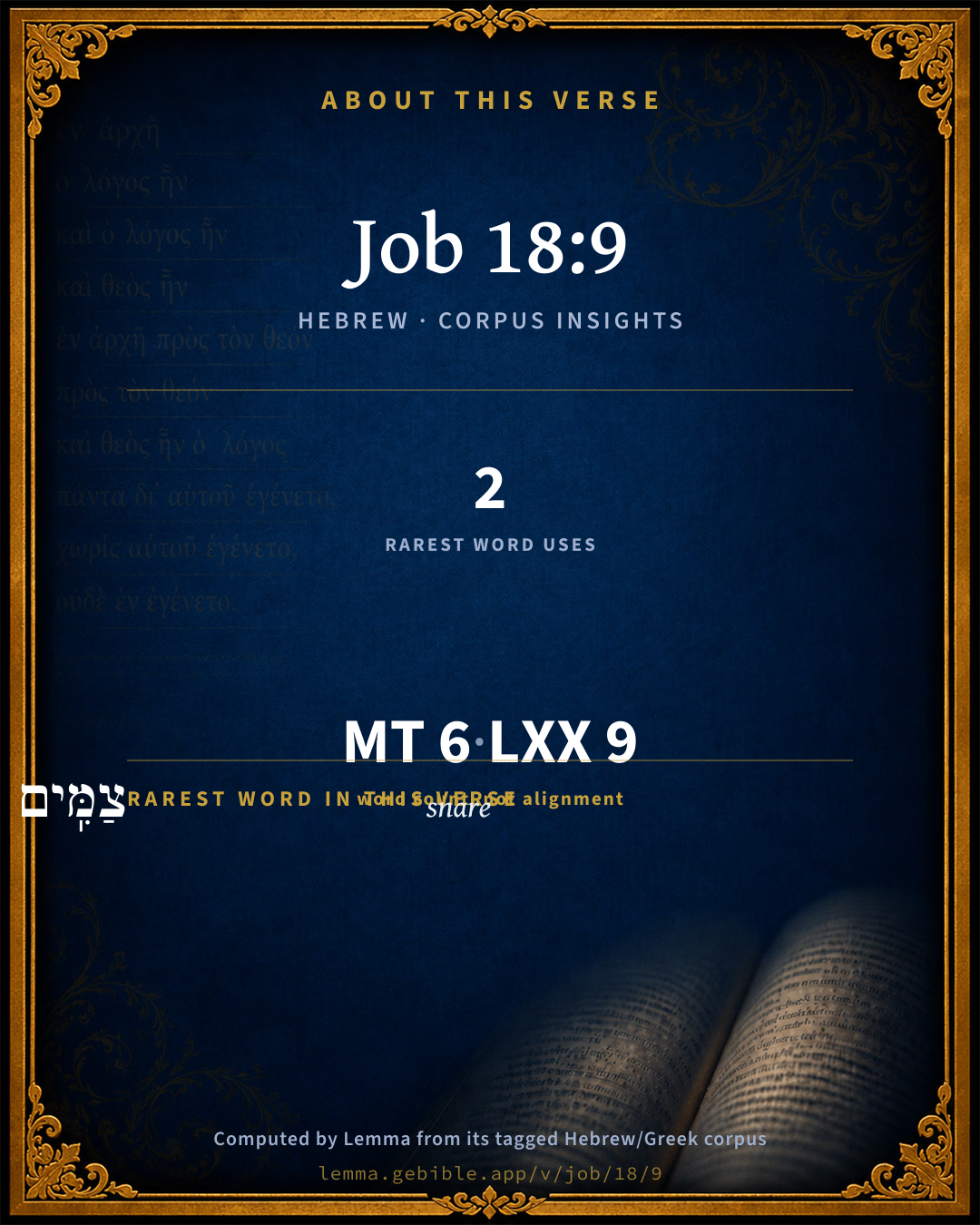
The rarest word here is צַמִּֽים snare H6782 — appearing just 2 times in the whole Hebrew Bible.

Shared distinctive vocabulary

צַמִּֽים snare H6782 occurs in 2 verses of the Hebrew Bible. Also found in:

Grammatical profile

  • 2 verbs
  • 3 nouns
  • 1 preposition

Verb forms

  • יֹאחֵ֣ז Qal · Imperfect
  • יַחֲזֵ֖ק Hiphil · Imperfect

Hebrew & Septuagint length

In English translation the verse runs 15 words from the Hebrew and 15 from the Septuagint (LXX English) — the same length.

A rough comparison of the two English renderings, which tokenize alike — not a word-level alignment.

Word counts can differ between the Hebrew and the Greek without any difference in meaning — e.g. the Hebrew direct-object marker אֵת has no separate Greek word, and Greek often adds the article ὁ.

In the original languages it is 6 Hebrew tokens and 9 Greek tokens — but the two are counted differently (Hebrew bundles its prefixes and suffixes into one token; the Greek is in lemma form), so that isn’t a like-for-like length.

Cross-references

4

Topical passages linked to Job 18:9 in the Treasury of Scripture Knowledge — connected by theme and wording, ordered by reader-vote popularity; previews shown in the World English Bible.

  • Job 1:15 and the Sabeans attacked, and took them away. Yes, they have killed the servants with the edge of the sword, and I alone have escaped to tell you."
  • Job 1:17 While he was still speaking, there came also another, and said, "The Chaldeans made three bands, and swept down on the camels, and have taken them away, yes, and killed the servants with the edge of the sword; and I alone have escaped to tell you."
  • Job 5:5 Whose harvest the hungry eats up, And take it even out of the thorns; The snare gapes for their substance.
  • Isaiah 8:14–15 He shall be for a sanctuary; but for a stone of stumbling and for a rock of offense to both the houses of Israel, for a gin and for a snare to the inhabitants of Jerusalem.

Cross-references courtesy of OpenBible.info (CC BY 4.0).

Hebrew and Greek witnesses Masoretic Hebrew ↔ Greek Septuagint

The same verse in the two great witnesses to the Old Testament, shown verse-for-verse.

These are two independent witnesses, not word-aligned to each other, and the Septuagint is shown in lemma (dictionary) form.

Hebrew Job 18:9 Masoretic · Westminster Leningrad Codex

יֹאחֵ֣ז בְּעָקֵ֣ב פָּ֑ח יַחֲזֵ֖ק עָלָ֣יו צַמִּֽים

A snare shall take him by the heel; A trap shall lay hold on him.

World English Bible · Public Domain

Greek LXX Job 18:9 Septuagint · lemma form

ἔρχομαι δέ ἐπί αὐτός παγίς καταἰσχύω ἐπί αὐτός διψάω

And let snares come upon him: he shall strengthen those that thirst for his destruction.

LXX2012 (modern English Septuagint) · Public Domain

Hebrew: Westminster Leningrad Codex (CC BY 4.0). Greek: Septuagint (public domain); English from LXX2012 (modern English Septuagint) (Public Domain). How the Septuagint differs from the Hebrew →

Commentary

Notes on Job 18:9 from classic Christian and Jewish commentators (each source and its license shown beneath its notes). The classic Christian expositions comment on the surrounding passage and are grouped to its opening verse, so a note may address several verses; the Jewish commentaries on the Tanakh (Rashi and others) are per-verse, so they appear only where the commentator wrote on this verse.

Lemma curates 59 commentaries, every one of them public domain or Creative Commons licensed, each selected and text-cleaned for this edition rather than reprinted as found. About our sources →

Adam Clarke's Commentary

Verse 9. The gin shall take him] Houbigant reads the tenth before the ninth verse, thus: "The snare is laid for him in the ground, and a trap for him in the way. The gin shall take him by the heel, and the robber shall prevail against him."

From the beginning of the seventh verse to the end of the thirteenth there is an allusion to the various arts and methods practiced in hunting.

1. A number of persons extend themselves in a forest, and drive the game before them, still straitening the space from a broad base to a narrow point in form of a triangle, so that the farther they go the less room have they on the right and left, the hunters lining each side, while the drovers with their dogs are coming up behind. "The steps of his strength shall be straitened," Job 18:7.

2. Nets, gins, and pitfalls, are laid or formed in different places, so that many are taken before they come to the point where the two lines close. "He is cast into a net, he walketh upon a snare - the trap is laid for him in the way-the snare in the ground," Job 18:8-10.

3. The howling of the dogs, with the shouts of the huntsmen, fill him with dismay, and cause him to run himself beyond his strength and out of breath. "Terrors shall make him afraid on every side, and shall drive him to his feet," Job 18:11.

4. While spent with hunger and fatigue, he is entangled in the spread nets; and the huntsman either pierces him with an arrow or spear, or cuts the sinews of his legs, so that he is easily captured and destroyed. "The robbers shall prevail against him," Job 18:9. "His strength is hunger-bitten, and destruction is ready at his side," Job 18:12. This latter verse is thus paraphrased by the Chaldee: "Let his first-born son be famished; and affliction be prepared for his wife."

Adam Clarke's Commentary on the Bible (1810–1826) — public domain. Text from a community e-Sword/MySword module.

Trapp's Complete Commentary

John Trapp

Job 18:9 The gin shall take [him] by the heel, [and] the robber shall prevail against him.

Ver. 9. The gin shall take him by the heel] Or, he shall lay hold on the trap with his heel, so Mercer readeth it; that is, he foolishly runs upon his own ruin, he perisheth by his own oversight.

And the robber shall prevail against him] Horridi sitibundi, the shag-haired ruffians, that have wasted their own estates, and now thirst after other men’s. Broughton readeth it, The savage shall lay hold on him. So that either by secret contrivance or open violence he shall be undone.

John Trapp, A Commentary or Exposition upon All the Books of the Old and New Testament (1647–1656) — public domain. Text from a community e-Sword module.

Joseph Benson's Commentary

Job 18:9-10. The gin shall take him by the heel — That is, take fast hold on him, so as to keep him in those distresses. And the robber shall prevail against him — Hebrew, צמים, tsammim, the horrible or terrible man, the huntsman that laid the snare for him shall come upon him, when he is insnared, take and spoil or kill him. The snare is laid for him in the ground — Where he did not discern nor expect it. The former snare he laid for himself, but this was laid for him by another.

Joseph Benson's Commentary on the Old and New Testaments (1811–1818) — public domain. Text from a community e-Sword module.

Jamieson, Fausset & Brown

Robert Jamieson, A. R. Fausset & David Brown

robber--rather answering to "gin" in the parallel clause, "the noose shall hold him fast" [UMBREIT].

Jamieson, Fausset & Brown — Commentary Critical and Explanatory on the Whole Bible (1871) — public domain (CC PDM 1.0). Text via the HelloAO Bible API.

The Cambridge Bible for Schools and Colleges

gen. ed. J. J. S. Perowne

9. the robber shall prevail] Rather, the trap layeth hold of him, as all the verbs in this passage should be put in the present tense. The word is that occurring ch. Job_5:5. The world of God is one network of snares for the wicked man, he walks upon snares, in the field and in the way alike. The idea that the world is a moral constitution is very prominent in the Old Testament, a mere physical constitution of things is an idea unknown to it.

The Cambridge Bible for Schools and Colleges (gen. ed. J. J. S. Perowne; Cambridge University Press, 1878–1918) — public domain. Text from a community e-Sword module.

John Gill's Exposition

The snare is laid for him in the ground,.... Or "hidden" (r) there; for, as Solomon says, "in vain the net is spread in sight of any bird", Pro 1:17; and in vain it is to lay a snare publicly in the sight or creature, it will not then come near it, but shun and avoid it; and therefore it is laid underground, or hid in the earth, or in some private place, where the creature it is designed for may be thought to come, or into which it is decoyed; or "the cord" (s), that which is fastened to the snare or net, and which the fowler holds in his hand, and pulls with; as he finds occasion and opportunity offers; but this is hid as much as possible, that it may not be seen:

and a trap for him in the way; in which he is used to walk, by the roadside, or in it; Mr. Broughton renders it, "a pitfall on the wayside", such as is dug for beasts to fall into and be taken. The whole of this is designed to show how suddenly and secretly wicked men are taken in nets, and snares, and gins, either of their own or others laying, and, while they are crying "Peace, peace, sudden destruction comes upon them"; see Ecc 9:12.

(r) "absconditus", V. L. Pagninus, Montanus, Junius & Tremellius, &c. (s) "funis ejus", Montanus, Tigurine version, Mercerus, Drusius, Cocceius, Schmidt.

John Gill's Exposition of the Whole Bible (1746–1763) — public domain (CC PDM 1.0). Text via the HelloAO Bible API.

Albert Barnes' Notes on the Bible

The gin - Another method of taking wild beasts. It was a snare so made as to spring suddenly on an animal, securing him by the neck or feet. We use a trap for the same purpose. The Hebrew word (פח pach) may denote anything of this kind - a snare, net, noose, etc. with which birds or wild animals are taken.

By the heel - By the foot.

And the robber shall prevail - He shall be overpowered by the highwayman; or the plunderer shall make a sudden descent upon him, and strip him of his all. The meaning is, that destruction would suddenly overtake him. There can be no doubt that Bildad meant to apply all this to Job.

Albert Barnes' Notes on the Bible (1834–1885) — public domain. Text from a community e-Sword/MySword module.

Haydock's Catholic Bible Commentary

Thirst: the greedy hunter. (Calmet) --- Hebrew, "the robber." (Haydock)

George Leo Haydock (1774–1849), Haydock's Catholic Family Bible and Commentary, 1859 edition — public domain. Excludes Psalms (Douay-Rheims chapter numbering differs from Protestant) and Deuterocanonical books (Catholic canon only).

Matthew Poole's English Annotations

Shall take the by the heel, i.e. take fast hold of him, so as to keep him in those distresses; and when he is insnared the robber shall come upon him, and take, and spoil, or kill him. Or,

the horrible or terrible man; the huntsman, that laid the snare for him. A metaphor from those who hunt for wild beasts, who first lay snares for them, and then seize upon them in the snares.

Matthew Poole's English Annotations on the Holy Bible (1683–1685) — public domain. Text from a community e-Sword/MySword module.

Whedon's Commentary on the Bible

Daniel D. Whedon

9. The robber — The noose (ch. Job_5:5) shall take fast hold of him. In Job_18:8-10 six different modes of taking wild animals are alluded to. They do not differ much from those still prevailing among barbarous tribes. The variety of figure employed indicates the hopelessness of escape.

Daniel D. Whedon (gen. ed.), Commentary on the Old and New Testaments (1874–1909) — public domain. Text from a community e-Sword module.

The Pulpit Commentary

The gin shall take him by the heel, and the robber (rather, the man-trap) shall prevail against him. Fifty years ago man-traps were commonly set at night in gardens and orchards in this country, which held intending thieves until the proprietor came and took them before a magistrate in the morning. (On the employment of such traps in antiquity, see Herod., 2:121.

The Pulpit Commentary (1880–1919), ed. H.D.M. Spence-Jones & Joseph S. Exell — public domain. Text from a community e-Sword module.

unfoldingWord translationNotes

Door43 World Missions Community

General Information:

Bildad continues to speak and uses three parallel images to describe how suddenly the wicked person will experience disaster. (See: Parallelism)

A trap will take him ... a snare will ... A noose is ... and a trap for him in the way

These four phrases speak of the wicked man experiencing disaster as if he were caught in a trap. AT: "It will be as though a trap will take him ... a snare will ... A noose is ... and a trap for him in the way" (See: Metaphor)

A trap

People used this kind of trap to catch birds. The trap snapped shut and held on to the foot of the bird.

will take him by the heel

Here the "heel" refers to the whole foot. AT: "will take hold of his foot" (See: Synecdoche)

A noose is hidden for him on the ground

This can be stated in active form. AT: "Someone has hidden a noose on the ground in order to catch him" (See: Active or Passive)

A noose

a rope with a loop that grabs hold of an animal's leg when the animal steps in the middle of the loop

a trap for him

The understood verbal phrase "is hidden" may be supplied. AT: "a trap is hidden on the path to catch him" or "someone will hide a trap to catch him in the way" (See: Ellipsis)

Terrors will make him afraid on every side

"Terrors all around will make him afraid"

they will chase him at his heels

This speaks of the things that terrify the wicked person as if they were enemies who chased him. AT: "it will be as if the terrors will chase him all around" (See: Personification)

translationWords

snare

terror

fear

unfoldingWord translationNotes — © Distant Shores Media and the Door43 World Missions Community, licensed CC BY-SA 4.0. Source: git.door43.org/Door43/en_tn.

Rashi

Rabbi Shlomo Yitzchaki (Rashi)

shall seize A trap shall seize him by the heel.

Rashi on the Tanakh — English translations: “The Judaica Press complete Tanach with Rashi, translated by A. J. Rosenberg” (CC BY 4.0); “Pentateuch with Rashi's commentary by M. Rosenbaum and A.M. Silbermann, 1929-1934” (public domain); “The Metsudah Tanach series, Lakewood, N.J” (CC BY 4.0); and “The Book of Joshua, Metsudah Publications, 1997” (CC BY 4.0). Text via Sefaria.

Lesson kit

Teaching starters — assembled from the data on this page, not authored interpretation. Every prompt links to the verse data it draws on. Edit before teaching.

Job, in the Wisdom, opens this verse with 6 words (6 distinct Hebrew lemmas). Its most distinctive word is tsammîym (“snare”). A historical commentator’s framing appears above. Read the whole chapter for the surrounding context.

Discussion questions

  1. How does “snare” (tsammîym) shape what this verse is saying?
  2. How does Job 5:5, which shares the word «snare», read alongside this verse?
  3. The translations on this page render this verse differently — a whole-verse word diff, not a word-by-word alignment. What might account for the different wordings?
  4. «יֹאחֵ֣ז» is a Qal Imperfect verb. How does that grammatical form shape the action described?
  5. Compare how Adam Clarke's Commentary and Trapp's Complete Commentary read this verse. Where do they agree or differ?

Things to notice

Reading settings

Reading text

Shown beneath each verse's original-language words.

Old Testament
Old Testament edition

Read the OT as the Masoretic Hebrew (MT) or the Greek Septuagint (LXX).

English shown for the Greek Septuagint (in the Hebrew ↔ Greek comparison).

Comparing translations? Open the Compare panel on any verse page to stack up to four side by side.