
Judges 16:28

Hebrew (Westminster Leningrad Codex) Judges 16:28 appears in the Hebrew Old Testament. The text above is from the Westminster Leningrad Codex. Each word links to its Strong’s number, a concise gloss, and parsing drawn from the Open Scriptures Hebrew Bible morphology. Click any word for its full Brown-Driver-Briggs (BDB) entry.
Download image
Cite this verse

Judges 16:28 (World English Bible). Public Domain. Lemma interlinear Bible study tool, https://lemma.gebible.app/v/judges/16/28.

Show BibTeX & RIS
BibTeX
RIS
English Translation
Samson called to Yahweh, and said, Lord Yahweh, remember me, Please, and strengthen me, Please, only this once, God, that I may be at once avenged of the Philistines for my two eyes.
World English Bible · Public Domain
Download a study sheet

One document with this verse’s original text, its word-by-word gloss line, the meaning frame, cross-references with their text, attributed commentary, and full source and license credits — printable, and it pastes into notes with its structure intact.

This verse Autodidact and up

Study sheet (.html) Plain text (.txt)

A passage Seminary Student

Up to 50 verses in one chapter. A passage sheet keeps up to 6 commentary sources and 12 cross-references per verse, in the order this page ranks them, and says so on the sheet whenever that leaves anything out. Ask for a single verse and you get the Autodidact verse sheet above.

Everything on this page stays free to read, with no account — the sheet is a download of what is already on screen, not access to it.

Want to remove ads? Support Godless Engineer
Compare translations 3

The same verse in 3 English versions, stacked beneath the original-language interlinear above. Click any original word for its lexicon entry.

Each is an independent rendering of the whole verse — the interlinear is not word-aligned to these translations.

Highlighted words mark where these versions differ — a whole-verse word diff, not a word-by-word alignment.

  • World English Bible Public Domain
    Samson called to Yahweh, and said, Lord Yahweh, remember me, Please, and strengthen me, Please, only this once, God, that I may be at once avenged of the Philistines for my two eyes.
  • King James Version Public Domain
    And Samson called unto the LORD, and said, O Lord God, remember me, I pray thee, and strengthen me, I pray thee, only this once, O God, that I may be at once avenged of the Philistines for my two eyes.
  • unfoldingWord Literal Text CC BY-SA 4.0
    Then Samson called to Yahweh and he said, “Lord Yahweh, please remember me, and please strengthen me only this time, O God, so I may avenge myself one vengeance against the Philistines for my two eyes.”

unfoldingWord Literal Text — © unfoldingWord, licensed CC BY-SA 4.0. Word-aligned USFM3 via Door43 (git.door43.org/unfoldingWord/en_ult).

Versions to compare (up to 4)

3 of 4 selected

Show all 18 translations

Every available English version of this verse, each an independent rendering of the whole verse.

  • World English Bible Public Domain
    Samson called to Yahweh, and said, Lord Yahweh, remember me, Please, and strengthen me, Please, only this once, God, that I may be at once avenged of the Philistines for my two eyes.
  • Berean Standard Bible Public Domain
    Then Samson called out to the LORD: “O Lord GOD, please remember me. Strengthen me, O God, just once more, so that with one vengeful blow I may pay back the Philistines for my two eyes.”
  • Majority Standard Bible Public Domain
    Then Samson called out to the LORD: “O Lord GOD, please remember me. Strengthen me, O God, just once more, so that with one vengeful blow I may pay back the Philistines for my two eyes.”
  • King James Version Public Domain
    And Samson called unto the LORD, and said, O Lord God, remember me, I pray thee, and strengthen me, I pray thee, only this once, O God, that I may be at once avenged of the Philistines for my two eyes.
  • American Standard Version (1901) Public Domain
    And Samson called unto Jehovah, and said, O Lord Jehovah, remember me, I pray thee, and strengthen me, I pray thee, only this once, O God, that I may be at once avenged of the Philistines for my two eyes.
  • Revised Version (1885) Public Domain
    And Samson called unto the LORD, and said, O Lord GOD, remember member me, I pray thee, and strengthen me, I pray thee, only this once, O God, that I may be at once avenged of the Philistines for my two eyes.
  • Geneva Bible (1599) Public Domain
    Then Samson called vnto the Lord, and sayde, O Lord God, I pray thee, thinke vpon me: O God, I beseech thee, strengthen me at this time onely, that I may be at once auenged of the Philistims for my two eyes.
  • Douay-Rheims (1899) Public Domain
    But he called upon the Lord, saying: O Lord God, remember me, and restore to me now my former strength, O my God, that I may revenge myself on my enemies, and for the loss of my two eyes I may take one revenge.
  • Young's Literal Translation Public Domain
    And Samson calleth unto Jehovah, and saith, `Lord Jehovah, remember me, I pray Thee, and strengthen me, I pray Thee, only this time, O God; and I am avenged -- vengeance at once -- because of my two eyes, on the Philistines.'
  • Literal Standard Version CC BY-SA 4.0
    And Samson calls to YHWH and says, “Lord YHWH, please remember me and please strengthen me only this time, O God; and I am avenged—vengeance at once—because of my two eyes, on the Philistines.”
  • Unlocked Literal Bible CC BY-SA 4.0
    Samson called to Yahweh and said, “Lord Yahweh, call me to mind! Please strengthen me only this once, God, so that I may have revenge in one blow on the Philistines for taking my two eyes.”
  • unfoldingWord Literal Text CC BY-SA 4.0
    Then Samson called to Yahweh and he said, “Lord Yahweh, please remember me, and please strengthen me only this time, O God, so I may avenge myself one vengeance against the Philistines for my two eyes.”
  • Darby Bible Public Domain
    Then Samson called to the LORD and said, "O Lord GOD, remember me, I pray thee, and strengthen me, I pray thee, only this once, O God, that I may be avenged upon the Philistines for one of my two eyes."
  • World Messianic Bible Public Domain
    Samson called to the LORD, and said, “Lord GOD, remember me, please, and strengthen me, please, only this once, God, that I may be at once avenged of the Philistines for my two eyes.”
  • Webster's Bible Public Domain
    And Samson called to the LORD, and said, O Lord GOD, remember me, I pray thee, and strengthen me, I pray thee, only this once, O God, that I may be at once avenged of the Philistines for my two eyes.
  • Free Bible Version CC BY-SA 4.0
    Samson called out to the Lord, “Lord God, please remember me and give me strength. Please God, do this just once more, so that with one act I may pay the Philistines back in revenge for the loss of my two eyes.”
  • Bible in Basic English Public Domain
    And Samson, crying out to the Lord, said, O Lord God, do have me now in mind, and do make me strong only this once, O God, so that I may take one last payment from the Philistines for my two eyes.
  • JPS Tanakh (1917) Public Domain
    And Samson called unto the LORD, and said: 'O Lord GOD, remember me, I pray Thee, and strengthen me, I pray Thee, only this once, O God, that I may be this once avenged of the Philistines for my two eyes.'

Literal Standard Version (2020), Covenant Press — licensed CC BY-SA 4.0. Text via the HelloAO Bible API (eBible.org). Unlocked Literal Bible (unfoldingWord) — licensed CC BY-SA 4.0. Text via the HelloAO Bible API (eBible.org). unfoldingWord Literal Text — © unfoldingWord, licensed CC BY-SA 4.0. Word-aligned USFM3 via Door43 (git.door43.org/unfoldingWord/en_ult). Free Bible Version, Dr. Jonathan Gallagher — licensed CC BY-SA 4.0. Text via the HelloAO Bible API (eBible.org).

Word by word

More ways to search: Search by grammar → Find every occurrence → Compare this word →

Practice this passage: Drill this verse → Learn its vocabulary →

נְקַם
nâqâm
H5359
“vengeance of”
Noun, Common, Masculine, Singular, Construct
Part of Speech
Noun
Type
Common
Gender
Masculine
Number
Singular
State
Construct
Full BDB Definition

Origin: from H5358

TWOT: 1413a

vengeance - vengeance (by God, by Samson, by enemies of Judah)
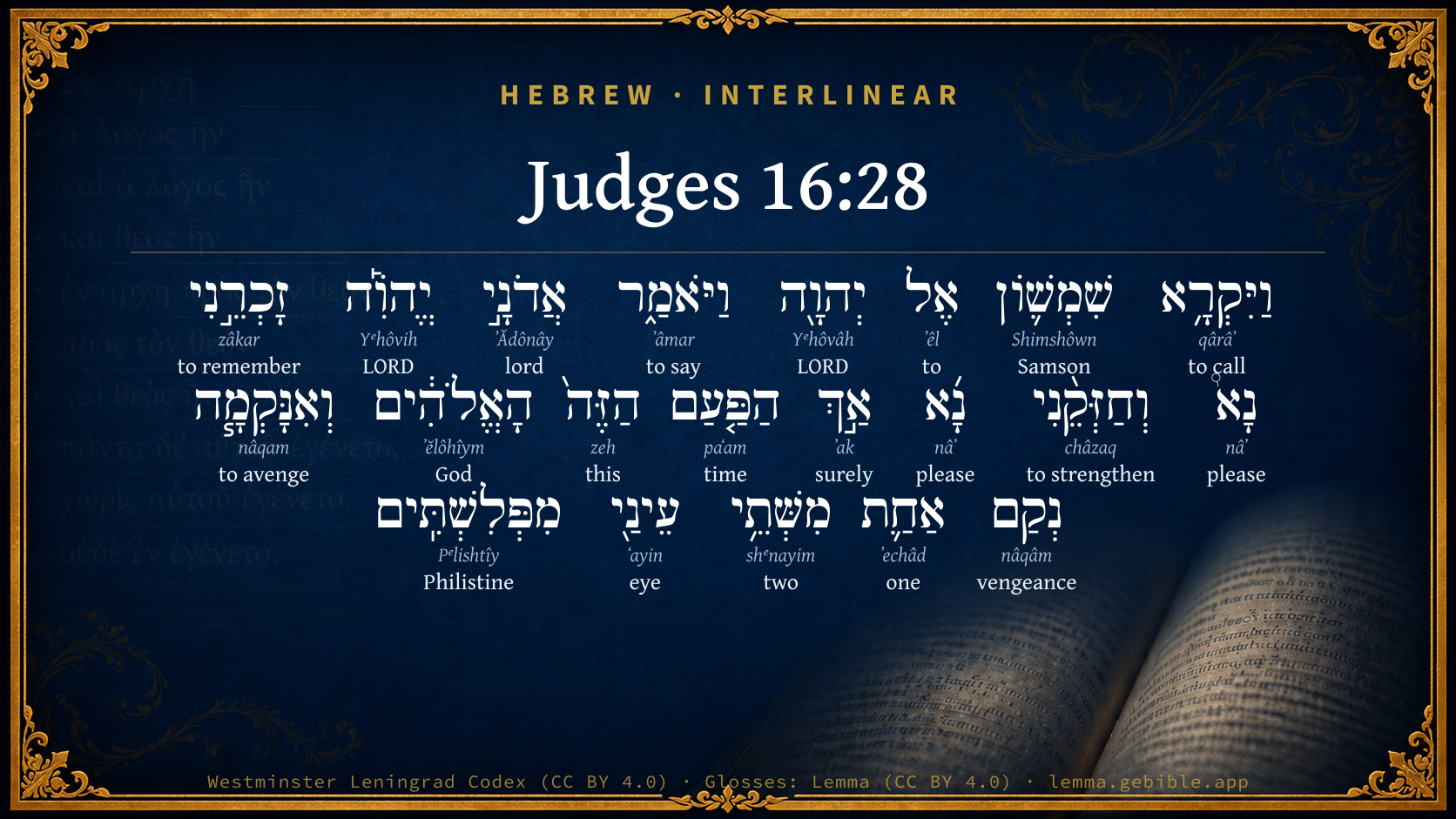
  1. וַיִּקְרָ֥א qârâʼ H7121 “and · to call” Conjunction + Verb, Qal, Sequential Imperfect, 3rd Person, Masculine, Singular
  2. שִׁמְשׁ֛וֹן Shimshôwn H8123 “Samson” Noun, Proper
  3. אֶל ʼêl H413 “to” Preposition
  4. יְהוָ֖ה Yᵉhôvâh H3068 “LORD” Noun, Proper
  5. וַיֹּאמַ֑ר ʼâmar H559 “and · to say” Conjunction + Verb, Qal, Sequential Imperfect, 3rd Person, Masculine, Singular
  6. אֲדֹנָ֣י ʼĂdônây H136 “Lord · my” Noun, Common, Masculine, Plural, Construct + Suffix, Personal, 1st Person, Common, Singular
  7. יֱהֹוִ֡ה Yᵉhôvih H3069 “LORD” Noun, Proper
  8. זָכְרֵ֣נִי zâkar H2142 “remember · me” Verb, Qal, Imperative, 2nd Person, Masculine, Singular + Suffix, Personal, 1st Person, Common, Singular
  9. נָא֩ nâʼ H4994 “please” Particle, Exhortation
  10. וְחַזְּקֵ֨נִי châzaq H2388 “and · strengthen · me” Conjunction + Verb, Piel, Imperative, 2nd Person, Masculine, Singular + Suffix, Personal, 1st Person, Common, Singular
  11. נָ֜א nâʼ H4994 “please” Particle, Exhortation
  12. אַ֣ךְ ʼak H389 “surely” Particle, Accusative
  13. הַפַּ֤עַם paʻam H6471 “the · time” Particle, Definite Article + Noun, Common, Feminine, Singular, Absolute
  14. הַזֶּה֙ zeh H2088 “the · this” Particle, Definite Article + Pronoun, Demonstrative, Masculine, Singular
  15. הָאֱלֹהִ֔ים ʼĕlôhîym H430 “the · God(s)” Particle, Definite Article + Noun, Common, Masculine, Plural, Absolute
  16. וְאִנָּקְמָ֧ה nâqam H5358 “and · to avenge” Conjunction + Verb, Niphal, Imperfect, 1st Person, Common, Singular
  17. אַחַ֛ת ʼechâd H259 “one” Adjective, Cardinal number, Feminine, Singular, Absolute
  18. מִשְּׁתֵ֥י shᵉnayim H8147 “from · two” Preposition + Adjective, Cardinal number, Feminine, Dual, Construct
  19. עֵינַ֖י ʻayin H5869 “eyes · my” Noun, Common, Both, Dual, Construct + Suffix, Personal, 1st Person, Common, Singular
  20. מִפְּלִשְׁתִּֽים Pᵉlishtîy H6430 “from · Philistines” Preposition + Noun, Gentilic, Masculine, Plural, Absolute

About this verse

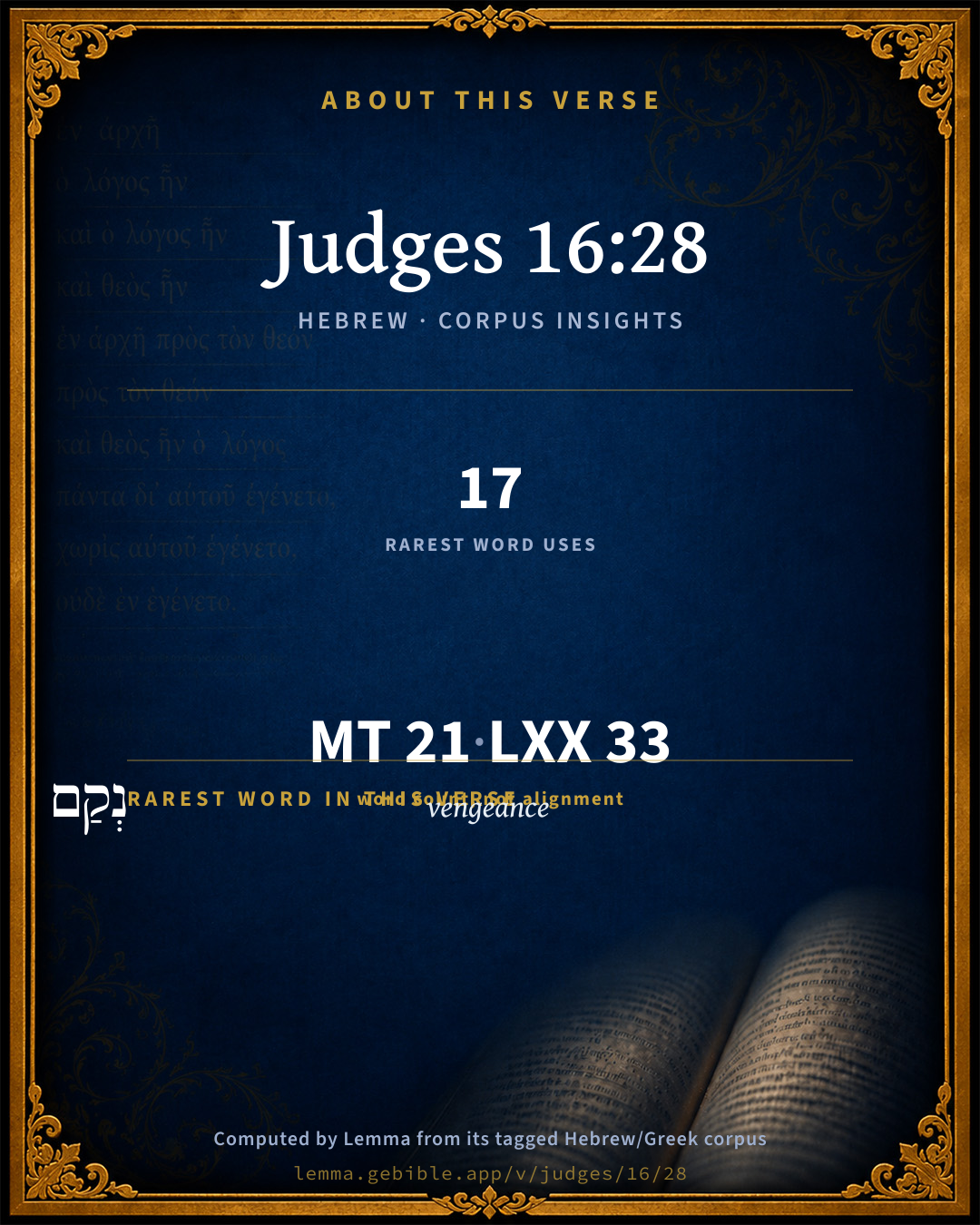
These counts appear in no published source. They are computed here, from the morphology-tagged text and Lemma’s own curated glosses. What Lemma adds →

21
words
20
distinct lemmas
Historical
section

Notable vocabulary

The rarest word here is נְקַם vengeance H5359 — appearing just 17 times in the whole Hebrew Bible.

Shared distinctive vocabulary

נְקַם vengeance H5359 occurs in 17 verses of the Hebrew Bible. Also found in:

Grammatical profile

  • 5 verbs
  • 9 nouns
  • 2 adjectives
  • 1 pronoun
  • 1 preposition
  • 3 particles

Verb forms

  • וַיִּקְרָ֥א Qal · Sequential Imperfect
  • וַיֹּאמַ֑ר Qal · Sequential Imperfect
  • זָכְרֵ֣נִי Qal · Imperative
  • וְחַזְּקֵ֨נִי Piel · Imperative
  • וְאִנָּקְמָ֧ה Niphal · Imperfect

Repetition

A word recurs within this verse — often emphatic in Hebrew:

  • נָא֩ please H4994 ×2

Hebrew & Septuagint length

In English translation the verse runs 33 words from the Hebrew and 38 from the Septuagint (LXX English) — closely comparable.

A rough comparison of the two English renderings, which tokenize alike — not a word-level alignment.

Word counts can differ between the Hebrew and the Greek without any difference in meaning — e.g. the Hebrew direct-object marker אֵת has no separate Greek word, and Greek often adds the article ὁ.

In the original languages it is 21 Hebrew tokens and 33 Greek tokens — but the two are counted differently (Hebrew bundles its prefixes and suffixes into one token; the Greek is in lemma form), so that isn’t a like-for-like length.

Cross-references

15

Topical passages linked to Judges 16:28 in the Treasury of Scripture Knowledge — connected by theme and wording, ordered by reader-vote popularity; previews shown in the World English Bible.

  • Jeremiah 15:15 Yahweh, you know; remember me, and visit me, and avenge me of my persecutors; don't take me away in your longsuffering: know that for your sake I have suffered reproach.
  • Lamentations 3:31–32 For the Lord will not cast off forever.
  • Psalms 91:15 He will call on me, and I will answer him. I will be with him in trouble. I will deliver him, and honor him.
  • Psalms 143:12 In your loving kindness, cut off my enemies, And destroy all those who afflict my soul, For I am your servant.
  • Revelation 6:10 They cried with a loud voice, saying, "How long, Master, the holy and true, until you judge and avenge our blood on those who dwell on the earth?"
  • Psalms 50:15 Call on me in the day of trouble. I will deliver you, and you will honor me."
  • Psalms 58:10–11 The righteous shall rejoice when he sees the vengeance. He shall wash his feet in the blood of the wicked;
  • Jonah 2:1–2 Then Jonah prayed to Yahweh, his God, out of the fish's belly.
  • 2 Timothy 4:14 Alexander, the coppersmith, did much evil to me. The Lord will repay him according to his works,
  • Psalms 74:18–23 Remember this, that the enemy has mocked you, Yahweh. Foolish people have blasphemed your name.
  • Psalms 116:4 Then called I on the name of Yahweh: "Yahweh, I beg you, deliver my soul."
  • Judges 5:31 So let all your enemies perish, Yahweh: But let those who love him be as the sun when he goes forth in his might. The land had rest forty years.
  • Judges 15:18 He was very thirsty, and called on Yahweh, and said, You have given this great deliverance by the hand of your servant; and now shall I die for thirst, and fall into the hand of the uncircumcised.
  • 2 Chronicles 20:12 Our God, will you not judge them? for we have no might against this great company that comes against us; neither know we what to do: but out eyes are on you.
  • Hebrews 11:32 What more shall I say? For the time would fail me if I told of Gideon, Barak, Samson, Jephthah, David, Samuel, and the prophets;

Cross-references courtesy of OpenBible.info (CC BY 4.0).

Hebrew and Greek witnesses Masoretic Hebrew ↔ Greek Septuagint

The same verse in the two great witnesses to the Old Testament, shown verse-for-verse.

These are two independent witnesses, not word-aligned to each other, and the Septuagint is shown in lemma (dictionary) form.

Hebrew Judges 16:28 Masoretic · Westminster Leningrad Codex

וַיִּקְרָ֥א שִׁמְשׁ֛וֹן אֶל יְהוָ֖ה וַיֹּאמַ֑ר אֲדֹנָ֣י יֱהֹוִ֡ה זָכְרֵ֣נִי נָא֩ וְחַזְּקֵ֨נִי נָ֜א אַ֣ךְ הַפַּ֤עַם הַזֶּה֙ הָאֱלֹהִ֔ים וְאִנָּקְמָ֧ה נְקַם אַחַ֛ת מִשְּׁתֵ֥י עֵינַ֖י מִפְּלִשְׁתִּֽים

Samson called to Yahweh, and said, Lord Yahweh, remember me, Please, and strengthen me, Please, only this once, God, that I may be at once avenged of the Philistines for my two eyes.

World English Bible · Public Domain

Greek LXX Judges 16:28 Septuagint · lemma form

καί κλαίω σαμψων πρός κύριος καί εἶπον ἀδωναϊέ κύριος μιμνήσκω δή ἐγώ νῦν καί ἐνἰσχύω ἐγώ ἔτι ὁ ἅπαξ οὗτος θεός καί ἀντι ἀποδίδωμι ἀνταπόδοσις εἷς περί ὁ δύο ὀφθαλμός ἐγώ ὁ ἀλλόφυλος

And Sampson wept before the Lord, and said, O Lord, my lord, remember me, I pray you, and strengthen me, O God, yet this once, and I will requite one recompense to the Philistines for my two eyes.

LXX2012 (modern English Septuagint) · Public Domain

On this verse, Ellicott's Commentary for English Readers discusses the Septuagint’s reading. Read the note in Commentary ↓

Hebrew: Westminster Leningrad Codex (CC BY 4.0). Greek: Septuagint (public domain); English from LXX2012 (modern English Septuagint) (Public Domain). How the Septuagint differs from the Hebrew →

Targum (Aramaic paraphrase)

1

The Targum is the ancient Jewish Aramaic paraphrase of the Hebrew Scriptures — an interpretive translation, not the Hebrew text itself. Onkelos (literal) and Pseudo-Jonathan (expansive) render the Torah, and Jonathan the Prophets. Coverage is partial: where no permissively-licensed English translation exists for a verse, only the Aramaic is shown. This is verse-level text, not a word-by-word alignment to the Hebrew.

  1. Targum Jonathan Prophets (Joshua–Malachi)
    וְצַלִי שִׁמְשׁוֹן קֳדָם יְיָ וַאֲמַר יְיָ אֱלֹהִים יֵיעוּל דָכְרָנִי קֳדָמָךְ וְתַקֵפְנִי כְעַן בְּרַם זִמְנָא הָדָא יְיָ וְאִתְפְּרַע פּוּרְעָנוּתָא חָדָא מִתַּרְתֵּי עֵינַי דְנַקְרוּ לִי פְּלִשְׁתָּאֵי:

    (no public-domain English translation for this verse)

    Targum Jonathan — Aramaic: “Mikraot Gedolot” (public domain). English: “Sefaria Community Translation” (CC0 1.0 (public-domain dedication)); “London "Chaldee Paraphrase," 1871” (public domain). Text via Sefaria.

Commentary

Notes on Judges 16:28 from classic Christian and Jewish commentators (each source and its license shown beneath its notes). The classic Christian expositions comment on the surrounding passage and are grouped to its opening verse, so a note may address several verses; the Jewish commentaries on the Tanakh (Rashi and others) are per-verse, so they appear only where the commentator wrote on this verse.

Lemma curates 59 commentaries, every one of them public domain or Creative Commons licensed, each selected and text-cleaned for this edition rather than reprinted as found. About our sources →

Trapp's Complete Commentary

John Trapp

Jdg 16:28 And Samson called unto the LORD, and said, O Lord GOD, remember me, I pray thee, and strengthen me, I pray thee, only this once, O God, that I may be at once avenged of the Philistines for my two eyes.

Ver. 28. And Samson called unto the Lord.] This was a prayer of faith, and a fruit of his repentance. Nunquam sero, si serio.

John Trapp, A Commentary or Exposition upon All the Books of the Old and New Testament (1647–1656) — public domain. Text from a community e-Sword module.

Joseph Benson's Commentary

Jdg 16:28. Samson called unto the Lord — This prayer proceeded not from malice and revenge, but from faith in, and zeal for, God, who was there publicly dishonoured, and from a concern to vindicate the whole commonwealth of Israel, which it was his duty to do to the uttermost of his power, as he was judge. And God, who heareth not sinners, and would never exert his omnipotence to gratify any man’s malice, manifested by the effect that he accepted and owned Samson’s prayer as the dictate of his own Spirit. And although, in this prayer, he mentions only the personal injuries done by the Philistines to himself, and not the indignities which they had offered to God and his people, yet that may be ascribed to the prudent care which he had manifested upon former occasions, to draw the rage of the Philistines upon himself alone, and divert it from the people. For which end, it is supposed that this prayer was made by him with an audible voice, though he knew the Philistines would entertain it only with scorn and laughter. “We must always consider Samson,” says Dr. Dodd, “in the light of an extraordinary person, immediately raised up by God for the chastisement of the Philistines. In this view, his death was heroic, as he voluntarily sacrificed himself, by the only means in his power, to the service of his country, in the destruction of those who had, in a base manner, insulted him and his God, and who, holding Israel in bondage, vainly imagined their Dagon superior to the eternal Jehovah.” Indeed, as the same author observes further, “Samson was unquestionably a very singular type of the Messiah; called and sanctified in and from the womb; set apart to deliver his people out of the hands of all their enemies; performing all by his own personal strength alone, without assistant, and almost without weapons, (Isa 63:1; Isa 63:3; Hos 1:7,) and in his death evidently doing more than in his life, thereby destroying the power of the devil, and triumphing over all his enemies,” Heb 2:14.

Joseph Benson's Commentary on the Old and New Testaments (1811–1818) — public domain. Text from a community e-Sword module.

Geneva Bible (1599)

Geneva Bible translators

According to my vocation which is to execute God’s judgments upon the wicked.

Hebrew, take one vengeance.

Geneva Bible (1599) marginal notes — public domain. Text via Bolls.life.

Jamieson, Fausset & Brown

Robert Jamieson, A. R. Fausset & David Brown

Samson called unto the Lord--His penitent and prayerful spirit seems clearly to indicate that this meditated act was not that of a vindictive suicide, and that he regarded himself as putting forth his strength in his capacity of a public magistrate. He must be considered, in fact, as dying for his country's cause. His death was not designed or sought, except as it might be the inevitable consequence of his great effort. His prayer must have been a silent ejaculation, and, from its being revealed to the historian, approved and accepted of God.

Jamieson, Fausset & Brown — Commentary Critical and Explanatory on the Whole Bible (1871) — public domain (CC PDM 1.0). Text via the HelloAO Bible API.

Adam Clarke's Commentary

Verse 28. Samson called unto the Lord] It was in consequence of his faith in God that he should be strengthened to overthrow his enemies and the enemies of his country, that he is mentioned, Heb 11:32, among those who were remarkable for their faith.

Adam Clarke's Commentary on the Bible (1810–1826) — public domain. Text from a community e-Sword/MySword module.

Ellicott's Commentary for English Readers

(28) O Lord God . . . O God.—Three names of God—Adonai, Jehovah, Elohim.

That I may be at once avenged of the Philistines.—Again we see that Samson stood at a comparatively low level of spiritual enlightenment as well as of moral purity. One cannot help feeling that Milton has read into the hero’s character an austere grandeur which it did not possess. His Samson of the Samson Agonistes is rather Milton himself than the Jewish hero. That stern classic poem is the “thundering reverberation of a mighty spirit, struck by the plectrum of disappointment.”

For my two eyes.—The words rendered “at once” in the previous clause may be rendered “that I may avenge myself the revenge of one of my two eyes.” If so, there seems to be in the words a grim jest, as though no vengeance would suffice for the fearful loss of both his eyes (LXX., “one revenge for my two eyes”), “one last tremendous deed, one last fearful jest.” There is a curious parallel to this achievement of Samson in the story of Cleo-medes of Astypalæa, who in revenge for a fine pulls down a pillar, and crushes the boys in a school (Pausan. Perieg. Vi. 2, 3). Cassel tells us that on July 21st, 1864, many people were killed by the breaking of a granite pillar in the Church of the Transfiguration at St. Petersburg.

A Bible Commentary for English Readers, edited by Charles John Ellicott (1878–1897) — public domain. Text from a community e-Sword module.

The Cambridge Bible for Schools and Colleges

gen. ed. J. J. S. Perowne

28. that I may be at once avenged] A questionable rendering; follow the mg., that I may be avenged … for one of my two eyes. The grim humour of the words, as Moore points out, is altogether in character. The utmost vengeance would barely compensate for the loss of one eye alone.

The Cambridge Bible for Schools and Colleges (gen. ed. J. J. S. Perowne; Cambridge University Press, 1878–1918) — public domain. Text from a community e-Sword module.

John Gill's Exposition

And Samson called unto the Lord,.... In an ejaculatory manner, by mental prayer; though he might possibly express it aloud, without being heard and observed by the people, amidst their noise and mirth; and if it was heard, it might only furnish out more ridicule and contempt; and be it as it may, the prayer must have been preserved by the Lord himself, and given by inspiration to the writer of this book; since there were none that heard it that lived to relate it to others, no, not Samson himself:

and said, O Lord God, remember me, I pray thee; the office that I bear as judge of Israel, the reproaches cast upon me, and which fall upon thy people, cause, and interest; remember thy lovingkindness, formerly expressed to me, the gracious promises made unto me, and the help and assistance I have had from thee:

and strengthen me, I pray thee, only this once, O God; and it was a prayer of faith, as appears by its being heard, accepted, and answered; and shows that his strength did not come with his hair, but was owing to the immediate communication of it from the Lord:

that I may be at once avenged of the Philistines for my two eyes; once for all, and no more; take his last and final vengeance on them; or one vengeance for his two eyes, or vengeance for one of his two eyes; either senses will bear. This was said not from a private spirit of revenge for personal injuries; but as a civil magistrate, a judge of Israel, whose office it was to be a revenger, to execute wrath; and though he mentions only his own eyes, yet he suffered the loss of them, and every other indignity and injury, as a public person, the common enemy of the Philistines, and destroyer of their country, and protector of Israel; and in this character he now acted.

John Gill's Exposition of the Whole Bible (1746–1763) — public domain (CC PDM 1.0). Text via the HelloAO Bible API.

Albert Barnes' Notes on the Bible

At once avenged - “i. e. with one final revenge.” These words do not breathe the spirit of the Gospel, but they express a sentiment, natural to the age, knowledge, and character of Samson.

Albert Barnes' Notes on the Bible (1834–1885) — public domain. Text from a community e-Sword/MySword module.

Haydock's Catholic Bible Commentary

Revenge myself. This desire of revenge was out of zeal for justice against the enemies of God and his people; and not out of private rancour and malice of heart. (Challoner) --- He was judge of his people, and concerned for their wrongs: God, by miracle, testified that he approved of his sentiments. (Calmet) -- Septuagint insinuates that the cry of Samson was accompanied with tears, (eklause.) It was the cry of the heart, which is most eloquent with God. Hebrew and Septuagint, "strengthen me yet this once, O God, and I will repay," &c. (Haydock)

George Leo Haydock (1774–1849), Haydock's Catholic Family Bible and Commentary, 1859 edition — public domain. Excludes Psalms (Douay-Rheims chapter numbering differs from Protestant) and Deuterocanonical books (Catholic canon only).

Matthew Poole's English Annotations

This prayer was not an act of malice and revenge, but of faith and zeal for God, who was there publicly dishonoured; and justice, in punishing their insolences, and vindicating the whole commonwealth of Israel, which was his duty, as he was judge, to do. And this is manifest from hence, because God, who heareth not sinners, and would never use his omnipotency to gratify any man’s impotent malice, did manifest by the effect that he accepted and owned his prayer, as the dictate of his own Spirit. And that in this prayer he mentions only his personal injury, the loss of his eyes, and not their indignities to God and his people, must be ascribed to that prudent care which he had, and declared upon former occasions, of deriving the rage and hatred of the Philistines upon himself alone, and diverting it from the people. For which end I conceive this prayer was made with an audible voice, though he knew they would entertain it only with scorn and laughter, which also he knew would quickly be turned into mourning.

Matthew Poole's English Annotations on the Holy Bible (1683–1685) — public domain. Text from a community e-Sword/MySword module.

Whedon's Commentary on the Bible

Daniel D. Whedon

28. Only this once — Samson does, upon attempting this last act of his life, what he is not said to have done before when he undertook his great feats of strength — invokes the help of Jehovah. The ancient expositors raise the question whether Samson, by his last act, committed suicide. This prayer and its context answer in the negative. Samson no more committed suicide than does a brave general when, with certain death before him, he rushes into the thickest battle, confident that his fall will save his country from a hated foe.

For my two eyes — Hebrew: for one of my two eyes. See Stanley’s note above, on Jdg_16:25. But instead of viewing, as he does, this expression as an instance of grim humour in the very moment of death, we may see a deeper meaning. Samson may have felt that the utmost vengeance could not requite him for the loss of both his eyes, and, with profoundest earnestness and emotion, he prayed that the present destruction might be great enough to measurably answer for the loss of at least one of his eyes.

Daniel D. Whedon (gen. ed.), Commentary on the Old and New Testaments (1874–1909) — public domain. Text from a community e-Sword module.

The Pulpit Commentary

And Samson called unto the Lord. This is the first mention we have of Samson praying since the memorable occasion when he gave the fountain the name of En-hakkoreh. (Jud_1:15:19, note) Perhaps we may see in this an evidence that his affliction and shame had not been without their effect, in bringing him back to God humbled and penitent. The language is very earnest. "O Lord, Jehovah, remember me strengthen me only this once, O God!" The threefold name by which he addresses the Almighty implies great tension of spirit. That I may be at once avenged. Meaning at one stroke he would take one vengeance so terrible that it would be sufficient for his two eyes, which makes very good sense if the Hebrew will bear it. The literal translation would be, that I may be avenged with a vengeance of one stroke. Others take it, that I may be avenged with a vengeance for one of my two eyes, which it is not easy to understand the meaning of.

Vers. 28-30. Samson"s heroic death.

The death of Samson was more honourable to the man and more useful to his nation than any event in his previous career. The heroism of his death followed the return of God"s strength.

I THE RETURN OF STRENGTH.

1. It followed a great fall. We may learn lessons from our own failures. Through our very weakness we may discern the secret of strength. The humility which should accompany failure is one of the first steps towards wiser conduct.

2. It came in a season of distress. Samson was a prisoner, defeated, insulted, mutilated. Sorrow is one road to God"s grace,

(1) as it teaches us the folly of the evil conduct that produced it,

(2) as it leads us into a mood of serious and heart-searching reflection in which true wisdom is found, and

(3) as it teaches us our helplessness, and compels us to turn to God for deliverance.

1. The return of strength followed a return to obedience. This was suggested by the growing of Samson"s hair and the return to fidelity to his vow. It was gradual. We are received into God"s favour immediately we return in penitent faith; but we only conquer evil consequences of sin and regain lost powers and position by degrees.

2. The return of strength was realised through prayer. Samson now knows his weakness. In his own soul he is weak. Strength must come from above. There is no prayer which God will more certainly hear than that which invokes his aid in our performance of some great self-sacrificing duty.

II THE HEROIC DEATH.

1. Samson uses his new strength for the deliverance of his nation. It is not given him merely for the amusement of the Philistines. If God gives us any special powers, he does so for some high purpose. We must not waste these in idle amusements, but put them to practical service.

2. Samson can only accomplish the greatest feat of his life by means that bring death to himself

(1) This was partly a result of his sinful weakness, which had betrayed him into the bands of his enemies, and brought him to such a position of bondage that his own death must be involved in that of the Philistines. Thus sin leaves consequences which produce suffering even after repentance and a return to a better life.

(2) It was also an instance of that strange law which makes the greatest good to men depend on the sacrifice of the benefactor. It has thus something in common with the death of Christ, though with many points of difference, Samson"s death involving the destruction of his enemies, while Christ"s death is expressly designed to give salvation to his enemies. A.

The Pulpit Commentary (1880–1919), ed. H.D.M. Spence-Jones & Joseph S. Exell — public domain. Text from a community e-Sword module.

John Wesley's Explanatory Notes

Samson called - This prayer was not an act of malice and revenge, but of faith and zeal for God, who was there publickly dishonoured; and justice, in vindicating the whole common- wealth of Israel, which was his duty, as he was judge. And God, who heareth not sinners, and would never use his omnipotence to gratify any man's malice, did manifest by the effect, that he accepted and owned his prayer as the dictate of his own Spirit. And that in this prayer he mentions only his personal injury, and not their indignities to God and his people, must be ascribed to that prudent care which he had, upon former occasions, of deriving the rage of the Philistines upon himself alone, and diverting it from the people. For which end I conceive this prayer was made with an audible voice, though he knew they would entertain it only with scorn and laughter.

John Wesley, Explanatory Notes Upon the Whole Bible (1754–1765) — public domain. Text via the GEBible commentary corpus.

unfoldingWord translationNotes

Door43 World Missions Community

called to Yahweh

"prayed to Yahweh"

call me to mind

This means to remember him and his situation. AT: "remember me" (See: Idiom)

only this once

"one more time"

in one blow on the Philistines

This idiom means that he wants to have one more powerful act against the Philistines to get full revenge for what they did to him. AT: "with one strike against the Philistine" or "in one powerful act against the Philistines" (See: Idiom)

on which the building rested

"which held up the building"

translationWords

Samson

call

Yahweh

Lord Yahweh

mind

God

avenge

Philistines

column

unfoldingWord translationNotes — © Distant Shores Media and the Door43 World Missions Community, licensed CC BY-SA 4.0. Source: git.door43.org/Door43/en_tn.

Rashi

Rabbi Shlomo Yitzchaki (Rashi)

Please remember me. Remember the twenty years that I judged Yisroel without asking any of them to carry a staff from place to place.

Avenge one of my two eyes. The reward for my second eye reserve for me in the World to Come. At present, grant me the reward for one of them.

Rashi on the Tanakh — English translations: “The Judaica Press complete Tanach with Rashi, translated by A. J. Rosenberg” (CC BY 4.0); “Pentateuch with Rashi's commentary by M. Rosenbaum and A.M. Silbermann, 1929-1934” (public domain); “The Metsudah Tanach series, Lakewood, N.J” (CC BY 4.0); and “The Book of Joshua, Metsudah Publications, 1997” (CC BY 4.0). Text via Sefaria.

Lesson kit

Teaching starters — assembled from the data on this page, not authored interpretation. Every prompt links to the verse data it draws on. Edit before teaching.

Judges, in the Historical, opens this verse with 21 words (20 distinct Hebrew lemmas). Its most distinctive word is nâqâm (“vengeance”). A historical commentator’s framing appears above. Read the whole chapter for the surrounding context.

Discussion questions

  1. How does “vengeance” (nâqâm) shape what this verse is saying?
  2. How does Leviticus 26:25, which shares the word «vengeance», read alongside this verse?
  3. What does the repetition of “please” (2× in this one verse) do in this verse?
  4. The translations on this page render this verse differently — a whole-verse word diff, not a word-by-word alignment. What might account for the different wordings?
  5. «וַיִּקְרָ֥א» is a Qal Sequential Imperfect verb. How does that grammatical form shape the action described?
  6. Compare how Trapp's Complete Commentary and Joseph Benson's Commentary read this verse. Where do they agree or differ?

Things to notice

Reading settings

Reading text

Shown beneath each verse's original-language words.

Old Testament
Old Testament edition

Read the OT as the Masoretic Hebrew (MT) or the Greek Septuagint (LXX).

English shown for the Greek Septuagint (in the Hebrew ↔ Greek comparison).

Comparing translations? Open the Compare panel on any verse page to stack up to four side by side.