
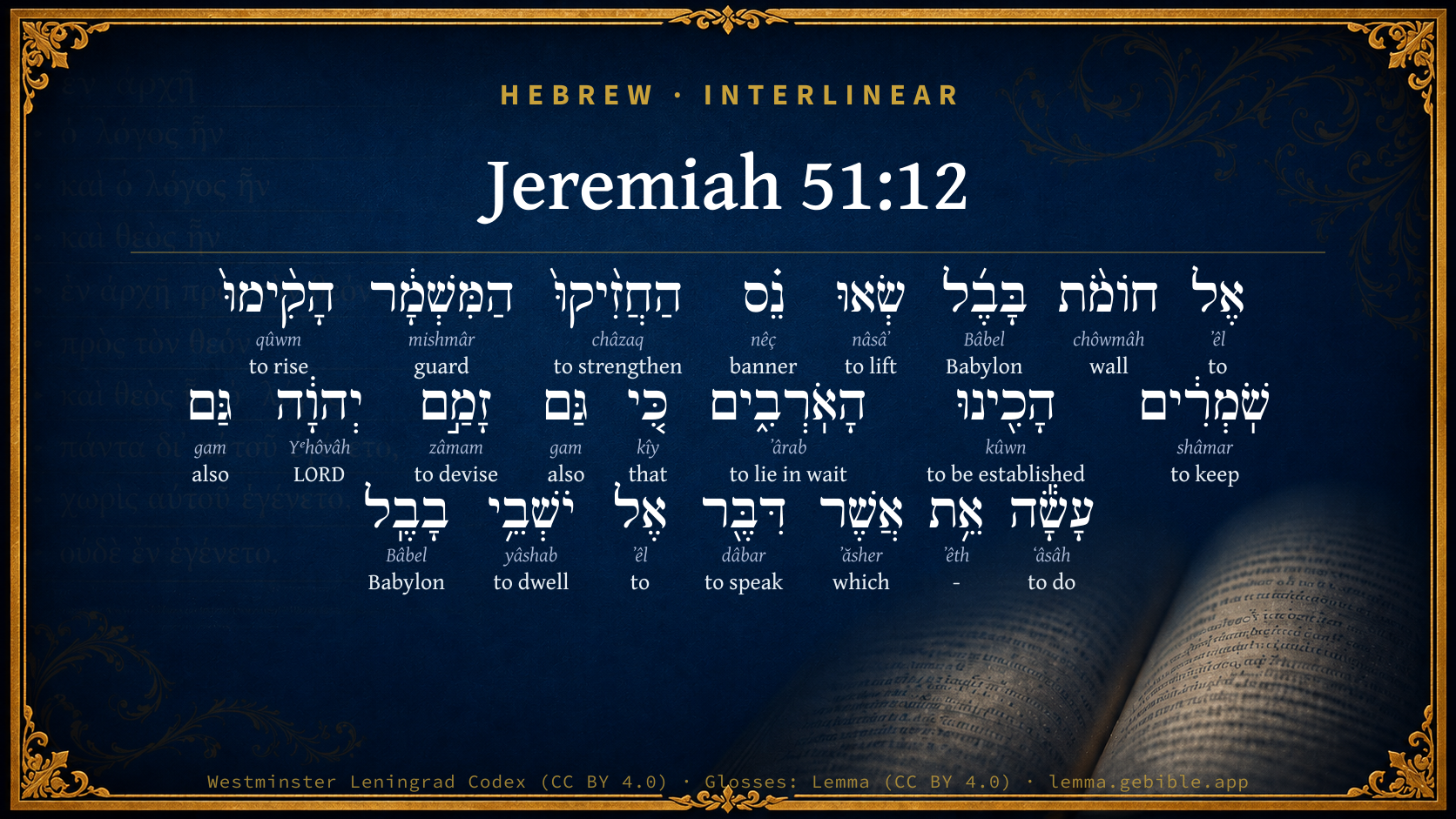
Jeremiah 51:12

Hebrew (Westminster Leningrad Codex) Jeremiah 51:12 appears in the Hebrew Old Testament. The text above is from the Westminster Leningrad Codex. Each word links to its Strong’s number, a concise gloss, and parsing drawn from the Open Scriptures Hebrew Bible morphology. Click any word for its full Brown-Driver-Briggs (BDB) entry.
Download image
Cite this verse

Jeremiah 51:12 (World English Bible). Public Domain. Lemma interlinear Bible study tool, https://lemma.gebible.app/v/jeremiah/51/12.

Show BibTeX & RIS
BibTeX
RIS
English Translation
Set up a standard against the walls of Babylon, make the watch strong, set the watchmen, prepare the ambushes; for Yahweh has both purposed and done that which he spoke concerning the inhabitants of Babylon.
World English Bible · Public Domain
Download a study sheet

One document with this verse’s original text, its word-by-word gloss line, the meaning frame, cross-references with their text, attributed commentary, and full source and license credits — printable, and it pastes into notes with its structure intact.

This verse Autodidact and up

Study sheet (.html) Plain text (.txt)

A passage Seminary Student

Up to 50 verses in one chapter. A passage sheet keeps up to 6 commentary sources and 12 cross-references per verse, in the order this page ranks them, and says so on the sheet whenever that leaves anything out. Ask for a single verse and you get the Autodidact verse sheet above.

Everything on this page stays free to read, with no account — the sheet is a download of what is already on screen, not access to it.

Want to remove ads? Support Godless Engineer
Compare translations 3

The same verse in 3 English versions, stacked beneath the original-language interlinear above. Click any original word for its lexicon entry.

Each is an independent rendering of the whole verse — the interlinear is not word-aligned to these translations.

Highlighted words mark where these versions differ — a whole-verse word diff, not a word-by-word alignment.

  • World English Bible Public Domain
    Set up a standard against the walls of Babylon, make the watch strong, set the watchmen, prepare the ambushes; for Yahweh has both purposed and done that which he spoke concerning the inhabitants of Babylon.
  • King James Version Public Domain
    Set up the standard upon the walls of Babylon, make the watch strong, set up the watchmen, prepare the ambushes: for the LORD hath both devised and done that which he spake against the inhabitants of Babylon.
  • unfoldingWord Literal Text CC BY-SA 4.0
    Lift up a banner over Babylon’s walls; make the watch strong; set up watchmen; prepare the ambushes; for the LORD will do what he has said concerning the inhabitants of Babylon.

unfoldingWord Literal Text — © unfoldingWord, licensed CC BY-SA 4.0. Word-aligned USFM3 via Door43 (git.door43.org/unfoldingWord/en_ult).

Versions to compare (up to 4)

3 of 4 selected

Show all 18 translations

Every available English version of this verse, each an independent rendering of the whole verse.

  • World English Bible Public Domain
    Set up a standard against the walls of Babylon, make the watch strong, set the watchmen, prepare the ambushes; for Yahweh has both purposed and done that which he spoke concerning the inhabitants of Babylon.
  • Berean Standard Bible Public Domain
    Raise a banner against the walls of Babylon; post the guard; station the watchmen; prepare the ambush. For the LORD has both devised and accomplished what He spoke against the people of Babylon.
  • Majority Standard Bible Public Domain
    Raise a banner against the walls of Babylon; post the guard; station the watchmen; prepare the ambush. For the LORD has both devised and accomplished what He spoke against the people of Babylon.
  • King James Version Public Domain
    Set up the standard upon the walls of Babylon, make the watch strong, set up the watchmen, prepare the ambushes: for the LORD hath both devised and done that which he spake against the inhabitants of Babylon.
  • American Standard Version (1901) Public Domain
    Set up a standard against the walls of Babylon, make the watch strong, set the watchmen, prepare the ambushes; for Jehovah hath both purposed and done that which he spake concerning the inhabitants of Babylon.
  • Revised Version (1885) Public Domain
    Set up a standard against the walls of Babylon, make the watch strong, set the watchmen, prepare the ambushes: for the LORD hath both devised and done that which he spake concerning the inhabitants of Babylon.
  • Geneva Bible (1599) Public Domain
    Set vp the standart vpon the walles of Babel, make the watch strong: set vp the watchmen: prepare the skoutes: for the Lord hath both deuised, and done that which he spake against the inhabitantes of Babel.
  • Douay-Rheims (1899) Public Domain
    Upon the walls of Babylon set up the standard, strengthen the watch: set up the watchmen, prepare the ambushes: for the Lord hath both purposed, and done all that he spoke against the inhabitants of Babylon.
  • Young's Literal Translation Public Domain
    Unto the walls of Babylon lift up an ensign, Strengthen the watch, Establish the watchers, prepare the ambush, For Jehovah hath both devised and done that which He spake, Concerning the inhabitants of Babylon.
  • Literal Standard Version CC BY-SA 4.0
    Lift up an ensign to the walls of Babylon, || Strengthen the watch, || Establish the watchers, prepare the ambush, || For YHWH has both devised and done that which He spoke, || Concerning the inhabitants of Babylon.
  • Unlocked Literal Bible CC BY-SA 4.0
    Lift up a banner over Babylon's walls; make the watch strong; set up watchmen; prepare the ambushes; for the LORD will do what he has said concerning the inhabitants of Babylon.
  • unfoldingWord Literal Text CC BY-SA 4.0
    Lift up a banner over Babylon’s walls; make the watch strong; set up watchmen; prepare the ambushes; for the LORD will do what he has said concerning the inhabitants of Babylon.
  • Darby Bible Public Domain
    Lift up a banner towards the walls of Babylon, make the watch strong, set the watchmen, prepare the ambushes; for Jehovah hath both devised and done that which he spoke against the inhabitants of Babylon.
  • World Messianic Bible Public Domain
    Set up a standard against the walls of Babylon! Make the watch strong! Set the watchmen, and prepare the ambushes; for the LORD has both purposed and done that which he spoke concerning the inhabitants of Babylon.
  • Webster's Bible Public Domain
    Set up the standard upon the walls of Babylon, make the watch strong, set up the watchmen, prepare the ambushes: for the LORD hath both devised and done that which he spoke against the inhabitants of Babylon.
  • Free Bible Version CC BY-SA 4.0
    Raise the signal flag to attack the walls of Babylon; strengthen the guard; have the watchmen take their places; get the ambush ready. The Lord planned and carried out his threats against the people of Babylon.
  • Bible in Basic English Public Domain
    Let the flag be lifted up against the walls of Babylon, make the watch strong, put the watchmen in their places, make ready a surprise attack: for it is the Lord's purpose, and he has done what he said about the people of Babylon.
  • JPS Tanakh (1917) Public Domain
    Set up a standard against the walls of Babylon, make the watch strong, set the watchmen, prepare the ambushes; for the LORD hath both devised and done that which He spoke concerning the inhabitants of Babylon.

Literal Standard Version (2020), Covenant Press — licensed CC BY-SA 4.0. Text via the HelloAO Bible API (eBible.org). Unlocked Literal Bible (unfoldingWord) — licensed CC BY-SA 4.0. Text via the HelloAO Bible API (eBible.org). unfoldingWord Literal Text — © unfoldingWord, licensed CC BY-SA 4.0. Word-aligned USFM3 via Door43 (git.door43.org/unfoldingWord/en_ult). Free Bible Version, Dr. Jonathan Gallagher — licensed CC BY-SA 4.0. Text via the HelloAO Bible API (eBible.org).

Word by word

More ways to search: Search by grammar → Find every occurrence → Compare this word →

Practice this passage: Drill this verse → Learn its vocabulary →

זָמַ֣ם
zâmam
H2161
“to devise”
Verb, Qal, Perfect, 3rd Person, Masculine, Singular
Part of Speech
Verb
Stem
Qal
Form
Perfect
Person
3rd Person
Gender
Masculine
Number
Singular
Full BDB Definition

Origin: a primitive root

TWOT: 556

to have a thought, devise, plan, consider, purpose - (Qal) - to consider, fix thought upon - to purpose, devise - to plot (of evil intent)
  1. אֶל ʼêl H413 “to” Preposition
  2. חוֹמֹ֨ת chôwmâh H2346 “walls of” Noun, Common, Feminine, Plural, Construct
  3. בָּבֶ֜ל Bâbel H894 “Babylon” Noun, Proper
  4. שְׂאוּ nâsâʼ H5375 “lift” Verb, Qal, Imperative, 2nd Person, Masculine, Plural
  5. נֵ֗ס nêç H5251 “banner” Noun, Common, Masculine, Singular, Absolute
  6. הַחֲזִ֨יקוּ֙ châzaq H2388 “strengthen” Verb, Hiphil, Imperative, 2nd Person, Masculine, Plural
  7. הַמִּשְׁמָ֔ר mishmâr H4929 “the · guard” Particle, Definite Article + Noun, Common, Masculine, Singular, Absolute
  8. הָקִ֨ימוּ֙ qûwm H6965 “rise” Verb, Hiphil, Imperative, 2nd Person, Masculine, Plural
  9. שֹֽׁמְרִ֔ים shâmar H8104 “keeping” Verb, Qal, Participle Active, Masculine, Plural, Absolute
  10. הָכִ֖ינוּ kûwn H3559 “be established” Verb, Hiphil, Imperative, 2nd Person, Masculine, Plural
  11. הָאֹֽרְבִ֑ים ʼârab H693 “the · lying in wait” Particle, Definite Article + Verb, Qal, Participle Active, Masculine, Plural, Absolute
  12. כִּ֚י kîy H3588 “that” Conjunction
  13. גַּם gam H1571 “also” Particle, Accusative
  14. יְהוָ֔ה Yᵉhôvâh H3068 “LORD” Noun, Proper
  15. גַּם gam H1571 “also” Particle, Accusative
  16. עָשָׂ֕ה ʻâsâh H6213 “to do” Verb, Qal, Perfect, 3rd Person, Masculine, Singular
  17. אֵ֥ת ʼêth H853 “-” Particle, Direct Object
  18. אֲשֶׁר ʼăsher H834 “which” Particle, Relative
  19. דִּבֶּ֖ר dâbar H1696 “to speak” Verb, Piel, Perfect, 3rd Person, Masculine, Singular
  20. אֶל ʼêl H413 “to” Preposition
  21. יֹשְׁבֵ֥י yâshab H3427 “dwelling” Verb, Qal, Participle Active, Masculine, Plural, Construct
  22. בָבֶֽל Bâbel H894 “Babylon” Noun, Proper

About this verse

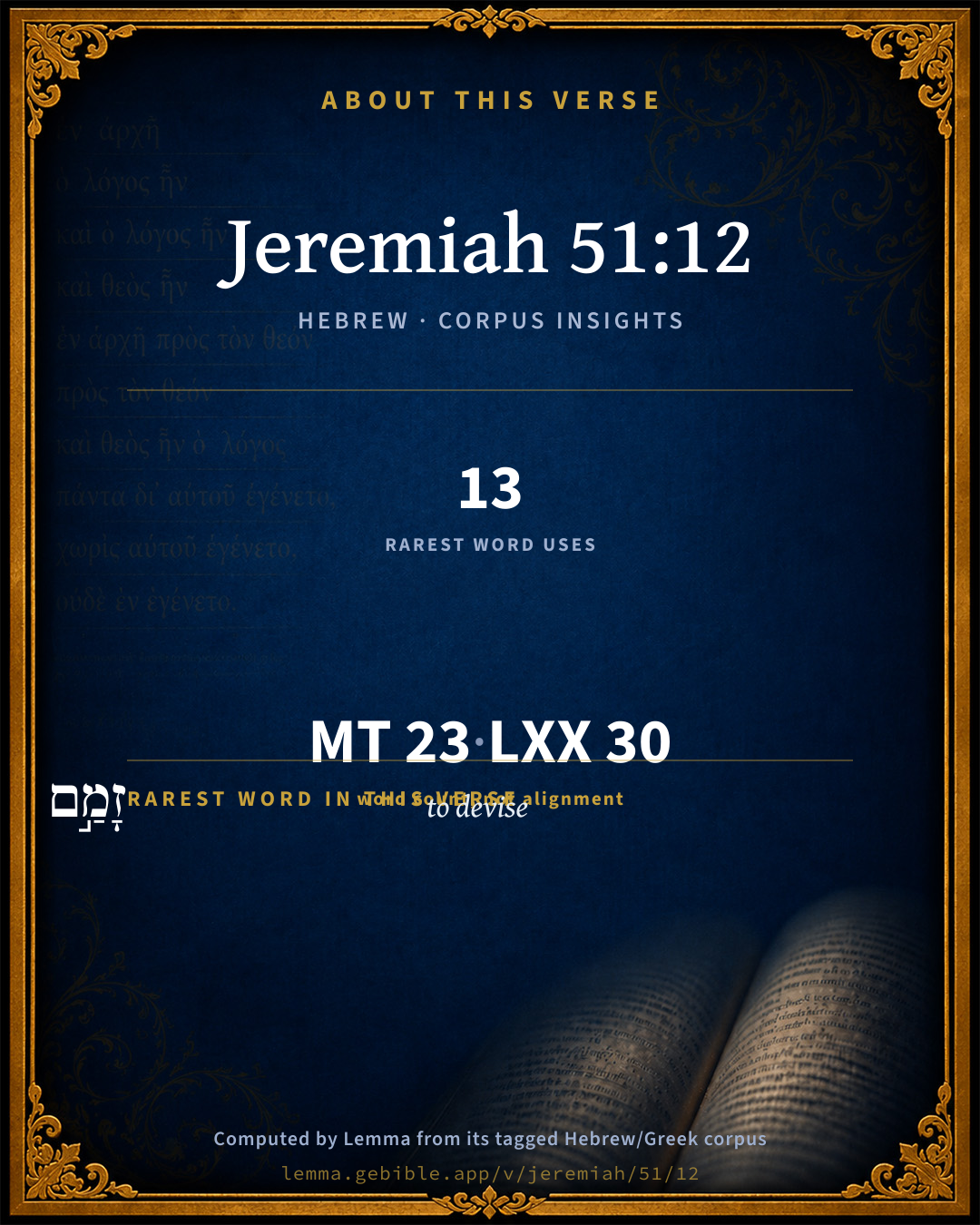
These counts appear in no published source. They are computed here, from the morphology-tagged text and Lemma’s own curated glosses. What Lemma adds →

23
words
20
distinct lemmas
Prophets
section

Notable vocabulary

The rarest word here is זָמַ֣ם to devise H2161 — appearing just 13 times in the whole Hebrew Bible.

Shared distinctive vocabulary

זָמַ֣ם to devise H2161 occurs in 13 verses of the Hebrew Bible. Also found in:

Grammatical profile

  • 10 verbs
  • 6 nouns
  • 2 prepositions
  • 1 conjunction
  • 4 particles

Verb forms

  • שְׂאוּ Qal · Imperative
  • הַחֲזִ֨יקוּ֙ Hiphil · Imperative
  • הָקִ֨ימוּ֙ Hiphil · Imperative
  • שֹֽׁמְרִ֔ים Qal · Participle Active
  • הָכִ֖ינוּ Hiphil · Imperative
  • הָאֹֽרְבִ֑ים Qal · Participle Active
  • זָמַ֣ם Qal · Perfect
  • עָשָׂ֕ה Qal · Perfect
  • דִּבֶּ֖ר Piel · Perfect
  • יֹשְׁבֵ֥י Qal · Participle Active

Repetition

Words recur within this verse — often emphatic in Hebrew:

  • בָּבֶ֜ל Babylon H894 ×2
  • גַּם also H1571 ×2
  • אֶל to H413 ×2

Hebrew & Septuagint length

In the original languages it is 23 Hebrew tokens and 30 Greek tokens — but the two are counted differently (Hebrew bundles its prefixes and suffixes into one token; the Greek is in lemma form), so that isn’t a like-for-like length.

Cross-references

14

Topical passages linked to Jeremiah 51:12 in the Treasury of Scripture Knowledge — connected by theme and wording, ordered by reader-vote popularity; previews shown in the World English Bible.

  • Isaiah 13:2 Set up an ensign on the bare mountain, lift up the voice to them, wave the hand, that they may go into the gates of the nobles.
  • Jeremiah 51:11 Make sharp the arrows; hold firm the shields: Yahweh has stirred up the spirit of the kings of the Medes; because his purpose is against Babylon, to destroy it: for it is the vengeance of Yahweh, the vengeance of his temple.
  • Jeremiah 51:29 The land trembles and is in pain; for the purposes of Yahweh against Babylon do stand, to make the land of Babylon a desolation, without inhabitant.
  • Nahum 2:1 He who dashes in pieces has come up against you. Keep the fortress! Watch the way! Strengthen your loins! Fortify your power mightily!
  • Joshua 8:14 It happened, when the king of Ai saw it, that they hurried and rose up early, and the men of the city went out against Israel to battle, he and all his people, at the time appointed, before the Arabah; but he didn't know that there was an ambush against him behind the city.
  • Proverbs 21:30 There is no wisdom nor understanding Nor counsel against Yahweh.
  • Isaiah 8:9–10 Make an uproar, O you peoples, and be broken in pieces! And give ear, all you of far countries: gird yourselves, and be broken in pieces! Gird yourselves, and be broken in pieces!
  • Jeremiah 46:3–5 Prepare you the buckler and shield, and draw near to battle.
  • Jeremiah 50:2 Declare you among the nations and publish, and set up a standard; publish, and don't conceal: say, Babylon is taken, Bel is disappointed, Merodach is dismayed; her images are disappointed, her idols are dismayed.
  • Jeremiah 51:27 Set up a standard in the land, blow the trumpet among the nations, prepare the nations against her, call together against her the kingdoms of Ararat, Minni, and Ashkenaz: appoint a marshal against her; cause the horses to come up as the rough canker-worm.
  • Lamentations 2:17 Yahweh has done that which he purposed; he has fulfilled his word that he commanded in the days of old; He has thrown down, and has not pitied: He has caused the enemy to rejoice over you; he has exalted the horn of your adversaries.
  • Joel 3:2 I will gather all nations, And will bring them down into the valley of Jehoshaphat; And I will execute judgment on them there for my people, And for my heritage, Israel, whom they have scattered among the nations. They have divided my land,
  • Joel 3:9–14 Proclaim this among the nations: Prepare war. Stir up the mighty men. Let all the warriors draw near. Let them come up.
  • Nahum 3:14–15 Draw water for the siege. Strengthen your fortresses. Go into the clay, and tread the mortar. Make the brick kiln strong.

Cross-references courtesy of OpenBible.info (CC BY 4.0).

Hebrew and Greek witnesses Masoretic Hebrew ↔ Greek Septuagint

The same verse in the two great witnesses to the Old Testament, shown verse-for-verse.

These are two independent witnesses, not word-aligned to each other, and the Septuagint is shown in lemma (dictionary) form.

Hebrew Jeremiah 51:12 Masoretic · Westminster Leningrad Codex

אֶל חוֹמֹ֨ת בָּבֶ֜ל שְׂאוּ נֵ֗ס הַחֲזִ֨יקוּ֙ הַמִּשְׁמָ֔ר הָקִ֨ימוּ֙ שֹֽׁמְרִ֔ים הָכִ֖ינוּ הָאֹֽרְבִ֑ים כִּ֚י גַּם זָמַ֣ם יְהוָ֔ה גַּם עָשָׂ֕ה אֵ֥ת אֲשֶׁר דִּבֶּ֖ר אֶל יֹשְׁבֵ֥י בָבֶֽל

Set up a standard against the walls of Babylon, make the watch strong, set the watchmen, prepare the ambushes; for Yahweh has both purposed and done that which he spoke concerning the inhabitants of Babylon.

World English Bible · Public Domain

Greek LXX Structure differs

In the Septuagint, Jeremiah is about an eighth shorter than the Hebrew and arranges its material differently — the Oracles Against the Nations (Hebrew chapters 46–51) appear in the middle of the Greek book, after 25:13. Because the chapter and verse boundaries do not line up, a verse-for-verse comparison with the Hebrew is not shown.

A verse-for-verse comparison isn’t shown here because the chapters and verses don’t line up. Switch to the LXX edition with the MT / LXX toggle above to read the Greek directly.

On this verse, Ellicott's Commentary for English Readers discusses the Septuagint’s reading. Read the note in Commentary ↓

Hebrew: Westminster Leningrad Codex (CC BY 4.0). Greek: Septuagint (public domain); English from a public-domain English Septuagint. How the Septuagint differs from the Hebrew →

Targum (Aramaic paraphrase)

1

The Targum is the ancient Jewish Aramaic paraphrase of the Hebrew Scriptures — an interpretive translation, not the Hebrew text itself. Onkelos (literal) and Pseudo-Jonathan (expansive) render the Torah, and Jonathan the Prophets. Coverage is partial: where no permissively-licensed English translation exists for a verse, only the Aramaic is shown. This is verse-level text, not a word-by-word alignment to the Hebrew.

  1. Targum Jonathan Prophets (Joshua–Malachi)
    עַל שׁוּרֵי בָּבֶל זְקוּפוּ אָתָא אַתְקִיפוּ מְטַרְתָּא אַקִימוּ נָטְרַיָא אַתְקִינוּ חוּצְנָיָא אֲרֵי אַף חָשַׁב יְיָ אַף עָבֵיד יַת דְמַלֵיל עַל יַתְבֵי בָּבֶל:

    (no public-domain English translation for this verse)

    Targum Jonathan — Aramaic: “Mikraot Gedolot” (public domain). English: “Sefaria Community Translation” (CC0 1.0 (public-domain dedication)); “London "Chaldee Paraphrase," 1871” (public domain). Text via Sefaria.

Commentary

Notes on Jeremiah 51:12 from classic Christian and Jewish commentators (each source and its license shown beneath its notes). The classic Christian expositions comment on the surrounding passage and are grouped to its opening verse, so a note may address several verses; the Jewish commentaries on the Tanakh (Rashi and others) are per-verse, so they appear only where the commentator wrote on this verse.

Lemma curates 59 commentaries, every one of them public domain or Creative Commons licensed, each selected and text-cleaned for this edition rather than reprinted as found. About our sources →

Trapp's Complete Commentary

John Trapp

Jer 51:12 Set up the standard upon the walls of Babylon, make the watch strong, set up the watchmen, prepare the ambushes: for the LORD hath both devised and done that which he spake against the inhabitants of Babylon.

Ver. 12. Set up the standard.] An irony all along, {a} as Jer 51:11.

{a} Hortatio ironica. - Piscator.

John Trapp, A Commentary or Exposition upon All the Books of the Old and New Testament (1647–1656) — public domain. Text from a community e-Sword module.

Jamieson, Fausset & Brown

Robert Jamieson, A. R. Fausset & David Brown

With all your efforts, your city shall be taken.

standard--to summon the defenders together to any point threatened by the besiegers.

Jamieson, Fausset & Brown — Commentary Critical and Explanatory on the Whole Bible (1871) — public domain (CC PDM 1.0). Text via the HelloAO Bible API.

Adam Clarke's Commentary

Verse 12. Set up the standard] A call to the enemies of Babylon to invest the city and press the siege.

Adam Clarke's Commentary on the Bible (1810–1826) — public domain. Text from a community e-Sword/MySword module.

John Calvin's Commentaries

These words seem to have been addressed to the Chaldeans rather than to the Medes or the Persians, as some expound them; for this is favored by the context; for as he bids them first to raise a standard on the walls, so he adds, Increase the watch, which refers to the citizens of Babylon, and then he says, set the watchmen All this cannot apply to the Persians and the Medes, but must be referred to the besieged, as being most suitable to them. I do not then doubt but that the Prophet here treats, with a taunt, all the efforts the Chaldeans would make for the defense of their city. For not only they who attack a city raise a standard, but also they who are besieged, and this as a sign of confidence, in order to show that they possess sufficient courage to check their enemies, and to sustain all their attacks. It was then the design of the Prophet to show, that however strenuously the Chaldeans might defend themselves, yet all their exertions would be in vain, because God would, without labor, destroy the city.

Raise, he says, the banner on the walls of Babylon, and strengthen, or increase the watch; and afterwards, set watchmen, so that every one might watch with more care than usual. He says at last, set in order the ambushes “When all things have been tried by you, your labor will be without any advantage, for the Lord hath spoken ” When the particle גם, gam, is repeated, it ought to be rendered as and so — for as the Lord hath thought, so will he do what he hath said, etc. He says again that God had thought, lest the faithful should imagine that he heedlessly casts forth threatenings; for this thought often occurs to the mind, that God terrifies without effecting anything, Hence the Prophet, that he might more fully confirm his prophecy, says, that the thing had been meditated upon by God; and we said yesterday that God does not deliberate with himself like men; but as we cannot otherwise understand the certainty and unchangeableness of his secret counsel, nor form an idea of the validity of his decrees, the word thought is mentioned. The Prophet, in short, means, that he brought forth nothing but what God had decreed. For words are often heedlessly uttered, and the reality and the words are not always connected; but Jeremiah testifies that he had taken what he announced from the hidden and immutable counsel of God. Then he adds, what he hath spoken or said; and this refers to his doctrine or his prediction. It follows, —

John Calvin's Commentaries (1540-1563) — public domain. Text from the Calvin Translation Society English edition (1840s-50s) via the Christian Classics Ethereal Library (ccel.org). Calvin's coverage is partial (roughly two-thirds of the Bible); uncommented books and verses are honest gaps, never fabricated. The 19th-century editor's footnotes and remarks are omitted so the notes are faithfully Calvin's own voice.

Ellicott's Commentary for English Readers

(12) Set up the standard upon the walls of Babylon.—The Authorised version, following the LXX. and the Vulgate, takes the words as an ironical summons to a defence which will prove fruitless. The preposition for “upon” may, however, mean against, and this agrees better with the context. The “standards” are the banners or signals that direct an attack on a given point of the walls. The “watch” and “watchmen” are the scouts and sentinels placed to give notice of any attempt at a sally on the part of the besieged. The “ambush” may indicate generally any sudden attack, or, more specifically, the stratagem of a feigned flight, like that employed by Joshua in the attack on Ai (Jos_8:14-16; comp. Jdg_20:33-35).

A Bible Commentary for English Readers, edited by Charles John Ellicott (1878–1897) — public domain. Text from a community e-Sword module.

The Cambridge Bible for Schools and Colleges

gen. ed. J. J. S. Perowne

12. Exhortation to commence the blockade.

watchmen] those of the attacking force who were appointed to see that the investiture was thorough.

the ambushes] to attack any of the besieged that ventured beyond the walls; or (better) to take advantage of a sortie to push their way through the opened gates. Cp. Jos_8:12 ff.; Jdg_20:29 ff.

The Cambridge Bible for Schools and Colleges (gen. ed. J. J. S. Perowne; Cambridge University Press, 1878–1918) — public domain. Text from a community e-Sword module.

John Gill's Exposition

Set up the standard upon the walls of Babylon,.... This is not said to the Medes and Persians, to put up a flag on the walls of Babylon, as a sign of victory, as Kimchi, Abarbinel, and others think; for as yet the city is not supposed to be taken by what follows; but rather to the Babylonians, to set up an ensign on their walls, to gather the inhabitants together, to defend their city, and the bulwarks of it; which, with what follows, is ironically spoken:

make the watch strong; to guard the city; observe the motions of the enemy, and give proper and timely notice; increase and double it:

set up watchmen; meaning the keepers of the walls; place them upon them, to keep a good look out, that they might not be surprised: this seems to respect the great carelessness and security the whole city was in the night it was taken; being wholly engaged in feasting and revelling, in rioting and drunkenness, having no fear of danger, or concern for their safety; with which they are tacitly upbraided:

prepare the ambushes; or, "liers in wait" (p); to second or relieve those on the walls upon occasion; or seize unawares the besiegers, should they attempt to scale the walls, and enter the city:

for the Lord hath devised and done that which he spoke against the inhabitants of Babylon; or as he hath devised, so hath he done, or will do: his purposes cannot be frustrated, his counsel shall stand; and therefore had the Babylonians been ever so industrious in their own defence, they could never have prevented their ruin and destruction, which was resolved upon, and accordingly effected.

(p) "insidiatores", Montanus, Junius & Tremellius, Piscator, Cocceius, Schmidt.

John Gill's Exposition of the Whole Bible (1746–1763) — public domain (CC PDM 1.0). Text via the HelloAO Bible API.

Albert Barnes' Notes on the Bible

Upon the walls of Babylon - Or, “against the walls.” The King James Version takes the word ironically, as a summons to Babylon to prepare for her defense; others take it as a summons to the army to make the attack.

Albert Barnes' Notes on the Bible (1834–1885) — public domain. Text from a community e-Sword/MySword module.

Haydock's Catholic Bible Commentary

Standard. Call together thy subjects and allies. (Haydock) --- This must be explained of Babylon. (Menochius) --- Yet all will be in vain, ver. 11. (Haydock) --- Ambushes. Herein the valour and genius of heroes was most displayed, Josue viii. 2. (Homer)

George Leo Haydock (1774–1849), Haydock's Catholic Family Bible and Commentary, 1859 edition — public domain. Excludes Psalms (Douay-Rheims chapter numbering differs from Protestant) and Deuterocanonical books (Catholic canon only).

Matthew Poole's English Annotations

Some judge these words spoken to the Medes, declaring the will of God, that they should use all probable means to conquer Babylon, or (as some would have it) display their banners upon the walls of it, as signs of its being already conquered: but certainly it is more reasonable to conclude them the prophet’s words to the Babylonians, either rousing them out of their security, (for it appears they were strangely secure from Da 5; historians tell us that the city was fortified by walls fifty cubits high, and two hundred cubits broad, and by a very deep and large ditch, besides that on one side it had the river Euphrates,) or at least quickening them to make all the preparation they could, though all would be to very little purpose, for God had resolved upon what he would do upon Babylon, and it was already as good as done.

Matthew Poole's English Annotations on the Holy Bible (1683–1685) — public domain. Text from a community e-Sword/MySword module.

Whedon's Commentary on the Bible

Daniel D. Whedon

12. Upon the walls — Rather, against “the walls of Babylon.” The language is not, as some have understood, ironical, but a summons to the enemy to make the attack. Make the watch strong, etc. — This language has reference to the details of attack, rather than modes of defence.

Daniel D. Whedon (gen. ed.), Commentary on the Old and New Testaments (1874–1909) — public domain. Text from a community e-Sword module.

The Pulpit Commentary

Upon the walls of Babylon; rather, toward the walls. (as Jer_4:6) The "standard" was carried before the army, to show the direction of the march. Make the watch strong. Not merely for the safety of the invaders, but to blockade the city. Comp. the phrase, "Watchers a synonymous Hebrew word is used came from a far country"; (Jer_4:16) i.e. besiegers. Prepare the ambushes. To press into the city when the besieged have made a sally. (as Jos_8:14-19 Jud_1:20:33, 37)

The Pulpit Commentary (1880–1919), ed. H.D.M. Spence-Jones & Joseph S. Exell — public domain. Text from a community e-Sword module.

John Wesley's Explanatory Notes

Set up - These seem to be the prophet's words to the Babylonians, rousing them out of their security. Historians tell us that the city was fortified by walls of fifty cubits high, and two hundred cubits broad, and by a very deep and large ditch.

John Wesley, Explanatory Notes Upon the Whole Bible (1754–1765) — public domain. Text via the GEBible commentary corpus.

Rashi

Rabbi Shlomo Yitzchaki (Rashi)

for the Lord both planned already many days.

and did His plan. It is customary for Scripture to speak with the word גַם twice, one after the other, and following the latter, comes the former.

Rashi on the Tanakh — English translations: “The Judaica Press complete Tanach with Rashi, translated by A. J. Rosenberg” (CC BY 4.0); “Pentateuch with Rashi's commentary by M. Rosenbaum and A.M. Silbermann, 1929-1934” (public domain); “The Metsudah Tanach series, Lakewood, N.J” (CC BY 4.0); and “The Book of Joshua, Metsudah Publications, 1997” (CC BY 4.0). Text via Sefaria.

Lesson kit

Teaching starters — assembled from the data on this page, not authored interpretation. Every prompt links to the verse data it draws on. Edit before teaching.

Jeremiah, in the Prophets, opens this verse with 23 words (20 distinct Hebrew lemmas). Its most distinctive word is zâmam (“to devise”). A historical commentator’s framing appears above. Read the whole chapter for the surrounding context.

Discussion questions

  1. The word zâmam carries the sense “to devise.” How does it shape the verse?
  2. Genesis 11:6 shares the word «to devise» with this verse. How do the two illuminate each other?
  3. “Babylon” occurs 2× in this one verse. What is the effect of the repetition?
  4. These translations render this verse differently. What is at stake in choosing one wording over another?
  5. The verb «שְׂאוּ» is Qal Imperative. How does its form color the action?
  6. Reading how Trapp's Complete Commentary and Jamieson, Fausset & Brown read this verse, where do the two commentators agree and where do they part?

Things to notice

Reading settings

Reading text

Shown beneath each verse's original-language words.

Old Testament
Old Testament edition

Read the OT as the Masoretic Hebrew (MT) or the Greek Septuagint (LXX).

English shown for the Greek Septuagint (in the Hebrew ↔ Greek comparison).

Comparing translations? Open the Compare panel on any verse page to stack up to four side by side.