
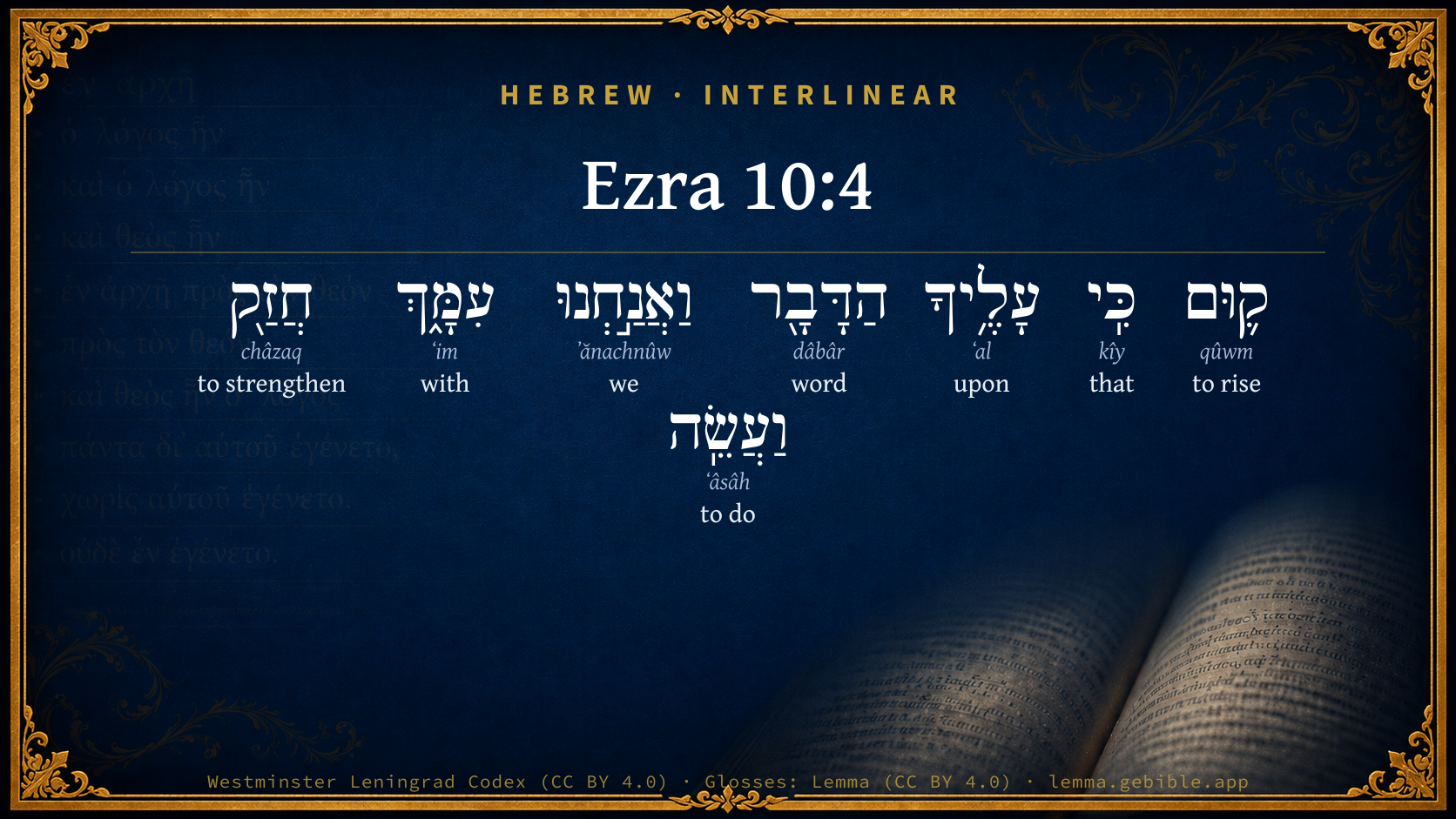
Ezra 10:4

Hebrew (Westminster Leningrad Codex) Ezra 10:4 appears in the Hebrew Old Testament. The text above is from the Westminster Leningrad Codex. Each word links to its Strong’s number, a concise gloss, and parsing drawn from the Open Scriptures Hebrew Bible morphology. Click any word for its full Brown-Driver-Briggs (BDB) entry.
Download image
Cite this verse

Ezra 10:4 (World English Bible). Public Domain. Lemma interlinear Bible study tool, https://lemma.gebible.app/v/ezra/10/4.

Show BibTeX & RIS
BibTeX
RIS
English Translation
Arise; for the matter belongs to you, and we are with you: be of good courage, and do it.
World English Bible · Public Domain
Download a study sheet

One document with this verse’s original text, its word-by-word gloss line, the meaning frame, cross-references with their text, attributed commentary, and full source and license credits — printable, and it pastes into notes with its structure intact.

This verse Autodidact and up

Study sheet (.html) Plain text (.txt)

A passage Seminary Student

Up to 50 verses in one chapter. A passage sheet keeps up to 6 commentary sources and 12 cross-references per verse, in the order this page ranks them, and says so on the sheet whenever that leaves anything out. Ask for a single verse and you get the Autodidact verse sheet above.

Everything on this page stays free to read, with no account — the sheet is a download of what is already on screen, not access to it.

Want to remove ads? Support Godless Engineer
Compare translations 3

The same verse in 3 English versions, stacked beneath the original-language interlinear above. Click any original word for its lexicon entry.

Each is an independent rendering of the whole verse — the interlinear is not word-aligned to these translations.

Highlighted words mark where these versions differ — a whole-verse word diff, not a word-by-word alignment.

  • World English Bible Public Domain
    Arise; for the matter belongs to you, and we are with you: be of good courage, and do it.
  • King James Version Public Domain
    Arise; for this matter belongeth unto thee: we also will be with thee: be of good courage, and do it.
  • unfoldingWord Literal Text CC BY-SA 4.0
    Arise, for the matter is on you, and we are with you. Be strong and do.”

unfoldingWord Literal Text — © unfoldingWord, licensed CC BY-SA 4.0. Word-aligned USFM3 via Door43 (git.door43.org/unfoldingWord/en_ult).

Versions to compare (up to 4)

3 of 4 selected

Show all 18 translations

Every available English version of this verse, each an independent rendering of the whole verse.

  • World English Bible Public Domain
    Arise; for the matter belongs to you, and we are with you: be of good courage, and do it.
  • Berean Standard Bible Public Domain
    Get up, for this matter is your responsibility, and we will support you. Be strong and take action!”
  • Majority Standard Bible Public Domain
    Get up, for this matter is your responsibility, and we will support you. Be strong and take action!”
  • King James Version Public Domain
    Arise; for this matter belongeth unto thee: we also will be with thee: be of good courage, and do it.
  • American Standard Version (1901) Public Domain
    Arise; for the matter belongeth unto thee, and we are with thee: be of good courage, and do it.
  • Revised Version (1885) Public Domain
    Arise; for the matter belongeth unto thee, and we are with thee: be of good courage, and do it.
  • Geneva Bible (1599) Public Domain
    Arise: for the matter belogeth vnto thee: we also wil be with thee: be of comfort and do it.
  • Douay-Rheims (1899) Public Domain
    Arise, it is thy part to give orders, and we will be with thee: take courage, and do it.
  • Young's Literal Translation Public Domain
    rise, for on thee `is' the matter, and we `are' with thee; be strong, and do.'
  • Literal Standard Version CC BY-SA 4.0
    rise, for on you [is] the matter, and we [are] with you; be strong, and do.”
  • Unlocked Literal Bible CC BY-SA 4.0
    Arise, for this thing is for you to carry out, and we are with you. Be strong and do this.”
  • unfoldingWord Literal Text CC BY-SA 4.0
    Arise, for the matter is on you, and we are with you. Be strong and do.”
  • Darby Bible Public Domain
    Arise, for this matter is incumbent on thee, and we will be with thee: be of good courage, and do [it].
  • World Messianic Bible Public Domain
    Arise, for the matter belongs to you and we are with you. Be courageous, and do it.”
  • Webster's Bible Public Domain
    Arise; for this matter belongeth to thee: we also will be with thee: be of good courage, and do it.
  • Free Bible Version CC BY-SA 4.0
    Take action! It's your responsibility. We are with you. Be brave and do it!”
  • Bible in Basic English Public Domain
    Up, now! for this is your business, and we are with you; take heart and do it.
  • JPS Tanakh (1917) Public Domain
    Arise; for the matter belongeth unto thee, and we are with thee; be of good courage, and do it.'

Literal Standard Version (2020), Covenant Press — licensed CC BY-SA 4.0. Text via the HelloAO Bible API (eBible.org). Unlocked Literal Bible (unfoldingWord) — licensed CC BY-SA 4.0. Text via the HelloAO Bible API (eBible.org). unfoldingWord Literal Text — © unfoldingWord, licensed CC BY-SA 4.0. Word-aligned USFM3 via Door43 (git.door43.org/unfoldingWord/en_ult). Free Bible Version, Dr. Jonathan Gallagher — licensed CC BY-SA 4.0. Text via the HelloAO Bible API (eBible.org).

Word by word

More ways to search: Search by grammar → Find every occurrence → Compare this word →

Practice this passage: Drill this verse → Learn its vocabulary →

About this verse

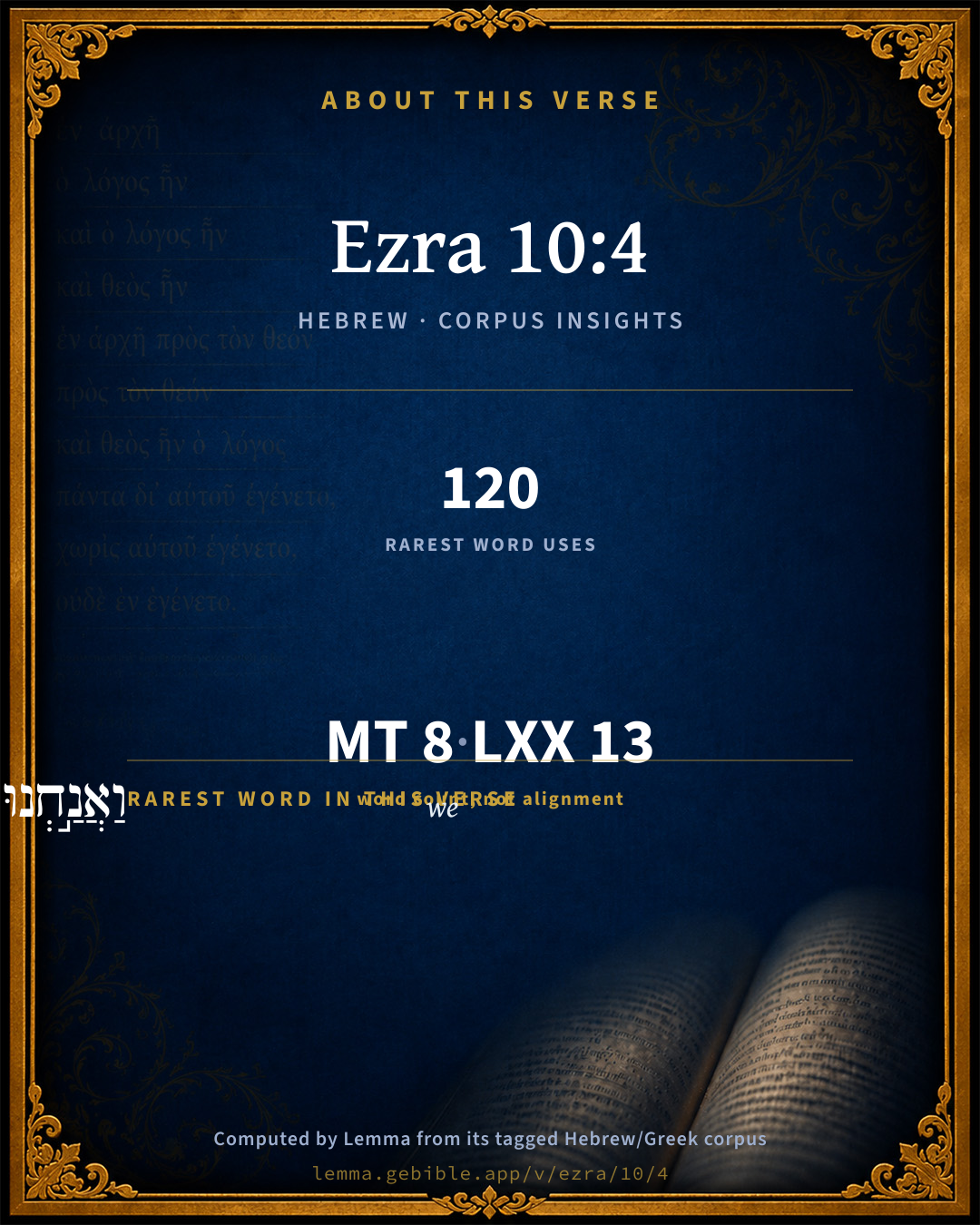
These counts appear in no published source. They are computed here, from the morphology-tagged text and Lemma’s own curated glosses. What Lemma adds →

8
words
8
distinct lemmas
Historical
section

Grammatical profile

  • 3 verbs
  • 1 noun
  • 1 pronoun
  • 2 prepositions
  • 1 conjunction

Verb forms

  • ק֛וּם Qal · Imperative
  • חֲזַ֖ק Qal · Imperative
  • וַעֲשֵֽׂה Qal · Imperative

Hebrew & Septuagint length

In English translation the verse runs 19 words from the Hebrew and 36 from the Septuagint (LXX English) — the Septuagint runs noticeably longer here. See the side-by-side →

A rough comparison of the two English renderings, which tokenize alike — not a word-level alignment.

Word counts can differ between the Hebrew and the Greek without any difference in meaning — e.g. the Hebrew direct-object marker אֵת has no separate Greek word, and Greek often adds the article ὁ.

In the original languages it is 8 Hebrew tokens and 13 Greek tokens — but the two are counted differently (Hebrew bundles its prefixes and suffixes into one token; the Greek is in lemma form), so that isn’t a like-for-like length.

Cross-references

12

Topical passages linked to Ezra 10:4 in the Treasury of Scripture Knowledge — connected by theme and wording, ordered by reader-vote popularity; previews shown in the World English Bible.

  • 1 Chronicles 28:10 Take heed now; for Yahweh has chosen you to build a house for the sanctuary: be strong, and do it.
  • Ecclesiastes 9:10 Whatever your hand finds to do, do it with your might; for there is no work, nor device, nor knowledge, nor wisdom, in Sheol, where you are going.
  • 1 Chronicles 22:19 Now set your heart and your soul to seek after Yahweh your God; arise therefore, and build the sanctuary of Yahweh God, to bring the ark of the covenant of Yahweh, and the holy vessels of God, into the house that is to be built to the name of Yahweh.
  • Hebrews 10:24 Let us consider how to provoke one another to love and good works,
  • Hebrews 12:12–13 Therefore, lift up the hands that hang down and the feeble knees,
  • Isaiah 35:3–4 Strengthen you the weak hands, and confirm the feeble knees.
  • 1 Chronicles 22:16 of the gold, the silver, and the brass, and the iron, there is no number. Arise and be doing, and Yahweh be with you.
  • Ezra 7:23–28 Whatever is commanded by the God of heaven, let it be done exactly for the house of the God of heaven; for why should there be wrath against the realm of the king and his sons?
  • Joshua 7:10–26 Yahweh said to Joshua, Get you up; why are you thus fallen on your face?
  • 1 Chronicles 28:21 Behold, there are the divisions of the priests and the Levites, for all the service of the house of God: and there shall be with you in all manner of work every willing man who has skill, for any manner of service: also the captains and all the people will be entirely at your command.
  • Mark 13:34 "It is like a man, traveling to another country, having left his house, and given authority to his servants, and to each one his work, and also commanded the doorkeeper to keep watch.
  • Joshua 1:16–18 They answered Joshua, saying, All that you have commanded us we will do, and wherever you send us we will go.

Cross-references courtesy of OpenBible.info (CC BY 4.0).

Hebrew and Greek witnesses Masoretic Hebrew ↔ Greek Septuagint

The same verse in the two great witnesses to the Old Testament, shown verse-for-verse.

Here the Septuagint runs noticeably longer than the Hebrew — LXX2012 (modern English Septuagint) 36 words vs World English Bible 19. A rough length comparison of the two English translations, not a word-level alignment — read both below.

These are two independent witnesses, not word-aligned to each other, and the Septuagint is shown in lemma (dictionary) form.

Hebrew Ezra 10:4 Masoretic · Westminster Leningrad Codex

ק֛וּם כִּֽי עָלֶ֥יךָ הַדָּבָ֖ר וַאֲנַ֣חְנוּ עִמָּ֑ךְ חֲזַ֖ק וַעֲשֵֽׂה

Arise; for the matter belongs to you, and we are with you: be of good courage, and do it.

World English Bible · Public Domain

Greek LXX Ezra 10:4 Septuagint · lemma form

ἀναἵστημι ὅτι ἐπί σύ ὁ ῥῆμα καί ἐγώ μετά σύ κραταιός καί ποιέω

arise, and alarm them with the commands of our God; and let it be done according to the law. Rise up, for the matter is upon you; and we are with you: be strong and do.

LXX2012 (modern English Septuagint) · Public Domain

In the Septuagint this is one book — Esdras B (2 Esdras): Ezra is chapters 1–10, Nehemiah 11–23.

Hebrew: Westminster Leningrad Codex (CC BY 4.0). Greek: Septuagint (public domain); English from LXX2012 (modern English Septuagint) (Public Domain). How the Septuagint differs from the Hebrew →

Commentary

Notes on Ezra 10:4 from classic Christian and Jewish commentators (each source and its license shown beneath its notes). The classic Christian expositions comment on the surrounding passage and are grouped to its opening verse, so a note may address several verses; the Jewish commentaries on the Tanakh (Rashi and others) are per-verse, so they appear only where the commentator wrote on this verse.

Lemma curates 59 commentaries, every one of them public domain or Creative Commons licensed, each selected and text-cleaned for this edition rather than reprinted as found. About our sources →

Trapp's Complete Commentary

John Trapp

Ezr 10:4 Arise; for [this] matter [belongeth] unto thee: we also [will be] with thee: be of good courage, and do [it].

Ver. 4. Arise] Surge, age, Summe Pater, Arise, act, most high father, said Mantuan to the pope, exciting him to take arms against the Turk: to the same sense Shechaniah here to Ezra; or rather as Jehovah to Joshua, Jos 7:10, Get thee up: why liest thou here on thy face?

For this matter belongeth unto thee] Who hast both a heart to do it, as appears by thine humiliation, and also power in thine hand, as witnesseth thy commission.

We also will be with thee] Every man must show himself forward to further the work of reformation, moving regularly within his own sphere, and trading every talent for that end and purpose.

Be of good courage, and do it] These were verba non inflantia, sed inflammantia. Not words, spoken but inflammed. And thus may one, by his hearty good counsel, become an angel, nay, a god, to another. Senarclaeus, in an epistle to Bucer, telling how John Diazius, the martyr, discoursed unto him the night before he was butchered by the appointment of his own brother Alphonsus, hath this notable expression, Ego vero illius oratione sic incendebar, &c., I was so inflamed with his words, as if I had heard the Holy Ghost himself speaking unto me.

John Trapp, A Commentary or Exposition upon All the Books of the Old and New Testament (1647–1656) — public domain. Text from a community e-Sword module.

Joseph Benson's Commentary

Ezr 10:4-5. Arise, for this matter belongeth unto thee — Who hast a perfect knowledge of the law, and full power from the king of Persia to see every thing done according to it; and who hast most skill to manage this matter. We also will be with thee: be of good courage — He promises him his assistance, and that of many other principal persons, which might give him confidence of success. Then arose Ezra, and made the chief priests, &c., to swear — He admonished them of their duty in the name of God, and then persuaded them to take a solemn oath, which they did, to put away their strange wives.

Joseph Benson's Commentary on the Old and New Testaments (1811–1818) — public domain. Text from a community e-Sword module.

Tyndale Open Study Notes

Tyndale Open Resources

10:4 it is your duty: As an expert in the law (see 7:10), Ezra was responsible for leading the people to a God-honoring solution to the problem of intermarriage. Because the law of Moses did not contain explicit directions for divorcing pagan wives, Ezra needed to develop a plan consistent with the requirements of Scripture and fair to the participants.

Tyndale Open Study Notes — © Tyndale Open Resources, licensed CC BY-SA 4.0. Text via the HelloAO Bible API.

Geneva Bible (1599)

Geneva Bible translators

Because God hath given thee authority and learning to persuade the people herein, and to command them.

Geneva Bible (1599) marginal notes — public domain. Text via Bolls.life.

Adam Clarke's Commentary

Verse 4. Arise; for this matter belongeth unto thee] By the decree of Artaxerxes, he was authorized to do everything that the law of God required: see Ezr 7:23-28. And all officers were commanded to be aiding and assisting; hence Shechaniah says, We are with you.

Adam Clarke's Commentary on the Bible (1810–1826) — public domain. Text from a community e-Sword/MySword module.

The Cambridge Bible for Schools and Colleges

gen. ed. J. J. S. Perowne

4. The appeal to Ezra.

Arise] Not a reference to Ezra’s prostration but a summons to energetic action, Jos_1:2; Jdg_4:14; 1Sa_16:12 and often.

for this matter belongeth unto thee:] R.V. for the matter &c. Literally ‘for this matter is upon thee’. Cf. Neh_13:13, ‘And their business was (lit. and it was upon them) to distribute unto their brethren’. Isa_9:6, ‘And the government shall be upon his shoulder’. Ezra was marked out for the duty, partly because he had so publicly testified to his condemnation of the people’s sin, partly because he had received the royal commission ‘to teach’ them that knew not the laws of his God (Ezr_7:25).

we also will be with thee] R.V. and we are with thee. The R.V. gives the full meaning, by placing only a comma after ‘thee’. The lead in the work was Ezra’s, but Shechaniah and his friends were ready to cooperate at once in the reform. The present tense is therefore more appropriate than the future.

be of good courage, and do it] Literally, ‘be strong, and do’. The responsibility of initiative required especial courage, when the policy would inevitably produce widespread discontent with no material compensation. David uses the same words to Solomon when entrusting to him the work of constructing the Temple. 1Ch_28:10, ‘Take heed now; for the Lord hath chosen thee to build an house for the sanctuary: be strong, and do it’: cf. 2Ch_19:11, ‘Deal courageously’ (Heb. Be strong and do), are the words of encouragement given to Amariah, Zebadiah and the Levites by Jehoshaphat, as he commissioned them to act as judges among the people.

The Cambridge Bible for Schools and Colleges (gen. ed. J. J. S. Perowne; Cambridge University Press, 1878–1918) — public domain. Text from a community e-Sword module.

John Gill's Exposition

Arise,.... From the ground, where he lay prostrate:

for this matter belongeth unto thee; as a priest and scribe of the law, well versed in it, and therefore could direct what was to be done according to it; and as a ruler under the king of Persia, and a commissioner of his, to inquire whether the law of God was observed by the Jews, Ezr 7:14 and so had authority to put the law in execution:

we also will be with thee; to help and assist in the reformation of this evil:

be of good courage, and do it; do not despair of going through it, though there may be some opposition to it; begin, and doubt not of succeeding.

John Gill's Exposition of the Whole Bible (1746–1763) — public domain (CC PDM 1.0). Text via the HelloAO Bible API.

Haydock's Catholic Bible Commentary

Thy part. The high priest not acting, (Menochius) Esdras was appointed chief, (Haydock) and his abilities were universally acknowledged. (Calmet)

George Leo Haydock (1774–1849), Haydock's Catholic Family Bible and Commentary, 1859 edition — public domain. Excludes Psalms (Douay-Rheims chapter numbering differs from Protestant) and Deuterocanonical books (Catholic canon only).

Matthew Poole's English Annotations

This matter belongeth unto thee; because thou hast both skill to manage it, and authority both from God and from the Persian king to do it.

Matthew Poole's English Annotations on the Holy Bible (1683–1685) — public domain. Text from a community e-Sword/MySword module.

Whedon's Commentary on the Bible

Daniel D. Whedon

4. Arise — Ezra was probably still bowed down before the temple. Ezr_10:1, note.

Unto thee — Ezra possessed the proper authority from the king, (Ezr_7:25,) and the wisdom to institute the needed reformation.

Daniel D. Whedon (gen. ed.), Commentary on the Old and New Testaments (1874–1909) — public domain. Text from a community e-Sword module.

The Pulpit Commentary

This matter belongeth unto thee. Ezra"s commission was to "let judgment be executed on those who would not do the law of God", (Ezr_7:26) and so to constrain them to obedience. It was therefore his place to inquire into the serious matter brought before him, and set it right. We will be with thee. We, the "very great congregation" which had gathered around Ezra, and of whom Shechaniah was the spokesman, undertake to be with thee, and support thee, in the steps which thou takest in this matter. Only be of good courage, and act.

The Pulpit Commentary (1880–1919), ed. H.D.M. Spence-Jones & Joseph S. Exell — public domain. Text from a community e-Sword module.

Keil & Delitzsch

C. F. Keil & F. Delitzsch

"Up! for this matter concerns thee (thou art called to carry it out), and we are with thee (will assist thee therein); be strong (courageous) and do it."

Keil & Delitzsch — Biblical Commentary on the Old Testament (1861–1891) — public domain (CC PDM 1.0). Text via the HelloAO Bible API. (Old Testament only.)

Rashi

Rabbi Shlomo Yitzchaki (Rashi)

and we are with you to agree with you.

Rashi on the Tanakh — English translations: “The Judaica Press complete Tanach with Rashi, translated by A. J. Rosenberg” (CC BY 4.0); “Pentateuch with Rashi's commentary by M. Rosenbaum and A.M. Silbermann, 1929-1934” (public domain); “The Metsudah Tanach series, Lakewood, N.J” (CC BY 4.0); and “The Book of Joshua, Metsudah Publications, 1997” (CC BY 4.0). Text via Sefaria.

Lesson kit

Teaching starters — assembled from the data on this page, not authored interpretation. Every prompt links to the verse data it draws on. Edit before teaching.

Ezra, in the Historical, opens this verse with 8 words (8 distinct Hebrew lemmas). Its most distinctive word is ʼănachnûw (“we”). The Greek Septuagint runs longer here. A historical commentator’s framing appears above. Read the whole chapter for the surrounding context.

Discussion questions

  1. What does “we” (ʼănachnûw) contribute to the verse as a whole?
  2. How does 1 Chronicles 28:10, which shares this passage’s theme, read alongside this verse?
  3. The Septuagint runs longer here than the Hebrew. What might account for the difference?
  4. These translations render this verse differently; the difference is in the English rendering, not the original. What questions does that raise?
  5. «ק֛וּם» is a Qal Imperative verb. How does that grammatical form shape the action described?
  6. Compare how Trapp's Complete Commentary and Joseph Benson's Commentary read this verse. Where do they agree or differ?

Things to notice

Reading settings

Reading text

Shown beneath each verse's original-language words.

Old Testament
Old Testament edition

Read the OT as the Masoretic Hebrew (MT) or the Greek Septuagint (LXX).

English shown for the Greek Septuagint (in the Hebrew ↔ Greek comparison).

Comparing translations? Open the Compare panel on any verse page to stack up to four side by side.