
Judges 19:25

Hebrew (Westminster Leningrad Codex) Judges 19:25 appears in the Hebrew Old Testament. The text above is from the Westminster Leningrad Codex. Each word links to its Strong’s number, a concise gloss, and parsing drawn from the Open Scriptures Hebrew Bible morphology. Click any word for its full Brown-Driver-Briggs (BDB) entry.
Download image
Cite this verse

Judges 19:25 (World English Bible). Public Domain. Lemma interlinear Bible study tool, https://lemma.gebible.app/v/judges/19/25.

Show BibTeX & RIS
BibTeX
RIS
English Translation
But the men wouldn't listen to him: so the man laid hold on his concubine, and brought her forth to them; and they knew her, and abused her all the night until the morning: and when the day began to spring, they let her go.
World English Bible · Public Domain
Download a study sheet

One document with this verse’s original text, its word-by-word gloss line, the meaning frame, cross-references with their text, attributed commentary, and full source and license credits — printable, and it pastes into notes with its structure intact.

This verse Autodidact and up

Study sheet (.html) Plain text (.txt)

A passage Seminary Student

Up to 50 verses in one chapter. A passage sheet keeps up to 6 commentary sources and 12 cross-references per verse, in the order this page ranks them, and says so on the sheet whenever that leaves anything out. Ask for a single verse and you get the Autodidact verse sheet above.

Everything on this page stays free to read, with no account — the sheet is a download of what is already on screen, not access to it.

Want to remove ads? Support Godless Engineer
Compare translations 3

The same verse in 3 English versions, stacked beneath the original-language interlinear above. Click any original word for its lexicon entry.

Each is an independent rendering of the whole verse — the interlinear is not word-aligned to these translations.

Highlighted words mark where these versions differ — a whole-verse word diff, not a word-by-word alignment.

  • World English Bible Public Domain
    But the men wouldn't listen to him: so the man laid hold on his concubine, and brought her forth to them; and they knew her, and abused her all the night until the morning: and when the day began to spring, they let her go.
  • King James Version Public Domain
    But the men would not hearken to him: so the man took his concubine, and brought her forth unto them; and they knew her, and abused her all the night until the morning: and when the day began to spring, they let her go.
  • unfoldingWord Literal Text CC BY-SA 4.0
    But the men did not consent to listen to him. So the man seized his concubine and made her go out to them outside. And they knew her and they abused her all of the night until the morning. Then they let her go at the rising of the dawn.

unfoldingWord Literal Text — © unfoldingWord, licensed CC BY-SA 4.0. Word-aligned USFM3 via Door43 (git.door43.org/unfoldingWord/en_ult).

Versions to compare (up to 4)

3 of 4 selected

Show all 18 translations

Every available English version of this verse, each an independent rendering of the whole verse.

  • World English Bible Public Domain
    But the men wouldn't listen to him: so the man laid hold on his concubine, and brought her forth to them; and they knew her, and abused her all the night until the morning: and when the day began to spring, they let her go.
  • Berean Standard Bible Public Domain
    But the men would not listen to him. So the Levite took his concubine and sent her outside to them, and they raped her and abused her throughout the night, and at dawn they let her go.
  • Majority Standard Bible Public Domain
    But the men would not listen to him. So the Levite took his concubine and sent her outside to them, and they raped her and abused her throughout the night, and at dawn they let her go.
  • King James Version Public Domain
    But the men would not hearken to him: so the man took his concubine, and brought her forth unto them; and they knew her, and abused her all the night until the morning: and when the day began to spring, they let her go.
  • American Standard Version (1901) Public Domain
    But the men would not hearken to him: so the man laid hold on his concubine, and brought her forth unto them; and they knew her, and abused her all the night until the morning: and when the day began to spring, they let her go.
  • Revised Version (1885) Public Domain
    But the men would not hearken to him: so the man laid hold on his concubine, and brought her forth unto them; and they knew her, and abused her all the night until the morning: and when the day began to spring, they let her go.
  • Geneva Bible (1599) Public Domain
    But the men woulde not hearken to him: therefore ye man tooke his concubine, and brought her out vnto them: and they knewe her and abused her all the night vnto the morning: and when the day began to spring, they let her goe.
  • Douay-Rheims (1899) Public Domain
    They would not be satisfied with his words; which the man seeing, brought out his concubine to them, and abandoned her to their wickedness: and when they had abused her all the night, they let her go in the morning.
  • Young's Literal Translation Public Domain
    And the men have not been willing to hearken to him, and the man taketh hold on his concubine, and bringeth `her' out unto them without, and they know her, and roll themselves upon her all the night, till the morning, and send her away in the ascending of the dawn;
  • Literal Standard Version CC BY-SA 4.0
    And the men have not been willing to listen to him, and the man takes hold on his concubine and brings [her] out to them outside, and they know her and roll themselves on her all the night until the morning, and they send her away in the ascending of the dawn;
  • Unlocked Literal Bible CC BY-SA 4.0
    But the men would not listen to him, so the man seized his concubine and brought her out to them. They raped her and abused her all throughout the night, and at dawn they let her go.
  • unfoldingWord Literal Text CC BY-SA 4.0
    But the men did not consent to listen to him. So the man seized his concubine and made her go out to them outside. And they knew her and they abused her all of the night until the morning. Then they let her go at the rising of the dawn.
  • Darby Bible Public Domain
    But the men would not listen to him. So the man seized his concubine, and put her out to them; and they knew her, and abused her all night until the morning. And as the dawn began to break, they let her go.
  • World Messianic Bible Public Domain
    But the men wouldn’t listen to him; so the man grabbed his concubine, and brought her out to them; and they had sex with her, and abused her all night until the morning. When the day began to dawn, they let her go.
  • Webster's Bible Public Domain
    But the men would not hearken to him: so the man took his concubine, and brought her forth to them; and they knew her, and abused her all the night until the morning: and when the day began to spring, they let her go.
  • Free Bible Version CC BY-SA 4.0
    But the men refused to listen, so the man grabbed his concubine and threw her outside to them. They raped her and abused her all night until the morning, and only discarded her at dawn.
  • Bible in Basic English Public Domain
    But the men would not give ear to him: so the man took his woman and sent her out to them; and they took her by force, using her for their pleasure all night till the morning; and when dawn came they let her go.
  • JPS Tanakh (1917) Public Domain
    But the men would not hearken to him; so the man laid hold on his concubine, and brought her forth unto them; and they knew her, and abused her all the night until the morning; and when the day began to spring, they let her go.

Literal Standard Version (2020), Covenant Press — licensed CC BY-SA 4.0. Text via the HelloAO Bible API (eBible.org). Unlocked Literal Bible (unfoldingWord) — licensed CC BY-SA 4.0. Text via the HelloAO Bible API (eBible.org). unfoldingWord Literal Text — © unfoldingWord, licensed CC BY-SA 4.0. Word-aligned USFM3 via Door43 (git.door43.org/unfoldingWord/en_ult). Free Bible Version, Dr. Jonathan Gallagher — licensed CC BY-SA 4.0. Text via the HelloAO Bible API (eBible.org).

Word by word

More ways to search: Search by grammar → Find every occurrence → Compare this word →

Practice this passage: Drill this verse → Learn its vocabulary →

וַיִּֽתְעַלְּלוּ
ʻâlal
H5953
“and · to act severely”
Conjunction + Verb, Hithpael, Sequential Imperfect, 3rd Person, Masculine, Plural
Part of Speech
Conjunction + Verb
Stem
Hithpael
Form
Sequential Imperfect
Person
3rd Person
Gender
Masculine
Number
Plural
Full BDB Definition

Origin: a primitive root

TWOT: 1627 , 1627b , 1628

to act severely, deal with severely, make a fool of someone - (Poel) to act severely - (Poal) to be severely dealt with - (Hithpael) to busy oneself, divert oneself, deal wantonly, deal - (Hithpoel) to practise practices, thrust forth (in wickedness) - (Poel) to glean - (Poel) to act or play the child - (Poel) to insert, thrust, thrust in, thrust upon ruthlessly, abuse (by thrusting through)
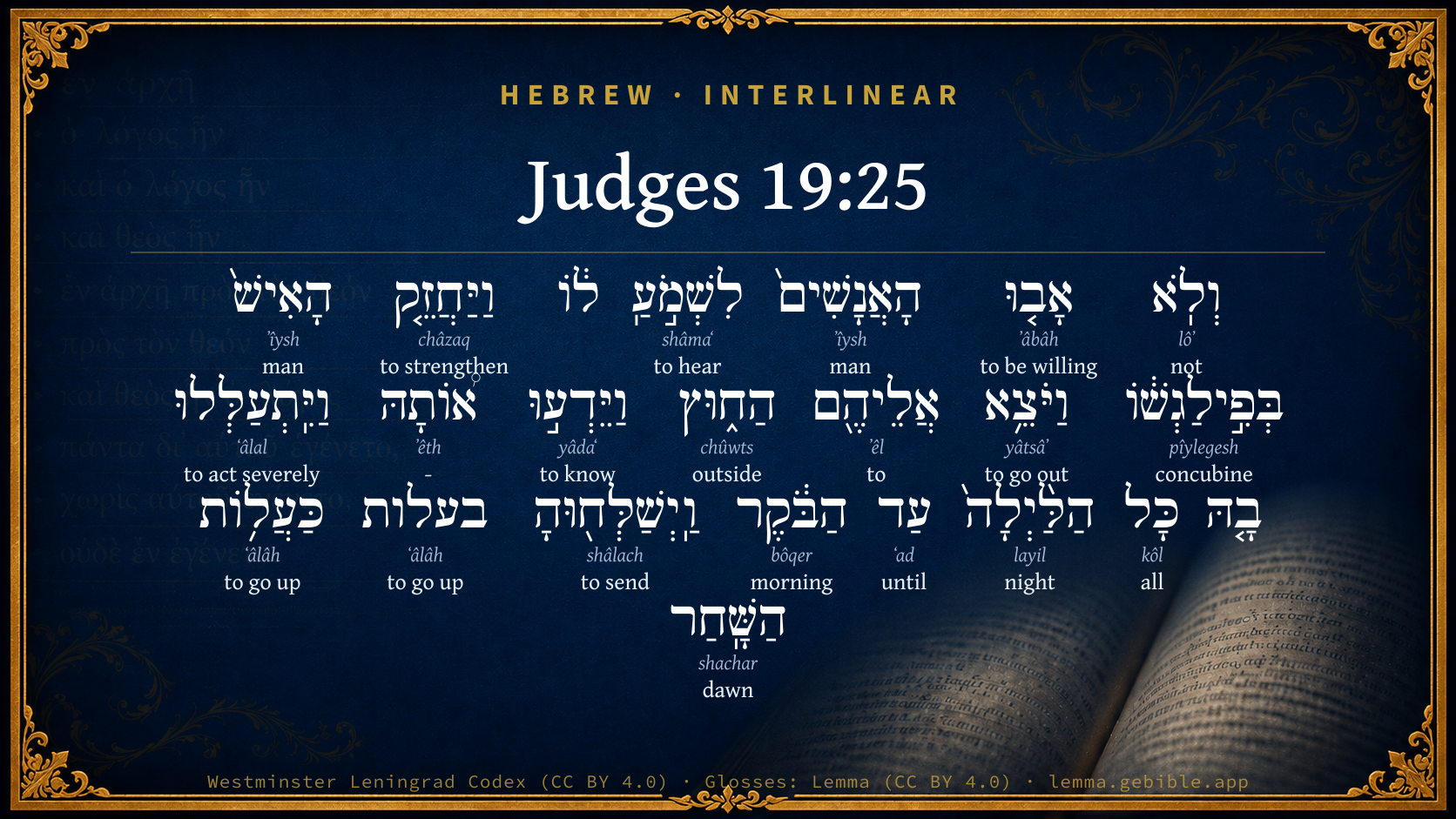
  1. וְלֹֽא lôʼ H3808 “and · not” Conjunction + Particle, Negative
  2. אָב֤וּ ʼâbâh H14 “to be willing” Verb, Qal, Perfect, 3rd Person, Common, Plural
  3. הָאֲנָשִׁים֙ ʼîysh H376 “the · men” Particle, Definite Article + Noun, Common, Masculine, Plural, Absolute
  4. לִשְׁמֹ֣עַֽ shâmaʻ H8085 “to hear” Preposition + Verb, Qal, Infinitive Construct
  5. וַיַּחֲזֵ֤ק châzaq H2388 “and · to strengthen” Conjunction + Verb, Hiphil, Sequential Imperfect, 3rd Person, Masculine, Singular
  6. הָאִישׁ֙ ʼîysh H376 “the · man” Particle, Definite Article + Noun, Common, Masculine, Singular, Absolute
  7. בְּפִ֣ילַגְשׁ֔וֹ pîylegesh H6370 “in/at · concubine · his” Preposition + Noun, Common, Feminine, Singular, Construct + Suffix, Personal, 3rd Person, Masculine, Singular
  8. וַיֹּצֵ֥א yâtsâʼ H3318 “and · to go out” Conjunction + Verb, Hiphil, Sequential Imperfect, 3rd Person, Masculine, Singular
  9. אֲלֵיהֶ֖ם ʼêl H413 “to · them” Preposition + Suffix, Personal, 3rd Person, Masculine, Plural
  10. הַח֑וּץ chûwts H2351 “the · outside” Particle, Definite Article + Noun, Common, Masculine, Singular, Absolute
  11. וַיֵּדְע֣וּ yâdaʻ H3045 “and · to know” Conjunction + Verb, Qal, Sequential Imperfect, 3rd Person, Masculine, Plural
  12. א֠וֹתָהּ ʼêth H853 “- · her” Particle, Direct Object + Suffix, Personal, 3rd Person, Feminine, Singular
  13. כָּל kôl H3605 “all of” Noun, Common, Masculine, Singular, Construct
  14. הַלַּ֨יְלָה֙ layil H3915 “the · night” Particle, Definite Article + Noun, Common, Masculine, Singular, Absolute
  15. עַד ʻad H5704 “until” Preposition
  16. הַבֹּ֔קֶר bôqer H1242 “the · morning” Particle, Definite Article + Noun, Common, Masculine, Singular, Absolute
  17. וַֽיְשַׁלְּח֖וּהָ shâlach H7971 “and · to send · her” Conjunction + Verb, Piel, Sequential Imperfect, 3rd Person, Masculine, Plural + Suffix, Personal, 3rd Person, Feminine, Singular
  18. בעלות ʻâlâh H5927 “in/at · to go up” Preposition + Verb, Qal, Infinitive Construct
  19. כַּעֲל֥וֹת ʻâlâh H5927 “like/as · to go up” Preposition + Verb, Qal, Infinitive Construct
  20. הַשָּֽׁחַר shachar H7837 “the · dawn” Particle, Definite Article + Noun, Common, Masculine, Singular, Absolute

About this verse

These counts appear in no published source. They are computed here, from the morphology-tagged text and Lemma’s own curated glosses. What Lemma adds →

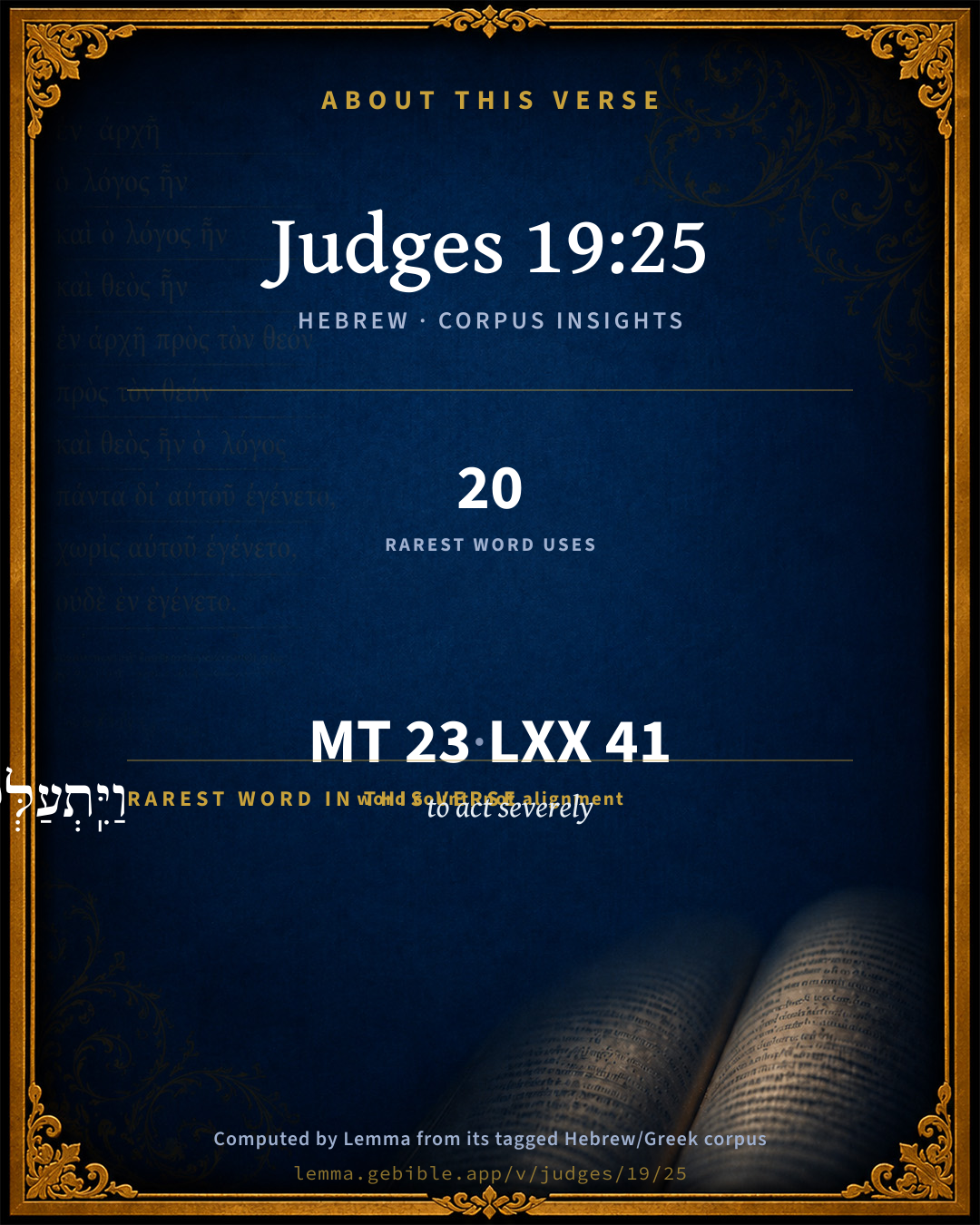
23
words
19
distinct lemmas
Historical
section

Notable vocabulary

The rarest word here is וַיִּֽתְעַלְּלוּ to act severely H5953 — appearing just 20 times in the whole Hebrew Bible.

Shared distinctive vocabulary

וַיִּֽתְעַלְּלוּ to act severely H5953 occurs in 18 verses of the Hebrew Bible. Also found in:

Grammatical profile

  • 9 verbs
  • 8 nouns
  • 4 prepositions
  • 2 particles

Verb forms

  • אָב֤וּ Qal · Perfect
  • לִשְׁמֹ֣עַֽ Qal · Infinitive Construct
  • וַיַּחֲזֵ֤ק Hiphil · Sequential Imperfect
  • וַיֹּצֵ֥א Hiphil · Sequential Imperfect
  • וַיֵּדְע֣וּ Qal · Sequential Imperfect
  • וַיִּֽתְעַלְּלוּ Hithpael · Sequential Imperfect
  • וַֽיְשַׁלְּח֖וּהָ Piel · Sequential Imperfect
  • בעלות Qal · Infinitive Construct
  • כַּעֲל֥וֹת Qal · Infinitive Construct

Repetition

Words recur within this verse — often emphatic in Hebrew:

  • הָאֲנָשִׁים֙ man H376 ×2
  • בעלות to go up H5927 ×2

Hebrew & Septuagint length

In English translation the verse runs 45 words from the Hebrew and 44 from the Septuagint (LXX English) — closely comparable.

A rough comparison of the two English renderings, which tokenize alike — not a word-level alignment.

Word counts can differ between the Hebrew and the Greek without any difference in meaning — e.g. the Hebrew direct-object marker אֵת has no separate Greek word, and Greek often adds the article ὁ.

In the original languages it is 23 Hebrew tokens and 41 Greek tokens — but the two are counted differently (Hebrew bundles its prefixes and suffixes into one token; the Greek is in lemma form), so that isn’t a like-for-like length.

Cross-references

6

Topical passages linked to Judges 19:25 in the Treasury of Scripture Knowledge — connected by theme and wording, ordered by reader-vote popularity; previews shown in the World English Bible.

  • Ephesians 4:19 who having become callous gave themselves up to lust, to work all uncleanness with greediness.
  • Genesis 4:1 The man knew Eve his wife. She conceived, and gave birth to Cain, and said, "I have gotten a man with Yahweh's help."
  • Jeremiah 5:7–8 How can I pardon you? your children have forsaken me, and sworn by them that are no gods: when I had fed them to the full, they committed adultery, and assembled themselves in troops at the prostitutes' houses.
  • Hosea 7:4–7 They are all adulterers. They are burning like an oven that the baker stops stirring, From the kneading of the dough, until it is leavened.
  • Hosea 9:9 They have deeply corrupted themselves, As in the days of Gibeah. He will remember their iniquity. He will punish them for their sins.
  • Hosea 10:9 "Israel, you have sinned from the days of Gibeah. There they remained. The battle against the children of iniquity doesn't overtake them in Gibeah.

Cross-references courtesy of OpenBible.info (CC BY 4.0).

Hebrew and Greek witnesses Masoretic Hebrew ↔ Greek Septuagint

The same verse in the two great witnesses to the Old Testament, shown verse-for-verse.

These are two independent witnesses, not word-aligned to each other, and the Septuagint is shown in lemma (dictionary) form.

Hebrew Judges 19:25 Masoretic · Westminster Leningrad Codex

וְלֹֽא אָב֤וּ הָאֲנָשִׁים֙ לִשְׁמֹ֣עַֽ ל֔וֹ וַיַּחֲזֵ֤ק הָאִישׁ֙ בְּפִ֣ילַגְשׁ֔וֹ וַיֹּצֵ֥א אֲלֵיהֶ֖ם הַח֑וּץ וַיֵּדְע֣וּ א֠וֹתָהּ וַיִּֽתְעַלְּלוּ בָ֤הּ כָּל הַלַּ֨יְלָה֙ עַד הַבֹּ֔קֶר וַֽיְשַׁלְּח֖וּהָ בעלות כַּעֲל֥וֹת הַשָּֽׁחַר

But the men wouldn't listen to him: so the man laid hold on his concubine, and brought her forth to them; and they knew her, and abused her all the night until the morning: and when the day began to spring, they let her go.

World English Bible · Public Domain

Greek LXX Judges 19:25 Septuagint · lemma form

καί οὐ εὐδοκέω ὁ ἀνήρ ὁ εἰςἀκούω αὐτός καί ἐπιλαμβάνω ὁ ἀνήρ ὁ παλλακή αὐτός καί ἐκἄγω αὐτός πρός αὐτός ἔξω καί γιγνώσκω αὐτός καί ἐνπαίζω ἐν αὐτός ὅλος ὁ νύξ ἕως πρωΐ καί ἐκ ἀποστέλλω αὐτός ὡς ἀναβαίνω ὁ πρωΐ

But the men would not consent to listen to him; so the man laid hold of his concubine, and brought her out to them; and they knew her, and abused her all night till the morning, and let her go when the morning dawned.

LXX2012 (modern English Septuagint) · Public Domain

Hebrew: Westminster Leningrad Codex (CC BY 4.0). Greek: Septuagint (public domain); English from LXX2012 (modern English Septuagint) (Public Domain). How the Septuagint differs from the Hebrew →

Targum (Aramaic paraphrase)

1

The Targum is the ancient Jewish Aramaic paraphrase of the Hebrew Scriptures — an interpretive translation, not the Hebrew text itself. Onkelos (literal) and Pseudo-Jonathan (expansive) render the Torah, and Jonathan the Prophets. Coverage is partial: where no permissively-licensed English translation exists for a verse, only the Aramaic is shown. This is verse-level text, not a word-by-word alignment to the Hebrew.

  1. Targum Jonathan Prophets (Joshua–Malachi)
    וְלָא אָבוּ גַבְרַיָא לְקַבָּלָא מִנֵיהּ וְאַתְקֵיף גַבְרָא בִּלְחֵינָתֵיהּ וְאַפֵּיק לְוַתְהוֹן לְבָּרָא וִידָעוּ יָתָהּ וְאִתְלְעָבוּ בָהּ כָּל לֵילְיָא עַד צַפְרָא וְשַׁלְחוּהָא כְּמֵיסַק צַפְרָא:

    (no public-domain English translation for this verse)

    Targum Jonathan — Aramaic: “Mikraot Gedolot” (public domain). English: “Sefaria Community Translation” (CC0 1.0 (public-domain dedication)); “London "Chaldee Paraphrase," 1871” (public domain). Text via Sefaria.

Commentary

Notes on Judges 19:25 from classic Christian and Jewish commentators (each source and its license shown beneath its notes). The classic Christian expositions comment on the surrounding passage and are grouped to its opening verse, so a note may address several verses; the Jewish commentaries on the Tanakh (Rashi and others) are per-verse, so they appear only where the commentator wrote on this verse.

Lemma curates 59 commentaries, every one of them public domain or Creative Commons licensed, each selected and text-cleaned for this edition rather than reprinted as found. About our sources →

Trapp's Complete Commentary

John Trapp

Jdg 19:25 But the men would not hearken to him: so the man took his concubine, and brought her forth unto them; and they knew her, and abused her all the night until the morning: and when the day began to spring, they let her go.

Ver. 25. But the men would not hearken] Unruly lust hath no ears. Fertur equis aurigo, nec audit currus habenis: like heavy bodies down steep hills, which once in motion, move themselves, and know no ground but the bottom.

And abused her all the night.] Factitarunt in ea; vel occuparunt sese in ea: opus abominabile fecerunt in ea in coitu. {a} This was a just hand of God upon her for her former filthiness and unfaithfulness. Lais, that notorious harlot, died in the act of uncleanness: so did Pope Paul IV, of whom the proverb went, Eum per eandum partem vitam profudisse per quam acceperat. {b}

{a} Piscat. Vatab.

{b} Jac. Revius, De Vit. Pontiff

John Trapp, A Commentary or Exposition upon All the Books of the Old and New Testament (1647–1656) — public domain. Text from a community e-Sword module.

Adam Clarke's Commentary

Verse 25. So the man took his concubine] The word יחזק yachazek, which we here translate simply took, signifies rather to take or seize by violence. The woman would not go out to them; but her graceless husband forced her to go, in order that he might save his own body. He could have but little love for her, and this was the cause of their separation before.

The men of Gibeah who wished to abuse the body of the Levite; the Levite who wished to save his body at the expense of the modesty, reputation, and life of his wife; and the old man who wished to save his guest at the expense of the violation of his daughter; are all characters that humanity and modesty wish to be buried in everlasting oblivion.

When the day began to spring] Their turpitude could not bear the full light of the day; and they dismissed the poor woman when the day began to break.

Adam Clarke's Commentary on the Bible (1810–1826) — public domain. Text from a community e-Sword/MySword module.

The Cambridge Bible for Schools and Colleges

gen. ed. J. J. S. Perowne

25. If the offer of the host strikes us as immoral, the conduct of the Levite makes an even worse impression: he sacrifices his concubine-wife to save himself. The same despicable behaviour appears in the stories of Abraham and Isaac, Gen_12:10 ff. J, Gen_12:20 E, Gen_26:6-11 J; no blame or condemnation is attached to any one; we must not expect to find even the elements of chivalry in the ancient Hebrew estimate of womanhood. Our standards of morality are inapplicable.

The Cambridge Bible for Schools and Colleges (gen. ed. J. J. S. Perowne; Cambridge University Press, 1878–1918) — public domain. Text from a community e-Sword module.

John Gill's Exposition

But the men would not hearken to him,.... Especially with respect to his daughter, whom they knew very well, and had no affection for, perhaps was not handsome enough for them:

so the man took his concubine, and brought her forth unto them; that is, not the old man, but the Levite took his own wife or concubine, and put her forth to them, very probably with her consent, to try if that would pacify them, she being a fair and beautiful woman, as Ben Gersom and Abarbinel suggest; and Josephus (u) intimates, that some young men of the city had seen her in the street, and were captivated with her beauty, and came on purpose for her, and would not be satisfied unless she was delivered to them; and upon which her husband, perceiving this, laid hold on her by main strength, as the word signifies, and brought her out whether she would or not, as Kimchi notes:

and they knew her, and abused her all night until the morning; had carnal knowledge of her, and used her in a most shocking manner one after another, all the night long, until the morning appeared:

and when the day began to spring; at break of day, when the light dawned: they let her go; their works being works of darkness, and would not bear the light.

(u) Antiqu. l. 5. c. 2. sect. 8.

John Gill's Exposition of the Whole Bible (1746–1763) — public domain (CC PDM 1.0). Text via the HelloAO Bible API.

Haydock's Catholic Bible Commentary

And abandoned. Hebrew, "and they knew her and abused her." (Haydock) --- Interpreters say in the most unnatural manner. (Calmet)

George Leo Haydock (1774–1849), Haydock's Catholic Family Bible and Commentary, 1859 edition — public domain. Excludes Psalms (Douay-Rheims chapter numbering differs from Protestant) and Deuterocanonical books (Catholic canon only).

Matthew Poole's English Annotations

The man took his concubine; being willing to expose her rather than the daughter of his host, who had expressed such a singular care and affection for him.

Matthew Poole's English Annotations on the Holy Bible (1683–1685) — public domain. Text from a community e-Sword/MySword module.

The Pulpit Commentary

The man took his concubine, etc. One"s blood boils at such selfish baseness and such cowardly cruelty. It is not quite clear whether the man means the Levite or the old Ephraimite.

The Pulpit Commentary (1880–1919), ed. H.D.M. Spence-Jones & Joseph S. Exell — public domain. Text from a community e-Sword module.

Lesson kit

Teaching starters — assembled from the data on this page, not authored interpretation. Every prompt links to the verse data it draws on. Edit before teaching.

Judges, in the Historical, opens this verse with 23 words (19 distinct Hebrew lemmas). Its most distinctive word is ʻâlal (“to act severely”). A historical commentator’s framing appears above. Read the whole chapter for the surrounding context.

Discussion questions

  1. How does “to act severely” (ʻâlal) shape what this verse is saying?
  2. How does Exodus 10:2, which shares the word «to act severely», read alongside this verse?
  3. What does the repetition of “man” (2× in this one verse) do in this verse?
  4. These translations render this verse differently; the difference is in the English rendering, not the original. What questions does that raise?
  5. «אָב֤וּ» is a Qal Perfect verb. How does that grammatical form shape the action described?
  6. Compare how Trapp's Complete Commentary and Adam Clarke's Commentary read this verse. Where do they agree or differ?

Things to notice

Reading settings

Reading text

Shown beneath each verse's original-language words.

Old Testament
Old Testament edition

Read the OT as the Masoretic Hebrew (MT) or the Greek Septuagint (LXX).

English shown for the Greek Septuagint (in the Hebrew ↔ Greek comparison).

Comparing translations? Open the Compare panel on any verse page to stack up to four side by side.