Ezekiel 22:14

Hebrew (Westminster Leningrad Codex) Ezekiel 22:14 appears in the Hebrew Old Testament. The text above is from the Westminster Leningrad Codex. Each word links to its Strong’s number, a concise gloss, and parsing drawn from the Open Scriptures Hebrew Bible morphology. Click any word for its full Brown-Driver-Briggs (BDB) entry.
Download image
Cite this verse

Ezekiel 22:14 (World English Bible). Public Domain. Lemma interlinear Bible study tool, https://lemma.gebible.app/v/ezekiel/22/14.

Show BibTeX & RIS
BibTeX
RIS
English Translation
Can your heart endure, or can your hands be strong, in the days that I shall deal with you? I, Yahweh, have spoken it, and will do it.
World English Bible · Public Domain
Download a study sheet

One document with this verse’s original text, its word-by-word gloss line, the meaning frame, cross-references with their text, attributed commentary, and full source and license credits — printable, and it pastes into notes with its structure intact.

This verse Autodidact and up

Study sheet (.html) Plain text (.txt)

A passage Seminary Student

Up to 50 verses in one chapter. A passage sheet keeps up to 6 commentary sources and 12 cross-references per verse, in the order this page ranks them, and says so on the sheet whenever that leaves anything out. Ask for a single verse and you get the Autodidact verse sheet above.

Everything on this page stays free to read, with no account — the sheet is a download of what is already on screen, not access to it.

Want to remove ads? Support Godless Engineer
Compare translations 3

The same verse in 3 English versions, stacked beneath the original-language interlinear above. Click any original word for its lexicon entry.

Each is an independent rendering of the whole verse — the interlinear is not word-aligned to these translations.

Highlighted words mark where these versions differ — a whole-verse word diff, not a word-by-word alignment.

  • World English Bible Public Domain
    Can your heart endure, or can your hands be strong, in the days that I shall deal with you? I, Yahweh, have spoken it, and will do it.
  • King James Version Public Domain
    Can thine heart endure, or can thine hands be strong, in the days that I shall deal with thee? I the LORD have spoken it, and will do it.
  • unfoldingWord Literal Text CC BY-SA 4.0
    Will your heart stand, will your hands be strong on the days when I myself will deal with you? I, Yahweh, am declaring this, and I will do it.

unfoldingWord Literal Text — © unfoldingWord, licensed CC BY-SA 4.0. Word-aligned USFM3 via Door43 (git.door43.org/unfoldingWord/en_ult).

Versions to compare (up to 4)

3 of 4 selected

Show all 18 translations

Every available English version of this verse, each an independent rendering of the whole verse.

  • World English Bible Public Domain
    Can your heart endure, or can your hands be strong, in the days that I shall deal with you? I, Yahweh, have spoken it, and will do it.
  • Berean Standard Bible Public Domain
    Will your courage endure or your hands be strong in the day I deal with you? I, the LORD, have spoken, and I will act.
  • Majority Standard Bible Public Domain
    Will your courage endure or your hands be strong in the day I deal with you? I, the LORD, have spoken, and I will act.
  • King James Version Public Domain
    Can thine heart endure, or can thine hands be strong, in the days that I shall deal with thee? I the LORD have spoken it, and will do it.
  • American Standard Version (1901) Public Domain
    Can thy heart endure, or can thy hands be strong, in the days that I shall deal with thee? I, Jehovah, have spoken it, and will do it.
  • Revised Version (1885) Public Domain
    Can thine heart endure, or can thine hands be strong, in the days that I shall deal with thee? I the LORD have spoken it, and will do it.
  • Geneva Bible (1599) Public Domain
    Can thine heart endure, or can thine hands be strong, in the dayes that I shall haue to doe with thee? I the Lord haue spoken it, and will doe it.
  • Douay-Rheims (1899) Public Domain
    Shall thy heart endure, or shall thy hands prevail ill the days which I will bring upon thee: I the Lord have spoken, and will do it.
  • Young's Literal Translation Public Domain
    Doth thy heart stand -- are thy hands strong, For the days that I am dealing with thee? I, Jehovah, have spoken and have done `it'.
  • Literal Standard Version CC BY-SA 4.0
    Does your heart stand—are your hands strong, || For the days that I am dealing with you? I, YHWH, have spoken and have done [it].
  • Unlocked Literal Bible CC BY-SA 4.0
    Will your heart stand, will your hands be strong on the days when I myself will deal with you? I, Yahweh, am declaring this, and I will do it.
  • unfoldingWord Literal Text CC BY-SA 4.0
    Will your heart stand, will your hands be strong on the days when I myself will deal with you? I, Yahweh, am declaring this, and I will do it.
  • Darby Bible Public Domain
    Shall thy heart endure, shall thy hands be strong, in the days that I shall deal with thee? I Jehovah have spoken, and will do [it].
  • World Messianic Bible Public Domain
    Can your heart endure, or can your hands be strong, in the days that I will deal with you? I, the LORD, have spoken it, and will do it.
  • Webster's Bible Public Domain
    Can thy heart endure, or can thy hands be strong, in the days that I shall deal with thee? I the LORD have spoken it, and will do it.
  • Free Bible Version CC BY-SA 4.0
    Are you going to be so brave, and will you be strong enough to defend yourselves when it comes time for me to deal with you? I, the Lord, have spoken, and I'm going to act.
  • Bible in Basic English Public Domain
    Will your heart be high or your hands strong in the days when I take you in hand? I the Lord have said it and will do it.
  • JPS Tanakh (1917) Public Domain
    Can thy heart endure, or can thy hands be strong, in the days that I shall deal with thee? I the LORD have spoken it, and will do it.

Literal Standard Version (2020), Covenant Press — licensed CC BY-SA 4.0. Text via the HelloAO Bible API (eBible.org). Unlocked Literal Bible (unfoldingWord) — licensed CC BY-SA 4.0. Text via the HelloAO Bible API (eBible.org). unfoldingWord Literal Text — © unfoldingWord, licensed CC BY-SA 4.0. Word-aligned USFM3 via Door43 (git.door43.org/unfoldingWord/en_ult). Free Bible Version, Dr. Jonathan Gallagher — licensed CC BY-SA 4.0. Text via the HelloAO Bible API (eBible.org).

Word by word

More ways to search: Search by grammar → Find every occurrence → Compare this word →

Practice this passage: Drill this verse → Learn its vocabulary →

תֶּחֱזַ֣קְנָה
châzaq
H2388
“to strengthen”
Verb, Qal, Imperfect, 3rd Person, Feminine, Plural
Part of Speech
Verb
Stem
Qal
Form
Imperfect
Person
3rd Person
Gender
Feminine
Number
Plural
Full BDB Definition

Origin: a primitive root

TWOT: 636

to strengthen, prevail, harden, be strong, become strong, be courageous, be firm, grow firm, be resolute, be sore - (Qal) - to be strong, grow strong - to prevail, prevail upon - to be firm, be caught fast, be secure - to press, be urgent - to grow stout, grow rigid, grow hard (bad sense) - to be severe, be grievous - to strengthen - (Piel) - to make strong - to restore to strength, give strength - to strengthen, sustain, encourage - to make strong, make bold, encourage - to make firm - to make rigid, make hard - (Hiphil) - to make strong, strengthen - to make firm - to display strength - to make severe - to support - to repair - to prevail, prevail upon - to have or take or keep hold of, retain, hold up, sustain, support - to hold, contain - (Hithpael) - to strengthen oneself - to put forth strength, use one's strength - to withstand - to hold strongly with

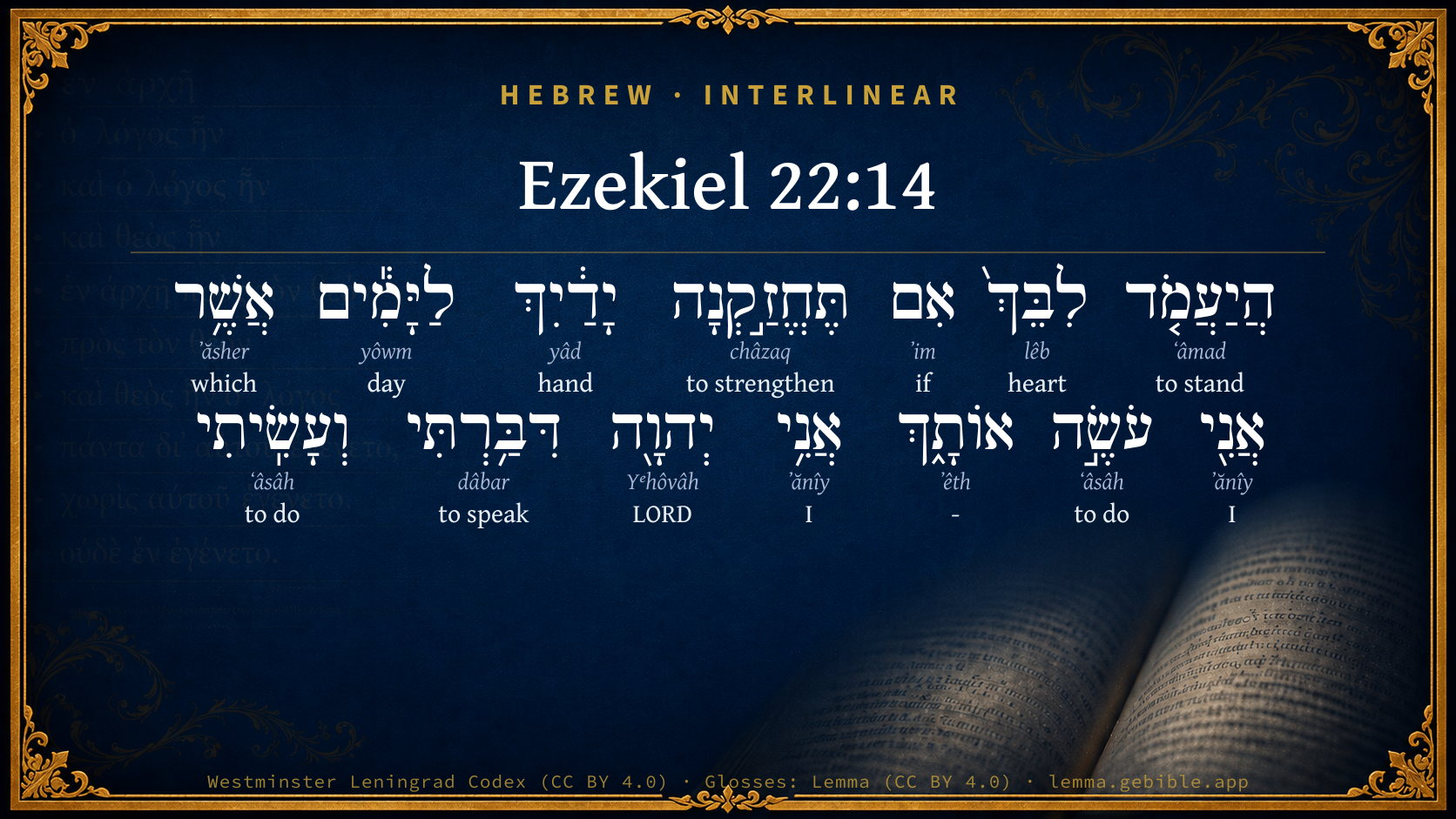
  1. הֲיַעֲמֹ֤ד ʻâmad H5975 “to stand” Particle, Interrogative + Verb, Qal, Imperfect, 3rd Person, Masculine, Singular
  2. לִבֵּךְ֙ lêb H3820 “heart · your” Noun, Common, Masculine, Singular, Construct + Suffix, Personal, 2nd Person, Feminine, Singular
  3. אִם ʼim H518 “if” Conjunction
  4. יָדַ֔יִךְ yâd H3027 “hands · your” Noun, Common, Both, Dual, Construct + Suffix, Personal, 2nd Person, Feminine, Singular
  5. לַיָּמִ֕ים yôwm H3117 “to/for the · days” Preposition, Determined + Noun, Common, Masculine, Plural, Absolute
  6. אֲשֶׁ֥ר ʼăsher H834 “which” Particle, Relative
  7. אֲנִ֖י ʼănîy H589 “I” Pronoun, Personal, 1st Person, Common, Singular
  8. עֹשֶׂ֣ה ʻâsâh H6213 “doing” Verb, Qal, Participle Active, Masculine, Singular, Absolute
  9. אוֹתָ֑ךְ ʼêth H853 “- · you” Particle, Direct Object + Suffix, Personal, 2nd Person, Feminine, Singular
  10. אֲנִ֥י ʼănîy H589 “I” Pronoun, Personal, 1st Person, Common, Singular
  11. יְהוָ֖ה Yᵉhôvâh H3068 “LORD” Noun, Proper
  12. דִּבַּ֥רְתִּי dâbar H1696 “to speak” Verb, Piel, Perfect, 1st Person, Common, Singular
  13. וְעָשִֽׂיתִי ʻâsâh H6213 “and · to do” Conjunction + Verb, Qal, Sequential Perfect, 1st Person, Common, Singular

About this verse

These counts appear in no published source. They are computed here, from the morphology-tagged text and Lemma’s own curated glosses. What Lemma adds →

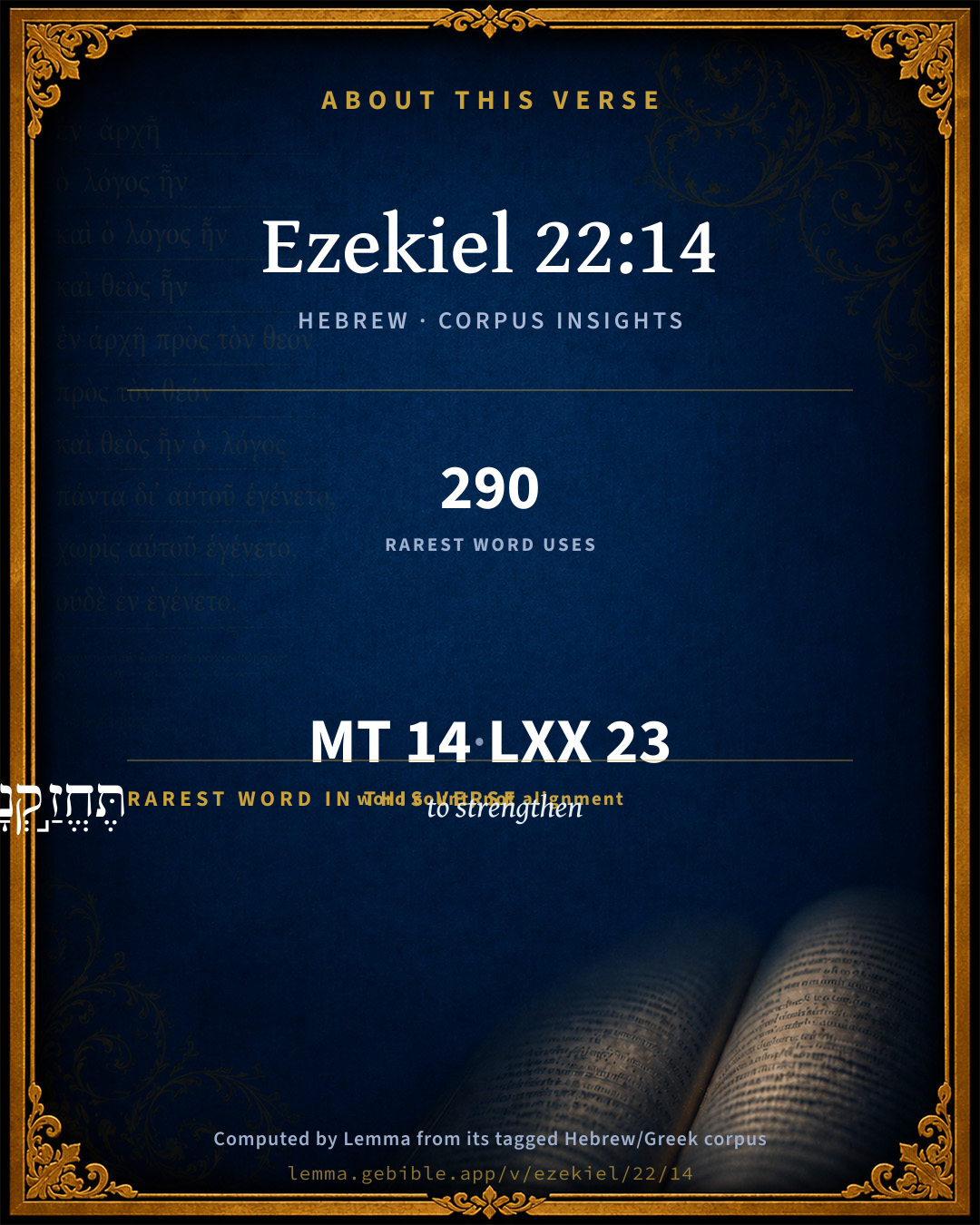
14
words
12
distinct lemmas
Prophets
section

Grammatical profile

  • 5 verbs
  • 4 nouns
  • 2 pronouns
  • 1 conjunction
  • 2 particles

Verb forms

  • הֲיַעֲמֹ֤ד Qal · Imperfect
  • תֶּחֱזַ֣קְנָה Qal · Imperfect
  • עֹשֶׂ֣ה Qal · Participle Active
  • דִּבַּ֥רְתִּי Piel · Perfect
  • וְעָשִֽׂיתִי Qal · Sequential Perfect

Repetition

Words recur within this verse — often emphatic in Hebrew:

  • עֹשֶׂ֣ה to do H6213 ×2
  • אֲנִ֖י I H589 ×2

Hebrew & Septuagint length

In English translation the verse runs 28 words from the Hebrew and 26 from the Septuagint (LXX English) — closely comparable.

A rough comparison of the two English renderings, which tokenize alike — not a word-level alignment.

Word counts can differ between the Hebrew and the Greek without any difference in meaning — e.g. the Hebrew direct-object marker אֵת has no separate Greek word, and Greek often adds the article ὁ.

In the original languages it is 14 Hebrew tokens and 23 Greek tokens — but the two are counted differently (Hebrew bundles its prefixes and suffixes into one token; the Greek is in lemma form), so that isn’t a like-for-like length.

Cross-references

13

Topical passages linked to Ezekiel 22:14 in the Treasury of Scripture Knowledge — connected by theme and wording, ordered by reader-vote popularity; previews shown in the World English Bible.

  • Ezekiel 21:7 It shall be, when they tell you, Why do you sigh? that you shall say, Because of the news, for it comes; and every heart shall melt, and all hands shall be feeble, and every spirit shall faint, and all knees shall be weak as water: behold, it comes, and it shall be done, says the Lord Yahweh.
  • Ezekiel 17:24 All the trees of the field shall know that I, Yahweh, have brought down the high tree, have exalted the low tree, have dried up the green tree, and have made the dry tree to flourish; I, Yahweh, have spoken and have done it.
  • Ezekiel 24:14 I, Yahweh, have spoken it: it shall happen, and I will do it: I will not go back, neither will I spare, neither will I repent; according to your ways, and according to your doings, shall they judge you, says the Lord Yahweh.
  • 1 Samuel 15:29 Also the Strength of Israel will not lie nor repent; for he is not a man, that he should repent.
  • Job 40:9 Or have you an arm like God? Can you thunder with a voice like him?
  • Isaiah 31:3 Now the Egyptians are men, and not God; and their horses flesh, and not spirit: and when Yahweh shall stretch out his hand, both he who helps shall stumble, and he who is helped shall fall, and they all shall be consumed together.
  • Isaiah 45:9 Woe to him who strives with his Maker--a potsherd among the potsherds of the earth! Shall the clay ask him who fashions it, "What are you making?" or your work, "He has no hands?"
  • Jeremiah 13:21 What will you say, when he shall set over you as head those whom you have yourself taught to be friends to you? shall not sorrows take hold of you, as of a woman in travail?
  • Ezekiel 28:9 Will you yet say before him who kills you, I am God? but you are man, and not God, in the hand of him who wounds you.
  • Mark 13:31 Heaven and earth will pass away, but my words will not pass away.
  • 1 Corinthians 10:22 Or do we provoke the Lord to jealousy? Are we stronger than he?
  • Hebrews 10:31 It is a fearful thing to fall into the hands of the living God.
  • Ezekiel 5:13 Thus shall my anger be accomplished, and I will cause my wrath toward them to rest, and I shall be comforted; and they shall know that I, Yahweh, have spoken in my zeal, when I have accomplished my wrath on them.

Cross-references courtesy of OpenBible.info (CC BY 4.0).

Hebrew and Greek witnesses Masoretic Hebrew ↔ Greek Septuagint

The same verse in the two great witnesses to the Old Testament, shown verse-for-verse.

These are two independent witnesses, not word-aligned to each other, and the Septuagint is shown in lemma (dictionary) form.

Hebrew Ezekiel 22:14 Masoretic · Westminster Leningrad Codex

הֲיַעֲמֹ֤ד לִבֵּךְ֙ אִם תֶּחֱזַ֣קְנָה יָדַ֔יִךְ לַיָּמִ֕ים אֲשֶׁ֥ר אֲנִ֖י עֹשֶׂ֣ה אוֹתָ֑ךְ אֲנִ֥י יְהוָ֖ה דִּבַּ֥רְתִּי וְעָשִֽׂיתִי

Can your heart endure, or can your hands be strong, in the days that I shall deal with you? I, Yahweh, have spoken it, and will do it.

World English Bible · Public Domain

Greek LXX Ezekiel 22:14 Septuagint · lemma form

εἰ ὑποἵστημι ὁ καρδία σύ εἰ κρατέω ὁ χείρ σύ ἐν ὁ ἡμέρα ὅς ἐγώ ποιέω ἐν σύ ἐγώ κύριος λαλέω καί ποιέω

shall your heart endure? shall your hands be strong in the days which I bring upon you? I the Lord have spoken, and will do it.

LXX2012 (modern English Septuagint) · Public Domain

Hebrew: Westminster Leningrad Codex (CC BY 4.0). Greek: Septuagint (public domain); English from LXX2012 (modern English Septuagint) (Public Domain). How the Septuagint differs from the Hebrew →

Targum (Aramaic paraphrase)

1

The Targum is the ancient Jewish Aramaic paraphrase of the Hebrew Scriptures — an interpretive translation, not the Hebrew text itself. Onkelos (literal) and Pseudo-Jonathan (expansive) render the Torah, and Jonathan the Prophets. Coverage is partial: where no permissively-licensed English translation exists for a verse, only the Aramaic is shown. This is verse-level text, not a word-by-word alignment to the Hebrew.

  1. Targum Jonathan Prophets (Joshua–Malachi)
    הֲיִתְקַף לִבִּיךְ אִם יִתְחַסְנָן יְדֵיךְ לְיוֹמַיָא דַאֲנָא עֲתִיד לְמֶעְבַד עִמָךְ אֲנָא יְיָ גְזָרֵית בְּמֵימְרִי וַאֲקַיֵם:

    (no public-domain English translation for this verse)

    Targum Jonathan — Aramaic: “Mikraot Gedolot” (public domain). English: “Sefaria Community Translation” (CC0 1.0 (public-domain dedication)); “London "Chaldee Paraphrase," 1871” (public domain). Text via Sefaria.

Commentary

Notes on Ezekiel 22:14 from classic Christian and Jewish commentators (each source and its license shown beneath its notes). The classic Christian expositions comment on the surrounding passage and are grouped to its opening verse, so a note may address several verses; the Jewish commentaries on the Tanakh (Rashi and others) are per-verse, so they appear only where the commentator wrote on this verse.

Lemma curates 59 commentaries, every one of them public domain or Creative Commons licensed, each selected and text-cleaned for this edition rather than reprinted as found. About our sources →

Trapp's Complete Commentary

John Trapp

Eze 22:14 Can thine heart endure, or can thine hands be strong, in the days that I shall deal with thee? I the LORD have spoken [it], and will do [it].

Ver. 14. Can thine heart endure, or can thine hands be strong?] Interrogatio continens latentem ironiam - q.d., Misella superbula, erisne ferendo mala futura? Thou pour, proud thing of nought, canst thou make thy party good with me? Canst thou either in mind or body bear my wrath? will not thine heart soon fall into thy heels, and thine hands be enfeebled when I shall grapple with thee, and take thee to do?

And will do it.] Thou thinkest, likely, that all these are but terrible words, devised on purpose to frighten silly people, but I will do it.

John Trapp, A Commentary or Exposition upon All the Books of the Old and New Testament (1647–1656) — public domain. Text from a community e-Sword module.

Geneva Bible (1599)

Geneva Bible translators

That is, able to defend thyself.

Geneva Bible (1599) marginal notes — public domain. Text via Bolls.life.

Jamieson, Fausset & Brown

Robert Jamieson, A. R. Fausset & David Brown

(Eze 21:7).

Jamieson, Fausset & Brown — Commentary Critical and Explanatory on the Whole Bible (1871) — public domain (CC PDM 1.0). Text via the HelloAO Bible API.

The Cambridge Bible for Schools and Colleges

gen. ed. J. J. S. Perowne

14. Cf. Eze_21:7, “every heart shall melt, and all hands shall be feeble.”

The Cambridge Bible for Schools and Colleges (gen. ed. J. J. S. Perowne; Cambridge University Press, 1878–1918) — public domain. Text from a community e-Sword module.

John Gill's Exposition

Can thine heart endure,.... Or "stand" (d): surely it must fall within thee; become like water, and melt as wax, be it ever so hard and adamantine:

or can thine hands be strong in the days that I shall deal with thee? surely they must become weak, and drop, and not be able to hold a weapon for defence: and, if this would be the case, when God should deal with the Jews for their sins, by sending the Chaldean army to besiege their city, and take it; how will it be with sinners at the day of judgment, and to all eternity, when the awful sentence shall be pronounced, "go ye cursed"; when the wrath of God shall be poured out upon them; when they shall be cast into hell, where the worm dies not, and the fire is not quenched? this will be intolerable by the most stout hearted sinner; no heart will be strong enough to stand up under it, or hands to keep it off:

I the Lord have spoken it, and will do it; he who is the mighty God, the eternal and unchangeable Jehovah; he has said it, that he will deal with impenitent sinners in a way of wrath, and he will be as good as his word; he will certainly accomplish it; it is in vain for men to flatter themselves to the contrary; or to put away the evil day far from them; it shall surely be. The Targum is,

"I have decreed by my word, and I will establish it.''

(d) "num quid stabit cor tuum?" Paginus, Montanus; "consistet" Munster, Vatablus, Piscator; "perstabit", Junius and Tremellius, Polanus; "constabit", Coeccius, Starckius.

John Gill's Exposition of the Whole Bible (1746–1763) — public domain (CC PDM 1.0). Text via the HelloAO Bible API.

Matthew Poole's English Annotations

Can thine heart endure? this question is a vehement negation, thou canst by no means endure, withstand and repel the evils that are coming, or bear them when come. Will thy courage hold out, and conquer? Nay, it will be with thee as Eze 21:7, your hearts shall melt.

Can thine hands be strong, to hold the sword, and manage the warlike provisions against Nebuchadnezzar and his army? Your hands shall be exceeding feeble, Eze 21:7, your weapons fall out of your hands, your hearts first melting with fear.

The days; the times of long and multiplied sorrows, and furious indignation.

That I shall deal with thee; the Babylonians are but men, but I the Lord your God, whom you have provoked, am with them; they are my weapons of war and I strike by them, and thou shalt never be able to subsist under it. Flatter not thyself, the Lord will do it as he hath spoken it.

Matthew Poole's English Annotations on the Holy Bible (1683–1685) — public domain. Text from a community e-Sword/MySword module.

The Pulpit Commentary

Can thine heart endure, etc.? The question implies an answer in the negative. Heart would fail and hands wax feeble in the day of the Lord"s judgment. The doom of exile and dispersion must come, with all its horrors; but even here, Judah was not, like Ammon to be forgotten. (Eze_21:32) Her punishment was to do its work, and to consume her filthiness out of her.

A total collapse.

I DELUSIVE HOPE. Consider what it rests on.

1. A stout heart. The sinner believes in himself. He feels brave and confident. No doubt this temper of mind will help him over a number of difficulties. But will it stand in the awful day of Divine judgment?

2. Strong hands. The sinner is conscious of strength in himself and in his possessions, in his body and mind, and in the resources of his ill-gotten gain. The wicked king owns his army; the bad millionaire holds his money; the sinful man of humbler pretensions relies on his wits, his energy, or at worst on his luck.

3. Present prosperity. The text refers to future days, when God will deal with the sinner. Those days have not yet dawned, and all is fair at present. The natural tendency is to believe that the world will continue as it is now. "For as in the days that were before the Flood they were eating and drinking, marrying and giving in marriage, until the day that Noah entered into the ark". (Mat_24:38)

II CERTAIN FAILURE. The text is in the form of a question, but it plainly suggests only one dismal answer. The delusive hope must fail. Note the grounds of the certain failure.

1. Human feebleness. It is a case of the strength of man matched against the might of God. Who can doubt the issue? In such a contest the stoutest heart must fail and the strongest arm go down. Man is the lord of creation; but he is a feeble insect before Omnipotence.

2. Divine constancy. "I the Lord have spoken it, and will do it." God is true to his word. He does not mock his children with idle threats. He is too sure to fail.

3. Changed circumstances. "In the days that I shall deal with thee." Those days have not yet arrived. Therefore we cannot comfort ourselves that we shall be safe in the future because we are comfortable enough at present. The coming days will wear a new aspect. We are not fortified against winter storms by the enjoyment of summer sunshine. The ease with which we glide down the stream is no guarantee that the thunder of the falls will never be reached. The delusive hope which shines fair in the old times of Divine waiting will be shattered to fragments in the new days of Divine judgment.

III CONSEQUENT MISERY. The question of the text is not answered; but the doleful silence with which it is received suggests the misery that is to follow. If heart and hand fail, the ruin and wretchedness must be complete. While a good man fighting against adversity is said to be a sight for the admiration of gods as well as men, a bad man crushed by misery is only an object of horror. The stout heart of honest intentions can bear up against unmerited woes and find in its own fortitude a certain solace. But this solace will be wanting in the collapse of the false hope of the sinner. Then will follow the deepest misery, the sense of being confounded, the helplessness of being swept away in a flood of destruction. Pain is not the worst evil. The depth of hell is reached when heart and strength fail, and the sinner loses all power to withstand his fate. Hence the supreme need of a Savior. (Rom_8:1)

The Pulpit Commentary (1880–1919), ed. H.D.M. Spence-Jones & Joseph S. Exell — public domain. Text from a community e-Sword module.

John Wesley's Explanatory Notes

Endure - Withstand the evils that are coming, or bear them when come.

John Wesley, Explanatory Notes Upon the Whole Bible (1754–1765) — public domain. Text via the GEBible commentary corpus.

Rashi

Rabbi Shlomo Yitzchaki (Rashi)

that I will deal with you That I will deal with you according to your deeds.

Rashi on the Tanakh — English translations: “The Judaica Press complete Tanach with Rashi, translated by A. J. Rosenberg” (CC BY 4.0); “Pentateuch with Rashi's commentary by M. Rosenbaum and A.M. Silbermann, 1929-1934” (public domain); “The Metsudah Tanach series, Lakewood, N.J” (CC BY 4.0); and “The Book of Joshua, Metsudah Publications, 1997” (CC BY 4.0). Text via Sefaria.

Lesson kit

Teaching starters — assembled from the data on this page, not authored interpretation. Every prompt links to the verse data it draws on. Edit before teaching.

Ezekiel, in the Prophets, opens this verse with 14 words (12 distinct Hebrew lemmas). Its most distinctive word is châzaq (“to strengthen”). A historical commentator’s framing appears above. Read the whole chapter for the surrounding context.

Discussion questions

  1. How does “to strengthen” (châzaq) shape what this verse is saying?
  2. Ezekiel 21:7 shares this passage’s theme. How do the two illuminate each other?
  3. “to do” occurs 2× in this one verse. What is the effect of the repetition?
  4. These translations render this verse differently; the difference is in the English rendering, not the original. What questions does that raise?
  5. The verb «הֲיַעֲמֹ֤ד» is Qal Imperfect. How does its form color the action?
  6. Reading how Trapp's Complete Commentary and Geneva Bible (1599) read this verse, where do the two commentators agree and where do they part?

Things to notice

Reading settings

Reading text

Shown beneath each verse's original-language words.

Old Testament
Old Testament edition

Read the OT as the Masoretic Hebrew (MT) or the Greek Septuagint (LXX).

English shown for the Greek Septuagint (in the Hebrew ↔ Greek comparison).

Comparing translations? Open the Compare panel on any verse page to stack up to four side by side.