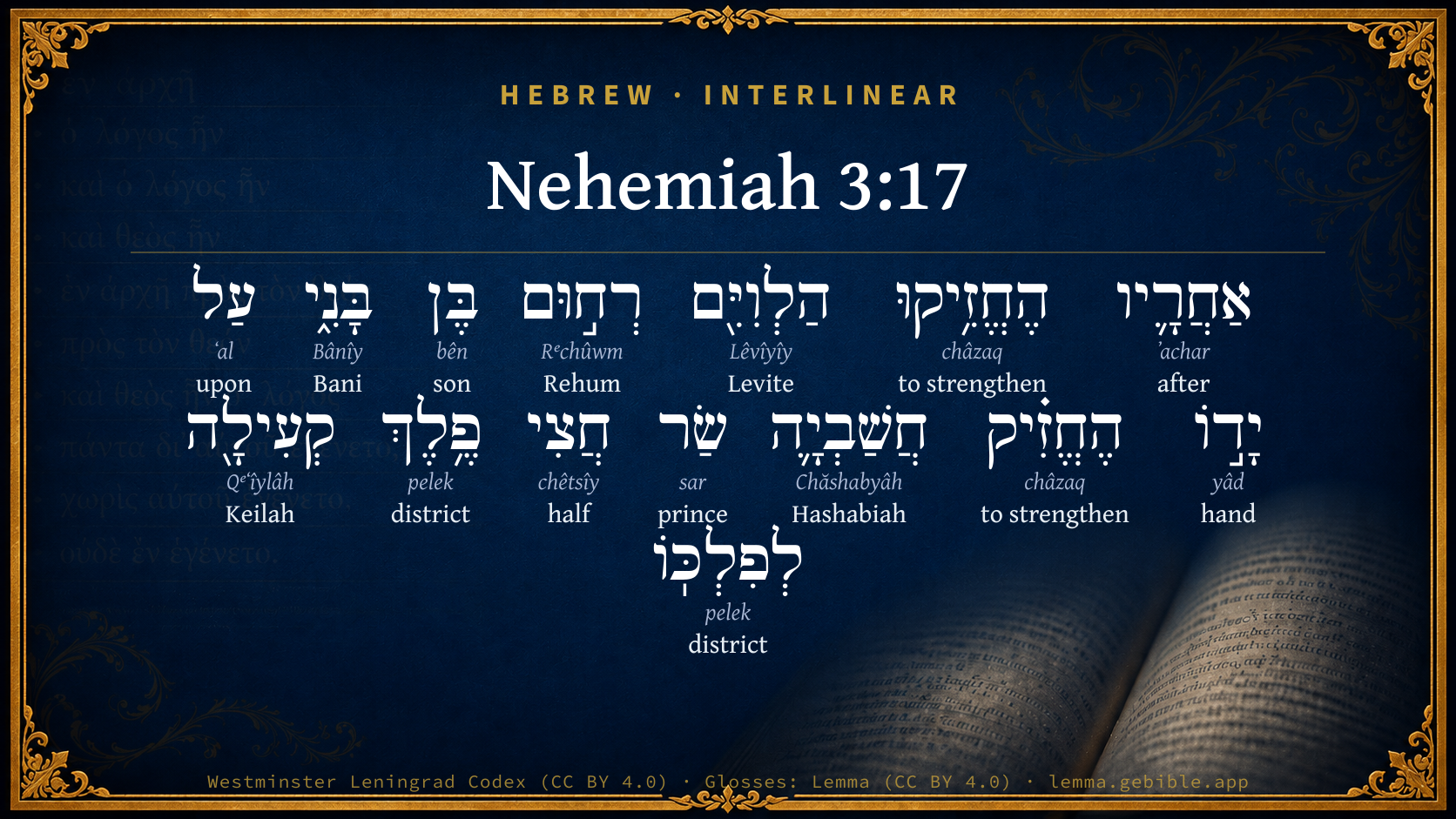
Nehemiah 3:17

Hebrew (Westminster Leningrad Codex) Nehemiah 3:17 appears in the Hebrew Old Testament. The text above is from the Westminster Leningrad Codex. Each word links to its Strong’s number, a concise gloss, and parsing drawn from the Open Scriptures Hebrew Bible morphology. Click any word for its full Brown-Driver-Briggs (BDB) entry.
Download image
Cite this verse

Nehemiah 3:17 (World English Bible). Public Domain. Lemma interlinear Bible study tool, https://lemma.gebible.app/v/nehemiah/3/17.

Show BibTeX & RIS
BibTeX
RIS
English Translation
After him repaired the Levites, Rehum the son of Bani. Next to him repaired Hashabiah, the ruler of half the district of Keilah, for his district.
World English Bible · Public Domain
Download a study sheet

One document with this verse’s original text, its word-by-word gloss line, the meaning frame, cross-references with their text, attributed commentary, and full source and license credits — printable, and it pastes into notes with its structure intact.

This verse Autodidact and up

Study sheet (.html) Plain text (.txt)

A passage Seminary Student

Up to 50 verses in one chapter. A passage sheet keeps up to 6 commentary sources and 12 cross-references per verse, in the order this page ranks them, and says so on the sheet whenever that leaves anything out. Ask for a single verse and you get the Autodidact verse sheet above.

Everything on this page stays free to read, with no account — the sheet is a download of what is already on screen, not access to it.

Want to remove ads? Support Godless Engineer
Compare translations 3

The same verse in 3 English versions, stacked beneath the original-language interlinear above. Click any original word for its lexicon entry.

Each is an independent rendering of the whole verse — the interlinear is not word-aligned to these translations.

Highlighted words mark where these versions differ — a whole-verse word diff, not a word-by-word alignment.

  • World English Bible Public Domain
    After him repaired the Levites, Rehum the son of Bani. Next to him repaired Hashabiah, the ruler of half the district of Keilah, for his district.
  • King James Version Public Domain
    After him repaired the Levites, Rehum the son of Bani. Next unto him repaired Hashabiah, the ruler of the half part of Keilah, in his part.
  • unfoldingWord Literal Text CC BY-SA 4.0
    After him, the Levites strengthened: Rehum the son of Bani; at his hand, Hashabiah, the administrator for half of the district of Keilah, strengthened for his district;

unfoldingWord Literal Text — © unfoldingWord, licensed CC BY-SA 4.0. Word-aligned USFM3 via Door43 (git.door43.org/unfoldingWord/en_ult).

Versions to compare (up to 4)

3 of 4 selected

Show all 18 translations

Every available English version of this verse, each an independent rendering of the whole verse.

  • World English Bible Public Domain
    After him repaired the Levites, Rehum the son of Bani. Next to him repaired Hashabiah, the ruler of half the district of Keilah, for his district.
  • Berean Standard Bible Public Domain
    Next to him, the Levites made repairs under Rehum son of Bani, and next to him, Hashabiah, ruler of a half-district of Keilah, made repairs for his district.
  • Majority Standard Bible Public Domain
    Next to him, the Levites made repairs under Rehum son of Bani, and next to him, Hashabiah, ruler of a half-district of Keilah, made repairs for his district.
  • King James Version Public Domain
    After him repaired the Levites, Rehum the son of Bani. Next unto him repaired Hashabiah, the ruler of the half part of Keilah, in his part.
  • American Standard Version (1901) Public Domain
    After him repaired the Levites, Rehum the son of Bani. Next unto him repaired Hashabiah, the ruler of half the district of Keilah, for his district.
  • Revised Version (1885) Public Domain
    After him repaired the Levites, Rehum the son of Bani. Next unto him repaired Hashabiah, the ruler of half the district of Keilah, for his district.
  • Geneva Bible (1599) Public Domain
    After him fortified the Leuites, Rehum the sonne of Bani, and next vnto him fortified Hashabiah the ruler of the halfe part of Keilah in his quarter.
  • Douay-Rheims (1899) Public Domain
    After him built the Levites, Rehum the son of Benni. After him built Hasebias, lord of half the street of Ceila in his own street.
  • Young's Literal Translation Public Domain
    After him have the Levites strengthened, `and' Rehum son of Bani: by his hand hath Hashabiah, head of the half of the district of Keilah, strengthened, for his district.
  • Literal Standard Version CC BY-SA 4.0
    After him the Levites have strengthened, [and] Rehum son of Bani; by his hand Hashabiah, head of the half of the district of Keilah, has strengthened for his district.
  • Unlocked Literal Bible CC BY-SA 4.0
    After him the Levites repaired, including Rehum son of Bani and next to him, Hashabiah, the ruler of half the district of Keilah, for his district.
  • unfoldingWord Literal Text CC BY-SA 4.0
    After him, the Levites strengthened: Rehum the son of Bani; at his hand, Hashabiah, the administrator for half of the district of Keilah, strengthened for his district;
  • Darby Bible Public Domain
    After him repaired the Levites, Rehum the son of Bani. Next to him repaired Hashabiah, the chief of the half district of Keilah, for his district.
  • World Messianic Bible Public Domain
    After him, the Levites—Rehum the son of Bani made repairs. Next to him, Hashabiah, the ruler of half the district of Keilah, made repairs for his district.
  • Webster's Bible Public Domain
    After him repaired the Levites Rehum the son of Bani. Next to him repaired Hashabiah the ruler of the half part of Keilah, in his part.
  • Free Bible Version CC BY-SA 4.0
    Next were the Levites under Rehum son of Bani, and next was Hashabiah, ruler of Keilah half-district, who made repairs on behalf of his district.
  • Bible in Basic English Public Domain
    Then came the Levites, Rehum, the son of Bani. By his side was working Hashabiah, ruler of half the division of Keilah, for his division.
  • JPS Tanakh (1917) Public Domain
    After him repaired the Levites, Rehum the son of Bani. Next unto him repaired Hashabiah, the ruler of half the district of Keilah, for his district.

Literal Standard Version (2020), Covenant Press — licensed CC BY-SA 4.0. Text via the HelloAO Bible API (eBible.org). Unlocked Literal Bible (unfoldingWord) — licensed CC BY-SA 4.0. Text via the HelloAO Bible API (eBible.org). unfoldingWord Literal Text — © unfoldingWord, licensed CC BY-SA 4.0. Word-aligned USFM3 via Door43 (git.door43.org/unfoldingWord/en_ult). Free Bible Version, Dr. Jonathan Gallagher — licensed CC BY-SA 4.0. Text via the HelloAO Bible API (eBible.org).

Word by word

More ways to search: Search by grammar → Find every occurrence → Compare this word →

Practice this passage: Drill this verse → Learn its vocabulary →

רְח֣וּם
Rᵉchûwm
H7348
“Rehum”
Noun, Proper
Part of Speech
Noun
Type
Proper
Full BDB Definition

Origin: a form of H7349

TWOT: None

Rehum = "compassion" - an man who returned from exile with Zerubbabel - also 'Nehum' - a commander who wrote a letter to the king Artaxerxes in which he opposed the rebuilding of Jerusalem - a Levite of the family of Bani who assisted in rebuilding the walls of Jerusalem - one of the chiefs of the people who sealed the covenant with Nehemiah - a priest who returned from exile with Zerubbabel
  1. אַחֲרָ֛יו ʼachar H310 “after · him” Preposition + Suffix, Personal, 3rd Person, Masculine, Singular
  2. הֶחֱזִ֥יקוּ châzaq H2388 “to strengthen” Verb, Hiphil, Perfect, 3rd Person, Common, Plural
  3. הַלְוִיִּ֖ם Lêvîyîy H3881 “the · Levites” Particle, Definite Article + Noun, Gentilic, Masculine, Plural, Absolute
  4. בֶּן bên H1121 “son of” Noun, Common, Masculine, Singular, Construct
  5. בָּנִ֑י Bânîy H1137 “Bani” Noun, Proper
  6. עַל ʻal H5921 “upon” Preposition
  7. יָד֣וֹ yâd H3027 “hand · his” Noun, Common, Both, Singular, Construct + Suffix, Personal, 3rd Person, Masculine, Singular
  8. הֶחֱזִ֗יק châzaq H2388 “to strengthen” Verb, Hiphil, Perfect, 3rd Person, Masculine, Singular
  9. חֲשַׁבְיָ֛ה Chăshabyâh H2811 “Hashabiah” Noun, Proper
  10. שַׂר sar H8269 “prince of” Noun, Common, Masculine, Singular, Construct
  11. חֲצִי chêtsîy H2677 “half of” Noun, Common, Masculine, Singular, Construct
  12. פֶ֥לֶךְ pelek H6418 “district of” Noun, Common, Masculine, Singular, Construct
  13. קְעִילָ֖ה Qᵉʻîylâh H7084 “Keilah” Noun, Proper
  14. לְפִלְכּֽוֹ pelek H6418 “to/for · district · his” Preposition + Noun, Common, Masculine, Singular, Construct + Suffix, Personal, 3rd Person, Masculine, Singular

About this verse

These counts appear in no published source. They are computed here, from the morphology-tagged text and Lemma’s own curated glosses. What Lemma adds →

15
words
13
distinct lemmas
Historical
section

Notable vocabulary

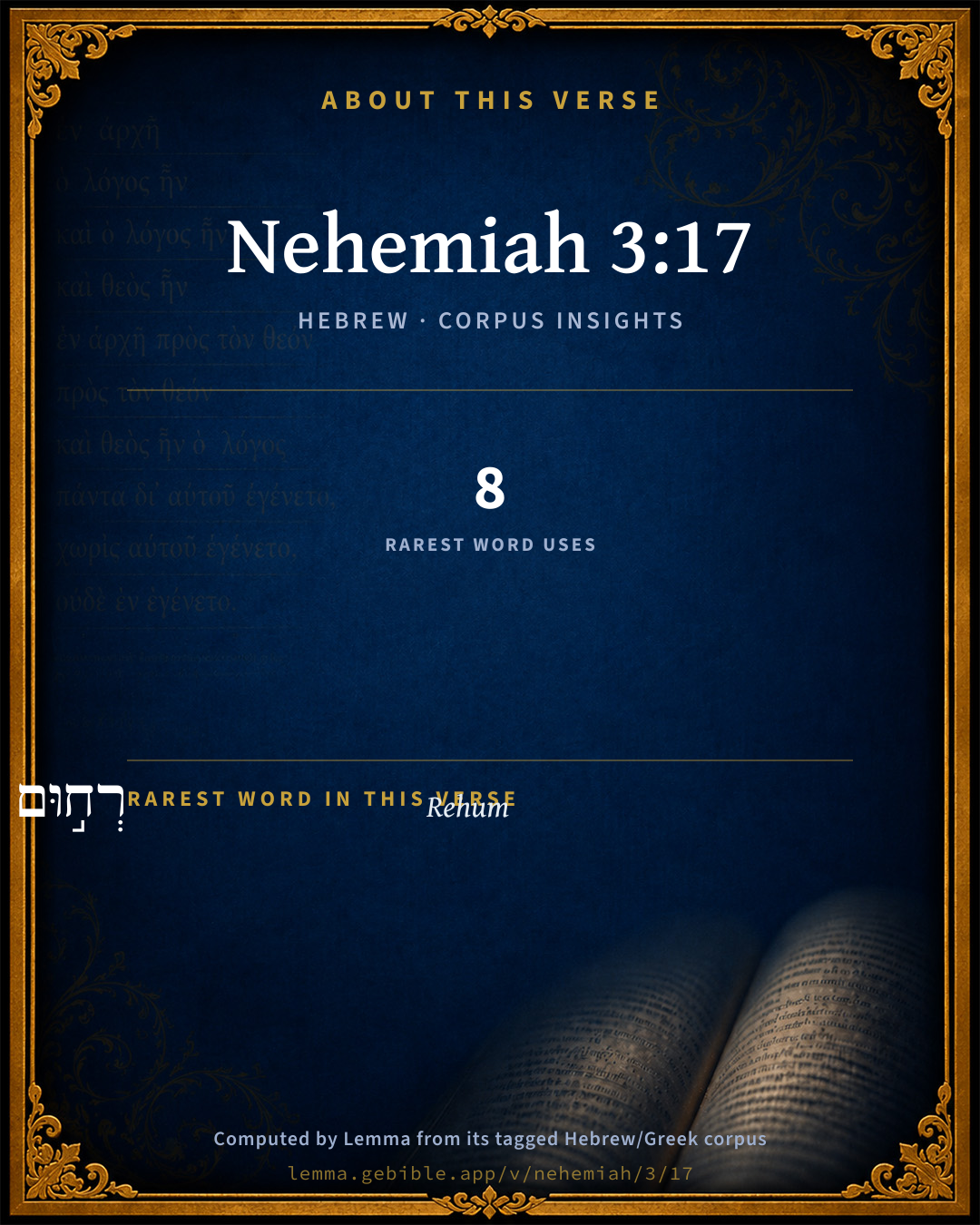
The rarest word here is רְח֣וּם Rehum H7348 — appearing just 8 times in the whole Hebrew Bible.

Shared distinctive vocabulary

רְח֣וּם Rehum H7348 occurs in 8 verses of the Hebrew Bible. Also found in:

Grammatical profile

  • 2 verbs
  • 11 nouns
  • 2 prepositions

Verb forms

  • הֶחֱזִ֥יקוּ Hiphil · Perfect
  • הֶחֱזִ֗יק Hiphil · Perfect

Repetition

Words recur within this verse — often emphatic in Hebrew:

  • הֶחֱזִ֥יקוּ to strengthen H2388 ×2
  • פֶ֥לֶךְ district H6418 ×2

Cross-references

4

Topical passages linked to Nehemiah 3:17 in the Treasury of Scripture Knowledge — connected by theme and wording, ordered by reader-vote popularity; previews shown in the World English Bible.

  • Joshua 15:44 and Keilah, and Achzib, and Mareshah; nine cities with their villages.
  • 1 Samuel 23:1–13 They told David, saying, Behold, the Philistines are fighting against Keilah, and are robbing the threshing floors.
  • 1 Chronicles 23:4 Of these, twenty-four thousand were to oversee the work of the house of Yahweh; and six thousand were officers and judges;
  • Nehemiah 3:16 After him repaired Nehemiah the son of Azbuk, the ruler of half the district of Beth Zur, to the place over against the tombs of David, and to the pool that was made, and to the house of the mighty men.

Cross-references courtesy of OpenBible.info (CC BY 4.0).

Hebrew and Greek witnesses Masoretic Hebrew ↔ Greek Septuagint

The same verse in the two great witnesses to the Old Testament, shown verse-for-verse.

These are two independent witnesses, not word-aligned to each other, and the Septuagint is shown in lemma (dictionary) form.

Hebrew Nehemiah 3:17 Masoretic · Westminster Leningrad Codex

אַחֲרָ֛יו הֶחֱזִ֥יקוּ הַלְוִיִּ֖ם רְח֣וּם בֶּן בָּנִ֑י עַל יָד֣וֹ הֶחֱזִ֗יק חֲשַׁבְיָ֛ה שַׂר חֲצִי פֶ֥לֶךְ קְעִילָ֖ה לְפִלְכּֽוֹ

After him repaired the Levites, Rehum the son of Bani. Next to him repaired Hashabiah, the ruler of half the district of Keilah, for his district.

World English Bible · Public Domain

Greek LXX Structure differs

The Septuagint has no separate book of Nehemiah. Its Greek text is the second half of Esdras B (2 Esdras), chapters 11–23; Ezra is the first half (1–10).

A verse-for-verse comparison isn’t shown here because the chapters and verses don’t line up. Switch to the LXX edition with the MT / LXX toggle above to read the Greek directly.

Hebrew: Westminster Leningrad Codex (CC BY 4.0). Greek: Septuagint (public domain); English from a public-domain English Septuagint. How the Septuagint differs from the Hebrew →

Commentary

Notes on Nehemiah 3:17 from classic Christian and Jewish commentators (each source and its license shown beneath its notes). The classic Christian expositions comment on the surrounding passage and are grouped to its opening verse, so a note may address several verses; the Jewish commentaries on the Tanakh (Rashi and others) are per-verse, so they appear only where the commentator wrote on this verse.

Lemma curates 59 commentaries, every one of them public domain or Creative Commons licensed, each selected and text-cleaned for this edition rather than reprinted as found. About our sources →

Trapp's Complete Commentary

John Trapp

Neh 3:17 After him repaired the Levites, Rehum the son of Bani. Next unto him repaired Hashabiah, the ruler of the half part of Keilah, in his part.

Ver. 17. After him repaired the Levites] Who therefore were not beggarly (as many would make ministers in our days, if they might have their will), but had somewhat to spare for pious uses. For when they are said to repair, the meaning is, they bore the charge of the work, and took care that it was done.

John Trapp, A Commentary or Exposition upon All the Books of the Old and New Testament (1647–1656) — public domain. Text from a community e-Sword module.

Ellicott's Commentary for English Readers

(17) The Levites.—The circuit is coming round to the Temple.

Rehum the son of Bani.—The Levites were under him as a body.

In his part.—The other part of the Keilah district (now Kila) is in the next verse.

A Bible Commentary for English Readers, edited by Charles John Ellicott (1878–1897) — public domain. Text from a community e-Sword module.

The Cambridge Bible for Schools and Colleges

gen. ed. J. J. S. Perowne

17. the Levites, Rehum the son of Bani] Here it may be noticed that the community is mentioned first, its representative afterwards. This variation from the usage in Neh_3:7-8 is perhaps intended to give prominence to the work of the Levites or of a particular band of them.

Rehum, whose name is the same as that of one of the chief colleagues of Zerubbabel at the Return from Exile (Ezr_2:2), is perhaps to be identified with the Rehum in Neh_10:25. Bani is mentioned in Neh_9:5.

the ruler of the half part of Keilah] R.V. the ruler of half the district of Keilah. This is in all probability to be identified with the Keilah of Jos_15:44; 1Sa_23:1, a town about 15 miles S. W. of Jerusalem.

in his part] R.V. for his part, i.e. for the district which he represented, in distinction from the district mentioned in the verse following.

The Cambridge Bible for Schools and Colleges (gen. ed. J. J. S. Perowne; Cambridge University Press, 1878–1918) — public domain. Text from a community e-Sword module.

John Gill's Exposition

After him repaired their brethren,.... Either the brethren of the two before named particularly, or the Levites their brethren in general, as Jarchi:

Bavai, the son of Henadad, the ruler of the half part of Keilah; the other half of that place.

John Gill's Exposition of the Whole Bible (1746–1763) — public domain (CC PDM 1.0). Text via the HelloAO Bible API.

Albert Barnes' Notes on the Bible

The constant mention of “priests,” “Levites,” and Nethinims,” sufficiently indicates that the writer is here concerned with the sacerdotal quarter, that immediately about the temple.

Neh 3:18

Bavai - Or, “Binnui” Neh 3:24; Neh 10:9.

The armoury at the turning of the wall - literally, “the armoury of the corner.” The northwestern corner of the special wall of the “city of David” seems to be intended. See Neh 3:1 note.

Neh 3:20

The other piece - Rather, “another piece.” The notice of Baruch’s first piece, like that of Malchijah’s and Hashub’s Neh 3:11, seems to have slipped out of the text.

Neh 3:22

The word here translated “plain” is applied in the rest of Scripture almost exclusively to the Ghor or Jordan valley. Compare, however, Neh 12:28.

Neh 3:24

The turning of the wall - The northeastern angle of the “city of David” seems here to be reached. At this point a tower “lay out” Neh 3:25, or projected extraordinarily, from the wall, being probably a watch-tower commanding the Kidron valley and all the approaches to the city from the southeast, the east, and the northeast.

Neh 3:25

The “king’s high house” is almost certainly the old palace of David, which was on the temple hill, and probably occupied a position directly north of the temple.

That was by the court of the prison - Prisons were in old times adjuncts of palaces. The palace of David must have had its prison; and the “prison gate” Neh 12:39 was clearly in this quarter.

Neh 3:26

The marginal reading is better. On the Nethinims see 1Ch 9:2 note.

Ophel was the slope south of the temple (see the marginal reference “y” note); and the water-gate, a gate in the eastern wall, either for the escape of the superfluous water from the temple reservoirs, or for the introduction of water from the Kidron valley when the reservoirs were low.

Neh 3:27

The foundations of an outlying tower near the southeast angle of the temple area in this position have been recently discovered.

Neh 3:28

“The horse gate” was on the east side of the city, overlooking the Kidron valley. It seems to have been a gate by which horses approached and left the old palace, that of David, which lay north of the temple Neh 3:25.

Albert Barnes' Notes on the Bible (1834–1885) — public domain. Text from a community e-Sword/MySword module.

Haydock's Catholic Bible Commentary

Ceila, in the tribe of Juda. He inspected the workmen from this place.

George Leo Haydock (1774–1849), Haydock's Catholic Family Bible and Commentary, 1859 edition — public domain. Excludes Psalms (Douay-Rheims chapter numbering differs from Protestant) and Deuterocanonical books (Catholic canon only).

Whedon's Commentary on the Bible

Daniel D. Whedon

17. Keilah — Situated about five miles northwest of Hebron, and some fifteen southwest of Jerusalem. See Jos_15:44; 1Sa_23:1.

In his part — That is, for his district. He represented the part of Keilah which he governed, just as Bavai represented, as mentioned in the next verse, the other half of Keilah.

Daniel D. Whedon (gen. ed.), Commentary on the Old and New Testaments (1874–1909) — public domain. Text from a community e-Sword module.

The Pulpit Commentary

The ruler of the half part of Keilah. Rather, "ruler of one-half of the region of K." The district within which Keilah stood was divided into two parts, one of which was under Hashabiah and the other under Bavai (ver. 18). Both took part in the work of restoration, and the two working-parties were assigned adjacent portions of the wall In his part; Rather, "for his partpro tractu suo, as Rambach renders.

The Pulpit Commentary (1880–1919), ed. H.D.M. Spence-Jones & Joseph S. Exell — public domain. Text from a community e-Sword module.

Rashi

Rabbi Shlomo Yitzchaki (Rashi)

half the district From that bailiwick, the half district, he built this structure. In the word לְפִּלְכּוֹ, the “kaff” has a “dagesh,” as one says from מֶלֶךְ, מַלְכּוֹ, from עֶבֶד, עַבְדוֹ, so does one say from פֶּלֶךְ, פִּלְכּוֹ, for [if] the last letter of the noun is one of the letters “beth,” “gimmel,” “daleth,” “kaff,” “pey,” or “tav,” it is punctuated with a “dagesh.”

Rashi on the Tanakh — English translations: “The Judaica Press complete Tanach with Rashi, translated by A. J. Rosenberg” (CC BY 4.0); “Pentateuch with Rashi's commentary by M. Rosenbaum and A.M. Silbermann, 1929-1934” (public domain); “The Metsudah Tanach series, Lakewood, N.J” (CC BY 4.0); and “The Book of Joshua, Metsudah Publications, 1997” (CC BY 4.0). Text via Sefaria.

Lesson kit

Teaching starters — assembled from the data on this page, not authored interpretation. Every prompt links to the verse data it draws on. Edit before teaching.

Nehemiah, in the Historical, opens this verse with 15 words (13 distinct Hebrew lemmas). Its most distinctive word is Rᵉchûwm (“Rehum”). A historical commentator’s framing appears above. Read the whole chapter for the surrounding context.

Discussion questions

  1. How does “Rehum” (Rᵉchûwm) shape what this verse is saying?
  2. Ezra 2:2 shares the word «Rehum» with this verse. How do the two illuminate each other?
  3. “to strengthen” occurs 2× in this one verse. What is the effect of the repetition?
  4. These translations render this verse differently; the difference is in the English rendering, not the original. What questions does that raise?
  5. The verb «הֶחֱזִ֥יקוּ» is Hiphil Perfect. How does its form color the action?
  6. Reading how Trapp's Complete Commentary and Ellicott's Commentary for English Readers read this verse, where do the two commentators agree and where do they part?

Things to notice

  • These translations choose different wording for 8 words in this verse.
  • “to strengthen” occurs 2× in this single verse.
  • 13 distinct Hebrew lemmas span 15 words in this verse.

Reading settings

Reading text

Shown beneath each verse's original-language words.

Old Testament
Old Testament edition

Read the OT as the Masoretic Hebrew (MT) or the Greek Septuagint (LXX).

English shown for the Greek Septuagint (in the Hebrew ↔ Greek comparison).

Comparing translations? Open the Compare panel on any verse page to stack up to four side by side.