

Nehemiah 3:20

Hebrew (Westminster Leningrad Codex) Nehemiah 3:20 appears in the Hebrew Old Testament. The text above is from the Westminster Leningrad Codex. Each word links to its Strong’s number, a concise gloss, and parsing drawn from the Open Scriptures Hebrew Bible morphology. Click any word for its full Brown-Driver-Briggs (BDB) entry.
Download image
Cite this verse

Nehemiah 3:20 (World English Bible). Public Domain. Lemma interlinear Bible study tool, https://lemma.gebible.app/v/nehemiah/3/20.

Show BibTeX & RIS
BibTeX
RIS
English Translation
After him Baruch the son of Zabbai earnestly repaired another portion, from the turning [of the wall] to the door of the house of Eliashib the high priest.
World English Bible · Public Domain
Highlights
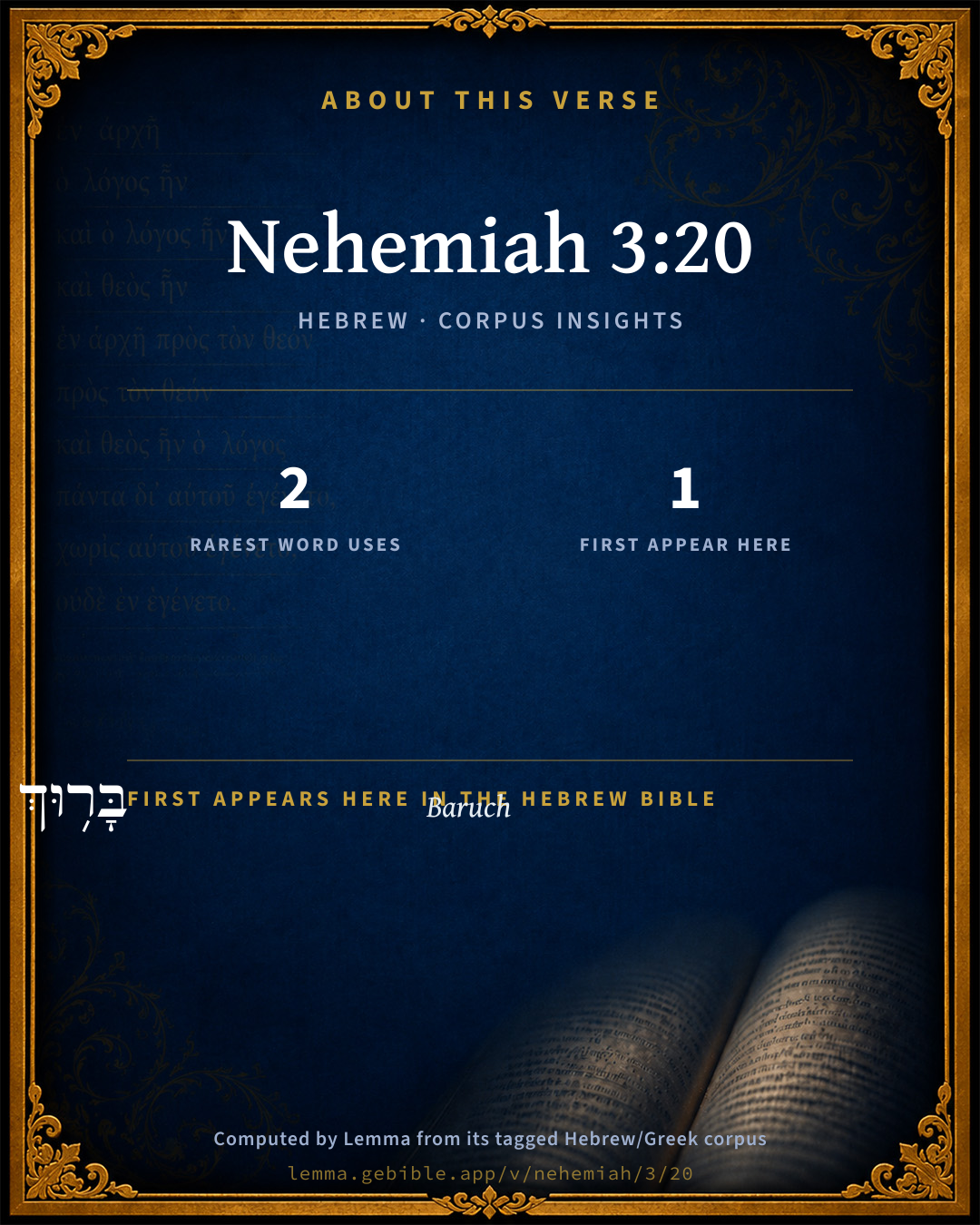
  • 1 first appearance in the Hebrew Bible
Full analysis ↓
Download a study sheet

One document with this verse’s original text, its word-by-word gloss line, the meaning frame, cross-references with their text, attributed commentary, and full source and license credits — printable, and it pastes into notes with its structure intact.

This verse Autodidact and up

Study sheet (.html) Plain text (.txt)

A passage Seminary Student

Up to 50 verses in one chapter. A passage sheet keeps up to 6 commentary sources and 12 cross-references per verse, in the order this page ranks them, and says so on the sheet whenever that leaves anything out. Ask for a single verse and you get the Autodidact verse sheet above.

Everything on this page stays free to read, with no account — the sheet is a download of what is already on screen, not access to it.

Want to remove ads? Support Godless Engineer
Compare translations 3

The same verse in 3 English versions, stacked beneath the original-language interlinear above. Click any original word for its lexicon entry.

Each is an independent rendering of the whole verse — the interlinear is not word-aligned to these translations.

Highlighted words mark where these versions differ — a whole-verse word diff, not a word-by-word alignment.

  • World English Bible Public Domain
    After him Baruch the son of Zabbai earnestly repaired another portion, from the turning [of the wall] to the door of the house of Eliashib the high priest.
  • King James Version Public Domain
    After him Baruch the son of Zabbai earnestly repaired the other piece, from the turning of the wall unto the door of the house of Eliashib the high priest.
  • unfoldingWord Literal Text CC BY-SA 4.0
    After him, Baruch the son of Zabbai burned, and strengthened a second section from the angle as far as the opening of the house of Eliashib the high priest.

unfoldingWord Literal Text — © unfoldingWord, licensed CC BY-SA 4.0. Word-aligned USFM3 via Door43 (git.door43.org/unfoldingWord/en_ult).

Versions to compare (up to 4)

3 of 4 selected

Show all 18 translations

Every available English version of this verse, each an independent rendering of the whole verse.

  • World English Bible Public Domain
    After him Baruch the son of Zabbai earnestly repaired another portion, from the turning [of the wall] to the door of the house of Eliashib the high priest.
  • Berean Standard Bible Public Domain
    Next to him, Baruch son of Zabbai diligently repaired another section, from the angle to the doorway of the house of Eliashib the high priest.
  • Majority Standard Bible Public Domain
    Next to him, Baruch son of Zabbai diligently repaired another section, from the angle to the doorway of the house of Eliashib the high priest.
  • King James Version Public Domain
    After him Baruch the son of Zabbai earnestly repaired the other piece, from the turning of the wall unto the door of the house of Eliashib the high priest.
  • American Standard Version (1901) Public Domain
    After him Baruch the son of Zabbai earnestly repaired another portion, from the turning `of the wall' unto the door of the house of Eliashib the high priest.
  • Revised Version (1885) Public Domain
    After him Baruch the son of Zabbai earnestly repaired another portion, from the turning of the wall unto the door of the house of Eliashib the high priest.
  • Geneva Bible (1599) Public Domain
    After him was earnest Baruch the sonne of Zacchai, and fortified another portion from the corner vnto the doore of the house of Eliashib the hie Priest.
  • Douay-Rheims (1899) Public Domain
    After him in the mount Baruch the son of Zachai built another measure, from the corner to the door of the house of Eliasib the high priest.
  • Young's Literal Translation Public Domain
    After him hath Baruch son of Zabbai hastened to strengthen a second measure from the angle unto the opening of the house of Eliashib the high priest.
  • Literal Standard Version CC BY-SA 4.0
    After him Baruch son of Zabbai has hurried to strengthen a second measure from the angle to the opening of the house of Eliashib the high priest.
  • Unlocked Literal Bible CC BY-SA 4.0
    After him Baruch son of Zabbai devotedly repaired another section, from the corner of the wall to the door of the house of Eliashib the high priest.
  • unfoldingWord Literal Text CC BY-SA 4.0
    After him, Baruch the son of Zabbai burned, and strengthened a second section from the angle as far as the opening of the house of Eliashib the high priest.
  • Darby Bible Public Domain
    After him Baruch the son of Zabbai earnestly repaired another piece, from the angle to the entry of the house of Eliashib the high priest.
  • World Messianic Bible Public Domain
    After him, Baruch the son of Zabbai earnestly repaired another portion, from the turning of the wall to the door of the house of Eliashib the high priest.
  • Webster's Bible Public Domain
    After him Baruch the son of Zabbai, earnestly repaired the other piece, from the turning of the wall to the door of the house of Eliashib the high priest.
  • Free Bible Version CC BY-SA 4.0
    Next was Baruch, son of Zabbai, who worked hard repairing another section, from where the wall turns to the entrance of Eliashib the high priest's house.
  • Bible in Basic English Public Domain
    After him Baruch, the son of Zabbai, was hard at work on another part, from the turning of the wall to the door of the house of Eliashib, the chief priest.
  • JPS Tanakh (1917) Public Domain
    After him Baruch the son of Zaccai earnestly repaired another portion, from the Turning unto the door of the house of Eliashib the high priest.

Literal Standard Version (2020), Covenant Press — licensed CC BY-SA 4.0. Text via the HelloAO Bible API (eBible.org). Unlocked Literal Bible (unfoldingWord) — licensed CC BY-SA 4.0. Text via the HelloAO Bible API (eBible.org). unfoldingWord Literal Text — © unfoldingWord, licensed CC BY-SA 4.0. Word-aligned USFM3 via Door43 (git.door43.org/unfoldingWord/en_ult). Free Bible Version, Dr. Jonathan Gallagher — licensed CC BY-SA 4.0. Text via the HelloAO Bible API (eBible.org).

Word by word

More ways to search: Search by grammar → Find every occurrence → Compare this word →

Practice this passage: Drill this verse → Learn its vocabulary →

זבי
Zabbay
H2079
“Zabbai”
Noun, Proper
Part of Speech
Noun
Type
Proper
Full BDB Definition

Origin: probably by orthographical error for H2140

TWOT: None

Zabbai = "pure" - a descendant of Bebai who took a foreign wife in the days of Ezra - father of Baruch, who assisted Nehemiah in rebuilding the city wall
  1. אַחֲרָ֨יו ʼachar H310 “after · him” Preposition + Suffix, Personal, 3rd Person, Masculine, Singular
  2. הֶחֱרָ֧ה chârâh H2734 “to be angry” Verb, Hiphil, Perfect, 3rd Person, Masculine, Singular
  3. הֶחֱזִ֛יק châzaq H2388 “to strengthen” Verb, Hiphil, Perfect, 3rd Person, Masculine, Singular
  4. בָּר֥וּךְ Bârûwk H1263 “Baruch” Noun, Proper
  5. בֶּן bên H1121 “son of” Noun, Common, Masculine, Singular, Construct
  6. זַכַּ֖י Zakkay H2140 “Zaccai” Noun, Proper
  7. מִדָּ֣ה middâh H4060 “measure” Noun, Common, Feminine, Singular, Absolute
  8. שֵׁנִ֑ית shênîy H8145 “second” Adjective, Ordinal number, Feminine, Singular, Absolute
  9. מִן min H4480 “from” Preposition
  10. הַ֨מִּקְצ֔וֹעַ maqtsôwaʻ H4740 “the · corner” Particle, Definite Article + Noun, Common, Masculine, Singular, Absolute
  11. עַד ʻad H5704 “until” Preposition
  12. פֶּ֨תַח֙ pethach H6607 “doorway of” Noun, Common, Masculine, Singular, Construct
  13. בֵּ֣ית bayith H1004 “house of” Noun, Common, Masculine, Singular, Construct
  14. אֶלְיָשִׁ֔יב ʼElyâshîyb H475 “Eliashib” Noun, Proper
  15. הַכֹּהֵ֖ן kôhên H3548 “the · priest” Particle, Definite Article + Noun, Common, Masculine, Singular, Absolute
  16. הַגָּדֽוֹל gâdôwl H1419 “the · great” Particle, Definite Article + Adjective, Adjective, Masculine, Singular, Absolute

About this verse

These counts appear in no published source. They are computed here, from the morphology-tagged text and Lemma’s own curated glosses. What Lemma adds →

17
words
17
distinct lemmas
Historical
section

Notable vocabulary

The rarest word here is זבי Zabbai H2079 — appearing just 2 times in the whole Hebrew Bible.

First appearance in Scripture

This word makes its first canonical appearance in the Hebrew Bible here:

  • בָּר֥וּךְ Baruch H1263

Shared distinctive vocabulary

זבי Zabbai H2079 occurs in 2 verses of the Hebrew Bible. Also found in:

Grammatical profile

  • 2 verbs
  • 10 nouns
  • 2 adjectives
  • 3 prepositions

Verb forms

  • הֶחֱרָ֧ה Hiphil · Perfect
  • הֶחֱזִ֛יק Hiphil · Perfect

Cross-references

7

Topical passages linked to Nehemiah 3:20 in the Treasury of Scripture Knowledge — connected by theme and wording, ordered by reader-vote popularity; previews shown in the World English Bible.

  • Nehemiah 3:1 Then Eliashib the high priest rose up with his brothers the priests, and they built the sheep gate; they sanctified it, and set up the doors of it; even to the tower of Hammeah they sanctified it, to the tower of Hananel.
  • Ecclesiastes 9:10 Whatever your hand finds to do, do it with your might; for there is no work, nor device, nor knowledge, nor wisdom, in Sheol, where you are going.
  • Romans 12:11 not lagging in diligence; fervent in spirit; serving the Lord;
  • Nehemiah 3:21 After him repaired Meremoth the son of Uriah the son of Hakkoz another portion, from the door of the house of Eliashib even to the end of the house of Eliashib.
  • Nehemiah 12:22–23 As for the Levites, in the days of Eliashib, Joiada, and Johanan, and Jaddua, there were recorded the heads of fathers' [houses]; also the priests, in the reign of Darius the Persian.
  • Nehemiah 13:4 Now before this, Eliashib the priest, who was appointed over the chambers of the house of our God, being allied to Tobiah,
  • Nehemiah 13:28 One of the sons of Joiada, the son of Eliashib the high priest, was son-in-law to Sanballat the Horonite: therefore I chased him from me.

Cross-references courtesy of OpenBible.info (CC BY 4.0).

Hebrew and Greek witnesses Masoretic Hebrew ↔ Greek Septuagint

The same verse in the two great witnesses to the Old Testament, shown verse-for-verse.

These are two independent witnesses, not word-aligned to each other, and the Septuagint is shown in lemma (dictionary) form.

Hebrew Nehemiah 3:20 Masoretic · Westminster Leningrad Codex

אַחֲרָ֨יו הֶחֱרָ֧ה הֶחֱזִ֛יק בָּר֥וּךְ בֶּן זבי זַכַּ֖י מִדָּ֣ה שֵׁנִ֑ית מִן הַ֨מִּקְצ֔וֹעַ עַד פֶּ֨תַח֙ בֵּ֣ית אֶלְיָשִׁ֔יב הַכֹּהֵ֖ן הַגָּדֽוֹל

After him Baruch the son of Zabbai earnestly repaired another portion, from the turning [of the wall] to the door of the house of Eliashib the high priest.

World English Bible · Public Domain

Greek LXX Structure differs

The Septuagint has no separate book of Nehemiah. Its Greek text is the second half of Esdras B (2 Esdras), chapters 11–23; Ezra is the first half (1–10).

A verse-for-verse comparison isn’t shown here because the chapters and verses don’t line up. Switch to the LXX edition with the MT / LXX toggle above to read the Greek directly.

On this verse, The Cambridge Bible for Schools and Colleges discusses the Septuagint’s reading. Read the note in Commentary ↓

Hebrew: Westminster Leningrad Codex (CC BY 4.0). Greek: Septuagint (public domain); English from a public-domain English Septuagint. How the Septuagint differs from the Hebrew →

Commentary

Notes on Nehemiah 3:20 from classic Christian and Jewish commentators (each source and its license shown beneath its notes). The classic Christian expositions comment on the surrounding passage and are grouped to its opening verse, so a note may address several verses; the Jewish commentaries on the Tanakh (Rashi and others) are per-verse, so they appear only where the commentator wrote on this verse.

Lemma curates 59 commentaries, every one of them public domain or Creative Commons licensed, each selected and text-cleaned for this edition rather than reprinted as found. About our sources →

Trapp's Complete Commentary

John Trapp

Neh 3:20 After him Baruch the son of Zabbai earnestly repaired the other piece, from the turning [of the wall] unto the door of the house of Eliashib the high priest.

Ver. 20. Earnestly repaired the other piece] Or a second piece, as Neh 3:19. He did two pieces whiles others were about one. A ready heart makes riddance of God’s work. He burst out in a heat (so the Heb.), being angry both at himself and others that had done no more; and, in a holy fume, finished quickly, kindling himself from other men’s coldness, and quickening himself from their slothfulness, Se accendit.

- Sic Caesar in omnia praeceps

Nil actum credens, dum quid superesset agendum,

Fertur atrox - (Lucan).

John Trapp, A Commentary or Exposition upon All the Books of the Old and New Testament (1647–1656) — public domain. Text from a community e-Sword module.

Joseph Benson's Commentary

Neh 3:20. Baruch earnestly repaired the other piece — Did his work with eminent diligence and fervency; which is here noted to his commendation. And, it is probable, this good man’s zeal provoked many to take the more pains, and make the more haste.

Joseph Benson's Commentary on the Old and New Testaments (1811–1818) — public domain. Text from a community e-Sword module.

Keil & Delitzsch

C. F. Keil & F. Delitzsch

The wall from the angle to the place of the court of the prison by the king's upper house. - Neh 3:20 After him Baruch the son of Zabbai emulously repaired a second length of wall, from the angle to the door of the house of Eliashib the high priest. Bertheau objects to the reading החרה, and conjectures that it should be ההרה, "up the hill." But the reason he adduces, viz., that often as the word החזיק occurs in this description, a further definition is nowhere else added to it, speaks as much against, as for his proposed alteration; definitions of locality never, throughout the entire narrative, preceding החזיק, but uniformly standing after it, as also in the present verse. Certainly החרה cannot here mean either to be angry, or to be incensed, but may without difficulty be taken, in the sense of the Tiphal תּחרה, to emulate, to contend (Jer 22:15; Jer 12:5), and the perfect adverbially subordinated to the following verb (comp. Gesen. Gramm. 142, 3, a). The Keri offers זכּי instead of זבּי, probably from Ezr 2:9, but on insufficient grounds, the name זבּי occurring also Ezr 10:28. Of the position of the house of Eliashib the high priest, we know nothing further than what appears from these Ezr 10:20 and Ezr 10:21, viz., that it stood at the northern part of the eastern side of Zion (not at the south-western angle of the temple area, as Bertheau supposes), and extended some considerable distance from south to north, the second length of wall built by Meremoth reaching from the door at its southern end to the תּכלית, termination, at its northern end. On Meremoth, see rem. on Neh 3:4.

Keil & Delitzsch — Biblical Commentary on the Old Testament (1861–1891) — public domain (CC PDM 1.0). Text via the HelloAO Bible API. (Old Testament only.)

Adam Clarke's Commentary

Verse 20. Earnestly repaired] He distinguished himself by his zeal and activity.

Adam Clarke's Commentary on the Bible (1810–1826) — public domain. Text from a community e-Sword/MySword module.

Ellicott's Commentary for English Readers

(20) Earnestly repaired the other piece.—The reason of this man’s emulation in building near the high priest’s house does not appear.

A Bible Commentary for English Readers, edited by Charles John Ellicott (1878–1897) — public domain. Text from a community e-Sword module.

The Cambridge Bible for Schools and Colleges

gen. ed. J. J. S. Perowne

20. Baruch the son of Zabbai] R.V. marg. ‘Another reading is, Zaccai.’ Zabbai (so Ezr_10:28) is the reading of C’thib and LXX., Zaccai of K’ri and Vulg.

earnestly repaired] The word rendered ‘earnestly’ calls for remark. (a) In the original it appears as an unusual causative of a verb meaning ‘to be angry,’ which in this exact form is only elsewhere found in Job_19:11. ‘He hath also kindled his wrath against me. The word occurs also in Jer_12:5 = ‘contend,’ Jer_22:15 = ‘strivest to excel.’ (b) A causative verb in the past tense immediately preceding the finite verb ‘repaired,’ may be idiomatic Hebrew, but is not to be expected in narrative prose. (c) The word ‘repaired’ is found nowhere else in this list with any qualification. If the reading is correct, the word will denote the ardour or the emulous spirit with which Baruch undertook his work.

The same word differently pointed is capable of meaning ‘towards the hill,’ being then the same as that rendered in Gen_14:10 ‘to the mountain.’ This must have been the reading of the Vulgate ‘in monte ædificavit Baruch.’

If this is the right reading, it refers to the summit of the Ophel, where the high-priest’s house would have stood immediately S. of the Temple.

the other piece] R.V. another portion. See note on Neh_3:11. Here these words, as Baruch’s name has not occurred before, suggest the incompleteness of the description.

The Cambridge Bible for Schools and Colleges (gen. ed. J. J. S. Perowne; Cambridge University Press, 1878–1918) — public domain. Text from a community e-Sword module.

John Gill's Exposition

After him repaired Meremoth the son of Uriah, the son of Koz, another piece,.... He had wrought before in another part, Neh 3:4, but having finished that, he sets his hand a second time to the work:

from the door of the house of Eliashib, even to the end of the house of Eliashib; the door of his house seems to have been at one end of it, and from that end to the other was a considerable length; he being a great man, the high priest, had a large house.

John Gill's Exposition of the Whole Bible (1746–1763) — public domain (CC PDM 1.0). Text via the HelloAO Bible API.

Haydock's Catholic Bible Commentary

CHAPTER III.

Mount Sion. (Menochius) --- Hebrew and Septuagint, "earnestly repaired;" (Haydock) being indignant at the negligence of his neighbour, or undertaking his work with zeal. (Calmet)

George Leo Haydock (1774–1849), Haydock's Catholic Family Bible and Commentary, 1859 edition — public domain. Excludes Psalms (Douay-Rheims chapter numbering differs from Protestant) and Deuterocanonical books (Catholic canon only).

Matthew Poole's English Annotations

Earnestly repaired; did his work with eminent diligence and fervency; which is here noted to his commendation.

From the turning of the wall, or, from the corner, as Neh 3:19. Unto the door of the house; unto that part of the wall which was over against or next to this door.

Matthew Poole's English Annotations on the Holy Bible (1683–1685) — public domain. Text from a community e-Sword/MySword module.

Whedon's Commentary on the Bible

Daniel D. Whedon

20. Earnestly repaired — Being filled with holy zeal, he strove to emulate and rival his fellow-builders.

House of Eliashib — This probably adjoined the temple enclosure, and from the next verse would seem to have been of considerable extent.

Daniel D. Whedon (gen. ed.), Commentary on the Old and New Testaments (1874–1909) — public domain. Text from a community e-Sword module.

The Pulpit Commentary

Earnestly repaired. So Gesenius, Pool, and Bertheau. The construction is not free from difficulty, and the reading is somewhat doubtful (the Vulgate "in monte" showing a different one); but on the whole the translation of the A. V. may stand. Baruch has the high honour of being singled out for special praise, as having shown a burning zeal which deserved this recompense. He rapidly accomplished the task first set him, the mention of which must have accidentally fallen out (see the comment on ver. 11), and now undertook a "second piece," which extended from the north-western angle of the inner wall to the door of the high priest"s house. It would seem that this door was in the wall, upon which the house must have abutted (see the next verse).

Earnest work.

"Baruch the son of Zabbal earnestly repaired another piece." It is singular that this word "earnestly" should be used of Baruch and of none else. Perhaps it is a mis-reading. Or quite as likely it alludes to circumstances unknown to us. The word signifies "burning," and is commonly used of anger; here, however, of zeal, or perhaps emulation. Baruch is set before us as "an earnest worker." Such should all Christians be. It is one of the marks of the "peculiar people" of Christ whom he has redeemed by giving himself for them, that they are "zealous of good works". (Tit_2:14) The subject then is earnestness in Christian work.

I WHAT IT IS. Not zeal without knowledge, nor zeal fed by worldly motives, nor the ardour of a bigoted sectarianism, nor yet the warmth of transitory emotion, excited by speech or sermon or passing incident; but a steady flame of pious zeal, springing from Christian knowledge, faith, and love, and sustaining resolute purpose and endeavour. It is the life of God in the soul, in a state of vigour and animation, directed to practical service.

II ITS CAUSES.

1. Ardent gratitude for blessings received. It does not spring from a desire or expectation of earning or deserving salvation by diligent works, but from the experience and hope of salvation freely bestowed, and realisation of the manifold benefits included in it. Its language is, "What shall I render unto the Lord for all his benefits towards me?

2. Love to God and Christ and men. It is love in action; love to God and the Saviour, inciting to obedience and making service a delight; love to men, impelling to the effort to do them good.

3. Contemplation of the condition and prospects of mankind.

4. Faith in the Divine remedies for human sin and misery.

5. The example of others. Of such men as St. Paul. Preeminently of the Lord Jesus Christ, "who went about doing good," and could say, "My meat is to do the will of him that sent me, and to finish his work." The example of known living Christians eminent for zeal has a mighty influence in producing like characters. Earnestness of men in other pursuits.

6. The very indifference and neglect of which some are guilty. Stirring the heart to excusable, if not holy indignation; fear lest the work should suffer in consequence, and determination that it shall not.

7. Anticipation of the final account.

8. Fervent prayer. For pure Christian earnestness, by whatever means excited, is a gift of the Holy Ghost.

III ITS SIGNS AND EFFECTS.

1. Generosity of gift and labour. Not meting these out according to a careful calculation of our share, or of what is "necessary" in order to retain a hope of eternal life, but delighting to do all that is possible.

2. Ready self-denial.

3. Courage in facing difficulty and opposition. Earnestness is slow to believe in impossibility.

4. Thoroughness of work. Doing our best as alone in any sense worthy of the Lord and his work.

5. Constancy and perseverance. Superiority to the influence of bad examples, and all other temptations to remissness in, or abandonment of, the service.

IV ITS BLESSEDNESS.

1. As clear and abiding evidence of true faith and love. Giving "assurance of hope," which without practical and benevolent earnestness is unfounded, if it exist. No strictness of orthodoxy, or raptures of religious emotion, are sufficient without it.

2. As making the Christian"s work happy.

3. As securing the Divine approval and blessing.

4. As insuring success.

5. As anticipating abundant recompense.

The Pulpit Commentary (1880–1919), ed. H.D.M. Spence-Jones & Joseph S. Exell — public domain. Text from a community e-Sword module.

John Wesley's Explanatory Notes

Earnestly - Did his work with eminent diligence and fervency: which is here noted to his commendation. And it is probable, this good man's zeal provoked many, to take the more pains, and make the more haste.

John Wesley, Explanatory Notes Upon the Whole Bible (1754–1765) — public domain. Text via the GEBible commentary corpus.

Kretzmann's Popular Commentary

Paul E. Kretzmann

The Walls of Zion

v. 20. After him Baruch, the son of Zabbai, earnestly repaired the other piece, from the turning of the wall unto the door of the house of Eliashib, the high priest.

v. 21. After him repaired Meremoth, the son of Urijah, the son of Koz, another piece, in addition to that named in verse 4, from the door of the house of Eliashlb, even to the end of the house of Eliashib, the entire enclosure of his palace being meant.

v. 22. And after him repaired the priests, the men of the plain, the Valley of Jordan.

v. 23. After him repaired Benjamin and Hashub over against their house, a second section in addition to that named in verse 11. After him repaired Azariah, the son of Maaseiah, the son of Ananiah, by his house, all these residences being in the same district, or quarter, as that of the high priest.

v. 24. After him repaired Binnui, the son of Henadad, another piece, Cf v. 17, from the house of Azariah unto the turning of the wall, even unto the corner, an outlying tower not far from the southeastern corner of the Temple.

v. 25. Palal, the son of Uzai, over against the turning of the wall, and the tower which lieth out from the king’s high house, the watch-tower by the royal palace, that was by the court of the prison. Cf Jer 32:2. After him Pedaiah, the son of Parosh.

v. 26. Moreover, the Nethinim dwelt in Ophel, and these also worked on the wall, unto the place over against the Water Gate toward the east, a gate opening into the subterranean reservoirs, and the tower that lieth out, the southern wall of the Temple area.

v. 27. After them the Tekoites repaired another piece, Cf v. 5, over against the great tower that lieth out, even unto the wall of Ophel.

v. 28. From above the Horse Gate, which was between the Temple and the royal palace, repaired the priests, every one over against his house.

v. 29. After them repaired Zadok, the son of Immer, over against his house. After him repaired also Shemaiah, the son of Shechaniah, the keeper of the East Gate, one of the inner Temple gates.

v. 30. After him repaired Hananiah, the son of Shelemiah, and Hanun, the sixth son of Zalaph, another piece, Cf v. 13. After him repaired Meshullam, the son of Berechiah, over against his chamber, Cf v. 4.

v. 31. After him repaired Malchiah, the goldsmith’s son, unto the place of the Nethinim, apparently the place where the traders brought their animals of all kinds for sale to worshipers in the Temple, and of the merchants, over against the gate Miphkad, one of those leading to the Temple area, and to the going up of the corner, the stairs leading to the northeast tower, not far from the Sheep Gate.

v. 32. And between the going up of the corner unto the Sheep Gate repaired the goldsmiths and the merchants, both of whom were interested in the market which was held in this neighborhood. As the Jewish Church at this time had lost some of the finest appointments of the Temple, so in the Christian Church some of the special gifts of the Apostolic Age are no longer found in the same measure. But one thing has remained, the Word of God. Where this is taught in its truth and purity, the Lord Himself will come and make His abode with men.

Paul E. Kretzmann, Popular Commentary of the Bible (1921–1924) — public domain. Text from a community e-Sword module.

unfoldingWord translationNotes

Door43 World Missions Community

After him

"Next to him"

Baruch ... Zabbai ... Eliashib ... Meremoth ... Uriah ... Hakkoz

These are the names of men. (See: How to Translate Names)

repaired another section

This refers to repairing the wall. AT: "repaired another section of the wall" (See: Ellipsis)

translationWords

son

house

high priest

unfoldingWord translationNotes — © Distant Shores Media and the Door43 World Missions Community, licensed CC BY-SA 4.0. Source: git.door43.org/Door43/en_tn.

Rashi

Rabbi Shlomo Yitzchaki (Rashi)

repaired Heb. הֶחֱרָה. Its interpretation is according to the context, and it is a double expression for repairing.

Rashi on the Tanakh — English translations: “The Judaica Press complete Tanach with Rashi, translated by A. J. Rosenberg” (CC BY 4.0); “Pentateuch with Rashi's commentary by M. Rosenbaum and A.M. Silbermann, 1929-1934” (public domain); “The Metsudah Tanach series, Lakewood, N.J” (CC BY 4.0); and “The Book of Joshua, Metsudah Publications, 1997” (CC BY 4.0). Text via Sefaria.

Lesson kit

Teaching starters — assembled from the data on this page, not authored interpretation. Every prompt links to the verse data it draws on. Edit before teaching.

Nehemiah, in the Historical, opens this verse with 17 words (17 distinct Hebrew lemmas). Its most distinctive word is Zabbay (“Zabbai”). A historical commentator’s framing appears above. Read the whole chapter for the surrounding context.

Discussion questions

  1. The word Zabbay carries the sense “Zabbai.” How does it shape the verse?
  2. The word “Baruch” first appears here in Scripture. What is being introduced at this debut?
  3. Ezra 10:28 shares the word «Zabbai» with this verse. How do the two illuminate each other?
  4. These translations render this verse differently; the difference is in the English rendering, not the original. What questions does that raise?
  5. The verb «הֶחֱרָ֧ה» is Hiphil Perfect. How does its form color the action?
  6. Reading how Trapp's Complete Commentary and Joseph Benson's Commentary read this verse, where do the two commentators agree and where do they part?

Things to notice

Reading settings

Reading text

Shown beneath each verse's original-language words.

Old Testament
Old Testament edition

Read the OT as the Masoretic Hebrew (MT) or the Greek Septuagint (LXX).

English shown for the Greek Septuagint (in the Hebrew ↔ Greek comparison).

Comparing translations? Open the Compare panel on any verse page to stack up to four side by side.