Judges 1:28

Hebrew (Westminster Leningrad Codex) Judges 1:28 appears in the Hebrew Old Testament. The text above is from the Westminster Leningrad Codex. Each word links to its Strong’s number, a concise gloss, and parsing drawn from the Open Scriptures Hebrew Bible morphology. Click any word for its full Brown-Driver-Briggs (BDB) entry.
Download image
Cite this verse

Judges 1:28 (World English Bible). Public Domain. Lemma interlinear Bible study tool, https://lemma.gebible.app/v/judges/1/28.

Show BibTeX & RIS
BibTeX
RIS
English Translation
It happened, when Israel had grown strong, that they put the Canaanites to forced labor, and did not utterly drive them out.
World English Bible · Public Domain
Download a study sheet

One document with this verse’s original text, its word-by-word gloss line, the meaning frame, cross-references with their text, attributed commentary, and full source and license credits — printable, and it pastes into notes with its structure intact.

This verse Autodidact and up

Study sheet (.html) Plain text (.txt)

A passage Seminary Student

Up to 50 verses in one chapter. A passage sheet keeps up to 6 commentary sources and 12 cross-references per verse, in the order this page ranks them, and says so on the sheet whenever that leaves anything out. Ask for a single verse and you get the Autodidact verse sheet above.

Everything on this page stays free to read, with no account — the sheet is a download of what is already on screen, not access to it.

Want to remove ads? Support Godless Engineer
Compare translations 3

The same verse in 3 English versions, stacked beneath the original-language interlinear above. Click any original word for its lexicon entry.

Each is an independent rendering of the whole verse — the interlinear is not word-aligned to these translations.

Highlighted words mark where these versions differ — a whole-verse word diff, not a word-by-word alignment.

  • World English Bible Public Domain
    It happened, when Israel had grown strong, that they put the Canaanites to forced labor, and did not utterly drive them out.
  • King James Version Public Domain
    And it came to pass, when Israel was strong, that they put the Canaanites to tribute, and did not utterly drive them out.
  • unfoldingWord Literal Text CC BY-SA 4.0
    Now it happened that Israel became strong and he put the Canaanite to forced labor, but he did not dispossess him.

unfoldingWord Literal Text — © unfoldingWord, licensed CC BY-SA 4.0. Word-aligned USFM3 via Door43 (git.door43.org/unfoldingWord/en_ult).

Versions to compare (up to 4)

3 of 4 selected

Show all 18 translations

Every available English version of this verse, each an independent rendering of the whole verse.

  • World English Bible Public Domain
    It happened, when Israel had grown strong, that they put the Canaanites to forced labor, and did not utterly drive them out.
  • Berean Standard Bible Public Domain
    When Israel became stronger, they pressed the Canaanites into forced labor, but they never drove them out completely.
  • Majority Standard Bible Public Domain
    When Israel became stronger, they pressed the Canaanites into forced labor, but they never drove them out completely.
  • King James Version Public Domain
    And it came to pass, when Israel was strong, that they put the Canaanites to tribute, and did not utterly drive them out.
  • American Standard Version (1901) Public Domain
    And it came to pass, when Israel was waxed strong, that they put the Canaanites to taskwork, and did not utterly drive them out.
  • Revised Version (1885) Public Domain
    And it came to pass, when Israel was waxen strong, that they put the Canaanites to taskwork, and did not utterly drive them out.
  • Geneva Bible (1599) Public Domain
    Neuerthelesse when Israel was strong, they put the Canaanites to tribute, and expelled them not wholly.
  • Douay-Rheims (1899) Public Domain
    But after Israel was grown strong he made them tributaries, and would not destroy them.
  • Young's Literal Translation Public Domain
    and it cometh to pass, when Israel hath been strong, that he setteth the Canaanite to tribute, and hath not utterly dispossessed it.
  • Literal Standard Version CC BY-SA 4.0
    and it comes to pass, when Israel has been strong, that he sets the Canaanite to forced labor, and has not utterly dispossessed it.
  • Unlocked Literal Bible CC BY-SA 4.0
    When Israel became strong, they forced the Canaanites to serve them with hard labor, but they never drove them out completely.
  • unfoldingWord Literal Text CC BY-SA 4.0
    Now it happened that Israel became strong and he put the Canaanite to forced labor, but he did not dispossess him.
  • Darby Bible Public Domain
    When Israel grew strong, they put the Canaanites to forced labor, but did not utterly drive them out.
  • World Messianic Bible Public Domain
    When Israel had grown strong, they put the Canaanites to forced labor, and didn’t utterly drive them out.
  • Webster's Bible Public Domain
    And it came to pass when Israel was strong, that they subjected the Canaanites to tribute, and did not utterly expel them.
  • Free Bible Version CC BY-SA 4.0
    When the Israelites grew stronger, they made the Canaanites do forced labor, but they never completely drove them out.
  • Bible in Basic English Public Domain
    And whenever Israel became strong, they put the Canaanites to forced work, without driving them out completely.
  • JPS Tanakh (1917) Public Domain
    And it came to pass, when Israel was waxen strong, that they put the Canaanites to task-work, but did in no wise drive them out.

Literal Standard Version (2020), Covenant Press — licensed CC BY-SA 4.0. Text via the HelloAO Bible API (eBible.org). Unlocked Literal Bible (unfoldingWord) — licensed CC BY-SA 4.0. Text via the HelloAO Bible API (eBible.org). unfoldingWord Literal Text — © unfoldingWord, licensed CC BY-SA 4.0. Word-aligned USFM3 via Door43 (git.door43.org/unfoldingWord/en_ult). Free Bible Version, Dr. Jonathan Gallagher — licensed CC BY-SA 4.0. Text via the HelloAO Bible API (eBible.org).

Word by word

More ways to search: Search by grammar → Find every occurrence → Compare this word →

Practice this passage: Drill this verse → Learn its vocabulary →

לָמַ֑ס
maç
H4522
“to/for · forced labor”
Preposition + Noun, Common, Masculine, Singular, Absolute
Part of Speech
Preposition + Noun
Type
Common
Gender
Masculine
Number
Singular
State
Absolute
Full BDB Definition

Origin: from H4549

TWOT: 1218

gang or body of forced labourers, task-workers, labour band or gang, forced service, task-work, serfdom, tributary, tribute, levy, taskmasters, discomfited - labour-band, labour-gang, slave gang - gang-overseers - forced service, serfdom, tribute, enforced payment
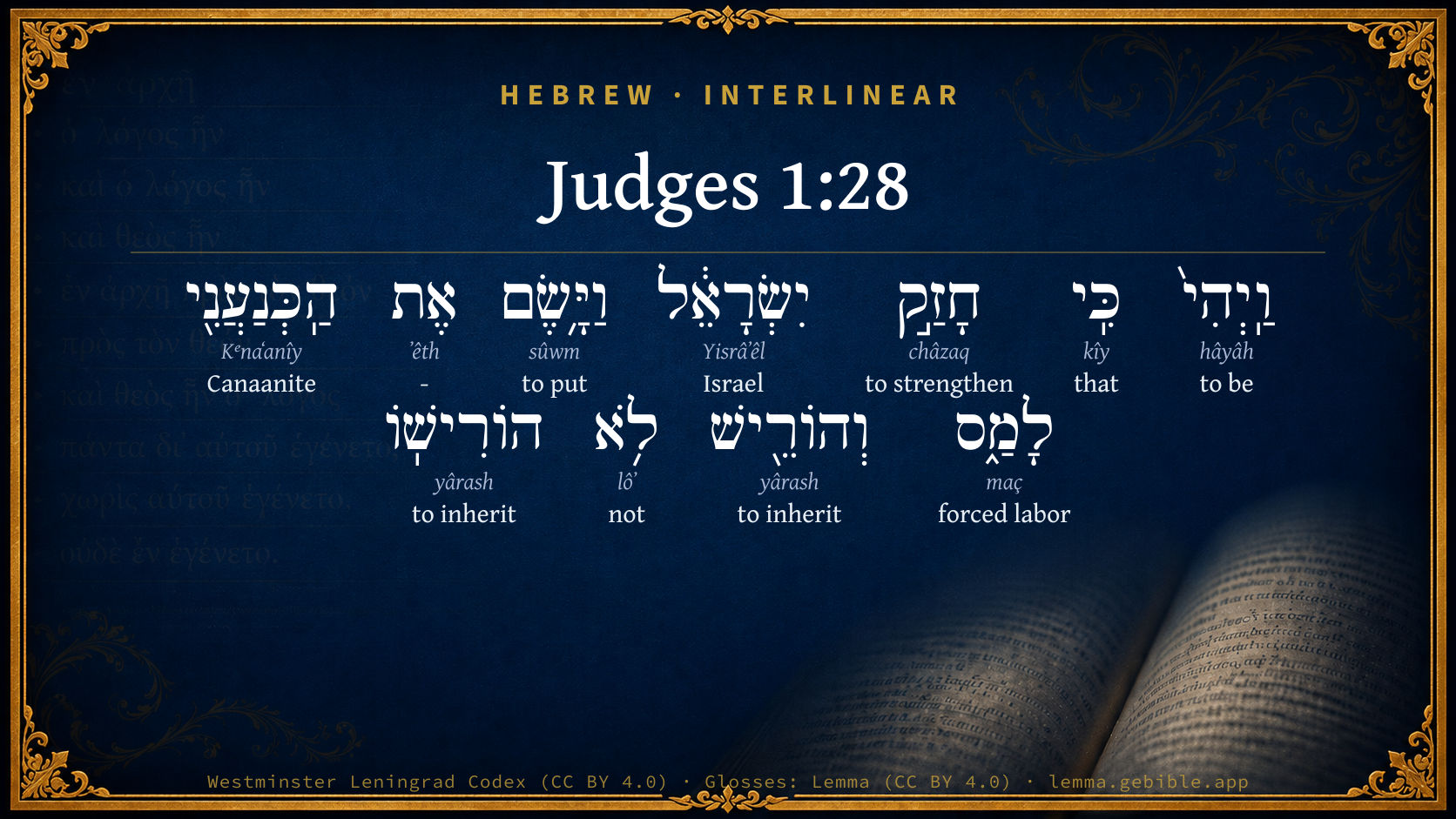
  1. וַֽיְהִי֙ hâyâh H1961 “and · to be” Conjunction + Verb, Qal, Sequential Imperfect, 3rd Person, Masculine, Singular
  2. כִּֽי kîy H3588 “that” Conjunction
  3. חָזַ֣ק châzaq H2388 “to strengthen” Verb, Qal, Perfect, 3rd Person, Masculine, Singular
  4. יִשְׂרָאֵ֔ל Yisrâʼêl H3478 “Israel” Noun, Proper
  5. וַיָּ֥שֶׂם sûwm H7760 “and · to put” Conjunction + Verb, Qal, Sequential Imperfect, 3rd Person, Masculine, Singular
  6. אֶת ʼêth H853 “-” Particle, Direct Object
  7. הַֽכְּנַעֲנִ֖י Kᵉnaʻanîy H3669 “the · Canaanite” Particle, Definite Article + Noun, Gentilic, Masculine, Singular, Absolute
  8. וְהוֹרֵ֖ישׁ yârash H3423 “and · to inherit” Conjunction + Verb, Hiphil, Infinitive Absolute
  9. לֹ֥א lôʼ H3808 “not” Particle, Negative
  10. הוֹרִישֽׁוֹ yârash H3423 “to inherit · him” Verb, Hiphil, Perfect, 3rd Person, Masculine, Singular + Suffix, Personal, 3rd Person, Masculine, Singular

About this verse

These counts appear in no published source. They are computed here, from the morphology-tagged text and Lemma’s own curated glosses. What Lemma adds →

11
words
10
distinct lemmas
Historical
section

Notable vocabulary

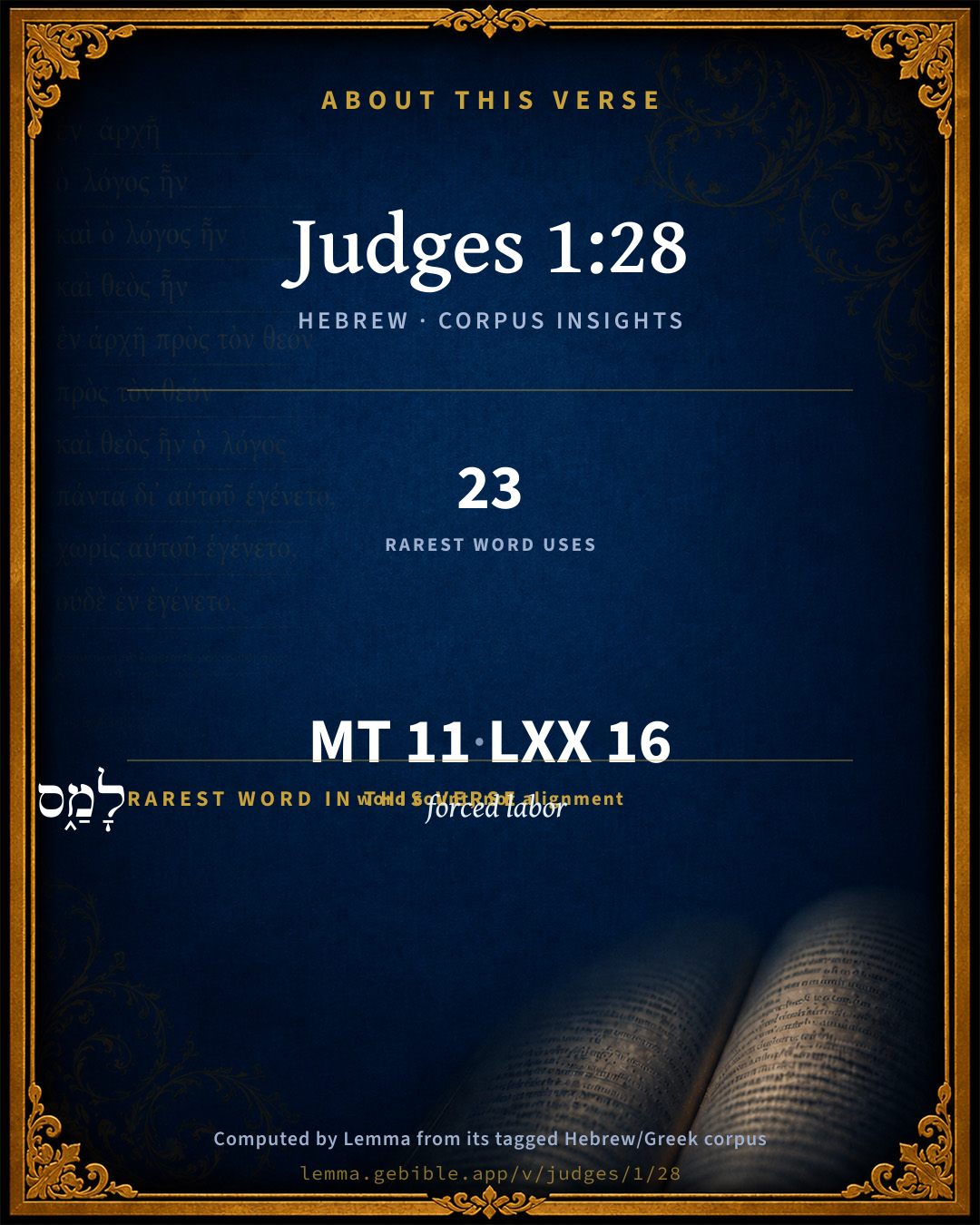
The rarest word here is לָמַ֑ס forced labor H4522 — appearing just 23 times in the whole Hebrew Bible.

Shared distinctive vocabulary

לָמַ֑ס forced labor H4522 occurs in 22 verses of the Hebrew Bible. Also found in:

Grammatical profile

  • 5 verbs
  • 3 nouns
  • 1 conjunction
  • 2 particles

Verb forms

  • וַֽיְהִי֙ Qal · Sequential Imperfect
  • חָזַ֣ק Qal · Perfect
  • וַיָּ֥שֶׂם Qal · Sequential Imperfect
  • וְהוֹרֵ֖ישׁ Hiphil · Infinitive Absolute
  • הוֹרִישֽׁוֹ Hiphil · Perfect

Repetition

A word recurs within this verse — often emphatic in Hebrew:

  • וְהוֹרֵ֖ישׁ to inherit H3423 ×2

Hebrew & Septuagint length

In English translation the verse runs 22 words from the Hebrew and 22 from the Septuagint (LXX English) — the same length.

A rough comparison of the two English renderings, which tokenize alike — not a word-level alignment.

Word counts can differ between the Hebrew and the Greek without any difference in meaning — e.g. the Hebrew direct-object marker אֵת has no separate Greek word, and Greek often adds the article ὁ.

In the original languages it is 11 Hebrew tokens and 16 Greek tokens — but the two are counted differently (Hebrew bundles its prefixes and suffixes into one token; the Greek is in lemma form), so that isn’t a like-for-like length.

Hebrew and Greek witnesses Masoretic Hebrew ↔ Greek Septuagint

The same verse in the two great witnesses to the Old Testament, shown verse-for-verse.

These are two independent witnesses, not word-aligned to each other, and the Septuagint is shown in lemma (dictionary) form.

Hebrew Judges 1:28 Masoretic · Westminster Leningrad Codex

וַֽיְהִי֙ כִּֽי חָזַ֣ק יִשְׂרָאֵ֔ל וַיָּ֥שֶׂם אֶת הַֽכְּנַעֲנִ֖י לָמַ֑ס וְהוֹרֵ֖ישׁ לֹ֥א הוֹרִישֽׁוֹ

It happened, when Israel had grown strong, that they put the Canaanites to forced labor, and did not utterly drive them out.

World English Bible · Public Domain

Greek LXX Judges 1:28 Septuagint · lemma form

καί γίγνομαι ὅτε ἐνἰσχύω ἰσραήλ καί ποιέω ὁ χαναναῖος εἰς φόρος καί ἐκαἴρω οὐ ἐκαἴρω αὐτός

And it came to pass when Israel was strong, that he made the Chananite tributary, but did not utterly drive them out.

LXX2012 (modern English Septuagint) · Public Domain

Hebrew: Westminster Leningrad Codex (CC BY 4.0). Greek: Septuagint (public domain); English from LXX2012 (modern English Septuagint) (Public Domain). How the Septuagint differs from the Hebrew →

Targum (Aramaic paraphrase)

1

The Targum is the ancient Jewish Aramaic paraphrase of the Hebrew Scriptures — an interpretive translation, not the Hebrew text itself. Onkelos (literal) and Pseudo-Jonathan (expansive) render the Torah, and Jonathan the Prophets. Coverage is partial: where no permissively-licensed English translation exists for a verse, only the Aramaic is shown. This is verse-level text, not a word-by-word alignment to the Hebrew.

  1. Targum Jonathan Prophets (Joshua–Malachi)
    וַהֲוָה כַּד תַּקֵיף יִשְׂרָאֵל וְשַׁוֵי יַת כְּנַעֲנָאָה לְמַסְקֵי מִסִין וְתָרָכָא לָא תָרְכִינוּן:

    (no public-domain English translation for this verse)

    Targum Jonathan — Aramaic: “Mikraot Gedolot” (public domain). English: “Sefaria Community Translation” (CC0 1.0 (public-domain dedication)); “London "Chaldee Paraphrase," 1871” (public domain). Text via Sefaria.

Commentary

Notes on Judges 1:28 from classic Christian and Jewish commentators (each source and its license shown beneath its notes). The classic Christian expositions comment on the surrounding passage and are grouped to its opening verse, so a note may address several verses; the Jewish commentaries on the Tanakh (Rashi and others) are per-verse, so they appear only where the commentator wrote on this verse.

Lemma curates 59 commentaries, every one of them public domain or Creative Commons licensed, each selected and text-cleaned for this edition rather than reprinted as found. About our sources →

Trapp's Complete Commentary

John Trapp

Jdg 1:28 And it came to pass, when Israel was strong, that they put the Canaanites to tribute, and did not utterly drive them out.

Ver. 28. They put the Canaanites to tribute.] When they could have cast them out: this they did out of covetousness, that root of all evil, neglecting the command of God to the contrary. Well might David pray, "Incline mine heart to thy testimonies, and not to covetousness." {Psa 119:36} Sallust saith, Ubi divitiae clarae habentur, ibi omnia bona vilia sunt, fides, probitas, pudor, pudicitia; Where money is in price, there honesty and fidelity are easily parted with.

John Trapp, A Commentary or Exposition upon All the Books of the Old and New Testament (1647–1656) — public domain. Text from a community e-Sword module.

Joseph Benson's Commentary

Jdg 1:28. When Israel was strong they put the Canaanites to tribute — Herein they violated the law, whereby they were enjoined to destroy or expel that people when they were able. And as they were strong enough to impose tribute on them, they undoubtedly might have driven them entirely out of the land. But it cost them less trouble, and brought them more profit, to make them tributaries, than to expel them; and therefore they preferred it, being influenced by sloth and covetousness. And this seems to be here spoken of as their common fault at this time.

Joseph Benson's Commentary on the Old and New Testaments (1811–1818) — public domain. Text from a community e-Sword module.

Ellicott's Commentary for English Readers

(28) Did not utterly drive them out.—This is mentioned by way of blame, as the cause of their future sins and disasters (Jdg_2:2; Josh. 16:16, Jos_17:13). As to the morality of these exterminating wars, we must bear in mind that men and nations must alike be judged by the moral standard of their own day, not by the advanced morality of later ages. We learn from unanimous testimony that the nations of Canaan had sunk to the lowest and vilest depths of moral degeneracy. When nations have fallen thus low, the cup of their iniquity is full; they are practically irreclaimable. To mingle with them would inevitably be to learn their works, for their worst abominations would find an ally in the natural weakness and corruption of the human heart. The Israelites therefore believed that it was their positive duty to destroy them, and the impulse which led them to do so was one which sprang from their best and not from their worst instincts. It must not be forgotten that the teaching of Christ has absolutely changed the moral conceptions of the world. It intensified, to a degree which we can hardly estimate, our sense of the inalienable rights of humanity and of the individual man. In these days there is scarcely any amount of evidence which would convince us that we were bidden to exterminate a whole population, and involve women and children in one indistinguishable massacre. But neither the Israelites nor any other ancient nations, at this early stage of their moral development, had any conception corresponding to those which would in our minds rightly excite horror, were we to receive a command like that given by Moses, that “thou shalt save nothing alive that breatheth” (Deu_22:16), or by Samuel, “Slay both man and woman, infant and suckling, ox and sheep, camel and ass” (1Sa_15:3). We should instantly declare it to be impossible that God—as Christ has revealed to us the character of our Father in heaven—should give us commands which would militate against our sense of justice no less than against our sense of compassion. To quote such commands as an excuse for, or an incentive to, such horrible acts of wickedness as the Sack of Beziers, or the Massacre of St. Bartholomew, is ignorantly and recklessly to obliterate the whole results of God’s progressive moral education of our race. It is to ignore the fact that we are living under a wholly different dispensation, and to disavow every blessing which has accrued to humanity from the broadening light and divine revelation of three thousand years. But the ancient Israelites, living as they did in the “days of ignorance” which God “winked at” (Act_17:30), had never attained to that idea of human individuality—that sense of the independence and infinite worth of each human life—which would have shown them that they knew not what manner of spirit they were of (Luk_9:56). The wild and passionate sense of severe justice, the comparative indifference to human life, the familiarity with pain and death which blunted the keen edge of pity, “the deficient sense of individuality, the exaggerated sense of the solidarity which united a criminal with all his surroundings and possessions,” prevented them from regarding the execution of their ban on guilty nations, cities, or families in any other light than that of the zeal for righteousness by which it was impelled. Their deeds must be estimated by the elements of nobleness which mingled with them, and not indiscriminately condemned by standards of judgment of which neither they nor the age in which they lived had any conception. They firmly believed that in exterminating Canaan they were acting under Divine commands; and there was nothing in such commands which would in that day have shocked the moral sense of the world. “They did not look unnatural to the ancient Jew; they were not foreign to his standard; they excited no surprise or perplexity; they appealed to a genuine but rough idea of justice which existed, when the longing for retribution upon crime in the human mind was not checked by the strict sense of human individuality” (Mozley, Lectures on the Old Test., p. 103).

A Bible Commentary for English Readers, edited by Charles John Ellicott (1878–1897) — public domain. Text from a community e-Sword module.

The Cambridge Bible for Schools and Colleges

gen. ed. J. J. S. Perowne

28. By the time of Solomon these cities had become Israelite possessions, 1Ki_4:11 f.; it was probably David who subdued them, after they had been weakened by the Philistines. The latter were masters of Beth-shean in Saul’s time, 1Sa_31:10 ff.

taskwork] or forced labour. The word mas properly denotes a body of men engaged upon forced labour; here it is used of the Canaanites when reduced to subjection, cf. Deu_20:11; Isa_31:8. As an institution in Israel, the corvée or labour-gang (employed in the East down to modern times) first appears at the end of David’s reign, 2Sa_20:24; it was further organized by Solomon for his public works, 1Ki_5:13; 1Ki_9:15; 1Ki_9:21. Though Canaanites may have been employed for the fortifying of Megiddo and Gezer (1Ki_9:15), the levying of Israelites for this slavery was deeply resented, ib. 1Ki_12:4; 1Ki_12:18. The word does not mean ‘tribute.’

did not utterly drive them out] Even when subjugated, the Canaanites in many places continued to live among the dominant population, a constant danger, as the subsequent history shews, to Israelite religion and morals. The extermination of the Canaanites was but the theory of later times. Of the cities named, Beth-shean, for instance, harboured an alien population throughout its history; see G. A. Smith, Hist. Geogr., p. 358.

The Cambridge Bible for Schools and Colleges (gen. ed. J. J. S. Perowne; Cambridge University Press, 1878–1918) — public domain. Text from a community e-Sword module.

John Gill's Exposition

And it came to pass, when Israel was strong,.... All the tribes of Israel were become numerous, and able to drive the Canaanites out of the land everywhere, and particularly were able to assist Manasseh in expelling the Canaanites out of the above places, yet they did not; but all they did was:

that they put the Canaanites to tribute, and did not utterly drive them out; which flowed from covetousness, and a love of ease; they did not care to be at the trouble of expelling them, as they found it turned more to their account and present advantage to make them tributaries; and this was true of the Israelites in general, and of the half tribe of Manasseh in particular; which, as Abarbinel thinks, is here respected.

John Gill's Exposition of the Whole Bible (1746–1763) — public domain (CC PDM 1.0). Text via the HelloAO Bible API.

Haydock's Catholic Bible Commentary

Them. We shall see the punishment of their prevarication during the greatest part of this book. (Calmet)

George Leo Haydock (1774–1849), Haydock's Catholic Family Bible and Commentary, 1859 edition — public domain. Excludes Psalms (Douay-Rheims chapter numbering differs from Protestant) and Deuterocanonical books (Catholic canon only).

Whedon's Commentary on the Bible

Daniel D. Whedon

28. When Israel was strong — The lack of strength was the excuse for their cowardice and disobedience to a positive command, notwithstanding they had the assurance of aid from God. Perhaps, too, their previous weakness was owing to their fear of the war chariots. See note on Jdg_1:19. Nearly all these towns were on the great plain of Esdraelon; and bordering, as they did, the track of oriental commerce with the great cities of Phenicia, they were probably well fortified. But, in course of time, it seems that Israel became strong enough to bring them into subjection.

They put the Canaanites to tribute — The love of money is now added to their love of ease and disobedience. When they became strong they were no more disposed to obey the voice of God than they were before. By long familiarity with them their pagan foes had ceased to be abominable in their eyes, while the command to exterminate them had become in their estimation more and more unreasonable and barbarous. Yet they soon learned, to their sorrow, that they had planted the seeds of social and national ruin by refusing to apply to themselves the divinely appointed safeguard of their well-being — the radical extermination of their enemies.

Daniel D. Whedon (gen. ed.), Commentary on the Old and New Testaments (1874–1909) — public domain. Text from a community e-Sword module.

The Pulpit Commentary

Put the Canaanites to tribute, or made them tributaries, as in vers. 30, 33, i.e. imposed forced labour upon them, as the Gibeonites were made hewers of wood and drawers of water. (Jos_9:21, Jos_9:27; see 1Ki_9:21)

Human wisdom versus Divine.

No option was left to the Israelites as to the mode in which they were to deal with the Canaanites. Even if they were unable to subdue the Canaanites because of their own weakness, it would not be without fault; for had they not to sustain and direct them? But the sin of Israel was the greater that, when they were able to obey God"s direction, they set it aside in favour of a policy of their own. This was direct disobedience, however it might be disguised by the name of prudence or expediency. In the end they had to rue their own folly.

I PEOPLE IN PROSPEROUS CIRCUMSTANCES ARE FREQUENTLY TEMPTED TO FOLLOW A WORLDLY INSTEAD OF A HEAVENLY LINE OF CONDUCT, AND TO QUALIFY THE DICTATES OF OBVIOUS DUTY BY CONSIDERATIONS THAT ARE PURELY SELFISH AND PRESUMPTUOUS IN THEIR NATURE.

II WHEN MEN THUS SHIRK OBVIOUS DUTY, THEY DO IT FROM A TWOFOLD MISCONCEPTION

(1) of their own power and wisdom, and

(2) of the true character of that with which they tamper.

III IN THE END THEIR FOLLY WILL MANIFEST ITSELF IN DISASTER AND RUIN. M.

The Pulpit Commentary (1880–1919), ed. H.D.M. Spence-Jones & Joseph S. Exell — public domain. Text from a community e-Sword module.

Lesson kit

Teaching starters — assembled from the data on this page, not authored interpretation. Every prompt links to the verse data it draws on. Edit before teaching.

Judges, in the Historical, opens this verse with 11 words (10 distinct Hebrew lemmas). Its most distinctive word is maç (“forced labor”). A historical commentator’s framing appears above. Read the whole chapter for the surrounding context.

Discussion questions

  1. The word maç carries the sense “forced labor.” How does it shape the verse?
  2. How does Genesis 49:15, which shares the word «forced labor», read alongside this verse?
  3. What does the repetition of “to inherit” (2× in this one verse) do in this verse?
  4. The translations on this page render this verse differently — a whole-verse word diff, not a word-by-word alignment. What might account for the different wordings?
  5. «וַֽיְהִי֙» is a Qal Sequential Imperfect verb. How does that grammatical form shape the action described?
  6. Compare how Trapp's Complete Commentary and Joseph Benson's Commentary read this verse. Where do they agree or differ?

Things to notice

Reading settings

Reading text

Shown beneath each verse's original-language words.

Old Testament
Old Testament edition

Read the OT as the Masoretic Hebrew (MT) or the Greek Septuagint (LXX).

English shown for the Greek Septuagint (in the Hebrew ↔ Greek comparison).

Comparing translations? Open the Compare panel on any verse page to stack up to four side by side.