
2 Chronicles 8:3

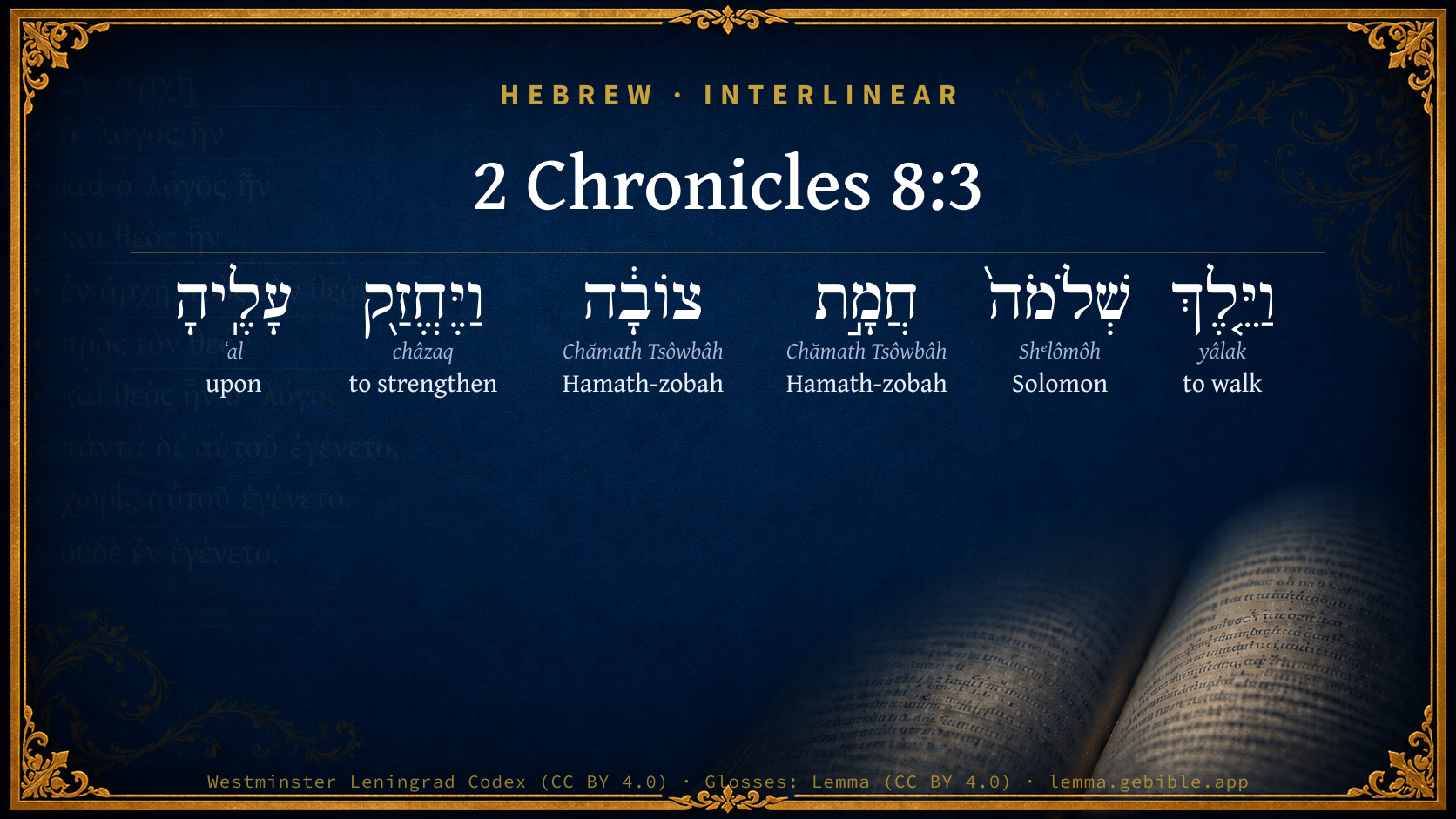
Hebrew (Westminster Leningrad Codex) 2 Chronicles 8:3 appears in the Hebrew Old Testament. The text above is from the Westminster Leningrad Codex. Each word links to its Strong’s number, a concise gloss, and parsing drawn from the Open Scriptures Hebrew Bible morphology. Click any word for its full Brown-Driver-Briggs (BDB) entry.
Download image
Cite this verse

2 Chronicles 8:3 (World English Bible). Public Domain. Lemma interlinear Bible study tool, https://lemma.gebible.app/v/2-chronicles/8/3.

Show BibTeX & RIS
BibTeX
RIS
English Translation
Solomon went to Hamath-zobah, and prevailed against it.
World English Bible · Public Domain
Highlights
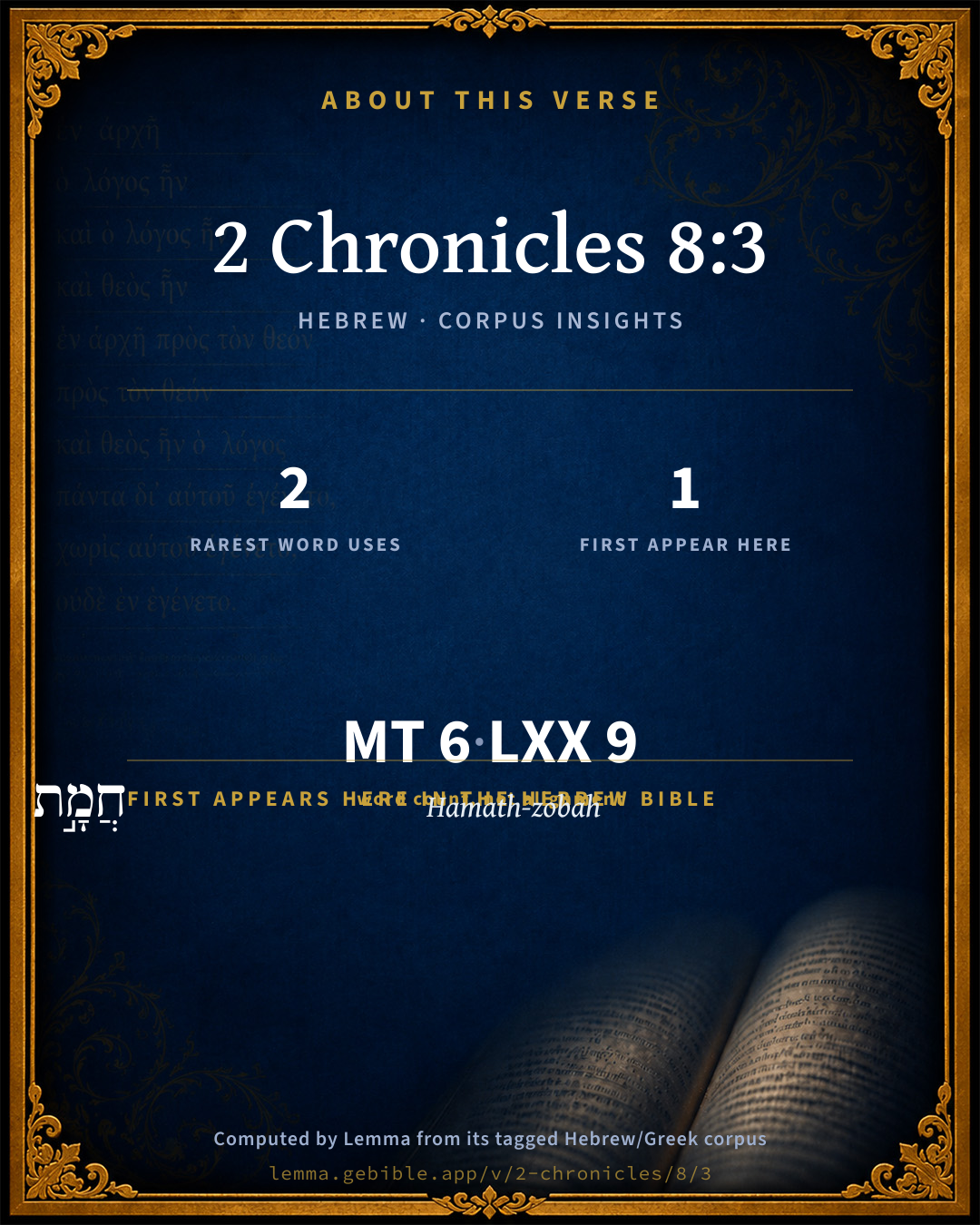
  • 1 first appearance in the Hebrew Bible
Full analysis ↓
Download a study sheet

One document with this verse’s original text, its word-by-word gloss line, the meaning frame, cross-references with their text, attributed commentary, and full source and license credits — printable, and it pastes into notes with its structure intact.

This verse Autodidact and up

Study sheet (.html) Plain text (.txt)

A passage Seminary Student

Up to 50 verses in one chapter. A passage sheet keeps up to 6 commentary sources and 12 cross-references per verse, in the order this page ranks them, and says so on the sheet whenever that leaves anything out. Ask for a single verse and you get the Autodidact verse sheet above.

Everything on this page stays free to read, with no account — the sheet is a download of what is already on screen, not access to it.

Want to remove ads? Support Godless Engineer
Compare translations 3

The same verse in 3 English versions, stacked beneath the original-language interlinear above. Click any original word for its lexicon entry.

Each is an independent rendering of the whole verse — the interlinear is not word-aligned to these translations.

Highlighted words mark where these versions differ — a whole-verse word diff, not a word-by-word alignment.

  • World English Bible Public Domain
    Solomon went to Hamath-zobah, and prevailed against it.
  • King James Version Public Domain
    And Solomon went to Hamathzobah, and prevailed against it.
  • unfoldingWord Literal Text CC BY-SA 4.0
    And Solomon went to Hamathzobah and he prevailed over it.

unfoldingWord Literal Text — © unfoldingWord, licensed CC BY-SA 4.0. Word-aligned USFM3 via Door43 (git.door43.org/unfoldingWord/en_ult).

Versions to compare (up to 4)

3 of 4 selected

Show all 18 translations

Every available English version of this verse, each an independent rendering of the whole verse.

  • World English Bible Public Domain
    Solomon went to Hamath-zobah, and prevailed against it.
  • Berean Standard Bible Public Domain
    Then Solomon went to Hamath-zobah and captured it.
  • Majority Standard Bible Public Domain
    Then Solomon went to Hamath-zobah and captured it.
  • King James Version Public Domain
    And Solomon went to Hamathzobah, and prevailed against it.
  • American Standard Version (1901) Public Domain
    And Solomon went to Hamath-zobah, and prevailed against it.
  • Revised Version (1885) Public Domain
    And Solomon went to Hamath-zobah, and prevailed against it.
  • Geneva Bible (1599) Public Domain
    And Salomon went to Hamath Zobah, and ouercame it.
  • Douay-Rheims (1899) Public Domain
    He went also into Emath Suba, and possessed it.
  • Young's Literal Translation Public Domain
    And Solomon goeth to Hamath-Zobah, and layeth hold upon it;
  • Literal Standard Version CC BY-SA 4.0
    And Solomon goes to Hamath-Zobah, and lays hold on it;
  • Unlocked Literal Bible CC BY-SA 4.0
    Solomon attacked Hamathzobah and defeated it.
  • unfoldingWord Literal Text CC BY-SA 4.0
    And Solomon went to Hamathzobah and he prevailed over it.
  • Darby Bible Public Domain
    And Solomon went to Hamath-Zobah, and overcame it.
  • World Messianic Bible Public Domain
    Solomon went to Hamath Zobah, and prevailed against it.
  • Webster's Bible Public Domain
    And Solomon went to Hamath-zobah, and prevailed against it.
  • Free Bible Version CC BY-SA 4.0
    Then Solomon attacked Hamath-zobah and captured it.
  • Bible in Basic English Public Domain
    And Solomon went to Hamath-zobah and overcame it.
  • JPS Tanakh (1917) Public Domain
    And Solomon went to Hamath-zobah, and prevailed against it.

Literal Standard Version (2020), Covenant Press — licensed CC BY-SA 4.0. Text via the HelloAO Bible API (eBible.org). Unlocked Literal Bible (unfoldingWord) — licensed CC BY-SA 4.0. Text via the HelloAO Bible API (eBible.org). unfoldingWord Literal Text — © unfoldingWord, licensed CC BY-SA 4.0. Word-aligned USFM3 via Door43 (git.door43.org/unfoldingWord/en_ult). Free Bible Version, Dr. Jonathan Gallagher — licensed CC BY-SA 4.0. Text via the HelloAO Bible API (eBible.org).

Word by word

More ways to search: Search by grammar → Find every occurrence → Compare this word →

Practice this passage: Drill this verse → Learn its vocabulary →

About this verse

These counts appear in no published source. They are computed here, from the morphology-tagged text and Lemma’s own curated glosses. What Lemma adds →

6
words
5
distinct lemmas
Historical
section

Notable vocabulary

The rarest word here is חֲמָ֣ת Hamath-zobah H2578 — appearing just 2 times in the whole Hebrew Bible.

First appearance in Scripture

This word makes its first canonical appearance in the Hebrew Bible here:

  • חֲמָ֣ת Hamath-zobah H2578

Grammatical profile

  • 2 verbs
  • 3 nouns
  • 1 preposition

Verb forms

  • וַיֵּ֤לֶךְ Qal · Sequential Imperfect
  • וַיֶּחֱזַ֖ק Qal · Sequential Imperfect

Repetition

A word recurs within this verse — often emphatic in Hebrew:

  • חֲמָ֣ת Hamath-zobah H2578 ×2

Hebrew & Septuagint length

In English translation the verse runs 8 words from the Hebrew and 8 from the Septuagint (LXX English) — the same length.

A rough comparison of the two English renderings, which tokenize alike — not a word-level alignment.

Word counts can differ between the Hebrew and the Greek without any difference in meaning — e.g. the Hebrew direct-object marker אֵת has no separate Greek word, and Greek often adds the article ὁ.

In the original languages it is 6 Hebrew tokens and 9 Greek tokens — but the two are counted differently (Hebrew bundles its prefixes and suffixes into one token; the Greek is in lemma form), so that isn’t a like-for-like length.

Cross-references

5

Topical passages linked to 2 Chronicles 8:3 in the Treasury of Scripture Knowledge — connected by theme and wording, ordered by reader-vote popularity; previews shown in the World English Bible.

  • Numbers 13:21 So they went up, and spied out the land from the wilderness of Zin to Rehob, to the entrance of Hamath.
  • Numbers 34:8 from Mount Hor you shall mark out to the entrance of Hamath; and the goings out of the border shall be at Zedad;
  • 2 Samuel 8:3 David struck also Hadadezer the son of Rehob, king of Zobah, as he went to recover his dominion at the River.
  • 1 Kings 11:23–25 God raised up [another] adversary to him, Rezon the son of Eliada, who had fled from his lord Hadadezer king of Zobah.
  • 1 Chronicles 18:3 David struck Hadarezer king of Zobah to Hamath, as he went to establish his dominion by the river Euphrates.

Cross-references courtesy of OpenBible.info (CC BY 4.0).

Hebrew and Greek witnesses Masoretic Hebrew ↔ Greek Septuagint

The same verse in the two great witnesses to the Old Testament, shown verse-for-verse.

These are two independent witnesses, not word-aligned to each other, and the Septuagint is shown in lemma (dictionary) form.

Hebrew 2 Chronicles 8:3 Masoretic · Westminster Leningrad Codex

וַיֵּ֤לֶךְ שְׁלֹמֹה֙ חֲמָ֣ת צוֹבָ֔ה וַיֶּחֱזַ֖ק עָלֶֽיהָ

Solomon went to Hamath-zobah, and prevailed against it.

World English Bible · Public Domain

Greek LXX 2 Chronicles 8:3 Septuagint · lemma form

καί ἔρχομαι σαλωμών εἰς αιμαθ σωβα καί καταἰσχύω αὐτός

And Solomon came to Baesoba, and fortified it.

LXX2012 (modern English Septuagint) · Public Domain

Hebrew: Westminster Leningrad Codex (CC BY 4.0). Greek: Septuagint (public domain); English from LXX2012 (modern English Septuagint) (Public Domain). How the Septuagint differs from the Hebrew →

Commentary

Notes on 2 Chronicles 8:3 from classic Christian and Jewish commentators (each source and its license shown beneath its notes). The classic Christian expositions comment on the surrounding passage and are grouped to its opening verse, so a note may address several verses; the Jewish commentaries on the Tanakh (Rashi and others) are per-verse, so they appear only where the commentator wrote on this verse.

Lemma curates 59 commentaries, every one of them public domain or Creative Commons licensed, each selected and text-cleaned for this edition rather than reprinted as found. About our sources →

The Cambridge Bible for Schools and Colleges

gen. ed. J. J. S. Perowne

3. Hamath-zobah] The two kingdoms of Hamath and Zobah are distinguished from one another (1Ch_18:3; 1Ch_18:9 = 1Sa_8:3; 1Sa_8:9), Hamath apparently being north of Zobah. It is probable however that Hamath as the name of a city belonged to more than one place, and Hamath-Zobah may be a southern namesake of the well-known Hamath the great (Amo_6:2).

Though Solomon was a “man of rest” (1Ch_22:9) his reign was not wholly free from war (cp. 1Ki_11:14; 1Ki_11:13).

The Cambridge Bible for Schools and Colleges (gen. ed. J. J. S. Perowne; Cambridge University Press, 1878–1918) — public domain. Text from a community e-Sword module.

Trapp's Complete Commentary

John Trapp

2Ch 8:3 And Solomon went to Hamathzobah, and prevailed against it.

Ver. 3. And prevailed against it.] King James, when he first entered England at Berwick, himself gave fire to, and shot off a piece of ordinance, in which cannon he might seem to have discharged war out of England; so did Solomon out of Israel, by this one expedition.

John Trapp, A Commentary or Exposition upon All the Books of the Old and New Testament (1647–1656) — public domain. Text from a community e-Sword module.

Tyndale Open Study Notes

Tyndale Open Resources

8:3 This verse is the only reference in Chronicles of Solomon’s military accomplishments; he was known as a man of peace (1 Chr 22:9). The kingdoms of David and Solomon extended to Hamath-zobah in the far north on the Orontes River. King Toi, the ruler of Hamath, sought David’s support against Hadadezer, king of Zobah (1 Chr 18:9-10). Hadadezer was also referred to as the king of Zobah-Hamath (1 Chr 18:3). Solomon conducted an expedition against this territory to maintain the stability of his kingdom’s northern border.

Tyndale Open Study Notes — © Tyndale Open Resources, licensed CC BY-SA 4.0. Text via the HelloAO Bible API.

Jamieson, Fausset & Brown

Robert Jamieson, A. R. Fausset & David Brown

And Solomon went to Hamath-zobah--Hamath was on the Orontes, in Cœle-Syria. Its king, Toi, had been the ally of David; but from the combination, Hamath and Zobah, it would appear that some revolution had taken place which led to the union of these two petty kingdoms of Syria into one. For what cause the resentment of Solomon was provoked against it, we are not informed, but he sent an armed force which reduced it. He made himself master also of Tadmor, the famous Palmyra in the same region. Various other cities along the frontiers of his extended dominions he repaired and fitted up, either to serve as store-places for the furtherance of his commercial enterprises, or to secure his kingdom from foreign invasion (see on Ch2 1:14; Kg1 9:15).

Jamieson, Fausset & Brown — Commentary Critical and Explanatory on the Whole Bible (1871) — public domain (CC PDM 1.0). Text via the HelloAO Bible API.

Adam Clarke's Commentary

Verse 3. Hamath-zobah] "Emessa, on the river Orontes." - Calmet.

Adam Clarke's Commentary on the Bible (1810–1826) — public domain. Text from a community e-Sword/MySword module.

Ellicott's Commentary for English Readers

(3) And Solomon went.—Marched (2Sa_12:29).

Hamath-zobah.—That is, Hamath bordering on Zobah. (Comp. 1Ch_18:3.) Solomon’s conquest of the kingdom of Hamath, which had been on terms of amity with David, is not mentioned in 1 Kings 9; nor indeed anywhere else in the Old Testament. Thenius (on 2Ki_14:25) supposes that the text describes not a conquest of Hamath itself, but only the annexation of part of its territory; viz., a part of the highly fruitful plain of Cœle-Syria, called by the Arabs Ard-el-Beqâa. This appears to be correct.

Against it.—Or, over it (a late construction, 2Ch_27:5; Dan_11:5).

A Bible Commentary for English Readers, edited by Charles John Ellicott (1878–1897) — public domain. Text from a community e-Sword module.

John Gill's Exposition

And built Tadmor in the wilderness,.... Of which See Gill on Kg1 9:18.

and all the storehouses which he built in Hamath; a country in Syria, which he made himself master of, and where he laid up store of provision and ammunition to keep it, should any attempt be made to rescue it out of his hands. According to an Arabic writer (a), Solomon in the twenty fourth year of his reign having demolished Antioch, built seven cities, of which Tadmor was one.

(a) Abulpharag. Hist. Dynast. dyn. 3. p. 53.

John Gill's Exposition of the Whole Bible (1746–1763) — public domain (CC PDM 1.0). Text via the HelloAO Bible API.

Albert Barnes' Notes on the Bible

Hamath-zobah - Usually identified with the “great Hamath” Amo 6:2; the capital of Coele-Syria; but probably a town of Zobah otherwise unknown, which revolted from Solomon, and was reduced to subjection.

Albert Barnes' Notes on the Bible (1834–1885) — public domain. Text from a community e-Sword/MySword module.

Haydock's Catholic Bible Commentary

Emath, or Emesa, on the Orontes. This city had belonged to Thou, who cultivated the friendship of David, 2 Kings viii. 9. But after the death of these princes, it had given some offence to Solomon, who took it, as well as Palmira, or Thadmor, though not perhaps in person.

George Leo Haydock (1774–1849), Haydock's Catholic Family Bible and Commentary, 1859 edition — public domain. Excludes Psalms (Douay-Rheims chapter numbering differs from Protestant) and Deuterocanonical books (Catholic canon only).

The Pulpit Commentary

Hamath-zobah. Hamath (when the name occurs separately) was a place both of great geographical note (occupying, whether regarded as a larger region or a town, an important position in the northern end of that broad valley of Coele-Syria which separates Lebanon and Antilebanon, and through which passed the river Orontes) and of great historical note from the time of the Exodus to that of Amos. The town, or city, is to be understood to be the Great Hamath. (Amo_6:2) But the kingdom, or district, or county, was almost conterminous with Coele-Syria. Zobah, also a portion of Syria, amounted to a small kingdom, and is read of alike in Saul"s and in David"s times, as in Solomon"s time. It probably lay to the north-east of Hamath (1Sa_14:47; 2Sa_8:8, 2Sa_8:7, 2Sa_8:8, 10 10:9, 16, 19; 1Ch_18:4 1Ch_19:16) But Hamath-zobah of this verse was probably a place called Hamath, in the region of Zobah, in which also two other cities are mentioned, Berothai and Tibhath, or Betah (2Sa_8:8; 1Ch_18:8) These two kingdoms of Hamath and Zobah, contiguous as they were, seem as though they purposed to compliment one another Zobah by naming one of its towns Hamath, and vice versa It is said that the Assyrian inscriptions show that they remained, after Solomon, distinct kingdoms.

The Pulpit Commentary (1880–1919), ed. H.D.M. Spence-Jones & Joseph S. Exell — public domain. Text from a community e-Sword module.

unfoldingWord translationNotes

Door43 World Missions Community

Solomon attacked Hamathzobah

Solomon represents his whole fighting army. AT: "Solomon's army attacked the town of Hamathzolbah" (See: Synecdoche and How to Translate Names)

He built Tadmor in the wilderness

Tadmor was a city north of Israel, in modern-day Syria. The author writes of Solomon commanding the people to build Tadmor as if Solomon himself built it. AT: "Solomon caused the town of Tadmor in the wilderness to be rebuilt" or "Solomon commanded, and the people built the town of Tadmor in the wilderness" (See: Synecdoche)

Tadmor

Tadmor was a city north of Israel, in modern-day Syria. (See: How to Translate Names)

store cities

"storage cities" or "supply cities." These are cities where the government stored food or supplies.

Hamath

Hamath was a region north of Israel, in modern-day Syria. (See: How to Translate Names)

translationWords

desert

unfoldingWord translationNotes — © Distant Shores Media and the Door43 World Missions Community, licensed CC BY-SA 4.0. Source: git.door43.org/Door43/en_tn.

Lesson kit

Teaching starters — assembled from the data on this page, not authored interpretation. Every prompt links to the verse data it draws on. Edit before teaching.

2 Chronicles, in the Historical, opens this verse with 6 words (5 distinct Hebrew lemmas). Its most distinctive word is Chămath Tsôwbâh (“Hamath-zobah”). A historical commentator’s framing appears above. Read the whole chapter for the surrounding context.

Discussion questions

  1. What does “Hamath-zobah” (Chămath Tsôwbâh) contribute to the verse as a whole?
  2. This is the first place “Hamath-zobah” appears in Scripture (first appears here). What does its debut here establish?
  3. How does Numbers 13:21, which shares this passage’s theme, read alongside this verse?
  4. What does the repetition of “Hamath-zobah” (2× in this one verse) do in this verse?
  5. These translations render this verse differently. What is at stake in choosing one wording over another?
  6. «וַיֵּ֤לֶךְ» is a Qal Sequential Imperfect verb. How does that grammatical form shape the action described?
  7. Compare how The Cambridge Bible for Schools and Colleges and Trapp's Complete Commentary read this verse. Where do they agree or differ?

Things to notice

Reading settings

Reading text

Shown beneath each verse's original-language words.

Old Testament
Old Testament edition

Read the OT as the Masoretic Hebrew (MT) or the Greek Septuagint (LXX).

English shown for the Greek Septuagint (in the Hebrew ↔ Greek comparison).

Comparing translations? Open the Compare panel on any verse page to stack up to four side by side.