
2 Chronicles 15:8

Hebrew (Westminster Leningrad Codex) 2 Chronicles 15:8 appears in the Hebrew Old Testament. The text above is from the Westminster Leningrad Codex. Each word links to its Strong’s number, a concise gloss, and parsing drawn from the Open Scriptures Hebrew Bible morphology. Click any word for its full Brown-Driver-Briggs (BDB) entry.
Download image
Cite this verse

2 Chronicles 15:8 (World English Bible). Public Domain. Lemma interlinear Bible study tool, https://lemma.gebible.app/v/2-chronicles/15/8.

Show BibTeX & RIS
BibTeX
RIS
English Translation
When Asa heard these words, and the prophecy of Oded the prophet, he took courage, and put away the abominations out of all the land of Judah and Benjamin, and out of the cities which he had taken from the hill-country of Ephraim; and he renewed the altar of Yahweh, that was before the porch of Yahweh.
World English Bible · Public Domain
Download a study sheet

One document with this verse’s original text, its word-by-word gloss line, the meaning frame, cross-references with their text, attributed commentary, and full source and license credits — printable, and it pastes into notes with its structure intact.

This verse Autodidact and up

Study sheet (.html) Plain text (.txt)

A passage Seminary Student

Up to 50 verses in one chapter. A passage sheet keeps up to 6 commentary sources and 12 cross-references per verse, in the order this page ranks them, and says so on the sheet whenever that leaves anything out. Ask for a single verse and you get the Autodidact verse sheet above.

Everything on this page stays free to read, with no account — the sheet is a download of what is already on screen, not access to it.

Want to remove ads? Support Godless Engineer
Compare translations 3

The same verse in 3 English versions, stacked beneath the original-language interlinear above. Click any original word for its lexicon entry.

Each is an independent rendering of the whole verse — the interlinear is not word-aligned to these translations.

Highlighted words mark where these versions differ — a whole-verse word diff, not a word-by-word alignment.

  • World English Bible Public Domain
    When Asa heard these words, and the prophecy of Oded the prophet, he took courage, and put away the abominations out of all the land of Judah and Benjamin, and out of the cities which he had taken from the hill-country of Ephraim; and he renewed the altar of Yahweh, that was before the porch of Yahweh.
  • King James Version Public Domain
    And when Asa heard these words, and the prophecy of Oded the prophet, he took courage, and put away the abominable idols out of all the land of Judah and Benjamin, and out of the cities which he had taken from mount Ephraim, and renewed the altar of the LORD, that was before the porch of the LORD.
  • unfoldingWord Literal Text CC BY-SA 4.0
    And when Asa heard these words and the prophecy of Oded the prophet, he strengthened himself and caused to pass away the abhorrences from all the land of Judah and Benjamin, and from the cities that he had captured from the hill country of Ephraim. And he restored the altar of Yahweh which was before the porch of Yahweh.

unfoldingWord Literal Text — © unfoldingWord, licensed CC BY-SA 4.0. Word-aligned USFM3 via Door43 (git.door43.org/unfoldingWord/en_ult).

Versions to compare (up to 4)

3 of 4 selected

Show all 18 translations

Every available English version of this verse, each an independent rendering of the whole verse.

  • World English Bible Public Domain
    When Asa heard these words, and the prophecy of Oded the prophet, he took courage, and put away the abominations out of all the land of Judah and Benjamin, and out of the cities which he had taken from the hill-country of Ephraim; and he renewed the altar of Yahweh, that was before the porch of Yahweh.
  • Berean Standard Bible Public Domain
    When Asa heard these words and the prophecy of Azariah son of Oded the prophet, he took courage and removed the detestable idols from the whole land of Judah and Benjamin and from the cities he had captured in the hill country of Ephraim. He then restored the altar of the LORD that was in front of the portico of the LORD’s temple.
  • Majority Standard Bible Public Domain
    When Asa heard these words and the prophecy of Azariah son of Oded the prophet, he took courage and removed the detestable idols from the whole land of Judah and Benjamin and from the cities he had captured in the hill country of Ephraim. He then restored the altar of the LORD that was in front of the portico of the LORD’s temple.
  • King James Version Public Domain
    And when Asa heard these words, and the prophecy of Oded the prophet, he took courage, and put away the abominable idols out of all the land of Judah and Benjamin, and out of the cities which he had taken from mount Ephraim, and renewed the altar of the LORD, that was before the porch of the LORD.
  • American Standard Version (1901) Public Domain
    And when Asa heard these words, and the prophecy of Oded the prophet, he took courage, and put away the abominations out of all the land of Judah and Benjamin, and out of the cities which he had taken from the hill-country of Ephraim; and he renewed the altar of Jehovah, that was before the porch of Jehovah.
  • Revised Version (1885) Public Domain
    And when Asa heard these words, and the prophecy of Oded the prophet, he took courage, and put away the abominations out of all the land of Judah and Benjamin, and out of the cities which he had taken from the hill country of Ephraim; and he renewed the altar of the LORD, that was before the porch of the LORD.
  • Geneva Bible (1599) Public Domain
    And when Asa heard these wordes, and the prophesie of Obed the Prophet, he was encouraged, and tooke away the abominations out of all the lande of Iudah, and Beniamin, and out of the cities which he had taken of mount Ephraim, and he renued the altar of the Lord, that was before the porche of the Lord.
  • Douay-Rheims (1899) Public Domain
    And when Asa had heard the words, and the prophecy of Azarias the son of Oded the prophet, he took courage, and took away the idols out of all the land of Juda, and out of Benjamin, and out of the cities of mount Ephraim, which he had taken, and he dedicated the altar of the Lord, which was before the porch of the Lord.
  • Young's Literal Translation Public Domain
    And at Asa's hearing these words, and the prophecy of Oded the prophet, he hath strengthened himself, and doth cause the abominations to pass away out of all the land of Judah and Benjamin, and out of the cities that he hath captured from the hill-country of Ephraim, and reneweth the altar of Jehovah that `is' before the porch of Jehovah,
  • Literal Standard Version CC BY-SA 4.0
    And at Asa’s hearing these words, and the prophecy of Oded the prophet, he has strengthened himself, and causes the abominations to pass away out of all the land of Judah and Benjamin, and out of the cities that he has captured from the hill-country of Ephraim, and renews the altar of YHWH that [is] before the porch of YHWH,
  • Unlocked Literal Bible CC BY-SA 4.0
    When Asa heard these words, the prophecy of Oded the prophet, he took courage and drove away the disgusting things from all the land of Judah and Benjamin, and from the cities that he had captured from the hill country of Ephraim, and he rebuilt Yahweh's altar, which was in front of the portico of Yahweh's house.
  • unfoldingWord Literal Text CC BY-SA 4.0
    And when Asa heard these words and the prophecy of Oded the prophet, he strengthened himself and caused to pass away the abhorrences from all the land of Judah and Benjamin, and from the cities that he had captured from the hill country of Ephraim. And he restored the altar of Yahweh which was before the porch of Yahweh.
  • Darby Bible Public Domain
    And when Asa heard these words and the prophecy of Oded the prophet, he took courage, and put away the abominations out of all the land of Judah and Benjamin, and out of the cities that he had taken from mount Ephraim, and renewed the altar of Jehovah, that was before the porch of Jehovah.
  • World Messianic Bible Public Domain
    When Asa heard these words and the prophecy of Oded the prophet, he took courage, and put away the abominations out of all the land of Judah and Benjamin, and out of the cities which he had taken from the hill country of Ephraim; and he renewed the LORD’s altar that was before the LORD’s porch.
  • Webster's Bible Public Domain
    And when Asa heard these words, and the prophecy of Oded the prophet, he took courage, and put away the abominable idols out of all the land of Judah and Benjamin, and out of the cities which he had taken from mount Ephraim, and renewed the altar of the LORD, that was before the porch of the LORD.
  • Free Bible Version CC BY-SA 4.0
    When Asa heard these words of prophecy from Azariah the prophet, son of Oded, he was encouraged. He removed the vile idols from the whole territory of Judah and Benjamin and from the towns he had captured in the hill country of Ephraim. Then he repaired the altar of the Lord that stood in front of the porch of the Lord's Temple.
  • Bible in Basic English Public Domain
    And Asa, hearing these words of Azariah, the son of Oded the prophet, took heart and put away all the disgusting things out of all the land of Judah and Benjamin, and out of the towns which he had taken from the hill-country of Ephraim; and he made new again the altar of the Lord in front of the covered way of the Lord's house.
  • JPS Tanakh (1917) Public Domain
    And when Asa heard these words, even the prophecy of Oded the prophet, he took courage, and put away the detestable things out of all the land of Judah and Benjamin, and out of the cities which he had taken from the hill-country of Ephraim; and he renewed the altar of the LORD, that was before the porch of the LORD.

Literal Standard Version (2020), Covenant Press — licensed CC BY-SA 4.0. Text via the HelloAO Bible API (eBible.org). Unlocked Literal Bible (unfoldingWord) — licensed CC BY-SA 4.0. Text via the HelloAO Bible API (eBible.org). unfoldingWord Literal Text — © unfoldingWord, licensed CC BY-SA 4.0. Word-aligned USFM3 via Door43 (git.door43.org/unfoldingWord/en_ult). Free Bible Version, Dr. Jonathan Gallagher — licensed CC BY-SA 4.0. Text via the HelloAO Bible API (eBible.org).

Word by word

More ways to search: Search by grammar → Find every occurrence → Compare this word →

Practice this passage: Drill this verse → Learn its vocabulary →

וְהַנְּבוּאָה֮
nᵉbûwʼâh
H5016
“and · the · prophecy”
Conjunction + Particle, Definite Article + Noun, Common, Feminine, Singular, Absolute
Part of Speech
Conjunction + Particle + Noun
Type
Common
Gender
Feminine
Number
Singular
State
Absolute
Full BDB Definition

Origin: from H5012

TWOT: 1277b

prophecy - prophecy - specific and genuine - false - prophetic writing
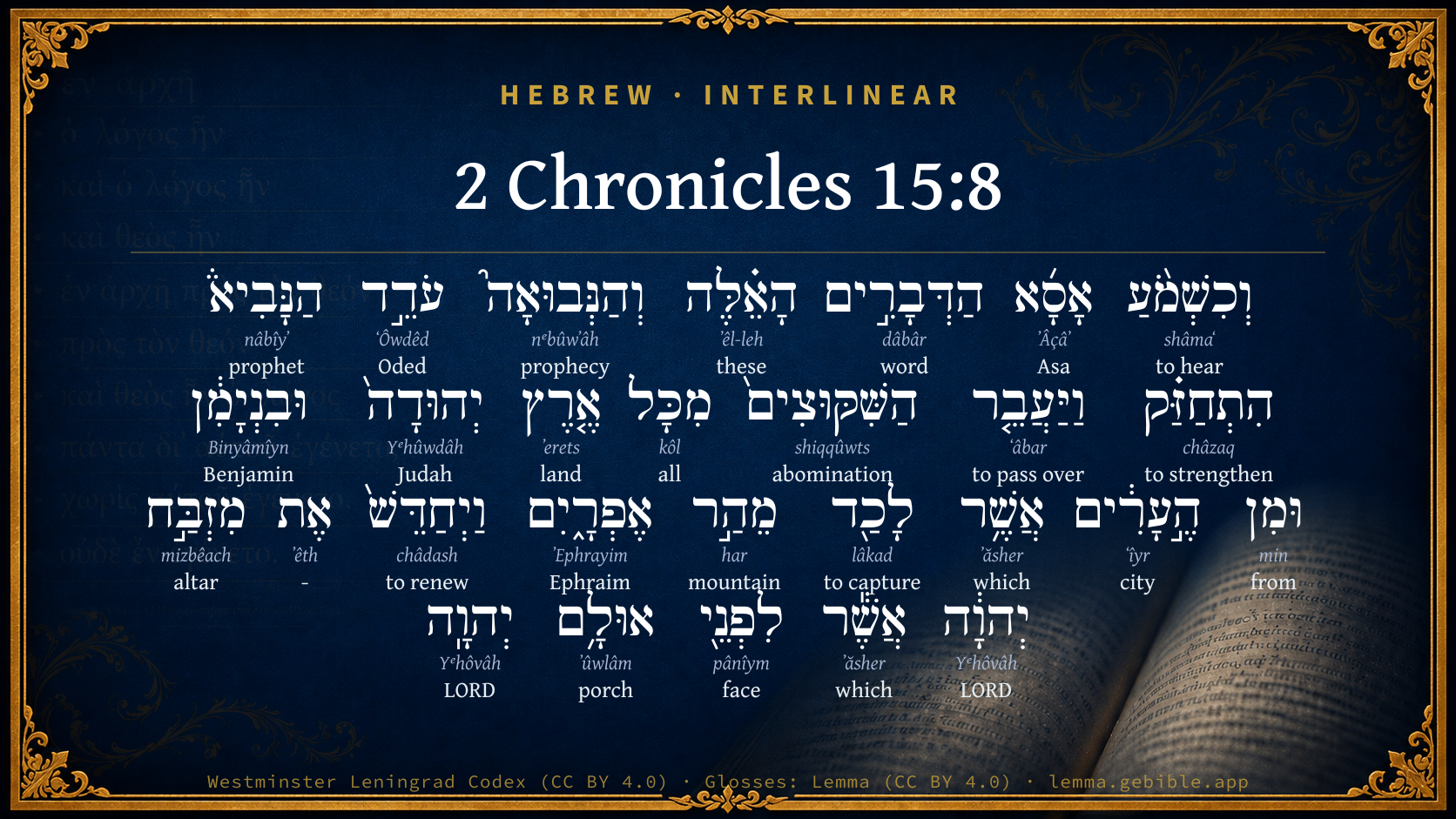
  1. וְכִשְׁמֹ֨עַ shâmaʻ H8085 “and · like/as · to hear” Conjunction + Preposition + Verb, Qal, Infinitive Construct
  2. אָסָ֜א ʼÂçâʼ H609 “Asa” Noun, Proper
  3. הַדְּבָרִ֣ים dâbâr H1697 “the · words” Particle, Definite Article + Noun, Common, Masculine, Plural, Absolute
  4. הָאֵ֗לֶּה ʼêl-leh H428 “the · these” Particle, Definite Article + Pronoun, Demonstrative, Common, Plural
  5. עֹדֵ֣ד ʻÔwdêd H5752 “Oded” Noun, Proper
  6. הַנָּבִיא֒ nâbîyʼ H5030 “the · prophet” Particle, Definite Article + Noun, Common, Masculine, Singular, Absolute
  7. הִתְחַזַּ֗ק châzaq H2388 “to strengthen” Verb, Hithpael, Perfect, 3rd Person, Masculine, Singular
  8. וַיַּעֲבֵ֤ר ʻâbar H5674 “and · to pass over” Conjunction + Verb, Hiphil, Sequential Imperfect, 3rd Person, Masculine, Singular
  9. הַשִּׁקּוּצִים֙ shiqqûwts H8251 “the · abominations” Particle, Definite Article + Noun, Common, Masculine, Plural, Absolute
  10. מִכָּל kôl H3605 “from · all of” Preposition + Noun, Common, Masculine, Singular, Construct
  11. אֶ֤רֶץ ʼerets H776 “land of” Noun, Common, Both, Singular, Construct
  12. יְהוּדָה֙ Yᵉhûwdâh H3063 “Judah” Noun, Proper
  13. וּבִנְיָמִ֔ן Binyâmîyn H1144 “and · Benjamin” Conjunction + Noun, Proper
  14. וּמִן min H4480 “and · from” Conjunction + Preposition
  15. הֶ֣עָרִ֔ים ʻîyr H5892 “the · cities” Particle, Definite Article + Noun, Common, Feminine, Plural, Absolute
  16. אֲשֶׁ֥ר ʼăsher H834 “which” Particle, Relative
  17. לָכַ֖ד lâkad H3920 “to capture” Verb, Qal, Perfect, 3rd Person, Masculine, Singular
  18. מֵהַ֣ר har H2022 “from · mountain of” Preposition + Noun, Common, Masculine, Singular, Construct
  19. אֶפְרָ֑יִם ʼEphrayim H669 “Ephraim” Noun, Proper
  20. וַיְחַדֵּשׁ֙ châdash H2318 “and · to renew” Conjunction + Verb, Piel, Sequential Imperfect, 3rd Person, Masculine, Singular
  21. אֶת ʼêth H853 “-” Particle, Direct Object
  22. מִזְבַּ֣ח mizbêach H4196 “altar of” Noun, Common, Masculine, Singular, Construct
  23. יְהוָ֔ה Yᵉhôvâh H3068 “LORD” Noun, Proper
  24. אֲשֶׁ֕ר ʼăsher H834 “which” Particle, Relative
  25. לִפְנֵ֖י pânîym H6440 “to/for · face(s) of” Preposition + Noun, Common, Both, Plural, Construct
  26. אוּלָ֥ם ʼûwlâm H197 “porch of” Noun, Common, Masculine, Singular, Construct
  27. יְהוָֽה Yᵉhôvâh H3068 “LORD” Noun, Proper

About this verse

These counts appear in no published source. They are computed here, from the morphology-tagged text and Lemma’s own curated glosses. What Lemma adds →

28
words
26
distinct lemmas
Historical
section

Notable vocabulary

The rarest word here is וְהַנְּבוּאָה֮ prophecy H5016 — appearing just 3 times in the whole Hebrew Bible.

Shared distinctive vocabulary

וְהַנְּבוּאָה֮ prophecy H5016 occurs in 3 verses of the Hebrew Bible. Also found in:

Grammatical profile

  • 5 verbs
  • 18 nouns
  • 1 pronoun
  • 1 preposition
  • 3 particles

Verb forms

  • וְכִשְׁמֹ֨עַ Qal · Infinitive Construct
  • הִתְחַזַּ֗ק Hithpael · Perfect
  • וַיַּעֲבֵ֤ר Hiphil · Sequential Imperfect
  • לָכַ֖ד Qal · Perfect
  • וַיְחַדֵּשׁ֙ Piel · Sequential Imperfect

Repetition

Words recur within this verse — often emphatic in Hebrew:

  • יְהוָ֔ה LORD H3068 ×2
  • אֲשֶׁ֥ר which H834 ×2

Hebrew & Septuagint length

In English translation the verse runs 57 words from the Hebrew and 56 from the Septuagint (LXX English) — closely comparable.

A rough comparison of the two English renderings, which tokenize alike — not a word-level alignment.

Word counts can differ between the Hebrew and the Greek without any difference in meaning — e.g. the Hebrew direct-object marker אֵת has no separate Greek word, and Greek often adds the article ὁ.

In the original languages it is 28 Hebrew tokens and 46 Greek tokens — but the two are counted differently (Hebrew bundles its prefixes and suffixes into one token; the Greek is in lemma form), so that isn’t a like-for-like length.

Cross-references

19

Topical passages linked to 2 Chronicles 15:8 in the Treasury of Scripture Knowledge — connected by theme and wording, ordered by reader-vote popularity; previews shown in the World English Bible.

  • 2 Chronicles 8:12 Then Solomon offered burnt-offerings to Yahweh on the altar of Yahweh, which he had built before the porch,
  • 2 Chronicles 13:19 Abijah pursued after Jeroboam, and took cities from him, Bethel with the towns of it, and Jeshanah with the towns of it, and Ephron with the towns of it.
  • 2 Chronicles 4:1 Moreover he made an altar of brass, twenty cubits the length of it, and twenty cubits the breadth of it, and ten cubits the height of it.
  • Leviticus 18:30 Therefore you shall keep my charge, that you do not practice any of these abominable customs, which were practiced before you, and that you do not defile yourselves with them: I am Yahweh your God.'"
  • Deuteronomy 27:15 Cursed be the man who makes an engraved or molten image, an abomination to Yahweh, the work of the hands of the craftsman, and sets it up in secret. All the people shall answer and say, Amen.
  • 1 Kings 11:5 For Solomon went after Ashtoreth the goddess of the Sidonians, and after Milcom the abomination of the Ammonites.
  • 1 Kings 11:7 Then did Solomon build a high place for Chemosh the abomination of Moab, on the mountain that is before Jerusalem, and for Molech the abomination of the children of Ammon.
  • 2 Kings 16:14 The brazen altar, which was before Yahweh, he brought from the forefront of the house, from between his altar and the house of Yahweh, and put it on the north side of his altar.
  • 2 Kings 18:22 But if you tell me, We trust in Yahweh our God; isn't that he whose high places and whose altars Hezekiah has taken away, and has said to Judah and to Jerusalem, You shall worship before this altar in Jerusalem?
  • 2 Kings 23:13 The high places that were before Jerusalem, which were on the right hand of the mountain of corruption, which Solomon the king of Israel had built for Ashtoreth the abomination of the Sidonians, and for Chemosh the abomination of Moab, and for Milcom the abomination of the children of Ammon, did the king defile.
  • 2 Chronicles 19:11 Behold, Amariah the chief priest is over you in all matters of Yahweh; and Zebadiah the son of Ishmael, the ruler of the house of Judah, in all the king's matters: also the Levites shall be officers before you. Deal courageously, and Yahweh be with the good.
  • 2 Chronicles 29:18 Then they went in to Hezekiah the king within [the palace], and said, We have cleansed all the house of Yahweh, and the altar of burnt offering, with all the vessels of it, and the table of show bread, with all the vessels of it.
  • Isaiah 44:14 He cuts down cedars for himself, and takes the cypress and the oak, and strengthens for himself one among the trees of the forest: he plants a fir tree, and the rain nourishes it.
  • Isaiah 65:4 who sit among the graves, and lodge in the secret places; who eat pig's flesh, and broth of abominable things is in their vessels;
  • Jeremiah 16:18 First I will recompense their iniquity and their sin double, because they have polluted my land with the carcasses of their detestable things, and have filled my inheritance with their abominations.
  • Ezekiel 8:10 So I went in and saw; and see, every form of creeping things, and abominable animals, and all the idols of the house of Israel, portrayed on the wall round about.
  • Acts 28:15 From there the brothers, when they heard of us, came to meet us as far as The Market of Appius and The Three Taverns. When Paul saw them, he thanked God, and took courage.
  • 1 Peter 4:3 For we have spent enough of our past time doing the desire of the Gentiles, and having walked in lewdness, lusts, drunken binges, orgies, carousings, and abominable idolatries.
  • Revelation 17:4–5 The woman was dressed in purple and scarlet, and decked with gold and precious stones and pearls, having in her hand a golden cup full of abominations and the impurities of the sexual immorality of the earth.

Cross-references courtesy of OpenBible.info (CC BY 4.0).

Hebrew and Greek witnesses Masoretic Hebrew ↔ Greek Septuagint

The same verse in the two great witnesses to the Old Testament, shown verse-for-verse.

These are two independent witnesses, not word-aligned to each other, and the Septuagint is shown in lemma (dictionary) form.

Hebrew 2 Chronicles 15:8 Masoretic · Westminster Leningrad Codex

וְכִשְׁמֹ֨עַ אָסָ֜א הַדְּבָרִ֣ים הָאֵ֗לֶּה וְהַנְּבוּאָה֮ עֹדֵ֣ד הַנָּבִיא֒ הִתְחַזַּ֗ק וַיַּעֲבֵ֤ר הַשִּׁקּוּצִים֙ מִכָּל אֶ֤רֶץ יְהוּדָה֙ וּבִנְיָמִ֔ן וּמִן הֶ֣עָרִ֔ים אֲשֶׁ֥ר לָכַ֖ד מֵהַ֣ר אֶפְרָ֑יִם וַיְחַדֵּשׁ֙ אֶת מִזְבַּ֣ח יְהוָ֔ה אֲשֶׁ֕ר לִפְנֵ֖י אוּלָ֥ם יְהוָֽה

When Asa heard these words, and the prophecy of Oded the prophet, he took courage, and put away the abominations out of all the land of Judah and Benjamin, and out of the cities which he had taken from the hill-country of Ephraim; and he renewed the altar of Yahweh, that was before the porch of Yahweh.

World English Bible · Public Domain

Greek LXX 2 Chronicles 15:8 Septuagint · lemma form

καί ἐν ὁ ἀκούω ὁ λόγος οὗτος καί ὁ προφητεία αδαδ ὁ προφήτης καί καταἰσχύω καί ἐκβάλλω ὁ βδέλυγμα ἀπό πᾶς ὁ γῆ ἰουδά καί βενιαμίν καί ἀπό ὁ πόλις ὅς καταἔχω ἐν ὄρος ἐφράιμ καί ἐνκαινίζω ὁ θυσιαστήριον κύριος ὅς εἰμί ἔμπροσθεν ὁ ναός κύριος

And when Asa heard these words, and the prophesy of Adad the prophet, then he strengthened himself, and cast out the abominations from all the land of Juda and Benjamin, and from the cities which Jeroboam possessed, in mount Ephraim, and he renewed the altar of the Lord, which was before the temple of the Lord.

LXX2012 (modern English Septuagint) · Public Domain

On this verse, Ellicott's Commentary for English Readers discusses the Septuagint’s reading. Read the note in Commentary ↓

Hebrew: Westminster Leningrad Codex (CC BY 4.0). Greek: Septuagint (public domain); English from LXX2012 (modern English Septuagint) (Public Domain). How the Septuagint differs from the Hebrew →

Commentary

Notes on 2 Chronicles 15:8 from classic Christian and Jewish commentators (each source and its license shown beneath its notes). The classic Christian expositions comment on the surrounding passage and are grouped to its opening verse, so a note may address several verses; the Jewish commentaries on the Tanakh (Rashi and others) are per-verse, so they appear only where the commentator wrote on this verse.

Lemma curates 59 commentaries, every one of them public domain or Creative Commons licensed, each selected and text-cleaned for this edition rather than reprinted as found. About our sources →

Matthew Henry's Commentary

We are here told what good effect the foregoing sermon had upon Asa.

I. He grew more bold for God than he had been. His victory would inspire him with some new degrees of resolution, but this message from God with much more. Now he took courage. he saw how necessary a further reformation was, and what assurance he had of God's presence with him in it; and this made him daring, and helped him over the difficulties which had before deterred him and driven him off from the undertaking. Now he ventured to destroy all the abominable idols (and all idolatries are abominable, Pe1 4:3) as far as ever his power went. Away with them all. He also renewed the altar of the Lord, which, it seems, had gone out of repair, though it was not above thirty-five years since Solomon's head was laid, who erected it. So soon did these ceremonial institutions begin to wax old, as things which, in the fulness of time, must vanish away, Heb 8:13.

II. He extended his influence further than before, Ch2 15:9. He summoned a solemn assembly, and particularly brought the strangers to it, who had come over to him from the ten tribes. 1. Their coming was a great encouragement to him; for the reason of their coming was because they saw that the Lord his God was with him. It is good to be with those that have God with them, to come into relation to, and contract acquaintance and friendship with, those that live in the fear and favour of God. We will go with you, for we have heard that God is with you, Zac 8:23. 2. The cognizance he took of them, and the invitation he gave them to the general assembly, were a great encouragement to them. All strangers are to be helped, but those that cast themselves upon God's good providence, purely to keep a good conscience, are worthy of double honour. Asa gave orders for the gathering of them together (Ch2 15:9), yet it is said (Ch2 15:10) that they gathered themselves together, made it their own act, so forward were they to obey the king's orders. This meeting was held in the third month, probably at the feast of Pentecost, which was in that month.

III. He and his people offered sacrifices to God, as his share of the spoil they had got, Ch2 15:11. Their offering here was nothing to Solomon's (Ch2 7:5), which was owing to the diminution either of their zeal or of their wealth, or of both. These sacrifices were intended by way of thanksgiving for the favours they had received, and supplication for further favours. Prayers and praises are now our spiritual sacrifices. And, as he took care that the altar should have its gift, so he took care that the temple should have its gold: He brought into the house of God all the dedicated things, Ch2 15:18. It is honesty to render to God the things that are his. What has been long designed for him, and long laid by for him, as it should seem these dedicated things had been, should at length be laid out for him. Will a man rob God, or make slow payment to him, who is always ready to do us good?

IV. They entered into covenant with God, repenting that they had violated their engagements to him and resolving to do better for the future. It is proper for penitents, for converts, to renew their covenants. It should seem, the motion came not from Asa, but from the people themselves. Let every man be a volunteer that covenants with God. Thy people shall be willing, Psa 110:3. Observe,

1. What was the matter of this covenant. Nothing but what they were before obliged to; and, though no vow or promise of theirs could lay any higher obligation upon them than they were already under from the divine precept, yet it would help to increase their sense of the obligation, to arm them against temptations, and would be a testimony to the equity and goodness of the precept. And, by joining all together in this covenant, they strengthened the hands one of another. Two things they engaged themselves to: - (1.) That they would diligently seek God themselves, seek his precepts, seek his favour. What is religion but seeking God, enquiring after him, applying to him, upon all occasions? We shall not enjoy him till we come to heaven; while we are here we must continue seeking. They would seek God as the God of their fathers, in the way that their fathers sought him and in dependence upon the promise made to their fathers; and they would do it with all their heart and with all their soul, for those only seek God acceptably and successfully that are inward with him, intent upon him, and entire for him, in their seeking him. We make nothing of our religion if we do not make heart-work of it. God will have all the heart or none; and, when a jewel of such inestimable value as the divine favour is to be found, it is worth while to seek it with all our soul. (2.) That they would, to the utmost of their power, oblige others to seek him, Ch2 15:13. They agreed that whosoever would not seek the Lord God of Israel (that is, would either worship other gods or refuse to join with them in the worship of the true God, that was either an obstinate idolater or an obstinate atheist) he should be put to death. This was no new law of their own making, but an order to put in execution that law of God to this purport, Deu 17:2, etc. If this law had been duly executed, there would not have been so many abominable idols found in Judah and Benjamin, Ch2 15:8. Whether men may now, under the gospel, be compelled by such methods as these to seek the Lord is justly questioned; for the weapons of our warfare are not carnal, and yet mighty.

2. In what manner they made this covenant. (1.) With great cheerfulness, and all possible expressions of joy: The swore unto the Lord; not secretly, as if they were either ashamed of what they did or afraid of binding themselves too fast to him, but with a loud voice, to express their own zeal and to animate one another; and they all rejoiced at the oath, Ch2 15:14, Ch2 15:15. They did not swear to God with reluctancy (as the poor debtor confesses a judgment to his creditor), but with all the pleasure and satisfaction imaginable, as the bridegroom plights his troth to the bride in the marriage covenant. Every honest Israelite was pleased with his own engagements to God, and they were all pleased with one another's. They rejoiced in it as a hopeful expedient to prevent their apostasy from God and a happy indication of God's presence with them. Note, The times of renewing our covenant with God should be times of rejoicing, and national reformation cannot but give general satisfaction to all that are good. It is an honour and happiness to be in bonds to God. (2.) They did it with great sincerity, zeal and resolution: They swore to God with all their hearts, and sought him with their whole desire. The Israelites were now in an extraordinarily good frame. O that there had always been such a heart in them! This comes in as the reason why they rejoiced so much in what they did: it was because they were hearty in it. Note, Those only experience the pleasure and comfort of religion that are sincere and upright in it. What is done in hypocrisy is a mere drudgery. But, if God has the heart, we have the joy.

V. We are told what was the effect of this their solemn covenanting with God. 1. God did well for them: He was found of them, and gave them rest round about (Ch2 15:15), so that there was no war for a long time after (Ch2 15:19), no open general war, though there were constant bickerings between Judah and Israel upon the frontiers, Kg1 15:16. National piety procures national blessings. 2. They did, on the whole, well for him. They carried on the reformation so far that Maachah the queen-mother was deposed for idolatry and her idol destroyed, Ch2 15:16. This was bravely done of Asa, that he would not connive at idolatry in those that were nearest to him, like Levi, that said to his father and mother, I have not seen him, Deu 33:9. Asa knows he must honour God more than his grandmother, and dares not leave an idol in an apartment of his palace while he is destroying idols in the cities of his kingdom. We may suppose this Maachah was so far convinced of her sin that she was willing to subscribe the association mentioned (Ch2 15:12, Ch2 15:13), binding herself to seek the Lord, and therefore was not put to death as those were that refused to sign it, great as well as small, women as well as men: probably it was with an eye to her that women were specified. But because she had been an idolater Asa thought fit to divest her of the dignity and authority she had, and probably he banished her the court and confined her to privacy, lest she should influence and infect others. But the reformation was not complete; the high places were not all taken away, though many of them were, Ch2 14:3, Ch2 14:5. Those in the cities were removed, but not those in the cities of Judah, but not those in the cities of Israel which were reduced to the house of David; or those that were used in the service of false gods, but not those that were used in the service of the God of Israel. These he connived at, and yet his heart was perfect. There may be defects in some particular duties where yet the heart, in the man, is upright with God. Sincerity is something less than sinless perfection.

Matthew Henry's Commentary on the Whole Bible (1708–1710) — public domain (CC PDM 1.0). Text via the HelloAO Bible API.

Ellicott's Commentary for English Readers

(b) THE REFORM OF WORSHIP, AND PUBLIC RENEWAL OF THE COVENANT

(2Ch_15:8-15).

(8) And the prophecy of Oded the prophet.—Heb., And the prophecy Oded the prophet; without any connection. This is suspicious, and suggests the idea that “Oded the prophet” is a marginal gloss, which has crept into the text; especially as, according to 2Ch_15:1, not Oded, but Azariah son of Oded, was the author of the prophecy. Possibly there is a lacuna, and the original text ran: “And the prophecy which Azariah son of Oded, the prophet, spake.” There is no variation in Heb. MSS., and the readings of the versions only show that the difficulty is ancient. (LXX., Vatic., “the prophecy of Adad the prophet; “but in 2Ch_15:1 : “Azarias son of Oded;” Alex., “Azarias son of Adad the prophet;” Syr., “Azariah son of Azur;” Vulg., “Azariah son of Oded the prophet.”) these words and the prophecy, i.e., these words, even (or, that is) the prophecy. Epexegetical use of the conjunction.

He took courage.—Hithchazzaq, strengthened himself (2Ch_12:13). The same verb as be strong chizqû), 2Ch_15:7.

And put away.—Removed (1Ki_15:12).

The abominable idols.—Abominations (shiqqûtsim): one of the many terms of contempt applied (to idols (Deu_29:17; 1Ki_11:5; 1Ki_11:7; Jer_4:1).

The cities which he had taken from mount Ephraim.—The hill-country of Ephraim. In 2Ch_17:2 we read again: “the cities of Ephraim, which Asa had taken.” It is generally assumed that in both passages there is a somewhat inaccurate reference to the conquests of Abijah recorded in 2Ch_13:19; for hitherto Asa had had no wars with the northern kingdom (2Ch_14:1; 2Ch_14:6; 2Ch_15:19). But Asa may have annexed some of the towns on his northern border without resistance, after his victory over Zerah. (Comp. the voluntary immigration into Judah described in 2Ch_15:9.) Thenius, who fixes the date of Baasha’s attempt before the Cushite invasion, says that Asa seems to have assumed the offensive after Baasha’s retreat from Ramah.

And renewed the altar.—The context seems to imply that this “renewal” consisted in reconsecration, the altar having been defiled by an illegal cultus. So the LXX. and Vulg., ἐνκάινισε, dedicavit. The word, however, may only mean repaired, restored. The altar had now stood sixty years. (Comp. 2Ch_24:4.)

A Bible Commentary for English Readers, edited by Charles John Ellicott (1878–1897) — public domain. Text from a community e-Sword module.

Trapp's Complete Commentary

John Trapp

2Ch 15:8 And when Asa heard these words, and the prophecy of Oded the prophet, he took courage, and put away the abominable idols out of all the land of Judah and Benjamin, and out of the cities which he had taken from mount Ephraim, and renewed the altar of the LORD, that [was] before the porch of the LORD.

Ver. 8. And when Asa heard these words.] He was zealous for God before, but now his heart, was all on a light flame for God. "Did not our hearts burn within us, whilst he opened unto us the Scriptures?" said those two disciples travelling to Emmaus. {Luk 24:32} Together with Christ’s words there went forth a power. {Luk 5:15}

And the prophecy of Oded.] That is, Of Azariah, son of Oded.

He put away the abominable idols.] St Peter speaketh of "abominable idolatry." {1Pe 4:3} Some Papists would hence infer that there is some idolatry not abominable, so loath are idolaters that their asses’ ears should be seen. Some think that Asa now purged out this abomination, quaestione domesticatim habita, {a} by narrow search made from house to house.

And out of the cities which he had taken from mount Ephraim.] Where the Ethiopians haply had left some of their spawn, as toads and other vermin leave their slime and filth congealed behind them.

And renewed the altar of the Lord,] i.e., Repaired it, being decayed, and offered on it very many sacrifices.

{a} Jun.

John Trapp, A Commentary or Exposition upon All the Books of the Old and New Testament (1647–1656) — public domain. Text from a community e-Sword module.

Joseph Benson's Commentary

2Ch 15:8. When Asa heard these words of Oded the prophet — Of Azariah, the son of Oded, who was also called by his father’s name; he took courage — For it required great courage to put away all the idols, to which so great a number of his people were still attached, and among others Maachah, the queen, his mother, whom, for this reason, he deposed, 1Ki 15:13. And out of the cities which he had taken — Or, which had been taken, namely, by Abijah his father. And renewed the altar of the Lord — Which had been either decayed by time and long use of it, or broken by his idolatrous mother’s means. Or the expression may signify, He consecrated, or dedicated, the altar, &c., which, possibly, had been polluted by idolaters, and now needed some purification.

Joseph Benson's Commentary on the Old and New Testaments (1811–1818) — public domain. Text from a community e-Sword module.

Whedon's Commentary on the Bible

Daniel D. Whedon

ASA’S REFORMS AND RENEWAL OF THE COVENANT, 2Ch_15:8-19.

8. And the prophecy of Oded the prophet — Here is doubtless a corruption in the text. Either the words of Oded should be omitted, as an interpolation, or else the words Azariah the son (see 2Ch_15:1) should be supplied.

Took courage — Azariah’s oracle inspired the king with a zeal and enthusiasm even additional to that occasioned by the recent marvellous victory.

Put away the abominable idols — This effort to clear his realm of idolatry is probably not to be identified with his earlier work of reform described in 1Ch_14:3, but a later effort, inspired and encouraged by his victory over Zerah and by the words of the prophet. It may have been that his earlier efforts were only partially successful, and that Azariah’s oracle reminded him that much remained to be done in the work of reform.

The cities which he had taken from mount Ephraim — The cities which his father had taken from Jeroboam. 2Ch_13:19. The writer, in his hasty brevity of narration, attributed to Asa what was really the work of his father. See a similar inaccuracy in 2Ch_17:2.

Renewed the altar — The great brazen altar described in 1Ch_4:1, which stood in the priests’ court before the porch of the temple. Some sixty years had passed since the temple was built, and this altar may, for that reason, have needed repair; or it may have been polluted by idolatry, and therefore needed renewal.

Daniel D. Whedon (gen. ed.), Commentary on the Old and New Testaments (1874–1909) — public domain. Text from a community e-Sword module.

Keil & Delitzsch

C. F. Keil & F. Delitzsch

Completion of the reform in worship, and the renewal of the covenant. - Ch2 15:8. The speech and prophecy of the prophet strengthened the king to carry out the work he had begun, viz., the extirpation of idolatry from the whole land. In Ch2 15:8 the words הנּניא עדד are surprising, not only because the prophet is called in Ch2 15:1, not Oded, but Azariah the son of Oded, but also on account of the preceding הנּבוּאה in the absolute state, which cannot stand, without more ado, for the stat. constr. נבוּאת (cf. Ch2 9:29). The view of Cler. and Ew., that by an orthographical error בּן עזריהוּ has been dropped out, does not remove the difficulty, for it leaves the stat. absol. הנּבוּאה .lo unexplained. This is also the case with the attempt to explain the name Oded in Ch2 15:8 by transposing the words Azariah ben Oded, Ch2 15:1, so as to obtain Oded ben Azariah (Movers); and there seems to be no other solution of the difficulty than to strike out the words Oded the prophet from the text as a gloss which has crept into it (Berth.), or to suppose that there is a considerable hiatus in the text caused by the dropping out of the words בּן עזריהוּ דּבּר אשׁר.

(Note: C. P. Caspari, der Syrisch-ephraimitische Krieg, Christian. 1849, S. 51, explains the absol. הנּבוּאה by an ellipse, as in Isa 3:14; Isa 8:11, "the prophecy (that) of Oded," but answers the question why Oded is used in Ch2 15:8 instead of Azarjahu ben Oded by various conjectures, none of which can be looked upon as probable.)

התחזק corresponds to חזקוּ. Asa complied with the exhortation, and removed (ויּעבר, as in Kg1 15:12) all abominations (idols) from the whole land, and from the cities which he had taken from Mount Ephraim: these are the cities which Asa's father Abijah had conquered, Ch2 13:19. "And he renewed the altar before the porch," i.e., the altar of burnt-offering, which might stand in need of repairs sixty years after the building of the temple. The Vulg. is incorrect in translating dedicavit, and Berth. in supposing that the renovation refers only to a purification of it from defilement by idolatry. חדּשׁ is everywhere to renew, repair, restaurare; cf. Ch2 24:4. - But in order to give internal stability to the reform he had begun, Asa prepared a great sacrificial festival, to which he invited the people out of all the kingdom, and induced them to renew the covenant with the Lord. Ch2 15:9. He gathered together the whole of Judah and Benjamin, and the strangers out of Ephraim, Manasseh, and Simeon, who dwelt among them. Strangers, i.e., Israelites from the ten tribes, had come over as early as Rehoboam's reign to the kingdom of Judah (Ch2 11:16); these immigrations increased under Asa when it was seen that Jahve was with him, and had given him a great victory over the Cushites. It is surprising that Simeon should be mentioned among the tribes from which Israelites went over to the kingdom of Judah, since Simeon had received his heritage in the southern district of the tribal domain of Judah, so that at the division of the kingdom it would not well separate itself from Judah, and join with the tribes who had revolted from the house of David. The grouping together of Simeon, Ephraim, and Manasseh, both in our verse and in Ch2 34:6, can consequently scarcely be otherwise explained than by the supposition, either from the cities assigned to them under Joshua into districts in the northern kingdom (Berth.), or that the Simeonites, though politically united with Judah, yet in religious matters were not so, but abstained from taking part in the Jahve-worship in Jerusalem, and had set up in Beersheba a worship of their own similar to that in Bethel and Dan. In such a case, the more earnest and thoughtful people from Simeon, as well as from Ephraim and Manasseh, may have gone to Jerusalem to the sacrificial festival prepared by Asa. In favour of this last supposition we may adduce the fact that the prophet Amos, Amo 5:5; Amo 4:4; Amo 8:14, mentions Beersheba, along with Bethel and Gilgal, as a place to which pilgrimages were made by the idolatrous Israelites.

Keil & Delitzsch — Biblical Commentary on the Old Testament (1861–1891) — public domain (CC PDM 1.0). Text via the HelloAO Bible API. (Old Testament only.)

Tyndale Open Study Notes

Tyndale Open Resources

15:8-18 The Chronicler described Asa’s response in the precise terms of the prophet’s exhortation, but Asa’s specific actions went far beyond its general directives. As soon as Asa heard the prophetic words, he took courage in initiating a comprehensive reform, beginning with the removal of the detestable idols that again infested the land (see 14:5). Full trust in God had won the war against the Cushites, and total renewal of the covenant brought the Promised Land to rest (15:15).

15:8 The towns he had captured in the hill country of Ephraim were those conquered in his war with Baasha (16:1). There was continuous warfare between Baasha and Asa (see 1 Kgs 15:16).

Tyndale Open Study Notes — © Tyndale Open Resources, licensed CC BY-SA 4.0. Text via the HelloAO Bible API.

Jamieson, Fausset & Brown

Robert Jamieson, A. R. Fausset & David Brown

when Asa heard . . . the prophecy of Oded the prophet--The insertion of these words, "of Oded the prophet," is generally regarded as a corruption of the text. "The sole remedy is to erase them. They are, probably, the remains of a note, which crept in from the margin into the text" [BERTHEAU].

he took courage--Animated by the seasonable and pious address of Azariah, Asa became a more zealous reformer than ever, employing all his royal authority and influence to extirpate every vestige of idolatry from the land.

and out of the cities which he had taken from mount Ephraim--He may have acquired cities of Ephraim, the conquest of which is not recorded (Ch2 17:2); but it has been commonly supposed that the reference is to cities which his father Abijah had taken in that quarter (Ch2 13:19).

renewed the altar of the Lord . . . before the porch--that is, the altar of burnt offering. As this was done on or about the fifteenth year of the reign of this pious king, the renewal must have consisted in some splendid repairs or embellishments, which made it look like a new dedication, or in a reconstruction of a temporary altar, like that of Solomon (Ch2 7:7), for extraordinary sacrifices to be offered on an approaching occasion.

Jamieson, Fausset & Brown — Commentary Critical and Explanatory on the Whole Bible (1871) — public domain (CC PDM 1.0). Text via the HelloAO Bible API.

Adam Clarke's Commentary

Verse 8. Renewed the altar] Dedicated it afresh, or perhaps enlarged it, that more sacrifices might be offered on it than ever before; for it cannot be supposed that this altar had no victims offered on it till the fifteenth year of the reign of Asa, who had previously been so zealous in restoring the Divine worship.

Adam Clarke's Commentary on the Bible (1810–1826) — public domain. Text from a community e-Sword/MySword module.

The Cambridge Bible for Schools and Colleges

gen. ed. J. J. S. Perowne

8. and the prophecy of Oded the prophet] Some words have fallen out of the text. Read, Even the prophecy which Azariah the son of Oded prophesied.

the abominable idols] R.V. the abominations; cp. 1Ki_14:23-24; 1Ki_15:12-13.

mount Ephraim] R.V. the hill country of Ephraim. The term describes the hilly country between the plain of Esdrelon and the territory of Benjamin.

that was before the porch] Cp. 2Ch_7:7; 2Ch_8:12.

The Cambridge Bible for Schools and Colleges (gen. ed. J. J. S. Perowne; Cambridge University Press, 1878–1918) — public domain. Text from a community e-Sword module.

John Gill's Exposition

And when Asa heard these words, and the prophecy of Oded the prophet,.... Some think that besides the above words of Azariah the son of Oded, a prophecy of Oded his father was related by him, though not recorded; but rather Oded here is the same with the son of Oded; and so the Vulgate Latin and Syriac versions read Azariah the son of Oded; and so does the Alexandrian copy of the Septuagint version:

he took courage, and put away the abominable idols out of all the land of Judah and Benjamin; which were abominable to God, and all good men; besides the images and statues he had broken before, he removed other idols that remained, being animated and emboldened by the speech of the prophet:

and out of the cities which he had taken from Mount Ephraim: the same which his father Abijah had taken from Jeroboam, Ch2 13:19 and which perhaps, upon the approach of the Ethiopians, revolted from Asa, or were restored by them to Jeroboam, and Which Asa retook upon his conquest of them:

and renewed the altar of the Lord before the porch of the Lord; the altar of burnt offering, which had never been repaired since it was made by Solomon; perhaps he anew overlaid it with brass that being worn out, or become very thin in some places.

John Gill's Exposition of the Whole Bible (1746–1763) — public domain (CC PDM 1.0). Text via the HelloAO Bible API.

Albert Barnes' Notes on the Bible

Some versions have “the prophecy of Azariah the son of Oded,” which is perhaps the true reading.

Albert Barnes' Notes on the Bible (1834–1885) — public domain. Text from a community e-Sword/MySword module.

Haydock's Catholic Bible Commentary

Azarias, the son, is omitted in Hebrew and the Vatican Septuagint, which reads Adad, (Haydock) but it is supplied in the other editions, and in the Syriac, (Calmet) as [in] ver. 1. (Haydock) --- Taken: we do not read on what occasion, chap. xvii. 2. His father had seized upon Bethel, &c., chap. xiii. 19. (Calmet) --- Yet Asa waged war himself with the king of Israel. --- Dedicated. Septuagint, "renewed," as the altar had been neglected, or injured by the continual fire; (Menochius) or this was the extraordinary (Haydock) altar, which Solomon had used at the dedication of the temple. The multitude of Asa’s victims required more than one, ver. 11. It is not probable that God’s worship had been neglected till the 15th year of this pious king, (ver. 9) since even his wicked father was punctual in this respect, chap. xiii. 11. Before, at the higher end of the priests’ court, to the east of the altar of holocausts. (Calmet)

George Leo Haydock (1774–1849), Haydock's Catholic Family Bible and Commentary, 1859 edition — public domain. Excludes Psalms (Douay-Rheims chapter numbering differs from Protestant) and Deuterocanonical books (Catholic canon only).

Matthew Poole's English Annotations

Of Oded the prophet, to wit, of Azariah, 2Ch 15:1, who was also called by his father’s name Oded. Or Oded may be here put patronymically for the son of Oded; as David is put for Christ the Son of David, Jer 30:9, and elsewhere; and Moses for the sons of Moses, Psa 90:1. Or here is an ellipsis of the relative word, of which there are many instances both in sacred and profane authors; as 2Sa 21:19, the brother of Goliath; Mat 4:21, James the son of Zebedee; Luk 24:10, Mary the mother of James, by comparing Mar 15:40; Joh 19:25, Mary the wife of Cleophas, and many other places. And so this place may be thus read,

when Asa heard these words, even the prophecy of the son of Oded the prophet. And this ellipsis is the more easy and tolerable, because this defect might be well enough understood and supplied out of 2Ch 15:1. Though some understand this to be another prophecy of Oded the father, which is not here expressed, which Azariah his son repeated to them for the confirmation of his own prophecy.

He took courage; for it required great courage to put away all the idols, to which so great a number of his people were to this day addicted, and, among others, Maachah the queen, his mother, whom for this reason he deposed, 1Ki 15:13.

The cities which he had taken, to wit, Abijah his father; which was easily understood from 2Ch 13:19. Or, which had been taken; the active word being oft so used impersonally for the passive, as Hebricians know.

Renewed the altar of the Lord; which had been either decayed through age and long use of it, or broken by his idolatrous mother’s means. Or, he consecrated or dedicated the altar, &c.; which possibly had been polluted by idolaters, and now needed some purification.

Matthew Poole's English Annotations on the Holy Bible (1683–1685) — public domain. Text from a community e-Sword/MySword module.

The Pulpit Commentary

These words and the prophecy. In addition to what is said under ver. 1 on the question of the occurrence here of the name Oded, where we should have looked for the name Azariah, it may be noted that it is open to possibility that "these words" certainly referring to the language of Azariah, the "prophecy" may have in view some quotation more or less well known from Oded, satisfied by the latter part of ver. 2 or By ver. 7. This is not very likely; still, the conjunction "and" would thereby better account for itself. Nevertheless, it would still remain that the word "prophecy" is not in construct but absolute state, and we cannot count the difficulty removed, comparatively unimportant as it may be. He took courage, and put away, etc. These words may express either Asa"s accomplishing of the reforms spoken of in the former chapter (vers. 3-5), or quite as probably his perseverance and renewed diligence and vigour in the same; the language, "he took courage," favours this latter view. The cities which he had taken from, etc. Some say that the reference here and 2Ch_17:2 also must be understood to be to Abijahs victory and spoils, (2Ch_13:19) and that these two places must accordingly be in slight error. If this passage had stood alone, this view might have been more easy to accept, but the words in 2Ch_17:2 explicitly state that Asa had taken such cities, and the mere fact that the history does not record when, nor even show any very convenient gap into which Asa"s taking of such cities after conflict with Israel might well fit in, can scarcely be allowed to override the direct assertion of 2Ch_17:2. (comp. 2Ch_16:11) At the same time, the work that would devolve on Asa in holding the cities his father Abijah had first taken, may easily account for all, and have been accounted Asa"s taking, in the sense of taking to them, or retaking them. Renewed the altar. The altar, the place of which was before the porch, was the altar of burnt offering. The Hebrew for "renewed" is vDeji. The Vulgate translates insufficiently dedicavit. Bertheau thinks the renewal designs simply the purification of it from idolatrous defilements, although he admits that this is to assume that it had been defiled by idolatrous priests. Keil says the altar might well need genuine repair after the lapse of sixty years from the building of the temple. Of the nine occurrences of the word. five are metaphorical( as e.g. , (Psa_51:10) but of the remaining four distinctly literal uses, including the present, three must mean just strictly "repair" (2Ch_24:4, 2Ch_24:12; Isa_61:4) and the probability maytherefore be that such is the meaning now. Many, however, prefer the other view. The work of Ass, as described in 2Ch_14:3-5, was one of taking away, breaking down, and cutting down; but this item shows it now, in his fifteenth year, become also one of renewing. and repairing. The porch of (so 2Ch_29:17; 1Ki_7:6, 1Ki_7:7, 1Ki_7:12; Eze_40:7) Ya, though in construct state, the kametz impure.

Vers. 8-19.

Ancient covenanters.

I SERIOUS PREPARATIONS. (Vers, 8-11.)

1. The purgation of the land from idols. Encouraged by the words of the son of Oded not Oded, as in the text Asa, on reaching his capital, determined to convene a national assembly, and enter into a solemn league and covenant to carry out the work of reformation so auspiciously begun, (2Ch_14:2-5) and so manifestly owned of Jehovah in the splendid victory he had granted over the Cushite invader. (2Ch_14:12) As a preliminary, he "put away the abominations," i.e. the idols, "from the whole land of Judah and Benjamin, and out of the cities he had taken from the hill country of Ephraim." In the same spirit acted Jacob, before going up to meet with Jehovah at Bethel; (Gen_35:2) and Moses, before the interview of Israel with Jehovah at Sinai; (Exo_19:14) Hezekiah, before he celebrated the Passover; (2Ch_30:14) and Josiah, before he renewed the covenant. (2Ch_34:3-7) If such preparation on the part of Israel was needful to qualify her for an interview with Jehovah even in external celebrations, (Amo_4:12) much more is a similar preparation of the heart indispensable on the part of souls who come before God in any act of spiritual worship (2Ch_19:3 2Ch_20:33; 1Sa_7:3; Psa_57:7; Luk_1:17) In particular, all known sin must be abandoned. (Isa_1:16, Isa_1:17)

2. The renewal of the altar of the Lord. The great brazen altar of Solomon (2Ch_4:1) had probably been defiled by idol-rites during preceding reigns, and required reconsecration (Bertheau); while, after sixty years of service, it almost certainly stood in need of repairs (Keil). Most likely Asa"s renovation of the altar was of both kinds an external reparation and a religious consecration. It is commonly a sign that a Church or nation is in earnest in entering upon religious reformation when it attends to the externals as well as to the internals of religion when it corrects abuses, repairs defects, and adds improvements in the outward means of grace, as well as endeavours to impart to these fresh attractiveness and zeal Individuals begin not well who neglect to engage all their powers of body, mind, and heart in the work, or to seek for these a new and gracious baptism from above. (Rom_12:1)

3. The invitation of the people to a national assembly. Without the hearty consent and cooperation of the people, reforms of no kind can be effected as little religious as political or social, and just as little these as those.Accordingly, all Judah and Benjamin, with such Israelites as sympathized with the new movement, were summoned to Jerusalem on a certain day to covenant to seek Jehovah. As early as the days of Rehoboam, strangers from the northern kingdom had found their way into the southern (; (2Ch_11:16) Asa"s victory over Zerah having been accepted as a proof that Jehovah was on the side of Judah"s king, the number of these immigrants largely increased (ver. 9). What was wanted then in Judah and Israel to rally the pious is demanded still a leader, who has God upon his side, because he is on the side of God.

4. The gathering of the pious in Jerusalem. It showed the spirit of the people that they responded at once to their monarch"s call. Followers that will not follow are a hindrance to those who would lead in reformations in either Church or state, Union is strength, and generally victory; disunion weakness, and always defeat.

II SOLEMN TRANSACTIONS. (Vers. 12-14.)

1. The presentation of the spoils. These, seven hundred oxen and seven thousand sheep, formed part of the plunder taken from Zerah"s army, (2Ch_14:14, 2Ch_14:15) and were now presented to Jehovah; as Abraham gave tithes to Melchizedek on returning from the slaughter of the kings; (Gen_14:20) as the Israelites in the wilderness after the slaughter of the Midianites levied a tribute unto the Lord; (Num_31:11-47) as Saul said he intended to sacrifice unto the Lord the sheep and oxen he had reserved from the spoil of the Amalekites; (1Sa_15:21) and as victorious generals among the Romans were accustomed to dedicate to Jupiter part of the spoils taken from the enemy (Adam"s Roman Antiquities," p. 327). As Asa"s victory had been achieved solely through Divine help, this was becoming as well as right. Those whom God renders successful in their callings should honour him with the firstfruits of their increase. (Pro_3:9) Every man as God hath prospered him, a rule of Christian giving. (1Co_16:2)

2. The formation of a covenant.

(1) The object twofold.

(a) "To seek the Lord God of their fathers," etc. (ver. 12) a right thing for nations and individuals to do yea, for all, whether they covenant with and swear to one another concerning it or not. To seek God, a nation"s and individual"s life (Isa_55:3, Isa_55:6; Psa_69:32; Amo_5:4) and the only source of true prosperity for either (Psa_70:4; Amo_8:14; Lam_3:25) That the god a nation or an individual seeks is the god of his or its fathers, is no proof that that god is the true God; but, being the true God, he possesses an additional claim on the worship and homage of both individual and nation, from the fact that he is and has been their fathers" God. If God is to be sought at all, it should be with the whole heart. (Jer_29:13) Nothing short of this is religion (Deu_11:13 Deu_13:3; Mat_22:37; Mar_12:30, 33; Luk_10:27)

(b) To "put to death," etc. (ver. 13). Under the theocracy religious toleration was impossible, for the reason that idolatry was high treason. "A theocratic government is a government of constraint. Freedom of conscience would have been an unmeaning sound under the Jewish economy" (Pressense, Early Years of the Christian Church," vol. 1. p. 36). Church and state in Judah were one. No such identification existed among heathen nations, though approximations towards it were often seen. Nor does such identification exist under the gospel. Hence neither Church nor state now has authority to put to death those who decline the religion prescribed by either. The reformed Churches of England and Scotland were slow in perceiving that the extermination of heretics by the sword of the civil magistrate, however legitimate under the Jewish theocracy, was not permissible in the Church of Jesus Christ. Under the gospel God alone is Lord of the conscience; and to each man pertains the right of choosing his own religion, his own creed, and his own worship, without dictation, not to say coercion, from either king or parliament being answerable for the choice he makes in the first place to his own conscience, and in the last place to God, whose creature and subject he is. This is the doctrine of religious equality, which should be carefully distinguished from that of religious toleration, which proceeds upon the erroneous assumption that Church and state possess the right, but decline to exercise the power of coercion, and agree to allow, what they might justly put down, diversity of faith and practice in religion.

(2) The form simple. "They sware unto the Lord;" i.e. bound themselves with an oath to carry out the twofold purpose above described. This they did with enthusiasm (ver. 14), which is always good in a good, (Gal_4:18) and especially good in religion (Luk_13:24; Joh_9:4; Eph_5:16; Heb_6:11)

(3) The scene impressive. In more points than one this high transaction under Asa had a parallel in the National Covenant, which was formed by the Scottish people in Edinburgh on the last day of February, 1638, when in the churchyard of Greyfriars, in the grey dawn, a parchment was spread upon a gravestone, and one by one the nobility, gentry, burgesses, ministers of religion, and common people, with uplifted hand and solemn oath, affixed to it their names, engaging with one another to maintain the Presbyterian form of Church government, and, at the point of the sword, to exterminate the prelatical.

III SIGNIFICANT RESULTS. (Vers. 15-19.)

1. The joy of the people. (Ver. 15.) This proved they had been in earnest. They exulted in the unanimity and heartiness with which the covenant had been made, and in the prospect thus opened up for the attainment of its objects.

2. The zeal of the king. (Vers. 16-18.)

(1) The deposition of the queen-mother, Maachah, the mother of Abijah and grandmother of Asa. High rank, venerable age, and near relationship to Asa had given her at court and in the land commanding influence, which she exercised in the interest of idolatry. Her removal by Asa showed him sincere in desiring to effect a reformation. (Luk_14:26)

(2) The destruction of her abominable image. This, which was made of wood, and is supposed by some to have been an obscene figure, pudendum, representing the productive power of nature which is doubtful (Bertheau and Keil) was an object of horror and detestation to the Hebrews; its destruction was another indication of the spirit by which Asa was actuated. The only defect in his reformation activity, was that he did not at the same time abolish the high places connected with the worship of Jehovah.

(3) The introduction into the temple of the dedicated gifts of his father and of himself. The former, consisting of the spoils Abijah had taken in the war with Jeroboam (2Ch_13:16) silver, gold, and vessels had been used by the conqueror either to adorn some heathen temple or to enrich the royal treasury, but were now surrendered by Asa to the house of the Lord. The latter, composed of similar materials plundered by himself in the Cushite war, (2Ch_14:14, 2Ch_14:15) he also presented to their rightful Owner, Jehovah. To restore the former was as much a duty as to give up the latter. "Asa, like a good son, pays his father"s debts and his own" (Bishop Hall).

3. The approbation of Jehovah. Intimated by the fact that for the next twenty years the land enjoyed rest (ver. 19). "When a man"s ways please God, he maketh even his enemies to be at peace with him". (Pro_16:7) Were nations to please God by their ways, he would "make wars cease to the end of the earth". (Psa_46:9)

Learn:

1. The stimulus good men derive from God"s Word, exemplified in theeffect produced upon Asa by Oded"s prophecy (ver. 8).

2. The purifying power of true religion on the soul symbolized by Asa"s purgation of the land (ver. 8).

3. The attractive influence upon others of those who have God with them seen in the rallying of the pious round Asa (ver. 9).

1. The supreme duty of individuals and nations to seek the Lord (ver.12).

2. The lawfulness of men covenanting with each other for such a purpose,but not of compelling others (ver. 13).

3. The necessity in religion of proving the heart"s sincerity by the hand"sactivity and liberality (vers. 11, 18).

4. The propriety of being thorough in all undertakings connected withreligion the want of this a defect in Asa (ver. 17). W

The Pulpit Commentary (1880–1919), ed. H.D.M. Spence-Jones & Joseph S. Exell — public domain. Text from a community e-Sword module.

John Wesley's Explanatory Notes

Of Oded - Of Azariah, ver. 1, who was also called by his father's name Oded.

John Wesley, Explanatory Notes Upon the Whole Bible (1754–1765) — public domain. Text via the GEBible commentary corpus.

Scofield Reference Notes

C. I. Scofield

when Asa

Chapter 14 describes the outward prosperity of the kingdom, and Asa’s superficial reformation; chapter 15 the true reformation.

The Scofield Reference Bible (1917 edition), notes by C. I. Scofield — public domain. Text from a community e-Sword module.

unfoldingWord translationNotes

Door43 World Missions Community

When Asa heard these words, the prophecy of Oded the prophet

"When Asa heard the words that Oded the prophet spoke" or "When Asa heard the prophecy of Oded the prophet." The phrase "the prophecy of Oded the prophet" defines "these words."

the prophecy of Oded the prophet

Many versions, including the UDB, make this passage read, "the prophecy of Azariah, the son of Oded the prophet." They do this in order to make the sense agree with 2 Chronicles 15:1. Translators will probably want to do the same in their versions.

drove away the disgusting things

The words "the disgusting things" refers to idols. Having his people remove or destroy the idols is spoken of as if it were driving them away. AT: "got rid of the disgusting idols" (See: Assumed Knowledge and Implicit Information and Metaphor)

He gathered all Judah and Benjamin

Here the word "all" is a generalization. The phrase means that David assembled people from all over Judah and Benjamin. AT: "He gathered together people from all over Judah and Benjamin" (See: Hyperbole and Generalization)

For they came from Israel

"For people from of Ephraim, Manasseh, and Simeon came from Israel"

translationWords

word

prophet

Ephraim

altar

house of God

Manasseh

Simeon

Israel

unfoldingWord translationNotes — © Distant Shores Media and the Door43 World Missions Community, licensed CC BY-SA 4.0. Source: git.door43.org/Door43/en_tn.

Lesson kit

Teaching starters — assembled from the data on this page, not authored interpretation. Every prompt links to the verse data it draws on. Edit before teaching.

2 Chronicles, in the Historical, opens this verse with 28 words (26 distinct Hebrew lemmas). Its most distinctive word is nᵉbûwʼâh (“prophecy”). A historical commentator’s framing appears above. Read the whole chapter for the surrounding context.

Discussion questions

  1. The word nᵉbûwʼâh carries the sense “prophecy.” How does it shape the verse?
  2. 2 Chronicles 9:29 shares the word «prophecy» with this verse. How do the two illuminate each other?
  3. “LORD” occurs 2× in this one verse. What is the effect of the repetition?
  4. These translations render this verse differently; the difference is in the English rendering, not the original. What questions does that raise?
  5. The verb «וְכִשְׁמֹ֨עַ» is Qal Infinitive Construct. How does its form color the action?
  6. Reading how Matthew Henry's Commentary and Ellicott's Commentary for English Readers read this verse, where do the two commentators agree and where do they part?

Things to notice

Reading settings

Reading text

Shown beneath each verse's original-language words.

Old Testament
Old Testament edition

Read the OT as the Masoretic Hebrew (MT) or the Greek Septuagint (LXX).

English shown for the Greek Septuagint (in the Hebrew ↔ Greek comparison).

Comparing translations? Open the Compare panel on any verse page to stack up to four side by side.