Exodus 9:12

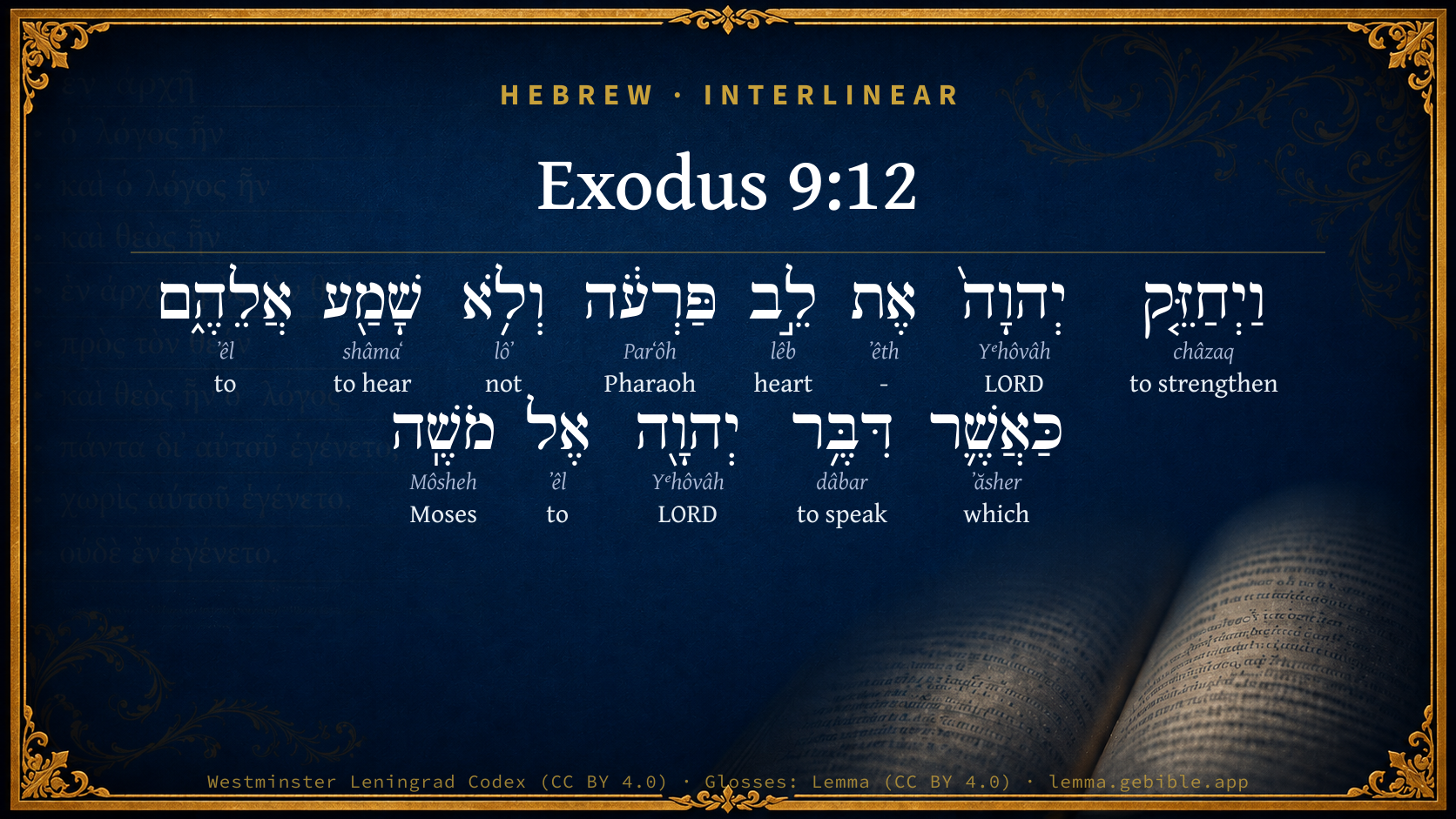
Hebrew (Westminster Leningrad Codex) Exodus 9:12 appears in the Hebrew Old Testament. The text above is from the Westminster Leningrad Codex. Each word links to its Strong’s number, a concise gloss, and parsing drawn from the Open Scriptures Hebrew Bible morphology. Click any word for its full Brown-Driver-Briggs (BDB) entry.
Download image
Cite this verse

Exodus 9:12 (World English Bible). Public Domain. Lemma interlinear Bible study tool, https://lemma.gebible.app/v/exodus/9/12.

Show BibTeX & RIS
BibTeX
RIS
English Translation
Yahweh hardened the heart of Pharaoh, and he didn't listen to them, as Yahweh had spoken to Moses.
World English Bible · Public Domain
Download a study sheet

One document with this verse’s original text, its word-by-word gloss line, the meaning frame, cross-references with their text, attributed commentary, and full source and license credits — printable, and it pastes into notes with its structure intact.

This verse Autodidact and up

Study sheet (.html) Plain text (.txt)

A passage Seminary Student

Up to 50 verses in one chapter. A passage sheet keeps up to 6 commentary sources and 12 cross-references per verse, in the order this page ranks them, and says so on the sheet whenever that leaves anything out. Ask for a single verse and you get the Autodidact verse sheet above.

Everything on this page stays free to read, with no account — the sheet is a download of what is already on screen, not access to it.

Want to remove ads? Support Godless Engineer
Compare translations 3

The same verse in 3 English versions, stacked beneath the original-language interlinear above. Click any original word for its lexicon entry.

Each is an independent rendering of the whole verse — the interlinear is not word-aligned to these translations.

Highlighted words mark where these versions differ — a whole-verse word diff, not a word-by-word alignment.

  • World English Bible Public Domain
    Yahweh hardened the heart of Pharaoh, and he didn't listen to them, as Yahweh had spoken to Moses.
  • King James Version Public Domain
    And the LORD hardened the heart of Pharaoh, and he hearkened not unto them; as the LORD had spoken unto Moses.
  • unfoldingWord Literal Text CC BY-SA 4.0
    But Yahweh strengthened the heart of Pharaoh, and he did not listen to them, just as Yahweh had said to Moses.

unfoldingWord Literal Text — © unfoldingWord, licensed CC BY-SA 4.0. Word-aligned USFM3 via Door43 (git.door43.org/unfoldingWord/en_ult).

Versions to compare (up to 4)

3 of 4 selected

Show all 18 translations

Every available English version of this verse, each an independent rendering of the whole verse.

  • World English Bible Public Domain
    Yahweh hardened the heart of Pharaoh, and he didn't listen to them, as Yahweh had spoken to Moses.
  • Berean Standard Bible Public Domain
    But the LORD hardened Pharaoh’s heart, and he would not listen to them, just as the LORD had said to Moses.
  • Majority Standard Bible Public Domain
    But the LORD hardened Pharaoh’s heart, and he would not listen to them, just as the LORD had said to Moses.
  • King James Version Public Domain
    And the LORD hardened the heart of Pharaoh, and he hearkened not unto them; as the LORD had spoken unto Moses.
  • American Standard Version (1901) Public Domain
    And Jehovah hardened the heart of Pharaoh, and he hearkened not unto them, as Jehovah had spoken unto Moses.
  • Revised Version (1885) Public Domain
    And the LORD hardened the heart of Pharaoh, and he hearkened not unto them; as the LORD had spoken unto Moses.
  • Geneva Bible (1599) Public Domain
    And the Lord hardened the heart of Pharaoh, and he hearkened not vnto them, as the Lord had said vnto Moses.
  • Douay-Rheims (1899) Public Domain
    And the Lord hardened Pharao's heart, and he hearkened not unto them, as the Lord had spoken to Moses.
  • Young's Literal Translation Public Domain
    And Jehovah strengtheneth the heart of Pharaoh, and he hath not hearkened unto them, as Jehovah hath spoken unto Moses.
  • Literal Standard Version CC BY-SA 4.0
    And YHWH strengthens the heart of Pharaoh, and he has not listened to them, as YHWH has spoken to Moses.
  • Unlocked Literal Bible CC BY-SA 4.0
    Yahweh hardened Pharaoh's heart, so Pharaoh did not listen to Moses and Aaron. This was just as Yahweh had said to Moses that Pharaoh would do.
  • unfoldingWord Literal Text CC BY-SA 4.0
    But Yahweh strengthened the heart of Pharaoh, and he did not listen to them, just as Yahweh had said to Moses.
  • Darby Bible Public Domain
    And Jehovah made Pharaoh's heart stubborn, and he did not hearken to them, as Jehovah had told Moses.
  • World Messianic Bible Public Domain
    The LORD hardened the heart of Pharaoh, and he didn’t listen to them, as the LORD had spoken to Moses.
  • Webster's Bible Public Domain
    And the LORD hardened the heart of Pharaoh, and he hearkened not to them; as the LORD had spoke to Moses.
  • Free Bible Version CC BY-SA 4.0
    But the Lord gave Pharaoh a stubborn attitude, and he would not listen to them, just as the Lord had told Moses.
  • Bible in Basic English Public Domain
    And the Lord made Pharaoh's heart hard, and he would not give ear to them, as the Lord had said.
  • JPS Tanakh (1917) Public Domain
    And the LORD hardened the heart of Pharaoh, and he hearkened not unto them; as the LORD had spoken unto Moses.

Literal Standard Version (2020), Covenant Press — licensed CC BY-SA 4.0. Text via the HelloAO Bible API (eBible.org). Unlocked Literal Bible (unfoldingWord) — licensed CC BY-SA 4.0. Text via the HelloAO Bible API (eBible.org). unfoldingWord Literal Text — © unfoldingWord, licensed CC BY-SA 4.0. Word-aligned USFM3 via Door43 (git.door43.org/unfoldingWord/en_ult). Free Bible Version, Dr. Jonathan Gallagher — licensed CC BY-SA 4.0. Text via the HelloAO Bible API (eBible.org).

Word by word

More ways to search: Search by grammar → Find every occurrence → Compare this word →

Practice this passage: Drill this verse → Learn its vocabulary →

About this verse

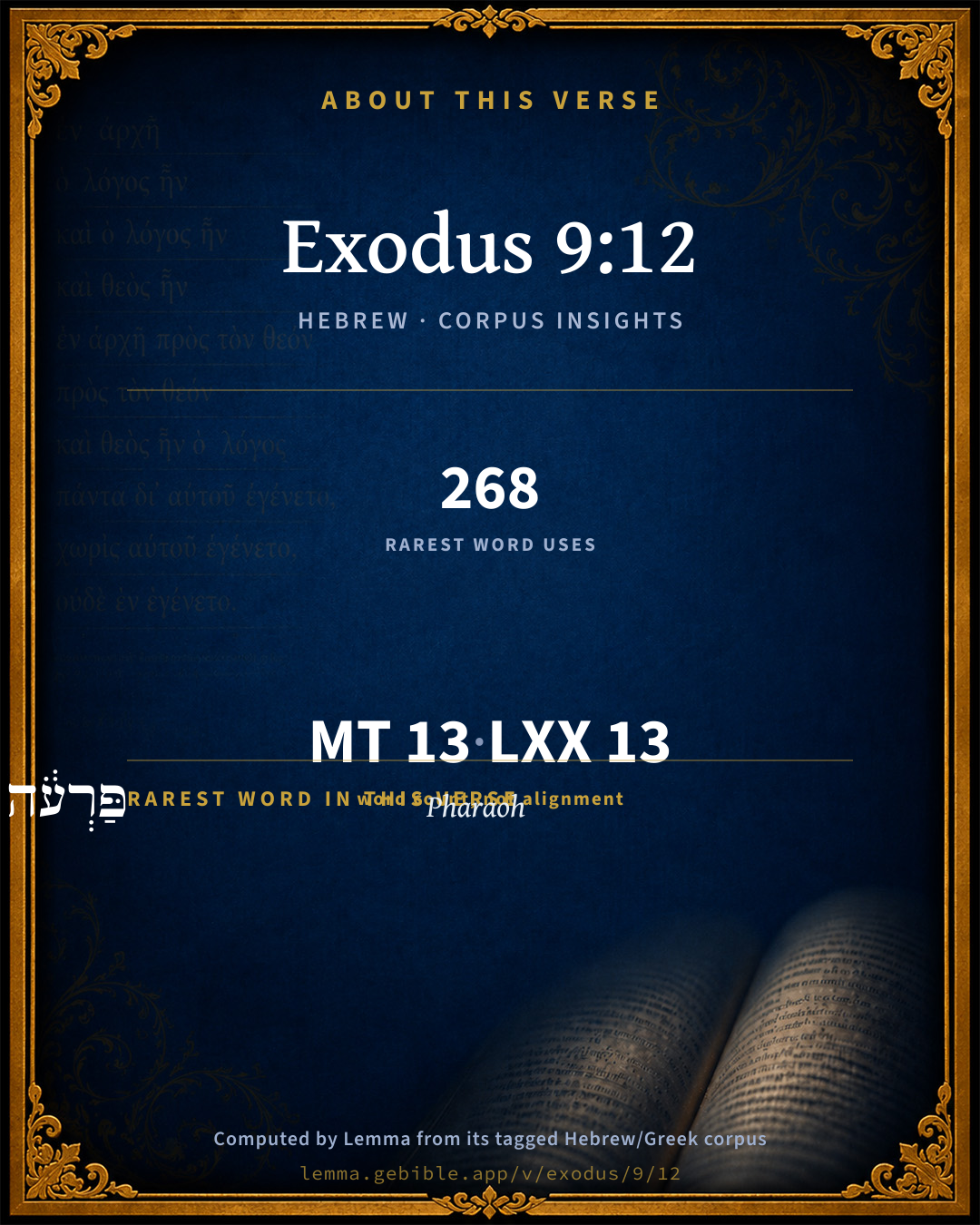
These counts appear in no published source. They are computed here, from the morphology-tagged text and Lemma’s own curated glosses. What Lemma adds →

13
words
11
distinct lemmas
Pentateuch
section

Grammatical profile

  • 3 verbs
  • 5 nouns
  • 2 prepositions
  • 3 particles

Verb forms

  • וַיְחַזֵּ֤ק Piel · Sequential Imperfect
  • שָׁמַ֖ע Qal · Perfect
  • דִּבֶּ֥ר Piel · Perfect

Repetition

Words recur within this verse — often emphatic in Hebrew:

  • יְהוָה֙ LORD H3068 ×2
  • אֲלֵהֶ֑ם to H413 ×2

Hebrew & Septuagint length

In English translation the verse runs 18 words from the Hebrew and 16 from the Septuagint (LXX English) — closely comparable.

A rough comparison of the two English renderings, which tokenize alike — not a word-level alignment.

Word counts can differ between the Hebrew and the Greek without any difference in meaning — e.g. the Hebrew direct-object marker אֵת has no separate Greek word, and Greek often adds the article ὁ.

In the original languages it is 13 Hebrew tokens and 13 Greek tokens — but the two are counted differently (Hebrew bundles its prefixes and suffixes into one token; the Greek is in lemma form), so that isn’t a like-for-like length.

Cross-references

4

Topical passages linked to Exodus 9:12 in the Treasury of Scripture Knowledge — connected by theme and wording, ordered by reader-vote popularity; previews shown in the World English Bible.

  • Exodus 4:21 Yahweh said to Moses, "When you go back into Egypt, see that you do before Pharaoh all the wonders which I have put in your hand, but I will harden his heart and he will not let the people go.
  • Exodus 7:13–14 Pharaoh's heart was hardened, and he didn't listen to them; as Yahweh had spoken.
  • Psalms 81:11–12 But my people didn't listen to my voice. Israel desired none of me.
  • Revelation 16:10–11 The fifth poured out his bowl on the throne of the beast, and his kingdom was darkened. They gnawed their tongues because of the pain,

Cross-references courtesy of OpenBible.info (CC BY 4.0).

Hebrew and Greek witnesses Masoretic Hebrew ↔ Greek Septuagint

The same verse in the two great witnesses to the Old Testament, shown verse-for-verse.

These are two independent witnesses, not word-aligned to each other, and the Septuagint is shown in lemma (dictionary) form.

Hebrew Exodus 9:12 Masoretic · Westminster Leningrad Codex

וַיְחַזֵּ֤ק יְהוָה֙ אֶת לֵ֣ב פַּרְעֹ֔ה וְלֹ֥א שָׁמַ֖ע אֲלֵהֶ֑ם כַּאֲשֶׁ֛ר דִּבֶּ֥ר יְהוָ֖ה אֶל מֹשֶֽׁה

Yahweh hardened the heart of Pharaoh, and he didn't listen to them, as Yahweh had spoken to Moses.

World English Bible · Public Domain

Greek LXX Exodus 9:12 Septuagint · lemma form

σκληρύνω δέ κύριος ὁ καρδία φαραώ καί οὐ εἰςἀκούω αὐτός καθά συντάσσω κύριος

And the Lord hardened Pharao's heart, and he listened not to them, as the Lord appointed.

LXX2012 (modern English Septuagint) · Public Domain

Hebrew: Westminster Leningrad Codex (CC BY 4.0). Greek: Septuagint (public domain); English from LXX2012 (modern English Septuagint) (Public Domain). How the Septuagint differs from the Hebrew →

Targum (Aramaic paraphrase)

2

The Targum is the ancient Jewish Aramaic paraphrase of the Hebrew Scriptures — an interpretive translation, not the Hebrew text itself. Onkelos (literal) and Pseudo-Jonathan (expansive) render the Torah, and Jonathan the Prophets. Coverage is partial: where no permissively-licensed English translation exists for a verse, only the Aramaic is shown. This is verse-level text, not a word-by-word alignment to the Hebrew.

  1. Targum Onkelos Torah (Genesis–Deuteronomy)
    וְתַקִיף יְיָ יָת לִבָּא דְפַרְעֹה וְלָא קַבִּיל מִנְהוֹן כְּמָא דְמַלֵיל יְיָ עִם משֶׁה:

    (no public-domain English translation for this verse)

    Targum Onkelos — Aramaic: “Onkelos Genesis” (public domain); “Onkelos Exodus” (public domain); “Onkelos Leviticus” (public domain); “Onkelos Numbers” (public domain); “Onkelos Deuteronomy” (public domain). English: “Sefaria Community Translation” (CC0 1.0 (public-domain dedication)); “J.W. Etheridge. The Targums of Onkelos and Jonathan Ben Uzziel on the Pentateuch. London: Longmans, Green, 1862” (public domain). Text via Sefaria.

  2. Targum Pseudo-Jonathan Torah (Genesis–Deuteronomy)
    וּתְקֵיף יְיָ יַת יִצְרָא דְלִבָּא דְפַרְעה וְלָא קַבֵּיל מִנְהוֹן הֵיכְמָא דְמַלֵיל יְיָ עִם משֶׁה

    And the Lord hardened the design of Pharoh's heart, and he would not hearken to them, as the Lord had said to Mosheh.

    Targum Pseudo-Jonathan — Aramaic: “Targum Jonathan on Genesis” (public domain); “Targum Jonathan on Exodus” (public domain); “Targum Jonathan on Leviticus” (public domain); “Targum Jonathan on Numbers” (public domain); “Targum Jonathan on Deuteronomy” (public domain). English: “The Targum of Jonathan ben Uzziel, trans. J. W. Etheridge, London, 1862” (public domain). Text via Sefaria.

Commentary

Notes on Exodus 9:12 from classic Christian and Jewish commentators (each source and its license shown beneath its notes). The classic Christian expositions comment on the surrounding passage and are grouped to its opening verse, so a note may address several verses; the Jewish commentaries on the Tanakh (Rashi and others) are per-verse, so they appear only where the commentator wrote on this verse.

Lemma curates 59 commentaries, every one of them public domain or Creative Commons licensed, each selected and text-cleaned for this edition rather than reprinted as found. About our sources →

Trapp's Complete Commentary

John Trapp

Exo 9:12 And the LORD hardened the heart of Pharaoh, and he hearkened not unto them; as the LORD had spoken unto Moses.

Ver. 12. And the Lord hardened.] See Exo 9:7; Exo 4:21, &c.

John Trapp, A Commentary or Exposition upon All the Books of the Old and New Testament (1647–1656) — public domain. Text from a community e-Sword module.

Joseph Benson's Commentary

Exo 9:12. And the Lord hardened Pharaoh’s heart — Before he had hardened his own heart, and resisted the grace of God; and now God justly gave him up to his own heart’s lusts, to strong delusions, permitting Satan to blind and harden him. Wilful hardness is generally punished with judicial hardness. Let us dread this as the sorest judgment a man can be under on this side hell.

Joseph Benson's Commentary on the Old and New Testaments (1811–1818) — public domain. Text from a community e-Sword module.

Tyndale Open Study Notes

Tyndale Open Resources

9:12 Plagues five and six apparently dissipated on their own, since there was no plea by Pharaoh to bring them to an end.

Tyndale Open Study Notes — © Tyndale Open Resources, licensed CC BY-SA 4.0. Text via the HelloAO Bible API.

Ellicott's Commentary for English Readers

(12) The Lord hardened the heart of Pharaoh.—The judicial punitive hardening of Pharaoh’s heart by God Himself now began. As with the heathen in later times, “because they did not like to retain God in their knowledge. God gave them over to a reprobate mind” (Rom_1:28), so now with Pharaoh: because he had twice hardened himself—i.e., resisted an impression made upon him, and crushed his inclination to yield to it (Exo_8:15; Exo_8:32), God hardened him. (See the comment on Exo_4:21.)

A Bible Commentary for English Readers, edited by Charles John Ellicott (1878–1897) — public domain. Text from a community e-Sword module.

The Cambridge Bible for Schools and Colleges

gen. ed. J. J. S. Perowne

12. As Exo_7:13; Exo_7:22 b, Exo_8:15 b, 19b) (all P). The result, as foretold in Exo_7:4 a (P). On God’s ‘hardening’ Pharaoh’s heart, see p. 53 f.

The Cambridge Bible for Schools and Colleges (gen. ed. J. J. S. Perowne; Cambridge University Press, 1878–1918) — public domain. Text from a community e-Sword module.

John Gill's Exposition

And the Lord hardened the heart of Pharaoh,.... He having often, and so long hardened his own heart, God gave him up to judicial hardness of heart, to his own corruptions, the temptations of Satan, and the lying magicians about him, to make an ill use of everything that offered to him, and put a wrong construction on all that befell him, so that whatever was said to him, or inflicted on him, made no impression to any purpose:

and he hearkened not unto them; to Moses and Aaron, and to the Lord by them:

as the Lord had spoken to Moses; both that he would harden his heart, and he should not hearken to them; all this was no other than what the Lord had said should be, Exo 4:21.

John Gill's Exposition of the Whole Bible (1746–1763) — public domain (CC PDM 1.0). Text via the HelloAO Bible API.

Haydock's Catholic Bible Commentary

Hardened, &c. See the annotations above, chap. v. 21, chap. vii. 3, and chap. viii. 15. (Challoner) --- The wicked man, when he is come into the depth of sins, condemneth: but ignominy and reproach follow him, Proverbs xviii. 3.

George Leo Haydock (1774–1849), Haydock's Catholic Family Bible and Commentary, 1859 edition — public domain. Excludes Psalms (Douay-Rheims chapter numbering differs from Protestant) and Deuterocanonical books (Catholic canon only).

Whedon's Commentary on the Bible

Daniel D. Whedon

12. And the Lord hardened the heart of Pharaoh — That is, by sending this manifestation of his anger he made his heart more hard. Punishment always hardens if it does not soften. It is worthy of remark that now, for the first time in the history, it is said that “the Lord hardened,” although this result of his sin had been predicted, Exo_4:21. Exo_7:13 is no exception; see the note. Here, then, is another marked stage in the history of these judgments. By persistent disobedience Pharaoh has now so blunted his moral sense that it is morally certain that he will not repent; that is, he has reached that state where punishment will only harden. Yet God punishes still. Since he will not honour him by obedience he must do it through punishment.

Daniel D. Whedon (gen. ed.), Commentary on the Old and New Testaments (1874–1909) — public domain. Text from a community e-Sword module.

The Pulpit Commentary

And the Lord hardened Pharaoh"s heart. Up to this time the hardening of Pharaoh"s heart has been ascribed to himself, or expressed indefinitely as a process that was continually going on now for the first time it is positively stated that God hardened his heart, as he had threatened that he would. (Exo_4:21) On the general law of God"s dealings with wicked men, see the comment on the above passage

The Pulpit Commentary (1880–1919), ed. H.D.M. Spence-Jones & Joseph S. Exell — public domain. Text from a community e-Sword module.

John Wesley's Explanatory Notes

Now the Lord hardened Pharaoh's heart - Before he had hardened his own heart, and resisted the grace of God, and now God justly gave him up to his own heart's lusts, to strong delusions, permitting Satan to blind and harden him. Wilful hardness is commonly punished with judicial hardness. Let us dread this as the sorest judgment a man can be under on this side hell.

John Wesley, Explanatory Notes Upon the Whole Bible (1754–1765) — public domain. Text via the GEBible commentary corpus.

Ramban (Nachmanides)

Rabbi Moshe ben Nachman (Ramban / Nachmanides)

AND THE ETERNAL HARDENED THE HEART OF PHARAOH. It is possible that during the first plagues, the magicians hardened Pharaoh’s heart in order to pride themselves in their wisdom. But now that they did not come before him and there was none to help him and none to uphold him in his folly except his iniquities that ensnared him, [it was G-d Who hardened his heart]. It is possible that Scripture is alluding to that which our Rabbis have explained, i.e., that during the first plagues, the hardening of Pharaoh’s heart was his own doing, and now it was [rightfully] caused by G-d, as I have explained above. This is the true explanation.

Ramban (Nachmanides) on the Tanakh — English translation: “Commentary on the Torah by Ramban (Nachmanides). Translated and annotated by Charles B. Chavel. New York, Shilo Pub. House, 1971-1976” (CC BY 4.0). Text via Sefaria.

Lesson kit

Teaching starters — assembled from the data on this page, not authored interpretation. Every prompt links to the verse data it draws on. Edit before teaching.

Exodus, in the Pentateuch, opens this verse with 13 words (11 distinct Hebrew lemmas). Its most distinctive word is Parʻôh (“Pharaoh”). A historical commentator’s framing appears above. Read the whole chapter for the surrounding context.

Discussion questions

  1. The word Parʻôh carries the sense “Pharaoh.” How does it shape the verse?
  2. Exodus 4:21 shares this passage’s theme. How do the two illuminate each other?
  3. “LORD” occurs 2× in this one verse. What is the effect of the repetition?
  4. These translations render this verse differently; the difference is in the English rendering, not the original. What questions does that raise?
  5. The verb «וַיְחַזֵּ֤ק» is Piel Sequential Imperfect. How does its form color the action?
  6. Reading how Trapp's Complete Commentary and Joseph Benson's Commentary read this verse, where do the two commentators agree and where do they part?

Things to notice

Reading settings

Reading text

Shown beneath each verse's original-language words.

Old Testament
Old Testament edition

Read the OT as the Masoretic Hebrew (MT) or the Greek Septuagint (LXX).

English shown for the Greek Septuagint (in the Hebrew ↔ Greek comparison).

Comparing translations? Open the Compare panel on any verse page to stack up to four side by side.