

Psalms 64:6

Hebrew (Westminster Leningrad Codex) Psalms 64:6 appears in the Hebrew Old Testament. The text above is from the Westminster Leningrad Codex. Each word links to its Strong’s number, a concise gloss, and parsing drawn from the Open Scriptures Hebrew Bible morphology. Click any word for its full Brown-Driver-Briggs (BDB) entry.
Download image
Cite this verse

Psalms 64:6 (World English Bible). Public Domain. Lemma interlinear Bible study tool, https://lemma.gebible.app/v/psalms/64/6.

Show BibTeX & RIS
BibTeX
RIS
English Translation
They plot injustice, saying, "We have made a perfect plan!" Surely man's mind and heart are cunning.
World English Bible · Public Domain
Highlights
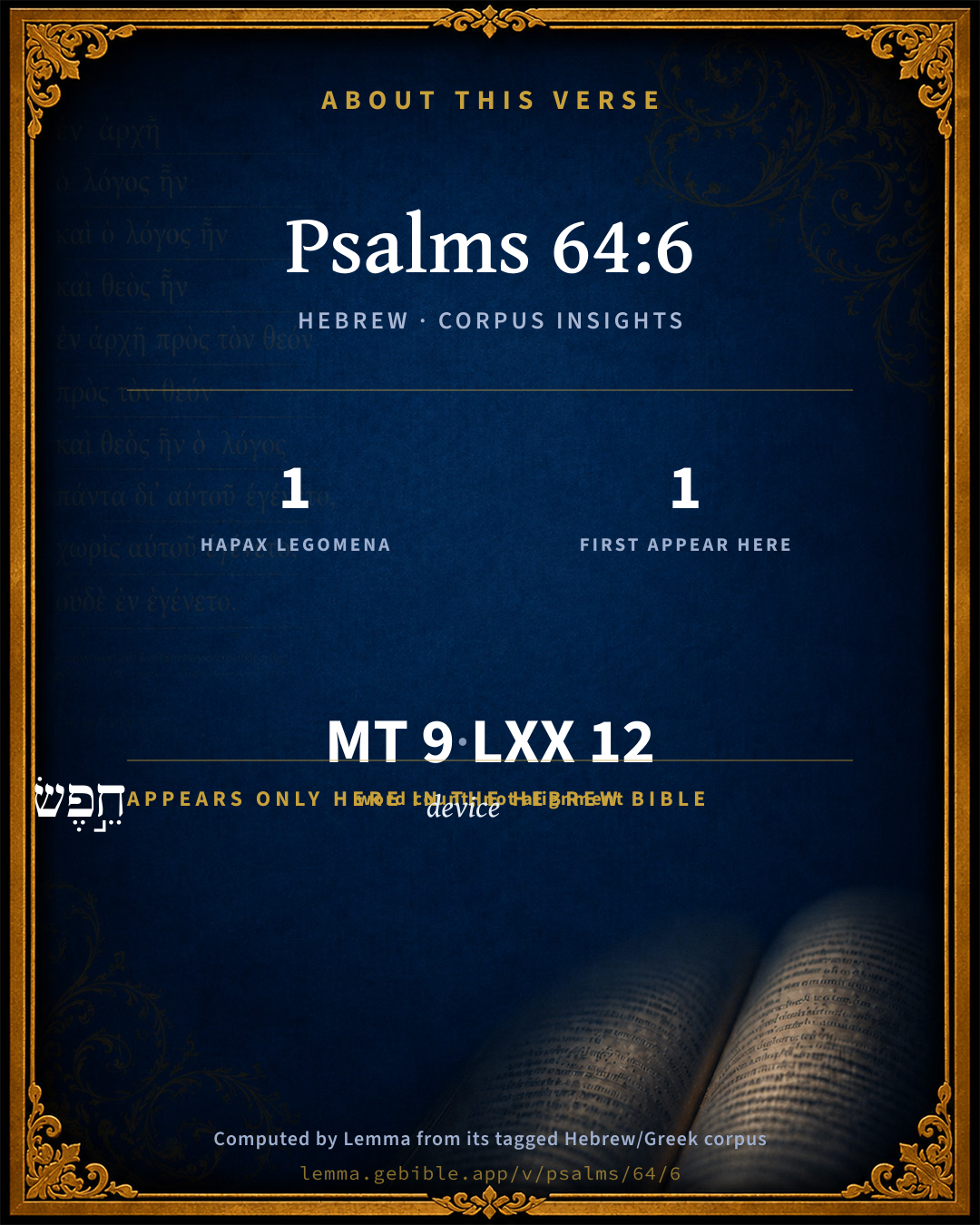
  • 1 hapax legomenon — only here in the Hebrew Bible
  • 1 first appearance in the Hebrew Bible
Full analysis ↓
Download a study sheet

One document with this verse’s original text, its word-by-word gloss line, the meaning frame, cross-references with their text, attributed commentary, and full source and license credits — printable, and it pastes into notes with its structure intact.

This verse Autodidact and up

Study sheet (.html) Plain text (.txt)

A passage Seminary Student

Up to 50 verses in one chapter. A passage sheet keeps up to 6 commentary sources and 12 cross-references per verse, in the order this page ranks them, and says so on the sheet whenever that leaves anything out. Ask for a single verse and you get the Autodidact verse sheet above.

Everything on this page stays free to read, with no account — the sheet is a download of what is already on screen, not access to it.

Want to remove ads? Support Godless Engineer
Compare translations 3

The same verse in 3 English versions, stacked beneath the original-language interlinear above. Click any original word for its lexicon entry.

Each is an independent rendering of the whole verse — the interlinear is not word-aligned to these translations.

Highlighted words mark where these versions differ — a whole-verse word diff, not a word-by-word alignment.

  • World English Bible Public Domain
    They plot injustice, saying, "We have made a perfect plan!" Surely man's mind and heart are cunning.
  • King James Version Public Domain
    They search out iniquities; they accomplish a diligent search: both the inward thought of every one of them, and the heart, is deep.
  • unfoldingWord Literal Text CC BY-SA 4.0
    They devise iniquities. “We have perfected a well-devised device!” Both the inside of man and the heart deep.

unfoldingWord Literal Text — © unfoldingWord, licensed CC BY-SA 4.0. Word-aligned USFM3 via Door43 (git.door43.org/unfoldingWord/en_ult).

Versions to compare (up to 4)

3 of 4 selected

Show all 18 translations

Every available English version of this verse, each an independent rendering of the whole verse.

  • World English Bible Public Domain
    They plot injustice, saying, "We have made a perfect plan!" Surely man's mind and heart are cunning.
  • Berean Standard Bible Public Domain
    They devise injustice and say, “We have perfected a secret plan.” For the inner man and the heart are mysterious.
  • Majority Standard Bible Public Domain
    They devise injustice and say, “We have perfected a secret plan.” For the inner man and the heart are mysterious.
  • King James Version Public Domain
    They search out iniquities; they accomplish a diligent search: both the inward thought of every one of them, and the heart, is deep.
  • American Standard Version (1901) Public Domain
    They search out iniquities; We have accomplished, `say they', a diligent search: And the inward thought and the heart of every one is deep.
  • Revised Version (1885) Public Domain
    They search out iniquities; We have accomplished, say they, a diligent search: and the inward thought of every one, and the heart, is deep.
  • Geneva Bible (1599) Public Domain
    They haue sought out iniquities, and haue accomplished that which they sought out, euen euery one his secret thoughtes, and the depth of his heart.
  • Douay-Rheims (1899) Public Domain
    They will shoot at him on a sudden, and will not fear: they are resolute in wickedness. They have talked of hiding snares; they have said: Who shall see them?
  • Young's Literal Translation Public Domain
    They search out perverse things, `We perfected a searching search,' And the inward part of man, and the heart `are' deep.
  • Literal Standard Version CC BY-SA 4.0
    They search out perverse things, “We perfected a searching search,” || And the inward part of man, and the heart, [are] deep.
  • Unlocked Literal Bible CC BY-SA 4.0
    They invent sinful plans; “We have finished,” they say, “a careful plan.” The inner thoughts and hearts of man are deep.
  • unfoldingWord Literal Text CC BY-SA 4.0
    They devise iniquities. “We have perfected a well-devised device!” Both the inside of man and the heart deep.
  • Darby Bible Public Domain
    They devise iniquities: We have it ready, the plan is diligently sought out. And each one's inward [thought] and heart is deep.
  • World Messianic Bible Public Domain
    They plot injustice, saying, “We have made a perfect plan!” Surely man’s mind and heart are cunning.
  • Webster's Bible Public Domain
    \\64:5\\They encourage themselves in an evil matter: they commune of laying snares privily; they say, Who will see them?
  • Free Bible Version CC BY-SA 4.0
    They plot wicked things. “What a great plan we've created!” they say. There are no limits to the depths to which human minds and thoughts can sink.
  • Bible in Basic English Public Domain
    Or make discovery of our secret purpose? The design is framed with care; and the inner thought of a man, and his heart, is deep.
  • JPS Tanakh (1917) Public Domain
    (64-7) They search out iniquities, they have accomplished a diligent search; even in the inward thought of every one, and the deep heart.

Literal Standard Version (2020), Covenant Press — licensed CC BY-SA 4.0. Text via the HelloAO Bible API (eBible.org). Unlocked Literal Bible (unfoldingWord) — licensed CC BY-SA 4.0. Text via the HelloAO Bible API (eBible.org). unfoldingWord Literal Text — © unfoldingWord, licensed CC BY-SA 4.0. Word-aligned USFM3 via Door43 (git.door43.org/unfoldingWord/en_ult). Free Bible Version, Dr. Jonathan Gallagher — licensed CC BY-SA 4.0. Text via the HelloAO Bible API (eBible.org).

Word by word

More ways to search: Search by grammar → Find every occurrence → Compare this word →

Practice this passage: Drill this verse → Learn its vocabulary →

About this verse

These counts appear in no published source. They are computed here, from the morphology-tagged text and Lemma’s own curated glosses. What Lemma adds →

9
words
8
distinct lemmas
Wisdom
section

Notable vocabulary

1 hapax legomenon — a word that appears only here in the entire Hebrew Bible:

  • חֵ֣פֶשׂ device H2665

First appearance in Scripture

This word makes its first canonical appearance in the Hebrew Bible here:

  • חֵ֣פֶשׂ device H2665

Shared distinctive vocabulary

עָמֹֽק deep H6013 occurs in 16 verses of the Hebrew Bible. Also found in:

Grammatical profile

  • 3 verbs
  • 5 nouns
  • 1 adjective

Verb forms

  • יַֽחְפְּֽשׂוּ Qal · Imperfect
  • תַּ֭מְנוּ Qal · Perfect
  • מְחֻפָּ֑שׂ Pual · Participle Passive

Repetition

A word recurs within this verse — often emphatic in Hebrew:

  • יַֽחְפְּֽשׂוּ to search H2664 ×2

Hebrew & Septuagint length

In English translation the verse runs 17 words from the Hebrew and 21 from the Septuagint (LXX English) — closely comparable.

A rough comparison of the two English renderings, which tokenize alike — not a word-level alignment.

Word counts can differ between the Hebrew and the Greek without any difference in meaning — e.g. the Hebrew direct-object marker אֵת has no separate Greek word, and Greek often adds the article ὁ.

In the original languages it is 9 Hebrew tokens and 12 Greek tokens — but the two are counted differently (Hebrew bundles its prefixes and suffixes into one token; the Greek is in lemma form), so that isn’t a like-for-like length.

Cross-references

14

Topical passages linked to Psalms 64:6 in the Treasury of Scripture Knowledge — connected by theme and wording, ordered by reader-vote popularity; previews shown in the World English Bible.

  • Jeremiah 17:9–10 The heart is deceitful above all things, and it is exceedingly corrupt: who can know it?
  • Matthew 26:59 Now the chief priests, the elders, and the whole council sought false testimony against Jesus, that they might put him to death;
  • Psalms 5:9 For there is no faithfulness in their mouth. Their heart is destruction. Their throat is an open tomb. They flatter with their tongue.
  • Isaiah 29:15 Woe to those who hide deep their counsel from Yahweh, and whose works are in the dark, and who say, Who sees us? and who knows us?
  • Daniel 6:4–5 Then the presidents and the satraps sought to find occasion against Daniel as touching the kingdom; but they could find no occasion nor fault, because he was faithful, neither was there any error or fault found in him.
  • 1 Corinthians 4:5 Therefore judge nothing before the time, until the Lord comes, who will both bring to light the hidden things of darkness, and reveal the counsels of the hearts. Then each man will get his praise from God.
  • Psalms 35:11 Unrighteous witnesses rise up. They ask me about things that I don't know about.
  • Proverbs 20:5 Counsel in the heart of man is like deep water; But a man of understanding will draw it out.
  • John 18:29–30 Pilate therefore went out to them, and said, "What accusation do you bring against this man?"
  • 1 Samuel 24:9 David said to Saul, Why listen you to men's words, saying, Behold, David seeks your hurt?
  • 1 Samuel 25:10 Nabal answered David's servants, and said, Who is David? and who is the son of Jesse? there are many servants now-a-days who break away every man from his master.
  • 1 Samuel 22:9 Then answered Doeg the Edomite, who stood by the servants of Saul, and said, I saw the son of Jesse coming to Nob, to Ahimelech the son of Ahitub.
  • Psalms 49:11 Their inward thought is that their houses will endure forever, And their dwelling places to all generations. They name their lands after themselves.
  • John 19:7 The Jews answered him, "We have a law, and by our law he ought to die, because he made himself the Son of God."

Cross-references courtesy of OpenBible.info (CC BY 4.0).

Hebrew and Greek witnesses Masoretic Hebrew ↔ Greek Septuagint

The same verse in the two great witnesses to the Old Testament, shown verse-for-verse.

You’re reading Greek Psalm 63 (Hebrew Psalm 64). The Septuagint counts the superscription, so verse numbers can differ from the Hebrew — chapter-level alignment, not verse-by-verse. Numbering follows Rahlfs.

These are two independent witnesses, not word-aligned to each other, and the Septuagint is shown in lemma (dictionary) form.

Hebrew Psalms 64:6 Masoretic · Westminster Leningrad Codex

יַֽחְפְּֽשׂוּ עוֹלֹ֗ת תַּ֭מְנוּ חֵ֣פֶשׂ מְחֻפָּ֑שׂ וְקֶ֥רֶב אִ֝֗ישׁ וְלֵ֣ב עָמֹֽק

They plot injustice, saying, "We have made a perfect plan!" Surely man's mind and heart are cunning.

World English Bible · Public Domain

Greek LXX Greek Psalm 63:6 Septuagint · lemma form

κραταιόω ἑαυτοῦ λόγος πονηρός διαἡγέομαι ὁ κρύπτω παγίς εἶπον τίς ὁράω αὐτός

They have searched out iniquity; they have wearied themselves with searching diligently, a man shall approach and the heart is deep,

LXX2012 (modern English Septuagint) · Public Domain

Hebrew: Westminster Leningrad Codex (CC BY 4.0). Greek: Septuagint (public domain); English from LXX2012 (modern English Septuagint) (Public Domain). How the Septuagint differs from the Hebrew →

Commentary

Notes on Psalms 64:6 from classic Christian and Jewish commentators (each source and its license shown beneath its notes). The classic Christian expositions comment on the surrounding passage and are grouped to its opening verse, so a note may address several verses; the Jewish commentaries on the Tanakh (Rashi and others) are per-verse, so they appear only where the commentator wrote on this verse.

Lemma curates 59 commentaries, every one of them public domain or Creative Commons licensed, each selected and text-cleaned for this edition rather than reprinted as found. About our sources →

Trapp's Complete Commentary

John Trapp

Psa 64:6 They search out iniquities; they accomplish a diligent search: both the inward [thought] of every one [of them], and the heart, [is] deep.

Ver. 6. They search out iniquities] Abstrusissima quaeque exquisierunt; they search the devil’s skull for new inventions; who is ready enough to lend them his seven heads to plot and his ten horns to push at good people. How wittily wicked was Saul to destroy David, if he could have done it! See his counsel to the Ziphites, 1Sa 23:22.

They accomplish a diligent search] Heb. a search searched, i.e. They seek out all occasions, they try all tricks, they do all that can be done to undo me. Whereunto he fitly subjoineth this epiphonema by way of exclamation, Adeo intimum viri et cor profundum est, So deep is the inward part and heart of man (for so I read it)! so deep and fathomless, so deceitful, and desperately wicked.

John Trapp, A Commentary or Exposition upon All the Books of the Old and New Testament (1647–1656) — public domain. Text from a community e-Sword module.

J. A. Alexander on Psalms

Joseph Addison Alexander

7. (Psa 64:6). They search out iniquities; (they say) We are ready—a consummate plan! and the inward thought and heart of (every) man (is) deep. They rack their invention and ransack their memory for modes of doing mischief. We are ready, literally finished, just as we might say in English, we are done. The next phrase consists of a passive participle, derived from the verb at the beginning of the sentence, and a cognate noun. The participle here corresponds to exquisite, recherché, something not to be had without laborious search, and the noun describes the product of the search itself. The last clause is added to enhance the danger, by representing the device as springing, not from shallow, superficial, but profound contrivance. Inward thought, literally inside, an equivalent to heart, often used by David. See above, on Psa 5:9; Psa 49:11; Psa 55:15; Psa 62:4.

Joseph Addison Alexander, The Psalms Translated and Explained (1850) — public domain. Text from a community e-Sword module.

Tyndale Open Study Notes

Tyndale Open Resources

64:6 The enemies create a perfect plan to harm the innocent without getting caught. • Human beings will sink to unthinkable depths with evil words, acts, or plans (83:3; see Jer 17:9).

Tyndale Open Study Notes — © Tyndale Open Resources, licensed CC BY-SA 4.0. Text via the HelloAO Bible API.

Geneva Bible (1599)

Geneva Bible translators

There is no way so secret and subtle to do hurt, which they invented not for his destruction.

Geneva Bible (1599) marginal notes — public domain. Text via Bolls.life.

Jamieson, Fausset & Brown

Robert Jamieson, A. R. Fausset & David Brown

This is further evinced by their diligent efforts and deeply laid schemes.

Jamieson, Fausset & Brown — Commentary Critical and Explanatory on the Whole Bible (1871) — public domain (CC PDM 1.0). Text via the HelloAO Bible API.

Adam Clarke's Commentary

Verse 6. They search out iniquities; they accomplish a diligent search] The word חפש chaphash, which is used three times, as a noun and a verb, in this sentence, signifies to strip off the clothes. "They investigate iniquities; they perfectly investigate an investigation." Most energetically translated by the old Psalter: Thai ransaked wickednesses: thai failled ransakand in ransaking. To ransack signifies to search every corner, to examine things part by part, to turn over every leaf, to leave no hole or cranny unexplored. But the word investigate fully expresses the meaning of the term, as it comes either from in, taken privately, and vestire, to clothe, stripping the man bare, that he may be exposed to all shame, and be the more easily wounded; or from the word investigo, which may be derived from in, intensive, and vestigium, the footstep or track of man or beast. A metaphor from hunting the stag; as the slot, or mark of his foot, is diligently sought out, in order to find whither he is gone, and whether he is old or young, for huntsmen can determine the age by the slot. Tuberville, in his Treatise on Hunting, gives rules to form this judgment, To this the next verse seems to refer.

Adam Clarke's Commentary on the Bible (1810–1826) — public domain. Text from a community e-Sword/MySword module.

Ellicott's Commentary for English Readers

(6) They search out iniquities—i.e., they plan wicked schemes.

They accomplish a diligent search.—See margin, which indicates the difficulty in this clause. The versions and some MSS. also suggest a corruption of the tent. Read “They have completed their subtle measures” (literally, the planned plan).

A Bible Commentary for English Readers, edited by Charles John Ellicott (1878–1897) — public domain. Text from a community e-Sword module.

The Cambridge Bible for Schools and Colleges

gen. ed. J. J. S. Perowne

6. They plan deeds of iniquity; We have perfected (say they) a consummate plan;

And each man’s innermost thought and heart is deep.

The form of the verb is anomalous, and it is uncertain whether it is meant for the first person, or, as A.V. takes it, the third person, ‘they accomplish.’ The first person is however more graphic and forcible. For a similar abrupt introduction of the persons spoken of as speakers, see Psa_59:7. The various reading they have hidden is improbable. They conceal their thoughts deep in their own hearts, but in vain! God explores the lowest depths and most tortuous labyrinths of the human heart (Jer_17:9-10). Cp. with this and the preceding verse Isa_29:15, “Woe unto them that seek deep to hide their counsel from Jehovah, and their works are in the dark, and they say, Who seeth us? and who knoweth us?” and the sarcastic words of Mic_7:3, “Both hands are set to that which is evil to do it well.”

The Cambridge Bible for Schools and Colleges (gen. ed. J. J. S. Perowne; Cambridge University Press, 1878–1918) — public domain. Text from a community e-Sword module.

John Gill's Exposition

They search out iniquities,.... The Targum adds,

"to destroy the just.''

Either occasions against them, by charging them with sin and hiring false witnesses against them, as did the enemies both of David and Christ; they sought for proper time and opportunity of committing the iniquities they were bent upon, and even searched for new sins, being inventors of evil things, Rom 1:30;

they accomplish a diligent search; diligently searched out the perfect man, and found him; and also false witnesses against him, and carried their point; which was especially true with respect to Christ;

both the inward thought of everyone of them, and the heart, is deep; being full of cunning, craftiness and wickedness, so as not to be searched out and fully known; see Psa 5:9.

John Gill's Exposition of the Whole Bible (1746–1763) — public domain (CC PDM 1.0). Text via the HelloAO Bible API.

Albert Barnes' Notes on the Bible

They search out iniquities - They search deep; they examine plans; they rack their invention to accomplish it. The original word - חפשׂ châphaś - is a word which is used to denote the act of exploring - as when one searches for treasure, or for anything that is hidden or lost - implying a deep and close attention of the mind to the subject. So here they examined every plan, or every way which was suggested to them, by which they could hope to accomplish their purpose.

They accomplish - This would be better translated by rendering it, “We have perfected it!” That is, We have found it out; it is complete; meaning that they had found a plan to their liking. It is the language of self-congratulatlon.

A diligent search - Or rather, “The search is a deep search.” In other words, “The plan is a consummate plan; it is just to our mind; it is exactly what we have sought to find.” This, too, is language of self-congratulation and satisfaction at the plan which they had thought of, and which was so exactly to their mind.

Both the inward thought - literally, the inside; that is, the hidden design.

And the heart - The plan formed in the heart; the secret purpose.

Is deep - A deep-laid scheme; a plan that indicates profound thought; a purpose that is the result of consummate sagacity. This is the language of the author of the psalm. He admitted that there had been great talent and skill in the formation of the plan. Hence, it was that he cried so earnestly to God.

Albert Barnes' Notes on the Bible (1834–1885) — public domain. Text from a community e-Sword/MySword module.

Matthew Poole's English Annotations

They search out iniquities; they study diligently and constantly to find out either matter, which they may lay to my charge, or new ways and means of doing me mischief.

They accomplish a diligent search; they have long and accurately searched, till at last they have ripened and perfected their thoughts, and found out a very cunning and deep plot. Or, they say, We have accomplished our accurate search. By long searching we have at last found what we desired. The heart is deep; mine enemies are not only cruel and malicious, but also very cunning, both to contrive and conceal, and to execute their plots.

Matthew Poole's English Annotations on the Holy Bible (1683–1685) — public domain. Text from a community e-Sword/MySword module.

The Treasury of David

Charles H. Spurgeon

Ver. 6. They search out iniquities. Diligently they consider, invent, devise, and seek for wicked plans to wreak their malice. These are no common villains, but explorers in iniquity, inventors and concoctors of evil. Sad indeed it is that to ruin a good man the evil disposed will often show as much avidity as if they were searching after treasure. The Inquisition could display instruments of torture, revealing as much skill as the machinery of our modern exhibitions. The deep places of history, manifesting most the skill of the human mind, are those in which revenge has arranged diplomacy, and used intrigue to compass its diabolical purposes.

They accomplish a diligent search. Their design is perfected, consummated, and brought into working order. They cry "Eureka; "they have sought and found the sure method of vengeance. Exquisite are the refinements of malice! hell's craft furnishes inspiration to the artistes who fashion deceit. Earth and the places under it are ransacked for the material of war, and profound skill turns all to account.

Both the inward thought of every one of them, and the heart, is deep. No superficial wit is theirs; but sagacity, sharpened by practice and keen hatred. Wicked men have frequently the craft to hasten slowly, to please in order to ruin, to flatter that ere long they may devour, to bow the knee that they may ultimately crush beneath their foot. He who deals with the serpent's seed has good need of the wisdom which is from above: the generation of vipers twist and turn, wind and wiggle, yet evermore they are set upon their purpose, and go the nearest way to it when they wander round about. Alas! how dangerous is the believer's condition, and how readily may he be overcome if left to himself. This is the complaint of reason and the moan of unbelief. When faith comes in, we see that even in all this the saints are still secure, for they are all in the hands of God.

Ver. 6. They search out iniquities, etc. It is a sign that malice boils up to a great height in men's hearts, when they are so active to find matter against their neighbours. Love would rather not see or hear of others' failings; or if it doth and must, busieth itself in healing and reforming them to the utmost of its power. John Milward(--1684), in "Morning Exercises."

Ver. 6. (two first clauses). The fault hunter; his motive, his character, his pretences, and his punishment.

Psalms 64:7*

Charles H. Spurgeon's The Treasury of David (1869–1885) — public domain. Psalms only. Text from a community e-Sword/MySword module.

Whedon's Commentary on the Bible

Daniel D. Whedon

6. They search out iniquities—Mentally, and with great labour, they work out plans for accomplishing wicked ends, as Psa_58:2.

They accomplish a diligent search—Literally, they have accomplished a search searched out; that is, an exhaustive investigation. But the verb accomplished (ended, finished) may be taken in the first person plural, as a soliloquy of the conspirators, thus: We have finished a plot thoroughly wrought out! which gives dramatic effect.

Both the inward thought—The word “inward,” here, is the same as “inward part,” Psa_5:9, and is here synonymous with heart, the seat of thought and affection. The inward part of a man, even the heart, is deep. This is the reflection of David after reviewing the conduct of his enemies. See Jer_17:9-10; Psa_19:12; Psa_139:23-24. The preparations of his enemies are ended. The crisis has come. It is now time for God to work.

Daniel D. Whedon (gen. ed.), Commentary on the Old and New Testaments (1874–1909) — public domain. Text from a community e-Sword module.

The Pulpit Commentary

They search out iniquities; they accomplish a diligent search; rather, they devise iniquities. We have accomplished (they say) a well devised device. So modern critics generally (Hengstenberg, Kay, Cheyne, Canon Cook, Revised Version). Both the inward thought of every one of them, and the heart, is deep. Therefore the righteous man is in great danger from them, unless God interpose.

The Pulpit Commentary (1880–1919), ed. H.D.M. Spence-Jones & Joseph S. Exell — public domain. Text from a community e-Sword module.

John Wesley's Explanatory Notes

Iniquities - They study diligently, to find new ways of doing mischief. Deep - Cunning, both to contrive and conceal, and to execute their plots.

John Wesley, Explanatory Notes Upon the Whole Bible (1754–1765) — public domain. Text via the GEBible commentary corpus.

Rashi

Rabbi Shlomo Yitzchaki (Rashi)

they tell to hide snares They speak cunningly to the king secret words, for even the king did not know why they were doing this. But they intended to hide snares to entrap Daniel, for they said to Darius, “All the viziers of the kingdom, etc., have conferred to establish the king’s law, etc.” [stating] that no one should offer up prayer to any god except you until thirty days [have passed].

Rashi on the Tanakh — English translations: “The Judaica Press complete Tanach with Rashi, translated by A. J. Rosenberg” (CC BY 4.0); “Pentateuch with Rashi's commentary by M. Rosenbaum and A.M. Silbermann, 1929-1934” (public domain); “The Metsudah Tanach series, Lakewood, N.J” (CC BY 4.0); and “The Book of Joshua, Metsudah Publications, 1997” (CC BY 4.0). Text via Sefaria.

Lesson kit

Teaching starters — assembled from the data on this page, not authored interpretation. Every prompt links to the verse data it draws on. Edit before teaching.

Psalms, in the Wisdom, opens this verse with 9 words (8 distinct Hebrew lemmas). Its most distinctive word is chêphes (“device”). A historical commentator’s framing appears above. Read the whole chapter for the surrounding context.

Discussion questions

  1. What does “device” (chêphes) contribute to the verse as a whole?
  2. This verse holds 1 word here found nowhere else in the Hebrew Bible. What might the rare word draw attention to?
  3. The word “device” first appears here in Scripture. What is being introduced at this debut?
  4. Leviticus 13:3 shares the word «deep» with this verse. How do the two illuminate each other?
  5. “to search” occurs 2× in this one verse. What is the effect of the repetition?
  6. These translations render this verse differently. What is at stake in choosing one wording over another?
  7. The verb «יַֽחְפְּֽשׂוּ» is Qal Imperfect. How does its form color the action?
  8. Reading how Trapp's Complete Commentary and J. A. Alexander on Psalms read this verse, where do the two commentators agree and where do they part?

Things to notice

  • 1 word in this verse appears nowhere else in the Hebrew Bible.
  • 1 word makes its first canonical appearance in Scripture here.
  • This verse counts 9 Hebrew ↔ 12 Greek words.
  • These translations choose different wording for 29 words in this verse.
  • “to search” occurs 2× in this single verse.

Reading settings

Reading text

Shown beneath each verse's original-language words.

Old Testament
Old Testament edition

Read the OT as the Masoretic Hebrew (MT) or the Greek Septuagint (LXX).

English shown for the Greek Septuagint (in the Hebrew ↔ Greek comparison).

Comparing translations? Open the Compare panel on any verse page to stack up to four side by side.