Nehemiah 3:11

Hebrew (Westminster Leningrad Codex) Nehemiah 3:11 appears in the Hebrew Old Testament. The text above is from the Westminster Leningrad Codex. Each word links to its Strong’s number, a concise gloss, and parsing drawn from the Open Scriptures Hebrew Bible morphology. Click any word for its full Brown-Driver-Briggs (BDB) entry.
Download image
Cite this verse

Nehemiah 3:11 (World English Bible). Public Domain. Lemma interlinear Bible study tool, https://lemma.gebible.app/v/nehemiah/3/11.

Show BibTeX & RIS
BibTeX
RIS
English Translation
Malchijah the son of Harim, and Hasshub the son of Pahath-moab, repaired another portion, and the tower of the furnaces.
World English Bible · Public Domain
Download a study sheet

One document with this verse’s original text, its word-by-word gloss line, the meaning frame, cross-references with their text, attributed commentary, and full source and license credits — printable, and it pastes into notes with its structure intact.

This verse Autodidact and up

Study sheet (.html) Plain text (.txt)

A passage Seminary Student

Up to 50 verses in one chapter. A passage sheet keeps up to 6 commentary sources and 12 cross-references per verse, in the order this page ranks them, and says so on the sheet whenever that leaves anything out. Ask for a single verse and you get the Autodidact verse sheet above.

Everything on this page stays free to read, with no account — the sheet is a download of what is already on screen, not access to it.

Want to remove ads? Support Godless Engineer
Compare translations 3

The same verse in 3 English versions, stacked beneath the original-language interlinear above. Click any original word for its lexicon entry.

Each is an independent rendering of the whole verse — the interlinear is not word-aligned to these translations.

Highlighted words mark where these versions differ — a whole-verse word diff, not a word-by-word alignment.

  • World English Bible Public Domain
    Malchijah the son of Harim, and Hasshub the son of Pahath-moab, repaired another portion, and the tower of the furnaces.
  • King James Version Public Domain
    Malchijah the son of Harim, and Hashub the son of Pahathmoab, repaired the other piece, and the tower of the furnaces.
  • unfoldingWord Literal Text CC BY-SA 4.0
    Malkijah the son of Harim, and Hasshub the son of Pahath-Moab, strengthened a second section along with the tower of ovens.

unfoldingWord Literal Text — © unfoldingWord, licensed CC BY-SA 4.0. Word-aligned USFM3 via Door43 (git.door43.org/unfoldingWord/en_ult).

Versions to compare (up to 4)

3 of 4 selected

Show all 18 translations

Every available English version of this verse, each an independent rendering of the whole verse.

  • World English Bible Public Domain
    Malchijah the son of Harim, and Hasshub the son of Pahath-moab, repaired another portion, and the tower of the furnaces.
  • Berean Standard Bible Public Domain
    Malchijah son of Harim and Hasshub son of Pahath-moab repaired another section, as well as the Tower of the Ovens.
  • Majority Standard Bible Public Domain
    Malchijah son of Harim and Hasshub son of Pahath-moab repaired another section, as well as the Tower of the Ovens.
  • King James Version Public Domain
    Malchijah the son of Harim, and Hashub the son of Pahathmoab, repaired the other piece, and the tower of the furnaces.
  • American Standard Version (1901) Public Domain
    Malchijah the son of Harim, and Hasshub the son of Pahath-moab, repaired another portion, and the tower of the furnaces.
  • Revised Version (1885) Public Domain
    Malchijah the son of Harim, and Hasshub the son of Pahath-moab, repaired another portion, and the tower of the furnaces.
  • Geneva Bible (1599) Public Domain
    Malchiiah the sonne of Harim, and Hashub the sonne of Pahath Moab fortified the seconde porcion, and the tower of the fornaces.
  • Douay-Rheims (1899) Public Domain
    ,11Melchias the son of Herem, and Ha- sub the son of Phahath Moab, built half the street, and the tower of the furnaces.
  • Young's Literal Translation Public Domain
    A second measure hath Malchijah son of Harim strengthened, and Hashub son of Pahath-Moab, even the tower of the furnaces.
  • Literal Standard Version CC BY-SA 4.0
    A second measure Malchijah son of Harim has strengthened, and Hashub son of Pahath-Moab, even the Tower of the Furnaces.
  • Unlocked Literal Bible CC BY-SA 4.0
    Malchijah son of Harim and Hasshub son of Pahath-Moab repaired another section along with the Tower of the Ovens.
  • unfoldingWord Literal Text CC BY-SA 4.0
    Malkijah the son of Harim, and Hasshub the son of Pahath-Moab, strengthened a second section along with the tower of ovens.
  • Darby Bible Public Domain
    Malchijah the son of Harim and Hasshub the son of Pahath-Moab repaired a second piece, and the tower of the furnaces.
  • World Messianic Bible Public Domain
    Malchijah the son of Harim and Hasshub the son of Pahathmoab repaired another portion and the tower of the furnaces.
  • Webster's Bible Public Domain
    Malchijah the son of Harim, and Hashub the son of Pahath-moab, repaired the other piece, and the tower of the furnaces.
  • Free Bible Version CC BY-SA 4.0
    Malchijah, son of Harim, and Hasshub, son of Pahath-moab, worked on another section, as well as the Tower of the Ovens.
  • Bible in Basic English Public Domain
    Malchijah, the son of Harim, and Hasshub, the son of Pahath-moab, were working on another part, and the tower of the ovens.
  • JPS Tanakh (1917) Public Domain
    Malchijah the son of Harim, and Hasshub the son of Pahath-moab, repaired another portion, and the tower of the furnaces.

Literal Standard Version (2020), Covenant Press — licensed CC BY-SA 4.0. Text via the HelloAO Bible API (eBible.org). Unlocked Literal Bible (unfoldingWord) — licensed CC BY-SA 4.0. Text via the HelloAO Bible API (eBible.org). unfoldingWord Literal Text — © unfoldingWord, licensed CC BY-SA 4.0. Word-aligned USFM3 via Door43 (git.door43.org/unfoldingWord/en_ult). Free Bible Version, Dr. Jonathan Gallagher — licensed CC BY-SA 4.0. Text via the HelloAO Bible API (eBible.org).

Word by word

More ways to search: Search by grammar → Find every occurrence → Compare this word →

Practice this passage: Drill this verse → Learn its vocabulary →

וְחַשּׁ֖וּב
Chashshûwb
H2815
“and · Hashub”
Conjunction + Noun, Proper
Part of Speech
Conjunction + Noun
Type
Proper
Full BDB Definition

Origin: from H2803

TWOT: None

Hashub = "considerate" - a Merarite Levite chief, son of Azrikam - a son of Pahath-moab who assisted in the repair of the wall of Jerusalem - a man who assisted in the repair of the wall of Jerusalem; may be same as 2 above - one of the heads of the people who sealed the covenant with Nehemiah
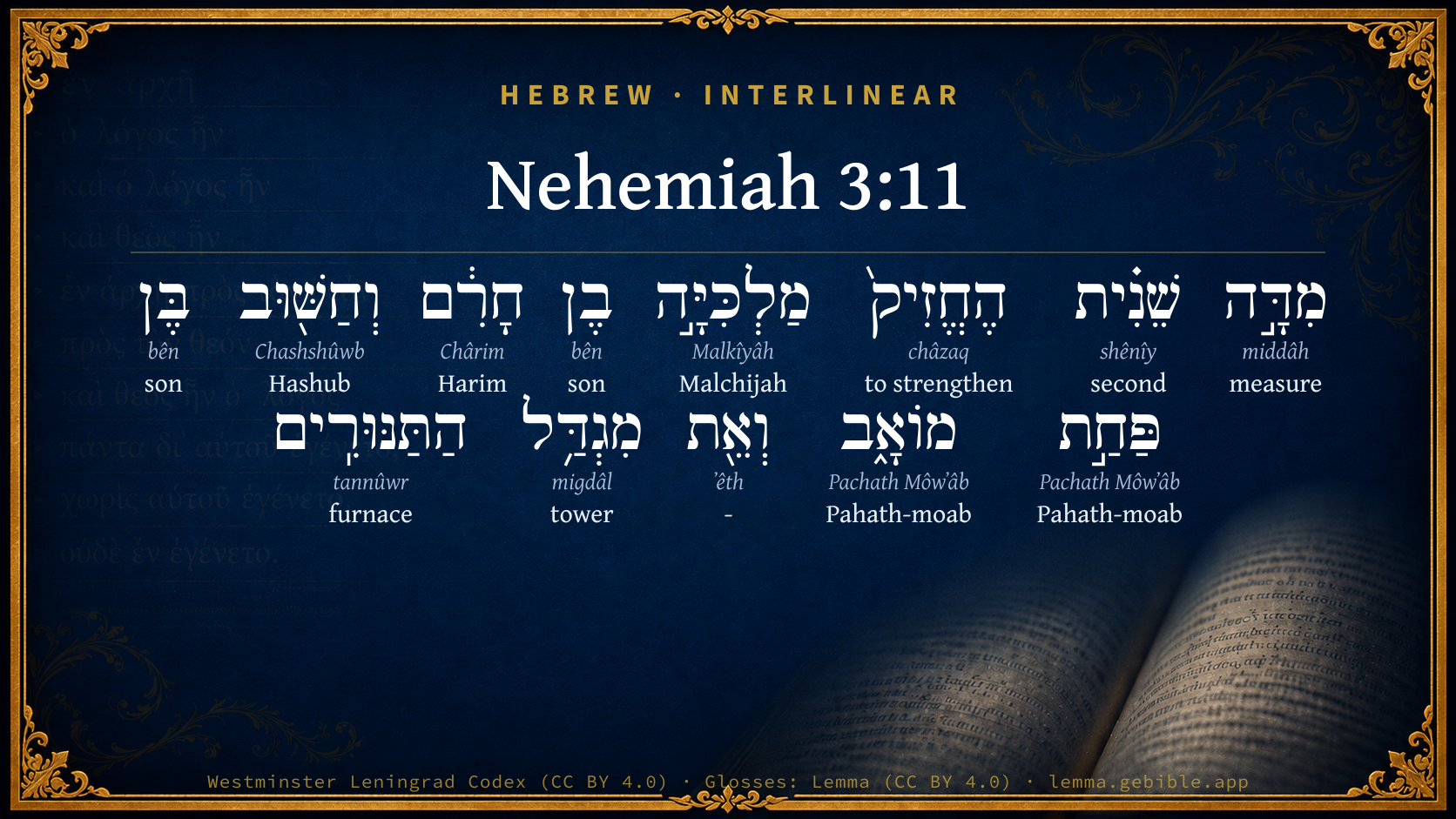
  1. מִדָּ֣ה middâh H4060 “measure” Noun, Common, Feminine, Singular, Absolute
  2. שֵׁנִ֗ית shênîy H8145 “second” Adjective, Ordinal number, Feminine, Singular, Absolute
  3. הֶחֱזִיק֙ châzaq H2388 “to strengthen” Verb, Hiphil, Perfect, 3rd Person, Masculine, Singular
  4. מַלְכִּיָּ֣ה Malkîyâh H4441 “Malchijah” Noun, Proper
  5. בֶן bên H1121 “son of” Noun, Common, Masculine, Singular, Construct
  6. חָרִ֔ם Chârim H2766 “Harim” Noun, Proper
  7. בֶּן bên H1121 “son of” Noun, Common, Masculine, Singular, Construct
  8. פַּחַ֣ת Pachath Môwʼâb H6355 “Pahath-moab” Noun, Proper
  9. מוֹאָ֑ב Pachath Môwʼâb H6355 “Pahath-moab” Noun, Proper
  10. וְאֵ֖ת ʼêth H853 “and · -” Conjunction + Particle, Direct Object
  11. מִגְדַּ֥ל migdâl H4026 “tower of” Noun, Common, Both, Singular, Construct
  12. הַתַּנּוּרִֽים tannûwr H8574 “the · furnaces” Particle, Definite Article + Noun, Common, Masculine, Plural, Absolute

About this verse

These counts appear in no published source. They are computed here, from the morphology-tagged text and Lemma’s own curated glosses. What Lemma adds →

13
words
11
distinct lemmas
Historical
section

Notable vocabulary

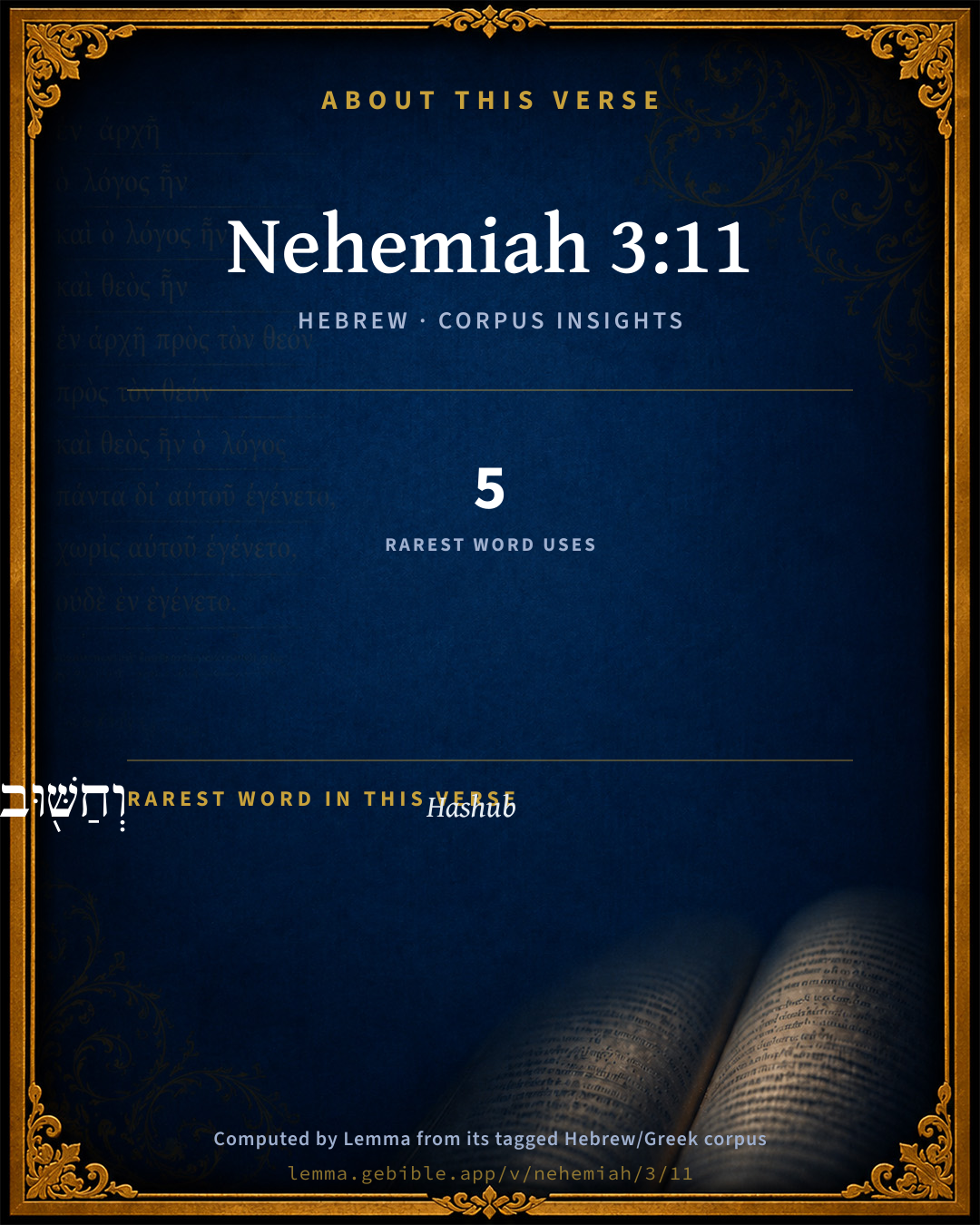
The rarest word here is וְחַשּׁ֖וּב Hashub H2815 — appearing just 5 times in the whole Hebrew Bible.

Shared distinctive vocabulary

וְחַשּׁ֖וּב Hashub H2815 occurs in 5 verses of the Hebrew Bible. Also found in:

Grammatical profile

  • 1 verb
  • 10 nouns
  • 1 adjective
  • 1 particle

Verb forms

  • הֶחֱזִיק֙ Hiphil · Perfect

Repetition

Words recur within this verse — often emphatic in Hebrew:

  • בֶן son H1121 ×2
  • פַּחַ֣ת Pahath-moab H6355 ×2

Cross-references

6

Topical passages linked to Nehemiah 3:11 in the Treasury of Scripture Knowledge — connected by theme and wording, ordered by reader-vote popularity; previews shown in the World English Bible.

  • Nehemiah 12:38 The other company of those who gave thanks went to meet them, and I after them, with the half of the people, on the wall, above the tower of the furnaces, even to the broad wall,
  • Ezra 2:6 The children of Pahath-moab, of the children of Jeshua [and] Joab, two thousand eight hundred twelve.
  • Ezra 8:4 Of the sons of Pahath-moab, Eliehoenai the son of Zerahiah; and with him two hundred males.
  • Nehemiah 7:11 The children of Pahath-moab, of the children of Jeshua and Joab, two thousand eight hundred [and] eighteen.
  • Nehemiah 10:5 Harim, Meremoth, Obadiah,
  • Nehemiah 10:14 The chiefs of the people: Parosh, Pahath-moab, Elam, Zattu, Bani,

Cross-references courtesy of OpenBible.info (CC BY 4.0).

Hebrew and Greek witnesses Masoretic Hebrew ↔ Greek Septuagint

The same verse in the two great witnesses to the Old Testament, shown verse-for-verse.

These are two independent witnesses, not word-aligned to each other, and the Septuagint is shown in lemma (dictionary) form.

Hebrew Nehemiah 3:11 Masoretic · Westminster Leningrad Codex

מִדָּ֣ה שֵׁנִ֗ית הֶחֱזִיק֙ מַלְכִּיָּ֣ה בֶן חָרִ֔ם וְחַשּׁ֖וּב בֶּן פַּחַ֣ת מוֹאָ֑ב וְאֵ֖ת מִגְדַּ֥ל הַתַּנּוּרִֽים

Malchijah the son of Harim, and Hasshub the son of Pahath-moab, repaired another portion, and the tower of the furnaces.

World English Bible · Public Domain

Greek LXX Structure differs

The Septuagint has no separate book of Nehemiah. Its Greek text is the second half of Esdras B (2 Esdras), chapters 11–23; Ezra is the first half (1–10).

A verse-for-verse comparison isn’t shown here because the chapters and verses don’t line up. Switch to the LXX edition with the MT / LXX toggle above to read the Greek directly.

Hebrew: Westminster Leningrad Codex (CC BY 4.0). Greek: Septuagint (public domain); English from a public-domain English Septuagint. How the Septuagint differs from the Hebrew →

Commentary

Notes on Nehemiah 3:11 from classic Christian and Jewish commentators (each source and its license shown beneath its notes). The classic Christian expositions comment on the surrounding passage and are grouped to its opening verse, so a note may address several verses; the Jewish commentaries on the Tanakh (Rashi and others) are per-verse, so they appear only where the commentator wrote on this verse.

Lemma curates 59 commentaries, every one of them public domain or Creative Commons licensed, each selected and text-cleaned for this edition rather than reprinted as found. About our sources →

Trapp's Complete Commentary

John Trapp

Neh 3:11 Malchijah the son of Harim, and Hashub the son of Pahathmoab, repaired the other piece, and the tower of the furnaces.

Ver. 11. The son of Pahathmoab] This man might be a Moabite by stock or descent, and an Israelite by religion; like as Jether was by nature an Ishmaelite, 1Ch 2:17, but by his faith an Israelite, 1Ch 7:38.

And the tower of the furnaces] That had furnaces or ovens under it; like as the library at Bonony hath an eating house and a wine cellar. In commendation of which situation Cardinal Bobba conceited that he had very wittily (indeed wickedly) applied that text, Pro 9:1-2, Wisdom hath builded her house, she hath also mingled her wine, she hath also furnished her table.

John Trapp, A Commentary or Exposition upon All the Books of the Old and New Testament (1647–1656) — public domain. Text from a community e-Sword module.

Tyndale Open Study Notes

Tyndale Open Resources

3:11 The Tower of the Ovens on the western wall of the city might have been a place to bake bread or to burnish pottery (Jer 19:1-2).

Tyndale Open Study Notes — © Tyndale Open Resources, licensed CC BY-SA 4.0. Text via the HelloAO Bible API.

Geneva Bible (1599)

Geneva Bible translators

Or, measure.

Geneva Bible (1599) marginal notes — public domain. Text via Bolls.life.

Adam Clarke's Commentary

Verse 11. Repaired the other piece] That which was left by Jedaiah after he had repaired the wall opposite to his own house. Probably some of the principal people were obliged to repair those parts of the wall opposite to their own dwellings. Perhaps this was the case generally.

Adam Clarke's Commentary on the Bible (1810–1826) — public domain. Text from a community e-Sword/MySword module.

Ellicott's Commentary for English Readers

(11) The other piece.—This expression occurs a few times when the repairers have been mentioned as having repaired a first piece. But it occurs several times when there is no such mention; and in these cases, as here, must mean only what the margin indicates, a second measure, in relation to what had just been referred to.

A Bible Commentary for English Readers, edited by Charles John Ellicott (1878–1897) — public domain. Text from a community e-Sword module.

The Cambridge Bible for Schools and Colleges

gen. ed. J. J. S. Perowne

11. Harim … Pahath-moab] See on Ezr_2:6; Ezr_2:32.

the other piece] R.V. another portion. This phrase, which occurs again in this chapter in Neh_3:19-21; Neh_3:24; Neh_3:27; Neh_3:30, has been explained, (1) (as the A.V.), as equivalent to ‘a further portion’ of the same section of wall, (2) as ‘a second portion’ of restoration-work undertaken by those mentioned in the verse. The latter is the more natural interpretation. There is this difficulty: whereas in Neh_3:21; Neh_3:27 we find the recurrence of names which have occurred earlier in the chapter (Neh_3:4-5), in this verse and in 19, 20, 24, 30 the names of those who are said to repair ‘another portion’ are not mentioned again. Accordingly some commentators, laying stress on the point that in Neh_3:19-21; Neh_3:24; Neh_3:27 the phrase is accompanied by a minute topographical notice, maintain that the words do not imply a second piece of work, but a special continuation of the work just mentioned.

On the other hand, it should be observed that (1) Malchijah’s name at any rate recurs in Neh_3:31; (2) in this portion of Nehemiah’s description ‘the gate of Ephraim’ is strangely altogether omitted, in spite of its great importance (cf. Neh_8:16, Neh_12:39): (3) it is on other grounds very probable that the complete list of those engaged on the work of restoration has not been preserved, and that numerous names have been lost. A recognition of the incompleteness of the list will fully meet the difficulty presented in this verse, and in Neh_3:19-20; Neh_3:24; Neh_3:30.

the tower of the furnaces] This tower lay between the gate of Ephraim and the gate of the valley (see Neh_12:38). It may have stood a little to the N. of the modern citadel. It was the fortress of the N.W. angle of the city, and probably constituted the chief fortification in connexion with the corner gate (2Ki_14:13; 2Ch_26:9; Jer_31:38; Zec_14:10.

The Cambridge Bible for Schools and Colleges (gen. ed. J. J. S. Perowne; Cambridge University Press, 1878–1918) — public domain. Text from a community e-Sword module.

John Gill's Exposition

And next unto him repaired Shallum, the son of Hallohesh,.... So called, as Ben Melech says, from his being an enchanter of serpents, or a wise prudent counsellor:

the ruler of the half part of Jerusalem; of the other half; see Neh 3:9

he and his daughters; who were rich widows or heiresses, and employed men to build at their own expense; he seems to have had no sons.

John Gill's Exposition of the Whole Bible (1746–1763) — public domain (CC PDM 1.0). Text via the HelloAO Bible API.

Albert Barnes' Notes on the Bible

The other piece - Rather, “another piece” (as in Neh 3:19, Neh 3:21, Neh 3:27, Neh 3:30). It is conjectured that a verse has fallen out in which Malchijah’s and Hashub’s “first piece” was mentioned.

The tower of the furnaces - Either a tower at the northwestern angle of the city; or, midway in the western wall. The origin of the name is uncertain.

Albert Barnes' Notes on the Bible (1834–1885) — public domain. Text from a community e-Sword/MySword module.

Haydock's Catholic Bible Commentary

Built. Hebrew, "repaired the other piece," or the part of the wall which corresponded with half a division, as in the following ver. 12, 15, 24, &c.

George Leo Haydock (1774–1849), Haydock's Catholic Family Bible and Commentary, 1859 edition — public domain. Excludes Psalms (Douay-Rheims chapter numbering differs from Protestant) and Deuterocanonical books (Catholic canon only).

Whedon's Commentary on the Bible

Daniel D. Whedon

11. The other piece — Or, as the margin, a second measure; that is, a section of the wall next adjoining the work of Hattush. The words seem to be equivalent to another section.

The tower of the furnaces — Situated on the northern wall, some distance west of the “broad wall.” See chap.

Neh_12:38. What gave the tower this name is uncertain; probably a number of furnaces, or ovens, near by.

Daniel D. Whedon (gen. ed.), Commentary on the Old and New Testaments (1874–1909) — public domain. Text from a community e-Sword module.

The Pulpit Commentary

Malchijah and Hashub, who are here said to have repaired, not the other piece, but "a second piece" of the wall, have not been previously mentioned in our present text; whence it has been concluded with reason (Bertheau) that the text is defective, some whole verses having fallen out (comp. ver. 20). The tower of the furnaces is mentioned again in Neh_12:38. Its exact position cannot be fixed.

The Pulpit Commentary (1880–1919), ed. H.D.M. Spence-Jones & Joseph S. Exell — public domain. Text from a community e-Sword module.

unfoldingWord translationNotes

Door43 World Missions Community

Malchijah ... Harim ... Hasshub ... Pahath-Moab ... Shallum ... Hallohesh

These are all names of men. (See: How to Translate Names)

repaired another section ... repaired, along with his daughters

These phrase refer to repairing the wall. AT: "repaired another section of the wall ... repaired the wall, along with his daughters" (See: Ellipsis)

Shallum son of Hallohesh, the ruler

Shallum was the ruler, not Hallohesh.

ruler

leader or chief administrator. See how you translated this in Nehemiah 3:9.

half the district

"Half" means one part out of two equal parts. (See: Fractions)

translationWords

son

rule

Jerusalem

unfoldingWord translationNotes — © Distant Shores Media and the Door43 World Missions Community, licensed CC BY-SA 4.0. Source: git.door43.org/Door43/en_tn.

Rashi

Rabbi Shlomo Yitzchaki (Rashi)

a second measure Just like the measurement which his friend built before [him], so he also built like [his friend.] a second measure in the building of the wall. The expression of measure is inappropriate for the building of the gates because they have [a measure] only in the building of a part of the wall, for we do not find in the entire chapter of the building of the gates the expression of a measure.

the Tower of the Furnaces He also built a tower by that name. All these towers in the chapter were built in the wall around the city.

Rashi on the Tanakh — English translations: “The Judaica Press complete Tanach with Rashi, translated by A. J. Rosenberg” (CC BY 4.0); “Pentateuch with Rashi's commentary by M. Rosenbaum and A.M. Silbermann, 1929-1934” (public domain); “The Metsudah Tanach series, Lakewood, N.J” (CC BY 4.0); and “The Book of Joshua, Metsudah Publications, 1997” (CC BY 4.0). Text via Sefaria.

Lesson kit

Teaching starters — assembled from the data on this page, not authored interpretation. Every prompt links to the verse data it draws on. Edit before teaching.

Nehemiah, in the Historical, opens this verse with 13 words (11 distinct Hebrew lemmas). Its most distinctive word is Chashshûwb (“Hashub”). A historical commentator’s framing appears above. Read the whole chapter for the surrounding context.

Discussion questions

  1. What does “Hashub” (Chashshûwb) contribute to the verse as a whole?
  2. 1 Chronicles 9:14 shares the word «Hashub» with this verse. How do the two illuminate each other?
  3. “son” occurs 2× in this one verse. What is the effect of the repetition?
  4. These translations render this verse differently. What is at stake in choosing one wording over another?
  5. The verb «הֶחֱזִיק֙» is Hiphil Perfect. How does its form color the action?
  6. Reading how Trapp's Complete Commentary and Tyndale Open Study Notes read this verse, where do the two commentators agree and where do they part?

Things to notice

Reading settings

Reading text

Shown beneath each verse's original-language words.

Old Testament
Old Testament edition

Read the OT as the Masoretic Hebrew (MT) or the Greek Septuagint (LXX).

English shown for the Greek Septuagint (in the Hebrew ↔ Greek comparison).

Comparing translations? Open the Compare panel on any verse page to stack up to four side by side.