
Exodus 8:19

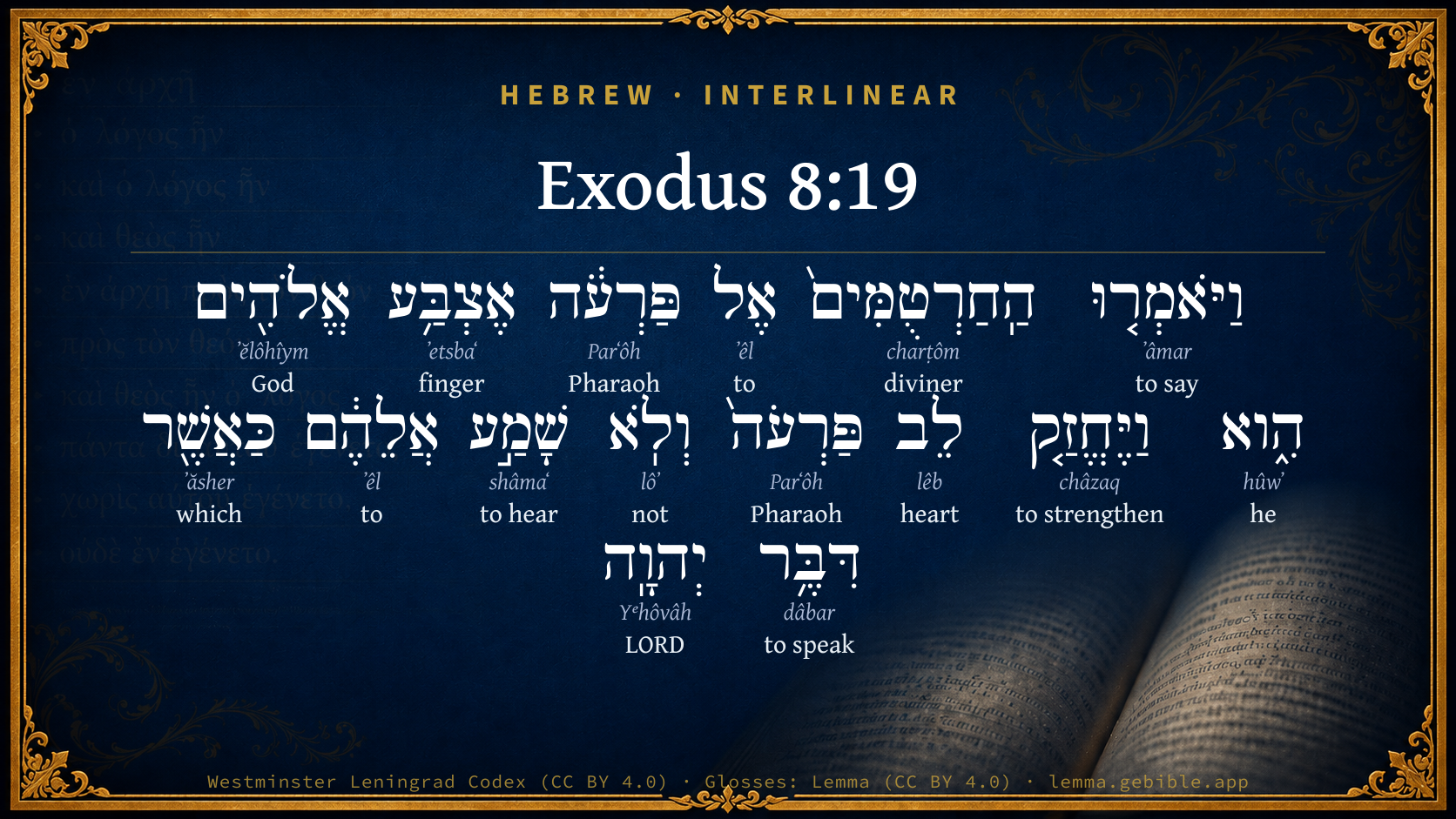
Hebrew (Westminster Leningrad Codex) Exodus 8:19 appears in the Hebrew Old Testament. The text above is from the Westminster Leningrad Codex. Each word links to its Strong’s number, a concise gloss, and parsing drawn from the Open Scriptures Hebrew Bible morphology. Click any word for its full Brown-Driver-Briggs (BDB) entry.
Download image
Cite this verse

Exodus 8:19 (World English Bible). Public Domain. Lemma interlinear Bible study tool, https://lemma.gebible.app/v/exodus/8/19.

Show BibTeX & RIS
BibTeX
RIS
English Translation
Then the magicians said to Pharaoh, "This is the finger of God:" and Pharaoh's heart was hardened, and he didn't listen to them; as Yahweh had spoken.
World English Bible · Public Domain
Highlights
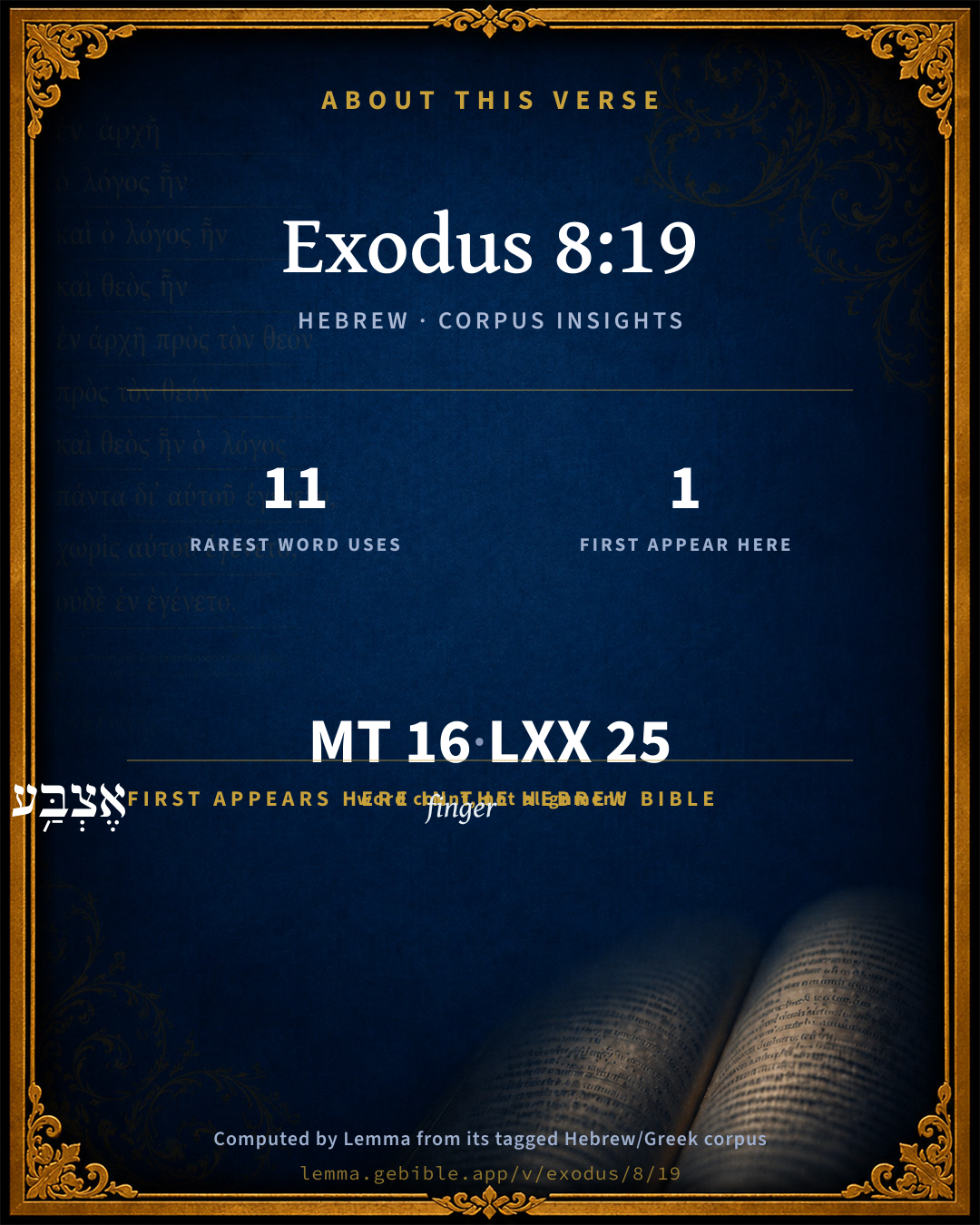
  • 1 first appearance in the Hebrew Bible
Full analysis ↓
Download a study sheet

One document with this verse’s original text, its word-by-word gloss line, the meaning frame, cross-references with their text, attributed commentary, and full source and license credits — printable, and it pastes into notes with its structure intact.

This verse Autodidact and up

Study sheet (.html) Plain text (.txt)

A passage Seminary Student

Up to 50 verses in one chapter. A passage sheet keeps up to 6 commentary sources and 12 cross-references per verse, in the order this page ranks them, and says so on the sheet whenever that leaves anything out. Ask for a single verse and you get the Autodidact verse sheet above.

Everything on this page stays free to read, with no account — the sheet is a download of what is already on screen, not access to it.

Want to remove ads? Support Godless Engineer
Compare translations 3

The same verse in 3 English versions, stacked beneath the original-language interlinear above. Click any original word for its lexicon entry.

Each is an independent rendering of the whole verse — the interlinear is not word-aligned to these translations.

Highlighted words mark where these versions differ — a whole-verse word diff, not a word-by-word alignment.

  • World English Bible Public Domain
    Then the magicians said to Pharaoh, "This is the finger of God:" and Pharaoh's heart was hardened, and he didn't listen to them; as Yahweh had spoken.
  • King James Version Public Domain
    Then the magicians said unto Pharaoh, This is the finger of God: and Pharaoh's heart was hardened, and he hearkened not unto them; as the LORD had said.
  • unfoldingWord Literal Text CC BY-SA 4.0
    And the magicians said to Pharaoh, “It is the finger of God.” And the heart of Pharaoh was strong, and he did not listen to them, just as Yahweh said.

unfoldingWord Literal Text — © unfoldingWord, licensed CC BY-SA 4.0. Word-aligned USFM3 via Door43 (git.door43.org/unfoldingWord/en_ult).

Versions to compare (up to 4)

3 of 4 selected

Show all 18 translations

Every available English version of this verse, each an independent rendering of the whole verse.

  • World English Bible Public Domain
    Then the magicians said to Pharaoh, "This is the finger of God:" and Pharaoh's heart was hardened, and he didn't listen to them; as Yahweh had spoken.
  • Berean Standard Bible Public Domain
    “This is the finger of God,” the magicians said to Pharaoh. But Pharaoh’s heart was hardened, and he would not listen to them, just as the LORD had said.
  • Majority Standard Bible Public Domain
    “This is the finger of God,” the magicians said to Pharaoh. But Pharaoh’s heart was hardened, and he would not listen to them, just as the LORD had said.
  • King James Version Public Domain
    Then the magicians said unto Pharaoh, This is the finger of God: and Pharaoh's heart was hardened, and he hearkened not unto them; as the LORD had said.
  • American Standard Version (1901) Public Domain
    Then the magicians said unto Pharaoh, This is the finger of God: and Pharaoh's heart was hardened, and he hearkened not unto them; as Jehovah had spoken.
  • Revised Version (1885) Public Domain
    Then the magicians said unto Pharaoh, This is the finger of God: and Pharaoh’s heart was hardened, and he hearkened not unto them; as the LORD had spoken.
  • Geneva Bible (1599) Public Domain
    Then saide the enchanters vnto Pharaoh, This is the finger of God. But Pharaohs heart remained obstinate, and hee hearkened not vnto them, as the Lord had said.
  • Douay-Rheims (1899) Public Domain
    And the magicians said to Pharao This is the finger of God. And Pharao heart was hardened, and he hearkened not unto them, as the Lord had commanded.
  • Young's Literal Translation Public Domain
    and the scribes say unto Pharaoh, `It `is' the finger of God;' and the heart of Pharaoh is strong, and he hath not hearkened unto them, as Jehovah hath spoken.
  • Literal Standard Version CC BY-SA 4.0
    and the enchanters say to Pharaoh, “It [is] the finger of God”; and the heart of Pharaoh is strong, and he has not listened to them, as YHWH has spoken.
  • Unlocked Literal Bible CC BY-SA 4.0
    Then the magicians said to Pharaoh, “This is the finger of God.” But Pharaoh's heart was hardened, so he refused to listen to them. It was just as Yahweh had said Pharaoh would do.
  • unfoldingWord Literal Text CC BY-SA 4.0
    And the magicians said to Pharaoh, “It is the finger of God.” And the heart of Pharaoh was strong, and he did not listen to them, just as Yahweh said.
  • Darby Bible Public Domain
    Then the scribes said to Pharaoh, This is the finger of God! But Pharaoh's heart was stubborn, and he hearkened not to them, as Jehovah had said.
  • World Messianic Bible Public Domain
    Then the magicians said to Pharaoh, “This is God’s finger;” but Pharaoh’s heart was hardened, and he didn’t listen to them, as the LORD had spoken.
  • Webster's Bible Public Domain
    Then the magicians said to Pharaoh, This is the finger of God: and Pharaoh's heart was hardened, and he hearkened not to them; as the LORD had said.
  • Free Bible Version CC BY-SA 4.0
    “This is an act of God,” the magicians told Pharaoh. But Pharaoh chose to be stubbornly hard-hearted, and he wouldn't listen to Moses and Aaron, just as the Lord had predicted.
  • Bible in Basic English Public Domain
    Then the wonder-workers said to Pharaoh, This is the finger of God: but Pharaoh's heart was hard, and he did not give ear to them, as the Lord had said.
  • JPS Tanakh (1917) Public Domain
    (8-15) Then the magicians said unto Pharaoh: 'This is the finger of God'; and Pharaoh's heart was hardened, and he hearkened not unto them; as the LORD had spoken.

Literal Standard Version (2020), Covenant Press — licensed CC BY-SA 4.0. Text via the HelloAO Bible API (eBible.org). Unlocked Literal Bible (unfoldingWord) — licensed CC BY-SA 4.0. Text via the HelloAO Bible API (eBible.org). unfoldingWord Literal Text — © unfoldingWord, licensed CC BY-SA 4.0. Word-aligned USFM3 via Door43 (git.door43.org/unfoldingWord/en_ult). Free Bible Version, Dr. Jonathan Gallagher — licensed CC BY-SA 4.0. Text via the HelloAO Bible API (eBible.org).

Word by word

More ways to search: Search by grammar → Find every occurrence → Compare this word →

Practice this passage: Drill this verse → Learn its vocabulary →

הַֽחַרְטֻמִּים֙
charṭôm
H2748
“the · diviners”
Particle, Definite Article + Noun, Common, Masculine, Plural, Absolute
Part of Speech
Particle + Noun
Type
Common
Gender
Masculine
Number
Plural
State
Absolute
Full BDB Definition

Origin: from the same as H2747

TWOT: 738b

diviner, magician, astrologer - engraver, writer (only in derivative sense of one possessed of occult knowledge)
  1. וַיֹּאמְר֤וּ ʼâmar H559 “and · to say” Conjunction + Verb, Qal, Sequential Imperfect, 3rd Person, Masculine, Plural
  2. אֶל ʼêl H413 “to” Preposition
  3. פַּרְעֹ֔ה Parʻôh H6547 “Pharaoh” Noun, Proper
  4. אֶצְבַּ֥ע ʼetsbaʻ H676 “finger of” Noun, Common, Feminine, Singular, Construct
  5. אֱלֹהִ֖ים ʼĕlôhîym H430 “God(s)” Noun, Common, Masculine, Plural, Absolute
  6. הִ֑וא hûwʼ H1931 “he” Pronoun, Personal, 3rd Person, Feminine, Singular
  7. וַיֶּחֱזַ֤ק châzaq H2388 “and · to strengthen” Conjunction + Verb, Qal, Sequential Imperfect, 3rd Person, Masculine, Singular
  8. לֵב lêb H3820 “heart of” Noun, Common, Masculine, Singular, Construct
  9. פַּרְעֹה֙ Parʻôh H6547 “Pharaoh” Noun, Proper
  10. וְלֹֽא lôʼ H3808 “and · not” Conjunction + Particle, Negative
  11. שָׁמַ֣ע shâmaʻ H8085 “to hear” Verb, Qal, Perfect, 3rd Person, Masculine, Singular
  12. אֲלֵהֶ֔ם ʼêl H413 “to · them” Preposition + Suffix, Personal, 3rd Person, Masculine, Plural
  13. כַּאֲשֶׁ֖ר ʼăsher H834 “like/as · which” Preposition + Particle, Relative
  14. דִּבֶּ֥ר dâbar H1696 “to speak” Verb, Piel, Perfect, 3rd Person, Masculine, Singular
  15. יְהוָֽה Yᵉhôvâh H3068 “LORD” Noun, Proper

About this verse

These counts appear in no published source. They are computed here, from the morphology-tagged text and Lemma’s own curated glosses. What Lemma adds →

16
words
14
distinct lemmas
Pentateuch
section

Notable vocabulary

The rarest word here is הַֽחַרְטֻמִּים֙ diviner H2748 — appearing just 11 times in the whole Hebrew Bible.

First appearance in Scripture

This word makes its first canonical appearance in the Hebrew Bible here:

  • אֶצְבַּ֥ע finger H676

Shared distinctive vocabulary

הַֽחַרְטֻמִּים֙ diviner H2748 occurs in 10 verses of the Hebrew Bible. Also found in:

Grammatical profile

  • 4 verbs
  • 7 nouns
  • 1 pronoun
  • 2 prepositions
  • 2 particles

Verb forms

  • וַיֹּאמְר֤וּ Qal · Sequential Imperfect
  • וַיֶּחֱזַ֤ק Qal · Sequential Imperfect
  • שָׁמַ֣ע Qal · Perfect
  • דִּבֶּ֥ר Piel · Perfect

Repetition

Words recur within this verse — often emphatic in Hebrew:

  • פַּרְעֹ֔ה Pharaoh H6547 ×2
  • אֶל to H413 ×2

Hebrew & Septuagint length

In English translation the verse runs 27 words from the Hebrew and 29 from the Septuagint (LXX English) — closely comparable.

A rough comparison of the two English renderings, which tokenize alike — not a word-level alignment.

Word counts can differ between the Hebrew and the Greek without any difference in meaning — e.g. the Hebrew direct-object marker אֵת has no separate Greek word, and Greek often adds the article ὁ.

In the original languages it is 16 Hebrew tokens and 25 Greek tokens — but the two are counted differently (Hebrew bundles its prefixes and suffixes into one token; the Greek is in lemma form), so that isn’t a like-for-like length.

Cross-references

11

Topical passages linked to Exodus 8:19 in the Treasury of Scripture Knowledge — connected by theme and wording, ordered by reader-vote popularity; previews shown in the World English Bible.

  • Luke 11:20 But if I by the finger of God cast out demons, then the Kingdom of God has come to you.
  • Psalms 8:3 When I consider your heavens, the work of your fingers, The moon and the stars, which you have ordained;
  • Exodus 7:5 The Egyptians shall know that I am Yahweh, when I stretch forth my hand on Egypt, and bring out the children of Israel from among them."
  • Matthew 12:28 But if I by the Spirit of God cast out demons, then the Kingdom of God has come upon you.
  • Acts 4:16 saying, "What shall we do to these men? Because indeed a notable miracle has been done through them, as can be plainly seen by all who dwell in Jerusalem, and we can't deny it.
  • Exodus 10:7 Pharaoh's servants said to him, "How long will this man be a snare to us? Let the men go, that they may serve Yahweh, their God. Don't you yet know that Egypt is destroyed?"
  • 1 Samuel 6:3 They said, "If you send away the ark of the God of Israel, don't send it empty; but by all means return him a trespass-offering: then you shall be healed, and it shall be known to you why his hand is not removed from you."
  • 1 Samuel 6:9 Behold; if it goes up by the way of its own border to Beth-shemesh, then he has done us this great evil: but if not, then we shall know that it is not his hand that struck us; it was a chance that happened to us."
  • Daniel 2:10–11 The Chaldeans answered before the king, and said, There is not a man on the earth who can show the king's matter, because no king, lord, or ruler, has asked such a thing of any magician, or enchanter, or Chaldean.
  • Daniel 2:19 Then was the secret revealed to Daniel in a vision of the night. Then Daniel blessed the God of heaven.
  • John 11:47 The chief priests therefore and the Pharisees gathered a council, and said, "What are we doing? For this man does many signs.

Cross-references courtesy of OpenBible.info (CC BY 4.0).

Hebrew and Greek witnesses Masoretic Hebrew ↔ Greek Septuagint

The same verse in the two great witnesses to the Old Testament, shown verse-for-verse.

These are two independent witnesses, not word-aligned to each other, and the Septuagint is shown in lemma (dictionary) form.

Hebrew Exodus 8:19 Masoretic · Westminster Leningrad Codex

וַיֹּאמְר֤וּ הַֽחַרְטֻמִּים֙ אֶל פַּרְעֹ֔ה אֶצְבַּ֥ע אֱלֹהִ֖ים הִ֑וא וַיֶּחֱזַ֤ק לֵב פַּרְעֹה֙ וְלֹֽא שָׁמַ֣ע אֲלֵהֶ֔ם כַּאֲשֶׁ֖ר דִּבֶּ֥ר יְהוָֽה

Then the magicians said to Pharaoh, "This is the finger of God:" and Pharaoh's heart was hardened, and he didn't listen to them; as Yahweh had spoken.

World English Bible · Public Domain

Greek LXX Exodus 8:19 Septuagint · lemma form

καί δίδωμι διαστολή ἀνά μέσος ὁ ἐγώ λαός καί ἀνά μέσος ὁ σύ λαός ἐν δέ ὁ αὔριον εἰμί ὁ σημεῖον οὗτος ἐπί ὁ γῆ

So the charmers said to Pharao, This is the finger of God. But the heart of Pharao was hardened, and he listened not to them, as the Lord said.

LXX2012 (modern English Septuagint) · Public Domain

Hebrew: Westminster Leningrad Codex (CC BY 4.0). Greek: Septuagint (public domain); English from LXX2012 (modern English Septuagint) (Public Domain). How the Septuagint differs from the Hebrew →

Targum (Aramaic paraphrase)

2

The Targum is the ancient Jewish Aramaic paraphrase of the Hebrew Scriptures — an interpretive translation, not the Hebrew text itself. Onkelos (literal) and Pseudo-Jonathan (expansive) render the Torah, and Jonathan the Prophets. Coverage is partial: where no permissively-licensed English translation exists for a verse, only the Aramaic is shown. This is verse-level text, not a word-by-word alignment to the Hebrew.

  1. Targum Onkelos Torah (Genesis–Deuteronomy)
    וֶאֱשַׁוֵי פוּרְקַן לְעַמִי וְעַל עַמָךְ אַיְתִי מָחָא לִמְחָר יְהֵא אָתָא הָדֵין:

    (no public-domain English translation for this verse)

    Targum Onkelos — Aramaic: “Onkelos Genesis” (public domain); “Onkelos Exodus” (public domain); “Onkelos Leviticus” (public domain); “Onkelos Numbers” (public domain); “Onkelos Deuteronomy” (public domain). English: “Sefaria Community Translation” (CC0 1.0 (public-domain dedication)); “J.W. Etheridge. The Targums of Onkelos and Jonathan Ben Uzziel on the Pentateuch. London: Longmans, Green, 1862” (public domain). Text via Sefaria.

  2. Targum Pseudo-Jonathan Torah (Genesis–Deuteronomy)
    וַאֲשַׁוֵי פּוּרְקַן לְעַמִי וְעַל עַמָךְ אַיְיתֵי מָחָא לְעִידַן מָחָר יְהֵי אָתָא הָדֵין

    And I will appoint redemption for My people, and upon thy people will I lay the plague: tomorrow this sign shall be.

    Targum Pseudo-Jonathan — Aramaic: “Targum Jonathan on Genesis” (public domain); “Targum Jonathan on Exodus” (public domain); “Targum Jonathan on Leviticus” (public domain); “Targum Jonathan on Numbers” (public domain); “Targum Jonathan on Deuteronomy” (public domain). English: “The Targum of Jonathan ben Uzziel, trans. J. W. Etheridge, London, 1862” (public domain). Text via Sefaria.

Commentary

Notes on Exodus 8:19 from classic Christian and Jewish commentators (each source and its license shown beneath its notes). The classic Christian expositions comment on the surrounding passage and are grouped to its opening verse, so a note may address several verses; the Jewish commentaries on the Tanakh (Rashi and others) are per-verse, so they appear only where the commentator wrote on this verse.

Lemma curates 59 commentaries, every one of them public domain or Creative Commons licensed, each selected and text-cleaned for this edition rather than reprinted as found. About our sources →

Trapp's Complete Commentary

John Trapp

Exo 8:19 Then the magicians said unto Pharaoh, This [is] the finger of God: and Pharaoh’s heart was hardened, and he hearkened not unto them; as the LORD had said.

Ver. 19. This is the finger of God.] An act of omnipotency, as Luk 11:20 Psa 8:3. "The heavens are the work of God’s fingers." Deus disponit membra pulicis et culicis, saith Augustine.

And he hearkened not to them.] Neither to Moses, nor to his own magicians, being akin to the catadupes that dwell at the fall of his river Nile, and are deaf.

John Trapp, A Commentary or Exposition upon All the Books of the Old and New Testament (1647–1656) — public domain. Text from a community e-Sword module.

Joseph Benson's Commentary

Exo 8:19. This is the finger of God — The devil’s agents, when God permitted them, could do great things; but when he laid an embargo upon them they could do nothing. And their inability in this instance might have shown them whence they had their ability in the former instances, and that they had no power against Moses but what was given them from above. But Pharaoh’s heart was hardened — By himself and the devil. Though he saw his magicians baffled, yet he could not prevail on himself to let the Israelites go. His kingly pride, the desire of detaining so many people in slavish dependance and subjection to him, and, above all, his superstitious prejudices, so blinded his mind that he still remained obdurate. Perhaps he yet considered Moses as a mere magician, like his own, only somewhat more expert in his art.

Joseph Benson's Commentary on the Old and New Testaments (1811–1818) — public domain. Text from a community e-Sword module.

Tyndale Open Study Notes

Tyndale Open Resources

8:19 This is the finger of God! See study note on 7:11.

Tyndale Open Study Notes — © Tyndale Open Resources, licensed CC BY-SA 4.0. Text via the HelloAO Bible API.

Geneva Bible (1599)

Geneva Bible translators

They acknowledged that this was done by God’s power and not by sorcery, Luke 11:20.

Geneva Bible (1599) marginal notes — public domain. Text via Bolls.life.

Adam Clarke's Commentary

Verse 19. This is the finger of God] That is, The power and skill of God are here evident. Probably before this the magicians supposed Moses and Aaron to be conjurers, like themselves; but now they are convinced that no man could do these miracles which these holy men did, unless God were with him. God permits evil spirits to manifest themselves in a certain way, that men may see that there is a spiritual world, and be on their guard against seduction. He at the same time shows that all these agents are under his control, that men may have confidence in his goodness and power.

Adam Clarke's Commentary on the Bible (1810–1826) — public domain. Text from a community e-Sword/MySword module.

Ellicott's Commentary for English Readers

(19) The finger of God.—Rather, of a goal. The magicians meant to say, “This is beyond the power of man: it is supernatural; some god must be helping Moses and Aaron.” They did not mean to profess a belief in One God.

Pharaoh’s heart was hardened.—The mosquitoes did not impress Pharaoh as the frogs had done (Exo_8:8-15). His heart remained hard. He had no need to harden it by an act of his will. Probably the visitation affected him but little, since he would possess mosquito curtains, and could inhabit the loftier parts of his palace, which would be above the height whereto the mosquito ascends (Herod, ii. 95).

A Bible Commentary for English Readers, edited by Charles John Ellicott (1878–1897) — public domain. Text from a community e-Sword module.

John Gill's Exposition

And the Lord said unto Moses, rise up early in the morning,.... Of the day following, the twenty eight of Adar, or February, according to Bishop Usher; this was the fittest time to meet with Pharaoh, and the most likely to make impressions on him:

and stand before Pharaoh: meet him as he comes along, and stop him, and stand before him as having something to say to him; this was using great boldness and freedom with a king; but as Moses was ordered to do it by the King of kings, it became him to obey him:

lo, he cometh forth to the water; See Gill on Exo 7:15.

and say unto him, thus saith the Lord, let my people go, that they may serve me; which had often been required before, but to no purpose, and in case of refusal he is threatened as follows.

John Gill's Exposition of the Whole Bible (1746–1763) — public domain (CC PDM 1.0). Text via the HelloAO Bible API.

Albert Barnes' Notes on the Bible

The finger of God - This expression is thoroughly Egyptian; it need not imply that the magicians recognized Yahweh, the God who performed the marvel. They may possibly have referred it to as a god that was hostile to their own protectors.

Albert Barnes' Notes on the Bible (1834–1885) — public domain. Text from a community e-Sword/MySword module.

Haydock's Catholic Bible Commentary

Finger, the spirit, (Luke xi. 20; compare Matthew xii. 28,) or power of God, Isaias xl. 12. The magicians here confess, that Moses is something more than themselves. (Calmet) --- Thus God interferes, whenever a contest of miracles, real or apparent, might lead any sincere seeker astray. He caused the priests of Baal to be confounded; (3 Kings xix,) and Simon Magus, flying in the air, was hurled down at the prayer of St. Peter. (Hegesip.) Cyrola, the Arian patriarch, attempting to deceive the people, by giving sight to a man whom he bribed to feign himself blind; and Calvin, who wished to have the honour of raising a man to life, at Geneva, by the like imposition, were both deservedly covered with confusion; while, of those unhappy men who joined in the collusion, one lost his sight, and the other his life. (Gregory of Tours, ii. Hist. 3; Bolsec.) On such occasions, we are admonished to be on our guard, and to adhere to the old religion. (Deuteronomy xiii.; Matthew xxiv.) (Worthington) --- The magicians, though fully convinced, were not still converted.

George Leo Haydock (1774–1849), Haydock's Catholic Family Bible and Commentary, 1859 edition — public domain. Excludes Psalms (Douay-Rheims chapter numbering differs from Protestant) and Deuterocanonical books (Catholic canon only).

Matthew Poole's English Annotations

The finger is put either synecdochically for the hand, as it is Exo 31:18; Psa 8:3; 144:1; or metaphorically for the power or virtue, as Luk 11:20, compared with Mat 12:28.

Of God; of that supreme God, whom both the Egyptians and other heathen idolaters acknowledged as superior to all men, and idols, and devils. This they said, lest they should be thought inferior to Moses and Aaron in magical art. But hereby they own the sovereign God to be on Israel’s side; and yet, like the devils, they proceed to fight against him.

He hearkened not unto them; either to his magicians, of whom he last spake; or rather to Moses and Aaron, as the following words show. For relatives oft belong to the remoter antecedents, as Gen 9:13; 1Sa 7:17; Mar 2:13.

Matthew Poole's English Annotations on the Holy Bible (1683–1685) — public domain. Text from a community e-Sword/MySword module.

Whedon's Commentary on the Bible

Daniel D. Whedon

19. This is the finger of God — Rather, of the gods; for they did not mean to own Jehovah, but declared that this was a supernatural infliction from their own gods. This explained their failure to Pharaoh, and so his heart became yet more hardened.

Daniel D. Whedon (gen. ed.), Commentary on the Old and New Testaments (1874–1909) — public domain. Text from a community e-Sword module.

The Pulpit Commentary

The magicians said unto Pharaoh, This is the finger of God. Or "of a God." It is not probable that the magicians believed in a single God, or intended in what they said to express any monotheistic idea. All that they meant to say was is beyond the power of man it is supernatural some god must be helping the Israelites." No doubt they had come to this conclusion by a careful scrutiny of all the miracles hitherto wrought by Aaron. He hearkened not unto them. The magicians were minded to resist no longer; but Pharaoh was otherwise minded. It is quite possible that the mosquito plague did not greatly annoy him. He would probably possess lofty apartments above the height to which the mosquito ascends (Heb 2:95); or he may have guarded himself by mosquito curtains of the finest Egyptian muslin. His subjects would naturally suffer from such a plague far more than he. As the Lord had said. See the comment on the same phrase in ver. 11.

Ver. 19. Moral avalanches not easily arrested when once set in motion.

The magicians had begun by exciting Pharaoh to obstinate unbelief and resistance to the Divine Will They had, by artifice or otherwise, persuaded him that there was nothing so very marvellous in the wonders wrought by Moses and Aaron, nothing that indicated a Divine author of the wonders. They had thus encouraged and stimulated him to embark upon a fatal course. Now, they would fain have stopped him, but they could not. His pride and self-conceit his honour, as no doubt he thought it, were concerned in the struggle upon which he had entered to give way would be to acknowledge himself worsted in a contest with two contemptible Hebrews. In vain did the magicians change their tone, and make the acknowledgment is the finger of God their altered spirit had no effect upon him. No whoever changed or blenched he would persevere his heart had become hardened if now and then he quailed, and seemed on the verge of yielding, yet after a time he drew back always provoking God more and more by his continual perverseness, until at last all Egypt was involved in destruction. (Exo_12:29, 30 14:27-30) The magicians, who had had a large share in causing his entrance upon an evil course, found themselves unable to arrest his steps, and must be regarded as in part responsible for the final catastrophe. So nations are often urged by evil counsellors into wars or rebellions, which they soon bitterly regret; but it is too late to stop the evil. Men in business are recommended to adopt questionable means of pushing or retrieving their fortunes, and embark on courses from which their advisers would fain withdraw them; but it is impossible. Advisers should recognise the greatness of their responsibility from the first, and set themselves against the very beginning of evil, else they will find the course of affairs soon get beyond their control they will be utterly powerless to stop the avalanche which they have set in motion.

The Pulpit Commentary (1880–1919), ed. H.D.M. Spence-Jones & Joseph S. Exell — public domain. Text from a community e-Sword module.

John Wesley's Explanatory Notes

This is the finger of God - The power of God. The devil's agents, when God permitted them, could do great things; but when he laid an embargo upon them, they could do nothing. The magicians inability in this instance shewed whence they had their ability in the former instances, and that they had no power against Moses but what was given them from above. But Pharaoh's heart was hardened - By himself and the devil.

John Wesley, Explanatory Notes Upon the Whole Bible (1754–1765) — public domain. Text via the GEBible commentary corpus.

Rashi

Rabbi Shlomo Yitzchaki (Rashi)

ושמתי פדות AND I WILL MAKE A DELIVERANCE which shall serve as a division BETWEEN MY PEOPLE AND THY PEOPLE.

Rashi on the Tanakh — English translations: “The Judaica Press complete Tanach with Rashi, translated by A. J. Rosenberg” (CC BY 4.0); “Pentateuch with Rashi's commentary by M. Rosenbaum and A.M. Silbermann, 1929-1934” (public domain); “The Metsudah Tanach series, Lakewood, N.J” (CC BY 4.0); and “The Book of Joshua, Metsudah Publications, 1997” (CC BY 4.0). Text via Sefaria.

Lesson kit

Teaching starters — assembled from the data on this page, not authored interpretation. Every prompt links to the verse data it draws on. Edit before teaching.

Exodus, in the Pentateuch, opens this verse with 16 words (14 distinct Hebrew lemmas). Its most distinctive word is charṭôm (“diviner”). A historical commentator’s framing appears above. Read the whole chapter for the surrounding context.

Discussion questions

  1. How does “diviner” (charṭôm) shape what this verse is saying?
  2. The word “finger” first appears here in Scripture. What is being introduced at this debut?
  3. Genesis 41:8 shares the word «diviner» with this verse. How do the two illuminate each other?
  4. “Pharaoh” occurs 2× in this one verse. What is the effect of the repetition?
  5. These translations render this verse differently; the difference is in the English rendering, not the original. What questions does that raise?
  6. The verb «וַיֹּאמְר֤וּ» is Qal Sequential Imperfect. How does its form color the action?
  7. Reading how Trapp's Complete Commentary and Joseph Benson's Commentary read this verse, where do the two commentators agree and where do they part?

Things to notice

Reading settings

Reading text

Shown beneath each verse's original-language words.

Old Testament
Old Testament edition

Read the OT as the Masoretic Hebrew (MT) or the Greek Septuagint (LXX).

English shown for the Greek Septuagint (in the Hebrew ↔ Greek comparison).

Comparing translations? Open the Compare panel on any verse page to stack up to four side by side.