
2 Chronicles 15:7

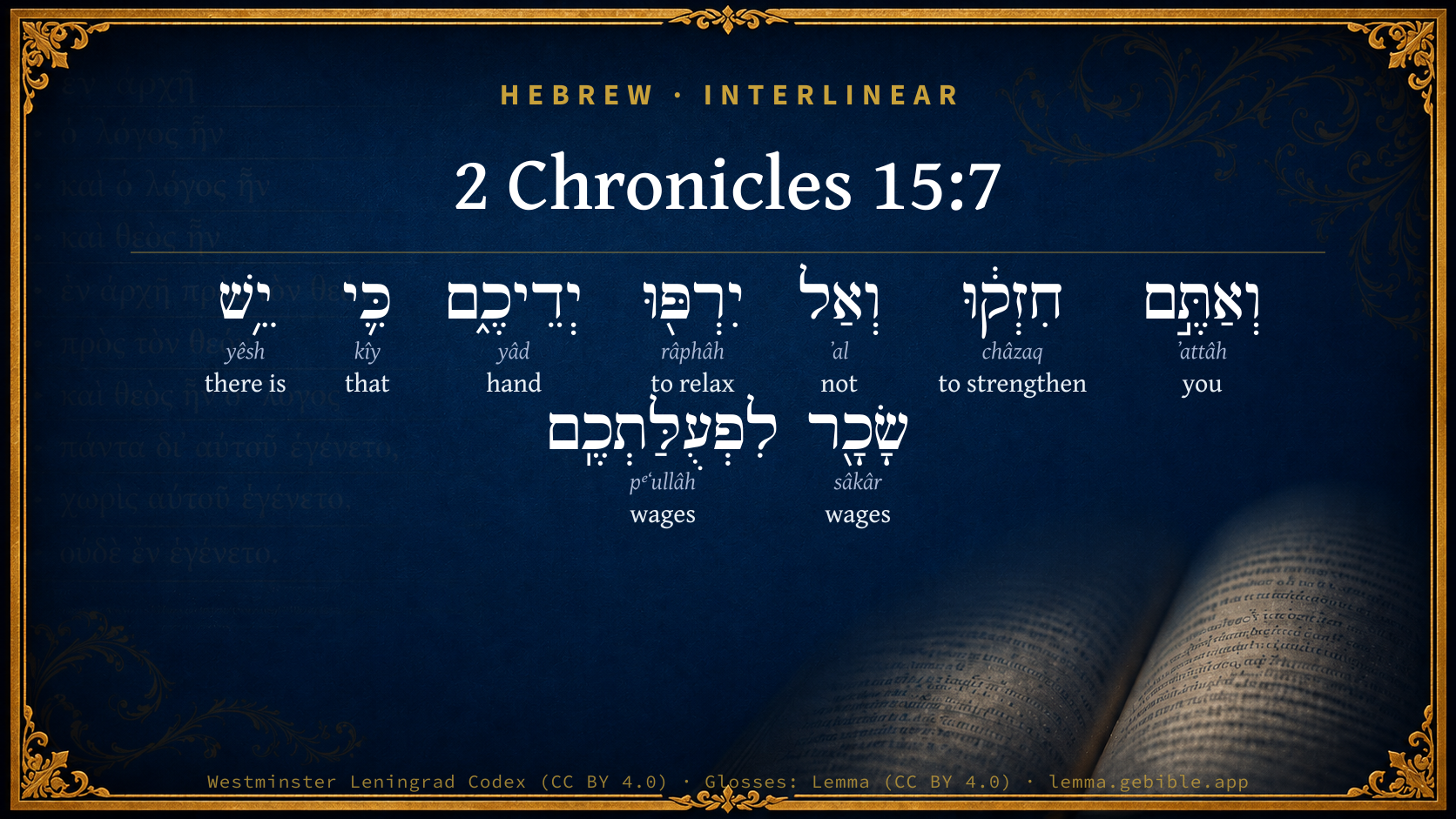
Hebrew (Westminster Leningrad Codex) 2 Chronicles 15:7 appears in the Hebrew Old Testament. The text above is from the Westminster Leningrad Codex. Each word links to its Strong’s number, a concise gloss, and parsing drawn from the Open Scriptures Hebrew Bible morphology. Click any word for its full Brown-Driver-Briggs (BDB) entry.
Download image
Cite this verse

2 Chronicles 15:7 (World English Bible). Public Domain. Lemma interlinear Bible study tool, https://lemma.gebible.app/v/2-chronicles/15/7.

Show BibTeX & RIS
BibTeX
RIS
English Translation
But be you strong, and don't let your hands be slack; for your work shall be rewarded.
World English Bible · Public Domain
Download a study sheet

One document with this verse’s original text, its word-by-word gloss line, the meaning frame, cross-references with their text, attributed commentary, and full source and license credits — printable, and it pastes into notes with its structure intact.

This verse Autodidact and up

Study sheet (.html) Plain text (.txt)

A passage Seminary Student

Up to 50 verses in one chapter. A passage sheet keeps up to 6 commentary sources and 12 cross-references per verse, in the order this page ranks them, and says so on the sheet whenever that leaves anything out. Ask for a single verse and you get the Autodidact verse sheet above.

Everything on this page stays free to read, with no account — the sheet is a download of what is already on screen, not access to it.

Want to remove ads? Support Godless Engineer
Compare translations 3

The same verse in 3 English versions, stacked beneath the original-language interlinear above. Click any original word for its lexicon entry.

Each is an independent rendering of the whole verse — the interlinear is not word-aligned to these translations.

Highlighted words mark where these versions differ — a whole-verse word diff, not a word-by-word alignment.

  • World English Bible Public Domain
    But be you strong, and don't let your hands be slack; for your work shall be rewarded.
  • King James Version Public Domain
    Be ye strong therefore, and let not your hands be weak: for your work shall be rewarded.
  • unfoldingWord Literal Text CC BY-SA 4.0
    But you all, be strong, and do not let your hands grow slack, for there is reward for your work.”

unfoldingWord Literal Text — © unfoldingWord, licensed CC BY-SA 4.0. Word-aligned USFM3 via Door43 (git.door43.org/unfoldingWord/en_ult).

Versions to compare (up to 4)

3 of 4 selected

Show all 18 translations

Every available English version of this verse, each an independent rendering of the whole verse.

  • World English Bible Public Domain
    But be you strong, and don't let your hands be slack; for your work shall be rewarded.
  • Berean Standard Bible Public Domain
    But as for you, be strong; do not be discouraged, for your work will be rewarded.”
  • Majority Standard Bible Public Domain
    But as for you, be strong; do not be discouraged, for your work will be rewarded.”
  • King James Version Public Domain
    Be ye strong therefore, and let not your hands be weak: for your work shall be rewarded.
  • American Standard Version (1901) Public Domain
    But be ye strong, and let not your hands be slack; for your work shall be rewarded.
  • Revised Version (1885) Public Domain
    But be ye strong, and let not your hands be slack: for your work shall be rewarded.
  • Geneva Bible (1599) Public Domain
    Be ye strong therefore, and let not your handes be weake: for your worke shall haue a rewarde.
  • Douay-Rheims (1899) Public Domain
    Do you therefore take courage, and let not your hands he weakened: for there shall be a reward for your work.
  • Young's Literal Translation Public Domain
    and ye, be ye strong, and let not your hands be feeble, for there is a reward for your work.'
  • Literal Standard Version CC BY-SA 4.0
    and you, be strong, and do not let your hands be feeble, for there is a reward for your work.”
  • Unlocked Literal Bible CC BY-SA 4.0
    But be strong, and do not let your hands be weak, for your work will be rewarded.”
  • unfoldingWord Literal Text CC BY-SA 4.0
    But you all, be strong, and do not let your hands grow slack, for there is reward for your work.”
  • Darby Bible Public Domain
    But as for you, be firm and let not your hands be weak; for there is a reward for your deeds.
  • World Messianic Bible Public Domain
    But you be strong! Don’t let your hands be slack, for your work will be rewarded.”
  • Webster's Bible Public Domain
    Be ye strong therefore, and let not your hands be weak; for your work shall be rewarded.
  • Free Bible Version CC BY-SA 4.0
    But you need to be strong, not weak, for you will be rewarded for the work you do.”
  • Bible in Basic English Public Domain
    But be you strong and let not your hands be feeble, for your work will be rewarded.
  • JPS Tanakh (1917) Public Domain
    But be ye strong, and let not your hands be slack; for your work shall be rewarded.'

Literal Standard Version (2020), Covenant Press — licensed CC BY-SA 4.0. Text via the HelloAO Bible API (eBible.org). Unlocked Literal Bible (unfoldingWord) — licensed CC BY-SA 4.0. Text via the HelloAO Bible API (eBible.org). unfoldingWord Literal Text — © unfoldingWord, licensed CC BY-SA 4.0. Word-aligned USFM3 via Door43 (git.door43.org/unfoldingWord/en_ult). Free Bible Version, Dr. Jonathan Gallagher — licensed CC BY-SA 4.0. Text via the HelloAO Bible API (eBible.org).

Word by word

More ways to search: Search by grammar → Find every occurrence → Compare this word →

Practice this passage: Drill this verse → Learn its vocabulary →

לִפְעֻלַּתְכֶֽם
pᵉʻullâh
H6468
“to/for · wages · your”
Preposition + Noun, Common, Feminine, Singular, Construct + Suffix, Personal, 2nd Person, Masculine, Plural
Part of Speech
Preposition + Noun
Type
Common
Gender
Feminine
Number
Singular
State
Construct
Full BDB Definition

Origin: pass part of H6466

TWOT: 1792b

work, recompense, reward - work - wages
  1. וְאַתֶּ֣ם ʼattâh H859 “and · you” Conjunction + Pronoun, Personal, 2nd Person, Masculine, Plural
  2. חִזְק֔וּ châzaq H2388 “strengthen” Verb, Qal, Imperative, 2nd Person, Masculine, Plural
  3. וְאַל ʼal H408 “and · not” Conjunction + Particle, Negative
  4. יִרְפּ֖וּ râphâh H7503 “to relax” Verb, Qal, Jussive, 3rd Person, Masculine, Plural
  5. יְדֵיכֶ֑ם yâd H3027 “hands · your” Noun, Common, Both, Dual, Construct + Suffix, Personal, 2nd Person, Masculine, Plural
  6. כִּ֛י kîy H3588 “that” Conjunction
  7. יֵ֥שׁ yêsh H3426 “there is” Particle, Demonstrative
  8. שָׂכָ֖ר sâkâr H7939 “wages” Noun, Common, Masculine, Singular, Absolute

About this verse

These counts appear in no published source. They are computed here, from the morphology-tagged text and Lemma’s own curated glosses. What Lemma adds →

9
words
9
distinct lemmas
Historical
section

Notable vocabulary

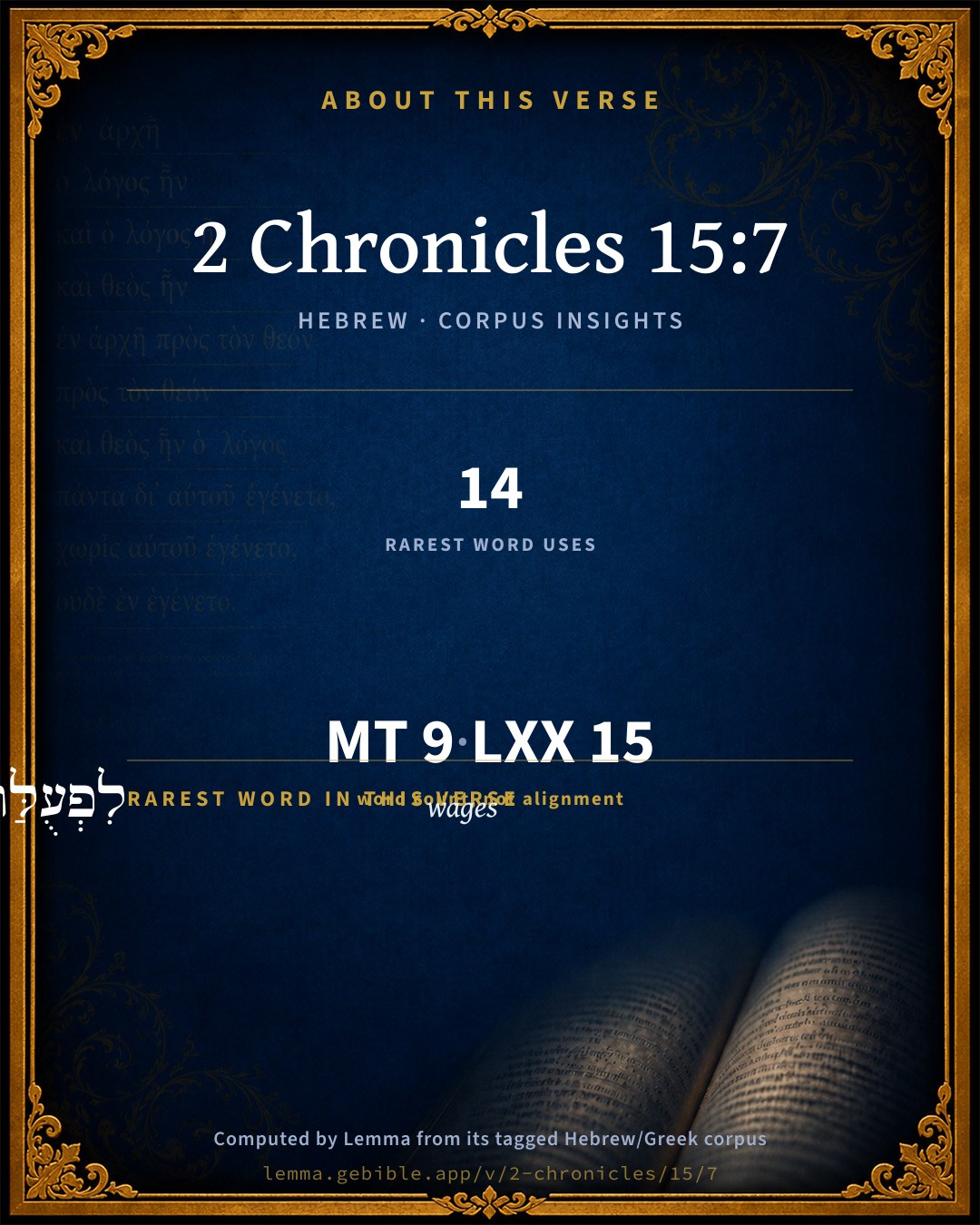
The rarest word here is לִפְעֻלַּתְכֶֽם wages H6468 — appearing just 14 times in the whole Hebrew Bible.

Shared distinctive vocabulary

לִפְעֻלַּתְכֶֽם wages H6468 occurs in 14 verses of the Hebrew Bible. Also found in:

Grammatical profile

  • 2 verbs
  • 3 nouns
  • 1 pronoun
  • 1 conjunction
  • 2 particles

Verb forms

  • חִזְק֔וּ Qal · Imperative
  • יִרְפּ֖וּ Qal · Jussive

Hebrew & Septuagint length

In English translation the verse runs 17 words from the Hebrew and 19 from the Septuagint (LXX English) — closely comparable.

A rough comparison of the two English renderings, which tokenize alike — not a word-level alignment.

Word counts can differ between the Hebrew and the Greek without any difference in meaning — e.g. the Hebrew direct-object marker אֵת has no separate Greek word, and Greek often adds the article ὁ.

In the original languages it is 9 Hebrew tokens and 15 Greek tokens — but the two are counted differently (Hebrew bundles its prefixes and suffixes into one token; the Greek is in lemma form), so that isn’t a like-for-like length.

Cross-references

29

Topical passages linked to 2 Chronicles 15:7 in the Treasury of Scripture Knowledge — connected by theme and wording, ordered by reader-vote popularity; previews shown in the World English Bible.

  • 1 Corinthians 15:58 Therefore, my beloved brothers, be steadfast, immovable, always abounding in the Lord's work, because you know that your labor is not in vain in the Lord.
  • Joshua 1:7 Only be strong and very courageous, to observe to do according to all the law, which Moses my servant commanded you: don't turn from it to the right hand or to the left, that you may have good success wherever you go.
  • Joshua 1:9 Haven't I commanded you? Be strong and of good courage; don't be afraid, neither be dismayed: for Yahweh your God is with you wherever you go.
  • Hebrews 10:35 Therefore don't throw away your boldness, which has a great reward.
  • 1 Chronicles 28:20 David said to Solomon his son, Be strong and of good courage, and do it: don't be afraid, nor be dismayed; for Yahweh God, even my God, is with you; he will not fail you, nor forsake you, until all the work for the service of the house of Yahweh is finished.
  • Genesis 15:1 After these things the word of Yahweh came to Abram in a vision, saying, "Don't be afraid, Abram. I am your shield, your exceedingly great reward."
  • Psalms 58:11 So that men shall say, "Most assuredly there is a reward for the righteous. Most assuredly there is a God who judges the earth."
  • 2 John 1:8 Watch yourselves, that we don't lose the things which we have accomplished, but that we receive a full reward.
  • Hebrews 6:10 For God is not unrighteous, so as to forget your work and the labor of love which you showed toward his name, in that you served the saints, and still do serve them.
  • Colossians 3:24 knowing that from the Lord you will receive the reward of the inheritance; for you serve the Lord Christ.
  • Ruth 2:12 Yahweh recompense your work, and a full reward be given you of Yahweh, the God of Israel, under whose wings you are come to take refuge.
  • 1 Corinthians 3:8 Now he who plants and he who waters are the same, but each will receive his own reward according to his own labor.
  • Ephesians 6:10 Finally, be strong in the Lord, and in the strength of his might.
  • 1 Corinthians 3:14 If any man's work remains which he built on it, he will receive a reward.
  • Matthew 6:6 But you, when you pray, enter into your inner chamber, and having shut your door, pray to your Father who is in secret, and your Father who sees in secret will reward you openly.
  • Romans 4:4–5 Now to him who works, the reward is not counted as grace, but as debt.
  • Matthew 6:4 so that your merciful deeds may be in secret, then your Father who sees in secret will reward you openly.
  • Matthew 10:41–42 He who receives a prophet in the name of a prophet will receive a prophet's reward: and he who receives a righteous man in the name of a righteous man will receive a righteous man's reward.
  • Psalms 27:14 Wait for Yahweh. Be strong, and let your heart take courage. Yes, wait for Yahweh.
  • Daniel 10:19 He said, "Greatly beloved man, don't be afraid: peace be to you, be strong, yes, be strong." When he spoke to me, I was strengthened, and said, "Let my lord speak; for you have strengthened me."
  • Matthew 5:46 For if you love those who love you, what reward do you have? Don't even the tax collectors do the same?
  • Matthew 6:18 so that you are not seen by men to be fasting, but by your Father who is in secret, and your Father, who sees in secret, will reward you.
  • Luke 6:35 But love your enemies, and do good, and lend, expecting nothing back; and your reward will be great, and you will be children of the Most High; for he is kind toward the unthankful and evil.
  • 1 Corinthians 16:13 Watch! Stand firm in the faith! Be courageous! Be strong!
  • Psalms 19:11 Moreover by them is your servant warned. In keeping them there is great reward.
  • Matthew 5:12 Rejoice, and be exceedingly glad, for great is your reward in heaven. For that is how they persecuted the prophets who were before you.
  • Matthew 6:1 "Be careful that you don't do your charitable giving before men, to be seen by them, or else you have no reward from your Father who is in heaven.
  • 1 Corinthians 9:17–18 For if I do this of my own will, I have a reward. But if not of my own will, I have a stewardship entrusted to me.
  • Isaiah 35:3–4 Strengthen you the weak hands, and confirm the feeble knees.

Cross-references courtesy of OpenBible.info (CC BY 4.0).

Hebrew and Greek witnesses Masoretic Hebrew ↔ Greek Septuagint

The same verse in the two great witnesses to the Old Testament, shown verse-for-verse.

These are two independent witnesses, not word-aligned to each other, and the Septuagint is shown in lemma (dictionary) form.

Hebrew 2 Chronicles 15:7 Masoretic · Westminster Leningrad Codex

וְאַתֶּ֣ם חִזְק֔וּ וְאַל יִרְפּ֖וּ יְדֵיכֶ֑ם כִּ֛י יֵ֥שׁ שָׂכָ֖ר לִפְעֻלַּתְכֶֽם

But be you strong, and don't let your hands be slack; for your work shall be rewarded.

World English Bible · Public Domain

Greek LXX 2 Chronicles 15:7 Septuagint · lemma form

καί σύ ἰσχύω καί μή ἐκλύω ὁ χείρ σύ ὅτι εἰμί μισθός ὁ ἐργασία σύ

But be you⌃ strong, and let not your hands be weakened: for there is a reward for your work.

LXX2012 (modern English Septuagint) · Public Domain

Hebrew: Westminster Leningrad Codex (CC BY 4.0). Greek: Septuagint (public domain); English from LXX2012 (modern English Septuagint) (Public Domain). How the Septuagint differs from the Hebrew →

Commentary

Notes on 2 Chronicles 15:7 from classic Christian and Jewish commentators (each source and its license shown beneath its notes). The classic Christian expositions comment on the surrounding passage and are grouped to its opening verse, so a note may address several verses; the Jewish commentaries on the Tanakh (Rashi and others) are per-verse, so they appear only where the commentator wrote on this verse.

Lemma curates 59 commentaries, every one of them public domain or Creative Commons licensed, each selected and text-cleaned for this edition rather than reprinted as found. About our sources →

Trapp's Complete Commentary

John Trapp

2Ch 15:7 Be ye strong therefore, and let not your hands be weak: for your work shall be rewarded.

Ver. 7. Be ye strong therefore.] Since God hath dealt better with you, and brought you back with victory and much spoil, set lustily and vigorously to work, be active for God, in reforming things amiss amongst us: your labour cannot be in vain in the Lord. Those viperous gunpowder traitors had, while they were digging in their vault of villainy, a psalter composed by some of their padres, and secretly passed from hand to hand, whereof this was a part, "Confirm your hearts with hope, for your redemption is not far off. The year of visitation draweth to an end, and jubilation is at hand. The memory of novelties shall perish with a crack, as a ruinous house falling to the ground: he will come as a flame that bursteth out beyond the furnace." &c.

John Trapp, A Commentary or Exposition upon All the Books of the Old and New Testament (1647–1656) — public domain. Text from a community e-Sword module.

The Biblical Illustrator

Joseph S. Exell

2Ch_15:7

Be ye Strong therefore, and let not your hands be weak.

Religious resolution

I. That resolution is necessary in promoting the cause of religion. Resolution is the essence of that mental strength which gives energy to all the powers and faculties of body and mind. It is composed of love, zeal, and confidence. Such resolution has always had a principal influence in effecting all the great things which have ever been effected by the men of the world. Necessary in religion. The Scriptures inculcate it (2Ch_19:11; Ezr_10:4). Examples of resolution: Moses, Elijah, Daniel, Shadrach, Meshach, Abednego, John the Baptist, Peter and John, Paul, Luther, Calvin, etc.

II. That the friends of God have good ground for such unshaken resolution in promoting such a great and good design.

1. The friends of God have often been succeeded in their sincere attempts to promote His glory in the salvation of sinners.

2. The promotion of religion is such a noble and laudable design that it is even glorious to fail in the attempt.

3. Those who espouse the cause of religion have reason to expect the peculiar presence and assistance of God in their pious exertions.

4. They also have the approbation and prayers of all good men.

5. They are equally sure of the esteem and affection of all those whom they shall be instrumental in converting.

6. Their efforts shall finally meet a glorious recompense of reward.

III. Inferences.

1. That the friends of God have been very negligent in promoting His cause in the world.

2. That none will ever do much to forward the work of spreading the gospel without a large share of Christian zeal and resolution. (N. Emmons, D.D.)

Strong hands

In the Bible, the human hand is often used as a figure to express actions of life. As a symbol, Elisha poured water over the hands of Elijah; meaning that he would henceforth be his servant, and minister unto him in deeds of kindness. The reason why the hand represents so many things is because of its manifold uses. What firmness in its grasp, and what delicacy in its touch! It can forge an anchor or make a needle; fell a tree or feel to read the Bible; and do a thousand things which would seem very wonderful if they were not so familiar. Be ye strong therefore, and let not your hands be weak.

I. That man will have strong hands who regularly lifts them up in prayer. If you lift up your hands in prayer as the apostles did, you shall have strength to do great deeds for God.

II. Let your hands be strong in cleaving to the Cross of Christ. (W. Birch.)

Success the certain fruit of faithful labours

Applying these words to the work of Sabbath schools, consider--

I. The work.

1. Its object is the benefit of the rising generation.

2. Its tendencies as to the interests of society at large are beneficial.

3. It accords with the spirit of Christianity and the predictions of sacred writ (Isa_11:9).

II. The exhortation.

1. To faith.

2. To union.

3. To perseverance.

III. The reward. This is to be found--

1. In the satisfaction of your own minds.

2. In the success of your efforts.

3. In the approbation of your Lord. (N. Hutchings.)

The Biblical Illustrator, edited by Joseph S. Exell (c. 1880s–1900s) — public domain. Text from a community e-Sword module.

Joseph Benson's Commentary

2Ch 15:7. Be ye strong therefore — Go on resolutely to maintain God’s worship, and to root out idolatry, as you have begun to do; for this is the only method of preserving yourselves from such calamities as your predecessors have felt. And let not your hands be weak — Be not discouraged with the opposition which you may possibly meet with. For your work shall be rewarded — What you do for God, and for his honour and service, shall not be overlooked, or go unrequited.

Joseph Benson's Commentary on the Old and New Testaments (1811–1818) — public domain. Text from a community e-Sword module.

Tyndale Open Study Notes

Tyndale Open Resources

15:7 The exhortation to be strong and courageous is a literal quotation of the exhortation that both Moses and Joshua gave Israel when they were first entering the land (Deut 31:6-7; Josh 1:6, 9, 18).

Tyndale Open Study Notes — © Tyndale Open Resources, licensed CC BY-SA 4.0. Text via the HelloAO Bible API.

Geneva Bible (1599)

Geneva Bible translators

Your confidence and trust in God shall not be frustrated.

Geneva Bible (1599) marginal notes — public domain. Text via Bolls.life.

Jamieson, Fausset & Brown

Robert Jamieson, A. R. Fausset & David Brown

Be ye strong--Great resolution and indomitable energy would be required to persevere in the face of the opposition your reforming measures will encounter.

your work shall be rewarded--What you do in the cause and for the glory of God will assuredly be followed by the happiest results both to yourself and your subjects.

Jamieson, Fausset & Brown — Commentary Critical and Explanatory on the Whole Bible (1871) — public domain (CC PDM 1.0). Text via the HelloAO Bible API.

Ellicott's Commentary for English Readers

(7) Be ye strong therefore.—Rather, But ye, be ye strong.

Be weak.—Droop, or hang down (Zep_3:16; 2Sa_4:1).

Your work shall be rewarded.—Literally, there is indeed a reward for your work; words occurring in Jer_31:16. We have here the moral of the prophet’s address. The ruinous results of not “seeking,” and “forsaking,” Jehovah (2Ch_15:2) have been briefly but powerfully sketched from the past history of the nation. The conclusion is, Do not ye fall away like your forefathers; but let your allegiance to Jehovah be decided and sincere.

Your work.—Of rooting out idolatry.

A Bible Commentary for English Readers, edited by Charles John Ellicott (1878–1897) — public domain. Text from a community e-Sword module.

The Cambridge Bible for Schools and Colleges

gen. ed. J. J. S. Perowne

7. Be ye strong therefore] R.V. But be ye strong. The prophet’s warning is continued in this verse.

be weak] R.V. be slack.

The Cambridge Bible for Schools and Colleges (gen. ed. J. J. S. Perowne; Cambridge University Press, 1878–1918) — public domain. Text from a community e-Sword module.

John Gill's Exposition

Be ye strong therefore, and let not your hands be weak,.... Be hearty, earnest, and vigorous, and not languid and remiss in reforming the worship of God, which Asa had begun:

for your work shall be rewarded; with peace and prosperity at home, and success against enemies abroad, of which they had had a recent instance.

John Gill's Exposition of the Whole Bible (1746–1763) — public domain (CC PDM 1.0). Text via the HelloAO Bible API.

Matthew Poole's English Annotations

Be ye strong therefore; go on therefore courageously and resolutely to maintain God’s worship, and to root out idolatry, as you have begun to do; for this is the only right method of preserving yourselves from such calamities as your predecessors have felt.

Let not your hands be weak; be not discouraged with the opposition which you may possibly meet with.

Your work shall be rewarded; what you do for God and for his honour and service shall not go unrequited.

Matthew Poole's English Annotations on the Holy Bible (1683–1685) — public domain. Text from a community e-Sword/MySword module.

Whedon's Commentary on the Bible

Daniel D. Whedon

7. Be ye, strong therefore — This was the direct application of Azariah’s prophecy — counsel and exhortation for the king and people to be firm in obedience to Jehovah and in maintaining the honour of his name and law.

Daniel D. Whedon (gen. ed.), Commentary on the Old and New Testaments (1874–1909) — public domain. Text from a community e-Sword module.

The Pulpit Commentary

Work rewarded so Jer_31:16; Pro_11:18; and compare with them the crown of all the rest. (Gen_15:1) Spiritual strength a sacred obligation.

ye strong therefore, and let not your hands be weak." This is in the imperative mood; it is a commandment. Strength is represented as a sacred duty; and weakness, consequently, as a culpable failure. To be spiritually strong is an obligation as much as an endowment. It may, indeed, be urged that there is

I CONSTITUTIONAL WEAKNESS, which is to be borne with rather than to be blamed. Some human spirits are less fully endowed than others; some bring with them sad consequences of their progenitors" sin. (Exo_20:5) It requires tenfold more spiritual courage and exertion on the part of these to be loyal and faithful than on the part of their brethren who are more richly equipped or less heavily weighted. We need to know much before we judge men. Only the Divine Father, who knows us altogether, who knows, therefore, the limitations and the propensities of our nature which we have received from himself or from our ancestors, can say how much we are to be blamed, how much to be pitied. But undoubtedly there is

II MORAL WEAKNESS, for which we are responsible, of which we are guilty, "Let not your hands be weak." But how often the hand is weak because the life has been low, and because the heart has been wrong! All vice leads down to weakness. And not vice alone, but all folly; the foolish and blameworthy disregard of the laws of our mind and of our body. Not only excessive indulgence in any one direction (mental or physical), but unregulated and ill-proportioned activity, ends in weakness; so that he who might have been an active and efficient workman in many a good field of usefulness is helpless; his hand hangs down; there is "no strength in his right hand," because there has been no wisdom in his mind.

III SPIRITUAL STRENGTH, which we are under obligation to acquire. There is much of real, effective strength which it is open to us all to obtain if we will. God is saying to us, "Be ye strong;" and if we do what he gives us the means of doing, we shall be strong. What are the sources of spiritual strength?

1. Christian morality. And this includes

(1) the care of the body the regulation of its instincts and craving, ministering to its necessities;

(2) the culture of the mind increasing its knowledge and nourishing its power;

(3) the training of the heart.

2. Sacred service. Our capacity for serving Christ and man depends very largely indeed on our making a continuous effort to serve. "To him that hath is given," i.e. to him that puts out his talent is given another; to him that expends his strength in paths of holy usefulness is given multiplied power to speak and strike for God and truth. Our present strength depends upon our growth in power; and that depends upon the measure of our exercise in the field of sacred work.

3. Divine communication. "Thou answeredst me and strengthenedst me with strength in my soul"; (Psa_138:3) "In Christ who strengtheneth.. (Php_4:13) Strength is one of the "good things" our heavenly Father will give to "them that ask him". C. (Mat_7:11)

The reward of Christian work.

work shall be rewarded." The very words recur in the prophecies of Jeremiah; (Jer_31:16) and the sentiment is frequently expressed by our Lord and by his apostles. It appears distinctly in the solemn statement of Jesus Christ, "The Son of man shall come in the glory of his Father and then he shall reward every man according to his works" (Mat_16:27; see also Rom_2:6, Rom_2:7; 1Co_3:8; Rev_22:12) What is the reward for which we are to look? Not

I THE REWARD OF HIRED LABOUR. Hired labour is rewarded precisely and particularly. So much money for so much work, measured by the hours occupied or the work done. There is a nice calculation of what has been wrought on the one hand, and of what is given in exchange on the other. It is supposed that the one is the equivalent of the other. But our Divine Saviour does not call us into his field on this arrangement. We are not his day-labourers, engaged at a certain price; we are his fellow-workers employed under him, indeed, but engaged with him in the completion ofhis great "work." He is not treating us as slaves or even as common servants, but as children and as friends as those whom he loves and desires to bless with true well-being. We aspire to

II THE REWARD OF THE LABOUR OF LOVE. Our Divine Master invites us to stand by his side and work out with him the redemption of our race. He charges us to be as he was in the world; to work as he did, in the spirit of entire self-surrender, of wholehearted love; to put forth our strength in his service and in the cause of righteousness and human elevation; and he tells us that we shall secure a "full reward." We shall find that in:

1. The possession of his good pleasure. The true soldier finds his best reward in the commendation of his commander; the true scholar in the approval of his teacher; the true workman in the smile of him in whose service he is engaged. We, as Christian workmen, look for our deepest joy in the smile and the approval of our Lord. We hope for no moment of keener ecstasy than that when we shall hear him say to us, "Well done, good and faithful servant!" To live in the known and felt possession of Jesus Christ"s benediction is one of the purest, as it is one of the most appreciated, rewards, we can receive.

2. The enlargement of our own powers of service. As we work in the cause of heavenly wisdom and of spiritual well-being, our power for action is constantly enlarging, until feebleness becomes strength, and strength becomes might. The more we do the more we are capable of doing (see previous homily).

3. The expansion of our sphere of service. "Thou hast been faithful in a few things, I will make thee ruler over many things". (Mat_25:21) "I will ask for no reward, except to serve thee still;" or, may we not say," except to serve thee mor "? to serve thee in that broader sphere, with those nobler opportunities into which thou wilt introduce me. For our Master does thus enlarge us now, as one fruit of our labour; and he will soon reward us by a far more generous enlargement, when he "cometh with his Father" and when "his reward is with him. C.

The Pulpit Commentary (1880–1919), ed. H.D.M. Spence-Jones & Joseph S. Exell — public domain. Text from a community e-Sword module.

John Wesley's Explanatory Notes

Be strong - Go on resolutely to maintain God's worship and to root out idolatry, as you have begun to do; for this is the only method of preserving yourselves from such calamities as your predecessors have felt.

John Wesley, Explanatory Notes Upon the Whole Bible (1754–1765) — public domain. Text via the GEBible commentary corpus.

Rashi

Rabbi Shlomo Yitzchaki (Rashi)

But you be strong to seek God.

Rashi on the Tanakh — English translations: “The Judaica Press complete Tanach with Rashi, translated by A. J. Rosenberg” (CC BY 4.0); “Pentateuch with Rashi's commentary by M. Rosenbaum and A.M. Silbermann, 1929-1934” (public domain); “The Metsudah Tanach series, Lakewood, N.J” (CC BY 4.0); and “The Book of Joshua, Metsudah Publications, 1997” (CC BY 4.0). Text via Sefaria.

Lesson kit

Teaching starters — assembled from the data on this page, not authored interpretation. Every prompt links to the verse data it draws on. Edit before teaching.

2 Chronicles, in the Historical, opens this verse with 9 words (9 distinct Hebrew lemmas). Its most distinctive word is pᵉʻullâh (“wages”). A historical commentator’s framing appears above. Read the whole chapter for the surrounding context.

Discussion questions

  1. The word pᵉʻullâh carries the sense “wages.” How does it shape the verse?
  2. How does Leviticus 19:13, which shares the word «wages», read alongside this verse?
  3. The translations on this page render this verse differently — a whole-verse word diff, not a word-by-word alignment. What might account for the different wordings?
  4. «חִזְק֔וּ» is a Qal Imperative verb. How does that grammatical form shape the action described?
  5. Compare how Trapp's Complete Commentary and The Biblical Illustrator read this verse. Where do they agree or differ?

Things to notice

Reading settings

Reading text

Shown beneath each verse's original-language words.

Old Testament
Old Testament edition

Read the OT as the Masoretic Hebrew (MT) or the Greek Septuagint (LXX).

English shown for the Greek Septuagint (in the Hebrew ↔ Greek comparison).

Comparing translations? Open the Compare panel on any verse page to stack up to four side by side.