
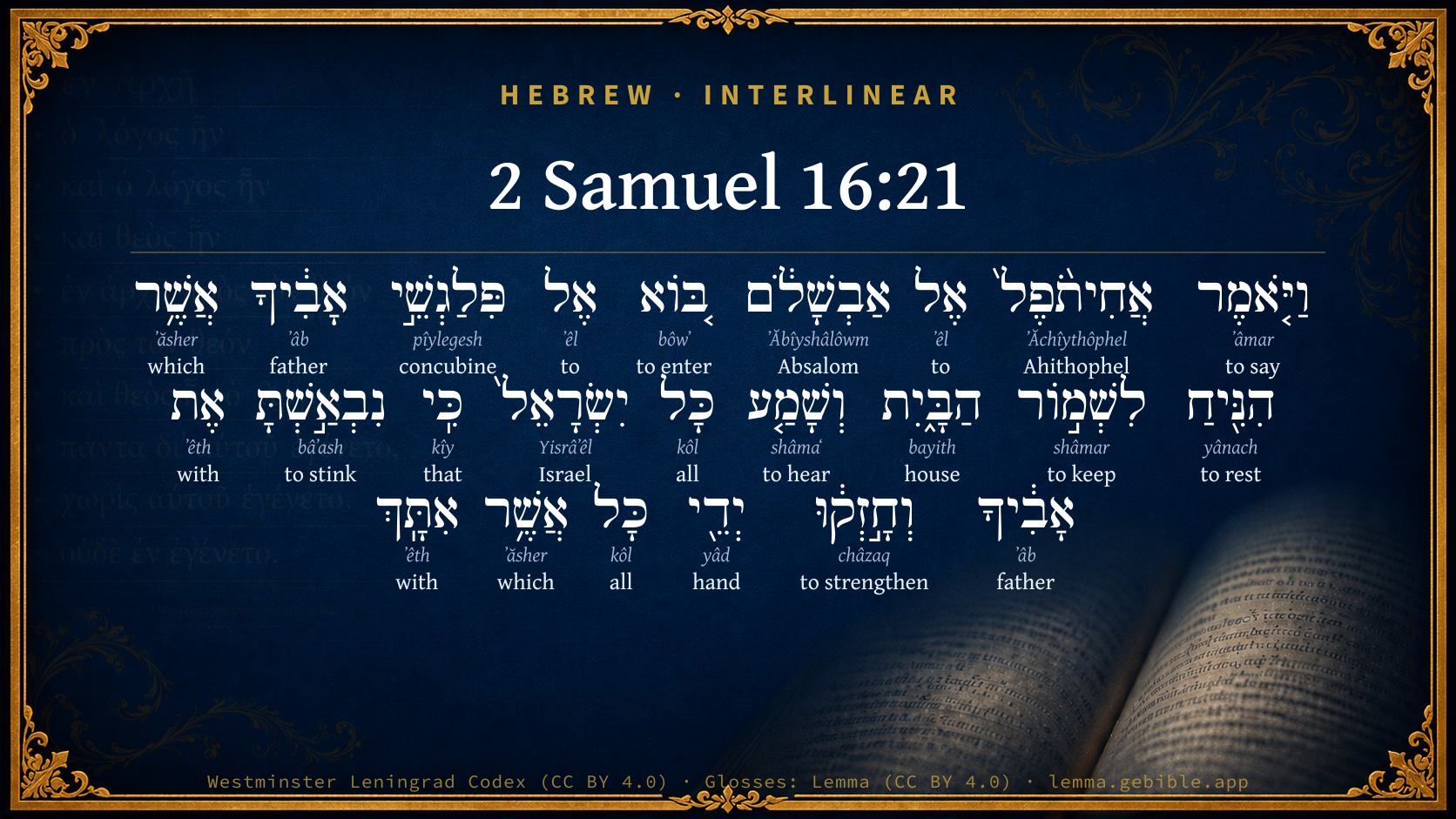
2 Samuel 16:21

Hebrew (Westminster Leningrad Codex) 2 Samuel 16:21 appears in the Hebrew Old Testament. The text above is from the Westminster Leningrad Codex. Each word links to its Strong’s number, a concise gloss, and parsing drawn from the Open Scriptures Hebrew Bible morphology. Click any word for its full Brown-Driver-Briggs (BDB) entry.
Download image
Cite this verse

2 Samuel 16:21 (World English Bible). Public Domain. Lemma interlinear Bible study tool, https://lemma.gebible.app/v/2-samuel/16/21.

Show BibTeX & RIS
BibTeX
RIS
English Translation
Ahithophel said to Absalom, Go in to your father's concubines, that he has left to keep the house; and all Israel will hear that you are abhorred of your father: then will the hands of all who are with you be strong.
World English Bible · Public Domain
Download a study sheet

One document with this verse’s original text, its word-by-word gloss line, the meaning frame, cross-references with their text, attributed commentary, and full source and license credits — printable, and it pastes into notes with its structure intact.

This verse Autodidact and up

Study sheet (.html) Plain text (.txt)

A passage Seminary Student

Up to 50 verses in one chapter. A passage sheet keeps up to 6 commentary sources and 12 cross-references per verse, in the order this page ranks them, and says so on the sheet whenever that leaves anything out. Ask for a single verse and you get the Autodidact verse sheet above.

Everything on this page stays free to read, with no account — the sheet is a download of what is already on screen, not access to it.

Want to remove ads? Support Godless Engineer
Compare translations 3

The same verse in 3 English versions, stacked beneath the original-language interlinear above. Click any original word for its lexicon entry.

Each is an independent rendering of the whole verse — the interlinear is not word-aligned to these translations.

Highlighted words mark where these versions differ — a whole-verse word diff, not a word-by-word alignment.

  • World English Bible Public Domain
    Ahithophel said to Absalom, Go in to your father's concubines, that he has left to keep the house; and all Israel will hear that you are abhorred of your father: then will the hands of all who are with you be strong.
  • King James Version Public Domain
    And Ahithophel said unto Absalom, Go in unto thy father's concubines, which he hath left to keep the house; and all Israel shall hear that thou art abhorred of thy father: then shall the hands of all that are with thee be strong.
  • unfoldingWord Literal Text CC BY-SA 4.0
    And Ahithophel said to Absalom, “Go in to the concubines of your father whom he left to keep the house, and all of Israel will hear that you have made yourself stink with your father, and the hands of all who with you will become strong.”

unfoldingWord Literal Text — © unfoldingWord, licensed CC BY-SA 4.0. Word-aligned USFM3 via Door43 (git.door43.org/unfoldingWord/en_ult).

Versions to compare (up to 4)

3 of 4 selected

Show all 18 translations

Every available English version of this verse, each an independent rendering of the whole verse.

  • World English Bible Public Domain
    Ahithophel said to Absalom, Go in to your father's concubines, that he has left to keep the house; and all Israel will hear that you are abhorred of your father: then will the hands of all who are with you be strong.
  • Berean Standard Bible Public Domain
    Ahithophel replied, “Sleep with your father’s concubines, whom he has left to keep the palace. When all Israel hears that you have become a stench to your father, then the hands of all who are with you will be strengthened.”
  • Majority Standard Bible Public Domain
    Ahithophel replied, “Sleep with your father’s concubines, whom he has left to take care of the palace. When all Israel hears that you have become a stench to your father, then the hands of all who are with you will be strengthened.”
  • King James Version Public Domain
    And Ahithophel said unto Absalom, Go in unto thy father's concubines, which he hath left to keep the house; and all Israel shall hear that thou art abhorred of thy father: then shall the hands of all that are with thee be strong.
  • American Standard Version (1901) Public Domain
    And Ahithophel said unto Absalom, Go in unto thy father's concubines, that he hath left to keep the house; and all Israel will hear that thou art abhorred of thy father: then will the hands of all that are with thee be strong.
  • Revised Version (1885) Public Domain
    And Ahithophel said unto Absalom, Go in unto thy father’s concubines, which he hath left to keep the house; and all Israel shall hear that thou art abhorred of thy father: then shall the hands of all that are with thee be strong.
  • Geneva Bible (1599) Public Domain
    And Ahithophel said vnto Absalom, Goe in to thy fathers concubines, which he hath left to keepe the house: and when all Israel shall heare, that thou art abhorred of thy father, the hands of all that are with thee, shall be strong.
  • Douay-Rheims (1899) Public Domain
    And Achitophel said to Absalom: Go in to the concubines of thy father, whom he hath left to keep the house: that when all Israel shall hear that thou hast disgraced thy father, their hands may be strengthened with thee.
  • Young's Literal Translation Public Domain
    And Ahithophel saith unto Absalom, `Go in unto the concubines of thy father, whom he left to keep the house, and all Israel hath heard that thou hast been abhorred by thy father, and the hands of all who `are' with thee have been strong.'
  • Literal Standard Version CC BY-SA 4.0
    And Ahithophel says to Absalom, “Go in to the concubines of your father, whom he left to keep the house, and all Israel has heard that you have been abhorred by your father, and the hands of all who [are] with you have been strong.”
  • Unlocked Literal Bible CC BY-SA 4.0
    Ahithophel answered Absalom, “Go sleep with your father's slave wives whom he has left to keep the palace, and all Israel will hear that you have become a stench to your father. Then the hands of all who are with you will be strong.”
  • unfoldingWord Literal Text CC BY-SA 4.0
    And Ahithophel said to Absalom, “Go in to the concubines of your father whom he left to keep the house, and all of Israel will hear that you have made yourself stink with your father, and the hands of all who with you will become strong.”
  • Darby Bible Public Domain
    And Ahithophel said to Absalom, Go in to thy father's concubines, whom he has left to keep the house; and all Israel shall hear that thou art become odious with thy father; and the hands of all that are with thee shall be strong.
  • World Messianic Bible Public Domain
    Ahithophel said to Absalom, “Go in to your father’s concubines that he has left to keep the house. Then all Israel will hear that you are abhorred by your father. Then the hands of all who are with you will be strong.”
  • Webster's Bible Public Domain
    And Ahithophel said to Absalom, Go in to thy father's concubines, which he hath left to keep the house; and all Israel shall hear that thou art abhorred by thy father: then shall the hands of all that are with thee be strong.
  • Free Bible Version CC BY-SA 4.0
    Ahithophel told him, “Go and sleep with your father's concubines—the ones he left here to look after the palace. Then everyone in Israel will realize that you have so offended your father there's no turning back, which will encourage all your supporters.”
  • Bible in Basic English Public Domain
    And Ahithophel said to Absalom, Go in to your father's women who are here looking after his house; then all Israel will have the news that you are hated by your father, and the hands of your supporters will be strong.
  • JPS Tanakh (1917) Public Domain
    And Ahithophel said unto Absalom: 'Go in unto thy father's concubines, that he hath left to keep the house; and all Israel will hear that thou art abhorred of thy father; then will the hands of all that are with thee be strong.'

Literal Standard Version (2020), Covenant Press — licensed CC BY-SA 4.0. Text via the HelloAO Bible API (eBible.org). Unlocked Literal Bible (unfoldingWord) — licensed CC BY-SA 4.0. Text via the HelloAO Bible API (eBible.org). unfoldingWord Literal Text — © unfoldingWord, licensed CC BY-SA 4.0. Word-aligned USFM3 via Door43 (git.door43.org/unfoldingWord/en_ult). Free Bible Version, Dr. Jonathan Gallagher — licensed CC BY-SA 4.0. Text via the HelloAO Bible API (eBible.org).

Word by word

More ways to search: Search by grammar → Find every occurrence → Compare this word →

Practice this passage: Drill this verse → Learn its vocabulary →

נִבְאַ֣שְׁתָּ
bâʼash
H887
“to stink”
Verb, Niphal, Perfect, 2nd Person, Masculine, Singular
Part of Speech
Verb
Stem
Niphal
Form
Perfect
Person
2nd Person
Gender
Masculine
Number
Singular
Full BDB Definition

Origin: a primitive root

TWOT: 195

to have a bad smell, stink, smell bad - (Qal) to stink, smell bad - (Niphal) - to become odious - to make oneself odious - (Hiphil) - to stink, emit a stinking odour - to cause to stink - of wickedness (figuratively) - (Hithpael) to make oneself odious - (TWOT) to abhor
  1. וַיֹּ֤אמֶר ʼâmar H559 “and · to say” Conjunction + Verb, Qal, Sequential Imperfect, 3rd Person, Masculine, Singular
  2. אֲחִיתֹ֨פֶל֙ ʼĂchîythôphel H302 “Ahithophel” Noun, Proper
  3. אֶל ʼêl H413 “to” Preposition
  4. אַבְשָׁלֹ֔ם ʼĂbîyshâlôwm H53 “Absalom” Noun, Proper
  5. בּ֚וֹא bôwʼ H935 “enter” Verb, Qal, Imperative, 2nd Person, Masculine, Singular
  6. אֶל ʼêl H413 “to” Preposition
  7. פִּלַגְשֵׁ֣י pîylegesh H6370 “concubines of” Noun, Common, Feminine, Plural, Construct
  8. אָבִ֔יךָ ʼâb H1 “father · your” Noun, Common, Masculine, Singular, Construct + Suffix, Personal, 2nd Person, Masculine, Singular
  9. אֲשֶׁ֥ר ʼăsher H834 “which” Particle, Relative
  10. הִנִּ֖יחַ yânach H3240 “to rest” Verb, Hiphil, Perfect, 3rd Person, Masculine, Singular
  11. לִשְׁמ֣וֹר shâmar H8104 “to keep” Preposition + Verb, Qal, Infinitive Construct
  12. הַבָּ֑יִת bayith H1004 “the · house” Particle, Definite Article + Noun, Common, Masculine, Singular, Absolute
  13. וְשָׁמַ֤ע shâmaʻ H8085 “and · to hear” Conjunction + Verb, Qal, Sequential Perfect, 3rd Person, Masculine, Singular
  14. כָּל kôl H3605 “all of” Noun, Common, Masculine, Singular, Construct
  15. יִשְׂרָאֵל֙ Yisrâʼêl H3478 “Israel” Noun, Proper
  16. כִּֽי kîy H3588 “that” Conjunction
  17. אֶת ʼêth H854 “with” Preposition
  18. אָבִ֔יךָ ʼâb H1 “father · your” Noun, Common, Masculine, Singular, Construct + Suffix, Personal, 2nd Person, Masculine, Singular
  19. וְחָ֣זְק֔וּ châzaq H2388 “and · to strengthen” Conjunction + Verb, Qal, Sequential Perfect, 3rd Person, Common, Plural
  20. יְדֵ֖י yâd H3027 “hands of” Noun, Common, Both, Dual, Construct
  21. כָּל kôl H3605 “all of” Noun, Common, Masculine, Singular, Construct
  22. אֲשֶׁ֥ר ʼăsher H834 “which” Particle, Relative
  23. אִתָּֽךְ ʼêth H854 “with · you” Preposition + Suffix, Personal, 2nd Person, Feminine, Singular

About this verse

These counts appear in no published source. They are computed here, from the morphology-tagged text and Lemma’s own curated glosses. What Lemma adds →

24
words
19
distinct lemmas
Historical
section

Notable vocabulary

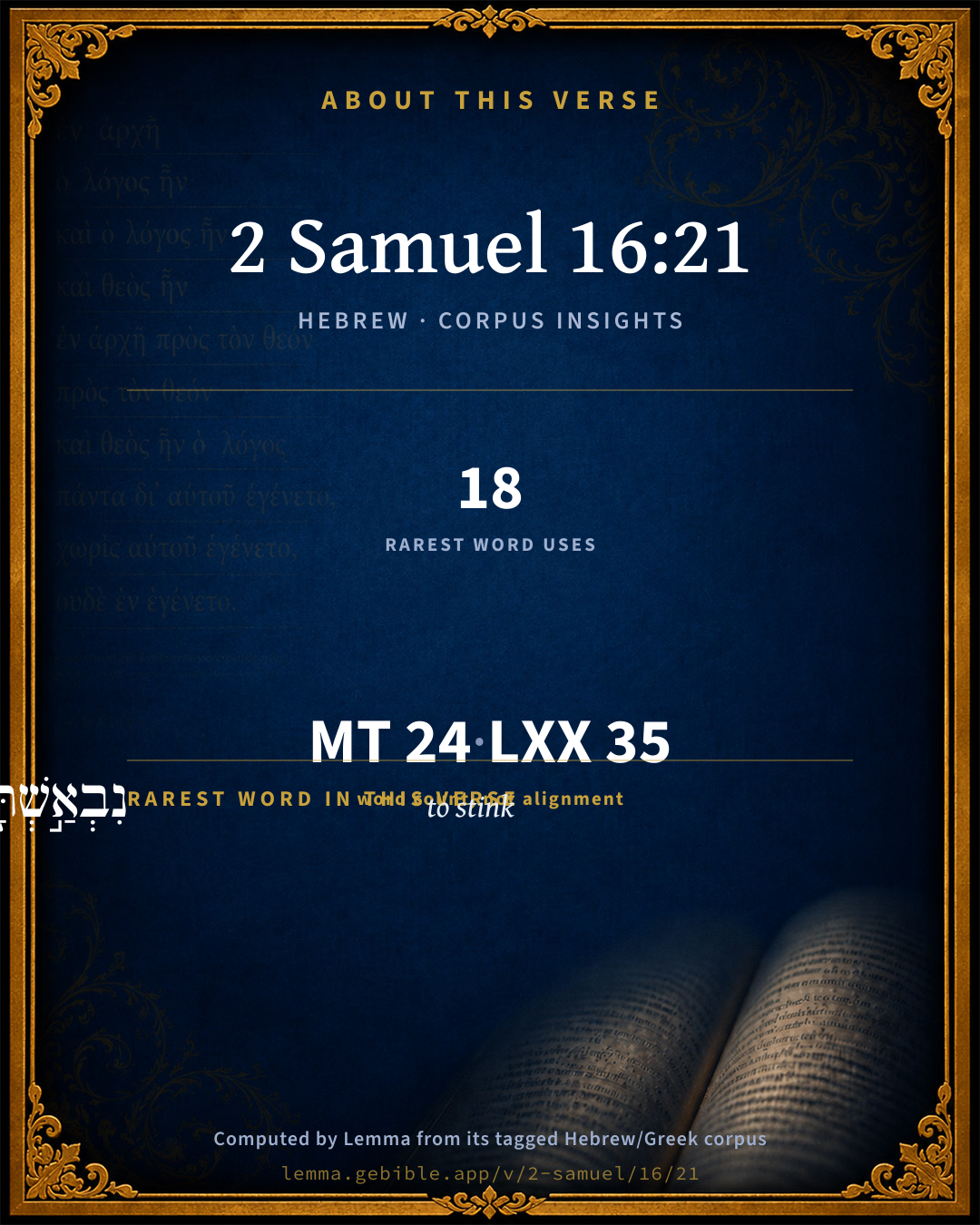
The rarest word here is נִבְאַ֣שְׁתָּ to stink H887 — appearing just 18 times in the whole Hebrew Bible.

Shared distinctive vocabulary

נִבְאַ֣שְׁתָּ to stink H887 occurs in 17 verses of the Hebrew Bible. Also found in:

Grammatical profile

  • 7 verbs
  • 10 nouns
  • 4 prepositions
  • 1 conjunction
  • 2 particles

Verb forms

  • וַיֹּ֤אמֶר Qal · Sequential Imperfect
  • בּ֚וֹא Qal · Imperative
  • הִנִּ֖יחַ Hiphil · Perfect
  • לִשְׁמ֣וֹר Qal · Infinitive Construct
  • וְשָׁמַ֤ע Qal · Sequential Perfect
  • נִבְאַ֣שְׁתָּ Niphal · Perfect
  • וְחָ֣זְק֔וּ Qal · Sequential Perfect

Repetition

Words recur within this verse — often emphatic in Hebrew:

  • אָבִ֔יךָ father H1 ×2
  • כָּל all H3605 ×2
  • אֶל to H413 ×2
  • אֲשֶׁ֥ר which H834 ×2
  • אֶת with H854 ×2

Hebrew & Septuagint length

In English translation the verse runs 42 words from the Hebrew and 41 from the Septuagint (LXX English) — closely comparable.

A rough comparison of the two English renderings, which tokenize alike — not a word-level alignment.

Word counts can differ between the Hebrew and the Greek without any difference in meaning — e.g. the Hebrew direct-object marker אֵת has no separate Greek word, and Greek often adds the article ὁ.

In the original languages it is 24 Hebrew tokens and 35 Greek tokens — but the two are counted differently (Hebrew bundles its prefixes and suffixes into one token; the Greek is in lemma form), so that isn’t a like-for-like length.

Cross-references

17

Topical passages linked to 2 Samuel 16:21 in the Treasury of Scripture Knowledge — connected by theme and wording, ordered by reader-vote popularity; previews shown in the World English Bible.

  • 2 Samuel 20:3 David came to his house at Jerusalem; and the king took the ten women his concubines, whom he had left to keep the house, and put them in custody, and provided them with sustenance, but didn't go in to them. So they were shut up to the day of their death, living in widowhood.
  • 2 Samuel 15:16 The king went forth, and all his household after him. The king left ten women, who were concubines, to keep the house.
  • Leviticus 18:8 "'You shall not uncover the nakedness of your father's wife: it is your father's nakedness.
  • 2 Samuel 2:7 Now therefore let your hands be strong, and be you valiant; for Saul your lord is dead, and also the house of Judah have anointed me king over them.
  • Zechariah 8:13 It shall come to pass that, as you were a curse among the nations, house of Judah and house of Israel, so will I save you, and you shall be a blessing. Don't be afraid. Let your hands be strong."
  • Genesis 6:4 The Nephilim were in the earth in those days, and also after that, when God's sons came to men's daughters. They bore children to them: the same were the mighty men who were of old, men of renown.
  • Genesis 34:30 Jacob said to Simeon and Levi, "You have troubled me, to make me odious to the inhabitants of the land, among the Canaanites and the Perizzites. I am few in number. They will gather themselves together against me and strike me, and I will be destroyed, I and my house."
  • Genesis 35:22 It happened, while Israel lived in that land, that Reuben went and lay with Bilhah, his father's concubine, and Israel heard of it. Now the sons of Jacob were twelve.
  • Genesis 38:16 He turned to her by the way, and said, "Please come, let me come in to you:" for he didn't know that she was his daughter-in-law. She said, "What will you give me, that you may come in to me?"
  • Genesis 49:3–4 "Reuben, you are my firstborn, my might, and the beginning of my strength; The pre-eminence of dignity, and the pre-eminence of power.
  • Leviticus 20:11 The man who lies with his father's wife has uncovered his father's nakedness: both of them shall surely be put to death; their blood shall be upon them.
  • 1 Samuel 13:4 All Israel heard say that Saul had struck the garrison of the Philistines, and also that Israel was had in abomination with the Philistines. The people were gathered together after Saul to Gilgal.
  • 1 Samuel 27:12 Achish believed David, saying, He has made his people Israel utterly to abhor him; therefore he shall be my servant forever.
  • 2 Samuel 12:11 This is what Yahweh says: 'Behold, I will raise up evil against you out of your own house; and I will take your wives before your eyes, and give them to your neighbor, and he will lie with your wives in the sight of this sun.
  • 1 Kings 2:17 He said, Please speak to Solomon the king (for he will not tell you 'no'), that he give me Abishag the Shunammite as wife.
  • 1 Kings 2:22 King Solomon answered his mother, Why do you ask Abishag the Shunammite for Adonijah? ask for him the kingdom also; for he is my elder brother; even for him, and for Abiathar the priest, and for Joab the son of Zeruiah.
  • 1 Corinthians 5:1 It is actually reported that there is sexual immorality among you, and such sexual immorality as is not even named among the Gentiles, that one has his father's wife.

Cross-references courtesy of OpenBible.info (CC BY 4.0).

Hebrew and Greek witnesses Masoretic Hebrew ↔ Greek Septuagint

The same verse in the two great witnesses to the Old Testament, shown verse-for-verse.

These are two independent witnesses, not word-aligned to each other, and the Septuagint is shown in lemma (dictionary) form.

Hebrew 2 Samuel 16:21 Masoretic · Westminster Leningrad Codex

וַיֹּ֤אמֶר אֲחִיתֹ֨פֶל֙ אֶל אַבְשָׁלֹ֔ם בּ֚וֹא אֶל פִּלַגְשֵׁ֣י אָבִ֔יךָ אֲשֶׁ֥ר הִנִּ֖יחַ לִשְׁמ֣וֹר הַבָּ֑יִת וְשָׁמַ֤ע כָּל יִשְׂרָאֵל֙ כִּֽי נִבְאַ֣שְׁתָּ אֶת אָבִ֔יךָ וְחָ֣זְק֔וּ יְדֵ֖י כָּל אֲשֶׁ֥ר אִתָּֽךְ

Ahithophel said to Absalom, Go in to your father's concubines, that he has left to keep the house; and all Israel will hear that you are abhorred of your father: then will the hands of all who are with you be strong.

World English Bible · Public Domain

Greek LXX 2 Samuel 16:21 Septuagint · lemma form

καί εἶπον αχιτοφελ πρός αβεσσαλωμ ἐιςἔρχομαι πρός ὁ παλλακή ὁ πατήρ σύ ὅς καταλείπω φυλάσσω ὁ οἶκος αὐτός καί ἀκούω πᾶς ἰσραήλ ὅτι κατααἰσχύνω ὁ πατήρ σύ καί ἐνἰσχύω ὁ χείρ πᾶς ὁ μετά σύ

And Achitophel said to Abessalom, Go in to your father's concubines, whom he left to keep his house; and all Israel shall hear that you have dishonored your father; and the hands of all that are with you shall be strengthened.

LXX2012 (modern English Septuagint) · Public Domain

Hebrew: Westminster Leningrad Codex (CC BY 4.0). Greek: Septuagint (public domain); English from LXX2012 (modern English Septuagint) (Public Domain). How the Septuagint differs from the Hebrew →

Targum (Aramaic paraphrase)

1

The Targum is the ancient Jewish Aramaic paraphrase of the Hebrew Scriptures — an interpretive translation, not the Hebrew text itself. Onkelos (literal) and Pseudo-Jonathan (expansive) render the Torah, and Jonathan the Prophets. Coverage is partial: where no permissively-licensed English translation exists for a verse, only the Aramaic is shown. This is verse-level text, not a word-by-word alignment to the Hebrew.

  1. Targum Jonathan Prophets (Joshua–Malachi)
    וַאֲמַר אֲחִיתוֹפֶל לְאַבְשָׁלוֹם עוּל לְוַת לְחֵינָתָא דַאֲבוּךְ דִי שְׁבַק לְמִיטַר בֵּיתָא וּשְׁמַע כָּל יִשְׂרָאֵל אֲרֵי אִתְגָרֵיתָא בַּאֲבוּךְ וְיִתְקוֹף יְדֵי כָּל דִי עִמָךְ:

    (no public-domain English translation for this verse)

    Targum Jonathan — Aramaic: “Mikraot Gedolot” (public domain). English: “Sefaria Community Translation” (CC0 1.0 (public-domain dedication)); “London "Chaldee Paraphrase," 1871” (public domain). Text via Sefaria.

Commentary

Notes on 2 Samuel 16:21 from classic Christian and Jewish commentators (each source and its license shown beneath its notes). The classic Christian expositions comment on the surrounding passage and are grouped to its opening verse, so a note may address several verses; the Jewish commentaries on the Tanakh (Rashi and others) are per-verse, so they appear only where the commentator wrote on this verse.

Lemma curates 59 commentaries, every one of them public domain or Creative Commons licensed, each selected and text-cleaned for this edition rather than reprinted as found. About our sources →

Trapp's Complete Commentary

John Trapp

2Sa 16:21 And Ahithophel said unto Absalom, Go in unto thy father’s concubines, which he hath left to keep the house; and all Israel shall hear that thou art abhorred of thy father: then shall the hands of all that [are] with thee be strong.

Ver. 21. Go in unto thy father’s concubines.] O tongue worthy to have been cut out, shred in gobbets and driven down the throat of him that thus misused him, to the engaging of Absalom in such an unpardonable villainy, beside hazard of his immortal soul!

That thou art abhorred of thy father.] And so no hope of reconciliation.

John Trapp, A Commentary or Exposition upon All the Books of the Old and New Testament (1647–1656) — public domain. Text from a community e-Sword module.

Joseph Benson's Commentary

2Sa 16:21. Go in unto thy father’s concubines — This counsel he gave, partly to revenge the injury done to Bath-sheba, the daughter of Eliam, chap. 2Sa 11:3; the son of Ahithophel, 2Sa 23:34; and principally for his own and the people’s safety, that the breach between David and Absalom might be irreparable. For this, he foresaw, would provoke David in the highest degree, and cut off all hope of reconciliation, which otherwise might have been expected to take place, by some treaty between Absalom and his tender-hearted father. But in that case his followers, and especially Ahithophel, would have been left to David’s mercy. That thou art abhorred of thy father — And, therefore, art obliged to prosecute the war with all vigour, and to abandon all thoughts of peace; as knowing that thy father, though he may dissemble, yet will never forgive such an act. Then shall the hands of all that are with thee be strong — They will fight with greater courage and resolution when they are freed from the fear of thy being ever reconciled to thy father, and see they are out of all danger of being sacrificed to any future treaty of peace or agreement between you. “An advice,” says Delaney, “for the present, and in appearance, wise; but in reality pernicious. Could not this long-headed, sagacious statesman foresee, that this action, for which some men would now become more attached to Absalom, must one day make him detestable in their eyes, when they reflected upon the horror of it? a guilt made mortal by the law of God, Lev 20:11, and not named even among the Gentiles; a guilt for which they must one day judge him more worthy to lose his crown than Reuben his birth-right. However, this hellish advice was immediately embraced.”

Joseph Benson's Commentary on the Old and New Testaments (1811–1818) — public domain. Text from a community e-Sword module.

Tyndale Open Study Notes

Tyndale Open Resources

16:21 Go and sleep with your father’s concubines: A usurper took a predecessor’s harem to assert or strengthen his claim to the throne (see 3:7). Absalom’s action was in violation of Deut 22:30.

Tyndale Open Study Notes — © Tyndale Open Resources, licensed CC BY-SA 4.0. Text via the HelloAO Bible API.

Geneva Bible (1599)

Geneva Bible translators

Suspecting the change of the Kingdom, and so his own overthrow, he giveth such counsel as might most hinder his father’s reconciliation: and also declare to the people that Absalom was in highest authority.

Geneva Bible (1599) marginal notes — public domain. Text via Bolls.life.

Jamieson, Fausset & Brown

Robert Jamieson, A. R. Fausset & David Brown

Ahithophel said unto Absalom--This councillor saw that now the die was cast; half measures would be inexpedient. To cut off all possibility of reconciliation between the king and his rebellious son, he gave this atrocious advice regarding the treatment of the royal women who had been left in charge of the palace. Women, being held sacred, are generally left inviolate in the casualties of war. The history of the East affords only one parallel to this infamous outrage of Absalom.

Next: 2 Samuel Chapter 17

Jamieson, Fausset & Brown — Commentary Critical and Explanatory on the Whole Bible (1871) — public domain (CC PDM 1.0). Text via the HelloAO Bible API.

Adam Clarke's Commentary

Verse 21. Go in unto thy father's concubines] It may be remembered that David left ten of them behind to take care of the house, see 2Sa 15:16. Ahithophel advised this infernal measure, in order to prevent the possibility of a reconciliation between David and his son; thus was the prophecy to Nathan fulfilled, 2Sa 12:11. And this was probably transacted in the very same place where David's eye took the adulterous view of Bath-sheba; see 2Sa 11:2.

The wives of the conquered king were always the property of the conqueror; and in possessing these, he appeared to possess the right to the kingdom. Herodotus informs us that Smerdis, having seized on the Persian throne after the death of Cambyses, espoused all the wives of his predecessor, lib. iii., c. 68. But for a son to take his father's wives was the sum of abomination, and was death by the law of God, Le 20:11. This was a sin rarely found, even among the Gentiles.

Every part of the conduct of Absalom shows him to have been a most profligate young man; he was proud, vindictive, adulterous, incestuous, a parricide, and, in fine, reprobate to every good word and work. We still however recollect that David had grievously sinned, and we should also recollect that he suffered grievously for it; and that his humiliation, repentance, and amendment, were most decisive and exemplary. Reader, God is as just as he is merciful.

Adam Clarke's Commentary on the Bible (1810–1826) — public domain. Text from a community e-Sword/MySword module.

Ellicott's Commentary for English Readers

(21) And Ahithophel said.—The counsel of Ahithophel was in effect that Absalom should make the breach between him and his father absolute and irreconcilable. His followers would thus be assured of the impossibility of his securing a pardon for himself while they were left to their fate. After adopting this course, he must necessarily persist to the end. The taking of the harem of his predecessor by the incoming monarch was an Oriental custom, to the enormity of which the mind was blunted by the practice of polygamy.

A Bible Commentary for English Readers, edited by Charles John Ellicott (1878–1897) — public domain. Text from a community e-Sword module.

John Gill's Exposition

And Ahithophel said unto Absalom,.... Either immediately of himself, without consulting with others; or after a consultation had been held between them, he as the president of it, and their mouth, gave the following advice; though the former seems most correct:

go in unto thy father's concubines, which he hath left, to keep the house; and lie with them; there were ten of them, Sa2 15:16,

and all Israel shall hear that thou art abhorred of thy father; this fact will be so abominable to him, and he will so highly resent it, as never to forgive thee, and be reconciled unto thee:

then shall the hands of all that are with thee be strong; he intimates that they were now weak, and did not act with spirit; they were fearful that David and Absalom would be reconciled, and then they should be reckoned traitors, and fall a sacrifice to David's vengeance, for their treason against him: but by Absalom's taking such a step as this, which would make him for ever the object of his father's hatred, their hands and hearts would be strengthened, and their fears removed, and they would not have the least jealousy of a reconciliation between them, and of their being left to the resentment of David. Some think this was not his only reason for giving this counsel, but also to revenge David's abuse of Bathsheba, his son's daughter, as she is supposed to be; see Gill on Sa2 15:12; however, it was so ordered in Providence, that this advice should be given and taken, to fulfil the prophecy of the Lord to Nathan, Sa2 12:11.

John Gill's Exposition of the Whole Bible (1746–1763) — public domain (CC PDM 1.0). Text via the HelloAO Bible API.

Albert Barnes' Notes on the Bible

Taking possession of the harem was the most decided act of sovereignty (see 1Ki 2:22). It was also the greatest offence and insult that could be offered. Such an act on Absalom’s part made reconciliation impossible. A further motive has been found in this advice, namely, the desire on the part of Ahithophel to make David taste the bitterness of that cup which he had caused others (Uriah and all Bath-sheba’s family) to drink, and receive the measure which he had meted withal.

Albert Barnes' Notes on the Bible (1834–1885) — public domain. Text from a community e-Sword/MySword module.

Haydock's Catholic Bible Commentary

Their hands may be strengthened, &c. The people might apprehend lest Absalom should be reconciled to his father; and therefore they followed him with some fear of being left in the lurch, till they saw such a crime committed, as seemed to make a reconciliation impossible. (Challoner) --- This was the most heinous outrage that a son could offer to his father. Jacob resented it to the last, Genesis xlix. 4. Amyntor devoted his son Phœnix to all the furies, for a similar offence. (Homer, Iliad ix.) Armais treated the wives of his brother Sesostris in this manner, when he had resolved to rebel. (Josephus, contra Apion i.)

George Leo Haydock (1774–1849), Haydock's Catholic Family Bible and Commentary, 1859 edition — public domain. Excludes Psalms (Douay-Rheims chapter numbering differs from Protestant) and Deuterocanonical books (Catholic canon only).

Matthew Poole's English Annotations

This counsel he gave, partly to revenge the injury done to Bath-sheba, who was the daughter of Eliam, 2Sa 11:3 who was

the son of Ahithophel, 2Sa 23:34; and principally for his own and the people’s safety, that the breach between David and Absalom might be made wide and irreparable by so vile an action which must needs provoke David in the highest degree, both for the sin and shame of it; as the like action had done Jacob, Gen 49:3,4; and cut off all hopes of reconciliation, which otherwise might have been expected by some treaty between Absalom and his tender-hearted father; in which case his followers, and especially Ahithophel himself, had been left to David’s mercy.

Israel shall hear that thou art abhorred of thy father; and therefore obliged by thy own interest to prosecute the war with all possible rigour, and to abandon all thoughts of peace; as knowing that his father, though he might dissemble, yet would never forgive so foul and scandalous a crime.

Then shall the hands of all that are with thee be strong; they will fight with greater courage and resolution when they are freed from the fear of thy reconciliation, which otherwise would make their hearts faint and hands slack in thy cause. But by this we may see the character of Absalom’s party, and how abominably wicked they were, whom such a loathsome and scandalous action tied the faster to him, whom for that very reason they should have deserted and abhorred. And we may further learn how corrupt and filthy the body of the people was, and how ripe for that severe judgment which is now hastening to them.

Matthew Poole's English Annotations on the Holy Bible (1683–1685) — public domain. Text from a community e-Sword/MySword module.

Whedon's Commentary on the Bible

Daniel D. Whedon

AHITHOPHEL’S IMPIOUS COUNSEL, 2Sa_16:20-23.

21. Go in unto thy father’s concubines — This would be a most bold and irrevocable assumption of all the royal rights, and render the breach between Absalom and his father utterly irreconcilable.

Daniel D. Whedon (gen. ed.), Commentary on the Old and New Testaments (1874–1909) — public domain. Text from a community e-Sword module.

The Pulpit Commentary

Ahithophel said. Ahithophel"s counsel was utterly abominable, even though the deed would not be regarded by any of the Israelites as incestuous. A king inherited his predecessor"s harem, and Absalom"s act was a coarse and rude assertion that David"s rights were at an end, and that crown and hinds and property, even to his wives, now all belonged to the usurper. But, while polygamy had thus degraded the wives and concubines into mere chattels, the harem was the property most jealously guarded by its owner (2Sa_3:7; 1Ki_2:22) and Absalom"s act was an outrage which David could never have pardoned. And this was what Ahithophel wanted. He was afraid that if Absalom"s cause began to decline, he might come to terms with his father, who would readily forgive a son if he submitted, but would certainly punish Ahithophel. For his own selfish purposes, therefore, he led Absalom on to a crime which rendered a reconciliation with David impossible, and pledged all the conspirators to carry out the matter to the bitter end; and that end could only be the death of David if the conspiracy succeeded. But this bitterness to David would vex all moderate men, and weaken Absalom"s cause. It was of advantage only to such as were deeply committed to the rebellion, and bent on killing David. To him it was terrible sorrow; for he knew that this open shame was the punishment of his own secret infamy; (2Sa_12:11, 2Sa_12:12) and in it, again, he saw the meshes of the avenger"s net tightening around him.

The Pulpit Commentary (1880–1919), ed. H.D.M. Spence-Jones & Joseph S. Exell — public domain. Text from a community e-Sword module.

John Wesley's Explanatory Notes

Go - This counsel he gave, partly to revenge the injury done to Bathsheba, the daughter of Eliam, chap. xi, 3, who was the son of Ahithophel, chap. xxiii, 34, and principally for his own, and the people's safety, that the breach between David and Absalom might be irreparable. For this would provoke David in the highest degree and cut of all hope of reconciliation, which otherwise might have been expected by some treaty between Absalom and his tender-hearted father. But in that case his followers, and especially Ahithophel, had been left to David's mercy, and therefore obliged to prosecute the war with all vigour, and to abandon all thoughts of peace: as knowing that his father, though be might dissemble, yet would never forgive so foul a crime. Be strong - They will fight with greater courage and resolution, when they are freed from the fear of thy reconciliation, which otherwise would make their hearts faint, and hands slack in thy cause. But by this we may see the character of Absalom's party, and how abominably wicked they were, whom such a scandalous action tied the faster to him. And we may farther learn, how corrupt the body of the people was, how ripe for that judgment which is now hastening to them.

John Wesley, Explanatory Notes Upon the Whole Bible (1754–1765) — public domain. Text via the GEBible commentary corpus.

Keil & Delitzsch

C. F. Keil & F. Delitzsch

Ahithophel gave the following counsel: "Go to thy father's concubines, whom he hath left behind to keep the house (i.e., lie with them: for אל בּוא, compare Sa2 3:7, etc.); so will all Israel hear that thou hast made thyself stinking with thy father, and the hands of all those who are with thee will strengthen themselves." This advice was sagacious enough. Lying with the king's concubines was an appropriation of the royal harem, and, as such, a complete usurpation of the throne (see at Sa2 3:7), which would render any reconciliation between Absalom and his father utterly impossible, and therefore would of necessity instigate the followers of Absalom to maintain his cause with all the greater firmness. This was what Ahithophel hoped to attain through his advice. For unless the breach was too great to be healed, with the affection of David towards his sons, which might in reality be called weakness, it was always a possible thing that he should forgive Absalom; and in that case Ahithophel would be the one to suffer. But under the superintendence of God this advice of Ahithophel was to effect the fulfilment, without any such intention on his part, of the threat held over David in Sa2 12:8.

Keil & Delitzsch — Biblical Commentary on the Old Testament (1861–1891) — public domain (CC PDM 1.0). Text via the HelloAO Bible API. (Old Testament only.)

Rashi

Rabbi Shlomo Yitzchaki (Rashi)

And you will strengthen the hands of all those who are with you. Because at present their hands are feeble in their ability to help you because they are saying [to themselves] in their hearts, "The son will change towards [and reconcile with] his father and we will be hated by the king.

Rashi on the Tanakh — English translations: “The Judaica Press complete Tanach with Rashi, translated by A. J. Rosenberg” (CC BY 4.0); “Pentateuch with Rashi's commentary by M. Rosenbaum and A.M. Silbermann, 1929-1934” (public domain); “The Metsudah Tanach series, Lakewood, N.J” (CC BY 4.0); and “The Book of Joshua, Metsudah Publications, 1997” (CC BY 4.0). Text via Sefaria.

Lesson kit

Teaching starters — assembled from the data on this page, not authored interpretation. Every prompt links to the verse data it draws on. Edit before teaching.

2 Samuel, in the Historical, opens this verse with 24 words (19 distinct Hebrew lemmas). Its most distinctive word is bâʼash (“to stink”). A historical commentator’s framing appears above. Read the whole chapter for the surrounding context.

Discussion questions

  1. What does “to stink” (bâʼash) contribute to the verse as a whole?
  2. How does Genesis 34:30, which shares the word «to stink», read alongside this verse?
  3. What does the repetition of “father” (2× in this one verse) do in this verse?
  4. The translations on this page render this verse differently — a whole-verse word diff, not a word-by-word alignment. What might account for the different wordings?
  5. «וַיֹּ֤אמֶר» is a Qal Sequential Imperfect verb. How does that grammatical form shape the action described?
  6. Compare how Trapp's Complete Commentary and Joseph Benson's Commentary read this verse. Where do they agree or differ?

Things to notice

Reading settings

Reading text

Shown beneath each verse's original-language words.

Old Testament
Old Testament edition

Read the OT as the Masoretic Hebrew (MT) or the Greek Septuagint (LXX).

English shown for the Greek Septuagint (in the Hebrew ↔ Greek comparison).

Comparing translations? Open the Compare panel on any verse page to stack up to four side by side.