
Proverbs 7:13

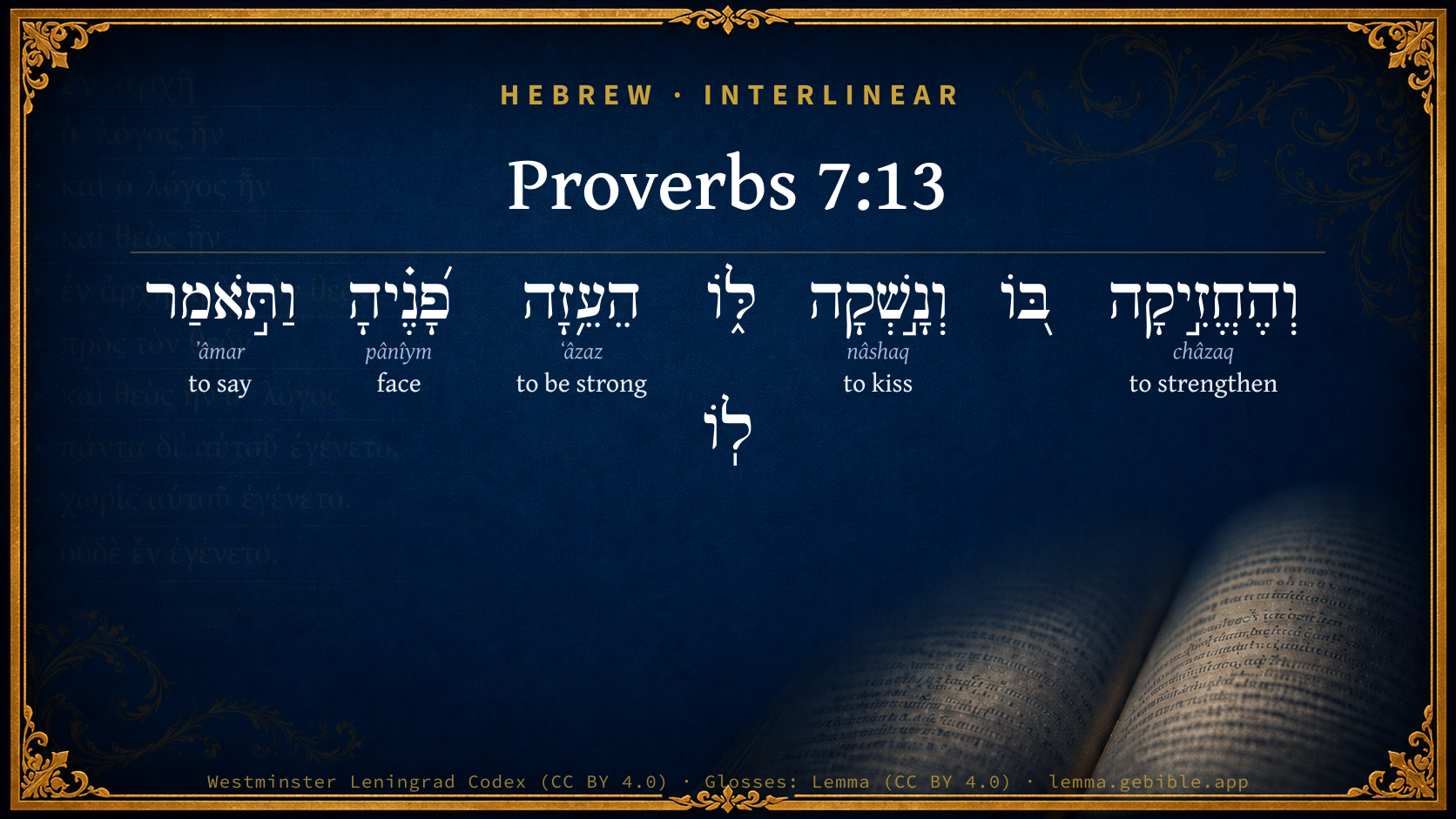
Hebrew (Westminster Leningrad Codex) Proverbs 7:13 appears in the Hebrew Old Testament. The text above is from the Westminster Leningrad Codex. Each word links to its Strong’s number, a concise gloss, and parsing drawn from the Open Scriptures Hebrew Bible morphology. Click any word for its full Brown-Driver-Briggs (BDB) entry.
Download image
Cite this verse

Proverbs 7:13 (World English Bible). Public Domain. Lemma interlinear Bible study tool, https://lemma.gebible.app/v/proverbs/7/13.

Show BibTeX & RIS
BibTeX
RIS
English Translation
So she caught him, and kissed him. With an impudent face she said to him:
World English Bible · Public Domain
Download a study sheet

One document with this verse’s original text, its word-by-word gloss line, the meaning frame, cross-references with their text, attributed commentary, and full source and license credits — printable, and it pastes into notes with its structure intact.

This verse Autodidact and up

Study sheet (.html) Plain text (.txt)

A passage Seminary Student

Up to 50 verses in one chapter. A passage sheet keeps up to 6 commentary sources and 12 cross-references per verse, in the order this page ranks them, and says so on the sheet whenever that leaves anything out. Ask for a single verse and you get the Autodidact verse sheet above.

Everything on this page stays free to read, with no account — the sheet is a download of what is already on screen, not access to it.

Want to remove ads? Support Godless Engineer
Compare translations 3

The same verse in 3 English versions, stacked beneath the original-language interlinear above. Click any original word for its lexicon entry.

Each is an independent rendering of the whole verse — the interlinear is not word-aligned to these translations.

Highlighted words mark where these versions differ — a whole-verse word diff, not a word-by-word alignment.

  • World English Bible Public Domain
    So she caught him, and kissed him. With an impudent face she said to him:
  • King James Version Public Domain
    So she caught him, and kissed him, and with an impudent face said unto him,
  • unfoldingWord Literal Text CC BY-SA 4.0
    And she grabs him and kisses him; she strengthens her face and says to him,

unfoldingWord Literal Text — © unfoldingWord, licensed CC BY-SA 4.0. Word-aligned USFM3 via Door43 (git.door43.org/unfoldingWord/en_ult).

Versions to compare (up to 4)

3 of 4 selected

Show all 18 translations

Every available English version of this verse, each an independent rendering of the whole verse.

  • World English Bible Public Domain
    So she caught him, and kissed him. With an impudent face she said to him:
  • Berean Standard Bible Public Domain
    She seizes him and kisses him; she brazenly says to him:
  • Majority Standard Bible Public Domain
    She seizes him and kisses him; she brazenly says to him:
  • King James Version Public Domain
    So she caught him, and kissed him, and with an impudent face said unto him,
  • American Standard Version (1901) Public Domain
    So she caught him, and kissed him, `And' with an impudent face she said unto him:
  • Revised Version (1885) Public Domain
    So she caught him, and kissed him, and with an impudent face she said unto him:
  • Geneva Bible (1599) Public Domain
    So she caught him and kissed him and with an impudent face said vnto him,
  • Douay-Rheims (1899) Public Domain
    And catching the young man, she kisseth him, and with an impudent face, flattereth, saying:
  • Young's Literal Translation Public Domain
    And she laid hold on him, and kissed him, She hath hardened her face, and saith to him,
  • Literal Standard Version CC BY-SA 4.0
    And she laid hold on him and kissed him, || She has hardened her face and says to him,
  • Unlocked Literal Bible CC BY-SA 4.0
    So she grabbed him and kissed him, with a strong face she said to him,
  • unfoldingWord Literal Text CC BY-SA 4.0
    And she grabs him and kisses him; she strengthens her face and says to him,
  • Darby Bible Public Domain
    And she caught him and kissed him, and with an impudent face said unto him,
  • World Messianic Bible Public Domain
    So she caught him, and kissed him. With an impudent face she said to him:
  • Webster's Bible Public Domain
    So she caught him, and kissed him, and with an impudent face said to him,
  • Free Bible Version CC BY-SA 4.0
    She grabbed hold of him and kissed him, and with a bold face she told him,
  • Bible in Basic English Public Domain
    So she took him by his hand, kissing him, and without a sign of shame she said to him:
  • JPS Tanakh (1917) Public Domain
    So she caught him, and kissed him, and with an impudent face she said unto him:

Literal Standard Version (2020), Covenant Press — licensed CC BY-SA 4.0. Text via the HelloAO Bible API (eBible.org). Unlocked Literal Bible (unfoldingWord) — licensed CC BY-SA 4.0. Text via the HelloAO Bible API (eBible.org). unfoldingWord Literal Text — © unfoldingWord, licensed CC BY-SA 4.0. Word-aligned USFM3 via Door43 (git.door43.org/unfoldingWord/en_ult). Free Bible Version, Dr. Jonathan Gallagher — licensed CC BY-SA 4.0. Text via the HelloAO Bible API (eBible.org).

Word by word

More ways to search: Search by grammar → Find every occurrence → Compare this word →

Practice this passage: Drill this verse → Learn its vocabulary →

הֵעֵ֥זָה
ʻâzaz
H5810
“to be strong”
Verb, Hiphil, Perfect, 3rd Person, Feminine, Singular
Part of Speech
Verb
Stem
Hiphil
Form
Perfect
Person
3rd Person
Gender
Feminine
Number
Singular
Full BDB Definition

Origin: a primitive root

TWOT: 1596

to be strong - (Qal) to be strong, prevail - (Hiphil) to make firm, strengthen
  1. וְהֶחֱזִ֣יקָה châzaq H2388 “and · to strengthen” Conjunction + Verb, Hiphil, Sequential Perfect, 3rd Person, Feminine, Singular
  2. וְנָ֣שְׁקָה nâshaq H5401 “and · to kiss” Conjunction + Verb, Qal, Sequential Perfect, 3rd Person, Feminine, Singular
  3. פָ֝נֶ֗יהָ pânîym H6440 “face(s) · her” Noun, Common, Both, Plural, Construct + Suffix, Personal, 3rd Person, Feminine, Singular
  4. וַתֹּ֣אמַר ʼâmar H559 “and · to say” Conjunction + Verb, Qal, Sequential Imperfect, 3rd Person, Feminine, Singular

About this verse

These counts appear in no published source. They are computed here, from the morphology-tagged text and Lemma’s own curated glosses. What Lemma adds →

8
words
5
distinct lemmas
Wisdom
section

Notable vocabulary

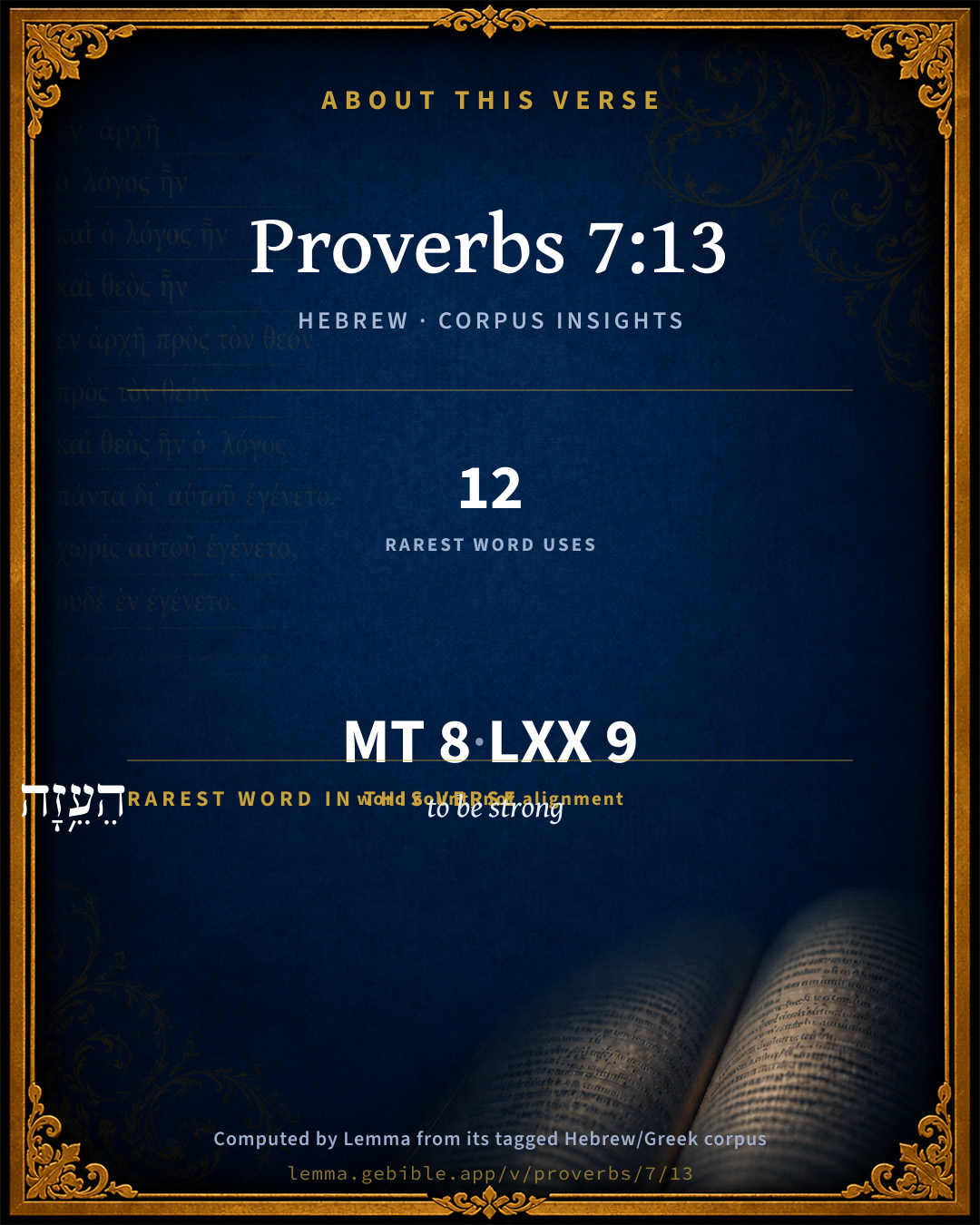
The rarest word here is הֵעֵ֥זָה to be strong H5810 — appearing just 12 times in the whole Hebrew Bible.

Shared distinctive vocabulary

הֵעֵ֥זָה to be strong H5810 occurs in 12 verses of the Hebrew Bible. Also found in:

Grammatical profile

  • 4 verbs
  • 1 noun
  • 3 prepositions

Verb forms

  • וְהֶחֱזִ֣יקָה Hiphil · Sequential Perfect
  • וְנָ֣שְׁקָה Qal · Sequential Perfect
  • הֵעֵ֥זָה Hiphil · Perfect
  • וַתֹּ֣אמַר Qal · Sequential Imperfect

Hebrew & Septuagint length

In English translation the verse runs 15 words from the Hebrew and 15 from the Septuagint (LXX English) — the same length.

A rough comparison of the two English renderings, which tokenize alike — not a word-level alignment.

Word counts can differ between the Hebrew and the Greek without any difference in meaning — e.g. the Hebrew direct-object marker אֵת has no separate Greek word, and Greek often adds the article ὁ.

In the original languages it is 8 Hebrew tokens and 9 Greek tokens — but the two are counted differently (Hebrew bundles its prefixes and suffixes into one token; the Greek is in lemma form), so that isn’t a like-for-like length.

Cross-references

12

Topical passages linked to Proverbs 7:13 in the Treasury of Scripture Knowledge — connected by theme and wording, ordered by reader-vote popularity; previews shown in the World English Bible.

  • Genesis 39:12 She caught him by his garment, saying, "Lie with me!" He left his garment in her hand, and ran outside.
  • Numbers 25:6–8 Behold, one of the children of Israel came and brought to his brothers a Midianite woman in the sight of Moses, and in the sight of all the congregation of the children of Israel, while they were weeping at the door of the tent of meeting.
  • Genesis 39:7 It happened after these things, that his master's wife cast her eyes on Joseph; and she said, "Lie with me."
  • Numbers 25:1 Israel abode in Shittim; and the people began to play the prostitute with the daughters of Moab:
  • Numbers 31:16 Behold, these caused the children of Israel, through the counsel of Balaam, to commit trespass against Yahweh in the matter of Peor, and so the plague was among the congregation of Yahweh.
  • Proverbs 21:29 A wicked man hardens his face; But as for the upright, he establishes his ways.
  • Isaiah 50:7 For the Lord Yahweh will help me; therefore I have not been confounded: therefore have I set my face like a flint, and I know that I shall not be disappointed.
  • Ezekiel 2:4 The children are impudent and stiff-hearted: I do sent you to them; and you shall tell them, Thus says the Lord Yahweh.
  • Ezekiel 2:6 You, son of man, don't be afraid of them, neither be afraid of their words, though briers and thorns are with you, and you do dwell among scorpions: don't be afraid of their words, nor be dismayed at their looks, though they are a rebellious house.
  • Ezekiel 3:7–9 But the house of Israel will not listen to you; for they will not listen to me: for all the house of Israel are of hard forehead and of a stiff heart.
  • Ezekiel 16:33 They give gifts to all prostitutes; but you give your gifts to all your lovers, and bribe them, that they may come to you on every side for your prostitution.
  • Revelation 2:20 But I have this against you, that you tolerate your woman, Jezebel, who calls herself a prophetess. She teaches and seduces my servants to commit sexual immorality, and to eat things sacrificed to idols.

Cross-references courtesy of OpenBible.info (CC BY 4.0).

Hebrew and Greek witnesses Masoretic Hebrew ↔ Greek Septuagint

The same verse in the two great witnesses to the Old Testament, shown verse-for-verse.

These are two independent witnesses, not word-aligned to each other, and the Septuagint is shown in lemma (dictionary) form.

Hebrew Proverbs 7:13 Masoretic · Westminster Leningrad Codex

וְהֶחֱזִ֣יקָה בּ֭וֹ וְנָ֣שְׁקָה לּ֑וֹ הֵעֵ֥זָה פָ֝נֶ֗יהָ וַתֹּ֣אמַר לֽוֹ

So she caught him, and kissed him. With an impudent face she said to him:

World English Bible · Public Domain

Greek LXX Proverbs 7:13 Septuagint · lemma form

εἶτα ἐπιλαμβάνω φιλέω αὐτός ἀναιδής δέ πρόσωπον προςεἶπον αὐτός

Then she caught him, and kissed him, and with an impudent face said to him,

LXX2012 (modern English Septuagint) · Public Domain

On this verse, The Cambridge Bible for Schools and Colleges discusses the Septuagint’s reading. Read the note in Commentary ↓

Hebrew: Westminster Leningrad Codex (CC BY 4.0). Greek: Septuagint (public domain); English from LXX2012 (modern English Septuagint) (Public Domain). How the Septuagint differs from the Hebrew →

Commentary

Notes on Proverbs 7:13 from classic Christian and Jewish commentators (each source and its license shown beneath its notes). The classic Christian expositions comment on the surrounding passage and are grouped to its opening verse, so a note may address several verses; the Jewish commentaries on the Tanakh (Rashi and others) are per-verse, so they appear only where the commentator wrote on this verse.

Lemma curates 59 commentaries, every one of them public domain or Creative Commons licensed, each selected and text-cleaned for this edition rather than reprinted as found. About our sources →

Trapp's Complete Commentary

John Trapp

Pro 7:13 So she caught him, and kissed him, [and] with an impudent face said unto him,

Ver. 13. So she caught him, and kissed him.] Strange impudence in this "strange woman," who hath not her name for nought. Potiphar’s wife was such a beast; so was Messalina the empress, wife to Claudius, Joan, queen of Naples, and other prodigious strumpets, of the kind of those whom they call Borboritae. We have heard, saith a grave divine, {a} of virgins, which at first seemed modest, blushing at the motions of an honest love; who being once corrupted and debauched, have grown flexible to easy entreaties to unchastity; and from thence boldly lascivious so as to solicit others, so as to prostitute themselves to all comers; yea, as our casuists {b} complain of some Spanish stews, to an unnatural filthiness.

{a} Dr Hall.

{b} Martin. Vivald., in Candelabro. cap. de Confes.

John Trapp, A Commentary or Exposition upon All the Books of the Old and New Testament (1647–1656) — public domain. Text from a community e-Sword module.

Geneva Bible (1599)

Geneva Bible translators

Hebrew, she strengthened her face.

Geneva Bible (1599) marginal notes — public domain. Text via Bolls.life.

Jamieson, Fausset & Brown

Robert Jamieson, A. R. Fausset & David Brown

The preparations for a feast do not necessarily imply peculiar religious professions. The offerer retained part of the victim for a feast (Lev 3:9, &c.). This feast she professes was prepared for him whom she boldly addresses as one sought specially to partake of it.

Jamieson, Fausset & Brown — Commentary Critical and Explanatory on the Whole Bible (1871) — public domain (CC PDM 1.0). Text via the HelloAO Bible API.

Adam Clarke's Commentary

Verse 13. So she caught him] Laid fast hold on him, and kissed him, to show that she was affectionately attached to him.

And with an impudent face] העזה פניה heezzah paneyha, "she strengthened her countenance," assumed the most confident look she could; endeavoured to appear friendly and sincere.

Adam Clarke's Commentary on the Bible (1810–1826) — public domain. Text from a community e-Sword/MySword module.

The Cambridge Bible for Schools and Colleges

gen. ed. J. J. S. Perowne

13. with an impudent face] An excellent translation (Lit. she strengthened, or hardened her face, and said, A.V. and R.V. marg.), following the LXX. ἀναιδεῖ προσώπῳ, and the Vulg. procaci vultu.

The Cambridge Bible for Schools and Colleges (gen. ed. J. J. S. Perowne; Cambridge University Press, 1878–1918) — public domain. Text from a community e-Sword module.

John Gill's Exposition

I have peace offerings with me,.... Meaning at her house. These peace offerings were of the eucharistic kind; they were offered by way of thanksgiving for favours received; the greatest part of which, all excepting the fat on the kidneys, the rump of the sheep, the breast and right shoulder, which were the priest's, were returned to the offerers to feast upon with their friends, and were to be eaten the same day, Lev 7:11. This she said to show that she was no common strumpet, or that prostituted herself for gain; that she was a sufficient housewife, had a considerable affluence of life, her substance greatly increased, for which she had made her thank offering that day; that she wanted nothing of him but his company, and the enjoyment of him; and that she had good cheer to regale him with. She was properly "a holy" religious harlot, as the word sometimes signifies; and such is the church of Rome, which makes great pretensions to devotion and religion, yet is the mother of harlots, and abominations of the earth, Rev 17:5;

this day have I paid my vows; not on account of the young man, and for his health, and for meeting with him; for those vows were not now made to be paid, but were made and paid already: but her vows of peace offerings and thanksgivings, which, as she had promised, she had performed. Under this point may be reckoned the vows of virginity and celibacy, through a show of which the most shocking iniquities are committed by the members of the church of Rome.

John Gill's Exposition of the Whole Bible (1746–1763) — public domain (CC PDM 1.0). Text via the HelloAO Bible API.

Whedon's Commentary on the Bible

Daniel D. Whedon

13. Impudent face — Literally, made strong her face; put on a bold, familiar air.

Daniel D. Whedon (gen. ed.), Commentary on the Old and New Testaments (1874–1909) — public domain. Text from a community e-Sword module.

The Pulpit Commentary

So she caught him and kissed him; being utterly lost to shame, like Potiphar"s wife. (Gen_39:12) With an impudent face said; literally, strengthened her face and said; put on a bold and brazen look to suit, the licentious words which she spoke. Wordsworth quotes the delineation of the "strange woman" drawn by St. Ambrose ("De Cain. et Abel.," 1:4): "Domi inquieta, in plateis vaga, osculis prodiga, pudore villis, amictu dives, genas picta; meretricio procax motu, infracto per delicias incessu, nutantibus oculis, et ludentibus jaculans palpebris retia, quibus pretiosas animus juveuum capit."

The Pulpit Commentary (1880–1919), ed. H.D.M. Spence-Jones & Joseph S. Exell — public domain. Text from a community e-Sword module.

Keil & Delitzsch

C. F. Keil & F. Delitzsch

After this digression the poet returns to the subject, and further describes the event as observed by himself.

And she laid hold on him and kissed him;

Put on a bold brow and said to him.

The verb נשׁק is here, after its primary signification, connected with the dat.: osculum fixit ei. Thus also Gen 27:26 is construed, and the Dagesh in לּו is, as there, Dag. forte conj., after the law for which the national grammarians have coined the technical name אתי מרחיק (veniens e longinquo, "coming out of the distance," i.e., the attraction of a word following by one accented on the penult.). The penult.-accenting of נשׁקה is the consequence of the retrogression of the accent (נסוג אחור), which, here where the word from the first had the penult, only with Metheg, and thus with a half a tone, brings with it the dageshing of the לו following, as the original penultima-accenting of והחזיקה does of the בו which follows it, for the reading בּו by Lwenstein is contrary to the laws of punctuation of the Textus receptus under consideration here.

(Note: Vid., Baer's Torath Emeth, p. 29f., and Psalmen-Commentar under Psa 52:5.)

As בו and לו have received the doubling Dagesh, so on the other hand, according to Ewald, 193b, it has disappeared from העזה (written with Raphe according to Kimchi, Michlol 145a). And as נשׁקה has the tone thrown back, so the proper pausal ותּאמר is accented on the ult., but without attracting the לו following by dageshing, which is the case only when the first of the two words terminates in the sound of ā (āh). העז פניו is said of one who shows firmness of hardness of countenance (Arab. slabt alwajh), i.e., one who shows shamelessness, or, as we say, an iron forehead (Fl.).

Keil & Delitzsch — Biblical Commentary on the Old Testament (1861–1891) — public domain (CC PDM 1.0). Text via the HelloAO Bible API. (Old Testament only.)

unfoldingWord translationNotes

Door43 World Missions Community

she

the woman who was introduced in Proverbs 7:10

grabbed him

"took hold of him firmly"

with a strong face

Here "strong" represents "stubborn." A "strong face" means a stubborn expression on a person's face. This implies that the woman is acting in a stubborn way, that she is deliberately doing what she knows is wrong. AT: "with a shameless expression on her face" (See: Idiom and Metonymy)

I paid my vows

Here "vows" represents what the person promised to sacrifice to God. AT: "I made the sacrifices I promised to God" (See: Metonymy)

seek your face

Here "face" represents the person and especially the person's presence. AT: "look for you" or "find out where you are" (See: Synecdoche)

translationWords

kiss

peace offering

vow

unfoldingWord translationNotes — © Distant Shores Media and the Door43 World Missions Community, licensed CC BY-SA 4.0. Source: git.door43.org/Door43/en_tn.

Lesson kit

Teaching starters — assembled from the data on this page, not authored interpretation. Every prompt links to the verse data it draws on. Edit before teaching.

Proverbs, in the Wisdom, opens this verse with 8 words (5 distinct Hebrew lemmas). Its most distinctive word is ʻâzaz (“to be strong”). A historical commentator’s framing appears above. Read the whole chapter for the surrounding context.

Discussion questions

  1. What does “to be strong” (ʻâzaz) contribute to the verse as a whole?
  2. Judges 3:10 shares the word «to be strong» with this verse. How do the two illuminate each other?
  3. These translations render this verse differently. What is at stake in choosing one wording over another?
  4. The verb «וְהֶחֱזִ֣יקָה» is Hiphil Sequential Perfect. How does its form color the action?
  5. Reading how Trapp's Complete Commentary and Geneva Bible (1599) read this verse, where do the two commentators agree and where do they part?

Things to notice

Reading settings

Reading text

Shown beneath each verse's original-language words.

Old Testament
Old Testament edition

Read the OT as the Masoretic Hebrew (MT) or the Greek Septuagint (LXX).

English shown for the Greek Septuagint (in the Hebrew ↔ Greek comparison).

Comparing translations? Open the Compare panel on any verse page to stack up to four side by side.