2 Kings 14:5

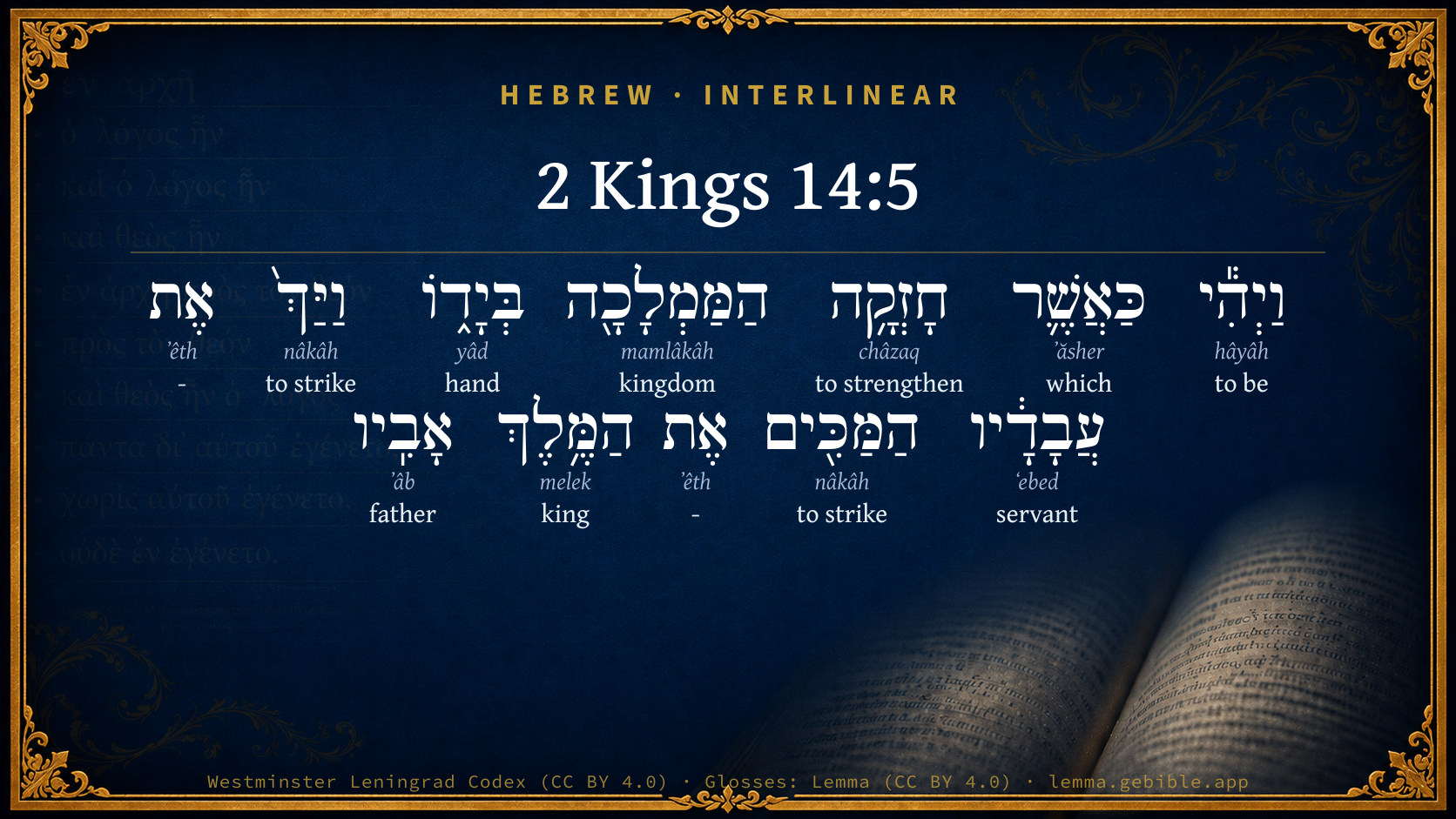
Hebrew (Westminster Leningrad Codex) 2 Kings 14:5 appears in the Hebrew Old Testament. The text above is from the Westminster Leningrad Codex. Each word links to its Strong’s number, a concise gloss, and parsing drawn from the Open Scriptures Hebrew Bible morphology. Click any word for its full Brown-Driver-Briggs (BDB) entry.
Download image
Cite this verse

2 Kings 14:5 (World English Bible). Public Domain. Lemma interlinear Bible study tool, https://lemma.gebible.app/v/2-kings/14/5.

Show BibTeX & RIS
BibTeX
RIS
English Translation
It happened, as soon as the kingdom was established in his hand, that he killed his servants who had slain the king his father:
World English Bible · Public Domain
Download a study sheet

One document with this verse’s original text, its word-by-word gloss line, the meaning frame, cross-references with their text, attributed commentary, and full source and license credits — printable, and it pastes into notes with its structure intact.

This verse Autodidact and up

Study sheet (.html) Plain text (.txt)

A passage Seminary Student

Up to 50 verses in one chapter. A passage sheet keeps up to 6 commentary sources and 12 cross-references per verse, in the order this page ranks them, and says so on the sheet whenever that leaves anything out. Ask for a single verse and you get the Autodidact verse sheet above.

Everything on this page stays free to read, with no account — the sheet is a download of what is already on screen, not access to it.

Want to remove ads? Support Godless Engineer
Compare translations 3

The same verse in 3 English versions, stacked beneath the original-language interlinear above. Click any original word for its lexicon entry.

Each is an independent rendering of the whole verse — the interlinear is not word-aligned to these translations.

Highlighted words mark where these versions differ — a whole-verse word diff, not a word-by-word alignment.

  • World English Bible Public Domain
    It happened, as soon as the kingdom was established in his hand, that he killed his servants who had slain the king his father:
  • King James Version Public Domain
    And it came to pass, as soon as the kingdom was confirmed in his hand, that he slew his servants which had slain the king his father.
  • unfoldingWord Literal Text CC BY-SA 4.0
    And it happened, as soon as the kingdom was strong in his hand, that he struck his servants, the ones having struck the king, his father.

unfoldingWord Literal Text — © unfoldingWord, licensed CC BY-SA 4.0. Word-aligned USFM3 via Door43 (git.door43.org/unfoldingWord/en_ult).

Versions to compare (up to 4)

3 of 4 selected

Show all 18 translations

Every available English version of this verse, each an independent rendering of the whole verse.

  • World English Bible Public Domain
    It happened, as soon as the kingdom was established in his hand, that he killed his servants who had slain the king his father:
  • Berean Standard Bible Public Domain
    As soon as the kingdom was firmly in his grasp, Amaziah executed the servants who had murdered his father the king.
  • Majority Standard Bible Public Domain
    As soon as the kingdom was firmly in his grasp, Amaziah executed the servants who had murdered his father the king.
  • King James Version Public Domain
    And it came to pass, as soon as the kingdom was confirmed in his hand, that he slew his servants which had slain the king his father.
  • American Standard Version (1901) Public Domain
    And it came to pass, as soon as the kingdom was established in his hand, that he slew his servants who had slain the king his father:
  • Revised Version (1885) Public Domain
    And it came to pass, as soon as the kingdom was established in his hand, that he slew his servants which had slain the king his father:
  • Geneva Bible (1599) Public Domain
    And when the kingdome was confirmed in his hand, he slewe his seruants which had killed the King his father.
  • Douay-Rheims (1899) Public Domain
    And when he had possession of the kingdom, he put his servants to death that had slain the king his father:
  • Young's Literal Translation Public Domain
    And it cometh to pass, when the kingdom hath been strong in his hand, that he smiteth his servants, those smiting the king his father,
  • Literal Standard Version CC BY-SA 4.0
    And it comes to pass, when the kingdom has been strong in his hand, that he strikes his servants, those striking his father the king,
  • Unlocked Literal Bible CC BY-SA 4.0
    It came about that as soon as his rule was well established, he killed the servants who had murdered his father, the king.
  • unfoldingWord Literal Text CC BY-SA 4.0
    And it happened, as soon as the kingdom was strong in his hand, that he struck his servants, the ones having struck the king, his father.
  • Darby Bible Public Domain
    And it came to pass when the kingdom was established in his hand, that he slew his servants who had smitten the king his father.
  • World Messianic Bible Public Domain
    As soon as the kingdom was established in his hand, he killed his servants who had slain the king his father,
  • Webster's Bible Public Domain
    And it came to pass, as soon as the kingdom was confirmed in his hand, that he slew his servants who had slain the king his father.
  • Free Bible Version CC BY-SA 4.0
    Once he was secure on the throne he executed the officials who had murdered his father the king.
  • Bible in Basic English Public Domain
    Now when he became strong in the kingdom, straight away he put to death those servants who had taken the life of the king his father;
  • JPS Tanakh (1917) Public Domain
    And it came to pass, as soon as the kingdom was established in his hand, that he slew his servants who had slain the king his father;

Literal Standard Version (2020), Covenant Press — licensed CC BY-SA 4.0. Text via the HelloAO Bible API (eBible.org). Unlocked Literal Bible (unfoldingWord) — licensed CC BY-SA 4.0. Text via the HelloAO Bible API (eBible.org). unfoldingWord Literal Text — © unfoldingWord, licensed CC BY-SA 4.0. Word-aligned USFM3 via Door43 (git.door43.org/unfoldingWord/en_ult). Free Bible Version, Dr. Jonathan Gallagher — licensed CC BY-SA 4.0. Text via the HelloAO Bible API (eBible.org).

Word by word

More ways to search: Search by grammar → Find every occurrence → Compare this word →

Practice this passage: Drill this verse → Learn its vocabulary →

הַמַּמְלָכָ֖ה
mamlâkâh
H4467
“the · kingdom”
Particle, Definite Article + Noun, Common, Feminine, Singular, Absolute
Part of Speech
Particle + Noun
Type
Common
Gender
Feminine
Number
Singular
State
Absolute
Full BDB Definition

Origin: from H4427

TWOT: 1199f

kingdom, dominion, reign, sovereignty - kingdom, realm - sovereignty, dominion - reign
  1. וַיְהִ֕י hâyâh H1961 “and · to be” Conjunction + Verb, Qal, Sequential Imperfect, 3rd Person, Masculine, Singular
  2. כַּאֲשֶׁ֛ר ʼăsher H834 “like/as · which” Preposition + Particle, Relative
  3. חָזְקָ֥ה châzaq H2388 “to strengthen” Verb, Qal, Perfect, 3rd Person, Feminine, Singular
  4. בְּיָד֑וֹ yâd H3027 “in/at · hand · his” Preposition + Noun, Common, Both, Singular, Construct + Suffix, Personal, 3rd Person, Masculine, Singular
  5. וַיַּךְ֙ nâkâh H5221 “and · to strike” Conjunction + Verb, Hiphil, Sequential Imperfect, 3rd Person, Masculine, Singular
  6. אֶת ʼêth H853 “-” Particle, Direct Object
  7. עֲבָדָ֔יו ʻebed H5650 “servants · his” Noun, Common, Masculine, Plural, Construct + Suffix, Personal, 3rd Person, Masculine, Singular
  8. הַמַּכִּ֖ים nâkâh H5221 “the · striking” Particle, Definite Article + Verb, Hiphil, Participle Active, Masculine, Plural, Absolute
  9. אֶת ʼêth H853 “-” Particle, Direct Object
  10. הַמֶּ֥לֶךְ melek H4428 “the · king” Particle, Definite Article + Noun, Common, Masculine, Singular, Absolute
  11. אָבִֽיו ʼâb H1 “father · his” Noun, Common, Masculine, Singular, Construct + Suffix, Personal, 3rd Person, Masculine, Singular

About this verse

These counts appear in no published source. They are computed here, from the morphology-tagged text and Lemma’s own curated glosses. What Lemma adds →

12
words
10
distinct lemmas
Historical
section

Grammatical profile

  • 4 verbs
  • 5 nouns
  • 3 particles

Verb forms

  • וַיְהִ֕י Qal · Sequential Imperfect
  • חָזְקָ֥ה Qal · Perfect
  • וַיַּךְ֙ Hiphil · Sequential Imperfect
  • הַמַּכִּ֖ים Hiphil · Participle Active

Repetition

A word recurs within this verse — often emphatic in Hebrew:

  • וַיַּךְ֙ to strike H5221 ×2

Hebrew & Septuagint length

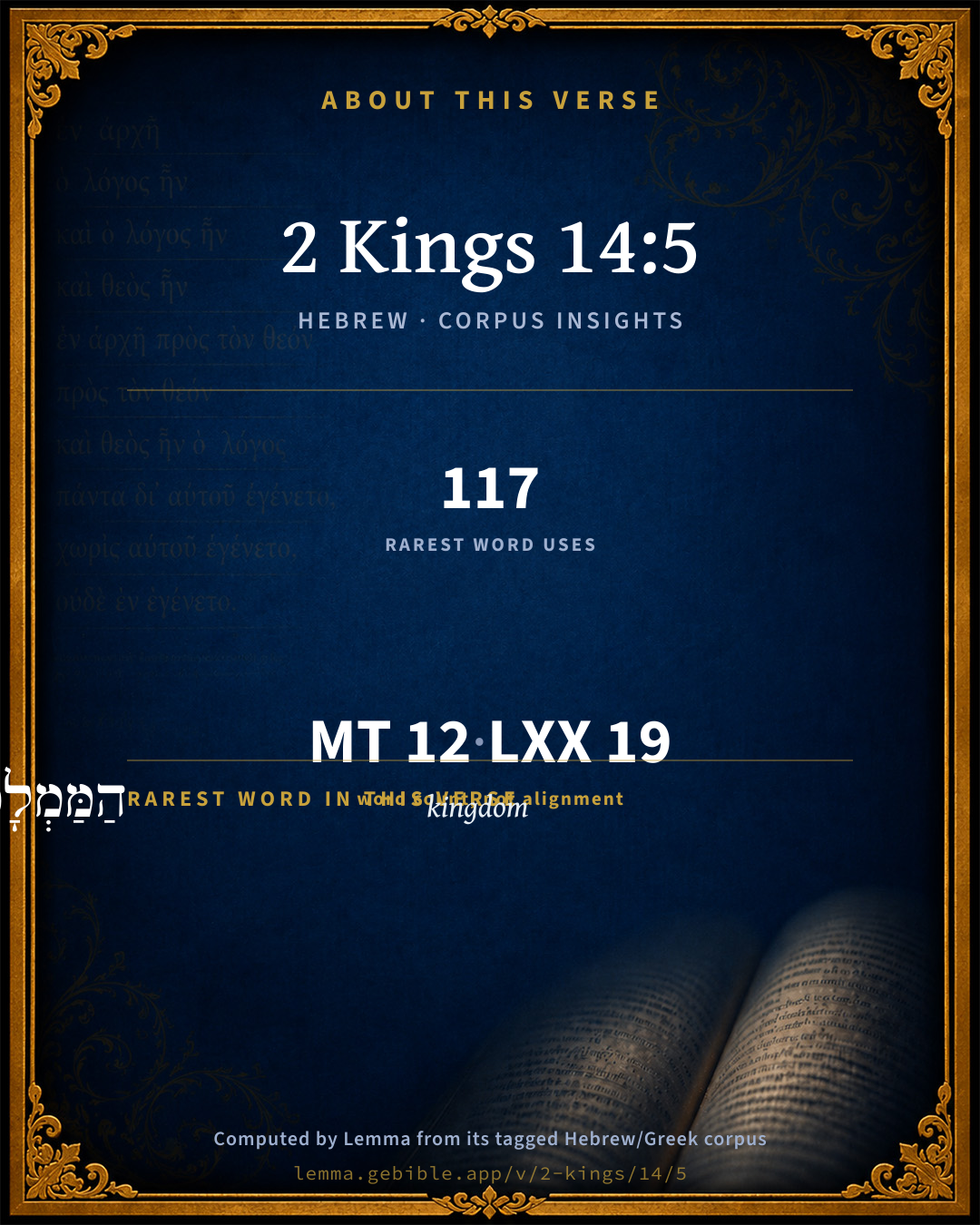
In English translation the verse runs 24 words from the Hebrew and 25 from the Septuagint (LXX English) — closely comparable.

A rough comparison of the two English renderings, which tokenize alike — not a word-level alignment.

Word counts can differ between the Hebrew and the Greek without any difference in meaning — e.g. the Hebrew direct-object marker אֵת has no separate Greek word, and Greek often adds the article ὁ.

In the original languages it is 12 Hebrew tokens and 19 Greek tokens — but the two are counted differently (Hebrew bundles its prefixes and suffixes into one token; the Greek is in lemma form), so that isn’t a like-for-like length.

Cross-references

5

Topical passages linked to 2 Kings 14:5 in the Treasury of Scripture Knowledge — connected by theme and wording, ordered by reader-vote popularity; previews shown in the World English Bible.

  • Numbers 35:33 So you shall not pollute the land in which you are: for blood, it pollutes the land; and no expiation can be made for the land for the blood that is shed therein, but by the blood of him who shed it.
  • 2 Kings 12:20–21 His servants arose, and made a conspiracy, and struck Joash at the house of Millo, [on the way] that goes down to Silla.
  • 2 Chronicles 25:3–4 Now it happened, when the kingdom was established to him, that he killed his servants who had killed the king his father.
  • Genesis 9:6 Whoever sheds man's blood, by man will his blood be shed, for in the image of God made he man.
  • Exodus 21:12–14 "One who strikes a man so that he dies shall surely be put to death,

Cross-references courtesy of OpenBible.info (CC BY 4.0).

Hebrew and Greek witnesses Masoretic Hebrew ↔ Greek Septuagint

The same verse in the two great witnesses to the Old Testament, shown verse-for-verse.

These are two independent witnesses, not word-aligned to each other, and the Septuagint is shown in lemma (dictionary) form.

Hebrew 2 Kings 14:5 Masoretic · Westminster Leningrad Codex

וַיְהִ֕י כַּאֲשֶׁ֛ר חָזְקָ֥ה הַמַּמְלָכָ֖ה בְּיָד֑וֹ וַיַּךְ֙ אֶת עֲבָדָ֔יו הַמַּכִּ֖ים אֶת הַמֶּ֥לֶךְ אָבִֽיו

It happened, as soon as the kingdom was established in his hand, that he killed his servants who had slain the king his father:

World English Bible · Public Domain

Greek LXX 2 Kings 14:5 Septuagint · lemma form

καί γίγνομαι ὅτε καταἰσχύω ὁ βασιλεία ἐν χείρ αὐτός καί πατάσσω ὁ δοῦλος αὐτός ὁ πατάσσω ὁ πατήρ αὐτός

And it came to pass when the kingdom was established in his hand, that he killed his servants that had slain the king his father.

LXX2012 (modern English Septuagint) · Public Domain

Hebrew: Westminster Leningrad Codex (CC BY 4.0). Greek: Septuagint (public domain); English from LXX2012 (modern English Septuagint) (Public Domain). How the Septuagint differs from the Hebrew →

Targum (Aramaic paraphrase)

1

The Targum is the ancient Jewish Aramaic paraphrase of the Hebrew Scriptures — an interpretive translation, not the Hebrew text itself. Onkelos (literal) and Pseudo-Jonathan (expansive) render the Torah, and Jonathan the Prophets. Coverage is partial: where no permissively-licensed English translation exists for a verse, only the Aramaic is shown. This is verse-level text, not a word-by-word alignment to the Hebrew.

  1. Targum Jonathan Prophets (Joshua–Malachi)
    וַהֲוָה כַד תְּקִיפַת מַלְכוּתָא בִּידֵיהּ וּקְטַל יַת עַבְדוֹהִי דִי קְטָלוּ יַת מַלְכָּא אֲבוּהִי:

    (no public-domain English translation for this verse)

    Targum Jonathan — Aramaic: “Mikraot Gedolot” (public domain). English: “Sefaria Community Translation” (CC0 1.0 (public-domain dedication)); “London "Chaldee Paraphrase," 1871” (public domain). Text via Sefaria.

Commentary

Notes on 2 Kings 14:5 from classic Christian and Jewish commentators (each source and its license shown beneath its notes). The classic Christian expositions comment on the surrounding passage and are grouped to its opening verse, so a note may address several verses; the Jewish commentaries on the Tanakh (Rashi and others) are per-verse, so they appear only where the commentator wrote on this verse.

Lemma curates 59 commentaries, every one of them public domain or Creative Commons licensed, each selected and text-cleaned for this edition rather than reprinted as found. About our sources →

Trapp's Complete Commentary

John Trapp

2Ki 14:5 And it came to pass, as soon as the kingdom was confirmed in his hand, that he slew his servants which had slain the king his father.

Ver. 5. As soon as the kingdom was confirmed in his hand] He politically dissembled his displeasure till he found his time. Qui nescit dissimulate, nescit regnare, saith Louis XI of France to his son. It is a weakness in a prince always to carry his love and hatred in his forehead.

John Trapp, A Commentary or Exposition upon All the Books of the Old and New Testament (1647–1656) — public domain. Text from a community e-Sword module.

Joseph Benson's Commentary

2Ki 14:5. As soon as the kingdom was confirmed, he slew his servants, &c. — It is implied in this, that his father’s murderers continued to be men of weight and interest at court, even after they had perpetrated that crime; for Amaziah retained them in his service for some time, nor durst venture to execute justice upon them till he was well settled in his authority. Probably the act they had done was in some sort approved by the generality of the people, to whom Joash had made himself hateful by his apostacy to idolatry, and his ingratitude to the house of Jehoiada.

Joseph Benson's Commentary on the Old and New Testaments (1811–1818) — public domain. Text from a community e-Sword module.

Tyndale Open Study Notes

Tyndale Open Resources

14:5-6 When Amaziah . . . executed his father’s assassins, he followed the standards of the law concerning “Parents . . . crimes” (Deut 24:16; see also 2 Chr 25:4) and did not put their children to death.

Tyndale Open Study Notes — © Tyndale Open Resources, licensed CC BY-SA 4.0. Text via the HelloAO Bible API.

Jamieson, Fausset & Brown

Robert Jamieson, A. R. Fausset & David Brown

as soon as the kingdom was confirmed in his hand--It was an act of justice no less than of filial piety to avenge the murder of his father. But it is evident that the two assassins must have possessed considerable weight and influence, as the king was obliged to retain them in his service, and durst not, for fear of their friends and supporters, institute proceedings against them until his power had been fully consolidated.

Jamieson, Fausset & Brown — Commentary Critical and Explanatory on the Whole Bible (1871) — public domain (CC PDM 1.0). Text via the HelloAO Bible API.

Adam Clarke's Commentary

Verse 5. As soon as the kingdom was confirmed in his hand] No doubt those wicked men, Jozachar and Jehozabad, who murdered his father, had considerable power and influence; and therefore he found it dangerous to bring them to justice, till he was assured of the loyalty of his other officers: when this was clear, he called them to account, and put them to death.

Adam Clarke's Commentary on the Bible (1810–1826) — public domain. Text from a community e-Sword/MySword module.

Ellicott's Commentary for English Readers

(5) As soon as the kingdom was confirmed—i.e., as soon as he was firmly established on the throne; as soon as he felt his power secure. (Comp. 1Ki_2:46.)

Slew . . .—slain.—Literally, smote . . . smitten.

A Bible Commentary for English Readers, edited by Charles John Ellicott (1878–1897) — public domain. Text from a community e-Sword module.

The Cambridge Bible for Schools and Colleges

gen. ed. J. J. S. Perowne

5. as soon as the kingdom was confirmed [R.V. established] in his hand] The change is in conformity with 2 Chronicles. It is worth notice that the conspirators made no attempt, as it seems, to divert the succession from the house of David, though they might have expected that the son would take revenge on his father’s murderers.

The Cambridge Bible for Schools and Colleges (gen. ed. J. J. S. Perowne; Cambridge University Press, 1878–1918) — public domain. Text from a community e-Sword module.

John Gill's Exposition

He slew of Edom in the valley of Salt ten thousand,.... Of which valley; see Gill on Sa2 8:13, the Edomites having revolted from Judah in the days of Joram, Kg2 8:20. Amaziah undertook to reduce them with an army of 300,000 choice men; and, besides these, hired also of Israel 100,000 valiant men, for one hundred talents of silver; but at the instance of a prophet of the Lord he dismissed the latter, and went against Edom only with his men, and slew of the Edomites 10,000, besides other 10,000 he took alive, and cast headlong from a rock, which came into his hands, see Ch2 25:5,

and took Selah by war; which signifies a rock, the same with Petra, the metropolis of Arabia Petraea, the country of the Edomites. The city itself was not a rock, nor built on one, but was situated in a plain, surrounded with rocks and mountains, as Strabo (z) and Pliny (a) relate, from whence it seems to have its name; and by the Syrians called Recem, where Rocan a king of Midian reigned (b), called in the Greek version of Num 31:8, Recon; though Vitringa (c) is of opinion, that not Petra, the metropolis of Edom, is meant, but Maalehakrabbim, Jos 15:3, which lay on the south border of Judea, near the salt sea:

and called the name of it Joktheel; which signifies "the obedience of God"; in memory of his obedience to the prophet of the Lord, in consequence of which he obtained this victory: and the name continued unto this day: the time of the writing this book.

(z) Geograph. l. 16. p. 536. (a) Nat. Hist. l. 6. c. 28. (b) Hieron. de loc. Heb. fol. 93. M. & 94. A. Vid. Joseph. Antiqu. l. 4. c. 7. sect. 1. (c) Comment. in Jesaiam, c. 16. 1.

John Gill's Exposition of the Whole Bible (1746–1763) — public domain (CC PDM 1.0). Text via the HelloAO Bible API.

Albert Barnes' Notes on the Bible

The phrase, “confirmed in his hand” 2Ki 15:19, usually expresses the authorisation of a new reign by an imperial superior (see 2Ki 15:19 note); but here it describes the result when the troubles consequent upon the murder of Joash had passed away. The new king’s authority was generally recognized by his subjects.

Albert Barnes' Notes on the Bible (1834–1885) — public domain. Text from a community e-Sword/MySword module.

Matthew Poole's English Annotations

Whereby it is implied that his father’s murderers had powerful friends and abettors, and that their fact was in some sort approved by the generality of the people, to whom Joash had made himself hateful by his apostacy to idolatry, and by his ingratitude to the house of Jehoiada.

Matthew Poole's English Annotations on the Holy Bible (1683–1685) — public domain. Text from a community e-Sword/MySword module.

Whedon's Commentary on the Bible

Daniel D. Whedon

5. Slew his servants — Jozachar and Jehozabad. See 2Ki_12:21. Amaziah was wise to wait till the kingdom was confirmed in his hand, and he had all its forces at control. Rawlinson conjectures that the kingdoms of Israel and Judah were, after the days of Jehu, dependencies of the king of Assyria, and when one after another of the Israelitish or Jewish kings came to the throne, he formally applied to the Assyrian monarch to be confirmed in his kingdom. This he infers from an Assyrian obelisk which represents Jehu as bringing tribute to the king of Assyria. See note on 2Ki_10:32.

Daniel D. Whedon (gen. ed.), Commentary on the Old and New Testaments (1874–1909) — public domain. Text from a community e-Sword module.

The Pulpit Commentary

And it came to pass, as soon as the kingdom was confirmed in his hand. Joash had been murdered in Jerusalem by conspirators. (2Ki_12:20) A time of trouble had, no doubt, supervened. The conspirators would not wish to see Amaziah placed upon the throne, and may have opposed and delayed his appointment. But their efforts proved fruitless. After a time, the young king was confirmed (literally, "strengthened"), i.e. settled and established in his kingdom, all opposition being overcome or dying away. This seems to be what the writer means. He cannot intend a confirmation by a foreign suzerain, which the phrase used might import, (2Ki_15:19) when he has given no hint of any subjection of the kingdom to any foreign power, or indeed of any serious attack on its independence. That he slew his servants. Jozachar and Jehozabad were "servants" of Joash, apparently domestic servants employed in his palace, and are therefore reckoned "servants" also of his successor. Which had slain the king his father. In the "house of Millo," where he lay sick. They "slew him on his bed". (see 2Ch_24:25)

Vers. 5, 6. A father"s sins not to be visited by the civil magistrate on his children.

Human legislators have differed greatly in their judgments upon this point. In the East, and in early times, the idea was generally accepted that the guilt of the father attached to all his descendants, and was justly visited on them. "Lege cantum erat," says Q. Curtius ("Vit. Alex.," 6:11), "ut propinqui eorum, qui regi insidiati essent, cum ipsis necarentur." The family was regarded as the unit of society, and the crime of one member tainted the whole of it. What the Egyptian practice was is uncertain; but we find the Israelites, shortly after the Exodus, putting to death the whole family of Achan on account of their father"s sin, (Jos_7:24, Jos_7:25) and the usage seems to have continued long afterwards. (2Ki_9:26) The Greeks and Romans adopted a different line of action. Recognizing the separateness of the individual, they never executed a family en masse, but only the guilty member or members of it. Yet, in secondary punishments, the contrary idea to some extent prevailed. At Athens, when the sentence on a man was degradation from his rights of citizenship (ajtimia), the penalty was shared by his children. A similar disability attached to the children of those who were executed. So, even by our own law, attainder and forfeiture, which mainly affect the children, are attached to the crime of treason, and the property of felons escheats to the Crown. It is very remarkable that the Law of Moses should have anticipated the ultimate judgment of the human conscience upon the point, and have laid down so clearly and strongly the humane principle that the criminal alone should be punished for his own crime. To us at the present day the principle may appear axiomatic; but at the time when Moses enunciated it, the contrary idea was prevalent; and it is doubtful whether the broad assertion, "Every man shall be put to death for his own sins," had ever been heard previously. Even now, though in the letter the principle is universally accepted, infractions of its spirit are common enough

I BY NATIONS. Nations infringe it when they cashier a royal family for the fault, or even the crime, of the reigning sovereign. In a hereditary monarchy the son has a right to succeed, though his father may by unconstitutional acts have justly forfeited the crown. Still more unjust is the perpetual exile of all those whose ancestors have ever reigned over a country. Such persons are punished, not so much for the sins as for the merits the wisdom, prowess, high renown of their forefathers, since it is for their merits, ordinarily, that persons are first placed upon thrones. Confiscation of the property of exiled princes is still more indefensible, since it is at once unjust and mean. It may be added that forfeiture and attainder, as they exist in our own law, seem to be contrary to the spirit of the rule, which is that no one should be punished for anything but his own acts.

II BY INDIVIDUALS. Individuals infringe this rule when they maintain a family feud, transferring to the children of those by whom they consider themselves to have been injured the animosity which they have long entertained towards their parents. Or when they treat a man with coldness or incivility because his father has done something disgraceful. Or, generally, when they attach blame or discredit to any one, not for anything that he has done, but for something that somebody connected with him has done. Strict justice requires that each man should "bear his own burden," and stand or fall by his own acts. If we allow anything but his own acts to affect our estimate of a man still more, if we allow it to affect our demeanor towards him we act unjustly, we infringe the principle of the law, "Every man shall be put to death i.e. shall suffer for his own sin.

Vers. 5, 6. Personal responsibility.

Amaziah visits with just execution the servants who had conspired against his father Joash. But he did not put to death the children of the murderers. He acted on the principle laid down by God through Moses, (Deu_24:16) that "the fathers shall not be put to death for the children, nor the children for the fathers; every man shall be put to death for his own sin.

I EVERY ONE OF US IS RESPONSIBLE FOR HIS OWN LIFE. "For we must all appear before the judgment-scat of Christ; that every one may receive the things done in his body, according to that he hath done, whether it be good or bad.

II EVERY ONE OF US IS RESPONSIBLE FOR THE RIGHT DISCHARGE OF HIS OWN DUTIES. We cannot excuse ourselves by the unfaithfulness of others. Responsibility is something which we can never transfer to any one else. Men may deny their responsibility. They may refuse to fulfill it. They may neglect it. But there it is they cannot get rid of it. Our responsibility to God for the life and opportunities which he has given is a truth we should do well to keep constantly before us. C.H.I.

The Pulpit Commentary (1880–1919), ed. H.D.M. Spence-Jones & Joseph S. Exell — public domain. Text from a community e-Sword module.

Lesson kit

Teaching starters — assembled from the data on this page, not authored interpretation. Every prompt links to the verse data it draws on. Edit before teaching.

2 Kings, in the Historical, opens this verse with 12 words (10 distinct Hebrew lemmas). Its most distinctive word is mamlâkâh (“kingdom”). A historical commentator’s framing appears above. Read the whole chapter for the surrounding context.

Discussion questions

  1. How does “kingdom” (mamlâkâh) shape what this verse is saying?
  2. Numbers 35:33 shares this passage’s theme. How do the two illuminate each other?
  3. “to strike” occurs 2× in this one verse. What is the effect of the repetition?
  4. These translations render this verse differently. What is at stake in choosing one wording over another?
  5. The verb «וַיְהִ֕י» is Qal Sequential Imperfect. How does its form color the action?
  6. Reading how Trapp's Complete Commentary and Joseph Benson's Commentary read this verse, where do the two commentators agree and where do they part?

Things to notice

Reading settings

Reading text

Shown beneath each verse's original-language words.

Old Testament
Old Testament edition

Read the OT as the Masoretic Hebrew (MT) or the Greek Septuagint (LXX).

English shown for the Greek Septuagint (in the Hebrew ↔ Greek comparison).

Comparing translations? Open the Compare panel on any verse page to stack up to four side by side.