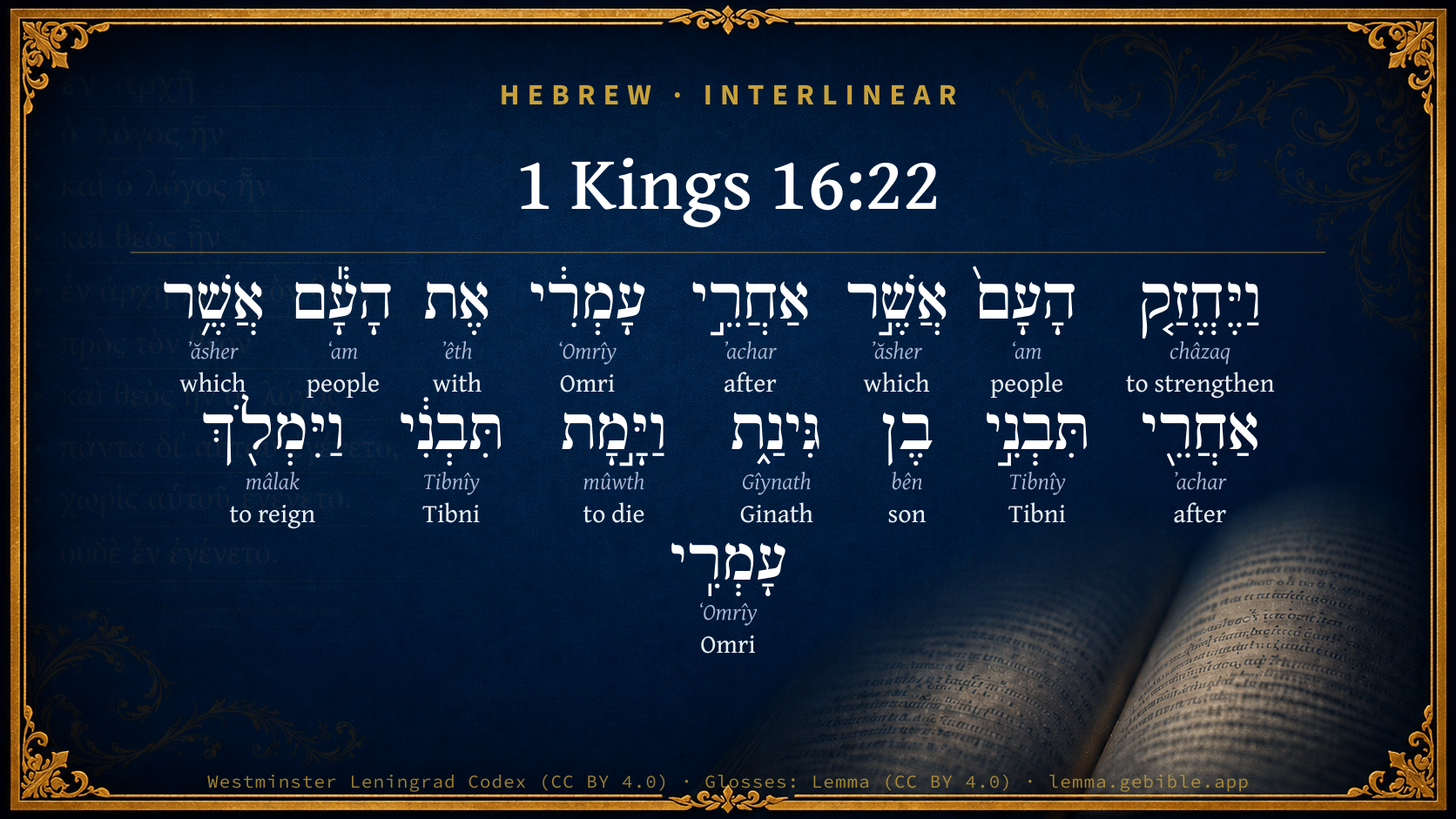
1 Kings 16:22

Hebrew (Westminster Leningrad Codex) 1 Kings 16:22 appears in the Hebrew Old Testament. The text above is from the Westminster Leningrad Codex. Each word links to its Strong’s number, a concise gloss, and parsing drawn from the Open Scriptures Hebrew Bible morphology. Click any word for its full Brown-Driver-Briggs (BDB) entry.
Download image
Cite this verse

1 Kings 16:22 (World English Bible). Public Domain. Lemma interlinear Bible study tool, https://lemma.gebible.app/v/1-kings/16/22.

Show BibTeX & RIS
BibTeX
RIS
English Translation
But the people who followed Omri prevailed against the people who followed Tibni the son of Ginath: so Tibni died, and Omri reigned.
World English Bible · Public Domain
Download a study sheet

One document with this verse’s original text, its word-by-word gloss line, the meaning frame, cross-references with their text, attributed commentary, and full source and license credits — printable, and it pastes into notes with its structure intact.

This verse Autodidact and up

Study sheet (.html) Plain text (.txt)

A passage Seminary Student

Up to 50 verses in one chapter. A passage sheet keeps up to 6 commentary sources and 12 cross-references per verse, in the order this page ranks them, and says so on the sheet whenever that leaves anything out. Ask for a single verse and you get the Autodidact verse sheet above.

Everything on this page stays free to read, with no account — the sheet is a download of what is already on screen, not access to it.

Want to remove ads? Support Godless Engineer
Compare translations 3

The same verse in 3 English versions, stacked beneath the original-language interlinear above. Click any original word for its lexicon entry.

Each is an independent rendering of the whole verse — the interlinear is not word-aligned to these translations.

Highlighted words mark where these versions differ — a whole-verse word diff, not a word-by-word alignment.

  • World English Bible Public Domain
    But the people who followed Omri prevailed against the people who followed Tibni the son of Ginath: so Tibni died, and Omri reigned.
  • King James Version Public Domain
    But the people that followed Omri prevailed against the people that followed Tibni the son of Ginath: so Tibni died, and Omri reigned.
  • unfoldingWord Literal Text CC BY-SA 4.0
    And the people who behind Omri prevailed against the people who behind Tibni, the son of Ginath. And Tibni died, and Omri reigned.

unfoldingWord Literal Text — © unfoldingWord, licensed CC BY-SA 4.0. Word-aligned USFM3 via Door43 (git.door43.org/unfoldingWord/en_ult).

Versions to compare (up to 4)

3 of 4 selected

Show all 18 translations

Every available English version of this verse, each an independent rendering of the whole verse.

  • World English Bible Public Domain
    But the people who followed Omri prevailed against the people who followed Tibni the son of Ginath: so Tibni died, and Omri reigned.
  • Berean Standard Bible Public Domain
    But the followers of Omri proved stronger than those of Tibni son of Ginath. So Tibni died and Omri became king.
  • Majority Standard Bible Public Domain
    But the followers of Omri proved stronger than those of Tibni son of Ginath. So Tibni died and Omri became king.
  • King James Version Public Domain
    But the people that followed Omri prevailed against the people that followed Tibni the son of Ginath: so Tibni died, and Omri reigned.
  • American Standard Version (1901) Public Domain
    But the people that followed Omri prevailed against the people that followed Tibni the son of Ginath: so Tibni died, and Omri reigned.
  • Revised Version (1885) Public Domain
    But the people that followed Omri prevailed against the people that followed Tibni the son of Ginath: so Tibni died, and Omri reigned.
  • Geneva Bible (1599) Public Domain
    But the people that folowed Omri, preuayled against the people that followed Tibni the sonne of Ginath: so Tibni dyed, and Omri reigned.
  • Douay-Rheims (1899) Public Domain
    But the people that were with Amri, prevailed over the people that followed Thebni the son of Gineth: and Thebni died, and Amri reigned.
  • Young's Literal Translation Public Domain
    and stronger are the people that are after Omri than the people that are after Tibni son of Ginath, and Tibni dieth, and Omri reigneth.
  • Literal Standard Version CC BY-SA 4.0
    and the people that are after Omri are stronger than the people that are after Tibni son of Ginath, and Tibni dies, and Omri reigns.
  • Unlocked Literal Bible CC BY-SA 4.0
    But the people who followed Omri were stronger than the people who followed Tibni son of Ginath. So Tibni died, and Omri became king.
  • unfoldingWord Literal Text CC BY-SA 4.0
    And the people who behind Omri prevailed against the people who behind Tibni, the son of Ginath. And Tibni died, and Omri reigned.
  • Darby Bible Public Domain
    But the people that followed Omri overcame the people that followed Tibni the son of Ginath; and Tibni died, and Omri reigned.
  • World Messianic Bible Public Domain
    But the people who followed Omri prevailed against the people who followed Tibni the son of Ginath; so Tibni died, and Omri reigned.
  • Webster's Bible Public Domain
    But the people that followed Omri prevailed against the people that followed Tibni the son of Ginath: so Tibni died, and Omri reigned.
  • Free Bible Version CC BY-SA 4.0
    However, those on Omri's side defeated Tibni's supporters. Tibni was killed and Omri became king.
  • Bible in Basic English Public Domain
    But the supporters of Omri overcame those who were on the side of Tibni, the son of Ginath; and death came to Tibni and to his brother Joram at that time: and Omri became king in the place of Tibni.
  • JPS Tanakh (1917) Public Domain
    But the people that followed Omri prevailed against the people that followed Tibni the son of Ginath; so Tibni died, and Omri reigned.

Literal Standard Version (2020), Covenant Press — licensed CC BY-SA 4.0. Text via the HelloAO Bible API (eBible.org). Unlocked Literal Bible (unfoldingWord) — licensed CC BY-SA 4.0. Text via the HelloAO Bible API (eBible.org). unfoldingWord Literal Text — © unfoldingWord, licensed CC BY-SA 4.0. Word-aligned USFM3 via Door43 (git.door43.org/unfoldingWord/en_ult). Free Bible Version, Dr. Jonathan Gallagher — licensed CC BY-SA 4.0. Text via the HelloAO Bible API (eBible.org).

Word by word

More ways to search: Search by grammar → Find every occurrence → Compare this word →

Practice this passage: Drill this verse → Learn its vocabulary →

גִּינַ֑ת
Gîynath
H1527
“Ginath”
Noun, Proper
Part of Speech
Noun
Type
Proper
Full BDB Definition

Origin: of uncertain derivation

TWOT: None

Ginath = "protection" - father of Tibni
  1. וַיֶּחֱזַ֤ק châzaq H2388 “and · to strengthen” Conjunction + Verb, Qal, Sequential Imperfect, 3rd Person, Masculine, Singular
  2. הָעָם֙ ʻam H5971 “the · people” Particle, Definite Article + Noun, Common, Masculine, Singular, Absolute
  3. אֲשֶׁ֣ר ʼăsher H834 “which” Particle, Relative
  4. אַחֲרֵ֣י ʼachar H310 “after” Preposition
  5. עָמְרִ֔י ʻOmrîy H6018 “Omri” Noun, Proper
  6. אֶת ʼêth H854 “with” Preposition
  7. הָעָ֕ם ʻam H5971 “the · people” Particle, Definite Article + Noun, Common, Masculine, Singular, Absolute
  8. אֲשֶׁ֥ר ʼăsher H834 “which” Particle, Relative
  9. אַחֲרֵ֖י ʼachar H310 “after” Preposition
  10. תִּבְנִ֣י Tibnîy H8402 “Tibni” Noun, Proper
  11. בֶן bên H1121 “son of” Noun, Common, Masculine, Singular, Construct
  12. וַיָּ֣מָת mûwth H4191 “and · to die” Conjunction + Verb, Qal, Sequential Imperfect, 3rd Person, Masculine, Singular
  13. תִּבְנִ֔י Tibnîy H8402 “Tibni” Noun, Proper
  14. וַיִּמְלֹ֖ךְ mâlak H4427 “and · to reign” Conjunction + Verb, Qal, Sequential Imperfect, 3rd Person, Masculine, Singular
  15. עָמְרִֽי ʻOmrîy H6018 “Omri” Noun, Proper

About this verse

These counts appear in no published source. They are computed here, from the morphology-tagged text and Lemma’s own curated glosses. What Lemma adds →

16
words
11
distinct lemmas
Historical
section

Notable vocabulary

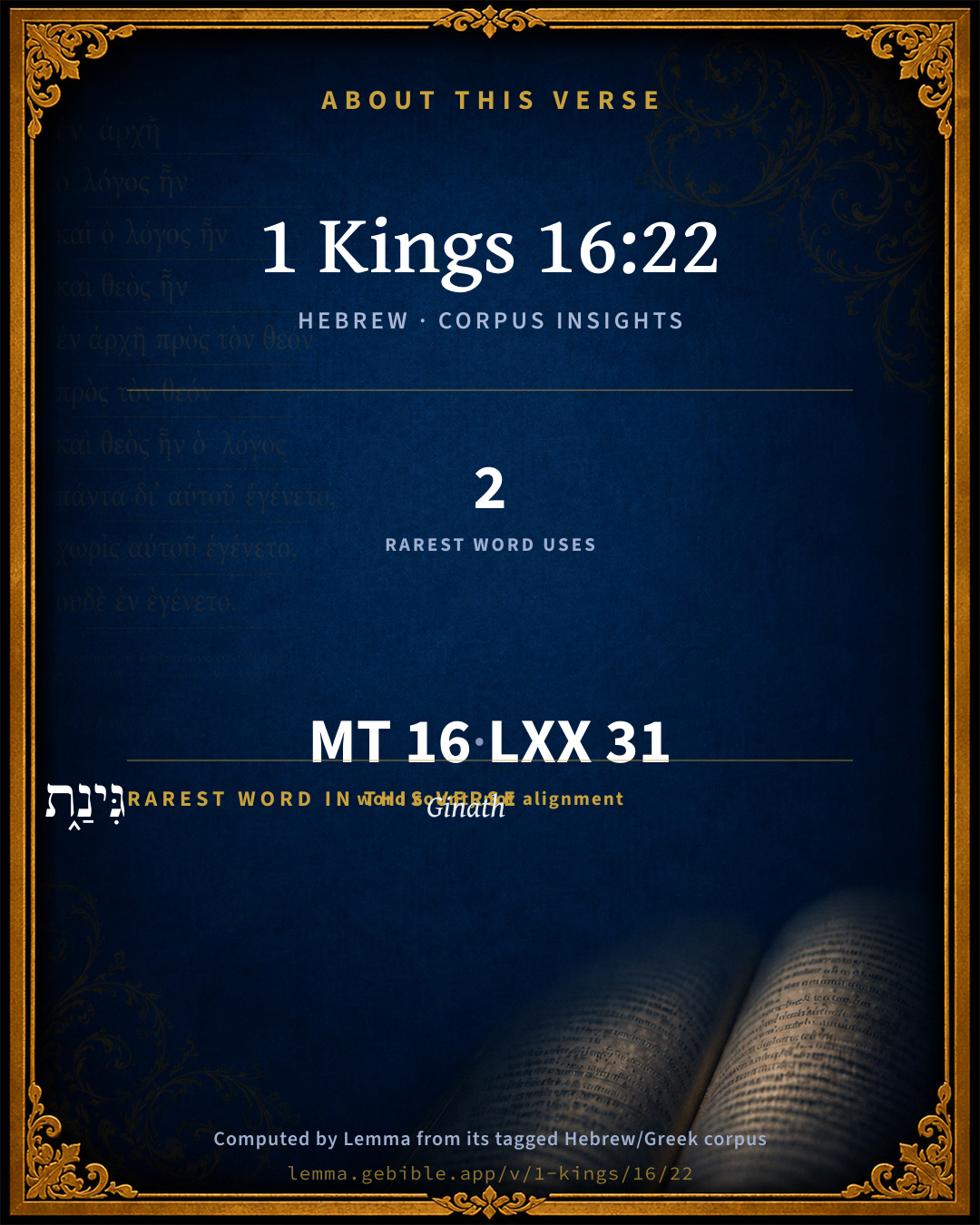
The rarest word here is גִּינַ֑ת Ginath H1527 — appearing just 2 times in the whole Hebrew Bible.

Shared distinctive vocabulary

גִּינַ֑ת Ginath H1527 occurs in 2 verses of the Hebrew Bible. Also found in:

Grammatical profile

  • 3 verbs
  • 8 nouns
  • 3 prepositions
  • 2 particles

Verb forms

  • וַיֶּחֱזַ֤ק Qal · Sequential Imperfect
  • וַיָּ֣מָת Qal · Sequential Imperfect
  • וַיִּמְלֹ֖ךְ Qal · Sequential Imperfect

Repetition

Words recur within this verse — often emphatic in Hebrew:

  • הָעָם֙ people H5971 ×2
  • אַחֲרֵ֣י after H310 ×2
  • עָמְרִ֔י Omri H6018 ×2
  • תִּבְנִ֣י Tibni H8402 ×2
  • אֲשֶׁ֣ר which H834 ×2

Hebrew & Septuagint length

In English translation the verse runs 23 words from the Hebrew and 29 from the Septuagint (LXX English) — closely comparable.

A rough comparison of the two English renderings, which tokenize alike — not a word-level alignment.

Word counts can differ between the Hebrew and the Greek without any difference in meaning — e.g. the Hebrew direct-object marker אֵת has no separate Greek word, and Greek often adds the article ὁ.

In the original languages it is 16 Hebrew tokens and 31 Greek tokens — but the two are counted differently (Hebrew bundles its prefixes and suffixes into one token; the Greek is in lemma form), so that isn’t a like-for-like length.

Hebrew and Greek witnesses Masoretic Hebrew ↔ Greek Septuagint

The same verse in the two great witnesses to the Old Testament, shown verse-for-verse.

These are two independent witnesses, not word-aligned to each other, and the Septuagint is shown in lemma (dictionary) form.

Hebrew 1 Kings 16:22 Masoretic · Westminster Leningrad Codex

וַיֶּחֱזַ֤ק הָעָם֙ אֲשֶׁ֣ר אַחֲרֵ֣י עָמְרִ֔י אֶת הָעָ֕ם אֲשֶׁ֥ר אַחֲרֵ֖י תִּבְנִ֣י בֶן גִּינַ֑ת וַיָּ֣מָת תִּבְנִ֔י וַיִּמְלֹ֖ךְ עָמְרִֽי

But the people who followed Omri prevailed against the people who followed Tibni the son of Ginath: so Tibni died, and Omri reigned.

World English Bible · Public Domain

Greek LXX 1 Kings 16:22 Septuagint · lemma form

ὁ λαός ὁ εἰμί ὀπίσω αμβρι ὑπερκρατέω ὁ λαός ὁ ὀπίσω θαμνι υἱός γωναθ καί ἀποθνήσκω θαμνι καί ιωραμ ὁ ἀδελφός αὐτός ἐν ὁ καιρός ἐκεῖνος καί βασιλεύω αμβρι μετά θαμνι

The people that followed Ambri overpowered the people that followed Thamni son of Gonath; and Thamni died and Joram his brother at that time, and Ambri reigned after Thamni.

LXX2012 (modern English Septuagint) · Public Domain

On this verse, The Cambridge Bible for Schools and Colleges discusses the Septuagint’s reading. Read the note in Commentary ↓

Hebrew: Westminster Leningrad Codex (CC BY 4.0). Greek: Septuagint (public domain); English from LXX2012 (modern English Septuagint) (Public Domain). How the Septuagint differs from the Hebrew →

Targum (Aramaic paraphrase)

1

The Targum is the ancient Jewish Aramaic paraphrase of the Hebrew Scriptures — an interpretive translation, not the Hebrew text itself. Onkelos (literal) and Pseudo-Jonathan (expansive) render the Torah, and Jonathan the Prophets. Coverage is partial: where no permissively-licensed English translation exists for a verse, only the Aramaic is shown. This is verse-level text, not a word-by-word alignment to the Hebrew.

  1. Targum Jonathan Prophets (Joshua–Malachi)
    וּתְקֵיף עַמָא דְבָתַר עָמְרִי מִן עַמָא דְבָתַר תִּבְנֵי בַר גִינַת וּמִית תִּבְנִי וּמְלַךְ עָמְרִי:

    (no public-domain English translation for this verse)

    Targum Jonathan — Aramaic: “Mikraot Gedolot” (public domain). English: “Sefaria Community Translation” (CC0 1.0 (public-domain dedication)); “London "Chaldee Paraphrase," 1871” (public domain). Text via Sefaria.

Commentary

Notes on 1 Kings 16:22 from classic Christian and Jewish commentators (each source and its license shown beneath its notes). The classic Christian expositions comment on the surrounding passage and are grouped to its opening verse, so a note may address several verses; the Jewish commentaries on the Tanakh (Rashi and others) are per-verse, so they appear only where the commentator wrote on this verse.

Lemma curates 59 commentaries, every one of them public domain or Creative Commons licensed, each selected and text-cleaned for this edition rather than reprinted as found. About our sources →

Trapp's Complete Commentary

John Trapp

1Ki 16:22 But the people that followed Omri prevailed against the people that followed Tibni the son of Ginath: so Tibni died, and Omri reigned.

Ver. 22. So Tibni died, and Omri reigned.] An untimely death it was likely that Tibni came to: as did most of the emperors of Rome till Constantine the Great. Of sixty-three of them, six only died in their beds. Ad generum Cereris, &c. This made Erasmus cry out, O miseros principes, si intelligant sua mala: miseriores, si non intelligant! Oh, the misery of princes, if they know their own misery!

John Trapp, A Commentary or Exposition upon All the Books of the Old and New Testament (1647–1656) — public domain. Text from a community e-Sword module.

The Biblical Illustrator

Joseph S. Exell

1Ki_16:22

So Tibni died, and Omri reigned.

Tibni and Omri

We have often been struck by the difference in the lot of men upon the earth; for example, as between the rich man and Lazarus, and between the great king and the poor wise man. The text brings these differences before us sharply--Tibni died, and Omri reigned. A short explanatory story is needed here. When Zimri killed Elah, the people proclaimed Omri as king; but the proclamation was not unanimous; half of the people wanted Tibni, and half wanted Omri: the half that wanted Omri prevailed; so Tibni died, and Omri reigned. Our purpose is to show that both Tibni and Omri are still living, and that we may learn a good deal from their different lots in life.

1. Tibni and Omri are both living in the persons of those who divide public opinion respecting themselves. Is there any man living with whom everybody is satisfied? Take a Christian minister--any minister in this great London, and see how public opinion is divided about him. To one set of men he is the supreme human teacher; to another set of men he is almost unfit to be in the pulpit at all. Take a statesman; to one class he is the salvation of the kingdom, to another he is an empiric, a traitor, or in some degree a political rascal. Take any friend in social life; to one man he is an idol, to another he is bore. There are great moral lessons coming out of these simple facts. Society will always be divided about its leading men; but let us insist that there may be difference without bitterness, and that you may make one man king without taking away the character and perhaps the life of his rival. Let us pray God to show us the best points in every man s character.

2. Tibni still lives in the man who comes very near being a king but just misses the throne. Half the people in the camp were in his favour. In some of the popular shouts you could hardly tell whether Tibni or Omri was the uppermost name. Now the one seemed to fill the whole wind and now the other. The men themselves did not know for certain which of them was to have the crown. Let us see if there be not a good deal of our own life in this apparently remote and uninteresting fact. Whatever you strive for most anxiously in life is the crown to you, because it is the thing you want beyond all others. Sometimes it is so near! You feel as if you could put out your hand and take it! And yet though so near, it is so far, like a star trembling in a pool. Here we come upon the very first lines of Providence, and the finer the lines the subtler the temptation. We are tempted to step over some lines; it seems right that we should do so; we say we ought to take advantage of our good fortune, and if God has come so near He means us to take the one last step. It is just there that many a man suffers the supreme trial of his faith and the supreme agony of his sensibilities. We have referred to the supreme trial of a mans sensibilities; let us explain our meaning. We often say of this man or that, How narrowly he escapes being a great man! There is only one thing wanting, one element, one force, one virtue--one thing thou lackest, one thing is needful! And the man himself is tormented by a sense of greatness which is always nearing the point of royalty but never absolutely reaching it. He feels that the great poem which would give him literary immortality is breathing within him and around him, but the moment he puts pen to paper the inspiration ceases and will not harden into words. He has m him strange wild dreamings of power; he can write a book, he can found a new school of philosophy, he can illumine the whole horizon of theology, he can save the State; innumerable things he attempts and completes in his dreams, but the day of execution never dawns! It is in such men that Tibni still lives; in disappointed hearts, in blighted hopes, in brilliant prospects overcast, in kingdoms made of cloud, in castles built in air.

3. Omri still lives in those who turn great powers and great openings to dishonourable and unholy uses. Omri got the throne. For twelve years he reigned in Israel, six of them in Tirzah. His rival died, and he was left in undisputed sovereignty. But his way was not honourable before the Lord. Omri wrought evil in the eyes of the Lord, and did worse than all that were before him. Some providences seem to be altogether thrown away, and we stand aghast at the destruction, saying, Why was this waste made? Great talents are made to serve the devil; great voices of song are never heard in the sanctuary; noble powers of speech are dumb when the righteous cause has to be pleaded. Application:

(1) If we cannot be great we can be good;

(2) There is one throne which we need not miss. (J. Parker, D. D.)

The Biblical Illustrator, edited by Joseph S. Exell (c. 1880s–1900s) — public domain. Text from a community e-Sword module.

Joseph Benson's Commentary

1Ki 16:22. But the people that followed Omri prevailed — Partly because they had the army on their side; and principally by the appointment of God, giving up the Israelites to him who was much the worse man, 1Ki 16:25-26. So Tibni died — A violent death, it seems, in battle: and doubtless many of the people died with him. But why, inquires Sir Walter Raleigh, (see his History of the World, 50:2, c. 19, § 6,) in all these confusions, and revolutions of the kingdom of Israel, did they never think of returning to the house of David? Probably, observes he, because the kings of Judah assumed a more absolute power over their subjects than the kings of Israel. It was the heaviness of the yoke which they complained of, when they first revolted from the house of David. And it is not unlikely but the dread of that made them averse to it ever after.

Joseph Benson's Commentary on the Old and New Testaments (1811–1818) — public domain. Text from a community e-Sword module.

Jamieson, Fausset & Brown

Robert Jamieson, A. R. Fausset & David Brown

Tibni died--The Hebrew does not enable us to determine whether his death was violent or natural.

Jamieson, Fausset & Brown — Commentary Critical and Explanatory on the Whole Bible (1871) — public domain (CC PDM 1.0). Text via the HelloAO Bible API.

The Cambridge Bible for Schools and Colleges

gen. ed. J. J. S. Perowne

22. so Tibni died] Here the LXX. says ‘and Thamni died and his brother Joram at that time, and Ambri reigned after Thamni.’ This is one of those additions which can hardly have arisen except from the existence of a different Hebrew text.

The Cambridge Bible for Schools and Colleges (gen. ed. J. J. S. Perowne; Cambridge University Press, 1878–1918) — public domain. Text from a community e-Sword module.

John Gill's Exposition

Now the rest of the acts of Omri, which he did, and his might which he showed, are they not written in the book of the chronicles of the kings of Israel? Where those of the preceding kings were written, see Kg1 14:19.

.

1 Kings 16:28

kg1 16:28

kg1 16:28

kg1 16:28So Omri slept with his fathers,.... Died a natural death:

and was buried in Samaria; the city he had built, and now the royal seat and metropolis of the kingdom:

and Ahab his son reigned in his stead; of whom much is said in the following history.

John Gill's Exposition of the Whole Bible (1746–1763) — public domain (CC PDM 1.0). Text via the HelloAO Bible API.

Albert Barnes' Notes on the Bible

From a comparison of the dates given in 1Ki 16:15, 1Ki 16:23, 1Ki 16:29 it follows that the contest between the two pretenders lasted four years.

Tibni’s death can scarcely be supposed to have been natural. Either he must have been slain in battle against Omri, or have fallen into his hands and been put to death.

There has probably been some derangement of the text here. The passage may have run thus: “So Tibni died, and Omri reigned in the thirty-first year of Asa, king of Judah. Omri reigned over Israel twelve years: six years reigned he in Tirzah.” Omri’s reign of 12 years began in Asa’s 27th 1Ki 16:15-16, and terminated in his 38th 1Ki 16:29. The event belonging to Asa’s 31st year was the death of Tibni, and the consequent extension of Omri’s kingdom.

The six years in Tirzah are probably made up of the four years of contention with Tibni, and two years afterward, during which enough of Samaria was built for the king to transfer his residence there.

Albert Barnes' Notes on the Bible (1834–1885) — public domain. Text from a community e-Sword/MySword module.

Haydock's Catholic Bible Commentary

Died in the battle, wherein Amri prevailed. (Menochius)

George Leo Haydock (1774–1849), Haydock's Catholic Family Bible and Commentary, 1859 edition — public domain. Excludes Psalms (Douay-Rheims chapter numbering differs from Protestant) and Deuterocanonical books (Catholic canon only).

Matthew Poole's English Annotations

The people that followed Omri prevailed; partly because they had the army on their side; and principally by the appointment and judgment of God, giving up the Israelites to him who was much the worst, 1Ki 16:25,26.

Tibni died a violent death in the battle.

Matthew Poole's English Annotations on the Holy Bible (1683–1685) — public domain. Text from a community e-Sword/MySword module.

Whedon's Commentary on the Bible

Daniel D. Whedon

22. So Tibni died — The record is so brief as to leave it doubtful whether he died naturally or by violence.

Daniel D. Whedon (gen. ed.), Commentary on the Old and New Testaments (1874–1909) — public domain. Text from a community e-Sword module.

The Pulpit Commentary

But the people that followed Omri prevailed against the people that followed Tibni the son of Ginath It appears, however, from the following verse that the struggle lasted four years: so Tibni died According to Jos., Ant. 8:12. he was slain by the conqueror. The LXX has here a curious and probably genuine addition. "And Thabni died, and Joram his brother at that time, and Omri reigned. The jingle of the Hebrew words is probably designed.

The Pulpit Commentary (1880–1919), ed. H.D.M. Spence-Jones & Joseph S. Exell — public domain. Text from a community e-Sword module.

John Wesley's Explanatory Notes

Prevailed - Partly, because they had the army on their side; and principally, by the appointment of God, giving up the Israelites to him who was much the worst, ver. 25, 26. Died - A violent death, in the battle: but not till after a struggle of some years. But why in all these confusions of the kingdom of Israel, did they never think of returning to the house of David? Probably because the kings of Judah assumed a more absolute power than the kings of Israel. It was the heaviness of the yoke that they complained of, when they first revolted from the house of David. And it is not unlikely, the dread of that made them averse to it ever after.

John Wesley, Explanatory Notes Upon the Whole Bible (1754–1765) — public domain. Text via the GEBible commentary corpus.

Rashi

Rabbi Shlomo Yitzchaki (Rashi)

And Tivni died. When Asa took Omri’s daughter in marriage for Yehoshofot his son, they killed Tivni, when they saw Omri’s prominence; according to Seder Olam.

Rashi on the Tanakh — English translations: “The Judaica Press complete Tanach with Rashi, translated by A. J. Rosenberg” (CC BY 4.0); “Pentateuch with Rashi's commentary by M. Rosenbaum and A.M. Silbermann, 1929-1934” (public domain); “The Metsudah Tanach series, Lakewood, N.J” (CC BY 4.0); and “The Book of Joshua, Metsudah Publications, 1997” (CC BY 4.0). Text via Sefaria.

Lesson kit

Teaching starters — assembled from the data on this page, not authored interpretation. Every prompt links to the verse data it draws on. Edit before teaching.

1 Kings, in the Historical, opens this verse with 16 words (11 distinct Hebrew lemmas). Its most distinctive word is Gîynath (“Ginath”). A historical commentator’s framing appears above. Read the whole chapter for the surrounding context.

Discussion questions

  1. What does “Ginath” (Gîynath) contribute to the verse as a whole?
  2. 1 Kings 16:21 shares the word «Ginath» with this verse. How do the two illuminate each other?
  3. “people” occurs 2× in this one verse. What is the effect of the repetition?
  4. These translations render this verse differently; the difference is in the English rendering, not the original. What questions does that raise?
  5. The verb «וַיֶּחֱזַ֤ק» is Qal Sequential Imperfect. How does its form color the action?
  6. Reading how Trapp's Complete Commentary and The Biblical Illustrator read this verse, where do the two commentators agree and where do they part?

Things to notice

Reading settings

Reading text

Shown beneath each verse's original-language words.

Old Testament
Old Testament edition

Read the OT as the Masoretic Hebrew (MT) or the Greek Septuagint (LXX).

English shown for the Greek Septuagint (in the Hebrew ↔ Greek comparison).

Comparing translations? Open the Compare panel on any verse page to stack up to four side by side.