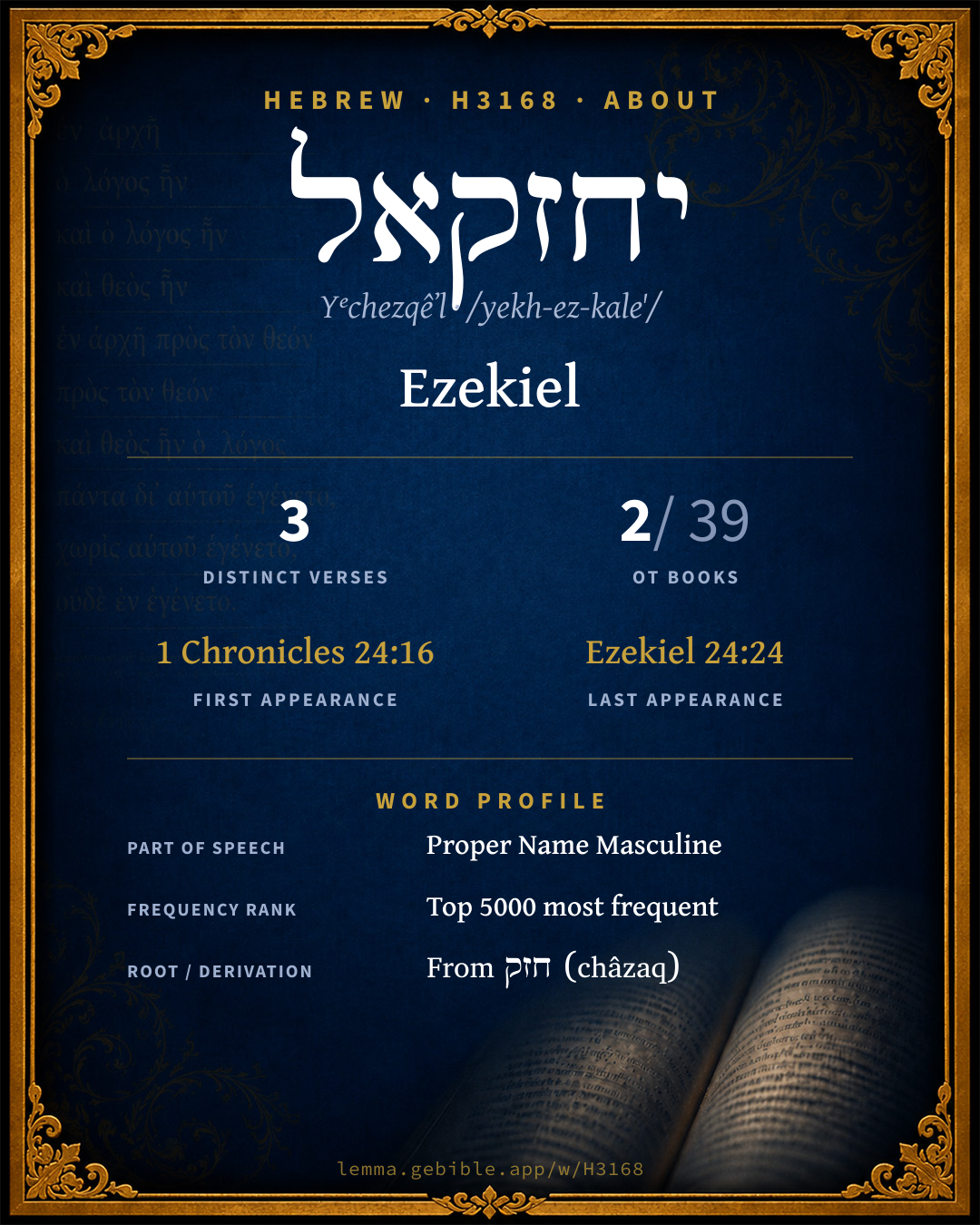
יְחֶזְקֵאל
Ezekiel
BDB lists 3 entries for ‘Ezekiel’ fuller range ↓
Full lexicon entry — Brown-Driver-Briggs (BDB)
From Brown-Driver-Briggs (BDB)
Where this word appears
Grammar key — what these labels mean
Part of speech
- Noun
- A naming word — a person, place, thing, or idea.
Noun type
- Proper
- A name of a specific person, place, or people (e.g. Abraham, Zion, Israel).
Every verse where H3168 appears — 3 distinct verses across 2 books. Click any verse to open its interlinear word-by-word view. Verse text shown in the World English Bible for context — . Each verse’s Hebrew form is shown with its reference; the English is not keyword-highlighted, since the data carries no word-level English alignment. Use “Compare translations” on any verse to read it across multiple English versions. This concordance covers the Hebrew Bible; Septuagint (Greek Old Testament) occurrences are not indexed here.
1 Chronicles 1 verse
Ezekiel 2 verses
- Ezekiel 1:3 יְחֶזְקֵ֨אל n Proper the word of Yahweh came expressly to Ezekiel the priest, the son of Buzi, in the land of the Chaldeans by the river Chebar; and the hand of Yahweh was there on him.
- Ezekiel 24:24 יְחֶזְקֵ֤אל n Proper Thus shall Ezekiel be to you a sign; according to all that he has done shall you do: when this comes, then shall you know that I am the Lord Yahweh.
About this entry
At a glance — auto-summarized from this page’s data, not written by a person. Every figure links to its source below. This summary describes the numbers; it doesn’t interpret them.
“Ezekiel” is the headline sense of the Hebrew name יחזקאל (Yᵉchezqêʼl). The Hebrew Bible uses it only 3 verses. It clusters heavily in Ezekiel, which alone accounts for 67% of its uses. First canonically at 1 Chronicles 24:16, it enters the text early. See 3-verse concordance and the renderings breakdown below.
Gloss history
Strong's 1890 vs modern scholarship
About this word
Strong's H3168 catalogs a Hebrew word from the Hebrew Old Testament.
These counts are not copied from any lexicon or concordance. They are computed here, from the morphology-tagged Hebrew Old Testament. What Lemma adds →
- 3
- distinct verses
- The word appears in 3 distinct verses.
- 2 / 39
- OT books
- The word appears in 2 of 39 Old Testament books.
- #4,179
- by frequency
- Top 5000 most frequent Hebrew words (rank 4,179 of 8,640 Hebrew words by occurrence).
View all 3 occurrences in the concordance →
Most concentrated in
- Ezekiel 2 verses 67%
- 1 Chronicles 1 verse 33%
By section of the Old Testament
By traditional corpus
Conventional, traditional groupings — biblical authorship is debated, so this is a traditional corpus grouping, not an authorship claim. Each share is this word’s portion of its verses in that division of the Hebrew canon. Each figure is a share of the word’s 3 distinct verses.
- Prophets (Nevi'im) 2 verses · 67%
- Writings (Ketuvim) 1 verse · 33%
How translations render this word
Counts come from each version’s own published word-to-Strong’s tagging or interlinear alignment — an approximate guide to how each version renders this word, not a word-level alignment the data otherwise carries. Because each total is that version’s own tagged count, the per-version totals vary from one another and need not match the appearance or distinct-verse counts above. These counts may also differ from a printed concordance because Lemma counts each distinctly tagged rendering and does not collapse phrase taggings into a single head-word total. This is a fixed set of word-tagged versions (KJV, ASV, BSB, ULT) and does not change with the reading translation you choose elsewhere. Each version’s license is shown beside its name below (and on Sources).
BDB lists this Strong’s number as 2 distinct words (homographs). Each count above pools all of them and is not split by sense — see the Senses section below. A low-frequency rendering may belong to a different one of those words, not the primary meaning.
- King James Version†: Came expressly unto ezekiel 1×, Ezekiel 1×, Jehezekel 1×
- American Standard Version†: Came expressly unto ezekiel 1×, Jehezkel 1×, Shall ezekiel 1×
- Berean Standard Bible†: Ezekiel 2×
- unfoldingWord Literal Text†: Ezekiel 2×
King James Version Public Domain
Renders H3168 across 3† tagged occurrences — most commonly:
American Standard Version Public Domain
Renders H3168 across 3† tagged occurrences — most commonly:
Berean Standard Bible Public Domain
Renders H3168 across 3† tagged occurrences — most commonly:
Plus 1 rendering that appears only once — usually multi-word phrases or single function words the recovered tagging swept in, not distinct renderings.
unfoldingWord Literal Text CC BY-SA 4.0
Renders H3168 across 3† tagged occurrences — most commonly:
Plus 1 rendering that appears only once — usually multi-word phrases or single function words the recovered tagging swept in, not distinct renderings.
Senses in the full BDB
What do BDB’s symbols mean?
BDB uses these scholarly abbreviations:
| Symbol | Meaning |
|---|---|
| 𝔊 | the Septuagint (the ancient Greek translation, LXX) |
| 𝔙 | the Vulgate (the Latin translation) |
| 𝔖 | the Syriac version (the Peshitta) |
| 𝔗 | the Targum (the Aramaic translation) |
| ψ | the Psalms |
| √ | root (the underlying root or stem) |
| ‖ | parallel passage (a synonymous or contrasted parallel) |
| † | the dagger: every passage where the word occurs is cited |
The 2 senses and sub-senses the full Brown-Driver-Briggs lexicon distinguishes for this word, in lexicon order (not ranked by frequency), with BDB’s own verbatim wording and sub-sense lettering. Shown in Hebrew script with BDB’s own scholarly abbreviations. The condensed entry is in the Lexicon Entry tab. See also the Forms in the corpus table below.
יחזקאל I m. (God strengtheneth, cf. foreg.
- 1. the well-known priest and prophet, son of Buzi, 𝔊 Ιεζεκιηλ, Ez 1:3; 24:24. e.g. Ezekiel 1:3
- 2. priest of 19th course (assigned to David’s time) 1 Ch 24:16, 𝔊 Εζεκηλ, 𝔊L (20th course, cf. A) Ιεζεκιηλ. e.g. 1 Chronicles 24:16
יחזקאל II (וּ) v. sub חזק.
Senses from the full Brown-Driver-Briggs lexicon (Brown, Driver, Briggs; Oxford 1906 — public domain), digitized via Sefaria, supplemented by the OpenScriptures HebrewLexicon (CC BY 4.0). Full attribution on Sources.
Word origin
n.pr.m. (God strengtheneth, cf. foreg.; v. LagBN 134)—
— Brown-Driver-Briggs (Oxford 1906, public domain), digitized via Sefaria, supplemented by the OpenScriptures HebrewLexicon (CC BY 4.0). See Sources.
Derived from חזק (châzaq) (H2388) — to strengthen.
Jastrow Dictionary
A second Hebrew/Aramaic lexicon for comparison, covering Aramaic and post-biblical (Talmudic, Targumic, Midrashic) usage that the biblical-Hebrew BDB does not. Matched by lemma rather than by Strong’s number, so a lemma may carry more than one Jastrow headword (shown separately below), and the entries cover usage well beyond the Bible.
יְחֶזְקֵאל
- (b. h.) pr. n. m. Ezekiel,
- 1. the prophet. Snh. 39ᵃ, v. יָסַר. Ḥag. 13ᵇ למה י׳ דומה לבן וכ׳ to whom is Ez. to be compared? To a villager that saw the king; a. fr.—ספר י׳ the Book of Ezekiel. Ib.ᵃ; Sabb. 13ᵇ, v. גָּנַז; Men. 45ᵃ; a. e.
- 2. Ez., the father of R. Judah, v. יְהוּדָה. Kidd. 70ᵃ
A Dictionary of the Targumim, the Talmud Babli and Yerushalmi, and the Midrashic Literature (Marcus Jastrow; London, Luzac, 1903) — Public Domain. Digitized via Sefaria. Digitized via Sefaria. Full attribution on Sources.
Forms in the corpus
The 3 distinct written forms H3168 takes in the Hebrew Bible, most frequent first — each parse links to that state’s occurrences in the concordance. Hebrew forms include their vowel points and cantillation, so a single lemma takes many written forms.
| Form | Parsing | Example | Uses |
|---|---|---|---|
| יְחֶזְקֵ֤אל | Noun, Proper | Ezekiel 24:24 | 1 |
| יְחֶזְקֵ֨אל | Noun, Proper | Ezekiel 1:3 | 1 |
| לִֽ/יחֶזְקֵ֖אל | Noun, Proper | 1 Chronicles 24:16 | 1 |
Same root — word family
Other BDB entries built from the same root as H3168, grouped by Strong’s listed origin. These share a root / origin per the lexicon — not necessarily a shared meaning. Each links to that word’s own entry.
Derives from
Shares the same root
- חזק châzâq H2389 strong
- חזק châzêq H2390 stronger
- חזק chêzeq H2391 strength
- חזק chôzeq H2392 strength
Proper names from this root
People and places named from this root — a name, not an additional meaning of the word.
Compare all same-root words → Showing 4 of 8 — not the complete family. 2 of the same-root words are proper names (people or places). They share a root, not necessarily a meaning.
Bible dictionary
Public-domain dictionary articles matched to this entry by name (Ezekiel). A biblical name can be shared by more than one person or place, so an article may treat several.
Easton's Bible Dictionary · M. G. Easton, 1897
God will strengthen. (1.) 1 Chr. 24:16, "Jehezekel."
(2.) One of the great prophets, the son of Buzi the priest (Ezek. 1:3). He was one of the Jewish exiles who settled at Tel-Abib, on the banks of the Chebar, "in the land of the Chaldeans." He was probably carried away captive with Jehoiachin (1:2; 2 Kings 24:14-16) about B.C. 597. His prophetic call came to him "in the fifth year of Jehoiachin's captivity" (B.C. 594). He had a house in the place of his exile, where he lost his wife, in the ninth year of his exile, by some sudden and unforeseen stroke (Ezek. 8:1; 24:18). He held a prominent place among the exiles, and was frequently consulted by the elders (8:1; 11:25; 14:1; 20:1). His ministry extended over twenty-three years (29:17), B.C. 595-573, during part of which he was contemporary with Daniel (14:14; 28:3) and Jeremiah, and probably also with Obadiah. The time and manner of his death are unknown. His reputed tomb is pointed out in the neighbourhood of Bagdad, at a place called Keffil.
Smith's Bible Dictionary · William Smith, 1863
(the strength of God), one of the four greater prophets, was the son of a priest named Buzi, and was taken captive in the captivity of Jehoiachin, eleven years before the destruction of Jerusalem. He was a member of a community of Jewish exiles who settled on the banks of the Chebar, a "river' or stream of Babylonia. He began prophesying B.C. 595, and continued until B.C. 573, a period of more than twenty-two years. We learn from an incidental allusion, (Ezekiel 24:18) that he was married, and had a house, (Ezekiel 8:1) in his place of exile, and lost his wife by a sudden and unforeseen stroke. He lived in the highest consideration among his companions in exile, and their elders consulted him on all occasions. He is said to have been buried on the banks of the Euphrates. The tomb, said to have been built by Jehoiachin, is shown, a few days journey from Bagdad. Ezekiel was distinguished by his stern and inflexible energy of will and character and his devoted adherence to the rites and ceremonies of his national religion. The depth of his matter and the marvellous nature of his visions make him occasionally obscure. Prophecy of Ezekiel .--The book is divided into two great parts, of which the destruction of Jerusalem is the turning-point. Chapters 1-24 contain predictions delivered before that event, and chs. 25-48 after it, as we see from ch. (Ezekiel 26:2) Again, chs. 1-32 are mainly occupied with correction, denunciation and reproof, while the remainder deal chiefly in consolation and promise. A parenthetical section in the middle of the book, chs. 25-32, contains a group of prophecies against seven foreign nations, the septenary arrangement being apparently intentional. There are no direct quotations from Ezekiel in the New Testament, but in the Apocalypse there are many parallels and obvious allusions to the later chapters 40-48.
Hitchcock's Bible Names Dictionary · Roswell D. Hitchcock, 1869
the strength of God
Classic public-domain reference works; full attribution on Sources.
Septuagint verse parallels
This word appears in 3 verses that also exist in the Greek Old Testament (Septuagint), out of the 3 Hebrew verses it occurs in. You can read those verses in Greek by switching the Old Testament edition to the Septuagint.
Read these verses in the Septuagint
This is a verse-level parallel only — the same verses exist in both the Hebrew and Greek Old Testaments. No word-level Hebrew↔Greek correspondence is claimed: the data carries no such alignment, so no Greek word is shown as this Hebrew word’s translation. Coverage is not total — the Septuagint omits the deuterocanon and renumbers the Psalms, so some Hebrew verses have no direct Greek parallel.