
Job 8:15

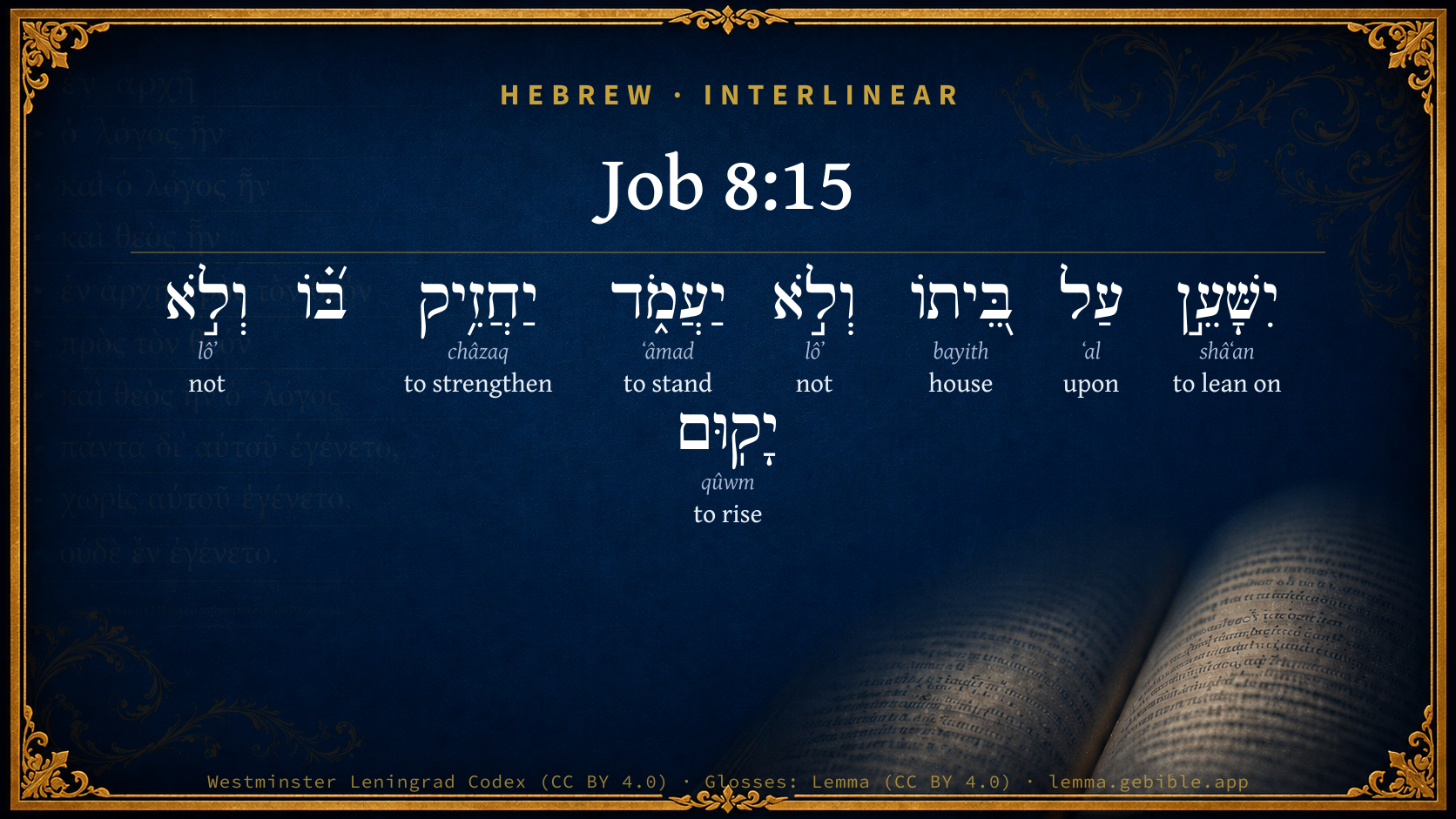
Hebrew (Westminster Leningrad Codex) Job 8:15 appears in the Hebrew Old Testament. The text above is from the Westminster Leningrad Codex. Each word links to its Strong’s number, a concise gloss, and parsing drawn from the Open Scriptures Hebrew Bible morphology. Click any word for its full Brown-Driver-Briggs (BDB) entry.
Download image
Cite this verse

Job 8:15 (World English Bible). Public Domain. Lemma interlinear Bible study tool, https://lemma.gebible.app/v/job/8/15.

Show BibTeX & RIS
BibTeX
RIS
English Translation
He shall lean on his house, but it shall not stand. He shall cling to it, but it shall not endure.
World English Bible · Public Domain
Download a study sheet

One document with this verse’s original text, its word-by-word gloss line, the meaning frame, cross-references with their text, attributed commentary, and full source and license credits — printable, and it pastes into notes with its structure intact.

This verse Autodidact and up

Study sheet (.html) Plain text (.txt)

A passage Seminary Student

Up to 50 verses in one chapter. A passage sheet keeps up to 6 commentary sources and 12 cross-references per verse, in the order this page ranks them, and says so on the sheet whenever that leaves anything out. Ask for a single verse and you get the Autodidact verse sheet above.

Everything on this page stays free to read, with no account — the sheet is a download of what is already on screen, not access to it.

Want to remove ads? Support Godless Engineer
Compare translations 3

The same verse in 3 English versions, stacked beneath the original-language interlinear above. Click any original word for its lexicon entry.

Each is an independent rendering of the whole verse — the interlinear is not word-aligned to these translations.

Highlighted words mark where these versions differ — a whole-verse word diff, not a word-by-word alignment.

  • World English Bible Public Domain
    He shall lean on his house, but it shall not stand. He shall cling to it, but it shall not endure.
  • King James Version Public Domain
    He shall lean upon his house, but it shall not stand: he shall hold it fast, but it shall not endure.
  • unfoldingWord Literal Text CC BY-SA 4.0
    He leans himself against his house and it does not stand; he takes hold of it, but it does not arise.

unfoldingWord Literal Text — © unfoldingWord, licensed CC BY-SA 4.0. Word-aligned USFM3 via Door43 (git.door43.org/unfoldingWord/en_ult).

Versions to compare (up to 4)

3 of 4 selected

Show all 18 translations

Every available English version of this verse, each an independent rendering of the whole verse.

  • World English Bible Public Domain
    He shall lean on his house, but it shall not stand. He shall cling to it, but it shall not endure.
  • Berean Standard Bible Public Domain
    He leans on his web, but it gives way; he holds fast, but it does not endure.
  • Majority Standard Bible Public Domain
    He leans on his web, but it gives way; he holds fast, but it does not endure.
  • King James Version Public Domain
    He shall lean upon his house, but it shall not stand: he shall hold it fast, but it shall not endure.
  • American Standard Version (1901) Public Domain
    He shall lean upon his house, but it shall not stand: He shall hold fast thereby, but it shall not endure.
  • Revised Version (1885) Public Domain
    He shall lean upon his house, but it shall not stand: he shall hold fast thereby, but it shall not endure.
  • Geneva Bible (1599) Public Domain
    He shall leane vpon his house, but it shall not stand: he shall holde him fast by it, yet shall it not endure.
  • Douay-Rheims (1899) Public Domain
    He shall lean upon his house, and it shall not stand: he shall prop it up, and it shall not rise:
  • Young's Literal Translation Public Domain
    He leaneth on his house -- and it standeth not: He taketh hold on it -- and it abideth not.
  • Literal Standard Version CC BY-SA 4.0
    He leans on his house—and it does not stand, || He takes hold on it—and it does not abide.
  • Unlocked Literal Bible CC BY-SA 4.0
    He leans on his house, but it will not support him; he takes hold of it, but it does not stand.
  • unfoldingWord Literal Text CC BY-SA 4.0
    He leans himself against his house and it does not stand; he takes hold of it, but it does not arise.
  • Darby Bible Public Domain
    He shall lean upon his house, and it shall not stand; he shall lay hold on it, but it shall not endure.
  • World Messianic Bible Public Domain
    He will lean on his house, but it will not stand. He will cling to it, but it will not endure.
  • Webster's Bible Public Domain
    He shall lean upon his house, but it shall not stand: he shall hold it fast, but it shall not endure.
  • Free Bible Version CC BY-SA 4.0
    They look to their home to provide security, but it provides no support. They try to hang onto it, but it doesn't last.
  • Bible in Basic English Public Domain
    He is looking to his family for support, but it is not there; he puts his hope in it, but it comes to nothing.
  • JPS Tanakh (1917) Public Domain
    He shall lean upon his house, but it shall not stand; he shall hold fast thereby, but it shall not endure.

Literal Standard Version (2020), Covenant Press — licensed CC BY-SA 4.0. Text via the HelloAO Bible API (eBible.org). Unlocked Literal Bible (unfoldingWord) — licensed CC BY-SA 4.0. Text via the HelloAO Bible API (eBible.org). unfoldingWord Literal Text — © unfoldingWord, licensed CC BY-SA 4.0. Word-aligned USFM3 via Door43 (git.door43.org/unfoldingWord/en_ult). Free Bible Version, Dr. Jonathan Gallagher — licensed CC BY-SA 4.0. Text via the HelloAO Bible API (eBible.org).

Word by word

More ways to search: Search by grammar → Find every occurrence → Compare this word →

Practice this passage: Drill this verse → Learn its vocabulary →

About this verse

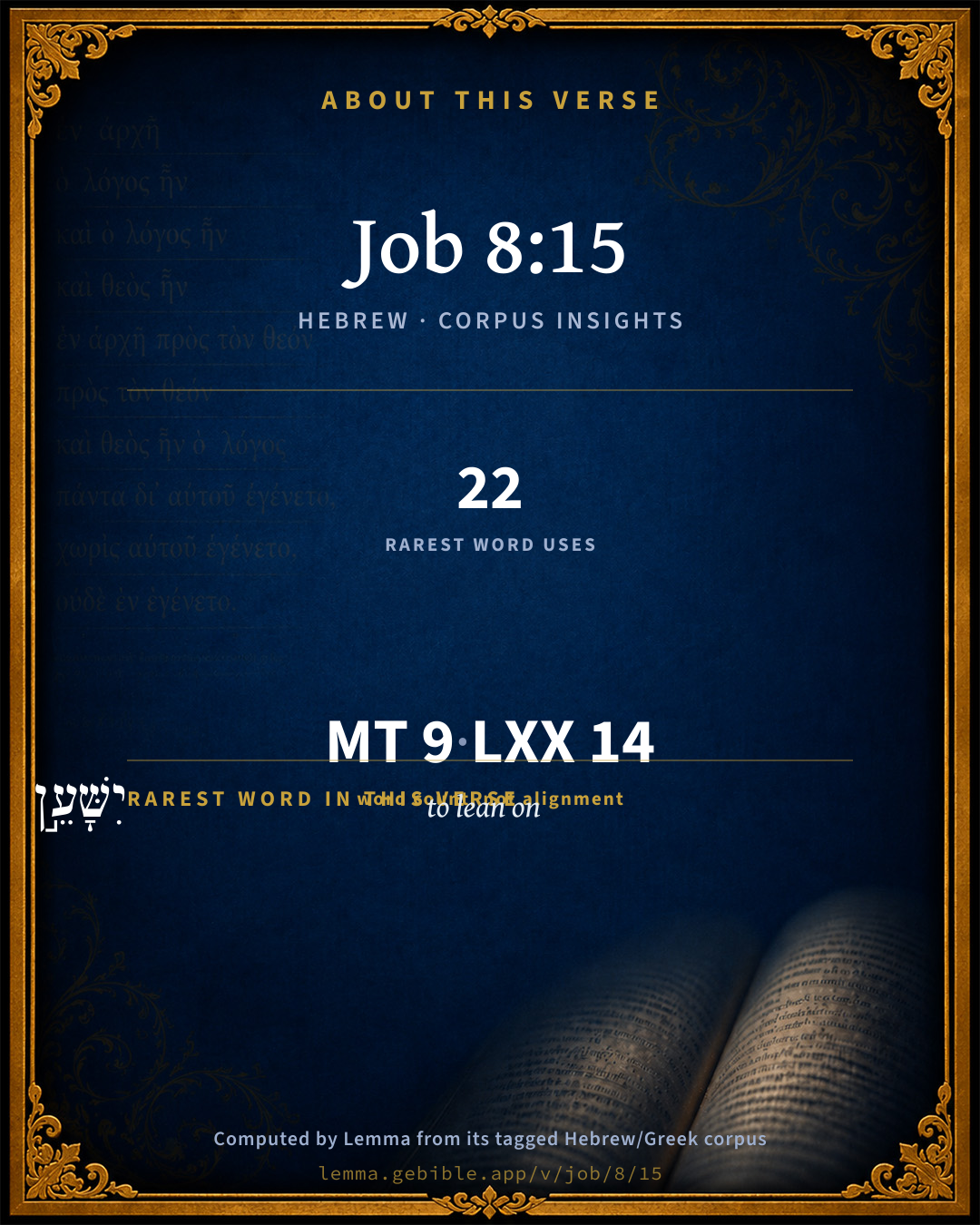
These counts appear in no published source. They are computed here, from the morphology-tagged text and Lemma’s own curated glosses. What Lemma adds →

9
words
7
distinct lemmas
Wisdom
section

Notable vocabulary

The rarest word here is יִשָּׁעֵ֣ן to lean on H8172 — appearing just 22 times in the whole Hebrew Bible.

Shared distinctive vocabulary

יִשָּׁעֵ֣ן to lean on H8172 occurs in 20 verses of the Hebrew Bible. Also found in:

Grammatical profile

  • 4 verbs
  • 1 noun
  • 2 prepositions
  • 2 particles

Verb forms

  • יִשָּׁעֵ֣ן Niphal · Imperfect
  • יַעֲמֹ֑ד Qal · Imperfect
  • יַחֲזִ֥יק Hiphil · Imperfect
  • יָקֽוּם Qal · Imperfect

Repetition

A word recurs within this verse — often emphatic in Hebrew:

  • וְלֹ֣א not H3808 ×2

Hebrew & Septuagint length

In English translation the verse runs 21 words from the Hebrew and 23 from the Septuagint (LXX English) — closely comparable.

A rough comparison of the two English renderings, which tokenize alike — not a word-level alignment.

Word counts can differ between the Hebrew and the Greek without any difference in meaning — e.g. the Hebrew direct-object marker אֵת has no separate Greek word, and Greek often adds the article ὁ.

In the original languages it is 9 Hebrew tokens and 14 Greek tokens — but the two are counted differently (Hebrew bundles its prefixes and suffixes into one token; the Greek is in lemma form), so that isn’t a like-for-like length.

Cross-references

8

Topical passages linked to Job 8:15 in the Treasury of Scripture Knowledge — connected by theme and wording, ordered by reader-vote popularity; previews shown in the World English Bible.

  • Job 27:18 He builds his house as the moth, As a booth which the watchman makes.
  • Matthew 7:24–27 "Everyone therefore who hears these words of mine, and does them, I will liken him to a wise man, who built his house on a rock.
  • Luke 6:47–49 Everyone who comes to me, and hears my words, and does them, I will show you who he is like.
  • Job 18:14 He shall be rooted out of his tent where he trusts. He shall be brought to the king of terrors.
  • Psalms 49:11 Their inward thought is that their houses will endure forever, And their dwelling places to all generations. They name their lands after themselves.
  • Psalms 52:5–7 God will likewise destroy you forever. He will take you up, and pluck you out of your tent, And root you out of the land of the living. Selah.
  • Psalms 112:10 The wicked will see it, and be grieved. He shall gnash with his teeth, and melt away. The desire of the wicked will perish.
  • Proverbs 10:28 The prospect of the righteous is joy, But the hope of the wicked will perish.

Cross-references courtesy of OpenBible.info (CC BY 4.0).

Hebrew and Greek witnesses Masoretic Hebrew ↔ Greek Septuagint

The same verse in the two great witnesses to the Old Testament, shown verse-for-verse.

These are two independent witnesses, not word-aligned to each other, and the Septuagint is shown in lemma (dictionary) form.

Hebrew Job 8:15 Masoretic · Westminster Leningrad Codex

יִשָּׁעֵ֣ן עַל בֵּ֭יתוֹ וְלֹ֣א יַעֲמֹ֑ד יַחֲזִ֥יק בּ֝֗וֹ וְלֹ֣א יָקֽוּם

He shall lean on his house, but it shall not stand. He shall cling to it, but it shall not endure.

World English Bible · Public Domain

Greek LXX Job 8:15 Septuagint · lemma form

ἐάν ὑποἐρείδω ὁ οἰκία αὐτός οὐ μή ἵστημι ἐπιλαμβάνω δέ αὐτός οὐ μή ὑπομένω

If he should prop up his house, it shall not stand: and when he has taken hold of it, it shall not remain.

LXX2012 (modern English Septuagint) · Public Domain

Hebrew: Westminster Leningrad Codex (CC BY 4.0). Greek: Septuagint (public domain); English from LXX2012 (modern English Septuagint) (Public Domain). How the Septuagint differs from the Hebrew →

Commentary

Notes on Job 8:15 from classic Christian and Jewish commentators (each source and its license shown beneath its notes). The classic Christian expositions comment on the surrounding passage and are grouped to its opening verse, so a note may address several verses; the Jewish commentaries on the Tanakh (Rashi and others) are per-verse, so they appear only where the commentator wrote on this verse.

Lemma curates 59 commentaries, every one of them public domain or Creative Commons licensed, each selected and text-cleaned for this edition rather than reprinted as found. About our sources →

Trapp's Complete Commentary

John Trapp

Job 8:15 He shall lean upon his house, but it shall not stand: he shall hold it fast, but it shall not endure.

Ver. 15. He shall lean upon his house] The spider shall, so Vatablus taketh it; but better, the hypocrite leaneth, or layeth his whole weight upon his house, that is, wealth, children, friends, clients, tenants, &c., as did Doeg, Psa 52:7; Haman, Est 3:9-11. That profane earl of Westmoreland, who said that he needed not at all to pray to God, for he had tenants enough to pray for him. Bildad probably glanceth here at Job, as if he had once trusted in his riches, relations, &c., which yet Job disavoweth, Job 31:24-25

But it shall not stand] No more than the spider’s house doth, borne down sometimes by her very weight, and not only by the wind. Hypocrites ruin their own houses by their sins, and particularly by relying on them. Though thou build thy palace as high as heaven, said the oracle to Phocas, yet sin, that lieth at the bottom, will be the ruin of it.

He shall hold it fast] Mordicus tenebit, he shall hold it, not with his hands only, but with his teeth, as Cynegiras did the Persian ship; or as a drowning man doth the branch of a tree.

But it shall not endure] All will not do; riches avail not in the day of wrath, &c. A hypocrite runs in his trouble to former false refuges; he trusted to his legs, or repairs to his bushes, as the hunted hare goes to the places that she used when she lived in quiet, thither she flees when she knows not how else to escape; but all to no purpose.

John Trapp, A Commentary or Exposition upon All the Books of the Old and New Testament (1647–1656) — public domain. Text from a community e-Sword module.

Joseph Benson's Commentary

Job 8:15. He shall lean upon his house — He shall trust to the multitude and strength of his children and servants, and to his wealth, all which come under the name of a man’s house in Scripture. But it shall not stand — That is, not be able to uphold itself, nor him that trusted to it. He shall hold it fast — Or, he shall take fast hold of it to strengthen and uphold himself by it. But his web, that refuge of lies, will be swept away, and he crushed in it. Or, by holding it fast, may be meant, that he shall endeavour to support his house by strong alliances, but it will be to no purpose, for it shall not endure.

Joseph Benson's Commentary on the Old and New Testaments (1811–1818) — public domain. Text from a community e-Sword module.

Jamieson, Fausset & Brown

Robert Jamieson, A. R. Fausset & David Brown

he shall hold it fast--implying his eager grasp, when the storm of trial comes: as the spider "holds fast" by its web; but with this difference: the light spider is sustained by that on which it rests; the godless is not by the thin web on which he rests. The expression, "Hold fast," properly applies to the spider holding his web, but is transferred to the man. Hypocrisy, like the spider's web, is fine-spun, flimsy, and woven out of its own inventions, as the spider's web out of its own bowels. An Arab proverb says, "Time destroys the well-built house, as well as the spider's web."

Jamieson, Fausset & Brown — Commentary Critical and Explanatory on the Whole Bible (1871) — public domain (CC PDM 1.0). Text via the HelloAO Bible API.

Adam Clarke's Commentary

Verse 15. He shall lean upon his house] This is all allusion to the spider. When he suspects his web, here called his house, to be frail or unsure, he leans upon it in different parts, propping himself on his hinder legs, and pulling with his fore claws, to see if all be safe. If he find any part of it injured, he immediately adds new cordage to that part, and attaches it strongly to the wall. When he finds all safe and strong, he retires into his hole at one corner, supposing himself to be in a state of complete security, when in a moment the brush or the besom sweeps away both himself, his house, and his confidence. This I have several times observed; and it is in this that the strength and point of the comparison consist. The wicked, whose hope is in his temporal possessions strengthens and keeps his house in repair; and thus leans on his earthly supports; in a moment, as in the case of the spider, his house is overwhelmed by the blast of God's judgments, and himself probably buried in its ruins. This is a very fine and expressive metaphor, which not one of the commentators that I have seen has ever discovered.

Adam Clarke's Commentary on the Bible (1810–1826) — public domain. Text from a community e-Sword/MySword module.

Ellicott's Commentary for English Readers

(15) It shall not endure.—The description of the wicked man ends here.

A Bible Commentary for English Readers, edited by Charles John Ellicott (1878–1897) — public domain. Text from a community e-Sword module.

The Cambridge Bible for Schools and Colleges

gen. ed. J. J. S. Perowne

15. hold it fast] i. e. hold fast by it. The meaning of course is not that he tries to uphold his house, but that he tries to support himself by holding on to it. This is true both of the spider and the man.

The Cambridge Bible for Schools and Colleges (gen. ed. J. J. S. Perowne; Cambridge University Press, 1878–1918) — public domain. Text from a community e-Sword module.

John Gill's Exposition

He is green before the sun,.... Which some understand of the rush or flag, of which a further account is given, as setting forth more fully the case of wicked men and hypocrites; but to either of these do not agree the situation of it in a garden, the shooting forth of its branches, and the height of it, and its striking its roots deep in stony places: Cocceius interprets it of the "herb" or grass before which the flag withers, Job 8:12; but the same objections, or most of them, lie against that also; rather, from the description of it, a tall large tree is designed, to which hypocrites in their most flourishing circumstances are compared, and yet come to nothing, Psa 37:35; that is "green" in its leaves, and looks beautiful, so they in a profession of religion, which is like green leaves without fruit; they make in it a fair show in the flesh, take up and him the lamp of a profession, and retain it bright and fair for a time; or, like a tree full of sap, or "juicy" (i); or, as Mr. Broughton renders it, "juiceful"; denoting, not a fulness of the spirit and his grace, or of faith, hope, love, &c. and of righteousness and goodness, but of, outward prosperity, having as much as heart could wish, and great plenty of good things laid up for many years: and this tree is said to be green and juicy "before the sun"; either in the presence and through the influence of it, as hypocrites flourish, even in a religious way, while the sun of prosperity shines upon them, and no longer; or openly and publicly, in the sight of all men, as this phrase is used, Sa2 12:11; and as such men do, in the view of all men, professors and profane, doing all they do to be seen of men, and before whom they are outwardly righteous, and reckoned good men; or, "before the sun" rises, as the Targum and Aben Ezra, so hypocrites flourish, before the sun of persecution arises and smites them, because of their profession, and then they drop it; see Mat 13:6,

and his branch shooteth forth in his garden; or "over" (k) it; and branch may be put branches, which in a flourishing tree spread themselves to cover a considerable piece of ground: Mr. Broughton renders it, "and his suckers sprout over his orchard"; all which may denote the increase of a wicked man, in his family, in his wealth and substance, and particularly in his posterity, which are as branches and suckers from him; and Bildad, if these are his own words, may have respect to Job, and to his large substance and number of children he had in his prosperity, when he had an hedge set about him, and was enclosed as in a garden: and whereas the church of God is sometimes compared to a garden, Sol 4:12; it agrees very well with hypocrites, who have a place there, and are called hypocrites in Sion, where they have a name, and flourish for a while: many interpreters, both Jewish (l) and Christian (m), interpret this, and what follows, of truly righteous and good men under afflictive providences, who notwithstanding continue, and are not the worse, but the better for them; their leaf of profession is always green, and withers not; and that "before the sun", even of adversity and affliction; and though that beats upon them, and smites them severely, they are like green olive trees, or the cedars of God, full of sap, full of the grace of God, and continually supplied with it; and so patiently endure temptation and affliction, bear the heat and burden of the day, and are not careful in the year of drought; see Sol 1:6; such are planted in the garden and house of the Lord by himself and shall never be rooted up; where their branches spread, and they grow in grace, and in the knowledge of all divine things, and are filled with the fruits of righteousness.

(i) "succosus", Junius & Tremellius, Piscator, Schultens; "viridis quidem et succi plenus", Michaelis. (k) "supra", Junius & Tremellius, Mercerus, Codurcus; "super", Montanus, Piscator, Schmidt, Schultens. (l) Saadiah Caon, R. Levi, Ben Gersom. (m) Vatablus, Beza, Diodati, Cocceius, Gussetius, p. 247.

John Gill's Exposition of the Whole Bible (1746–1763) — public domain (CC PDM 1.0). Text via the HelloAO Bible API.

Albert Barnes' Notes on the Bible

He shall lean upon his house - This is an allusion to the web or house of the spider. The hope of the hypocrite is called the house which he has built for himself; his home, his refuge, his support. But it shall fail him. In times of trial he will trust to it for support, and it will be found to be as frail as the web of the spider. How little the light and slender thread which a spider spins would avail a man for support in time of danger! So frail and unsubstantial will be the hope of the hypocrite! It is impossible to conceive any figure which would more strongly describe the utter vanity of the hopes of the wicked. A similar comparison occurs in the Koran, Sur. 28, 40: “They who assume any other patrons to themselves besides God, are like the spider building his house; for the house of the spider is most feeble.”

He shall hold it fast - Or, he shall lay hold on it to sustain him, denoting the avidity with which the hypocrite seizes upon his hope. The figure is still taken from the spider, and is an instance of a careful observation of the habits of that insect. The idea is, that the spider, when a high wind or a tempest blows, seizes upon its slender web to sustain itself. But it is insufficient. The wind sweeps all away. So the tempest of calamity sweeps away the hypocrite, though he grasps at his hope, and would seek security in that, as a spider does in the light and tenuous thread which it has spun.

Albert Barnes' Notes on the Bible (1834–1885) — public domain. Text from a community e-Sword/MySword module.

Haydock's Catholic Bible Commentary

He. The spider, or rather the hypocrite, who will not be able to screen himself, by his possessions, from the wrath of God. (Calmet)

George Leo Haydock (1774–1849), Haydock's Catholic Family Bible and Commentary, 1859 edition — public domain. Excludes Psalms (Douay-Rheims chapter numbering differs from Protestant) and Deuterocanonical books (Catholic canon only).

Matthew Poole's English Annotations

He, either the spider, or rather, the wicked man signified by it,

shall lean upon his house, i.e. he shall trust to the multitude and strength of his children and servants. and to his wealth, all which come under the name of a man’s house in Scripture use.

It shall not stand, i.e. not be able to uphold itself, nor him that trusted to it.

He shall hold it fast; or, he shall take fast hold of it; not to uphold it, but to strengthen and uphold himself by it, as it is in the former branch.

Matthew Poole's English Annotations on the Holy Bible (1683–1685) — public domain. Text from a community e-Sword/MySword module.

The Pulpit Commentary

He shall lean upon his house, but it shall not stand: he shall hold it fast, but it shall not endure. A spider"s web, once damaged, rapidly goes to pieces. It cannot be patched up. To "lean upon it" is to put its structure to a test which it is unable to bear. It cannot "stand" or "endure." The ease is the same with all the supports of the ungodly.

The Pulpit Commentary (1880–1919), ed. H.D.M. Spence-Jones & Joseph S. Exell — public domain. Text from a community e-Sword module.

John Wesley's Explanatory Notes

House - He shall trust to the multitude of his children and servants, and to his wealth, all which come under the name of a man's house in scripture. Hold it - To uphold himself by it. But his web, that refuge of lies, will be swept away, and he crushed in it.

John Wesley, Explanatory Notes Upon the Whole Bible (1754–1765) — public domain. Text via the GEBible commentary corpus.

Lesson kit

Teaching starters — assembled from the data on this page, not authored interpretation. Every prompt links to the verse data it draws on. Edit before teaching.

Job, in the Wisdom, opens this verse with 9 words (7 distinct Hebrew lemmas). Its most distinctive word is shâʻan (“to lean on”). A historical commentator’s framing appears above. Read the whole chapter for the surrounding context.

Discussion questions

  1. What does “to lean on” (shâʻan) contribute to the verse as a whole?
  2. How does Genesis 18:4, which shares the word «to lean on», read alongside this verse?
  3. What does the repetition of “not” (2× in this one verse) do in this verse?
  4. These translations render this verse differently. What is at stake in choosing one wording over another?
  5. «יִשָּׁעֵ֣ן» is a Niphal Imperfect verb. How does that grammatical form shape the action described?
  6. Compare how Trapp's Complete Commentary and Joseph Benson's Commentary read this verse. Where do they agree or differ?

Things to notice

Reading settings

Reading text

Shown beneath each verse's original-language words.

Old Testament
Old Testament edition

Read the OT as the Masoretic Hebrew (MT) or the Greek Septuagint (LXX).

English shown for the Greek Septuagint (in the Hebrew ↔ Greek comparison).

Comparing translations? Open the Compare panel on any verse page to stack up to four side by side.