
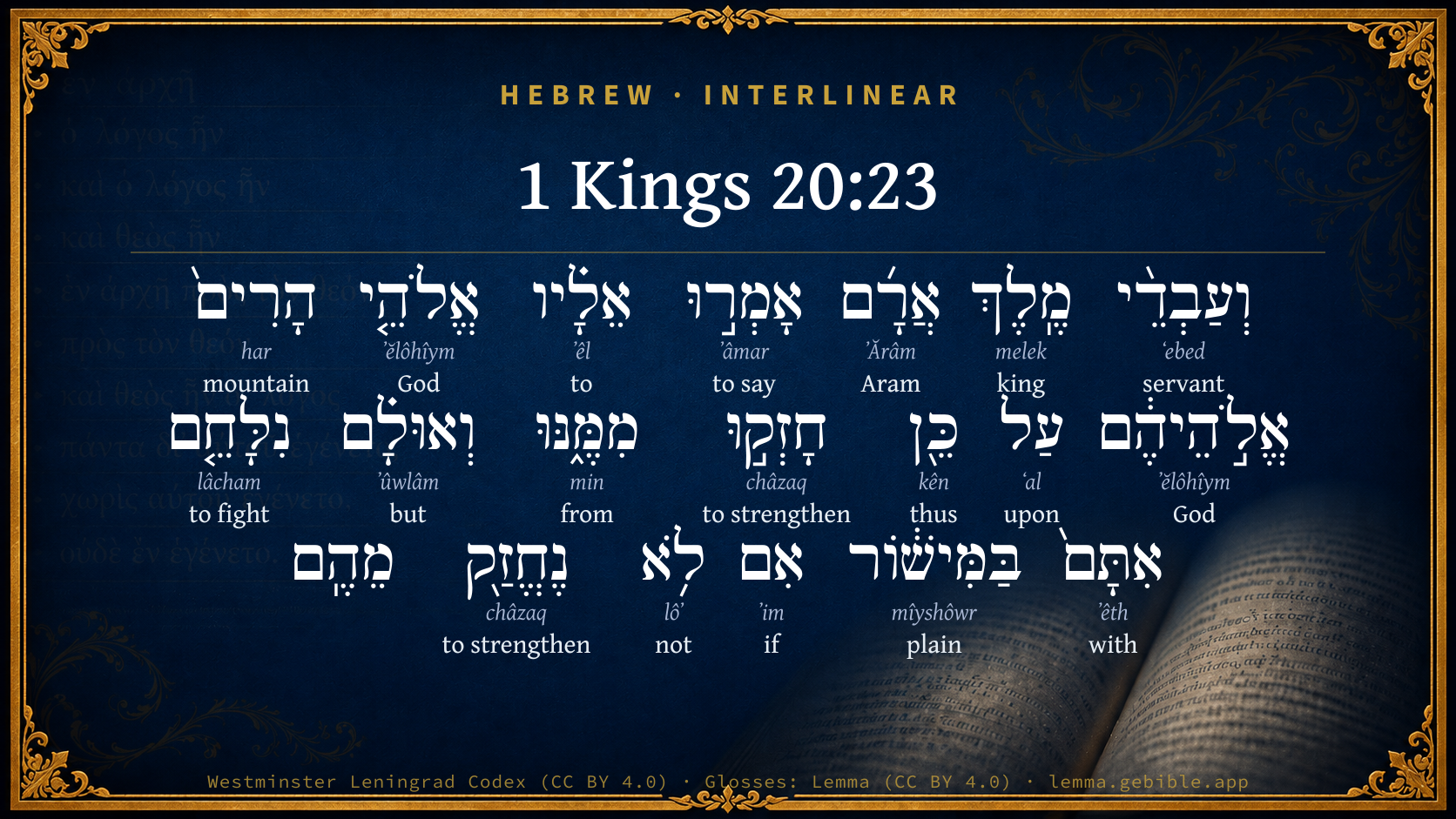
1 Kings 20:23

Hebrew (Westminster Leningrad Codex) 1 Kings 20:23 appears in the Hebrew Old Testament. The text above is from the Westminster Leningrad Codex. Each word links to its Strong’s number, a concise gloss, and parsing drawn from the Open Scriptures Hebrew Bible morphology. Click any word for its full Brown-Driver-Briggs (BDB) entry.
Download image
Cite this verse

1 Kings 20:23 (World English Bible). Public Domain. Lemma interlinear Bible study tool, https://lemma.gebible.app/v/1-kings/20/23.

Show BibTeX & RIS
BibTeX
RIS
English Translation
The servants of the king of Syria said to him, Their god is a god of the hills; therefore they were stronger than we: but let us fight against them in the plain, and surely we shall be stronger than they.
World English Bible · Public Domain
Download a study sheet

One document with this verse’s original text, its word-by-word gloss line, the meaning frame, cross-references with their text, attributed commentary, and full source and license credits — printable, and it pastes into notes with its structure intact.

This verse Autodidact and up

Study sheet (.html) Plain text (.txt)

A passage Seminary Student

Up to 50 verses in one chapter. A passage sheet keeps up to 6 commentary sources and 12 cross-references per verse, in the order this page ranks them, and says so on the sheet whenever that leaves anything out. Ask for a single verse and you get the Autodidact verse sheet above.

Everything on this page stays free to read, with no account — the sheet is a download of what is already on screen, not access to it.

Want to remove ads? Support Godless Engineer
Compare translations 3

The same verse in 3 English versions, stacked beneath the original-language interlinear above. Click any original word for its lexicon entry.

Each is an independent rendering of the whole verse — the interlinear is not word-aligned to these translations.

Highlighted words mark where these versions differ — a whole-verse word diff, not a word-by-word alignment.

  • World English Bible Public Domain
    The servants of the king of Syria said to him, Their god is a god of the hills; therefore they were stronger than we: but let us fight against them in the plain, and surely we shall be stronger than they.
  • King James Version Public Domain
    And the servants of the king of Syria said unto him, Their gods are gods of the hills; therefore they were stronger than we; but let us fight against them in the plain, and surely we shall be stronger than they.
  • unfoldingWord Literal Text CC BY-SA 4.0
    And the servants of the king of Aram said to him, “Their gods gods of the hills. Therefore they were stronger than us. But indeed, we shall fight them in the plain, surely we will be stronger than them.

unfoldingWord Literal Text — © unfoldingWord, licensed CC BY-SA 4.0. Word-aligned USFM3 via Door43 (git.door43.org/unfoldingWord/en_ult).

Versions to compare (up to 4)

3 of 4 selected

Show all 18 translations

Every available English version of this verse, each an independent rendering of the whole verse.

  • World English Bible Public Domain
    The servants of the king of Syria said to him, Their god is a god of the hills; therefore they were stronger than we: but let us fight against them in the plain, and surely we shall be stronger than they.
  • Berean Standard Bible Public Domain
    Meanwhile, the servants of the king of Aram said to him, “Their gods are gods of the hills. That is why they prevailed over us. Instead, we should fight them on the plains; surely then we will prevail.
  • Majority Standard Bible Public Domain
    Meanwhile, the servants of the king of Aram said to him, “Their gods are gods of the hills. That is why they prevailed over us. Instead, we should fight them on the plains; surely then we will prevail.
  • King James Version Public Domain
    And the servants of the king of Syria said unto him, Their gods are gods of the hills; therefore they were stronger than we; but let us fight against them in the plain, and surely we shall be stronger than they.
  • American Standard Version (1901) Public Domain
    And the servants of the king of Syria said unto him, Their god is a god of the hills; therefore they were stronger than we: but let us fight against them in the plain, and surely we shall be stronger than they.
  • Revised Version (1885) Public Domain
    And the servants of the king of Syria said unto him, Their god is a god of the hills; therefore they were stronger than we: but let us fight against them in the plain, and surely we shall be stronger than they.
  • Geneva Bible (1599) Public Domain
    Then the seruants of the King of Aram said vnto him, Their gods are gods of the moutaines, and therefore they ouercame vs: but let vs fight against them in the playne, and doubtlesse we shall ouercome them.
  • Douay-Rheims (1899) Public Domain
    But the servants of the king of Syria said to him: Their gods are gods of the hills, therefore they have overcome us: but it is better that we should fight against them in the plains, and we shall overcome them.
  • Young's Literal Translation Public Domain
    And the servants of the king of Aram said unto him, `Gods of hills `are' their gods, therefore they were stronger than we; and yet, we fight with them in the plain -- are we not stronger than they?
  • Literal Standard Version CC BY-SA 4.0
    And the servants of the king of Aram said to him, “Their gods [are] gods of hills, therefore they were stronger than us; and yet, we fight with them in the plain—are we not stronger than they?
  • Unlocked Literal Bible CC BY-SA 4.0
    The servants of the king of Aram said to him, “Their god is a god of the hills. That is why they were stronger than we were. But now let us fight against them in the plain, and surely we will be stronger than they are.
  • unfoldingWord Literal Text CC BY-SA 4.0
    And the servants of the king of Aram said to him, “Their gods gods of the hills. Therefore they were stronger than us. But indeed, we shall fight them in the plain, surely we will be stronger than them.
  • Darby Bible Public Domain
    And the servants of the king of Syria said to him, Their gods are gods of the mountains; therefore they were stronger than we; but if we fight against them on the plateau, shall we not be stronger than they?
  • World Messianic Bible Public Domain
    The servants of the king of Syria said to him, “Their god is a god of the hills; therefore they were stronger than we. But let’s fight against them in the plain, and surely we will be stronger than they.
  • Webster's Bible Public Domain
    And the servants of the king of Syria said to him, Their gods are gods of the hills; therefore they were stronger than we; but let us fight against them in the plain, and surely we shall be stronger than they.
  • Free Bible Version CC BY-SA 4.0
    In the meantime the king of Aram's officers told him, “Their gods are gods of the mountains. That's why they could defeat us. But if we fight them in the lowlands, we can beat them.
  • Bible in Basic English Public Domain
    Then the king of Aram's servants said to him, Their god is a god of the hills; that is why they were stronger than we: but if we make an attack on them in the lowlands, we will certainly be stronger than they.
  • JPS Tanakh (1917) Public Domain
    And the servants of the king of Aram said unto him: 'Their God is a God of the hills; therefore they were stronger than we; but let us fight against them in the plain, and surely we shall be stronger than they.

Literal Standard Version (2020), Covenant Press — licensed CC BY-SA 4.0. Text via the HelloAO Bible API (eBible.org). Unlocked Literal Bible (unfoldingWord) — licensed CC BY-SA 4.0. Text via the HelloAO Bible API (eBible.org). unfoldingWord Literal Text — © unfoldingWord, licensed CC BY-SA 4.0. Word-aligned USFM3 via Door43 (git.door43.org/unfoldingWord/en_ult). Free Bible Version, Dr. Jonathan Gallagher — licensed CC BY-SA 4.0. Text via the HelloAO Bible API (eBible.org).

Word by word

More ways to search: Search by grammar → Find every occurrence → Compare this word →

Practice this passage: Drill this verse → Learn its vocabulary →

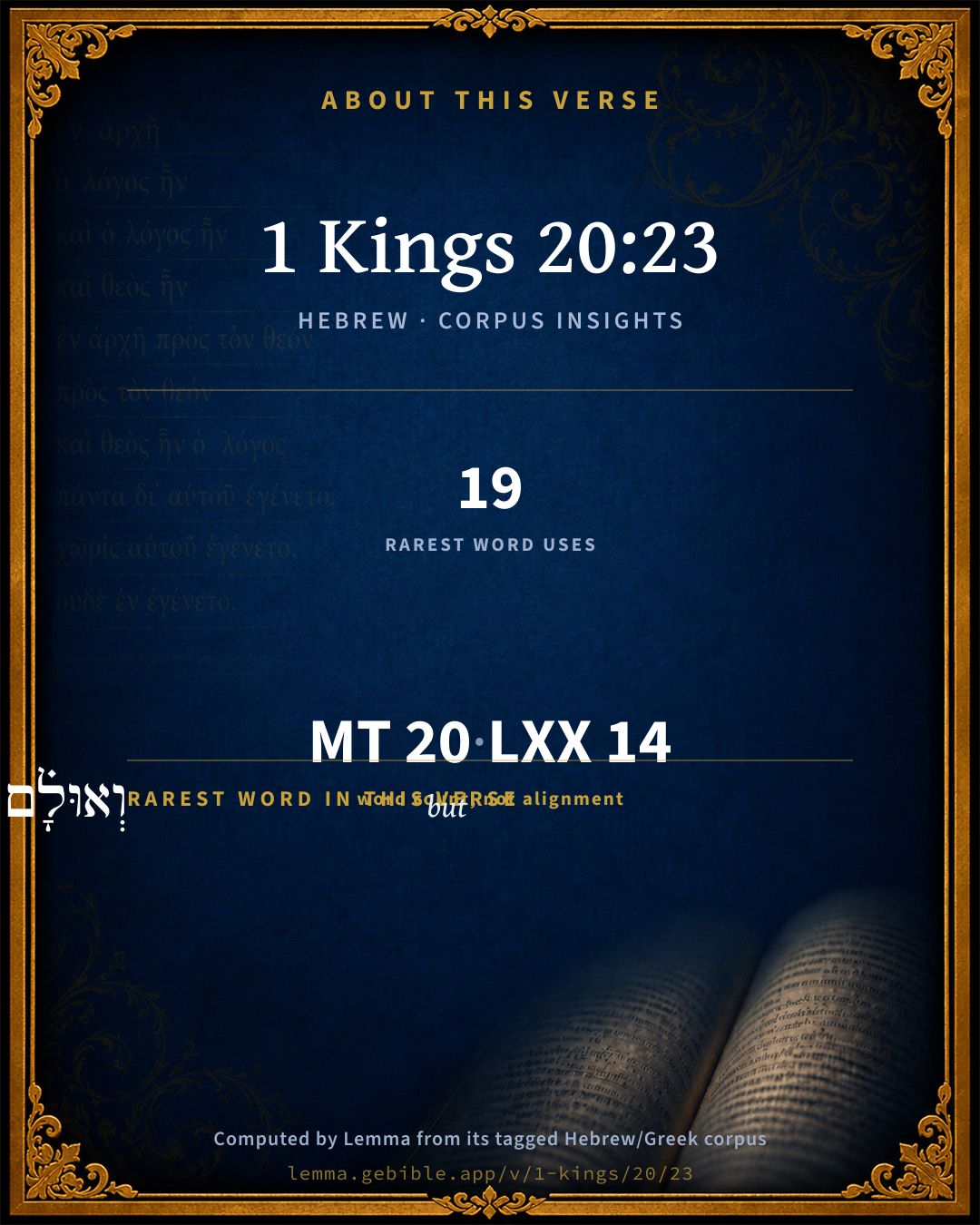
וְאוּלָ֗ם
ʼûwlâm
H199
“and · but”
Conjunction + Adverb
Part of Speech
Conjunction + Adverb
Full BDB Definition

Origin: apparently a variation of H194

TWOT: 47

but, but indeed (a strong adversative) - however, nevertheless
  1. וְעַבְדֵ֨י ʻebed H5650 “and · servants of” Conjunction + Noun, Common, Masculine, Plural, Construct
  2. מֶֽלֶךְ melek H4428 “king of” Noun, Common, Masculine, Singular, Construct
  3. אֲרָ֜ם ʼĂrâm H758 “Aram” Noun, Proper
  4. אָמְר֣וּ ʼâmar H559 “to say” Verb, Qal, Perfect, 3rd Person, Common, Plural
  5. אֵלָ֗יו ʼêl H413 “to · him” Preposition + Suffix, Personal, 3rd Person, Masculine, Singular
  6. אֱלֹהֵ֤י ʼĕlôhîym H430 “God(s) of” Noun, Common, Masculine, Plural, Construct
  7. הָרִים֙ har H2022 “mountains” Noun, Common, Masculine, Plural, Absolute
  8. אֱלֹ֣הֵיהֶ֔ם ʼĕlôhîym H430 “God(s) · their” Noun, Common, Masculine, Plural, Construct + Suffix, Personal, 3rd Person, Masculine, Plural
  9. עַל ʻal H5921 “upon” Preposition
  10. כֵּ֖ן kên H3651 “thus” Particle, Demonstrative
  11. חָזְק֣וּ châzaq H2388 “to strengthen” Verb, Qal, Perfect, 3rd Person, Common, Plural
  12. מִמֶּ֑נּוּ min H4480 “from · us” Preposition + Suffix, Personal, 1st Person, Common, Plural
  13. נִלָּחֵ֤ם lâcham H3898 “to fight” Verb, Niphal, Imperfect, 1st Person, Common, Plural
  14. אִתָּם֙ ʼêth H854 “with · them” Preposition + Suffix, Personal, 3rd Person, Masculine, Plural
  15. בַּמִּישׁ֔וֹר mîyshôwr H4334 “in/at the · plain” Preposition, Determined + Noun, Common, Masculine, Singular, Absolute
  16. אִם ʼim H518 “if” Conjunction
  17. לֹ֥א lôʼ H3808 “not” Particle, Negative
  18. נֶחֱזַ֖ק châzaq H2388 “to strengthen” Verb, Qal, Imperfect, 1st Person, Common, Plural

About this verse

These counts appear in no published source. They are computed here, from the morphology-tagged text and Lemma’s own curated glosses. What Lemma adds →

20
words
17
distinct lemmas
Historical
section

Notable vocabulary

The rarest word here is וְאוּלָ֗ם but H199 — appearing just 19 times in the whole Hebrew Bible.

Shared distinctive vocabulary

וְאוּלָ֗ם but H199 occurs in 19 verses of the Hebrew Bible. Also found in:

Grammatical profile

  • 4 verbs
  • 7 nouns
  • 5 prepositions
  • 1 conjunction
  • 1 adverb
  • 2 particles

Verb forms

  • אָמְר֣וּ Qal · Perfect
  • חָזְק֣וּ Qal · Perfect
  • נִלָּחֵ֤ם Niphal · Imperfect
  • נֶחֱזַ֖ק Qal · Imperfect

Repetition

Words recur within this verse — often emphatic in Hebrew:

  • אֱלֹהֵ֤י God H430 ×2
  • חָזְק֣וּ to strengthen H2388 ×2

Hebrew & Septuagint length

In English translation the verse runs 41 words from the Hebrew and 17 from the Septuagint (LXX English) — the Septuagint runs noticeably shorter here. See the side-by-side →

A rough comparison of the two English renderings, which tokenize alike — not a word-level alignment.

Word counts can differ between the Hebrew and the Greek without any difference in meaning — e.g. the Hebrew direct-object marker אֵת has no separate Greek word, and Greek often adds the article ὁ.

In the original languages it is 20 Hebrew tokens and 14 Greek tokens — but the two are counted differently (Hebrew bundles its prefixes and suffixes into one token; the Greek is in lemma form), so that isn’t a like-for-like length.

Cross-references

9

Topical passages linked to 1 Kings 20:23 in the Treasury of Scripture Knowledge — connected by theme and wording, ordered by reader-vote popularity; previews shown in the World English Bible.

  • 1 Kings 14:23 For they also built them high places, and pillars, and Asherim, on every high hill, and under every green tree;
  • 1 Samuel 4:8 Woe to us! who shall deliver us out of the hand of these mighty gods? these are the gods that struck the Egyptians with all manner of plagues in the wilderness.
  • 1 Kings 20:28 A man of God came near and spoke to the king of Israel, and said, Thus says Yahweh, Because the Syrians have said, Yahweh is a god of the hills, but he is not a god of the valleys; therefore will I deliver all this great multitude into your hand, and you shall know that I am Yahweh.
  • 2 Kings 19:12 Have the gods of the nations delivered them, which my fathers have destroyed, Gozan, and Haran, and Rezeph, and the children of Eden that were in Telassar?
  • 2 Chronicles 32:13–19 Don't you know what I and my fathers have done to all the peoples of the lands? Were the gods of the nations of the lands in any wise able to deliver their land out of my hand?
  • Psalms 50:21–22 You have done these things, and I kept silent. You thought that the "I AM" was just like you. I will rebuke you, and accuse you in front of your eyes.
  • Isaiah 42:8 I am Yahweh, that is my name; and my glory will I not give to another, neither my praise to engraved images.
  • Romans 1:21–23 Because, knowing God, they didn't glorify him as God, neither gave thanks, but became vain in their reasoning, and their senseless heart was darkened.
  • Psalms 121:1–2 I will lift up my eyes to the hills. Where does my help come from?

Cross-references courtesy of OpenBible.info (CC BY 4.0).

Hebrew and Greek witnesses Masoretic Hebrew ↔ Greek Septuagint

The same verse in the two great witnesses to the Old Testament, shown verse-for-verse.

Here the Septuagint runs noticeably shorter than the Hebrew — LXX2012 (modern English Septuagint) 17 words vs World English Bible 41. A rough length comparison of the two English translations, not a word-level alignment — read both below.

These are two independent witnesses, not word-aligned to each other, and the Septuagint is shown in lemma (dictionary) form.

Hebrew 1 Kings 20:23 Masoretic · Westminster Leningrad Codex

וְעַבְדֵ֨י מֶֽלֶךְ אֲרָ֜ם אָמְר֣וּ אֵלָ֗יו אֱלֹהֵ֤י הָרִים֙ אֱלֹ֣הֵיהֶ֔ם עַל כֵּ֖ן חָזְק֣וּ מִמֶּ֑נּוּ וְאוּלָ֗ם נִלָּחֵ֤ם אִתָּם֙ בַּמִּישׁ֔וֹר אִם לֹ֥א נֶחֱזַ֖ק מֵהֶֽם

The servants of the king of Syria said to him, Their god is a god of the hills; therefore they were stronger than we: but let us fight against them in the plain, and surely we shall be stronger than they.

World English Bible · Public Domain

Greek LXX 1 Kings 20:23 Septuagint · lemma form

καί ὁ ιεζαβελ λαλέω κύριος λέγω ὁ κύων καταἐσθίω αὐτός ἐν ὁ προτείχισμα ιεζραελ

And the Lord spoke of Jezabel, saying, The dogs shall devour her within the fortification of Jezrael.

LXX2012 (modern English Septuagint) · Public Domain

On this verse, The Cambridge Bible for Schools and Colleges discusses the Septuagint’s reading. Read the note in Commentary ↓

Hebrew: Westminster Leningrad Codex (CC BY 4.0). Greek: Septuagint (public domain); English from LXX2012 (modern English Septuagint) (Public Domain). How the Septuagint differs from the Hebrew →

Targum (Aramaic paraphrase)

1

The Targum is the ancient Jewish Aramaic paraphrase of the Hebrew Scriptures — an interpretive translation, not the Hebrew text itself. Onkelos (literal) and Pseudo-Jonathan (expansive) render the Torah, and Jonathan the Prophets. Coverage is partial: where no permissively-licensed English translation exists for a verse, only the Aramaic is shown. This is verse-level text, not a word-by-word alignment to the Hebrew.

  1. Targum Jonathan Prophets (Joshua–Malachi)
    וְעַבְדֵי מַלְכָּא דַאֲרָם אֲמַרוּ לֵיהּ אֱלָהָא דְשַׁלִיט עַל טוּרַיָא אֱלָהָהוֹן עַל כֵּן תַּקִיפוּ מִנָנָא וּבְרַם נַגִיחַ עִמְהוֹן בְּמֵישְׁרָא אִם לָא נִתְקֵיף מִנְהוֹן:

    (no public-domain English translation for this verse)

    Targum Jonathan — Aramaic: “Mikraot Gedolot” (public domain). English: “Sefaria Community Translation” (CC0 1.0 (public-domain dedication)); “London "Chaldee Paraphrase," 1871” (public domain). Text via Sefaria.

Commentary

Notes on 1 Kings 20:23 from classic Christian and Jewish commentators (each source and its license shown beneath its notes). The classic Christian expositions comment on the surrounding passage and are grouped to its opening verse, so a note may address several verses; the Jewish commentaries on the Tanakh (Rashi and others) are per-verse, so they appear only where the commentator wrote on this verse.

Lemma curates 59 commentaries, every one of them public domain or Creative Commons licensed, each selected and text-cleaned for this edition rather than reprinted as found. About our sources →

Trapp's Complete Commentary

John Trapp

1Ki 20:23 And the servants of the king of Syria said unto him, Their gods [are] gods of the hills; therefore they were stronger than we; but let us fight against them in the plain, and surely we shall be stronger than they.

Ver. 23. And the servants of the king of Syria said unto him.] Nothing they said to him of his drunkenness, or their own dastardliness; but tell him a tale of their tutelary gods, that they were gods of the plains and valleys only, not of the mountains, as the Israelites’ gods were: and hence the miscarriage Augustine {a} telleth us of the Romans, that for the hill tops they had their deum Iugatinum; for their little hills, the goddess Collatina; and for the valleys, Valloma. Ovid also brings in those petty deities thus speaking,

“ Dii sumus agrestes, et qui dominantur in altis

Montibus; Imperium est in sua tecta Iovi. ” - Ovid, Fastor., lib. vi.

{a} De Civ. Dei, lib. iv, cap. 8.

John Trapp, A Commentary or Exposition upon All the Books of the Old and New Testament (1647–1656) — public domain. Text from a community e-Sword module.

Joseph Benson's Commentary

1Ki 20:23. Their gods are gods of the hills, &c. — The heathen, in general, had no notion of the God of the universe, but only worshipped local and tutelary deities; who, they thought, ruled over particular countries, and distributed the several parts of those countries among them, some being gods of the woods, others of the rivers, and others of the mountains: and the Syrians fancied the gods of the Israelites, whom they thought to be no better than their own gods, to be of the latter kind, gods of the hills, because the land of Canaan was a mountainous land, and the great temple of their God, at Jerusalem, stood upon a hill, as did the city of Samaria, where they had received their last blow; or because the Israelites did generally choose high places for the places of their worship. It is observable, that the Syrians do not impute their ill success to their negligence, and drunkenness, and bad conduct, nor to the valour of the Israelites, but to a divine power, which was indeed visible in it. Let us fight against them in the plain — In this counsel there was not only superstition, but policy; because the Syrians excelled the Israelites in horses and chariots, which were most serviceable on plain ground.

Joseph Benson's Commentary on the Old and New Testaments (1811–1818) — public domain. Text from a community e-Sword module.

Keil & Delitzsch

C. F. Keil & F. Delitzsch

The Second Victory. - Kg1 20:23, Kg1 20:24. The servants (ministers) of Benhadad persuaded their lord to enter upon a fresh campaign, attributing the defeat they had sustained to two causes, which could be set aside, viz., to the supposed nature of the gods of Israel, and to the position occupied by the vassal-kings in the army. The gods of Israel were mountain gods: when fighting with them upon the mountains, the Syrians had had to fight against and succumb to the power of these gods, whereas on the plain they would conquer, because the power of these gods did not reach so far. This notion concerning the God of Israel the Syrians drew, according to their ethnical religious ideas, from the fact that the sacred places of this God - not only the temple at Jerusalem upon Moriah, but also the altars of the high places - were erected upon mountains; since heathenism really had its mountain deities, i.e., believed in gods who lived upon mountains and protected and conducted all that took place upon them (cf. Dougtaei Analect. ss. i. 178,179; Deyling, Observv. ss. iii. pp. 97ff.; Winer, bibl. R. W. i. p. 154), and in Syrophoenicia even mountains themselves had divine honours paid to them (vid., Movers, Phniz. i. p. 667ff.). The servants of Benhadad were at any rate so far right, that they attributed their defeat to the assistance which God had given to His people Israel; and were only wrong in regarding the God of Israel as a local deity, whose power did not extend beyond the mountains. They also advised their lord (Kg1 20:24) to remove the kings in his army from their position, and appoint governors in their stead (פּחות, see Kg1 10:15). The vassal-kings had most likely not shown the desired self-sacrifice for the cause of their superior in the war. And, lastly (Kg1 20:25), they advised the king to raise his army to its former strength, and then carry on the war in the plain. "Number thyself an army, like the army which has fallen from thee." מאותך, "from with thee," rendered correctly de tuis in the Vulgate, at least so far as the sense is concerned (for the form see Ewald, 264, b.). But these prudently-devised measures were to be of no avail to the Syrians; for they were to learn that the God of Israel was not a limited mountain-god.

Keil & Delitzsch — Biblical Commentary on the Old Testament (1861–1891) — public domain (CC PDM 1.0). Text via the HelloAO Bible API. (Old Testament only.)

Tyndale Open Study Notes

Tyndale Open Resources

20:23 The reasoning that Israel had gods of the hills set the stage for the Lord to show his true identity (20:28). Ben-hadad’s officers had a pagan religious outlook. Perhaps their erroneous view was fostered by traditional knowledge of the Lord’s appearance to Israel on Mount Sinai (Exod 19:1-3, 16-18) or of Israel’s long-term settlement of the hill country of Canaan (see Josh 10:40; 11:16; Judg 1:19). The Arameans were not aware that God is the Creator and Lord of all the earth (Isa 40:28; 54:5), the only God who alone can save (Isa 45:5, 22).

Tyndale Open Study Notes — © Tyndale Open Resources, licensed CC BY-SA 4.0. Text via the HelloAO Bible API.

Geneva Bible (1599)

Geneva Bible translators

Thus the wicked blaspheme God in their fury, whom notwithstanding he suffereth not unpunished.

Geneva Bible (1599) marginal notes — public domain. Text via Bolls.life.

Adam Clarke's Commentary

Verse 23. Their gods are gods of the hills] It is very likely that the small Israelitish army availed itself of the heights and uneven ground, that they might fight with greater advantage against the Syrian cavalry, for Ben-hadad came up against Samaria with horses and chariots, 1Kg 20:1. These therefore must be soon thrown into confusion when charging in such circumstances; indeed, the chariots must be nearly useless.

Let us fight against them in the plain] There our horses and chariots will all be able to bear on the enemy, and there their gods, whose influence is confined to the hills, will not be able to help them. It was a general belief in the heathen world that each district had its tutelary and protecting deity, who could do nothing out of his own sphere.

Adam Clarke's Commentary on the Bible (1810–1826) — public domain. Text from a community e-Sword/MySword module.

Ellicott's Commentary for English Readers

(23) Gods of the hills.—The idea of tutelary gods, whose strength was greatest on their own soil, is naturally common in polytheistic religions, which, by the very multiplication of gods, imply limitation of the power of each. Now the greater part of the territory where Jehovah was worshipped was a hill-country. Samaria in particular, the scene of recent defeat, lay in the mountain region of Ephraim. The Israelite armies, moreover, being mostly of infantry—having, indeed, few or no cavalry, except in the time of Solomon—naturally encamped and fought, as far as possible, on the hills; as Barak on Mount Tabor (Jdg_4:6-14), Saul on Mount Gilboa (1Sa_31:1), and Ahab himself (in 1Ki_20:27). Perhaps the worship of Jehovah in the “high places” may have also conduced to this belief that the “gods of Israel were gods of the hills,” whose power vanished in the plains; where, of course, the Syrian armies of chariots and horsemen would naturally fight at advantage. Shrewd policy might, as so often is the case, lurk in the advice of Ben-hadad’s counsellors under the cover of superstition; as, indeed, it seems also to show itself in seizing the opportunity to increase the central power, by organising the troops of the tributary kings under officers of his own.

A Bible Commentary for English Readers, edited by Charles John Ellicott (1878–1897) — public domain. Text from a community e-Sword module.

The Cambridge Bible for Schools and Colleges

gen. ed. J. J. S. Perowne

23. their gods are gods] R.V. their god is a god. The LXX. also renders by the singular. The Syrians would speak of the God of Israel as a national divinity, just as they would of their own god. The former battle had been fought in the hill country round about Samaria, and this may have given encouragement to the idea that in a level plain, like that in which their own Damascus lay, the Syrian forces would meet with more success. It was not unnatural, in the heathen ideas about the gods, that they should consider each divinity specially able, and suited, to protect the land over which he was supposed to have the charge.

The Cambridge Bible for Schools and Colleges (gen. ed. J. J. S. Perowne; Cambridge University Press, 1878–1918) — public domain. Text from a community e-Sword module.

John Gill's Exposition

And the servants of the king of Syria said unto him,.... His ministers of state, his privy counsellors:

their gods are gods of the hills, therefore they were stronger than we; and beat them in the last battle; this notion they might receive from what they had heard of Jehovah delivering the law on Mount Sinai to Moses, and of the miraculous things done lately on Mount Carmel, as well as of their worship being in high places, especially at Jerusalem, the temple there being built on an hill, as was Samaria itself, near to which they had their last defeat; and this notion of topical deities very much obtained among the Heathens in later times, some of which they supposed presided over rivers, others over woods, and others over hills and mountains (e): so Nemestinus the god of woods, Collina the goddess of hills, and Vallina of valleys (f); and Arnobins (g) makes mention of the god Montinus, and Livy (h) of the god Peninus, who had his name from a part of the Alps, so called where he was worshipped; and there also the goddess Penina was worshipped; and Lactantius (i) speaks of the gods of the mountains the mother of Maximilian was a worshipper of; and even Jupiter had names from mountains, as Olympius, Capitolinus, &c. and such was the great god Pan, called mountainous Pan (k):

but let us fight against them in the plain, and surely we shall be stronger than they; and prevail over them, and conquer them.

(e) "Dii fumus agrestes, et qui dominemur in altis montibus.----" Ovid. Fast. l. 3. (f) Vid. D. Herbert de Cherbury de Relig. Gent. c. 12. p. 198, 112. (g) Adv. Gentes, l. 4. (h) Hist. l. 21. c. 38. (i) De Mort. Persecutor. c. 11. p. 22. Vid. Ovid. Metamorph. l. 1. Fab. 8. ver. 320. "Et numina montis adorant". See Ep. 4. ver. 171. (k) Sophoclis Oedipus Tyr. ver. 1110.

John Gill's Exposition of the Whole Bible (1746–1763) — public domain (CC PDM 1.0). Text via the HelloAO Bible API.

Albert Barnes' Notes on the Bible

Their gods are gods of the hills - The local power and influence of deities was a fixed principle of the ancient polytheism. Each country was considered to have its own gods; and wars were regarded as being to a great extent struggles between the gods of the nations engaged in them. This is apparent throughout the Assyrian inscriptions. Compare also 2Ki 18:33-35; 2Ki 19:12. The present passage gives an unusual modification of this view. The suggestion of the Syrian chiefs may have been a mere politic device - they being really anxious, “an military grounds,” to encounter their enemy on the plain, where alone their chariots would be of much service. In the plain the Israelites had always fought at a disadvantage, and had proved themselves weaker than on the hills (see Jdg 1:19, Jdg 1:27, Jdg 1:34).

Albert Barnes' Notes on the Bible (1834–1885) — public domain. Text from a community e-Sword/MySword module.

Haydock's Catholic Bible Commentary

Hills. All the high places of Israel were covered with idols. Samaria, Bethel, Dan, &c., were built on eminences. (Menochius) --- Altars had also been erected to the true God on the most famous mountains. The law had been given at Sinai, and promulgated at Garizim. The late miracle at Carmel was known to all. Hence the pagans, (Calmet) conformably to their notions of assigning different parts of the creation to different gods, suspected that the god of Israel might preside only over the mountains. (Haydock) --- People are always ready to blame any but themselves. (Calmet) --- They lay the fault on fortune, &c. (Tirinus) --- The pride of Benadad could not bear to be told that his own temerity had brought on the defeat. (Haydock)

George Leo Haydock (1774–1849), Haydock's Catholic Family Bible and Commentary, 1859 edition — public domain. Excludes Psalms (Douay-Rheims chapter numbering differs from Protestant) and Deuterocanonical books (Catholic canon only).

Matthew Poole's English Annotations

The servants of the king of Syria suppose that their gods were no better than the Syrian gods, (which the idolatry of the Israelites had given them too great cause to imagine,) and that there were many gods who had each his particular charge and jurisdiction; which was the opinion of all heathen nations, that some were gods of the woods, others of the rivers, and others of the mountains; and they fancied these to be the latter, because the land of Canaan was a mountainous land, Deu 12:2; and the great temple of their god at Jerusalem stood upon a hill, and so did Samaria, where they had received their last blow: or because the Israelites did generally chose high places for the worship of their gods. It is observable that they do not impute their ill success to their negligence, and drunkenness, and bad conduct, or cowardice, of which they were really guilty; nor to the valour of the Israelites; but to a Divine power, which indeed was visible in it.

Let us fight against them in the plain; wherein there was not only superstition, but policy, because the Syrians most excelled the Israelites in horses, which are most serviceable in plain ground.

Matthew Poole's English Annotations on the Holy Bible (1683–1685) — public domain. Text from a community e-Sword/MySword module.

Whedon's Commentary on the Bible

Daniel D. Whedon

23. Their gods are gods of the hills — They speak after the manner of idolaters, and show their polytheistic notions of religion. They, perhaps, knew something of Israel’s receiving the law at Mount Sinai, and of the temple on Mount Moriah at Jerusalem and of the recent miracle on Mount Carmel, and had noticed the worship on the high places: and now, on their overwhelming defeat among the mountains of Samaria, they attribute the loss chiefly to those gods of the hills whom Israel worshipped. The heathen also had hill gods, and it seems to have been a prevalent belief that each district had its tutelary divinities. Compare 2Ki_17:26.

Daniel D. Whedon (gen. ed.), Commentary on the Old and New Testaments (1874–1909) — public domain. Text from a community e-Sword module.

The Pulpit Commentary

And the servants of the king of Syria said unto him naturally anxious to retrieve their character and obliterate their disgrace, Their gods are gods of the hills All pagan nations have believed in local deities, Dii montium, dii nemorum, etc.. (see 2Ki_18:33-35 2Ki_19:12, 2Ki_19:13) Keil accounts for this belief that the gods of Israel were mountain divinities, by the consideration that the temple was built on Mount Moriah, and that worship was always offered on high places." Kitto reminds us that the law was given from Mount Sinai, and that fire had recently descended on Mount Carmel. "In Syrophoenicia, even mountains themselves had Divine honours paid to them" (Movers, Phoen. 1:667 sqq.) But it is enough to remember that Samaria was a hilly district, and that the courtiers must find some excuse for the defeat; therefore they were stronger than we; but Heb. ( often well rendered but not in this instance) by the LXX ouj mhn de let us fight against them in the plain, and surely we shall be stronger than they. This counsel, which apparently rests on religious grounds alone, was, it is probable, really dictated by the practical consideration that in the plain the Syrians would be able to deploy their chariots a most important arm of their service in a way which they could not do in the valleys round Samaria. See 1Ki_16:24, note. Moreover the Israelites would lose the advantage of a strong position and the cover of their fortifications if they could be induced to meet them in the "great plain," or on any similar battlefield.

Their gods are gods of the hills." It is no uncommon thing to find men laying the blame of their misfortune on God. We smile at those poor pagans who beat their wooden gods with sticks, or those Italian villagers who, s few weeks ago (Sept., 1881), threw the image of their patron saint into a well, and set upon their parish priest, because their prayers for rain remained unanswered; but the same thing, slightly varied in shape, is often done amongst ourselves. "Bad luck" is held responsible for many of the failures for which we have only ourselves to thank. That "everybody is against him" is often the cry of the man who has no enemy but himself. The idle scoundrel who has wife and children generally accuses them of being the causes of his misfortunes; if he has no such scapegoats, he will lay the blame on God"s providence. He never remembers that he himself was "drinking himself drunk" at the hour for action.

The Pulpit Commentary (1880–1919), ed. H.D.M. Spence-Jones & Joseph S. Exell — public domain. Text from a community e-Sword module.

John Wesley's Explanatory Notes

Said to him - They suppose that their gods were no better than the Syrian gods and that there were many gods who had each his particular charge and jurisdiction; which was the opinion of all heathen nations; that some were gods of the woods, other of the rivers, and others of the mountains; and they fancied these to be the latter, because the land of Canaan was a mountainous land, and the great temple of their God at Jerusalem, stood upon an hill, and so did Samaria, where they had received their last blow: it is observable, they do not impute their ill success to their negligence, and drunkenness, and bad conduct, nor to the valour of the Israelites; but to a divine power, which was indeed visible in it. In the plain - Wherein there was not only superstition, but policy; because the Syrians excelled the Israelites in horses, which are most serviceable in plain ground.

John Wesley, Explanatory Notes Upon the Whole Bible (1754–1765) — public domain. Text via the GEBible commentary corpus.

Lesson kit

Teaching starters — assembled from the data on this page, not authored interpretation. Every prompt links to the verse data it draws on. Edit before teaching.

1 Kings, in the Historical, opens this verse with 20 words (17 distinct Hebrew lemmas). Its most distinctive word is ʼûwlâm (“but”). The Greek Septuagint runs shorter here. A historical commentator’s framing appears above. Read the whole chapter for the surrounding context.

Discussion questions

  1. The word ʼûwlâm carries the sense “but.” How does it shape the verse?
  2. Genesis 28:19 shares the word «but» with this verse. How do the two illuminate each other?
  3. “God” occurs 2× in this one verse. What is the effect of the repetition?
  4. Compared with the Hebrew, the Septuagint runs shorter here. What questions does that raise?
  5. These translations render this verse differently. What is at stake in choosing one wording over another?
  6. The verb «אָמְר֣וּ» is Qal Perfect. How does its form color the action?
  7. Reading how Trapp's Complete Commentary and Joseph Benson's Commentary read this verse, where do the two commentators agree and where do they part?

Things to notice

Reading settings

Reading text

Shown beneath each verse's original-language words.

Old Testament
Old Testament edition

Read the OT as the Masoretic Hebrew (MT) or the Greek Septuagint (LXX).

English shown for the Greek Septuagint (in the Hebrew ↔ Greek comparison).

Comparing translations? Open the Compare panel on any verse page to stack up to four side by side.