
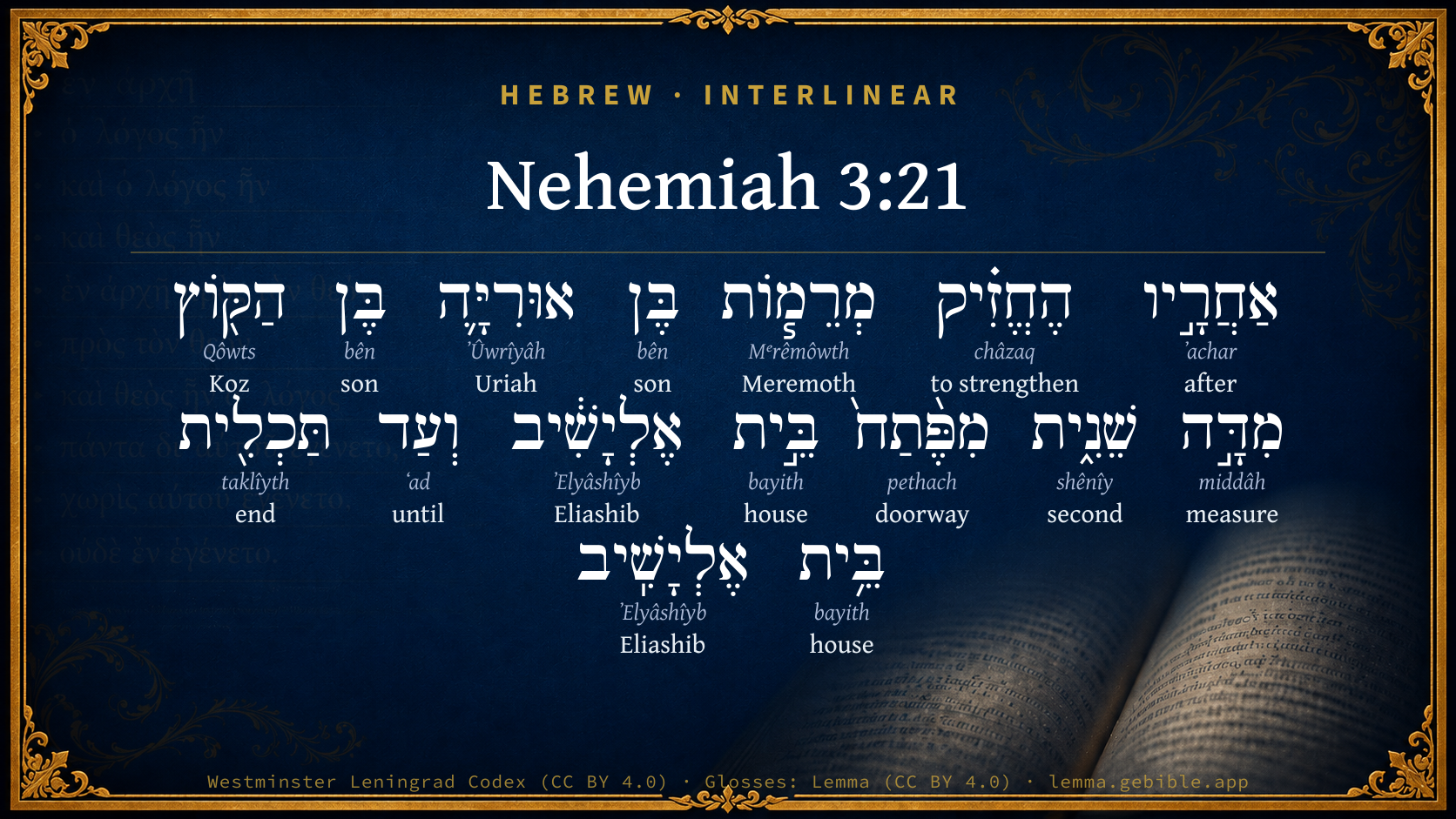
Nehemiah 3:21

Hebrew (Westminster Leningrad Codex) Nehemiah 3:21 appears in the Hebrew Old Testament. The text above is from the Westminster Leningrad Codex. Each word links to its Strong’s number, a concise gloss, and parsing drawn from the Open Scriptures Hebrew Bible morphology. Click any word for its full Brown-Driver-Briggs (BDB) entry.
Download image
Cite this verse

Nehemiah 3:21 (World English Bible). Public Domain. Lemma interlinear Bible study tool, https://lemma.gebible.app/v/nehemiah/3/21.

Show BibTeX & RIS
BibTeX
RIS
English Translation
After him repaired Meremoth the son of Uriah the son of Hakkoz another portion, from the door of the house of Eliashib even to the end of the house of Eliashib.
World English Bible · Public Domain
Highlights
  • 1 first appearance in the Hebrew Bible
Full analysis ↓
Download a study sheet

One document with this verse’s original text, its word-by-word gloss line, the meaning frame, cross-references with their text, attributed commentary, and full source and license credits — printable, and it pastes into notes with its structure intact.

This verse Autodidact and up

Study sheet (.html) Plain text (.txt)

A passage Seminary Student

Up to 50 verses in one chapter. A passage sheet keeps up to 6 commentary sources and 12 cross-references per verse, in the order this page ranks them, and says so on the sheet whenever that leaves anything out. Ask for a single verse and you get the Autodidact verse sheet above.

Everything on this page stays free to read, with no account — the sheet is a download of what is already on screen, not access to it.

Want to remove ads? Support Godless Engineer
Compare translations 3

The same verse in 3 English versions, stacked beneath the original-language interlinear above. Click any original word for its lexicon entry.

Each is an independent rendering of the whole verse — the interlinear is not word-aligned to these translations.

Highlighted words mark where these versions differ — a whole-verse word diff, not a word-by-word alignment.

  • World English Bible Public Domain
    After him repaired Meremoth the son of Uriah the son of Hakkoz another portion, from the door of the house of Eliashib even to the end of the house of Eliashib.
  • King James Version Public Domain
    After him repaired Meremoth the son of Urijah the son of Koz another piece, from the door of the house of Eliashib even to the end of the house of Eliashib.
  • unfoldingWord Literal Text CC BY-SA 4.0
    After him, Meremoth, the son of Uriah, the son of Hakkoz, strengthened a second section, from the opening of the house of Eliashib even as far as the end of the house of Eliashib.

unfoldingWord Literal Text — © unfoldingWord, licensed CC BY-SA 4.0. Word-aligned USFM3 via Door43 (git.door43.org/unfoldingWord/en_ult).

Versions to compare (up to 4)

3 of 4 selected

Show all 18 translations

Every available English version of this verse, each an independent rendering of the whole verse.

  • World English Bible Public Domain
    After him repaired Meremoth the son of Uriah the son of Hakkoz another portion, from the door of the house of Eliashib even to the end of the house of Eliashib.
  • Berean Standard Bible Public Domain
    Next to him, Meremoth son of Uriah, the son of Hakkoz, repaired another section, from the doorway of the house of Eliashib to the end of the house.
  • Majority Standard Bible Public Domain
    Next to him, Meremoth son of Uriah, the son of Hakkoz, repaired another section, from the doorway of the house of Eliashib to the end of the house.
  • King James Version Public Domain
    After him repaired Meremoth the son of Urijah the son of Koz another piece, from the door of the house of Eliashib even to the end of the house of Eliashib.
  • American Standard Version (1901) Public Domain
    After him repaired Meremoth the son of Uriah the son of Hakkoz another portion, from the door of the house of Eliashib even to the end of the house of Eliashib.
  • Revised Version (1885) Public Domain
    After him repaired Meremoth the son of Uriah the son of Hakkoz another portion, from the door of the house of Eliashib even to the end of the house of Eliashib.
  • Geneva Bible (1599) Public Domain
    After him fortified Merimoth, the sonne of Vriiah, the sonne of Hakkoz, another portion from the doore of the house of Eliashib, euen as long as the house of Eliashib extended.
  • Douay-Rheims (1899) Public Domain
    After him Merimuth the son of Urias the son of Haccus, built another measure, from the door of the house of Eliasib, to the end of the house of Eliasib.
  • Young's Literal Translation Public Domain
    After him hath Meremoth son of Urijah, son of Koz, strengthened, a second measure, from the opening of the house of Eliashib even unto the completion of the house of Eliashib.
  • Literal Standard Version CC BY-SA 4.0
    After him Meremoth son of Urijah, son of Koz, has strengthened a second measure, from the opening of the house of Eliashib even to the completion of the house of Eliashib.
  • Unlocked Literal Bible CC BY-SA 4.0
    After him Meremoth son of Uriah son of Hakkoz repaired another section, from the door of the house of Eliashib to the end of the house of Eliashib.
  • unfoldingWord Literal Text CC BY-SA 4.0
    After him, Meremoth, the son of Uriah, the son of Hakkoz, strengthened a second section, from the opening of the house of Eliashib even as far as the end of the house of Eliashib.
  • Darby Bible Public Domain
    After him repaired Meremoth the son of Urijah, the son of Koz, another piece, from the door of the house of Eliashib as far as the end of the house of Eliashib.
  • World Messianic Bible Public Domain
    After him, Meremoth the son of Uriah the son of Hakkoz repaired another portion, from the door of the house of Eliashib even to the end of the house of Eliashib.
  • Webster's Bible Public Domain
    After him repaired Meremoth the son of Urijah the son of Koz another piece, from the door of the house of Eliashib, even to the end of the house of Eliashib.
  • Free Bible Version CC BY-SA 4.0
    Next was Meremoth, son of Uriah, son of Hakkoz, who repaired another section, from the entrance of Eliashib the high priest's house to its end.
  • Bible in Basic English Public Domain
    After him Meremoth, the son of Uriah, the son of Hakkoz, was working on another part, from the door of the house of Eliashib as far as the end of his house.
  • JPS Tanakh (1917) Public Domain
    After him repaired Meremoth the son of Uriah the son of Hakkoz another portion, from the door of the house of Eliashib even to the end of the house of Eliashib.

Literal Standard Version (2020), Covenant Press — licensed CC BY-SA 4.0. Text via the HelloAO Bible API (eBible.org). Unlocked Literal Bible (unfoldingWord) — licensed CC BY-SA 4.0. Text via the HelloAO Bible API (eBible.org). unfoldingWord Literal Text — © unfoldingWord, licensed CC BY-SA 4.0. Word-aligned USFM3 via Door43 (git.door43.org/unfoldingWord/en_ult). Free Bible Version, Dr. Jonathan Gallagher — licensed CC BY-SA 4.0. Text via the HelloAO Bible API (eBible.org).

Word by word

More ways to search: Search by grammar → Find every occurrence → Compare this word →

Practice this passage: Drill this verse → Learn its vocabulary →

תַּכְלִ֖ית
taklîyth
H8503
“end of”
Noun, Common, Feminine, Singular, Construct
Part of Speech
Noun
Type
Common
Gender
Feminine
Number
Singular
State
Construct
Full BDB Definition

Origin: from H3615

TWOT: 982f

end, perfection, consummation, completion, completeness - end - completeness
  1. אַחֲרָ֣יו ʼachar H310 “after · him” Preposition + Suffix, Personal, 3rd Person, Masculine, Singular
  2. הֶחֱזִ֗יק châzaq H2388 “to strengthen” Verb, Hiphil, Perfect, 3rd Person, Masculine, Singular
  3. מְרֵמ֧וֹת Mᵉrêmôwth H4822 “Meremoth” Noun, Proper
  4. בֶּן bên H1121 “son of” Noun, Common, Masculine, Singular, Construct
  5. אוּרִיָּ֛ה ʼÛwrîyâh H223 “Uriah” Noun, Proper
  6. בֶּן bên H1121 “son of” Noun, Common, Masculine, Singular, Construct
  7. הַקּ֖וֹץ Qôwts H6976 “Koz” Noun, Proper
  8. מִדָּ֣ה middâh H4060 “measure” Noun, Common, Feminine, Singular, Absolute
  9. שֵׁנִ֑ית shênîy H8145 “second” Adjective, Ordinal number, Feminine, Singular, Absolute
  10. מִפֶּ֨תַח֙ pethach H6607 “from · doorway of” Preposition + Noun, Common, Masculine, Singular, Construct
  11. בֵּ֣ית bayith H1004 “house of” Noun, Common, Masculine, Singular, Construct
  12. אֶלְיָשִׁ֔יב ʼElyâshîyb H475 “Eliashib” Noun, Proper
  13. וְעַד ʻad H5704 “and · until” Conjunction + Preposition
  14. בֵּ֥ית bayith H1004 “house of” Noun, Common, Masculine, Singular, Construct
  15. אֶלְיָשִֽׁיב ʼElyâshîyb H475 “Eliashib” Noun, Proper

About this verse

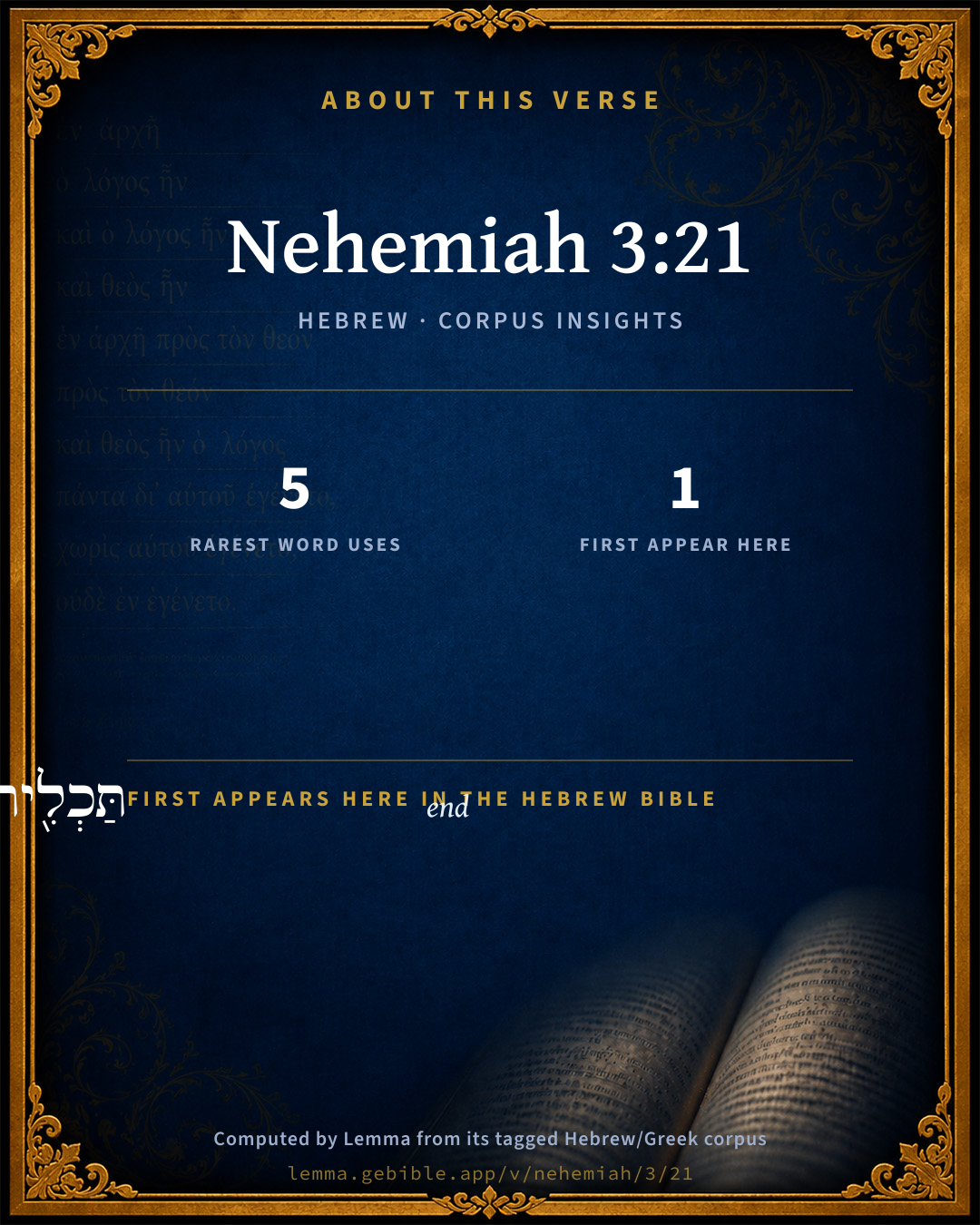
These counts appear in no published source. They are computed here, from the morphology-tagged text and Lemma’s own curated glosses. What Lemma adds →

16
words
13
distinct lemmas
Historical
section

Notable vocabulary

The rarest word here is תַּכְלִ֖ית end H8503 — appearing just 5 times in the whole Hebrew Bible.

First appearance in Scripture

This word makes its first canonical appearance in the Hebrew Bible here:

  • תַּכְלִ֖ית end H8503

Shared distinctive vocabulary

תַּכְלִ֖ית end H8503 occurs in 5 verses of the Hebrew Bible. Also found in:

Grammatical profile

  • 1 verb
  • 12 nouns
  • 1 adjective
  • 2 prepositions

Verb forms

  • הֶחֱזִ֗יק Hiphil · Perfect

Repetition

Words recur within this verse — often emphatic in Hebrew:

  • בֶּן son H1121 ×2
  • בֵּ֣ית house H1004 ×2
  • אֶלְיָשִׁ֔יב Eliashib H475 ×2

Cross-references

2

Topical passages linked to Nehemiah 3:21 in the Treasury of Scripture Knowledge — connected by theme and wording, ordered by reader-vote popularity; previews shown in the World English Bible.

  • Ezra 2:61 Of the children of the priests: the children of Habaiah, the children of Hakkoz, the children of Barzillai, who took a wife of the daughters of Barzillai the Gileadite, and was called after their name.
  • Nehemiah 7:63 Of the priests: the children of Hobaiah, the children of Hakkoz, the children of Barzillai, who took a wife of the daughters of Barzillai the Gileadite, and was called after their name.

Cross-references courtesy of OpenBible.info (CC BY 4.0).

Hebrew and Greek witnesses Masoretic Hebrew ↔ Greek Septuagint

The same verse in the two great witnesses to the Old Testament, shown verse-for-verse.

These are two independent witnesses, not word-aligned to each other, and the Septuagint is shown in lemma (dictionary) form.

Hebrew Nehemiah 3:21 Masoretic · Westminster Leningrad Codex

אַחֲרָ֣יו הֶחֱזִ֗יק מְרֵמ֧וֹת בֶּן אוּרִיָּ֛ה בֶּן הַקּ֖וֹץ מִדָּ֣ה שֵׁנִ֑ית מִפֶּ֨תַח֙ בֵּ֣ית אֶלְיָשִׁ֔יב וְעַד תַּכְלִ֖ית בֵּ֥ית אֶלְיָשִֽׁיב

After him repaired Meremoth the son of Uriah the son of Hakkoz another portion, from the door of the house of Eliashib even to the end of the house of Eliashib.

World English Bible · Public Domain

Greek LXX Structure differs

The Septuagint has no separate book of Nehemiah. Its Greek text is the second half of Esdras B (2 Esdras), chapters 11–23; Ezra is the first half (1–10).

A verse-for-verse comparison isn’t shown here because the chapters and verses don’t line up. Switch to the LXX edition with the MT / LXX toggle above to read the Greek directly.

On this verse, The Cambridge Bible for Schools and Colleges discusses the Septuagint’s reading. Read the note in Commentary ↓

Hebrew: Westminster Leningrad Codex (CC BY 4.0). Greek: Septuagint (public domain); English from a public-domain English Septuagint. How the Septuagint differs from the Hebrew →

Commentary

Notes on Nehemiah 3:21 from classic Christian and Jewish commentators (each source and its license shown beneath its notes). The classic Christian expositions comment on the surrounding passage and are grouped to its opening verse, so a note may address several verses; the Jewish commentaries on the Tanakh (Rashi and others) are per-verse, so they appear only where the commentator wrote on this verse.

Lemma curates 59 commentaries, every one of them public domain or Creative Commons licensed, each selected and text-cleaned for this edition rather than reprinted as found. About our sources →

Trapp's Complete Commentary

John Trapp

Neh 3:21 After him repaired Meremoth the son of Urijah the son of Koz another piece, from the door of the house of Eliashib even to the end of the house of Eliashib.

Ver. 21. Even to the end of the house of Eliashib] A small praise, saith one, if the house were not of some greatness. Eliashib was high priest, and dwelt, like himself, in a fair large house.

John Trapp, A Commentary or Exposition upon All the Books of the Old and New Testament (1647–1656) — public domain. Text from a community e-Sword module.

Joseph Benson's Commentary

Neh 3:21. From the door of the house of Eliashib, &c. — He carried on the work from the place where the other left off, from the door of the house to the end of it, which, being the house of a great man, we may suppose was very large.

Joseph Benson's Commentary on the Old and New Testaments (1811–1818) — public domain. Text from a community e-Sword module.

Ellicott's Commentary for English Readers

(21) Another piece.—Meremoth added to his other labour the repair of the wall under this house.

A Bible Commentary for English Readers, edited by Charles John Ellicott (1878–1897) — public domain. Text from a community e-Sword module.

The Cambridge Bible for Schools and Colleges

gen. ed. J. J. S. Perowne

21. Urijah the son of Koz] R.V. Uriah the son of Hakkoz.

another piece] R.V. another portion. Meremoth was also concerned in the repair of the Northern wall. See on Neh_3:4.

even to the end] This description seems to imply that the high-priest’s house was a building of considerable extent, and that it was built upon the city wall. The word rendered ‘end’ (taclîth) seems only to occur in this sense twice elsewhere in the O.T., Job_26:10, ‘confines,’ Job_28:3, ‘end.’ Elsewhere e.g. Psa_139:22 it is used to denote ‘perfection,’ ‘completeness.’ The words proved a difficulty to the versions, e.g. LXX. ἕως ἐκλείψεως, Vulg. donec extenderetur.

The Cambridge Bible for Schools and Colleges (gen. ed. J. J. S. Perowne; Cambridge University Press, 1878–1918) — public domain. Text from a community e-Sword module.

John Gill's Exposition

And after him repaired the priests, the men of the plain. Either of the plain of Jericho, where, in later times at least, there was a station of the priests, or of the plain about Jerusalem; those also assisted in the repairs of the wall.

And after him repaired the priests, the men of the plain. Either of the plain of Jericho, where, in later times at least, there was a station of the priests, or of the plain about Jerusalem; those also assisted in the repairs of the wall.

Nehemiah 3:23

neh 3:23

neh 3:23

neh 3:23After him,.... The last of the priests before mentioned:

repaired Benjamin, and Hashub, over against their house; as much of the wall as the length of their house, or houses, were:

after him repaired Azariah the son of Maaseiah, the son of Ananiah, by his house: as far as that reached.

John Gill's Exposition of the Whole Bible (1746–1763) — public domain (CC PDM 1.0). Text via the HelloAO Bible API.

Matthew Poole's English Annotations

Therefore the door was not in the middle of the house, as now they commonly are, but at one end of it.

Matthew Poole's English Annotations on the Holy Bible (1683–1685) — public domain. Text from a community e-Sword/MySword module.

The Pulpit Commentary

Meremoth"s first piece is mentioned in ver. 4. The second piece cannot have been very long, since it only extended along a portion of the high priest"s house.

The Pulpit Commentary (1880–1919), ed. H.D.M. Spence-Jones & Joseph S. Exell — public domain. Text from a community e-Sword module.

John Wesley's Explanatory Notes

The door - Therefore the door was not in the middle of the house, as now they commonly are, but at one end of it.

John Wesley, Explanatory Notes Upon the Whole Bible (1754–1765) — public domain. Text via the GEBible commentary corpus.

Rashi

Rabbi Shlomo Yitzchaki (Rashi)

from the entrance of the house of Eliashib until the end of, etc. Opposite that house he built his structure.

Rashi on the Tanakh — English translations: “The Judaica Press complete Tanach with Rashi, translated by A. J. Rosenberg” (CC BY 4.0); “Pentateuch with Rashi's commentary by M. Rosenbaum and A.M. Silbermann, 1929-1934” (public domain); “The Metsudah Tanach series, Lakewood, N.J” (CC BY 4.0); and “The Book of Joshua, Metsudah Publications, 1997” (CC BY 4.0). Text via Sefaria.

Lesson kit

Teaching starters — assembled from the data on this page, not authored interpretation. Every prompt links to the verse data it draws on. Edit before teaching.

Nehemiah, in the Historical, opens this verse with 16 words (13 distinct Hebrew lemmas). Its most distinctive word is taklîyth (“end”). A historical commentator’s framing appears above. Read the whole chapter for the surrounding context.

Discussion questions

  1. How does “end” (taklîyth) shape what this verse is saying?
  2. This is the first place “end” appears in Scripture (first appears here). What does its debut here establish?
  3. How does Job 11:7, which shares the word «end», read alongside this verse?
  4. What does the repetition of “son” (2× in this one verse) do in this verse?
  5. These translations render this verse differently. What is at stake in choosing one wording over another?
  6. «הֶחֱזִ֗יק» is a Hiphil Perfect verb. How does that grammatical form shape the action described?
  7. Compare how Trapp's Complete Commentary and Joseph Benson's Commentary read this verse. Where do they agree or differ?

Things to notice

  • 1 word makes its first canonical appearance in Scripture here.
  • These translations choose different wording for 14 words in this verse.
  • “son” occurs 2× in this single verse.
  • 13 distinct Hebrew lemmas span 16 words in this verse.

Reading settings

Reading text

Shown beneath each verse's original-language words.

Old Testament
Old Testament edition

Read the OT as the Masoretic Hebrew (MT) or the Greek Septuagint (LXX).

English shown for the Greek Septuagint (in the Hebrew ↔ Greek comparison).

Comparing translations? Open the Compare panel on any verse page to stack up to four side by side.