
Exodus 7:13

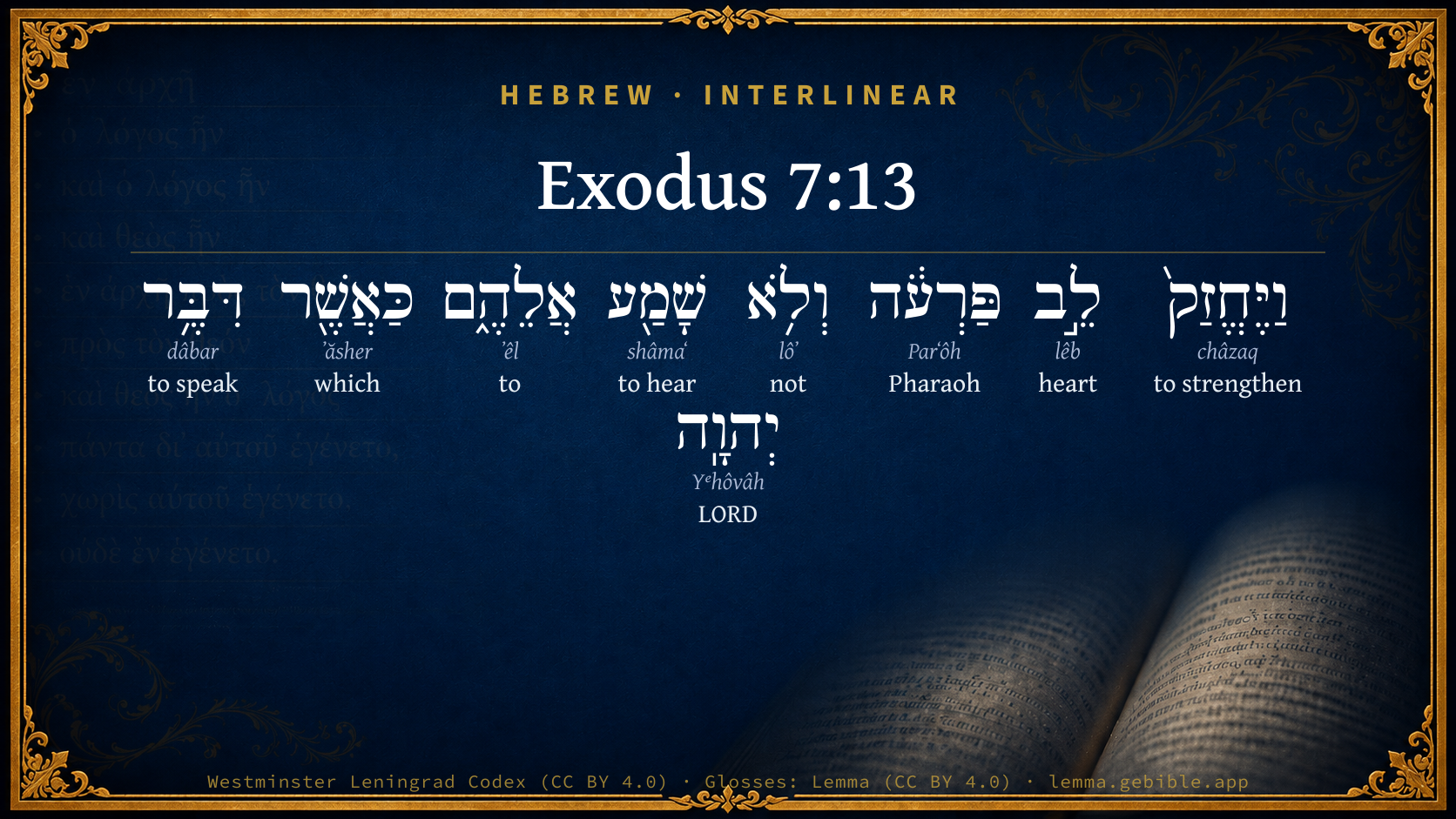
Hebrew (Westminster Leningrad Codex) Exodus 7:13 appears in the Hebrew Old Testament. The text above is from the Westminster Leningrad Codex. Each word links to its Strong’s number, a concise gloss, and parsing drawn from the Open Scriptures Hebrew Bible morphology. Click any word for its full Brown-Driver-Briggs (BDB) entry.
Download image
Cite this verse

Exodus 7:13 (World English Bible). Public Domain. Lemma interlinear Bible study tool, https://lemma.gebible.app/v/exodus/7/13.

Show BibTeX & RIS
BibTeX
RIS
English Translation
Pharaoh's heart was hardened, and he didn't listen to them; as Yahweh had spoken.
World English Bible · Public Domain
Download a study sheet

One document with this verse’s original text, its word-by-word gloss line, the meaning frame, cross-references with their text, attributed commentary, and full source and license credits — printable, and it pastes into notes with its structure intact.

This verse Autodidact and up

Study sheet (.html) Plain text (.txt)

A passage Seminary Student

Up to 50 verses in one chapter. A passage sheet keeps up to 6 commentary sources and 12 cross-references per verse, in the order this page ranks them, and says so on the sheet whenever that leaves anything out. Ask for a single verse and you get the Autodidact verse sheet above.

Everything on this page stays free to read, with no account — the sheet is a download of what is already on screen, not access to it.

Want to remove ads? Support Godless Engineer
Compare translations 3

The same verse in 3 English versions, stacked beneath the original-language interlinear above. Click any original word for its lexicon entry.

Each is an independent rendering of the whole verse — the interlinear is not word-aligned to these translations.

Highlighted words mark where these versions differ — a whole-verse word diff, not a word-by-word alignment.

  • World English Bible Public Domain
    Pharaoh's heart was hardened, and he didn't listen to them; as Yahweh had spoken.
  • King James Version Public Domain
    And he hardened Pharaoh's heart, that he hearkened not unto them; as the LORD had said.
  • unfoldingWord Literal Text CC BY-SA 4.0
    And the heart of Pharaoh was strong, and he did not listen to them, just as Yahweh had spoken.

unfoldingWord Literal Text — © unfoldingWord, licensed CC BY-SA 4.0. Word-aligned USFM3 via Door43 (git.door43.org/unfoldingWord/en_ult).

Versions to compare (up to 4)

3 of 4 selected

Show all 18 translations

Every available English version of this verse, each an independent rendering of the whole verse.

  • World English Bible Public Domain
    Pharaoh's heart was hardened, and he didn't listen to them; as Yahweh had spoken.
  • Berean Standard Bible Public Domain
    Still, Pharaoh’s heart was hardened, and he would not listen to them, just as the LORD had said.
  • Majority Standard Bible Public Domain
    Still, Pharaoh’s heart was hardened, and he would not listen to them, just as the LORD had said.
  • King James Version Public Domain
    And he hardened Pharaoh's heart, that he hearkened not unto them; as the LORD had said.
  • American Standard Version (1901) Public Domain
    And Pharaoh's heart was hardened, and he hearkened not unto them; as Jehovah had spoken.
  • Revised Version (1885) Public Domain
    And Pharaoh’s heart was hardened, and he hearkened not unto them; as the LORD had spoken.
  • Geneva Bible (1599) Public Domain
    So Pharaohs heart was hardened, and hee hearkened not to them, as the Lord had saide.
  • Douay-Rheims (1899) Public Domain
    And Pharao's heart was hardened, and he did not hearken to them, as the Lord had commanded.
  • Young's Literal Translation Public Domain
    and the heart of Pharaoh is strong, and he hath not hearkened unto them, as Jehovah hath spoken.
  • Literal Standard Version CC BY-SA 4.0
    and the heart of Pharaoh is strong, and he has not listened to them, as YHWH has spoken.
  • Unlocked Literal Bible CC BY-SA 4.0
    Pharaoh's heart was hardened, and he did not listen, just as Yahweh had foretold.
  • unfoldingWord Literal Text CC BY-SA 4.0
    And the heart of Pharaoh was strong, and he did not listen to them, just as Yahweh had spoken.
  • Darby Bible Public Domain
    And Pharaoh's heart was stubborn, and he hearkened not to them, as Jehovah had said.
  • World Messianic Bible Public Domain
    Pharaoh’s heart was hardened, and he didn’t listen to them, as the LORD had spoken.
  • Webster's Bible Public Domain
    And he hardened Pharaoh's heart that he hearkened not to them; as the LORD had said.
  • Free Bible Version CC BY-SA 4.0
    But Pharaoh had a hard, stubborn attitude, and he wouldn't listen to them, as the Lord had predicted.
  • Bible in Basic English Public Domain
    But Pharaoh's heart was made hard, and he did not give ear to them, as the Lord had said.
  • JPS Tanakh (1917) Public Domain
    And Pharaoh's heart was hardened, and he hearkened not unto them; as the LORD had spoken.

Literal Standard Version (2020), Covenant Press — licensed CC BY-SA 4.0. Text via the HelloAO Bible API (eBible.org). Unlocked Literal Bible (unfoldingWord) — licensed CC BY-SA 4.0. Text via the HelloAO Bible API (eBible.org). unfoldingWord Literal Text — © unfoldingWord, licensed CC BY-SA 4.0. Word-aligned USFM3 via Door43 (git.door43.org/unfoldingWord/en_ult). Free Bible Version, Dr. Jonathan Gallagher — licensed CC BY-SA 4.0. Text via the HelloAO Bible API (eBible.org).

Word by word

More ways to search: Search by grammar → Find every occurrence → Compare this word →

Practice this passage: Drill this verse → Learn its vocabulary →

About this verse

These counts appear in no published source. They are computed here, from the morphology-tagged text and Lemma’s own curated glosses. What Lemma adds →

9
words
9
distinct lemmas
Pentateuch
section

Grammatical profile

  • 3 verbs
  • 3 nouns
  • 1 preposition
  • 2 particles

Verb forms

  • וַיֶּחֱזַק֙ Qal · Sequential Imperfect
  • שָׁמַ֖ע Qal · Perfect
  • דִּבֶּ֥ר Piel · Perfect

Hebrew & Septuagint length

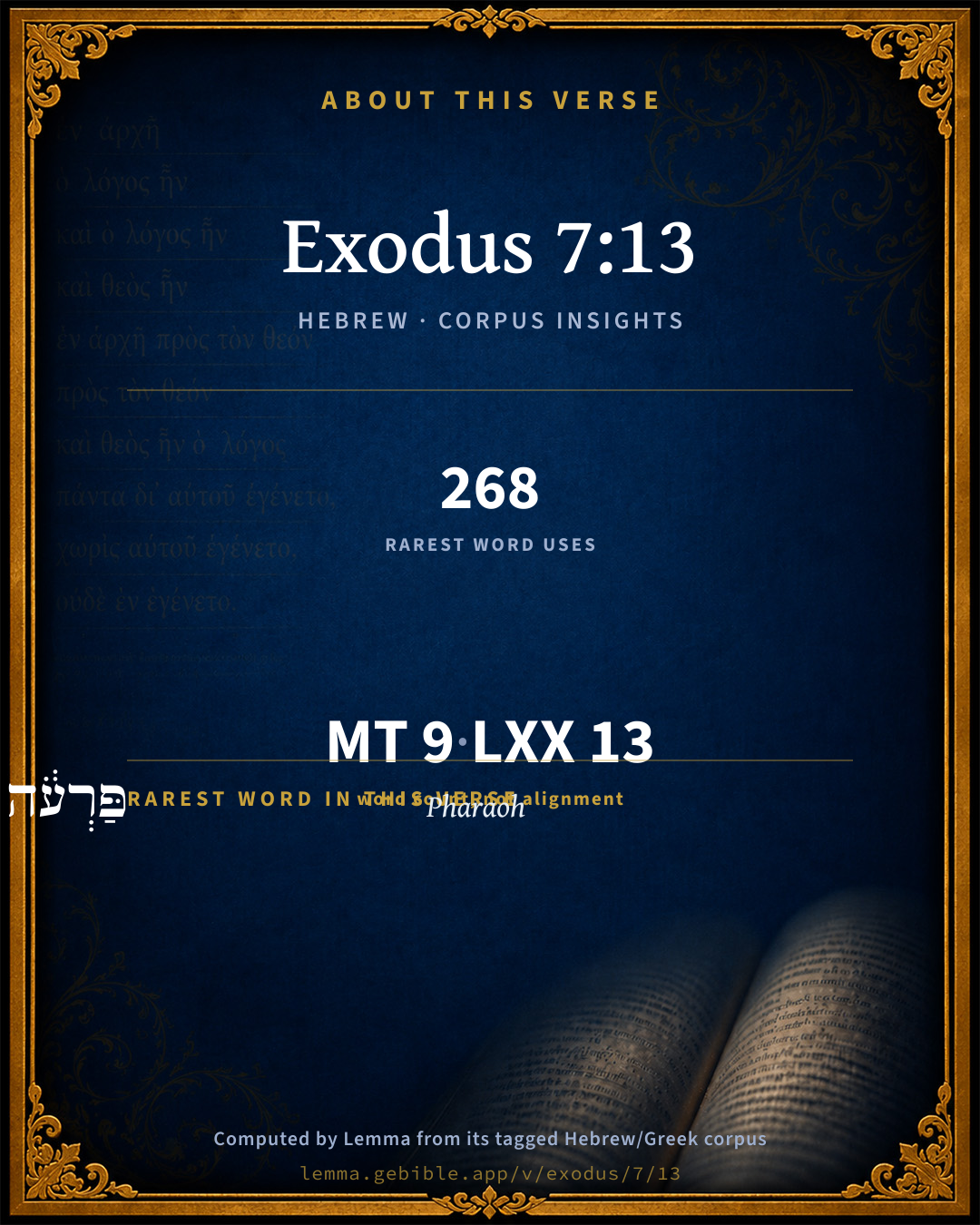
In English translation the verse runs 14 words from the Hebrew and 18 from the Septuagint (LXX English) — closely comparable.

A rough comparison of the two English renderings, which tokenize alike — not a word-level alignment.

Word counts can differ between the Hebrew and the Greek without any difference in meaning — e.g. the Hebrew direct-object marker אֵת has no separate Greek word, and Greek often adds the article ὁ.

In the original languages it is 9 Hebrew tokens and 13 Greek tokens — but the two are counted differently (Hebrew bundles its prefixes and suffixes into one token; the Greek is in lemma form), so that isn’t a like-for-like length.

Cross-references

13

Topical passages linked to Exodus 7:13 in the Treasury of Scripture Knowledge — connected by theme and wording, ordered by reader-vote popularity; previews shown in the World English Bible.

  • Exodus 4:21 Yahweh said to Moses, "When you go back into Egypt, see that you do before Pharaoh all the wonders which I have put in your hand, but I will harden his heart and he will not let the people go.
  • Exodus 8:15 But when Pharaoh saw that there was a respite, he hardened his heart, and didn't listen to them, as Yahweh had spoken.
  • Zechariah 7:11–12 But they refused to listen, and turned their backs, and stopped their ears, that they might not hear.
  • Exodus 10:1 Yahweh said to Moses, "Go in to Pharaoh, for I have hardened his heart, and the heart of his servants, that I may show these my signs in the midst of them,
  • Exodus 10:20 But Yahweh hardened Pharaoh's heart, and he didn't let the children of Israel go.
  • Exodus 10:27 But Yahweh hardened Pharaoh's heart, and he wouldn't let them go.
  • Romans 1:28 Even as they refused to have God in their knowledge, God gave them up to a reprobate mind, to do those things which are not fitting;
  • Romans 2:5 But according to your hardness and unrepentant heart you are treasuring up for yourself wrath in the day of wrath, revelation, and of the righteous judgment of God;
  • Hebrews 3:7–8 Therefore, even as the Holy Spirit says, "Today if you will hear his voice,
  • Hebrews 3:13 but exhort one another day by day, so long as it is called "today;" lest any one of you be hardened by the deceitfulness of sin.
  • Exodus 7:3–4 I will harden Pharaoh's heart, and multiply my signs and my wonders in the land of Egypt.
  • Exodus 14:17 I, behold, I will harden the hearts of the Egyptians, and they shall go in after them: and I will get myself honor over Pharaoh, and over all his host, over his chariots, and over his horsemen.
  • Deuteronomy 2:30 But Sihon king of Heshbon would not let us pass by him; for Yahweh your God hardened his spirit, and made his heart obstinate, that he might deliver him into your hand, as at this day.

Cross-references courtesy of OpenBible.info (CC BY 4.0).

Hebrew and Greek witnesses Masoretic Hebrew ↔ Greek Septuagint

The same verse in the two great witnesses to the Old Testament, shown verse-for-verse.

These are two independent witnesses, not word-aligned to each other, and the Septuagint is shown in lemma (dictionary) form.

Hebrew Exodus 7:13 Masoretic · Westminster Leningrad Codex

וַיֶּחֱזַק֙ לֵ֣ב פַּרְעֹ֔ה וְלֹ֥א שָׁמַ֖ע אֲלֵהֶ֑ם כַּאֲשֶׁ֖ר דִּבֶּ֥ר יְהוָֽה

Pharaoh's heart was hardened, and he didn't listen to them; as Yahweh had spoken.

World English Bible · Public Domain

Greek LXX Exodus 7:13 Septuagint · lemma form

καί καταἰσχύω ὁ καρδία φαραώ καί οὐ εἰςἀκούω αὐτός καθάπερ λαλέω αὐτός κύριος

and the heart of Pharao was hardened, and he listened not to them, as the Lord charged them.

LXX2012 (modern English Septuagint) · Public Domain

On this verse, Whedon's Commentary on the Bible discusses the Septuagint’s reading. Read the note in Commentary ↓

Hebrew: Westminster Leningrad Codex (CC BY 4.0). Greek: Septuagint (public domain); English from LXX2012 (modern English Septuagint) (Public Domain). How the Septuagint differs from the Hebrew →

Targum (Aramaic paraphrase)

2

The Targum is the ancient Jewish Aramaic paraphrase of the Hebrew Scriptures — an interpretive translation, not the Hebrew text itself. Onkelos (literal) and Pseudo-Jonathan (expansive) render the Torah, and Jonathan the Prophets. Coverage is partial: where no permissively-licensed English translation exists for a verse, only the Aramaic is shown. This is verse-level text, not a word-by-word alignment to the Hebrew.

  1. Targum Onkelos Torah (Genesis–Deuteronomy)
    וְאִתַּקַף לִבָּא דְפַרְעֹה וְלָא קַבִּיל מִנְהוֹן כְּמָא דְמַלִיל יְיָ:

    (no public-domain English translation for this verse)

    Targum Onkelos — Aramaic: “Onkelos Genesis” (public domain); “Onkelos Exodus” (public domain); “Onkelos Leviticus” (public domain); “Onkelos Numbers” (public domain); “Onkelos Deuteronomy” (public domain). English: “Sefaria Community Translation” (CC0 1.0 (public-domain dedication)); “J.W. Etheridge. The Targums of Onkelos and Jonathan Ben Uzziel on the Pentateuch. London: Longmans, Green, 1862” (public domain). Text via Sefaria.

  2. Targum Pseudo-Jonathan Torah (Genesis–Deuteronomy)
    וְאִיתְקַף יִצְרָא דְלִבָּא דְפַרְעה וְלָא קַבֵּיל מִנְהוֹן הֵיכְמָא דְמַלֵל יְיָ

    And the disposition Pharoh's heart was hardened, and he would not hearken to them, as the Lord had said.

    Targum Pseudo-Jonathan — Aramaic: “Targum Jonathan on Genesis” (public domain); “Targum Jonathan on Exodus” (public domain); “Targum Jonathan on Leviticus” (public domain); “Targum Jonathan on Numbers” (public domain); “Targum Jonathan on Deuteronomy” (public domain). English: “The Targum of Jonathan ben Uzziel, trans. J. W. Etheridge, London, 1862” (public domain). Text via Sefaria.

Commentary

Notes on Exodus 7:13 from classic Christian and Jewish commentators (each source and its license shown beneath its notes). The classic Christian expositions comment on the surrounding passage and are grouped to its opening verse, so a note may address several verses; the Jewish commentaries on the Tanakh (Rashi and others) are per-verse, so they appear only where the commentator wrote on this verse.

Lemma curates 59 commentaries, every one of them public domain or Creative Commons licensed, each selected and text-cleaned for this edition rather than reprinted as found. About our sources →

The Cambridge Bible for Schools and Colleges

gen. ed. J. J. S. Perowne

13. was hardened] Heb. was strong. One of the three synonyms used in Ex. to express the idea of hardening of the heart: the three being (1) ḥâzaḳ, ḥizzçḳ, lit. to be and to make strong (i.e. firm, hard, unyielding, cf. Eze_3:7-9 Heb.), used by P (Exo_7:13; Exo_7:22, Exo_8:19, Exo_9:12, Exo_11:10, Exo_14:4; Exo_14:8; Exo_14:17), and E (Exo_4:21, Exo_9:35, Exo_10:20; Exo_10:27); (2) kâbçd, hikbîd, lit. to be and to make heavy (i.e. slow to move or be affected, unimpressionable, cf. of the tongue, Exo_4:10), used by J (Exo_7:14, Exo_8:15; Exo_8:32, Exo_9:7; Exo_9:34, Exo_10:1); and (3) hiḳshâh, which is properly rendered, to harden (cf. the cognate adj. of the neck, Exo_32:9 al.), only Exo_7:3 (P). (1) and (2) are always distinguished in RV. of Ex. by a marg. In these passages, Pharaoh’s heart is itself said to be hard in Exo_7:13-14; Exo_7:22, Exo_8:19, Exo_9:7; Exo_9:35; Pharaoh is said to harden it himself in Exo_8:15; Exo_8:32, Exo_9:34; and God is said to harden it in Exo_4:21, Exo_7:3, Exo_9:12, Exo_10:1; Exo_10:20; Exo_10:27, Exo_11:10, Exo_14:4; Exo_14:8 (cf. 17). See further the detached note below.

and he hearkened not to them, as Jehovah had spoken] P’s closing formula (p. 55), as v. 22, Exo_8:15 b, 19, Exo_9:12. Had spoken, see v. 4a.

Both in P (Exo_7:13) and J (Exo_6:1), the same point has thus been reached: the Pharaoh will listen to no request to let the people go. Accordingly stronger measures are threatened; and the ten ‘Plagues’ follow.

On the hardening of Pharaoh’s heart

God is spoken of as ‘hardening’ Pharaoh’s heart by E in Exo_4:21, Exo_10:20; Exo_10:27, by J (or RJE) in Exo_10:1, and by P in Exo_7:3, Exo_9:12, Exo_11:10, Exo_14:4; Exo_14:8, by P also as hardening the heart of the Egyptians so that they followed Israel into the sea in Exo_14:17 : in Exo_4:21 and Exo_7:3 generally, in view of the whole series of coming plagues, otherwise first after the sixth plague Exo_9:12). In what sense are these passages to be understood? The Hebrews, with their vivid sense of the sovereignty of God, were in the habit of referring things done by man to the direct operation of God; and it is possible that these are merely examples of the same custom: we may notice that the performance of signs and wonders in Egypt, which in Exo_10:1 is described as a consequence of Jehovah’s having ‘hardened’ the hearts of Pharaoh and his servants, is in Exo_11:9 represented as a consequence simply of Pharaoh’s not hearkening himself to Moses and Aaron. In this case, the meaning will be that God ‘hardened’ Pharaoh just in so far as he hardened himself. But even supposing that the passages mean more than this, we must remember that, especially in His dealings with moral agents, God cannot be properly thought of as acting arbitrarily; He only hardens those who begin by hardening themselves: though the reasons for His actions are not always specified, it would be contrary to His moral attributes, and inconsistent with the character of a righteous God, if He were to harden those whose hearts were turned towards Him, and did not wish to harden themselves. The Pharaoh—whatever he was in actual history—is depicted in Exodus as from the first a self-willed, obstinate man who persistently hardens himself against God, and resists all warnings: God thus hardens him only because he has first hardened himself. And even here we must remember that the means by which God hardens a man is not necessarily by any extraordinary intervention on His part; it may be by the ordinary experiences of life, operating through the principles and character of human nature, which are of His appointment: the man who has once begun to harden himself, may thus find in the experiences of life, and even in the approaches made by God or His messengers to him, occasions and excuses for hardening himself yet more (cf. Psa_18:26 ‘with the crooked thou shewest thyself tortuous’).

The question arises again, in a slightly different form, in connexion with Exo_9:16, where Jehovah is said to have made Pharaoh continue in life, in order that he might experience His power. Does He, in so doing, act arbitrarily with Pharaoh? The passage is quoted, together with Exo_33:19 (see the note), in Rom_9:15-18, in order to shew that God has absolute liberty of choice in selecting whom He will, either as examples of His hardening judgement, or as the recipients of His mercy. But although St Paul says (v. 18) ‘He hath mercy on whom he will, and whom he will he hardeneth,’ we have no right to interpret this ‘will’ in a sense inconsistent with God’s righteousness, or to suppose that He is actuated in His choice by the motives of a despot, responsible not to a law of righteousness, but only to His own caprice. The apostle is arguing against those who maintained that because God had once chosen the Jewish nation, His hands were, so to say, tied, and, whatever they did, He could not reject them, except by being unrighteous. Against such a contention St Paul quotes two passages of the OT. in which Jehovah asserts His right to shew mercy and judgement to whom He will. But we must not exalt God’s sovereignty at the expense of His justice; and so we must think of God as ‘willing’ to shew mercy and judgement, not arbitrarily, or where either would be unmerited, but according to character and deserts. As Bp Gore says, in the course of an illuminative discussion of the whole question (Ep. to the Romans, ii. 3–13, 31–43), ‘The liberty asserted for God is wholly consistent with His being found, in fact, to have “hardened” those only who have deserved hardening by their own wilfulness. It was for such a moral cause that God hardened the hearts of the Jews, that “seeing they might not see, and hearing they might not hear.” We can feel no doubt that some similar moral cause underlay the hardening of Pharaoh’ (p. 38).

The Cambridge Bible for Schools and Colleges (gen. ed. J. J. S. Perowne; Cambridge University Press, 1878–1918) — public domain. Text from a community e-Sword module.

Trapp's Complete Commentary

John Trapp

Exo 7:13 And he hardened Pharaoh’s heart, that he hearkened not unto them; as the LORD had said.

Ver. 13. And he hardened Pharaoh’s heart.] Not by bare prescience, or permission only, but by withdrawing his grace, directing the tyrant’s actions to his own glory, irritating his corruptions by oracles and miracles, and delivering him up to Satan to be further hardened.

John Trapp, A Commentary or Exposition upon All the Books of the Old and New Testament (1647–1656) — public domain. Text from a community e-Sword module.

Joseph Benson's Commentary

Exo 7:13. And he hardened Pharaoh’s heart — That is, permitted it to be hardened: or, as the very same Hebrew word is rendered in Exo 7:22, Pharaoh’s heart was hardened.

Joseph Benson's Commentary on the Old and New Testaments (1811–1818) — public domain. Text from a community e-Sword module.

Adam Clarke's Commentary

Verse 13. And he hardened Pharaoh's heart] ויחזק לב פרעה vaiyechezah leb Paroh, "And the heart of Pharaoh was hardened," the identical words which in Ex 7:22 are thus translated, and which should have been rendered in the same way here, lest the hardening, which was evidently the effect of his own obstinate shutting of his eyes against the truth, should be attributed to God. See Clarke on Ex 4:21.

Adam Clarke's Commentary on the Bible (1810–1826) — public domain. Text from a community e-Sword/MySword module.

Ellicott's Commentary for English Readers

(13) He hardened Pharaoh’s heart.—This is a mis-translation. The verb is intransitive, and “Pharaoh’s heart” is its nominative case. Translate, “Pharaoh’s heart hardened itself.” It is essential to the idea of a final penal hardening that in the earlier stages Pharaoh should have been left to himself.

That he hearkened not.—Heb., and he hearkened not.

As the Lord had said.—See above, Exo_3:19; Exo_7:4

A Bible Commentary for English Readers, edited by Charles John Ellicott (1878–1897) — public domain. Text from a community e-Sword module.

John Gill's Exposition

And he hardened Pharaoh's heart,.... Or, "notwithstanding the heart of Pharaoh was hardened" (a); though he saw the rods of his magicians devoured by rod; or "therefore" (b) his heart was hardened, because he saw that the rods of his magicians became serpents as well as Aaron's; in which there was a deception of sight, and which was suffered for the hardening of his heart, there being other wonders and miracles to be wrought, for showing forth the divine power, before Israel must be let go:

that he hearkened not unto them; to Moses and Aaron, and comply with their demand, to dismiss the people of Israel:

as the Lord had said; or foretold he would not.

(a) "attamen obfirmatum est", Junius & Tremellius. (b) "Itaque", Piscator.

John Gill's Exposition of the Whole Bible (1746–1763) — public domain (CC PDM 1.0). Text via the HelloAO Bible API.

Albert Barnes' Notes on the Bible

And he hardened - Or Pharaoh’s heart was hardened. See Exo 4:21.

Albert Barnes' Notes on the Bible (1834–1885) — public domain. Text from a community e-Sword/MySword module.

Matthew Poole's English Annotations

He, the Lord, to whom this act of hardening is frequently ascribed both in this book and elsewhere.

Matthew Poole's English Annotations on the Holy Bible (1683–1685) — public domain. Text from a community e-Sword/MySword module.

Whedon's Commentary on the Bible

Daniel D. Whedon

13. And he hardened Pharaoh’s heart — Rather, And hard was the heart of Pharaoh. (Samuel, Septuagint, Vulg., Onk., Syr.) The presence of superhuman power, and the solemn symbolic lessons, though they may have created in Pharaoh a momentary awe, yet failed to arouse his torpid conscience. Here, in this “sign,” was no infliction of punishment, but a simple manifestation of power in attestation of the mission of Moses and Aaron, as well as a symbolic prediction hereafter to be more fully understood.

Daniel D. Whedon (gen. ed.), Commentary on the Old and New Testaments (1874–1909) — public domain. Text from a community e-Sword module.

The Pulpit Commentary

And he hardened Pharaoh"s heart. Rather, "But Pharaoh"s heart was hard. " The verb employed is not active, but neuter; and "his heart" is not the accusative, but the nominative. Pharaoh"s heart was too hard for the sign to make much impression on it. He did not see that Moses had done much more than his own magicians could do. As the Lord had said. See ver. 4.

The Pulpit Commentary (1880–1919), ed. H.D.M. Spence-Jones & Joseph S. Exell — public domain. Text from a community e-Sword module.

John Wesley's Explanatory Notes

And he harden'd Pharaoh's heart - That is, permitted it to be hardened.

John Wesley, Explanatory Notes Upon the Whole Bible (1754–1765) — public domain. Text via the GEBible commentary corpus.

Ibn Ezra

Rabbi Abraham ibn Ezra

Pharaoh’s heart remained hard. He himself caused the hardening of his heart, because he saw the sorcerers could replicate what Aharon did.

Ibn Ezra on the Tanakh — English translations: “Sefaria Community Translation” (CC0 1.0 (public-domain dedication)); “Yalkut, Sifsei Chachomim Chumash, Metsudah Publications, 2009” (CC BY 4.0); and “Commentary of Ibn Ezra on Isaiah - trans. by M. Friedlander, 1873” (public domain). Text via Sefaria.

Lesson kit

Teaching starters — assembled from the data on this page, not authored interpretation. Every prompt links to the verse data it draws on. Edit before teaching.

Exodus, in the Pentateuch, opens this verse with 9 words (9 distinct Hebrew lemmas). Its most distinctive word is Parʻôh (“Pharaoh”). A historical commentator’s framing appears above. Read the whole chapter for the surrounding context.

Discussion questions

  1. The word Parʻôh carries the sense “Pharaoh.” How does it shape the verse?
  2. How does Exodus 4:21, which shares this passage’s theme, read alongside this verse?
  3. The translations on this page render this verse differently — a whole-verse word diff, not a word-by-word alignment. What might account for the different wordings?
  4. «וַיֶּחֱזַק֙» is a Qal Sequential Imperfect verb. How does that grammatical form shape the action described?
  5. Compare how The Cambridge Bible for Schools and Colleges and Trapp's Complete Commentary read this verse. Where do they agree or differ?

Things to notice

Reading settings

Reading text

Shown beneath each verse's original-language words.

Old Testament
Old Testament edition

Read the OT as the Masoretic Hebrew (MT) or the Greek Septuagint (LXX).

English shown for the Greek Septuagint (in the Hebrew ↔ Greek comparison).

Comparing translations? Open the Compare panel on any verse page to stack up to four side by side.