
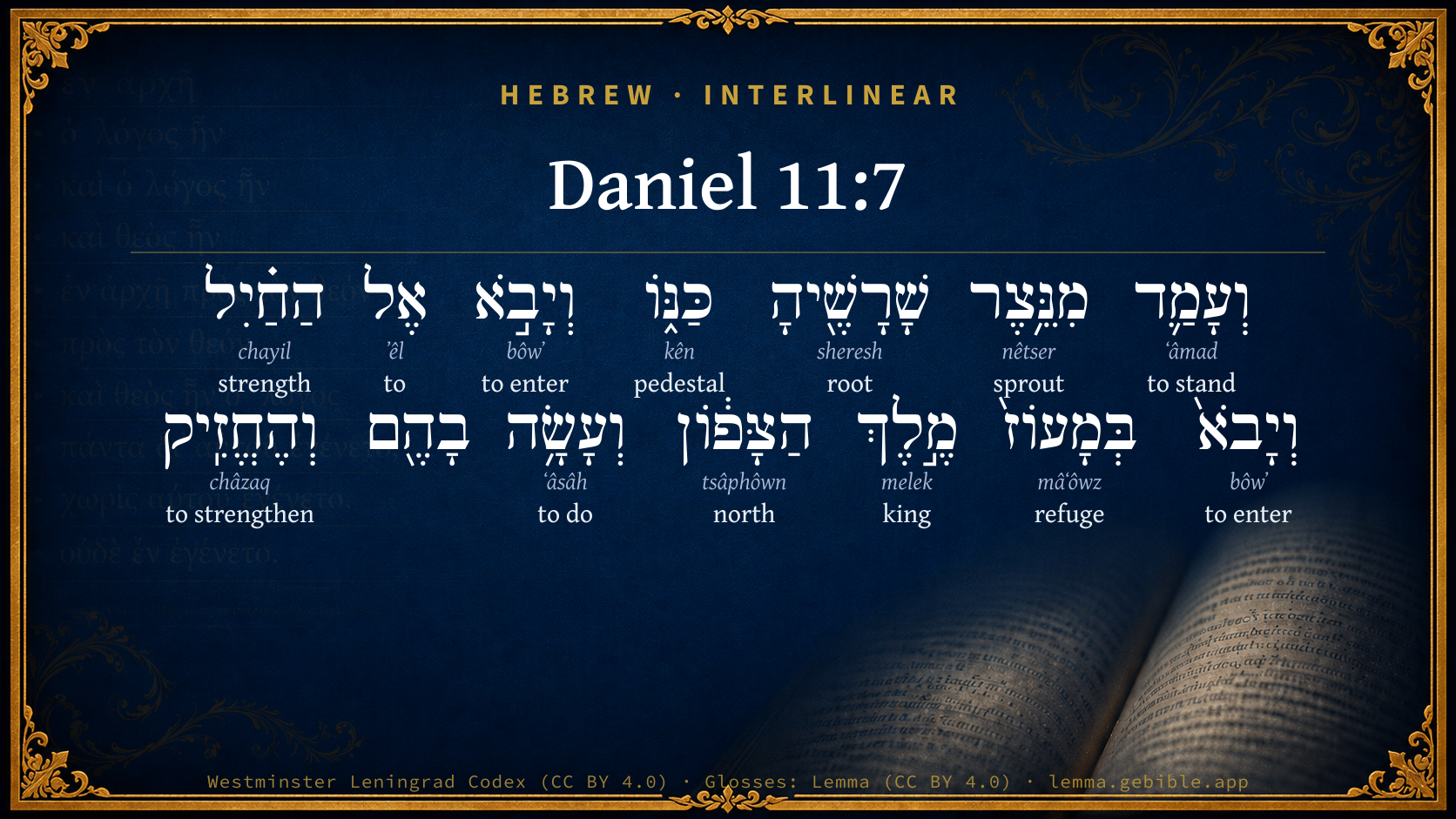
Daniel 11:7

Hebrew (Westminster Leningrad Codex) Daniel 11:7 appears in the Hebrew Old Testament. The text above is from the Westminster Leningrad Codex. Each word links to its Strong’s number, a concise gloss, and parsing drawn from the Open Scriptures Hebrew Bible morphology. Click any word for its full Brown-Driver-Briggs (BDB) entry.
Download image
Cite this verse

Daniel 11:7 (World English Bible). Public Domain. Lemma interlinear Bible study tool, https://lemma.gebible.app/v/daniel/11/7.

Show BibTeX & RIS
BibTeX
RIS
English Translation
But out of a shoot from her roots shall one stand up in his place, who shall come to the army, and shall enter into the fortress of the king of the north, and shall deal against them, and shall prevail.
World English Bible · Public Domain
Download a study sheet

One document with this verse’s original text, its word-by-word gloss line, the meaning frame, cross-references with their text, attributed commentary, and full source and license credits — printable, and it pastes into notes with its structure intact.

This verse Autodidact and up

Study sheet (.html) Plain text (.txt)

A passage Seminary Student

Up to 50 verses in one chapter. A passage sheet keeps up to 6 commentary sources and 12 cross-references per verse, in the order this page ranks them, and says so on the sheet whenever that leaves anything out. Ask for a single verse and you get the Autodidact verse sheet above.

Everything on this page stays free to read, with no account — the sheet is a download of what is already on screen, not access to it.

Want to remove ads? Support Godless Engineer
Compare translations 3

The same verse in 3 English versions, stacked beneath the original-language interlinear above. Click any original word for its lexicon entry.

Each is an independent rendering of the whole verse — the interlinear is not word-aligned to these translations.

Highlighted words mark where these versions differ — a whole-verse word diff, not a word-by-word alignment.

  • World English Bible Public Domain
    But out of a shoot from her roots shall one stand up in his place, who shall come to the army, and shall enter into the fortress of the king of the north, and shall deal against them, and shall prevail.
  • King James Version Public Domain
    But out of a branch of her roots shall one stand up in his estate, which shall come with an army, and shall enter into the fortress of the king of the north, and shall deal against them, and shall prevail:
  • unfoldingWord Literal Text CC BY-SA 4.0
    But from a branch of her roots one will rise up in his place. He will come against the army and enter the fortress of the king of the North. He will deal with them and will prevail.

unfoldingWord Literal Text — © unfoldingWord, licensed CC BY-SA 4.0. Word-aligned USFM3 via Door43 (git.door43.org/unfoldingWord/en_ult).

Versions to compare (up to 4)

3 of 4 selected

Show all 18 translations

Every available English version of this verse, each an independent rendering of the whole verse.

  • World English Bible Public Domain
    But out of a shoot from her roots shall one stand up in his place, who shall come to the army, and shall enter into the fortress of the king of the north, and shall deal against them, and shall prevail.
  • Berean Standard Bible Public Domain
    But one from her family line will rise up in his place, come against the army of the king of the North, and enter his fortress, fighting and prevailing.
  • Majority Standard Bible Public Domain
    But one from her family line will rise up in his place, come against the army of the king of the North, and enter his fortress, fighting and prevailing.
  • King James Version Public Domain
    But out of a branch of her roots shall one stand up in his estate, which shall come with an army, and shall enter into the fortress of the king of the north, and shall deal against them, and shall prevail:
  • American Standard Version (1901) Public Domain
    But out of a shoot from her roots shall one stand up in his place, who shall come unto the army, and shall enter into the fortress of the king of the north, and shall deal against them, and shall prevail.
  • Revised Version (1885) Public Domain
    But out of a shoot from her roots shall one stand up in his place, which shall come unto the army, and shall enter into the fortress of the king of the north, and shall deal against them, and shall prevail:
  • Geneva Bible (1599) Public Domain
    But out of the bud of her rootes shall one stand vp in his stead, which shall come with an armie, and shall enter into the fortresse of the King of the North, and doe with them as he list, and shall preuaile,
  • Douay-Rheims (1899) Public Domain
    And a plant of the bud of her roots, shall stand up: and he shall come with an army, and shall enter into the province of the king of the north: and he shall abuse them, and shall prevail.
  • Young's Literal Translation Public Domain
    `And `one' hath stood up from a branch of her roots, `in' his station, and he cometh in unto the bulwark, yea, he cometh into a stronghold of the king of the south, and hath wrought against them, and hath done mightily;
  • Literal Standard Version CC BY-SA 4.0
    And [one] has stood up from a branch of her roots, [in] his station, and he comes to the bulwark, indeed, he comes into a stronghold of the king of the north, and has worked against them, and has done mightily;
  • Unlocked Literal Bible CC BY-SA 4.0
    But a branch from her roots will rise up in her place. He will attack the army and enter the fortress of the king of the North. He will fight them, and he will conquer them.
  • unfoldingWord Literal Text CC BY-SA 4.0
    But from a branch of her roots one will rise up in his place. He will come against the army and enter the fortress of the king of the North. He will deal with them and will prevail.
  • Darby Bible Public Domain
    But out of a shoot from her roots shall one stand up in his place, who shall come to the army, and shall enter into the fortress of the king of the north, and shall deal against them, and shew himself mighty.
  • World Messianic Bible Public Domain
    “But out of a shoot from her roots one will stand up in his place, who will come to the army and will enter into the fortress of the king of the north, and will deal against them and will prevail.
  • Webster's Bible Public Domain
    But out of a branch of her roots shall one stand up in his estate, who shall come with an army, and shall enter into the fortress of the king of the north, and shall deal against them, and shall prevail:
  • Free Bible Version CC BY-SA 4.0
    a new king of the south from her family will take over. He will come to attack the army of the king of the north and enter his fortress. He will fight against them and will win.
  • Bible in Basic English Public Domain
    But out of a branch from her roots one will come up to take his place, who will come against the army, forcing his way into the strong place of the king of the north, and he will take them in hand and overcome them:
  • JPS Tanakh (1917) Public Domain
    But one of the shoots of her roots shall stand up in his place, and shall come unto the army, and shall enter into the stronghold of the king of the north, and shall deal with them, and shall prevail;

Literal Standard Version (2020), Covenant Press — licensed CC BY-SA 4.0. Text via the HelloAO Bible API (eBible.org). Unlocked Literal Bible (unfoldingWord) — licensed CC BY-SA 4.0. Text via the HelloAO Bible API (eBible.org). unfoldingWord Literal Text — © unfoldingWord, licensed CC BY-SA 4.0. Word-aligned USFM3 via Door43 (git.door43.org/unfoldingWord/en_ult). Free Bible Version, Dr. Jonathan Gallagher — licensed CC BY-SA 4.0. Text via the HelloAO Bible API (eBible.org).

Word by word

More ways to search: Search by grammar → Find every occurrence → Compare this word →

Practice this passage: Drill this verse → Learn its vocabulary →

מִנֵּ֥צֶר
nêtser
H5342
“from · sprout of”
Preposition + Noun, Common, Masculine, Singular, Construct
Part of Speech
Preposition + Noun
Type
Common
Gender
Masculine
Number
Singular
State
Construct
Full BDB Definition

Origin: from H5341 in the sense of greenness as a striking colour

TWOT: TWOT - 1408a

sprout, shoot, branch (always figuratively)
  1. וְעָמַ֛ד ʻâmad H5975 “and · to stand” Conjunction + Verb, Qal, Sequential Perfect, 3rd Person, Masculine, Singular
  2. שָׁרָשֶׁ֖יהָ sheresh H8328 “roots · her” Noun, Common, Masculine, Plural, Construct + Suffix, Personal, 3rd Person, Feminine, Singular
  3. כַּנּ֑וֹ kên H3653 “pedestal · his” Noun, Common, Masculine, Singular, Construct + Suffix, Personal, 3rd Person, Masculine, Singular
  4. וְיָבֹ֣א bôwʼ H935 “and · to enter” Conjunction + Verb, Qal, Imperfect, 3rd Person, Masculine, Singular
  5. אֶל ʼêl H413 “to” Preposition
  6. הַחַ֗יִל chayil H2428 “the · strength” Particle, Definite Article + Noun, Common, Masculine, Singular, Absolute
  7. וְיָבֹא֙ bôwʼ H935 “and · to enter” Conjunction + Verb, Qal, Imperfect, 3rd Person, Masculine, Singular
  8. בְּמָעוֹז֙ mâʻôwz H4581 “in/at · refuge of” Preposition + Noun, Common, Masculine, Singular, Construct
  9. מֶ֣לֶךְ melek H4428 “king of” Noun, Common, Masculine, Singular, Construct
  10. הַצָּפ֔וֹן tsâphôwn H6828 “the · north” Particle, Definite Article + Noun, Common, Feminine, Singular, Absolute
  11. וְעָשָׂ֥ה ʻâsâh H6213 “and · to do” Conjunction + Verb, Qal, Sequential Perfect, 3rd Person, Masculine, Singular
  12. וְהֶחֱזִֽיק châzaq H2388 “and · to strengthen” Conjunction + Verb, Hiphil, Sequential Perfect, 3rd Person, Masculine, Singular

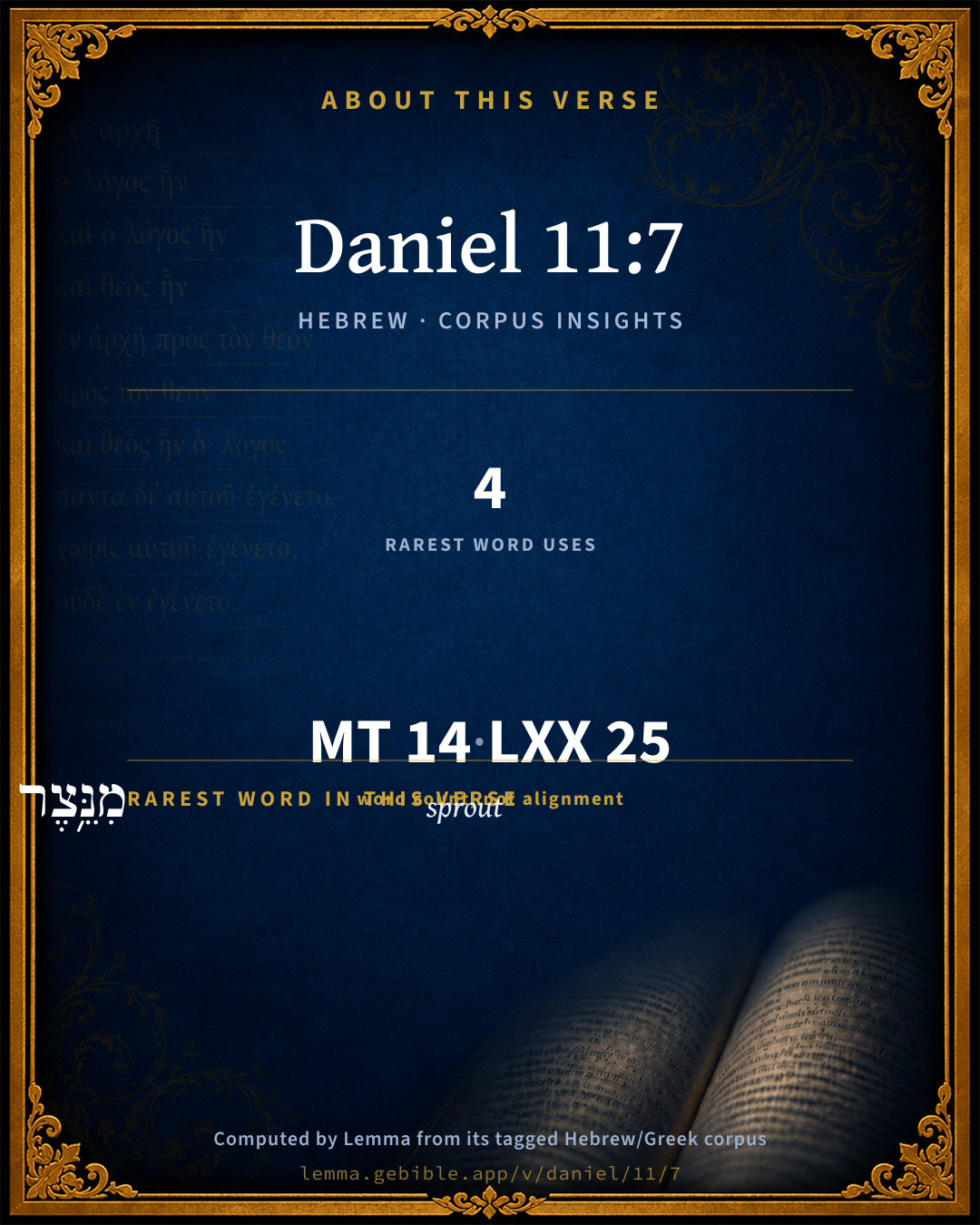
About this verse

These counts appear in no published source. They are computed here, from the morphology-tagged text and Lemma’s own curated glosses. What Lemma adds →

14
words
12
distinct lemmas
Prophets
section

Notable vocabulary

The rarest word here is מִנֵּ֥צֶר sprout H5342 — appearing just 4 times in the whole Hebrew Bible.

Shared distinctive vocabulary

מִנֵּ֥צֶר sprout H5342 occurs in 4 verses of the Hebrew Bible. Also found in:

Grammatical profile

  • 5 verbs
  • 7 nouns
  • 2 prepositions

Verb forms

  • וְעָמַ֛ד Qal · Sequential Perfect
  • וְיָבֹ֣א Qal · Imperfect
  • וְיָבֹא֙ Qal · Imperfect
  • וְעָשָׂ֥ה Qal · Sequential Perfect
  • וְהֶחֱזִֽיק Hiphil · Sequential Perfect

Repetition

A word recurs within this verse — often emphatic in Hebrew:

  • וְיָבֹ֣א to enter H935 ×2

Hebrew & Septuagint length

In English translation the verse runs 41 words from the Hebrew and 40 from the Septuagint (LXX English) — closely comparable.

A rough comparison of the two English renderings, which tokenize alike — not a word-level alignment.

Word counts can differ between the Hebrew and the Greek without any difference in meaning — e.g. the Hebrew direct-object marker אֵת has no separate Greek word, and Greek often adds the article ὁ.

In the original languages it is 14 Hebrew tokens and 25 Greek tokens — but the two are counted differently (Hebrew bundles its prefixes and suffixes into one token; the Greek is in lemma form), so that isn’t a like-for-like length.

Cross-references

12

Topical passages linked to Daniel 11:7 in the Treasury of Scripture Knowledge — connected by theme and wording, ordered by reader-vote popularity; previews shown in the World English Bible.

  • Job 14:7 "For there is hope for a tree, If it is cut down, that it will sprout again, That the tender branch of it will not cease.
  • Psalms 49:10–13 For he sees that wise men die; Likewise the fool and the senseless perish, And leave their wealth to others.
  • Psalms 55:23 But you, God, will bring them down into the pit of destruction. Bloodthirsty and deceitful men shall not live out half their days, But I will trust in you.
  • Psalms 109:8 Let his days be few. Let another take his office.
  • Isaiah 9:14 Therefore Yahweh will cut off from Israel head and tail, palm-branch and rush, in one day.
  • Isaiah 11:1 There shall come forth a shoot out of the stock of Jesse, and a branch out of his roots shall bear fruit.
  • Jeremiah 12:2 You have planted them, yes, they have taken root; they grow, yes, they bring forth fruit: you are near in their mouth, and far from their heart.
  • Ezekiel 17:18 For he has despised the oath by breaking the covenant; and behold, he had given his hand, and yet has done all these things; he shall not escape.
  • Daniel 11:19–20 Then he shall turn his face toward the fortresses of his own land; but he shall stumble and fall, and shall not be found.
  • Daniel 11:38–39 But in his place shall he honor the god of fortresses; and a god whom his fathers didn't know shall he honor with gold, and silver, and with precious stones, and pleasant things.
  • Malachi 4:1 "For, behold, the day comes, it burns as a furnace; and all the proud, and all who work wickedness, will be stubble; and the day that comes will burn them up," says Yahweh of Hosts, "that it shall leave them neither root nor branch.
  • Luke 12:20 "But God said to him, 'You foolish one, tonight your soul is required of you. The things which you have prepared--whose will they be?'

Cross-references courtesy of OpenBible.info (CC BY 4.0).

Hebrew and Greek witnesses Masoretic Hebrew ↔ Greek Septuagint

The same verse in the two great witnesses to the Old Testament, shown verse-for-verse.

These are two independent witnesses, not word-aligned to each other, and the Septuagint is shown in lemma (dictionary) form.

Hebrew Daniel 11:7 Masoretic · Westminster Leningrad Codex

וְעָמַ֛ד מִנֵּ֥צֶר שָׁרָשֶׁ֖יהָ כַּנּ֑וֹ וְיָבֹ֣א אֶל הַחַ֗יִל וְיָבֹא֙ בְּמָעוֹז֙ מֶ֣לֶךְ הַצָּפ֔וֹן וְעָשָׂ֥ה בָהֶ֖ם וְהֶחֱזִֽיק

But out of a shoot from her roots shall one stand up in his place, who shall come to the army, and shall enter into the fortress of the king of the north, and shall deal against them, and shall prevail.

World English Bible · Public Domain

Greek LXX Daniel 11:7 Septuagint · lemma form

καί ἀναἵστημι φυτόν ἐκ ὁ ῥίζα αὐτός κατά ἑαυτοῦ καί ἥκω ἐπί ὁ δύναμις αὐτός ἐν ἰσχύς αὐτός βασιλεύς βορέας καί ποιέω ταραχή καί καταἰσχύω

But out of the flower of her root there shall arise one on his place, and shall come against the host, and shall enter into the strongholds of the king of the north, and shall fight against them, and prevail.

LXX2012 (modern English Septuagint) · Public Domain

On this verse, Ellicott's Commentary for English Readers discusses the Septuagint’s reading. Read the note in Commentary ↓

Hebrew: Westminster Leningrad Codex (CC BY 4.0). Greek: Septuagint (public domain); English from LXX2012 (modern English Septuagint) (Public Domain). How the Septuagint differs from the Hebrew →

Commentary

Notes on Daniel 11:7 from classic Christian and Jewish commentators (each source and its license shown beneath its notes). The classic Christian expositions comment on the surrounding passage and are grouped to its opening verse, so a note may address several verses; the Jewish commentaries on the Tanakh (Rashi and others) are per-verse, so they appear only where the commentator wrote on this verse.

Lemma curates 59 commentaries, every one of them public domain or Creative Commons licensed, each selected and text-cleaned for this edition rather than reprinted as found. About our sources →

Trapp's Complete Commentary

John Trapp

Dan 11:7 But out of a branch of her roots shall [one] stand up in his estate, which shall come with an army, and shall enter into the fortress of the king of the north, and shall deal against them, and shall prevail:

Ver. 7. But out of the branch of her roots.] One of her stock; her own brother both by father and mother.

Shall one stand up in his estate.] Ptolemy Euergetes shall succeed his father Philadelph; and making war against Seleucus Callinicus, son of Antiochus Theos by Laodice, in revenge of his sister Bernice’s death, shall prevail on and overrun the greatest part of Callinicus’s kingdom.

John Trapp, A Commentary or Exposition upon All the Books of the Old and New Testament (1647–1656) — public domain. Text from a community e-Sword module.

Joseph Benson's Commentary

Dan 11:7-8. But out of a branch of her roots shall one stand up — One of the same stock, or original, with Berenice, namely, her brother, Ptolemy Euergetes, shall succeed his father in the government of Egypt, and shall revenge his sister’s quarrel, by invading the territories of Seleucus Callinicus, then reigning in Syria with his mother Laodice; and shall deal, or act, against them, and shall prevail — According to Justin and other authors, he prevailed so far, that he made himself master of Syria and Cilicia, and the upper parts beyond Euphrates, and almost all Asia. And shall carry captive, &c. — Jerome relates, out of authors extant in his time, that Ptolemy carried back with him into Egypt vast plunder from all the conquered provinces, upon the whole not less than forty thousand talents of silver, with “precious vessels,” and two thousand five hundred

“images of the gods:” among which were also those which Cambyses, after he had taken Egypt, had carried into Persia. And for thus restoring their gods, after many years, the Egyptians complimented him with the title of Euergetes, or benefactor. “Polybius, lib. v, observes, that he took the city Seleucia, which was kept for some years after by the garrisons of the kings of Egypt; and Justin gives us to understand, that all the fortified cities that had revolted surrendered to him. Archbishop Usher observes, from Josephus against Appian, that after Ptolemy had gained all Syria he came to Jerusalem, and there offered many eucharistic sacrifices to God, and dedicated some presents suitable to his victory. And from hence we may collect a sufficient reason why he obtains a part in the angel’s narrative, as it may in general be observed, that the history of the Jews is interwoven throughout the whole of it.” — Wintle. And he shall continue more years than the king of the north — He outlived Seleucus four or five years, the latter dying in exile of a fall from his horse.

Joseph Benson's Commentary on the Old and New Testaments (1811–1818) — public domain. Text from a community e-Sword module.

Scofield Reference Notes

C. I. Scofield

branch of her roots

Ptolemy Euergetes, brother of Berenice, who invaded Syria as described in Dan 11:7-9.

The Scofield Reference Bible (1917 edition), notes by C. I. Scofield — public domain. Text from a community e-Sword module.

Tyndale Open Study Notes

Tyndale Open Resources

11:7-8 one of her relatives: Berenice’s brother, Ptolemy III Euergetes, became king of the south (246–221 BC), invaded Syria with his army, defeated the king of the north (Seleucus II Callinicus, 246–226 BC), occupied the fortress cities of Antioch and Seleucia, and built the Ptolemaic kingdom to its greatest extent. When he returned to Egypt, he took their idols with him, but left Seleucus II on the throne.

Tyndale Open Study Notes — © Tyndale Open Resources, licensed CC BY-SA 4.0. Text via the HelloAO Bible API.

Geneva Bible (1599)

Geneva Bible translators

To revenge the sister’s death against Antiochus Callinicus king of Syria.

Meaning, that Ptolemeus Euergetes after the death of his father Philadelphus should succeed in the kingdom being of the same stock that Berenice was.

Geneva Bible (1599) marginal notes — public domain. Text via Bolls.life.

Jamieson, Fausset & Brown

Robert Jamieson, A. R. Fausset & David Brown

a branch of her roots . . . in his estate--Ptolemy Euergetes, brother of Berenice, succeeding in the place (Margin) of Philadelphus, avenged her death by overrunning Syria, even to the Euphrates.

deal against them--He shall deal with the Syrians at his own pleasure. He slew Laodice.

Jamieson, Fausset & Brown — Commentary Critical and Explanatory on the Whole Bible (1871) — public domain (CC PDM 1.0). Text via the HelloAO Bible API.

Adam Clarke's Commentary

Verse 7. But out of a branch of her roots] A branch from the same root from which she sprang. This was Ptolemy Euergetes, her brother, who, to avenge his sister's death, marched with a great army against Seleucus Callinicus, took some of his best places, indeed all Asia, from Mount Taurus to India, and returned to Egypt with an immense booty, forty thousand talents of silver, precious vessels, and images of their gods two thousand five hundred, without Callinicus daring to offer him battle. I can but touch on these historic facts, for fear of extending these notes to an immoderate length.

Adam Clarke's Commentary on the Bible (1810–1826) — public domain. Text from a community e-Sword/MySword module.

John Calvin's Commentaries

The angel treats here of Ptolemy Euergetes, the third king of Egypt, who succeeded his father Philadelphus. He collected large forces to revenge the insult offered to his sister, and thus carried on the war with Seleucus Callinicus, who had become king after his father’s death. The angel, therefore, now touches shortly on this war, by saying, There shall stand up a shoot from the root of that queen. Very possibly he was younger than his sister Berenice. He says, He shall stand in his own degree, meaning, in the royal rank. The interpretation of those who translate, He shall stand in his father’s rank, is forced. What is it then? He shall stand in his own rank; that is, he shall arrive at his own rank by hereditary right. Although, therefore, at first all thought the death of Berenice would be unrevenged through her father being dead, here the angel announces that her brother should be like a branch, and become the avenger of this great wickedness. He shall stand, then, in his rank, meaning, he shall arrive at the royal throne, from the branch or germ of her root, namely, Berenice. He shall come with an army against Callinicus. Profane writers bear witness to this. And he shall come even to the fortification of the king of the north He entered Syria, and caused so great a terror that many fortified cities surrendered themselves to him. During this war he drew to himself many cities which seemed impregnable; whence it is not surprising to find the angel stating his arrival at the fortifications. Some translate it “dwelling-place,” but without reason, and thus injure the Prophet’s meaning. He shall come unto the very fortification, meaning, he shall arrive in Syria, and shall posses many fortified cities.

He next adds, And he shall work on them, meaning, he shall prosper; for this word when used without any addition, implies in Hebrew performing great exploits. He shall proceed and acquire power over the greater part of Syria, and shall prevail. By this last word he explains how superior he should be to Callinicus. For this king sent for his younger brother whose fidelity he suspected, and thought it the safest course to treat with his enemy. But young Hierax, the hawk, determined to use that expedition to his own advantage. He was not content with his own province of Asia Minor, but he anticipated being his father’s sole heir, especially as he had hired some troops from Gaul, who had invaded Asia Minor, Bithynia, and other provinces. He was greatly puffed up, and betrayed his own covetousness. Seleucus Callinicus preferred making peace with his enemy to fostering his brother’s resources. At length Hierax more and more developed the perversity of his mind. For he openly declared war against his brother, to whose assistance he pretended to have come, after having been sent for according to agreement. His brother Seleucus had promised him a portion of Asia as far as Mount Taurus; and when he saw himself the victim of his impious and disgraceful snares, he openly waged war with his brother. But he was conquered at length, and thus received the reward of his impiety. Thus Ptolemy Euergetes prevailed, while he departed from Syria after spoiling his enemy, according to what follows —

John Calvin's Commentaries (1540-1563) — public domain. Text from the Calvin Translation Society English edition (1840s-50s) via the Christian Classics Ethereal Library (ccel.org). Calvin's coverage is partial (roughly two-thirds of the Bible); uncommented books and verses are honest gaps, never fabricated. The 19th-century editor's footnotes and remarks are omitted so the notes are faithfully Calvin's own voice.

Ellicott's Commentary for English Readers

(7) As yet there has been no account of any war between the northern and southern king, but it must not be forgotten that Ptolemy Philadelphus and Antiochus Theos were at war for ten years or more. In this and the following verses there is a description of a severe war, in which the southern king is victorious. This is explained of the war between Ptolemy Evergetes and Seleucus Callinicus, which lasted B.C. 246-243, and in which Ptolemy was successful, carrying back with him into Egypt on his return large quantities of spoil and images of gods which he had taken. The coincidence between history and prophecy is far from establishing the truth of the explanation; but the mention of Egypt in Dan_11:8 directs our attention to a country which will hereafter become the scene of the fulfilment of the prophecy.

Out of a branch of her roots.—The same words occur in Isa_11:1. The meaning is, “a branch growing from her roots shall stand up in the place of the person last mentioned.” It is not easy to say which king is meant, nor is there any agreement among commentators as to what is intended by “her roots.” According to one view, “her parents” are intended, so that “the branch” is some one of collateral descent with herself. According to another view the words mean “her family.”

With an army.—Literally, to the army. Theodotion and the LXX. both translate by δύναμιν, which Theodoret explains to be a name for Jerusalem. The person spoken of comes to attack the army, and the fortress has been supposed to be Seleucia. However, the use of the plural “them” in the latter part of the verse makes it more probable that the word “fortress” is used collectively for fortified cities.

A Bible Commentary for English Readers, edited by Charles John Ellicott (1878–1897) — public domain. Text from a community e-Sword module.

The Cambridge Bible for Schools and Colleges

gen. ed. J. J. S. Perowne

7. But one of the shoots (Isa_11:1) of her roots] Ptolemy III., Berenice’s brother.

shall stand up in his (Ptolemy II.’s) place] or office, position. So Gen_40:13; Gen_41:13; and below, Dan_11:20-21; Dan_11:38.

and shall come unto the army] shall place himself at its head, with the object, viz., of attacking Syria.

and shall enter into the stronghold of the king of the north] Seleukeia.

and shall deal with them] viz. as he may find fit, in no friendly manner; the pron. referring to the subjects of Seleucus: cf. Jer_18:23 ‘in the time of thine anger deal thou with them.’

and shall prevail] or shew strength, shew himself strong.

7–9. Ptolemy III. (Euergetes I.), 247–222, and Seleucus II. (Callinicus), 246–226.

Ptolemy Euergetes I., Berenice’s brother, an enterprising and energetic king, in revenge for his sister’s murder, invaded the empire of Seleucus, seized Seleukeia (Polyb. v. 58 end), the fortified port of Antioch (Act_13:4), and overran the greater part of Seleucus’ Asiatic dominions as far as Babylon. The murder of Berenice had made Seleucus unpopular with his subjects; and had Ptolemy not been called home by an insurrection in Egypt, he would in all probability have made himself master of Seleucus’ entire empire (Justin xxvii. 1). Ptolemy returned, bringing back with him an immense quantity of spoil (cf. Mahaffy, The Empire of the Ptolemies, pp. 196–200).

The Cambridge Bible for Schools and Colleges (gen. ed. J. J. S. Perowne; Cambridge University Press, 1878–1918) — public domain. Text from a community e-Sword module.

John Gill's Exposition

But out of a branch of her roots shall one stand up in his estate,.... Or, "out of a branch of her roots a shoot thereof shall stand or rise up" (x); by "her roots" are meant her ancestors, particularly Ptolemy Lagus; by "a branch" from thence, Ptolemy Philadelphus her father; and by the "shoot" out of that, or its plantation, as the Vulgate Latin version, is designed her brother, Ptolemy Euergetes; who succeeded her father in the kingdom, and stood firm in it; "upon his basis" (y), as some render it:

which shall come with an army; or, "to an army" (z) as soon as he heard of his sister's case, he put himself at the head of an army, and marched to her relief; but coming too late, he, and the forces of the lesser Asia, which came for the same purpose, joining him, resolved to revenge the death of his sister and her son, went with his army into Syria, as next foretold:

and shall enter into the fortress of the king of the north; the king of Syria, Seleucus Callinicus: Ptolemy entered into Syria itself, as Polybius (a) says, into the fortified cities of it, and took them, the singular being put for the plural; unless Seleucia itself is particularly designed, which Ptolemy seized, and put a garrison of Egyptians in it, which held it twenty seven years (b):

and shall deal against them; besiege and take them at his pleasure; the king of Syria not being able to stand against him and defend them:

and shall prevail; over the king of Syria, and conquer great part of his dominions, as he did: he took Syria and Cilicia, and the superior parts beyond Euphrates, and almost all Asia, as Jerome relates; and had it not been for a sedition in his own kingdom, which called him home, he had made himself master of the whole kingdom of Seleucus, as Justin (c) says.

(x) "plantatio ejus", V. L. (y) "Super basi sua", Pagninus, Gejerus. (z) "ad exercitum", Pagninus, Montanus, Cocceius, Michaelis. (a) Hist. l. 5. (b) See Prideaux, Connexion, part 2. B. 2. p. 100. (c) Ut supra. (Justin, l. 27. c. 1.)

John Gill's Exposition of the Whole Bible (1746–1763) — public domain (CC PDM 1.0). Text via the HelloAO Bible API.

Albert Barnes' Notes on the Bible

But out of a branch of her roots - Compare the notes at Isa 11:1. The meaning is, that as a branch or shoot springs up from a tree that is decayed and fallen, so there would spring up some one of her family who would come to avenge her. That is, a person is indicated who would be of a common stock with her; or, in other words, if taken strictly, a brother. The phrase “branch of her roots” is somewhat peculiar. The words “her roots” must refer to her family; that from which she sprang. We speak thus of the root or “stem” of a family or house; and the meaning here is, not that one of her “descendants,” or one that should “spring from her,” would thus come, but a branch of the same family; a branch springing from the same root or stem. The fact in the case - a fact to which there is undoubted reference here - is, that her revenge was undertaken by Ptolemy Euergetes, her brother. As soon as he heard of the calamities that had come upon her, he hastened with a great force out of Egypt to defend and rescue her. But it was in vain. She and her son were cut off before he could arrive for her help, but, in connection with an army which had come from Asia Minor for the same purpose, he undertook to avenge her death. He made himself master not only of Syria and Cilicia, but passed over the Euphrates, and brought all under subjection to him as far as the river Tigris. Having done this, he marched back to Egypt, taking with him vast treasures. See Prideaux, “Con.” iii. 120, 121.

Shall one stand up - Shall one arise. See the notes at Dan 11:2. That is, there shall “be” one who shall appear for that purpose.

In his estate - Margin, “place,” or “office.” The word כן kên means, properly, stand, station, place; then base, pedestal. Compare Dan 11:20-21, Dan 11:38. See also Gen 40:13 : “Within three days shall Pharaoh restore thee to thy p ace.” And again, Gen 41:13, “to my office.” Here it means, in his place or stead. That is, he would take the place which his father would naturally occupy - the place of protector, or defender, or avenger. Ptolemy Philadelphus, her father, in fact died before she was put to death; and his death was the cause of the calamities that came upon her, for as long as he lived his power would be dreaded. But when he was dead, Ptolemy Euergetes stood up in his place as her defender and avenger.

Which shall come with an an army - As Ptolemy Euergetes did. See above. He came out of Egypt as soon as he heard of these calamities, to defend her.

And shall enter into the fortress of the king of the north - His strongholds. In fact, he overran Syria and Cilicia, and extended his ravages to the Euphrates and the Tigris. Polybius (Hist. l. 5) says that he entered into the fortified cities of Syria, and took them. In the passage before us, the singular - “fortress” - is put for the plural.

And shall deal against them - Shall “act” against them. Literally, “shall do against them.”

And shall prevail - Shall overcome, or subdue them. As seen above, he took possession of no small part of the kingdom of Syria. He was recalled home by a sedition in Egypt; and had it not been for this (Justin says), he would have made himself master of the whole kingdom of Seleucus.

Albert Barnes' Notes on the Bible (1834–1885) — public domain. Text from a community e-Sword/MySword module.

Haydock's Catholic Bible Commentary

A plant, &c. Ptolemeus Evergetes, the son of Philadelphus. (Challoner) --- Three of Bernice’s maids of honour (Haydock) covered her body, and pretended that she was only wounded, till her brother Evergetes came and seized almost all Asia, Callinicus not daring to give him battle. (St. Jerome, &c.; Vaillant. A. 79. Lagid.) (Calmet) --- He laid waste Syria. (Worthington)

George Leo Haydock (1774–1849), Haydock's Catholic Family Bible and Commentary, 1859 edition — public domain. Excludes Psalms (Douay-Rheims chapter numbering differs from Protestant) and Deuterocanonical books (Catholic canon only).

Matthew Poole's English Annotations

i.e. Of Bernice shall come Ptolemy Euergetes, who shall be king, and revenge the wrong done to his sister; for he invaded Syria, and took many strong holds, with a great part of Syria. And shall prevail, i.e. shall be conqueror, and destroy Callinicus with his mother, whose treachery was hereby repaid.

Matthew Poole's English Annotations on the Holy Bible (1683–1685) — public domain. Text from a community e-Sword/MySword module.

Whedon's Commentary on the Bible

Daniel D. Whedon

7. This branch or “shoot” out of the ancestral roots from which Berenice came is acknowledged with general unanimity to be her brother Ptolemy Euergetes, who, having succeeded his father in his estate (or, place, as in Dan_11:20-21; Dan_11:38), advanced into Syria to avenge his sister, came “against the army” (R.V., margin) of the king of the north (Seleucus II), captured his capital and chief fortress, slew Laodice, and in general dealt (literally, did) with them as he wished.

Daniel D. Whedon (gen. ed.), Commentary on the Old and New Testaments (1874–1909) — public domain. Text from a community e-Sword module.

The Pulpit Commentary

But out of a branch of her roots shall one stand up in his estate, which shall come with an army, and shall enter into the fortress of the king of the north, and shall deal against them, and shall prevail. The version of the LXX is very different here also, "And a plant shall arise out of his root against himself, and the king of the north shall come against his power in his might, and shall cause disturbance, and prevail." The Hebrew text would bear the translation here given of the last clause, save "cause disturbance." The nominative may be the "king of the north." History confirms the ordinary interpretation. Theodotion, as usual, is in closer agreement with the Massoretic. Yet even he differs considerably: he connects the last words of the preceding verse, "In those times, one shall arise out of the flower of her root of his preparation, and shall enter into the strongholds of the king of the north, and shall do in them (according to his will), and prevail." The Peshitta is somewhat like this, "And there spring from the stem of her seed against his place, and he shall come in might, and he shall come in strength against the king of the north, and he shall pass over against them, and prevail." The Vulgate rendering seems to have a relation to that just given, "And a plant shall stand from the seed of his roots, and he shall come with an army, and shall enter into the province of the king of the north, and shall abuse them, and take possession." There must have been very different manuscript readings to explain these widely different renderings. The Massoretic text scarcely quite bears out the rendering of the Authorized Version. Yet it is difficult to make any other consistent sense. Certainly Euergetes, brother of the murdered Berenice, advanced into Syria, and overran the whole country, captured Seleucia, the port of Antioch, then mastered Antioch itself, and advanced even beyond the Tigris, while Seleucus retired behind the Taurus Mountains. The statements in the LXX suit better a later period in history, when Physcon rebelled against his brother Philometor. Epiphanes invaded Egypt, nominally in the interest of Philometor, and laid siege to Alexandria. This, however, does not suit with the next verse.

The Pulpit Commentary (1880–1919), ed. H.D.M. Spence-Jones & Joseph S. Exell — public domain. Text from a community e-Sword module.

John Wesley's Explanatory Notes

Shall one stand up - Of Bernice shall come Ptolemaeus Euergetes, who shall revenge the wrong done to his sister. Shall enter into the fortress - For he invaded Syria, and took many strong-holds.

John Wesley, Explanatory Notes Upon the Whole Bible (1754–1765) — public domain. Text via the GEBible commentary corpus.

Keil & Delitzsch

C. F. Keil & F. Delitzsch

A violent war shall then break out, in which the king of the north shall be overcome. One of the offspring of her roots shall appear. מן in מנּצר is partitive, as Dan 11:5, and נצר is used collectively. The figure reminds us of Isa 11:1. The suffix to שׁרשׁיה refers to the king's daughter, Dan 11:6. Her roots are her parents, and the offspring of her roots a brother of the king's daughter, but not a descendant of his daughter, as Kranichfeld by losing sight of נצר supposes. כּנּו is the accusative of direction, for which, in Dan 11:20, Dan 11:21, Dan 11:38, כּנּו על stands more distinctly; the suffix refers to the king of the south, who was also the subject in יעמד, Dan 11:6. אל־החיל יבא does not mean: he will go to the (to his) army (Michaelis, Berth., v. Leng., Hitz., Klief.); this would be a very heavy remark within the very characteristic, significant description here given (Kran., Hv.); nor does it mean: he attained to might (Hv.); but: he shall come to the army, i.e., against the host of the enemy, i.e., the king of the north (Kran.). אל בּוא, as Gen 32:9; Isa 37:33, is used of a hostile approach against a camp, a city, so as to take it, in contradistinction to the following בּמעוז יבא: to penetrate into the fortress. מעוז has a collective signification, as בּהם referring to it shows. ב עשׂה, to act against or with any one, cf. Jer 18:23 ("deal with them"), ad libidinem agere (Maurer), essentially corresponding to כּרצונו in Dan 11:33, Dan 11:36. החזיק, to show power, i.e., to demonstrate his superior power.

Keil & Delitzsch — Biblical Commentary on the Old Testament (1861–1891) — public domain (CC PDM 1.0). Text via the HelloAO Bible API. (Old Testament only.)

unfoldingWord translationNotes

Door43 World Missions Community

General Information:

The angel continues speaking to Daniel.

a branch from her roots

This family is spoken of as if it were a tree. The roots represent ancestors, and the branch represents a descendant. AT: "a descendant of her ancestors" or "one of her descendants" (See: Metaphor)

her roots

The word "her" refers to the daughter of the king of the South in Daniel 11:6.

He will attack the army

The word "he" refers to her descendant, and here it also refers to his army. AT: "He and his army will attack the army of the king of the North" (See: Synecdoche)

He will fight them

Here "them" represents the soldiers of the enemy army. AT: "He will fight the enemy soldiers"

but he will withdraw

The word "he" refers to the king of the North.

translationWords

raise

stronghold

king

Egypt

false god

image

silver

gold

unfoldingWord translationNotes — © Distant Shores Media and the Door43 World Missions Community, licensed CC BY-SA 4.0. Source: git.door43.org/Door43/en_tn.

Rashi

Rabbi Shlomo Yitzchaki (Rashi)

A scion of her roots will arise a son sitting on his position, on the throne of the kingdom.

and he will come to the army to the king of the north.

into the stronghold of the king of the north i.e., in the cities of his strength, in his fortresses.

and he will succeed in them Heb. וְעָשָׂה בָהֶם, lit. and he will succeed against them.

and take hold and he will conquer them.

Rashi on the Tanakh — English translations: “The Judaica Press complete Tanach with Rashi, translated by A. J. Rosenberg” (CC BY 4.0); “Pentateuch with Rashi's commentary by M. Rosenbaum and A.M. Silbermann, 1929-1934” (public domain); “The Metsudah Tanach series, Lakewood, N.J” (CC BY 4.0); and “The Book of Joshua, Metsudah Publications, 1997” (CC BY 4.0). Text via Sefaria.

Lesson kit

Teaching starters — assembled from the data on this page, not authored interpretation. Every prompt links to the verse data it draws on. Edit before teaching.

Daniel, in the Prophets, opens this verse with 14 words (12 distinct Hebrew lemmas). Its most distinctive word is nêtser (“sprout”). A historical commentator’s framing appears above. Read the whole chapter for the surrounding context.

Discussion questions

  1. The word nêtser carries the sense “sprout.” How does it shape the verse?
  2. Isaiah 11:1 shares the word «sprout» with this verse. How do the two illuminate each other?
  3. “to enter” occurs 2× in this one verse. What is the effect of the repetition?
  4. These translations render this verse differently. What is at stake in choosing one wording over another?
  5. The verb «וְעָמַ֛ד» is Qal Sequential Perfect. How does its form color the action?
  6. Reading how Trapp's Complete Commentary and Joseph Benson's Commentary read this verse, where do the two commentators agree and where do they part?

Things to notice

Reading settings

Reading text

Shown beneath each verse's original-language words.

Old Testament
Old Testament edition

Read the OT as the Masoretic Hebrew (MT) or the Greek Septuagint (LXX).

English shown for the Greek Septuagint (in the Hebrew ↔ Greek comparison).

Comparing translations? Open the Compare panel on any verse page to stack up to four side by side.