
Nehemiah 2:18

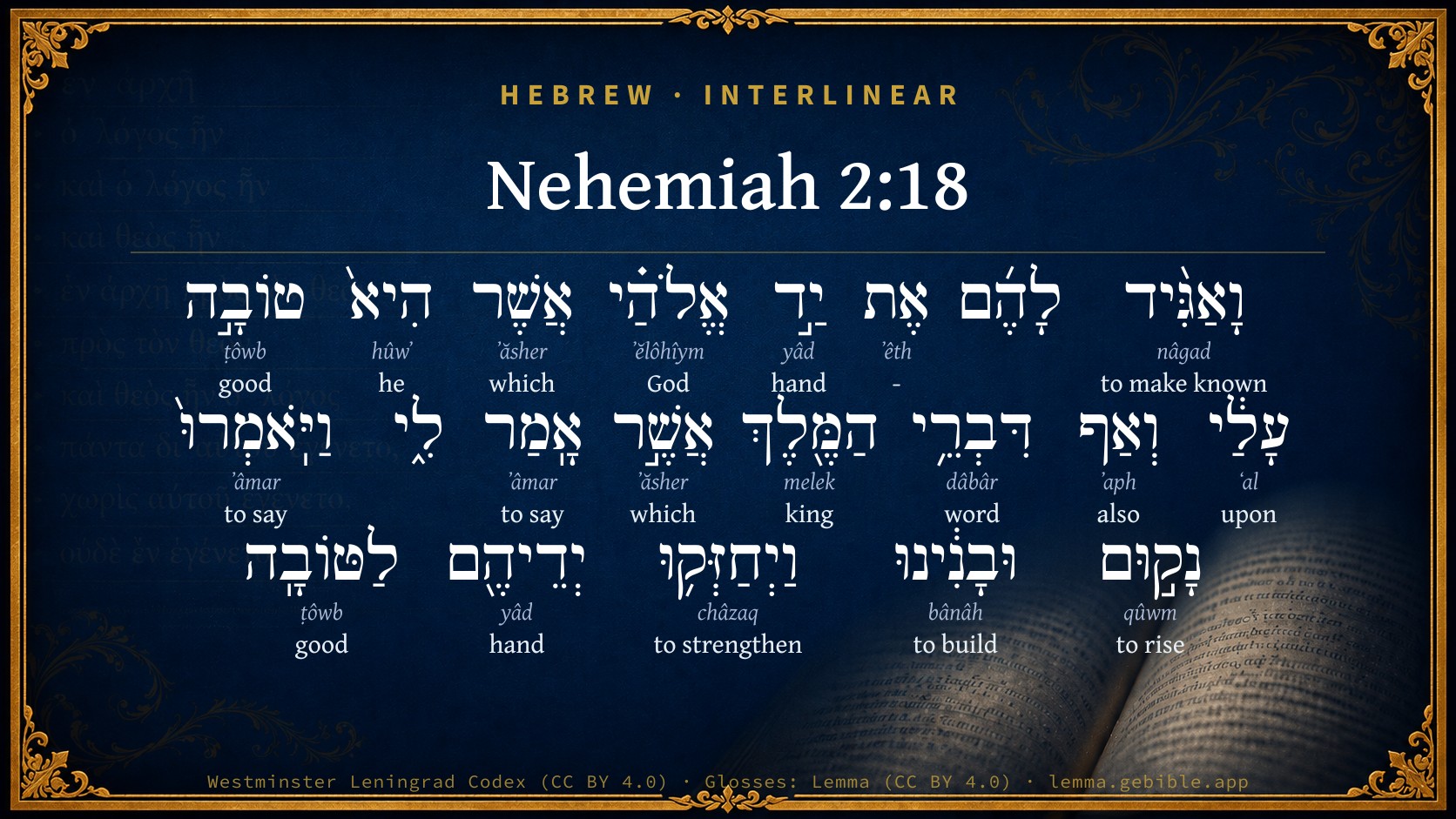
Hebrew (Westminster Leningrad Codex) Nehemiah 2:18 appears in the Hebrew Old Testament. The text above is from the Westminster Leningrad Codex. Each word links to its Strong’s number, a concise gloss, and parsing drawn from the Open Scriptures Hebrew Bible morphology. Click any word for its full Brown-Driver-Briggs (BDB) entry.
Download image
Cite this verse

Nehemiah 2:18 (World English Bible). Public Domain. Lemma interlinear Bible study tool, https://lemma.gebible.app/v/nehemiah/2/18.

Show BibTeX & RIS
BibTeX
RIS
English Translation
I told them of the hand of my God which was good on me, as also of the king's words that he had spoken to me. They said, Let us rise up and build. So they strengthened their hands for the good [work].
World English Bible · Public Domain
Download a study sheet

One document with this verse’s original text, its word-by-word gloss line, the meaning frame, cross-references with their text, attributed commentary, and full source and license credits — printable, and it pastes into notes with its structure intact.

This verse Autodidact and up

Study sheet (.html) Plain text (.txt)

A passage Seminary Student

Up to 50 verses in one chapter. A passage sheet keeps up to 6 commentary sources and 12 cross-references per verse, in the order this page ranks them, and says so on the sheet whenever that leaves anything out. Ask for a single verse and you get the Autodidact verse sheet above.

Everything on this page stays free to read, with no account — the sheet is a download of what is already on screen, not access to it.

Want to remove ads? Support Godless Engineer
Compare translations 3

The same verse in 3 English versions, stacked beneath the original-language interlinear above. Click any original word for its lexicon entry.

Each is an independent rendering of the whole verse — the interlinear is not word-aligned to these translations.

Highlighted words mark where these versions differ — a whole-verse word diff, not a word-by-word alignment.

  • World English Bible Public Domain
    I told them of the hand of my God which was good on me, as also of the king's words that he had spoken to me. They said, Let us rise up and build. So they strengthened their hands for the good [work].
  • King James Version Public Domain
    Then I told them of the hand of my God which was good upon me; as also the king's words that he had spoken unto me. And they said, Let us rise up and build. So they strengthened their hands for this good work.
  • unfoldingWord Literal Text CC BY-SA 4.0
    And I declared to them the hand of my God, that it was good upon me, and also the words of the king that he had spoken to me. And they said, “We will rise up and build.” And they strengthened their hands for good.

unfoldingWord Literal Text — © unfoldingWord, licensed CC BY-SA 4.0. Word-aligned USFM3 via Door43 (git.door43.org/unfoldingWord/en_ult).

Versions to compare (up to 4)

3 of 4 selected

Show all 18 translations

Every available English version of this verse, each an independent rendering of the whole verse.

  • World English Bible Public Domain
    I told them of the hand of my God which was good on me, as also of the king's words that he had spoken to me. They said, Let us rise up and build. So they strengthened their hands for the good [work].
  • Berean Standard Bible Public Domain
    I also told them about the gracious hand of my God upon me, and what the king had said to me. “Let us start rebuilding,” they replied, and they set their hands to this good work.
  • Majority Standard Bible Public Domain
    I also told them about the gracious hand of my God upon me, and what the king had said to me. “Let us start rebuilding,” they replied, and they set their hands to this good work.
  • King James Version Public Domain
    Then I told them of the hand of my God which was good upon me; as also the king's words that he had spoken unto me. And they said, Let us rise up and build. So they strengthened their hands for this good work.
  • American Standard Version (1901) Public Domain
    And I told them of the hand of my God which was good upon me, as also of the king's words that he had spoken unto me. And they said, Let us rise up and build. So they strengthened their hands for the good `work'.
  • Revised Version (1885) Public Domain
    And I told them of the hand of my God which was good upon me; as also of the king’s words that he had spoken unto me. And they said, Let us rise up and build. So they strengthened their hands for the good work.
  • Geneva Bible (1599) Public Domain
    Then I tolde them of the hande of my God, (which was good ouer me) and also of the Kings wordes that he had spoken vnto me. And they sayd, Let vs rise, and buyld. So they strengthened their hand to good.
  • Douay-Rheims (1899) Public Domain
    And I shewed them how the hand of my God was good with me, and the king's words, which he had spoken to me, and I said: Let us rise up, and build. And their hands were strengthened in good.
  • Young's Literal Translation Public Domain
    And I declare to them the hand of my God that is good upon me, and also the words of the king that he said to me, and they say, `Let us rise, and we have built;' and they strengthen their hands for good.
  • Literal Standard Version CC BY-SA 4.0
    And I declare to them the hand of my God that is good on me, and also the words of the king that he said to me, and they say, “Let us rise, and we have built”; and they strengthen their hands for good.
  • Unlocked Literal Bible CC BY-SA 4.0
    I told them that the good hand of my God was on me and also about the king's words that he had spoken to me. They said, “Let us rise up and build.” So they strengthened their hands for the good work.
  • unfoldingWord Literal Text CC BY-SA 4.0
    And I declared to them the hand of my God, that it was good upon me, and also the words of the king that he had spoken to me. And they said, “We will rise up and build.” And they strengthened their hands for good.
  • Darby Bible Public Domain
    And I told them of the hand of my God which had been good upon me; as also of the king's words which he had said unto me. And they said, Let us rise up and build. And they strengthened their hands for the good [work].
  • World Messianic Bible Public Domain
    I told them about the hand of my God which was good on me, and also about the king’s words that he had spoken to me. They said, “Let’s rise up and build.” So they strengthened their hands for the good work.
  • Webster's Bible Public Domain
    Then I told them of the hand of my God which was good upon me; as also the king's words that he had spoken to me. And they said, Let us rise and build. So they strengthened their hands for this good work.
  • Free Bible Version CC BY-SA 4.0
    Then I explained to them how good God had been to me, and what the king had told me. “Let's get on with the rebuilding,” they replied, and they set to work enthusiastically.
  • Bible in Basic English Public Domain
    Then I gave them an account of how the hand of my God was on me, helping me; and of the king's words which he had said to me. And they said, Let us get to work on the building. So they made their hands strong for the good work.
  • JPS Tanakh (1917) Public Domain
    And I told them of the hand of my God which was good upon me; as also of the king's words that he had spoken unto me. And they said: 'Let us rise up and build.' So they strengthened their hands for the good work.

Literal Standard Version (2020), Covenant Press — licensed CC BY-SA 4.0. Text via the HelloAO Bible API (eBible.org). Unlocked Literal Bible (unfoldingWord) — licensed CC BY-SA 4.0. Text via the HelloAO Bible API (eBible.org). unfoldingWord Literal Text — © unfoldingWord, licensed CC BY-SA 4.0. Word-aligned USFM3 via Door43 (git.door43.org/unfoldingWord/en_ult). Free Bible Version, Dr. Jonathan Gallagher — licensed CC BY-SA 4.0. Text via the HelloAO Bible API (eBible.org).

Word by word

More ways to search: Search by grammar → Find every occurrence → Compare this word →

Practice this passage: Drill this verse → Learn its vocabulary →

וְאַף
ʼaph
H637
“and · also”
Conjunction + Adverb
Part of Speech
Conjunction + Adverb
Full BDB Definition

Origin: a primitive particle

TWOT: 142

also, yea, though, so much the more - furthermore, indeed
  1. וָאַגִּ֨יד nâgad H5046 “and · to make known” Conjunction + Verb, Hiphil, Sequential Imperfect, 1st Person, Common, Singular
  2. אֶת ʼêth H853 “-” Particle, Direct Object
  3. יַ֣ד yâd H3027 “hand of” Noun, Common, Both, Singular, Construct
  4. אֱלֹהַ֗י ʼĕlôhîym H430 “God(s) · my” Noun, Common, Masculine, Plural, Construct + Suffix, Personal, 1st Person, Common, Singular
  5. אֲשֶׁר ʼăsher H834 “which” Particle, Relative
  6. הִיא֙ hûwʼ H1931 “he” Pronoun, Personal, 3rd Person, Feminine, Singular
  7. טוֹבָ֣ה ṭôwb H2896 “good” Adjective, Adjective, Feminine, Singular, Absolute
  8. עָלַ֔י ʻal H5921 “upon · me” Preposition + Suffix, Personal, 1st Person, Common, Singular
  9. דִּבְרֵ֥י dâbâr H1697 “words of” Noun, Common, Masculine, Plural, Construct
  10. הַמֶּ֖לֶךְ melek H4428 “the · king” Particle, Definite Article + Noun, Common, Masculine, Singular, Absolute
  11. אֲשֶׁ֣ר ʼăsher H834 “which” Particle, Relative
  12. אָֽמַר ʼâmar H559 “to say” Verb, Qal, Perfect, 3rd Person, Masculine, Singular
  13. וַיֹּֽאמְרוּ֙ ʼâmar H559 “and · to say” Conjunction + Verb, Qal, Sequential Imperfect, 3rd Person, Masculine, Plural
  14. נָק֣וּם qûwm H6965 “to rise” Verb, Qal, Imperfect, 1st Person, Common, Plural
  15. וּבָנִ֔ינוּ bânâh H1129 “and · to build” Conjunction + Verb, Qal, Sequential Perfect, 1st Person, Common, Plural
  16. וַיְחַזְּק֥וּ châzaq H2388 “and · to strengthen” Conjunction + Verb, Piel, Sequential Imperfect, 3rd Person, Masculine, Plural
  17. יְדֵיהֶ֖ם yâd H3027 “hands · their” Noun, Common, Both, Dual, Construct + Suffix, Personal, 3rd Person, Masculine, Plural
  18. לַטּוֹבָֽה ṭôwb H2896 “to/for the · good” Preposition, Determined + Adjective, Adjective, Feminine, Singular, Absolute

About this verse

These counts appear in no published source. They are computed here, from the morphology-tagged text and Lemma’s own curated glosses. What Lemma adds →

21
words
15
distinct lemmas
Historical
section

Grammatical profile

  • 6 verbs
  • 5 nouns
  • 2 adjectives
  • 1 pronoun
  • 3 prepositions
  • 1 adverb
  • 3 particles

Verb forms

  • וָאַגִּ֨יד Hiphil · Sequential Imperfect
  • אָֽמַר Qal · Perfect
  • וַיֹּֽאמְרוּ֙ Qal · Sequential Imperfect
  • נָק֣וּם Qal · Imperfect
  • וּבָנִ֔ינוּ Qal · Sequential Perfect
  • וַיְחַזְּק֥וּ Piel · Sequential Imperfect

Repetition

Words recur within this verse — often emphatic in Hebrew:

  • יַ֣ד hand H3027 ×2
  • טוֹבָ֣ה good H2896 ×2
  • אָֽמַר to say H559 ×2
  • אֲשֶׁר which H834 ×2

Cross-references

8

Topical passages linked to Nehemiah 2:18 in the Treasury of Scripture Knowledge — connected by theme and wording, ordered by reader-vote popularity; previews shown in the World English Bible.

  • Philippians 2:13 For it is God who works in you both to will and to work, for his good pleasure.
  • 1 Chronicles 19:13 Be of good courage, and let us play the man for our people, and for the cities of our God: and Yahweh do that which seems him good.
  • 2 Chronicles 32:5 He took courage, and built up all the wall that was broken down, and raised [it] up to the towers, and the other wall outside, and strengthened Millo [in] the city of David, and made weapons and shields in abundance.
  • Ephesians 6:10 Finally, be strong in the Lord, and in the strength of his might.
  • Haggai 1:13–14 Then Haggai, Yahweh's messenger, spoke in Yahweh's message to the people, saying, "I am with you," says Yahweh.
  • 2 Samuel 2:7 Now therefore let your hands be strong, and be you valiant; for Saul your lord is dead, and also the house of Judah have anointed me king over them.
  • Ezra 6:22 and kept the feast of unleavened bread seven days with joy: for Yahweh had made them joyful, and had turned the heart of the king of Assyria to them, to strengthen their hands in the work of the house of God, the God of Israel.
  • 1 Chronicles 11:10 Now these are the chief of the mighty men whom David had, who shown themselves strong with him in his kingdom, together with all Israel, to make him king, according to the word of Yahweh concerning Israel.

Cross-references courtesy of OpenBible.info (CC BY 4.0).

Hebrew and Greek witnesses Masoretic Hebrew ↔ Greek Septuagint

The same verse in the two great witnesses to the Old Testament, shown verse-for-verse.

These are two independent witnesses, not word-aligned to each other, and the Septuagint is shown in lemma (dictionary) form.

Hebrew Nehemiah 2:18 Masoretic · Westminster Leningrad Codex

וָאַגִּ֨יד לָהֶ֜ם אֶת יַ֣ד אֱלֹהַ֗י אֲשֶׁר הִיא֙ טוֹבָ֣ה עָלַ֔י וְאַף דִּבְרֵ֥י הַמֶּ֖לֶךְ אֲשֶׁ֣ר אָֽמַר לִ֑י וַיֹּֽאמְרוּ֙ נָק֣וּם וּבָנִ֔ינוּ וַיְחַזְּק֥וּ יְדֵיהֶ֖ם לַטּוֹבָֽה

I told them of the hand of my God which was good on me, as also of the king's words that he had spoken to me. They said, Let us rise up and build. So they strengthened their hands for the good [work].

World English Bible · Public Domain

Greek LXX Structure differs

The Septuagint has no separate book of Nehemiah. Its Greek text is the second half of Esdras B (2 Esdras), chapters 11–23; Ezra is the first half (1–10).

A verse-for-verse comparison isn’t shown here because the chapters and verses don’t line up. Switch to the LXX edition with the MT / LXX toggle above to read the Greek directly.

On this verse, The Cambridge Bible for Schools and Colleges discusses the Septuagint’s reading. Read the note in Commentary ↓

Hebrew: Westminster Leningrad Codex (CC BY 4.0). Greek: Septuagint (public domain); English from a public-domain English Septuagint. How the Septuagint differs from the Hebrew →

Commentary

Notes on Nehemiah 2:18 from classic Christian and Jewish commentators (each source and its license shown beneath its notes). The classic Christian expositions comment on the surrounding passage and are grouped to its opening verse, so a note may address several verses; the Jewish commentaries on the Tanakh (Rashi and others) are per-verse, so they appear only where the commentator wrote on this verse.

Lemma curates 59 commentaries, every one of them public domain or Creative Commons licensed, each selected and text-cleaned for this edition rather than reprinted as found. About our sources →

Trapp's Complete Commentary

John Trapp

Neh 2:18 Then I told them of the hand of my God which was good upon me; as also the king’s words that he had spoken unto me. And they said, Let us rise up and build. So they strengthened their hands for [this] good [work].

Ver. 18. Then I told them of the hand of my God] i.e., of his gracious providence in prospering me in all.

As also the king’s words] Which were likewise very gracious and comfortable. Now he that hath both God and the king on his side, what would he have more?

And they said, Let us rise up and build] So forcible are right words, delivered in a mild and moderate manner, as here. Let us rise, say they. Let us linger no longer, but speedily fall to labour; and recover that with our diligence that our fathers lost by their disobedience.

So they strengthened their hands for this good work] They took courage, and went an end with it. So much good may one man of place, power, and zeal do for the Church, by stirring up to love and good works. It is said of the precious stone Pyrites, that it puts not forth its fiery power till well rubbed; and then it is so hot that it burneth one’s fingers.

John Trapp, A Commentary or Exposition upon All the Books of the Old and New Testament (1647–1656) — public domain. Text from a community e-Sword module.

Tyndale Open Study Notes

Tyndale Open Resources

2:18 Evidence of God’s clear involvement (2:8) is a strong motivator in any project. Nehemiah had God’s guidance, the king’s permission, the necessary letters to procure lumber, and a plan to lead the project. So the people enthusiastically agreed to begin working.

Tyndale Open Study Notes — © Tyndale Open Resources, licensed CC BY-SA 4.0. Text via the HelloAO Bible API.

Geneva Bible (1599)

Geneva Bible translators

They were encouraged, and gave themselves to do well, and to travel in this worthy enterprise.

Geneva Bible (1599) marginal notes — public domain. Text via Bolls.life.

Adam Clarke's Commentary

Verse 18. Then I told them] He opened to them his design and his commission.

Adam Clarke's Commentary on the Bible (1810–1826) — public domain. Text from a community e-Sword/MySword module.

Ellicott's Commentary for English Readers

(18) Then I told them.—Nehemiah relates his providential call, with the king’s commission, and the people were thoroughly enlisted in the good cause.

A Bible Commentary for English Readers, edited by Charles John Ellicott (1878–1897) — public domain. Text from a community e-Sword module.

The Cambridge Bible for Schools and Colleges

gen. ed. J. J. S. Perowne

18. the hand of my God] Cf. Neh_2:8. The blessing which had so far attended his plan.

as also the king’s words] R.V. as also of, &c. He reported the substance of the king’s words, which the compiler has not given us.

Let us rise up and build] The people responded with enthusiasm.

So they strengthened their hands] The presence of enemies on every side made the undertaking hazardous. At the same time the need of courage will be more obvious if we accept the theory of a recent hostile attack (cf. note on Neh_1:2). The versions render the verb in the passive, LXX. ἐκραταιώθησαν αἱ χεῖρες αὐτῶν, Vulg. confortatae sunt manus eorum, which is followed by Luther, ‘ihre Hände wurden gestärkt.

for this good work] R.V. for the good work. Literally, ‘for the good,’ the same expression as ‘the well-fare’ in Neh_2:10. LXX. εἰς τὸ ἀγαθόν, Vulg. in bono.

The Cambridge Bible for Schools and Colleges (gen. ed. J. J. S. Perowne; Cambridge University Press, 1878–1918) — public domain. Text from a community e-Sword module.

John Gill's Exposition

But when Sanballat the Horonite, and Tobiah the servant, the Ammonite, and Geshem the Arabian,.... This third man might be both an Arabian by birth, and governor of some part of Arabia near Judea:

heard it; of their beginning to build:

they laughed us to scorn, and despised us; as very silly people, that undertook what they could never perform:

and said; adding threatenings to their scoffs:

what is this thing that ye do? do ye know what ye are about? have ye any authority to do it? it is unlawful, you will certainly suffer for it:

will ye rebel against the king? the king of Persia; it will be deemed rebellion and treason, and you will be taken up and treated as rebels and traitors; take care what you do, be it at your peril if you proceed.

John Gill's Exposition of the Whole Bible (1746–1763) — public domain (CC PDM 1.0). Text via the HelloAO Bible API.

Albert Barnes' Notes on the Bible

The king’s words - These have not been given; but the royal permission to restore the walls is implied in Neh 2:5-6.

Albert Barnes' Notes on the Bible (1834–1885) — public domain. Text from a community e-Sword/MySword module.

Haydock's Catholic Bible Commentary

Hand. God had manifested his goodness and power, at the court of Persia. (Worthington)

George Leo Haydock (1774–1849), Haydock's Catholic Family Bible and Commentary, 1859 edition — public domain. Excludes Psalms (Douay-Rheims chapter numbering differs from Protestant) and Deuterocanonical books (Catholic canon only).

Whedon's Commentary on the Bible

Daniel D. Whedon

18. The king’s words — Nehemiah informed them, doubtless, not only of what the king had spoken to him, but also of the letters of authority which he held from the king.

They strengthened their hands — Encouraged each other, and set vigorously about the work.

For this good work — Literally, for good. Vatablus explains it, on account of the favour of God and of the king. But the words seem better taken in the more general sense which the literal rendering gives; they encouraged one another for good, not for evil; they set about the work with a good will.

Daniel D. Whedon (gen. ed.), Commentary on the Old and New Testaments (1874–1909) — public domain. Text from a community e-Sword module.

The Pulpit Commentary

Then I told them of the hand of my God. Nehemiah sketched the history of his past life, and showed how God"s providence had always shielded him and supported him. This, however, would scarcely have had any great effect had he not been able to appeal further to the king"s words that he had spoken. These words clearly contained permission to rebuild the wall, and took away the danger of their so doing being regarded as an act of rebellion by the Persians. What others might think was not of very much account. And they said, Let us rise up and build. Nehemiah"s address had all the effect he hoped for from it. He was anxious to carry the nation with him, and induce them, one and. all, to engage heartily in the work, which must be accomplished, if it was to be accomplished at all, by something like a burst of enthusiasm. Such a burst he evokes, and its result is seen in the next chapter. Almost the whole people came forward, and set to work with zeal So they strengthened their hands for this good work. The original is briefer, and more emphatic they strengthened their hands for good." They embraced the good cause, took the good part, set themselves to work heartily on the right side.

Mutual encouragement.

"And they said, Let us rise up and build. So they strengthened their hands for the good work." Narrates the effect produced on all classes at Jerusalem by Nehemiah"s address.

I WHAT MOVED THEM.

1. There was a plain need for energetic and united action.

2. They had a good leader. Competent, resolute, courageous, generous, devoted, self-denying; and withal having authority.

3. There were many encouragements and helps.

4. In all, the will and favourable providence of God seemed manifest.

II TO WHAT IT LED THEM.

1. Ardent enthusiasm.

2. Resolute determination.

3. Mutual exhortation. "Let us rise up and build.

4. Confidence and courage.

5. All combining to impart vigour for the work.

"They strengthened their hands," braced themselves "for the good work." Note throughout that Christians have similar incentives to their work, and should be similarly affected by them. There is sadder and more wide-spread ruin to move our hearts; we have a Divine leader; the word, the grace, and the providence of God combine to urge and encourage us. Let us "provoke" one another "to love and good works," and give ourselves to them with unanimous zeal, resolution, and confidence; thus "strengthening our hands for the good work."

The Pulpit Commentary (1880–1919), ed. H.D.M. Spence-Jones & Joseph S. Exell — public domain. Text from a community e-Sword module.

John Wesley's Explanatory Notes

Rise up - Let us do it with vigour, and diligence, and resolution, as those that are determined to go through with it. Their hands - Their own and one anothers.

John Wesley, Explanatory Notes Upon the Whole Bible (1754–1765) — public domain. Text via the GEBible commentary corpus.

Keil & Delitzsch

C. F. Keil & F. Delitzsch

To gain the favourable regard of the assembly for his design, he informs them how God had so far prospered his undertaking: I told them of the hand of my God, that it = that the hand my God had graciously provided for me, i.e., that God had so graciously arranged my journey to Jerusalem; and the king's words that he had spoken to me, sc. with respect to the building of the wall, of which we are told Neh 2:8 only thus much, that the king gave orders to the keeper of the royal forest to give him wood for building. Encouraged by this information, the assembly exclaimed, "Let us arise and build;" and "they strengthened their hands for good," i.e., they vigorously set about the good work.

Keil & Delitzsch — Biblical Commentary on the Old Testament (1861–1891) — public domain (CC PDM 1.0). Text via the HelloAO Bible API. (Old Testament only.)

Rashi

Rabbi Shlomo Yitzchaki (Rashi)

the hand of my God who gave me favor and success before the king.

for good They intended everything for good—to build the wall of the city and its towers.

Rashi on the Tanakh — English translations: “The Judaica Press complete Tanach with Rashi, translated by A. J. Rosenberg” (CC BY 4.0); “Pentateuch with Rashi's commentary by M. Rosenbaum and A.M. Silbermann, 1929-1934” (public domain); “The Metsudah Tanach series, Lakewood, N.J” (CC BY 4.0); and “The Book of Joshua, Metsudah Publications, 1997” (CC BY 4.0). Text via Sefaria.

Lesson kit

Teaching starters — assembled from the data on this page, not authored interpretation. Every prompt links to the verse data it draws on. Edit before teaching.

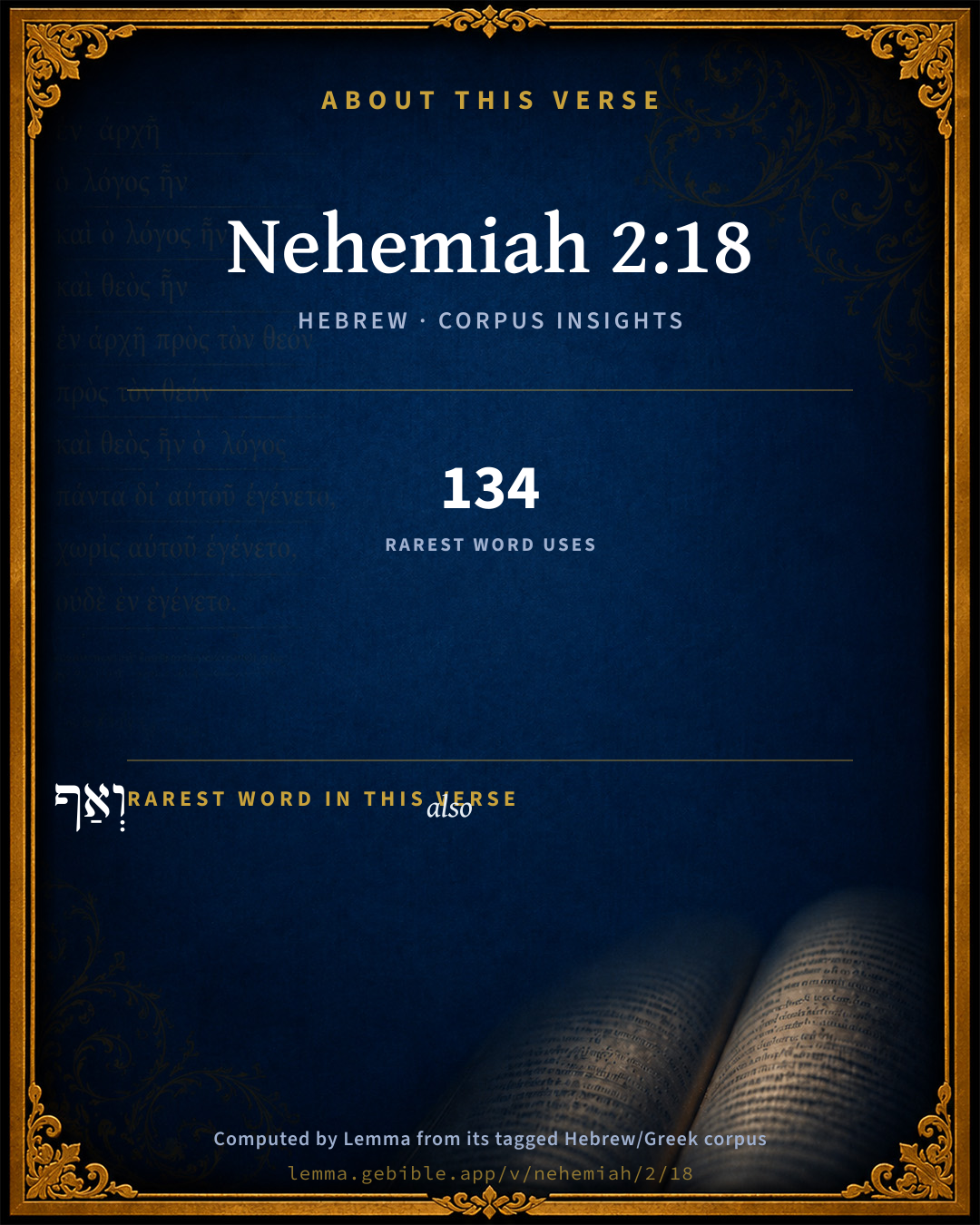
Nehemiah, in the Historical, opens this verse with 21 words (15 distinct Hebrew lemmas). Its most distinctive word is ʼaph (“also”). A historical commentator’s framing appears above. Read the whole chapter for the surrounding context.

Discussion questions

  1. The word ʼaph carries the sense “also.” How does it shape the verse?
  2. Philippians 2:13 shares this passage’s theme. How do the two illuminate each other?
  3. “hand” occurs 2× in this one verse. What is the effect of the repetition?
  4. These translations render this verse differently; the difference is in the English rendering, not the original. What questions does that raise?
  5. The verb «וָאַגִּ֨יד» is Hiphil Sequential Imperfect. How does its form color the action?
  6. Reading how Trapp's Complete Commentary and Tyndale Open Study Notes read this verse, where do the two commentators agree and where do they part?

Things to notice

Reading settings

Reading text

Shown beneath each verse's original-language words.

Old Testament
Old Testament edition

Read the OT as the Masoretic Hebrew (MT) or the Greek Septuagint (LXX).

English shown for the Greek Septuagint (in the Hebrew ↔ Greek comparison).

Comparing translations? Open the Compare panel on any verse page to stack up to four side by side.