
Nehemiah 10:29

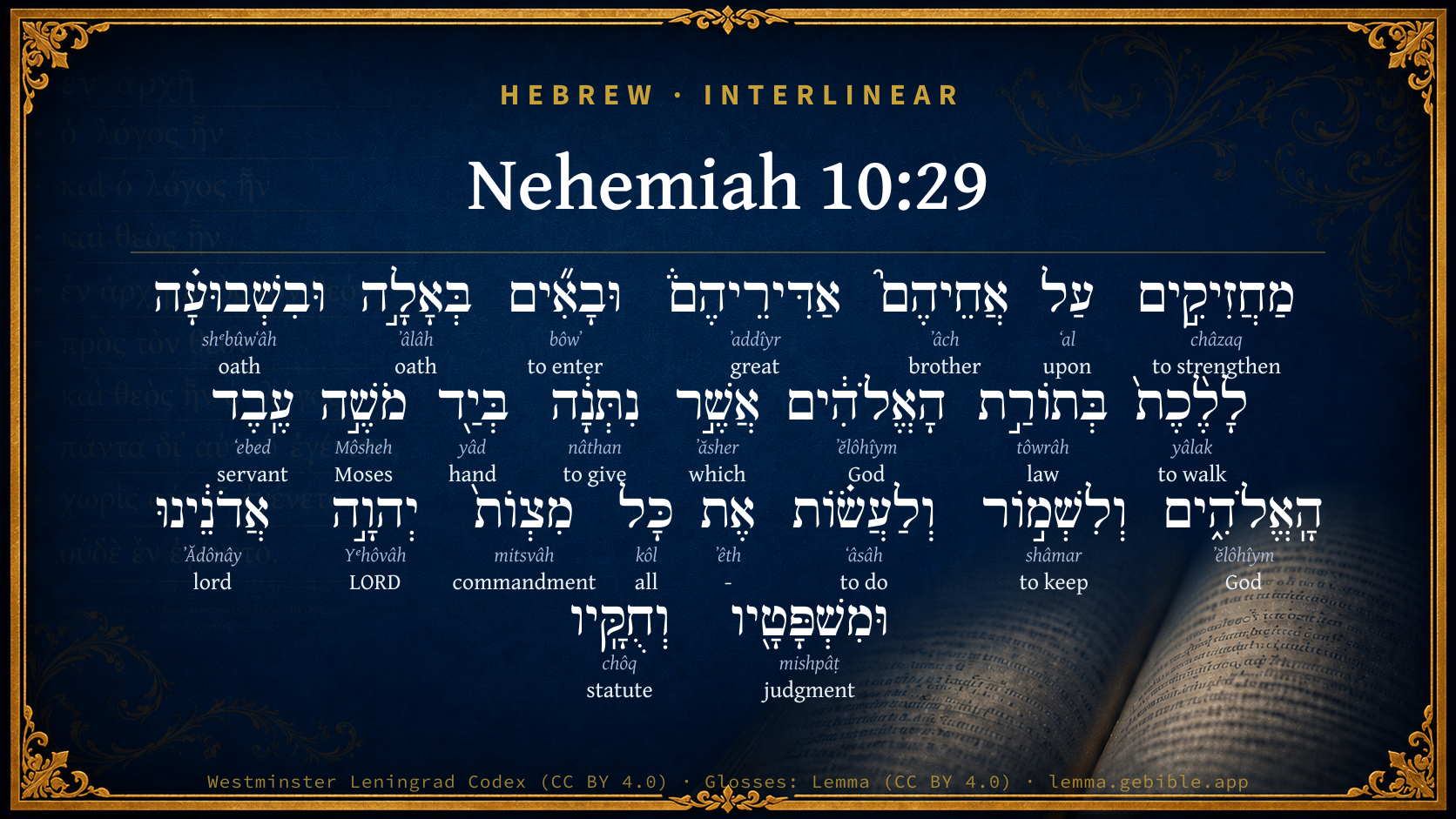
Hebrew (Westminster Leningrad Codex) Nehemiah 10:29 appears in the Hebrew Old Testament. The text above is from the Westminster Leningrad Codex. Each word links to its Strong’s number, a concise gloss, and parsing drawn from the Open Scriptures Hebrew Bible morphology. Click any word for its full Brown-Driver-Briggs (BDB) entry.
Download image
Cite this verse

Nehemiah 10:29 (World English Bible). Public Domain. Lemma interlinear Bible study tool, https://lemma.gebible.app/v/nehemiah/10/29.

Show BibTeX & RIS
BibTeX
RIS
English Translation
They joined with their brothers, their nobles, and entered into a curse, and into an oath, to walk in God's law, which was given by Moses the servant of God, and to observe and do all the commandments of Yahweh our Lord, and his ordinances and his statutes;
World English Bible · Public Domain
Download a study sheet

One document with this verse’s original text, its word-by-word gloss line, the meaning frame, cross-references with their text, attributed commentary, and full source and license credits — printable, and it pastes into notes with its structure intact.

This verse Autodidact and up

Study sheet (.html) Plain text (.txt)

A passage Seminary Student

Up to 50 verses in one chapter. A passage sheet keeps up to 6 commentary sources and 12 cross-references per verse, in the order this page ranks them, and says so on the sheet whenever that leaves anything out. Ask for a single verse and you get the Autodidact verse sheet above.

Everything on this page stays free to read, with no account — the sheet is a download of what is already on screen, not access to it.

Want to remove ads? Support Godless Engineer
Compare translations 3

The same verse in 3 English versions, stacked beneath the original-language interlinear above. Click any original word for its lexicon entry.

Each is an independent rendering of the whole verse — the interlinear is not word-aligned to these translations.

Highlighted words mark where these versions differ — a whole-verse word diff, not a word-by-word alignment.

  • World English Bible Public Domain
    They joined with their brothers, their nobles, and entered into a curse, and into an oath, to walk in God's law, which was given by Moses the servant of God, and to observe and do all the commandments of Yahweh our Lord, and his ordinances and his statutes;
  • King James Version Public Domain
    They clave to their brethren, their nobles, and entered into a curse, and into an oath, to walk in God's law, which was given by Moses the servant of God, and to observe and do all the commandments of the LORD our Lord, and his judgments and his statutes;
  • unfoldingWord Literal Text CC BY-SA 4.0
    were clinging to their brothers, their nobles, and were entering into a curse and into an oath: to walk in the law of God, which was given by the hand of Moses the servant of God; and to keep and to do all the commandments of Yahweh our Lord, and his judgments and his statutes;

unfoldingWord Literal Text — © unfoldingWord, licensed CC BY-SA 4.0. Word-aligned USFM3 via Door43 (git.door43.org/unfoldingWord/en_ult).

Versions to compare (up to 4)

3 of 4 selected

Show all 18 translations

Every available English version of this verse, each an independent rendering of the whole verse.

  • World English Bible Public Domain
    They joined with their brothers, their nobles, and entered into a curse, and into an oath, to walk in God's law, which was given by Moses the servant of God, and to observe and do all the commandments of Yahweh our Lord, and his ordinances and his statutes;
  • Berean Standard Bible Public Domain
    hereby join with their noble brothers and commit themselves with a sworn oath to follow the Law of God given through His servant Moses and to carefully obey all the commandments, ordinances, and statutes of the LORD our Lord.
  • Majority Standard Bible Public Domain
    hereby join with their noble brothers and commit themselves with a sworn oath to follow the Law of God given through His servant Moses and to obey carefully all the commandments, ordinances, and statutes of the LORD our Lord.
  • King James Version Public Domain
    They clave to their brethren, their nobles, and entered into a curse, and into an oath, to walk in God's law, which was given by Moses the servant of God, and to observe and do all the commandments of the LORD our Lord, and his judgments and his statutes;
  • American Standard Version (1901) Public Domain
    They clave to their brethren, their nobles, and entered into a curse, and into an oath, to walk in God's law, which was given by Moses the servant of God, and to observe and do all the commandments of Jehovah our Lord, and his ordinances and his statutes;
  • Revised Version (1885) Public Domain
    They clave to their brethren, their nobles, and entered into a curse, and into an oath, to walk in God’s law, which was given by Moses the servant of God, and to observe and to do all the commandments of the LORD our Lord, and his judgments and his statutes;
  • Geneva Bible (1599) Public Domain
    The chiefe of them receiued it for their brethren, and they came to the curse and to the othe to walke in Gods Law, which was giuen by Moses the seruant of God, to obserue and doe all the commandements of the Lord our God, and his iudgements and his statutes:
  • Douay-Rheims (1899) Public Domain
    All that could understand promising for their brethren, with their chief men, and they came to promise, and swear that they would walk in the law of God, which he gave in the hand of Moses the servant of God, that they would do and keep all the commandments of the Lord our God, and his judgments and his ceremonies.
  • Young's Literal Translation Public Domain
    are laying hold on their brethren, their honourable ones, and coming in to an execration, and in to an oath, to walk in the law of God, that was given by the hand of Moses, servant of God, and to observe and to do all the commands of Jehovah our Lord, and His judgments, and His statutes;
  • Literal Standard Version CC BY-SA 4.0
    are laying hold on their brothers, their majestic ones, and coming into an execration and an oath, to walk in the Law of God, that was given by the hand of Moses, servant of God, and to observe and to do all the commands of YHWH our Lord, and His judgments, and His statutes;
  • Unlocked Literal Bible CC BY-SA 4.0
    they joined together with their brothers, their nobles, and bound themselves with both a curse and an oath to walk in God's law, which was given by Moses the servant of God, and to observe and obey all the commandments of Yahweh our Lord and his decrees and his statutes.
  • unfoldingWord Literal Text CC BY-SA 4.0
    were clinging to their brothers, their nobles, and were entering into a curse and into an oath: to walk in the law of God, which was given by the hand of Moses the servant of God; and to keep and to do all the commandments of Yahweh our Lord, and his judgments and his statutes;
  • Darby Bible Public Domain
    joined with their brethren, their nobles, and entered into a curse and into an oath, to walk in the law of God, which had been given by Moses the servant of God, and to keep and do all the commandments of Jehovah our Lord, and his ordinances and his statutes;
  • World Messianic Bible Public Domain
    joined with their brothers, their nobles, and entered into a curse and into an oath, to walk in God’s Torah, which was given by Moses the servant of God, and to observe and do all the commandments of the LORD our Lord, and his ordinances and his statutes;
  • Webster's Bible Public Domain
    They united with their brethren, their nobles, and entered into a curse, and into an oath, to walk in God's law, which was given by Moses the servant of God, and to observe and do all the commandments of the LORD our Lord, and his judgments and his statutes;
  • Free Bible Version CC BY-SA 4.0
    joined the leaders in swearing an oath to follow the Law of God given through Moses the servant of God, to pay attention to and carry out all the commands of the Lord our God, his rules and regulations.
  • Bible in Basic English Public Domain
    They were united with their brothers, their rulers, and put themselves under a curse and an oath, to keep their steps in the way of God's law, which was given by Moses, the servant of God, and to keep and do all the orders of the Lord, our Lord, and his decisions and his rules;
  • JPS Tanakh (1917) Public Domain
    (10-30) they cleaved to their brethren, their nobles, and entered into a curse, and into an oath, to walk in God's law, which was given by Moses the servant of God, and to observe and do all the commandments of the LORD our Lord, and His ordinances and His statutes;

Literal Standard Version (2020), Covenant Press — licensed CC BY-SA 4.0. Text via the HelloAO Bible API (eBible.org). Unlocked Literal Bible (unfoldingWord) — licensed CC BY-SA 4.0. Text via the HelloAO Bible API (eBible.org). unfoldingWord Literal Text — © unfoldingWord, licensed CC BY-SA 4.0. Word-aligned USFM3 via Door43 (git.door43.org/unfoldingWord/en_ult). Free Bible Version, Dr. Jonathan Gallagher — licensed CC BY-SA 4.0. Text via the HelloAO Bible API (eBible.org).

Word by word

More ways to search: Search by grammar → Find every occurrence → Compare this word →

Practice this passage: Drill this verse → Learn its vocabulary →

אַדִּירֵיהֶם֒
ʼaddîyr
H117
“great · their”
Adjective, Adjective, Masculine, Plural, Construct + Suffix, Personal, 3rd Person, Masculine, Plural
Part of Speech
Adjective
Type
Adjective
Gender
Masculine
Number
Plural
State
Construct
Full BDB Definition

Origin: from H142

TWOT: 28b

great, majestic - of waters of sea - of a tree - of kings, nations, gods - great one, majestic one - of nobles, chieftains, servants
  1. מַחֲזִיקִ֣ים châzaq H2388 “strengthening” Verb, Hiphil, Participle Active, Masculine, Plural, Absolute
  2. עַל ʻal H5921 “upon” Preposition
  3. אֲחֵיהֶם֮ ʼâch H251 “brothers · their” Noun, Common, Masculine, Plural, Construct + Suffix, Personal, 3rd Person, Masculine, Plural
  4. וּבָאִ֞ים bôwʼ H935 “and · entering” Conjunction + Verb, Qal, Participle Active, Masculine, Plural, Absolute
  5. בְּאָלָ֣ה ʼâlâh H423 “in/at · oath” Preposition + Noun, Common, Feminine, Singular, Absolute
  6. וּבִשְׁבוּעָ֗ה shᵉbûwʻâh H7621 “and · in/at · oath” Conjunction + Preposition + Noun, Common, Feminine, Singular, Absolute
  7. לָלֶ֨כֶת֙ yâlak H3212 “to walk” Preposition + Verb, Qal, Infinitive Construct
  8. בְּתוֹרַ֣ת tôwrâh H8451 “in/at · law of” Preposition + Noun, Common, Feminine, Singular, Construct
  9. הָאֱלֹהִ֔ים ʼĕlôhîym H430 “the · God(s)” Particle, Definite Article + Noun, Common, Masculine, Plural, Absolute
  10. אֲשֶׁ֣ר ʼăsher H834 “which” Particle, Relative
  11. נִתְּנָ֔ה nâthan H5414 “to give” Verb, Niphal, Perfect, 3rd Person, Feminine, Singular
  12. בְּיַ֖ד yâd H3027 “in/at · hand of” Preposition + Noun, Common, Both, Singular, Construct
  13. מֹשֶׁ֣ה Môsheh H4872 “Moses” Noun, Proper
  14. עֶֽבֶד ʻebed H5650 “servant of” Noun, Common, Masculine, Singular, Construct
  15. הָֽאֱלֹהִ֑ים ʼĕlôhîym H430 “the · God(s)” Particle, Definite Article + Noun, Common, Masculine, Plural, Absolute
  16. וְלִשְׁמ֣וֹר shâmar H8104 “and · to keep” Conjunction + Preposition + Verb, Qal, Infinitive Construct
  17. וְלַעֲשׂ֗וֹת ʻâsâh H6213 “and · to do” Conjunction + Preposition + Verb, Qal, Infinitive Construct
  18. אֶת ʼêth H853 “-” Particle, Direct Object
  19. כָּל kôl H3605 “all of” Noun, Common, Masculine, Singular, Construct
  20. מִצְוֺת֙ mitsvâh H4687 “commandments of” Noun, Common, Feminine, Plural, Construct
  21. יְהוָ֣ה Yᵉhôvâh H3068 “LORD” Noun, Proper
  22. אֲדֹנֵ֔ינוּ ʼĂdônây H136 “Lord · our” Noun, Common, Masculine, Plural, Construct + Suffix, Personal, 1st Person, Common, Plural
  23. וּמִשְׁפָּטָ֖יו mishpâṭ H4941 “and · judgments · his” Conjunction + Noun, Common, Masculine, Plural, Construct + Suffix, Personal, 3rd Person, Masculine, Singular
  24. וְחֻקָּֽיו chôq H2706 “and · statutes · his” Conjunction + Noun, Common, Masculine, Plural, Construct + Suffix, Personal, 3rd Person, Masculine, Singular

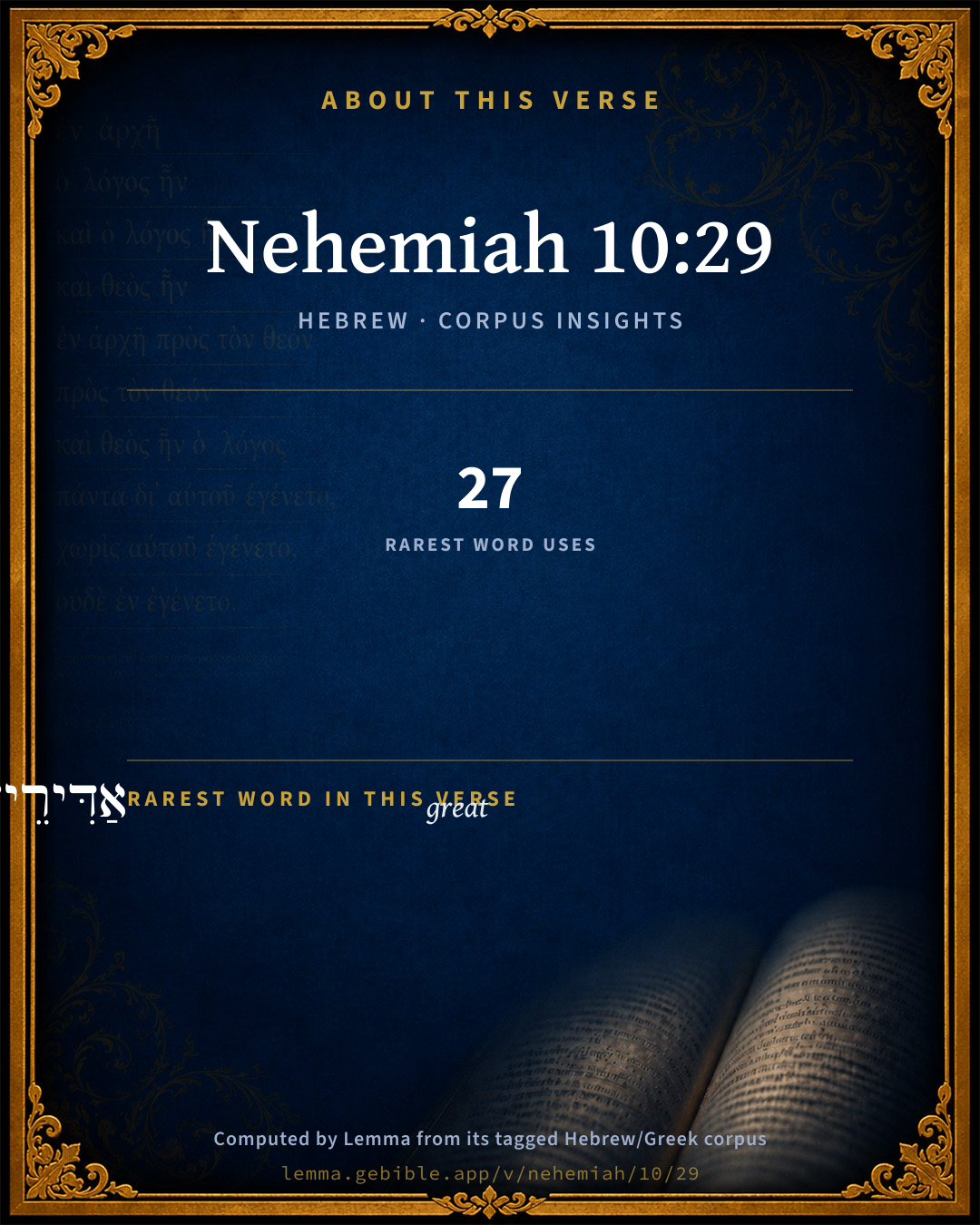
About this verse

These counts appear in no published source. They are computed here, from the morphology-tagged text and Lemma’s own curated glosses. What Lemma adds →

25
words
24
distinct lemmas
Historical
section

Shared distinctive vocabulary

אַדִּירֵיהֶם֒ great H117 occurs in 25 verses of the Hebrew Bible. Also found in:

Grammatical profile

  • 6 verbs
  • 15 nouns
  • 1 adjective
  • 1 preposition
  • 2 particles

Verb forms

  • מַחֲזִיקִ֣ים Hiphil · Participle Active
  • וּבָאִ֞ים Qal · Participle Active
  • לָלֶ֨כֶת֙ Qal · Infinitive Construct
  • נִתְּנָ֔ה Niphal · Perfect
  • וְלִשְׁמ֣וֹר Qal · Infinitive Construct
  • וְלַעֲשׂ֗וֹת Qal · Infinitive Construct

Repetition

A word recurs within this verse — often emphatic in Hebrew:

  • הָאֱלֹהִ֔ים God H430 ×2

Cross-references

29

Topical passages linked to Nehemiah 10:29 in the Treasury of Scripture Knowledge — connected by theme and wording, ordered by reader-vote popularity; previews shown in the World English Bible.

  • Ezekiel 36:27 I will put my Spirit within you, and cause you to walk in my statutes, and you shall keep my ordinances, and do them.
  • Psalms 119:106 I have sworn, and have confirmed it, That I will obey your righteous ordinances.
  • John 15:14 You are my friends, if you do whatever I command you.
  • Titus 2:11–14 For the grace of God has appeared, bringing salvation to all men,
  • 2 Kings 23:3 The king stood by the pillar, and made a covenant before Yahweh, to walk after Yahweh, and to keep his commandments, and his testimonies, and his statutes, with all [his] heart, and all [his] soul, to confirm the words of this covenant that were written in this book: and all the people stood to the covenant.
  • 2 Chronicles 34:31 The king stood in his place, and made a covenant before Yahweh, to walk after Yahweh, and to keep his commandments, and his testimonies, and his statutes, with all his heart, and with all his soul, to perform the words of the covenant that were written in this book.
  • Nehemiah 5:12–13 Then said they, We will restore them, and will require nothing of them; so will we do, even as you say. Then I called the priests, and took an oath of them, that they would do according to this promise.
  • Romans 12:9 Let love be without hypocrisy. Abhor that which is evil. Cling to that which is good.
  • Deuteronomy 5:1 Moses called to all Israel, and said to them, Hear, Israel, the statutes and the ordinances which I speak in your ears this day, that you may learn them, and observe to do them.
  • Deuteronomy 5:32 You shall observe to do therefore as Yahweh your God has commanded you: you shall not turn aside to the right hand or to the left.
  • Deuteronomy 27:15–26 Cursed be the man who makes an engraved or molten image, an abomination to Yahweh, the work of the hands of the craftsman, and sets it up in secret. All the people shall answer and say, Amen.
  • Deuteronomy 29:12–14 that you may enter into the covenant of Yahweh your God, and into his oath, which Yahweh your God makes with you this day;
  • Deuteronomy 33:4 Moses commanded us a law, An inheritance for the assembly of Jacob.
  • 2 Kings 10:31 But Jehu took no heed to walk in the law of Yahweh, the God of Israel, with all his heart: he didn't depart from the sins of Jeroboam, with which he made Israel to sin.
  • 2 Chronicles 6:16 Now therefore, Yahweh, the God of Israel, keep with your servant David my father that which you have promised him, saying, There shall not fail you a man in my sight to sit on the throne of Israel, if only your children take heed to their way, to walk in my law as you have walked before me.
  • 2 Chronicles 15:13–14 and that whoever would not seek Yahweh, the God of Israel, should be put to death, whether small or great, whether man or woman.
  • Nehemiah 13:25 I contended with them, and cursed them, and struck certain of them, and plucked off their hair, and made them swear by God, [saying], You shall not give your daughters to their sons, nor take their daughters for your sons, or for yourselves.
  • Psalms 8:1 Yahweh, our Lord, how majestic is your name in all the earth, Who has set your glory above the heavens!
  • Psalms 8:9 Yahweh, our Lord, How majestic is your name in all the earth!
  • Psalms 105:45 That they might keep his statutes, And observe his laws. Praise Yah!
  • Isaiah 14:1 For Yahweh will have compassion on Jacob, and will yet choose Israel, and set them in their own land: and the foreigner shall join himself with them, and they shall cleave to the house of Jacob.
  • Jeremiah 26:4 You shall tell them, Thus says Yahweh: If you will not listen to me, to walk in my law, which I have set before you,
  • Malachi 4:4 "Remember the law of Moses my servant, which I commanded to him in Horeb for all Israel, even statutes and ordinances.
  • John 1:17 For the law was given through Moses. Grace and truth came through Jesus Christ.
  • John 7:19 Didn't Moses give you the law, and yet none of you keeps the law? Why do you seek to kill me?"
  • Acts 11:23 who, when he had come, and had seen the grace of God, was glad. He exhorted them all, that with purpose of heart they should remain near to the Lord.
  • Acts 17:34 But certain men joined with him, and believed, among whom also was Dionysius the Areopagite, and a woman named Damaris, and others with them.
  • Acts 23:12–15 When it was day, some of the Jews banded together, and bound themselves under a curse, saying that they would neither eat nor drink until they had killed Paul.
  • Acts 23:21 Therefore don't yield to them, for more than forty men lie in wait for him, who have bound themselves under a curse neither to eat nor to drink until they have killed him. Now they are ready, looking for the promise from you."

Cross-references courtesy of OpenBible.info (CC BY 4.0).

Hebrew and Greek witnesses Masoretic Hebrew ↔ Greek Septuagint

The same verse in the two great witnesses to the Old Testament, shown verse-for-verse.

These are two independent witnesses, not word-aligned to each other, and the Septuagint is shown in lemma (dictionary) form.

Hebrew Nehemiah 10:29 Masoretic · Westminster Leningrad Codex

מַחֲזִיקִ֣ים עַל אֲחֵיהֶם֮ אַדִּירֵיהֶם֒ וּבָאִ֞ים בְּאָלָ֣ה וּבִשְׁבוּעָ֗ה לָלֶ֨כֶת֙ בְּתוֹרַ֣ת הָאֱלֹהִ֔ים אֲשֶׁ֣ר נִתְּנָ֔ה בְּיַ֖ד מֹשֶׁ֣ה עֶֽבֶד הָֽאֱלֹהִ֑ים וְלִשְׁמ֣וֹר וְלַעֲשׂ֗וֹת אֶת כָּל מִצְוֺת֙ יְהוָ֣ה אֲדֹנֵ֔ינוּ וּמִשְׁפָּטָ֖יו וְחֻקָּֽיו

They joined with their brothers, their nobles, and entered into a curse, and into an oath, to walk in God's law, which was given by Moses the servant of God, and to observe and do all the commandments of Yahweh our Lord, and his ordinances and his statutes;

World English Bible · Public Domain

Greek LXX Structure differs

The Septuagint has no separate book of Nehemiah. Its Greek text is the second half of Esdras B (2 Esdras), chapters 11–23; Ezra is the first half (1–10).

A verse-for-verse comparison isn’t shown here because the chapters and verses don’t line up. Switch to the LXX edition with the MT / LXX toggle above to read the Greek directly.

Hebrew: Westminster Leningrad Codex (CC BY 4.0). Greek: Septuagint (public domain); English from a public-domain English Septuagint. How the Septuagint differs from the Hebrew →

Commentary

Notes on Nehemiah 10:29 from classic Christian and Jewish commentators (each source and its license shown beneath its notes). The classic Christian expositions comment on the surrounding passage and are grouped to its opening verse, so a note may address several verses; the Jewish commentaries on the Tanakh (Rashi and others) are per-verse, so they appear only where the commentator wrote on this verse.

Lemma curates 59 commentaries, every one of them public domain or Creative Commons licensed, each selected and text-cleaned for this edition rather than reprinted as found. About our sources →

Jamieson, Fausset & Brown

Robert Jamieson, A. R. Fausset & David Brown

POINTS OF THE COVENANT. (Neh 10:29-39)

to observe and do all the commandments, &c.--This national covenant, besides containing a solemn pledge of obedience to the divine law generally, specified their engagement to some particular duties, which the character and exigency of the times stamped with great urgency and importance, and which may be summed up under the following heads: that they abstain from contracting matrimonial alliances with the heathen; that they would rigidly observe the sabbath; that they would let the land enjoy rest and remit debts every seventh year; that they would contribute to the maintenance of the temple service, the necessary expenses of which had formerly been defrayed out of the treasury of the temple (Ch1 26:20), and when it was drained, given out from the king's privy purse (Ch2 31:3); and that they would make an orderly payment of the priests' dues. A minute and particular enumeration of the first-fruits was made, that all might be made fully aware of their obligations, and that none might excuse themselves on pretext of ignorance from withholding taxes which the poverty of many, and the irreligion of others, had made them exceedingly prone to evade.

Jamieson, Fausset & Brown — Commentary Critical and Explanatory on the Whole Bible (1871) — public domain (CC PDM 1.0). Text via the HelloAO Bible API.

Trapp's Complete Commentary

John Trapp

Neh 10:29 They clave to their brethren, their nobles, and entered into a curse, and into an oath, to walk in God’s law, which was given by Moses the servant of God, and to observe and do all the commandments of the LORD our Lord, and his judgments and his statutes;

Ver. 29. They clave to their brethren] Heb. They laid fast hold on them, viz. by taking hold of the covenant, to keep the Sabbath from polluting it, and choosing the things that please God, as Isa 56:4; Isa 56:6.

And entered into a curse] The more to confirm the oath, and to keep their deceitful hearts close to God. See Deu 29:12; Deu 29:21. This is called the oath of God, Ecc 7:2. Confer Isa 19:18; Isa 44:5; 2Ch 15:12; 2Ch 15:14; 2Ch 34:31.

To walk in God’s law] Ex gnomone et canone decalogi, to walk accurately and exactly by line and by rule (Aug. in Exod.). "In all the commandments and ordinances of the Lord blameless," Luk 1:6, so far as by his grace he should vouchsafe to assist them. For lex iubet, gratia iuvat. The law orders, grace assists. The bowls of the candlestick have no oil but what droppeth from the olive branches. David can wish well to the keeping of God’s commandments diligently, Psa 119:4-5, but promise no further than God shall please to enlarge his heart, Neh 10:32. Vows and covenants indefinitely and absolutely made (as that of Jephthah, Jdg 11:31) prove a snare. Condition with the Lord for his strength and grace; rely not on thine own sufficiency, lest it repent thee of thy rashness and self-confidence, as it befell Peter. Consider that thou art but a poor garrison soldier; and without supplies of the Spirit of Jesus Christ, Php 1:19, thou canst do nothing. David knew this, and therefore called earnestly for help from heaven, Psa 51:13-15; Psa 119:106-107.

John Trapp, A Commentary or Exposition upon All the Books of the Old and New Testament (1647–1656) — public domain. Text from a community e-Sword module.

Joseph Benson's Commentary

Neh 10:29. They clave to their brethren, their nobles — The commonalty owned and ratified what the nobles had done in their names, declaring their assent to it by their words, or by lifting up of their hands, as the manner was. Great men never look so great as when they encourage religion, and are examples of it: and they would by that, as much as any thing, make an interest in the most valuable of their inferiors, who would cleave to them closer than they can imagine. Observe, their nobles are called their brethren; for in the things of God, rich and poor, high and low, meet together. And entered into a curse, and into an oath — That is, an oath under an execration. They obliged themselves by an oath to walk in God’s law, with an imprecation upon themselves, if they violated it; wishing, probably, that all the curses written in the law might fall upon them, if they did not observe it in all things.

Joseph Benson's Commentary on the Old and New Testaments (1811–1818) — public domain. Text from a community e-Sword module.

Keil & Delitzsch

C. F. Keil & F. Delitzsch

All the members of the community acceded to the agreement thus signed by the princes of the people, and the heads of the priests and Levites, and bound themselves by an oath to walk in the law of the Lord, and to separate themselves from the heathen.

Neh 10:29

And the rest of the people, the priests, the Levites, the door-keepers, the singers, the Nethinim, and all that had separated themselves from the people of the lands unto the law of God, their wives, their sons, and their daughters, all who had knowledge and understanding, held with their brethren, their nobles, and entered into an oath and curse, etc. מצזיקים is the predicate of the subjects in Neh 10:29 : they were holding with their brethren, i.e., uniting with them in this matter. "The rest of the people, the priests," etc., are the members of the community, exclusive of the princes and heads of the priestly and Levitical orders. The Nethinim, to whom belonged the servants of Solomon (see rem. on Ezr 2:43.), were probably also represented in the assembly by the heads of the Levites. To these are added all who had separated themselves, etc., i.e., the descendants of those Israelites who had been left in the land, and who now joined the new community; see rem. on Ezr 6:21. The connection of נבדּל with אל־תּורת is significant: separated from the heathen to the law of God, i.e., to live according thereto; comp. Ezr 6:21. Not, however, the men only, but also women and children of riper years, acceded to the covenant. כּל־יודע מבין, every one knowing, understanding (מבין and יודע being connected as an asyndeton, to strengthen the meaning), refers to sons and daughters of an age sufficient to enable them to understand the matter. אדּרריהם, their nobles, is connected in the form of an apposition with אחיהם, instead of the adjective האדּירים. The princes and the heads of the community and priesthood are intended. באלה בּוא, to enter into an oath, comp. Eze 17:13. אלה is an oath of self-imprecation, grievous punishments being imprecated in case of transgression; שׁבוּעה, a promissory oath to live conformably with the law. We hence perceive the tenor of the agreement entered into and sealed by the princes. Non subscripsit quidem populus, remarks Clericus, sed ratum habuit, quid-quid nomine totius populi a proceribus factum erat, juravitque id a se observatum iri. Besides the general obligation to observe all the commandments, judgments, and statutes of God, two points, then frequently transgressed, are specially mentioned in Neh 10:31 and Neh 10:23. In Neh 10:31 : that we would not give our daughters to the people of the lands, etc.; see rem. on Ezr 9:2. In Neh 10:32 : that if the people of the land brought wares or any victuals on the Sabbath-day to sell, we would not buy if of them on the Sabbath, or on a holy day; and would let the seventh year lie, and the loan of every hand. The words וגו הארץ עמּי are prefixed absolutely, and are afterwards subordinated to the predicate of the sentence by מהם. מקּחות, wares for sale, from לקח, to take, in the sense of to buy, occurs only here. מהם נקּח, to take from them, i.e., to buy. קדשׁ יום beside שׁבּת means the other holy days, the annual festivals, on which, according to the law, Num 28 and 29, no work was to be done. To the sanctification of the Sabbath pertained the celebration of the sabbatical year, which is therefore named immediately afterwards. The words השׁ את־השּׁנה נטשׁ, to let the seventh year lie, i.e., in the seventh year to let the land lie untilled and unsown, is an abbreviation taken from the language of the law, Exo 28:10. כל־יד משּׁא also depends upon נטּשׁ. This expression (משּׁא, not משּׂא, being the reading of the best editions) is to be explained from Deu 15:2, and means the loan, that which the hand has lent to another; see rem. on Deu 15:2.

Keil & Delitzsch — Biblical Commentary on the Old Testament (1861–1891) — public domain (CC PDM 1.0). Text via the HelloAO Bible API. (Old Testament only.)

Tyndale Open Study Notes

Tyndale Open Resources

10:29 swore a curse on themselves if they failed to obey the Law: Cp. Lev 26:14-35; Deut 28:15-62.

Tyndale Open Study Notes — © Tyndale Open Resources, licensed CC BY-SA 4.0. Text via the HelloAO Bible API.

Geneva Bible (1599)

Geneva Bible translators

They made the oath in the name of the whole multitude.

Whereunto they gave themselves if they brake the Law, as Deut. 28:15.

Geneva Bible (1599) marginal notes — public domain. Text via Bolls.life.

Adam Clarke's Commentary

Verse 29. They clave to their brethren] Though they did not sign this instrument, yet they bound themselves under a solemn oath that they would fulfil the conditions of the covenant, and walk according to the law of Moses.

Adam Clarke's Commentary on the Bible (1810–1826) — public domain. Text from a community e-Sword/MySword module.

Ellicott's Commentary for English Readers

(29) They clave to their brethren.—It was a union of the people as such, and sprang from a deep national conviction.

Entered into a curse, and into an oath.—The oath assumed the obligation; the curse imprecated the penalty of violation. (Comp. Deu_29:12.)

A Bible Commentary for English Readers, edited by Charles John Ellicott (1878–1897) — public domain. Text from a community e-Sword module.

John Gill's Exposition

They clave to their brethren, their nobles,.... Who had signed and sealed the covenant, they declared their approbation of it, attended to it, and ratified what they had done in their name:

and entered into a curse, and into an oath, to walk in God's law, which was given by Moses the servant of God; they bound themselves with an oath that they would keep the law of God, and added a curse or imprecation on themselves to it should they break it; or, according to Piscator, they went into the space between the two pieces of the calf, which they cut asunder for the confirmation of the covenant, and so they cursed themselves if they should break it, see Jer 34:18

and to observe and do all the commandments of the Lord our God, and his judgments and his statutes; all the laws, moral, ceremonial, and judicial; this they engaged to do in general; some particulars follow.

John Gill's Exposition of the Whole Bible (1746–1763) — public domain (CC PDM 1.0). Text via the HelloAO Bible API.

Haydock's Catholic Bible Commentary

Understand. Hebrew mebin, "the teachers," or Levites, 1 Esdras viii. 16. (Menochius) --- Promising. Hebrew, "clave to their brethren;" and they promised with a curse to transgressors, and with an oath to walk, &c. (Haydock)

George Leo Haydock (1774–1849), Haydock's Catholic Family Bible and Commentary, 1859 edition — public domain. Excludes Psalms (Douay-Rheims chapter numbering differs from Protestant) and Deuterocanonical books (Catholic canon only).

Matthew Poole's English Annotations

They clave to their brethren; they owned and ratified what the others had done in their names, declaring their assent to it by their words, or by the lifting up of their hands, as the manner was.

Into an oath, i.e. an oath bound with a curse or imprecation upon themselves, in case they violated it.

Matthew Poole's English Annotations on the Holy Bible (1683–1685) — public domain. Text from a community e-Sword/MySword module.

Whedon's Commentary on the Bible

Daniel D. Whedon

29. Entered into a curse, and into an oath — Bound themselves by publicly uttered vows, and invoked upon themselves the curse of God should they prove unfaithful to their oaths.

Daniel D. Whedon (gen. ed.), Commentary on the Old and New Testaments (1874–1909) — public domain. Text from a community e-Sword module.

The Pulpit Commentary

They clave to their brethren, their nobles. They gave their support and adherence to their more distinguished brethren who had attached their seals to the document, approving what they had done, and ratifying it. Entered into a curse, and into an oath, to walk in God"s law. Something of this kind seems to have occurred in the wilderness, when God"s law was first given to his people; (Deu_29:12) and therefore, when renewals of the covenant were made, and the people were required to ratify the act, it was natural to recur to the old sanction, An oath was probably taken of the people in the time of Josiah, (2Ki_23:3) when they are said to have "stood to the covenant." Moses the servant of God. The epithet "servant of God," or "servant of the Lord," attaches to Moses in a peculiar way. God called him (Num_12:7) "my servant Moses, who is faithful in all my house;" and henceforward "servant of God" was his epitheton usitatum. (see Jos_1:1 Jos_8:31, 33 1Ch_6:49 2Ch_24:9 Dan_9:11 Heb_3:5 Rev_15:3) St. Paul contrasts "Moses, the servant" with "Christ, the Son". (Heb_3:1-6)

The Pulpit Commentary (1880–1919), ed. H.D.M. Spence-Jones & Joseph S. Exell — public domain. Text from a community e-Sword module.

John Wesley's Explanatory Notes

Their nobles - The commonality agreed with the nobles in this good work, great men never look so great, as when they encourage religion and are examples of it: and they would by that, as much as any thing, make an interest in the most valuable of their inferiors, who would cleave to them closer than they can imagine. Observe their nobles are called their brethren; for in the things of God, rich and poor, high and low meet together. They cleave - They ratified what the others had done in their names, declaring their assent to it.

John Wesley, Explanatory Notes Upon the Whole Bible (1754–1765) — public domain. Text via the GEBible commentary corpus.

Rashi

Rabbi Shlomo Yitzchaki (Rashi)

and all who separated themselves These are the proselytes who separated themselves from the practice of the nations to cling and attach themselves to the Law of the Holy One, blessed be He, and to keep His commandments.

Rashi on the Tanakh — English translations: “The Judaica Press complete Tanach with Rashi, translated by A. J. Rosenberg” (CC BY 4.0); “Pentateuch with Rashi's commentary by M. Rosenbaum and A.M. Silbermann, 1929-1934” (public domain); “The Metsudah Tanach series, Lakewood, N.J” (CC BY 4.0); and “The Book of Joshua, Metsudah Publications, 1997” (CC BY 4.0). Text via Sefaria.

Lesson kit

Teaching starters — assembled from the data on this page, not authored interpretation. Every prompt links to the verse data it draws on. Edit before teaching.

Nehemiah, in the Historical, opens this verse with 25 words (24 distinct Hebrew lemmas). Its most distinctive word is ʼaddîyr (“great”). A historical commentator’s framing appears above. Read the whole chapter for the surrounding context.

Discussion questions

  1. The word ʼaddîyr carries the sense “great.” How does it shape the verse?
  2. How does Exodus 15:10, which shares the word «great», read alongside this verse?
  3. What does the repetition of “God” (2× in this one verse) do in this verse?
  4. These translations render this verse differently. What is at stake in choosing one wording over another?
  5. «מַחֲזִיקִ֣ים» is a Hiphil Participle Active verb. How does that grammatical form shape the action described?
  6. Compare how Jamieson, Fausset & Brown and Trapp's Complete Commentary read this verse. Where do they agree or differ?

Things to notice

Reading settings

Reading text

Shown beneath each verse's original-language words.

Old Testament
Old Testament edition

Read the OT as the Masoretic Hebrew (MT) or the Greek Septuagint (LXX).

English shown for the Greek Septuagint (in the Hebrew ↔ Greek comparison).

Comparing translations? Open the Compare panel on any verse page to stack up to four side by side.