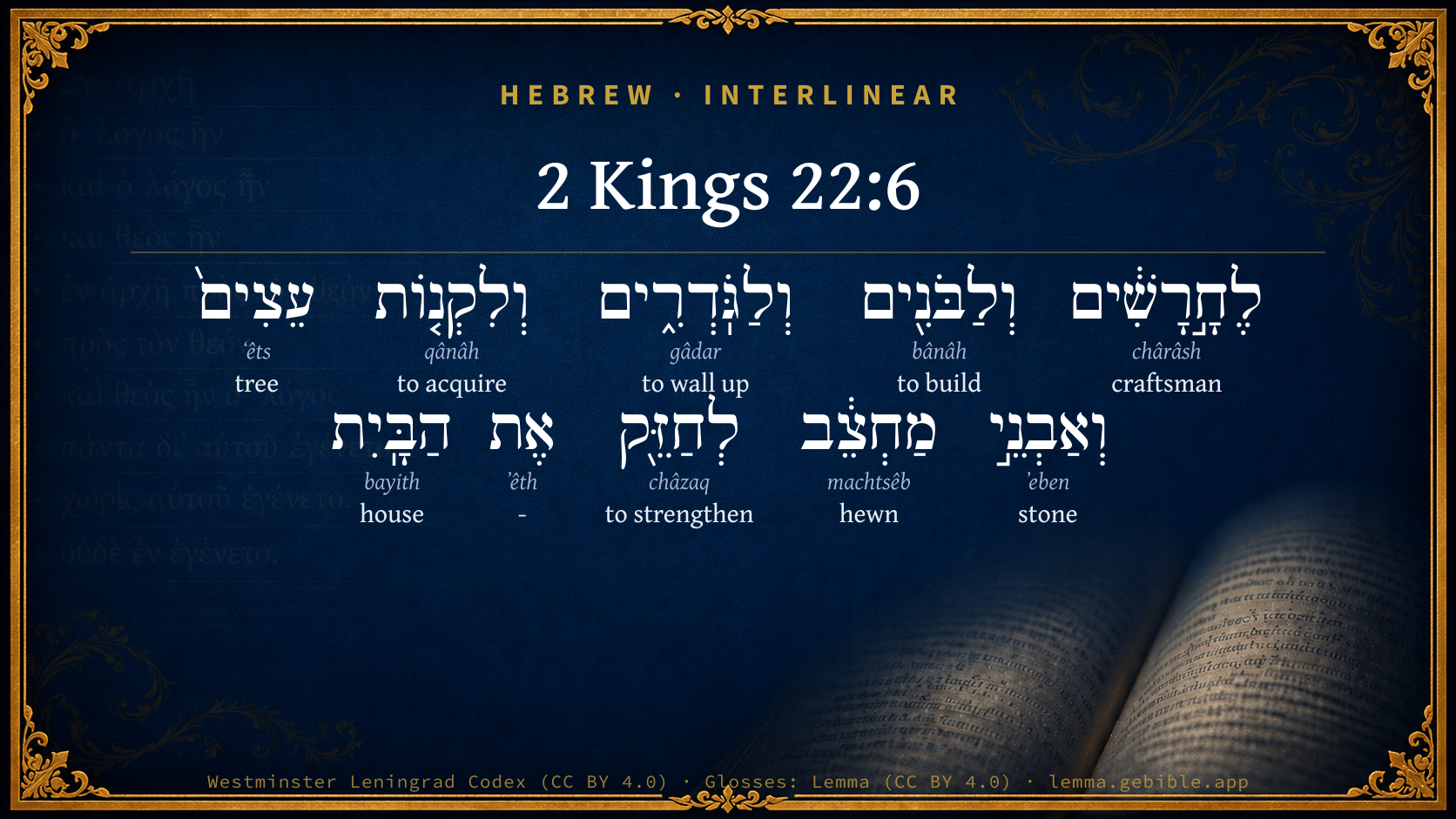
2 Kings 22:6

Hebrew (Westminster Leningrad Codex) 2 Kings 22:6 appears in the Hebrew Old Testament. The text above is from the Westminster Leningrad Codex. Each word links to its Strong’s number, a concise gloss, and parsing drawn from the Open Scriptures Hebrew Bible morphology. Click any word for its full Brown-Driver-Briggs (BDB) entry.
Download image
Cite this verse

2 Kings 22:6 (World English Bible). Public Domain. Lemma interlinear Bible study tool, https://lemma.gebible.app/v/2-kings/22/6.

Show BibTeX & RIS
BibTeX
RIS
English Translation
to the carpenters, and to the builders, and to the masons, and for buying timber and hewn stone to repair the house.
World English Bible · Public Domain
Download a study sheet

One document with this verse’s original text, its word-by-word gloss line, the meaning frame, cross-references with their text, attributed commentary, and full source and license credits — printable, and it pastes into notes with its structure intact.

This verse Autodidact and up

Study sheet (.html) Plain text (.txt)

A passage Seminary Student

Up to 50 verses in one chapter. A passage sheet keeps up to 6 commentary sources and 12 cross-references per verse, in the order this page ranks them, and says so on the sheet whenever that leaves anything out. Ask for a single verse and you get the Autodidact verse sheet above.

Everything on this page stays free to read, with no account — the sheet is a download of what is already on screen, not access to it.

Want to remove ads? Support Godless Engineer
Compare translations 3

The same verse in 3 English versions, stacked beneath the original-language interlinear above. Click any original word for its lexicon entry.

Each is an independent rendering of the whole verse — the interlinear is not word-aligned to these translations.

Highlighted words mark where these versions differ — a whole-verse word diff, not a word-by-word alignment.

  • World English Bible Public Domain
    to the carpenters, and to the builders, and to the masons, and for buying timber and hewn stone to repair the house.
  • King James Version Public Domain
    Unto carpenters, and builders, and masons, and to buy timber and hewn stone to repair the house.
  • unfoldingWord Literal Text CC BY-SA 4.0
    to the craftsmen and to the builders and to the masons, and to buy wood and stones of hewing to strengthen the house.”

unfoldingWord Literal Text — © unfoldingWord, licensed CC BY-SA 4.0. Word-aligned USFM3 via Door43 (git.door43.org/unfoldingWord/en_ult).

Versions to compare (up to 4)

3 of 4 selected

Show all 18 translations

Every available English version of this verse, each an independent rendering of the whole verse.

  • World English Bible Public Domain
    to the carpenters, and to the builders, and to the masons, and for buying timber and hewn stone to repair the house.
  • Berean Standard Bible Public Domain
    to the carpenters, builders, and masons—to buy timber and dressed stone to repair the temple.
  • Majority Standard Bible Public Domain
    to the carpenters, builders, and masons—to buy timber and dressed stone to repair the temple.
  • King James Version Public Domain
    Unto carpenters, and builders, and masons, and to buy timber and hewn stone to repair the house.
  • American Standard Version (1901) Public Domain
    unto the carpenters, and to the builders, and to the masons, and for buying timber and hewn stone to repair the house.
  • Revised Version (1885) Public Domain
    unto the carpenters, and to the builders, and to the masons; and for buying timber and hewn stone to repair the house.
  • Geneva Bible (1599) Public Domain
    To wit, vnto the artificers and carpenters and masons, and to bye timber, and hewed stone to repaire the house.
  • Douay-Rheims (1899) Public Domain
    That is, to carpenters and masons, and to such as mend breaches: and that timber may be bought, and stones out of the quarries, to repair the temple of the Lord.
  • Young's Literal Translation Public Domain
    to artificers, and to builders, and `to repairers of' the wall, and to buy wood and hewn stones to strengthen the house;
  • Literal Standard Version CC BY-SA 4.0
    to craftsmen, and to builders, and [to repairers of] the wall, and to buy wood and hewn stones to strengthen the house;
  • Unlocked Literal Bible CC BY-SA 4.0
    Let them give money to the carpenters, the builders, and the masons, and also to buy timber and cut stone to repair the temple.”
  • unfoldingWord Literal Text CC BY-SA 4.0
    to the craftsmen and to the builders and to the masons, and to buy wood and stones of hewing to strengthen the house.”
  • Darby Bible Public Domain
    to the carpenters and the builders and the masons, and to buy timber and hewn stone to repair the house.
  • World Messianic Bible Public Domain
    to the carpenters, and to the builders, and to the masons, and for buying timber and cut stone to repair the house.
  • Webster's Bible Public Domain
    To carpenters, and builders, and masons, and to buy timber, and hewn stone to repair the house.
  • Free Bible Version CC BY-SA 4.0
    the carpenters, the builders and the masons. In addition have them purchase timber and cut stone to repair the Temple.
  • Bible in Basic English Public Domain
    To the woodworkers and the builders and the stone-cutters; and for getting wood and cut stones for the building up of the house.
  • JPS Tanakh (1917) Public Domain
    unto the carpenters, and to the builders, and to the masons; and for buying timber and hewn stone to repair the house.' —

Literal Standard Version (2020), Covenant Press — licensed CC BY-SA 4.0. Text via the HelloAO Bible API (eBible.org). Unlocked Literal Bible (unfoldingWord) — licensed CC BY-SA 4.0. Text via the HelloAO Bible API (eBible.org). unfoldingWord Literal Text — © unfoldingWord, licensed CC BY-SA 4.0. Word-aligned USFM3 via Door43 (git.door43.org/unfoldingWord/en_ult). Free Bible Version, Dr. Jonathan Gallagher — licensed CC BY-SA 4.0. Text via the HelloAO Bible API (eBible.org).

Word by word

More ways to search: Search by grammar → Find every occurrence → Compare this word →

Practice this passage: Drill this verse → Learn its vocabulary →

מַחְצֵ֔ב
machtsêb
H4274
“hewn”
Noun, Common, Masculine, Singular, Absolute
Part of Speech
Noun
Type
Common
Gender
Masculine
Number
Singular
State
Absolute
Full BDB Definition

Origin: from H2672

TWOT: 718a

hewing, hewn - of stones
  1. לֶחָ֣רָשִׁ֔ים chârâsh H2796 “to/for the · craftsmen” Preposition, Determined + Noun, Common, Masculine, Plural, Absolute
  2. וְלַבֹּנִ֖ים bânâh H1129 “and · to/for the · building” Conjunction + Preposition, Determined + Verb, Qal, Participle Active, Masculine, Plural, Absolute
  3. וְלַגֹּֽדְרִ֑ים gâdar H1443 “and · to/for the · walling up” Conjunction + Preposition, Determined + Verb, Qal, Participle Active, Masculine, Plural, Absolute
  4. וְלִקְנ֤וֹת qânâh H7069 “and · to acquire” Conjunction + Preposition + Verb, Qal, Infinitive Construct
  5. עֵצִים֙ ʻêts H6086 “trees” Noun, Common, Masculine, Plural, Absolute
  6. וְאַבְנֵ֣י ʼeben H68 “and · stones of” Conjunction + Noun, Common, Feminine, Plural, Construct
  7. לְחַזֵּ֖ק châzaq H2388 “to strengthen” Preposition + Verb, Piel, Infinitive Construct
  8. אֶת ʼêth H853 “-” Particle, Direct Object
  9. הַבָּֽיִת bayith H1004 “the · house” Particle, Definite Article + Noun, Common, Masculine, Singular, Absolute

About this verse

These counts appear in no published source. They are computed here, from the morphology-tagged text and Lemma’s own curated glosses. What Lemma adds →

10
words
10
distinct lemmas
Historical
section

Notable vocabulary

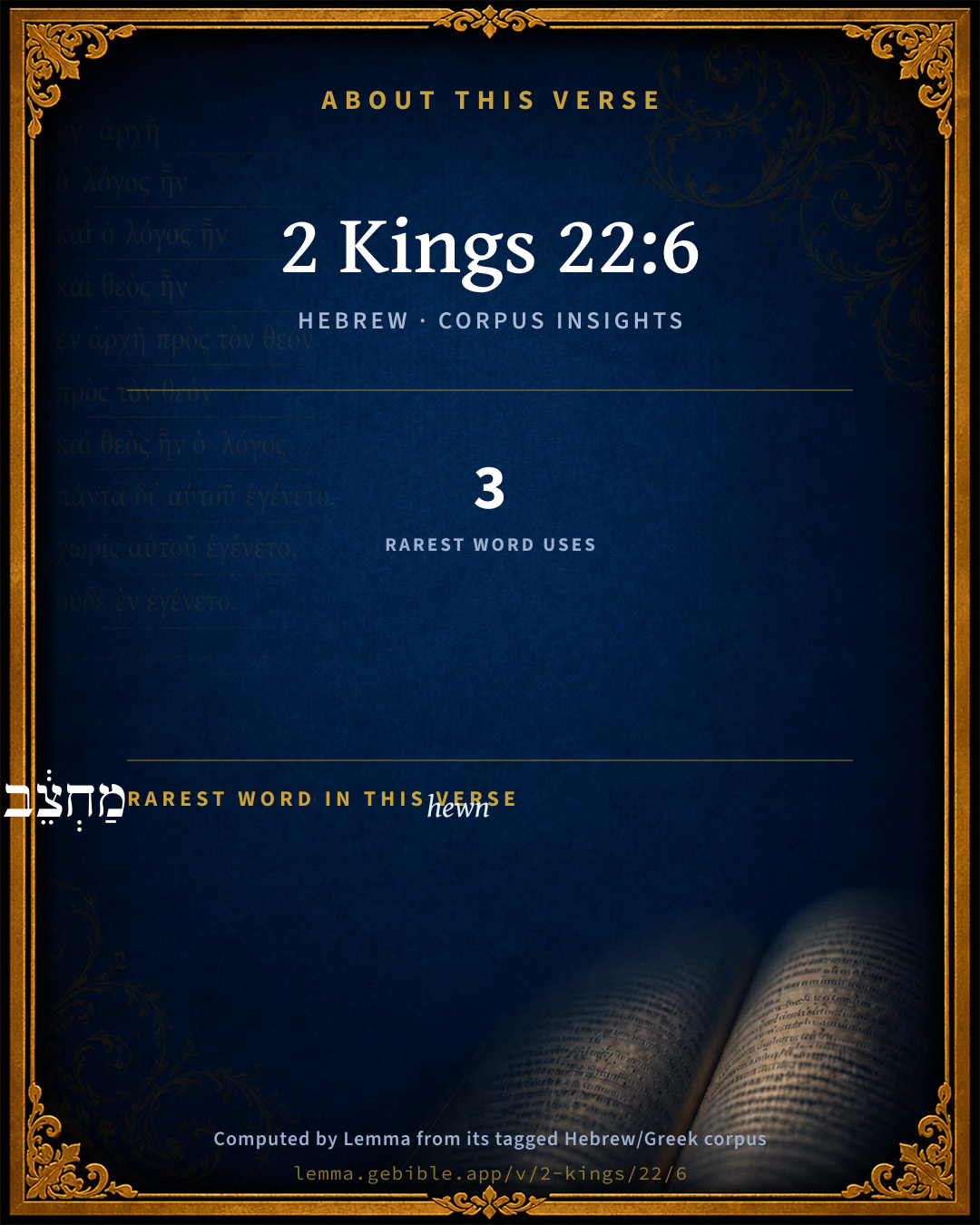
The rarest word here is מַחְצֵ֔ב hewn H4274 — appearing just 3 times in the whole Hebrew Bible.

Shared distinctive vocabulary

מַחְצֵ֔ב hewn H4274 occurs in 3 verses of the Hebrew Bible. Also found in:

Grammatical profile

  • 4 verbs
  • 5 nouns
  • 1 particle

Verb forms

  • וְלַבֹּנִ֖ים Qal · Participle Active
  • וְלַגֹּֽדְרִ֑ים Qal · Participle Active
  • וְלִקְנ֤וֹת Qal · Infinitive Construct
  • לְחַזֵּ֖ק Piel · Infinitive Construct

Hebrew & Septuagint length

In English translation the verse runs 22 words from the Hebrew and 23 from the Septuagint (LXX English) — closely comparable.

A rough comparison of the two English renderings, which tokenize alike — not a word-level alignment.

Word counts can differ between the Hebrew and the Greek without any difference in meaning — e.g. the Hebrew direct-object marker אֵת has no separate Greek word, and Greek often adds the article ὁ.

Hebrew and Greek witnesses Masoretic Hebrew ↔ Greek Septuagint

The same verse in the two great witnesses to the Old Testament, shown verse-for-verse.

These are two independent witnesses, not word-aligned to each other, and the Septuagint is shown in lemma (dictionary) form.

Hebrew 2 Kings 22:6 Masoretic · Westminster Leningrad Codex

לֶחָ֣רָשִׁ֔ים וְלַבֹּנִ֖ים וְלַגֹּֽדְרִ֑ים וְלִקְנ֤וֹת עֵצִים֙ וְאַבְנֵ֣י מַחְצֵ֔ב לְחַזֵּ֖ק אֶת הַבָּֽיִת

to the carpenters, and to the builders, and to the masons, and for buying timber and hewn stone to repair the house.

World English Bible · Public Domain

Greek LXX 2 Kings 22:6 Septuagint · lemma form

ὁ τέκτων καί ὁ οἰκοδόμος καί ὁ τειχιστής καί ὁ κτάομαι ξύλον καί λίθος λατόμητος ὁ κραταιόω ὁ βεδεκ ὁ οἶκος

even to the carpenters, and builders, and masons, and also to purchase timber and hewn stones, to repair the breaches of the house.

LXX2012 (modern English Septuagint) · Public Domain

Hebrew: Westminster Leningrad Codex (CC BY 4.0). Greek: Septuagint (public domain); English from LXX2012 (modern English Septuagint) (Public Domain). How the Septuagint differs from the Hebrew →

Targum (Aramaic paraphrase)

1

The Targum is the ancient Jewish Aramaic paraphrase of the Hebrew Scriptures — an interpretive translation, not the Hebrew text itself. Onkelos (literal) and Pseudo-Jonathan (expansive) render the Torah, and Jonathan the Prophets. Coverage is partial: where no permissively-licensed English translation exists for a verse, only the Aramaic is shown. This is verse-level text, not a word-by-word alignment to the Hebrew.

  1. Targum Jonathan Prophets (Joshua–Malachi)
    לְנַגָרַיָא וּלְאַרְדַכְלַיָא וּלְאַרְגוּבְלַיָא וּלְמִזְבַּן אָעִין וְאַבְנִין פְּסִילַן לְתַקָפָא יַת בֵּיתָא:

    (no public-domain English translation for this verse)

    Targum Jonathan — Aramaic: “Mikraot Gedolot” (public domain). English: “Sefaria Community Translation” (CC0 1.0 (public-domain dedication)); “London "Chaldee Paraphrase," 1871” (public domain). Text via Sefaria.

Commentary

Notes on 2 Kings 22:6 from classic Christian and Jewish commentators (each source and its license shown beneath its notes). The classic Christian expositions comment on the surrounding passage and are grouped to its opening verse, so a note may address several verses; the Jewish commentaries on the Tanakh (Rashi and others) are per-verse, so they appear only where the commentator wrote on this verse.

Lemma curates 59 commentaries, every one of them public domain or Creative Commons licensed, each selected and text-cleaned for this edition rather than reprinted as found. About our sources →

Trapp's Complete Commentary

John Trapp

2Ki 22:6 Unto carpenters, and builders, and masons, and to buy timber and hewn stone to repair the house.

Ver. 6. To buy timber and hewn stone.] For the very stone walls also temporis iniuria et hominum incuria were much decayed.

John Trapp, A Commentary or Exposition upon All the Books of the Old and New Testament (1647–1656) — public domain. Text from a community e-Sword module.

The Cambridge Bible for Schools and Colleges

gen. ed. J. J. S. Perowne

6. unto [R.V. adds the] carpenters, and [R.V. to the] builders, and [R.V. to the] masons] All the words are definite in the original.

and to buy [R.V. for buying] timber] The contractors had to provide both materials and labour from the money which was put at their disposal, and they were apparently persons who could be trusted to make the best possible provision without oversight.

The Cambridge Bible for Schools and Colleges (gen. ed. J. J. S. Perowne; Cambridge University Press, 1878–1918) — public domain. Text from a community e-Sword module.

John Gill's Exposition

Unto carpenters, and builders, and masons,.... Who were employed, some in mending the woodwork, and others in repairing the stone walls

and to buy timber and hewn stone to repair the house; not only money was to be given them for their workmanship, but to buy timber and stone to work with.

John Gill's Exposition of the Whole Bible (1746–1763) — public domain (CC PDM 1.0). Text via the HelloAO Bible API.

Matthew Poole's English Annotations

Either hewed or cut out of the quarries, or to be hewed and fitted to the building.

Matthew Poole's English Annotations on the Holy Bible (1683–1685) — public domain. Text from a community e-Sword/MySword module.

The Pulpit Commentary

Unto carpenters, and builders, and masons, and to buy timber, and hewn stone to repair the house. (comp. 2Ch_34:11) The money had to be expended, partly in labor, partly in materials. The materials consisted of both wood and stone, since it was of these that Solomon"s temple had been built. (see 1Ki_5:18 1Ki_6:7, 1Ki_6:9, 1Ki_6:10, 1Ki_6:15, 1Ki_6:36)

The Pulpit Commentary (1880–1919), ed. H.D.M. Spence-Jones & Joseph S. Exell — public domain. Text from a community e-Sword module.

unfoldingWord translationNotes

Door43 World Missions Community

General Information:

The message from King Josiah to Hilkiah, the high priest, continues.

Let them give money ... was given to them ... because they handled

Here "them" and "they" refer to the workmen who are in charge of the house of Yahweh in 2 Kings 22:5.

the carpenters, the builders, and the masons

These are the same as the workmen who are in the house of Yahweh in 2 Kings 22:5. Here the workers are described in more detail.

carpenters

workers who build with wood

masons

workers who build with stone

no accounting was required for the money that was given to them

This can be stated in active form. AT: "the workmen who were in charge did not have to report how they used the money that the temple guards gave them" (See: Active or Passive)

because they handled it faithfully

"because they used the money honestly"

translationWords

faithful

unfoldingWord translationNotes — © Distant Shores Media and the Door43 World Missions Community, licensed CC BY-SA 4.0. Source: git.door43.org/Door43/en_tn.

Lesson kit

Teaching starters — assembled from the data on this page, not authored interpretation. Every prompt links to the verse data it draws on. Edit before teaching.

2 Kings, in the Historical, opens this verse with 10 words (10 distinct Hebrew lemmas). Its most distinctive word is machtsêb (“hewn”). A historical commentator’s framing appears above. Read the whole chapter for the surrounding context.

Discussion questions

  1. What does “hewn” (machtsêb) contribute to the verse as a whole?
  2. 2 Kings 12:12 shares the word «hewn» with this verse. How do the two illuminate each other?
  3. These translations render this verse differently. What is at stake in choosing one wording over another?
  4. The verb «וְלַבֹּנִ֖ים» is Qal Participle Active. How does its form color the action?
  5. Reading how Trapp's Complete Commentary and The Cambridge Bible for Schools and Colleges read this verse, where do the two commentators agree and where do they part?

Things to notice

Reading settings

Reading text

Shown beneath each verse's original-language words.

Old Testament
Old Testament edition

Read the OT as the Masoretic Hebrew (MT) or the Greek Septuagint (LXX).

English shown for the Greek Septuagint (in the Hebrew ↔ Greek comparison).

Comparing translations? Open the Compare panel on any verse page to stack up to four side by side.