1 Samuel 23:16

Hebrew (Westminster Leningrad Codex) 1 Samuel 23:16 appears in the Hebrew Old Testament. The text above is from the Westminster Leningrad Codex. Each word links to its Strong’s number, a concise gloss, and parsing drawn from the Open Scriptures Hebrew Bible morphology. Click any word for its full Brown-Driver-Briggs (BDB) entry.
Download image
Cite this verse

1 Samuel 23:16 (World English Bible). Public Domain. Lemma interlinear Bible study tool, https://lemma.gebible.app/v/1-samuel/23/16.

Show BibTeX & RIS
BibTeX
RIS
English Translation
Jonathan, Saul's son, arose, and went to David into the wood, and strengthened his hand in God.
World English Bible · Public Domain
Download a study sheet

One document with this verse’s original text, its word-by-word gloss line, the meaning frame, cross-references with their text, attributed commentary, and full source and license credits — printable, and it pastes into notes with its structure intact.

This verse Autodidact and up

Study sheet (.html) Plain text (.txt)

A passage Seminary Student

Up to 50 verses in one chapter. A passage sheet keeps up to 6 commentary sources and 12 cross-references per verse, in the order this page ranks them, and says so on the sheet whenever that leaves anything out. Ask for a single verse and you get the Autodidact verse sheet above.

Everything on this page stays free to read, with no account — the sheet is a download of what is already on screen, not access to it.

Want to remove ads? Support Godless Engineer
Compare translations 3

The same verse in 3 English versions, stacked beneath the original-language interlinear above. Click any original word for its lexicon entry.

Each is an independent rendering of the whole verse — the interlinear is not word-aligned to these translations.

Highlighted words mark where these versions differ — a whole-verse word diff, not a word-by-word alignment.

  • World English Bible Public Domain
    Jonathan, Saul's son, arose, and went to David into the wood, and strengthened his hand in God.
  • King James Version Public Domain
    And Jonathan Saul's son arose, and went to David into the wood, and strengthened his hand in God.
  • unfoldingWord Literal Text CC BY-SA 4.0
    And Jonathan, the son of Saul, arose and went to David in the forest. And he strengthened his hand in God.

unfoldingWord Literal Text — © unfoldingWord, licensed CC BY-SA 4.0. Word-aligned USFM3 via Door43 (git.door43.org/unfoldingWord/en_ult).

Versions to compare (up to 4)

3 of 4 selected

Show all 18 translations

Every available English version of this verse, each an independent rendering of the whole verse.

  • World English Bible Public Domain
    Jonathan, Saul's son, arose, and went to David into the wood, and strengthened his hand in God.
  • Berean Standard Bible Public Domain
    And Saul’s son Jonathan came to David in Horesh and strengthened his hand in God,
  • Majority Standard Bible Public Domain
    And Saul’s son Jonathan came to David in Horesh and strengthened his hand in God,
  • King James Version Public Domain
    And Jonathan Saul's son arose, and went to David into the wood, and strengthened his hand in God.
  • American Standard Version (1901) Public Domain
    And Jonathan, Saul's son, arose, and went to David into the wood, and strengthened his hand in God.
  • Revised Version (1885) Public Domain
    And Jonathan Saul’s son arose, and went to David into the wood, and strengthened his hand in God.
  • Geneva Bible (1599) Public Domain
    And Ionathan Sauls sonne arose and went to Dauid into the wood, and comforted him in God,
  • Douay-Rheims (1899) Public Domain
    And Jonathan the son of Saul arose, and went to David into the wood, and strengthened his hands in God: and he said to him:
  • Young's Literal Translation Public Domain
    And Jonathan son of Saul riseth, and goeth unto David to the forest, and strengtheneth his hand in God,
  • Literal Standard Version CC BY-SA 4.0
    And Jonathan son of Saul rises, and goes to David [in the] forest, and strengthens his hand in God,
  • Unlocked Literal Bible CC BY-SA 4.0
    Then Jonathan, Saul's son, got up and went to David at Horesh, and strengthened his hand in God.
  • unfoldingWord Literal Text CC BY-SA 4.0
    And Jonathan, the son of Saul, arose and went to David in the forest. And he strengthened his hand in God.
  • Darby Bible Public Domain
    And Jonathan Saul's son arose, and went to David into the wood, and strengthened his hand in God.
  • World Messianic Bible Public Domain
    Jonathan, Saul’s son, arose and went to David into the woods, and strengthened his hand in God.
  • Webster's Bible Public Domain
    And Jonathan Saul's son arose, and went to David into the wood, and strengthened his hand in God.
  • Free Bible Version CC BY-SA 4.0
    Saul's son Jonathan went to see David in Horesh and encouraged him to go on trusting in God, telling him,
  • Bible in Basic English Public Domain
    And Saul's son Jonathan went to David in Horesh, and made his hands strong in God;
  • JPS Tanakh (1917) Public Domain
    And Jonathan Saul's son arose, and went to David into the wood, and strengthened his hand in God.

Literal Standard Version (2020), Covenant Press — licensed CC BY-SA 4.0. Text via the HelloAO Bible API (eBible.org). Unlocked Literal Bible (unfoldingWord) — licensed CC BY-SA 4.0. Text via the HelloAO Bible API (eBible.org). unfoldingWord Literal Text — © unfoldingWord, licensed CC BY-SA 4.0. Word-aligned USFM3 via Door43 (git.door43.org/unfoldingWord/en_ult). Free Bible Version, Dr. Jonathan Gallagher — licensed CC BY-SA 4.0. Text via the HelloAO Bible API (eBible.org).

Word by word

More ways to search: Search by grammar → Find every occurrence → Compare this word →

Practice this passage: Drill this verse → Learn its vocabulary →

About this verse

These counts appear in no published source. They are computed here, from the morphology-tagged text and Lemma’s own curated glosses. What Lemma adds →

12
words
12
distinct lemmas
Historical
section

Notable vocabulary

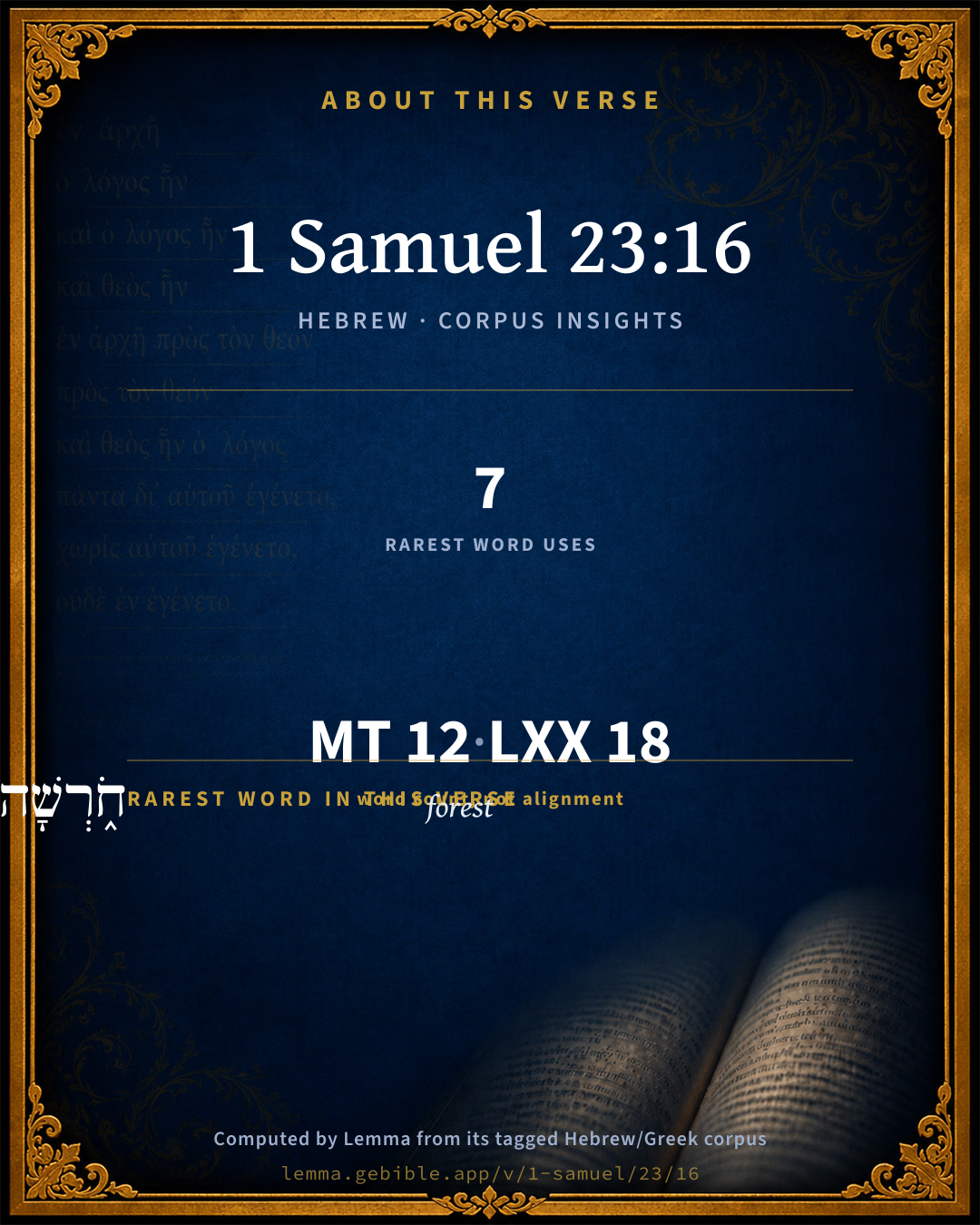
The rarest word here is חֹ֑רְשָׁה forest H2793 — appearing just 7 times in the whole Hebrew Bible.

Shared distinctive vocabulary

חֹ֑רְשָׁה forest H2793 occurs in 7 verses of the Hebrew Bible. Also found in:

Grammatical profile

  • 3 verbs
  • 7 nouns
  • 1 preposition
  • 1 particle

Verb forms

  • וַיָּ֨קָם֙ Qal · Sequential Imperfect
  • וַיֵּ֥לֶךְ Qal · Sequential Imperfect
  • וַיְחַזֵּ֥ק Piel · Sequential Imperfect

Hebrew & Septuagint length

In English translation the verse runs 17 words from the Hebrew and 19 from the Septuagint (LXX English) — closely comparable.

A rough comparison of the two English renderings, which tokenize alike — not a word-level alignment.

Word counts can differ between the Hebrew and the Greek without any difference in meaning — e.g. the Hebrew direct-object marker אֵת has no separate Greek word, and Greek often adds the article ὁ.

In the original languages it is 12 Hebrew tokens and 18 Greek tokens — but the two are counted differently (Hebrew bundles its prefixes and suffixes into one token; the Greek is in lemma form), so that isn’t a like-for-like length.

Cross-references

15

Topical passages linked to 1 Samuel 23:16 in the Treasury of Scripture Knowledge — connected by theme and wording, ordered by reader-vote popularity; previews shown in the World English Bible.

  • Isaiah 35:3–4 Strengthen you the weak hands, and confirm the feeble knees.
  • Hebrews 12:12–13 Therefore, lift up the hands that hang down and the feeble knees,
  • Job 4:3–4 Behold, you have instructed many, You have strengthened the weak hands.
  • 2 Timothy 2:1 You therefore, my child, be strengthened in the grace that is in Christ Jesus.
  • Ephesians 6:10 Finally, be strong in the Lord, and in the strength of his might.
  • Luke 22:32 but I prayed for you, that your faith wouldn't fail. You, when once you have turned again, establish your brothers."
  • 1 Samuel 30:6 David was greatly distressed; for the people spoke of stoning him, because the soul of all the people was grieved, every man for his sons and for his daughters: but David strengthened himself in Yahweh his God.
  • Luke 22:43 An angel from heaven appeared to him, strengthening him.
  • Nehemiah 2:18 I told them of the hand of my God which was good on me, as also of the king's words that he had spoken to me. They said, Let us rise up and build. So they strengthened their hands for the good [work].
  • Proverbs 27:9 Perfume and incense bring joy to the heart; So does earnest counsel from a man's friend.
  • Proverbs 27:17 Iron sharpens iron; So a man sharpens his friend's countenance.
  • Deuteronomy 3:28 But charge Joshua, and encourage him, and strengthen him; for he shall go over before this people, and he shall cause them to inherit the land which you shall see.
  • Ecclesiastes 4:9–12 Two are better than one, because they have a good reward for their labor.
  • Job 16:5 But I would strengthen you with my mouth. The solace of my lips would relieve you.
  • Ezekiel 13:22 Because with lies you have grieved the heart of the righteous, whom I have not made sad; and strengthened the hands of the wicked, that he should not return from his wicked way, and be saved alive:

Cross-references courtesy of OpenBible.info (CC BY 4.0).

Hebrew and Greek witnesses Masoretic Hebrew ↔ Greek Septuagint

The same verse in the two great witnesses to the Old Testament, shown verse-for-verse.

These are two independent witnesses, not word-aligned to each other, and the Septuagint is shown in lemma (dictionary) form.

Hebrew 1 Samuel 23:16 Masoretic · Westminster Leningrad Codex

וַיָּ֨קָם֙ יְהוֹנָתָ֣ן בֶּן שָׁא֔וּל וַיֵּ֥לֶךְ אֶל דָּוִ֖ד חֹ֑רְשָׁה וַיְחַזֵּ֥ק אֶת יָד֖וֹ בֵּאלֹהִֽים

Jonathan, Saul's son, arose, and went to David into the wood, and strengthened his hand in God.

World English Bible · Public Domain

Greek LXX 1 Samuel 23:16 Septuagint · lemma form

καί ἀναἵστημι ιωναθαν υἱός σαούλ καί πορεύομαι πρός δαυίδ εἰς καινή καί κραταιόω ὁ χείρ αὐτός ἐν κύριος

And Jonathan son of Saul rose, and went to David to Caene, and strengthened his hands in the Lord.

LXX2012 (modern English Septuagint) · Public Domain

Hebrew: Westminster Leningrad Codex (CC BY 4.0). Greek: Septuagint (public domain); English from LXX2012 (modern English Septuagint) (Public Domain). How the Septuagint differs from the Hebrew →

Targum (Aramaic paraphrase)

1

The Targum is the ancient Jewish Aramaic paraphrase of the Hebrew Scriptures — an interpretive translation, not the Hebrew text itself. Onkelos (literal) and Pseudo-Jonathan (expansive) render the Torah, and Jonathan the Prophets. Coverage is partial: where no permissively-licensed English translation exists for a verse, only the Aramaic is shown. This is verse-level text, not a word-by-word alignment to the Hebrew.

  1. Targum Jonathan Prophets (Joshua–Malachi)
    וְקָם יְהוֹנָתָן בַּר שָׁאוּל וַאֲזַל לְוַת דָוִד לְחוּרְשָׁא וּתְקֵיף יַת יְדֵיהּ בְּמֵימְרָא דַיָי:

    (no public-domain English translation for this verse)

    Targum Jonathan — Aramaic: “Mikraot Gedolot” (public domain). English: “Sefaria Community Translation” (CC0 1.0 (public-domain dedication)); “London "Chaldee Paraphrase," 1871” (public domain). Text via Sefaria.

Commentary

Notes on 1 Samuel 23:16 from classic Christian and Jewish commentators (each source and its license shown beneath its notes). The classic Christian expositions comment on the surrounding passage and are grouped to its opening verse, so a note may address several verses; the Jewish commentaries on the Tanakh (Rashi and others) are per-verse, so they appear only where the commentator wrote on this verse.

Lemma curates 59 commentaries, every one of them public domain or Creative Commons licensed, each selected and text-cleaned for this edition rather than reprinted as found. About our sources →

Trapp's Complete Commentary

John Trapp

1Sa 23:16 And Jonathan Saul’s son arose, and went to David into the wood, and strengthened his hand in God.

Ver. 16. Jonathan Saul’s son arose.] Jonathan could tell where to find David, though Saul could not: there being messengers still passing between them as fast friends, solicitous of each other’s welfare. {a}

And strengthened his hand in God.] By imminding him of the promises, and assuring him of God’s powerful protection. This was true friendship.

{a} Lyra.

John Trapp, A Commentary or Exposition upon All the Books of the Old and New Testament (1647–1656) — public domain. Text from a community e-Sword module.

The Biblical Illustrator

Joseph S. Exell

1Sa_23:16

And Jonathan went to David into the wood, and strengthened his hand in God.

The true in life

Two lessons stand out in this chapter. First, that the most heroic heart may sometimes be overcome with fear. Few men had a more intrepid soul than the conqueror of Goliath; yet now he was driven by fear of Saul into the wood. We are subject to variations of mood. Secondly, that the crimes of a father may alienate the hearts of his children. Jonathan the son of Saul was now succouring the man whom his own sire hated, and sought to destroy. Evil, even in a parent, cannot be loved, nor wrong in a parent obeyed.

I. The deep depression of a true soul. Few men ever had a truer soul than David--clear in its perceptions of truth, strong in its attachments to truth, inflexible in its allegiance to truth. But that soul, in the wood here, is under depression. Several things tend to depress the true spirit in this world.

1. Seemingly adverse circumstances. Jacob: All these things are against, me.

2. Providential discrepancies. Job, Aspah. My foot had well nigh slipped.

3. Non-success in religious service.

4. Consciousness of moral unworthiness.

5. Physical infirmities.

II. The distinguishing power of a true man. What is the distinguishing power which a true man has? To destroy life! Brutes can do this. To weaken faith, and shake confidence? A child can do this. What then? To strengthen a brothers heart in God! This is what Jonathan did now in the wood. But how can a true man strengthen a depressed brother thus?

1. By a truthful exposition of Gods method of governing the fallen in this world. The Gospel unfolds that method; shows that it is to the true corrective, not penal.

2. By a practical expression of genuine sympathy. One breath of it infuses new life to the soul.

3. By a devout intercession with Heaven.

III. The highest function of a true friend. It is one thing to have the power to strengthen, and another thing to use it when and where required. (Homilist.)

The Biblical Illustrator, edited by Joseph S. Exell (c. 1880s–1900s) — public domain. Text from a community e-Sword module.

Joseph Benson's Commentary

1Sa 23:16. Jonathan went and strengthened his hand in God — He comforted and supported him against all his fears, by considerations on the divine goodness and power, and by reminding him of God’s faithful promises made to him, and of his singular providence, which hitherto had been, and still would be with him.

Joseph Benson's Commentary on the Old and New Testaments (1811–1818) — public domain. Text from a community e-Sword module.

Tyndale Open Study Notes

Tyndale Open Resources

23:16 Jonathan . . . encouraged David because he knew that God had chosen David to be king.

Tyndale Open Study Notes — © Tyndale Open Resources, licensed CC BY-SA 4.0. Text via the HelloAO Bible API.

Geneva Bible (1599)

Geneva Bible translators

Hebrew, his hand.

Geneva Bible (1599) marginal notes — public domain. Text via Bolls.life.

Jamieson, Fausset & Brown

Robert Jamieson, A. R. Fausset & David Brown

Jonathan went to David into the wood, and strengthened his hand in God--by the recollection of their mutual covenant. What a victory over natural feelings and lower considerations must the faith of Jonathan have won, before he could seek such an interview and give utterance to such sentiments! To talk with calm and assured confidence of himself and family being superseded by the man who was his friend by the bonds of a holy and solemn covenant, could only have been done by one who, superior to all views of worldly policy, looked at the course of things in the spirit and through the principles of that theocracy which acknowledged God as the only and supreme Sovereign of Israel. Neither history nor fiction depicts the movements of a friendship purer, nobler, and more self-denying than Jonathan's!

Jamieson, Fausset & Brown — Commentary Critical and Explanatory on the Whole Bible (1871) — public domain (CC PDM 1.0). Text via the HelloAO Bible API.

Adam Clarke's Commentary

Verse 16. And Jonathan - strengthened his hand in God.] It is probable that there was always a secret intercourse between David and Jonathan, and that by this most trusty friend he was apprised of the various designs of Saul to take away his life. As Jonathan well knew that God had appointed David to the kingdom, he came now to encourage him to trust in the Most High, and to assure him that the hand of Saul should not prevail against him; and at this interview they renewed their covenant of friendship. Now all this Jonathan could do, consistently with his duty to his father and his king. He knew that David had delivered the kingdom; he saw that his father was ruling unconstitutionally; and he knew that God had appointed David to succeed Saul. This he knew would come about in the order of Providence; and neither he nor David took one step to hasten the time. Jonathan, by his several interferences, prevented his father from imbruing his hands in innocent blood: a more filial and a more loyal part he could not have acted; and therefore, in his attachment to David, he is wholly free of blame.

Adam Clarke's Commentary on the Bible (1810–1826) — public domain. Text from a community e-Sword/MySword module.

Ellicott's Commentary for English Readers

(16) And Jonathan Saul’s son arose, and went to David.—Some have wished to show that the account of the last interview between the friends really belongs to the secret meeting between David and Jonathan recounted in 1 Samuel 20, and that it has got transposed; but such a view is quite untenable, for the narrative here is circumstantial, and even mentions the scene of the interview—“the wood,” or, less probable, the town named “Horesh.” The expression “strengthened his hand in God” is added by the narrator to show how sorely tried was the king of the future at this juncture, notwithstanding that so many gallant spirits rallied round him. The determined and relentless hostility of the king of the land, his sovereign, and once his friend—the apparent hopelessness of his struggle—the cruel ingratitude of whole bodies of his fellow countrymen, such as the men of Ziph—his homeless, outlawed condition: all these things naturally weighed upon the nervous and enthusiastic temperament of David, which was soon depressed. His sad forebodings in his desolateness and loneliness at this time are breathed forth in not a few of the Psalms which tradition ascribes to him. At such a juncture the warm sympathy, the steady onlook to a sunnier future of one like Jonathan was a real help to David. Jonathan was far-sighted enough when David’s fortunes were at their lowest ebb to look confidently forward to a time when all these thick dark clouds of trouble should have passed away. Jonathan, we know (1Sa_20:14-15) possessed sufficient confidence in David’s future fortune even to ask the hunted exile to remember him, the prince, with kindness when he should have come into his kingdom. Such warm sympathy, such glowing trustful words, we may well imagine, raised the spirits of the outlaw, and gave him new courage to face the grave difficulties of his dangerous position.

A Bible Commentary for English Readers, edited by Charles John Ellicott (1878–1897) — public domain. Text from a community e-Sword module.

The Cambridge Bible for Schools and Colleges

gen. ed. J. J. S. Perowne

16–18. Jonathan’s last meeting with David

16. strengthened his hand in God] Revived his courage by pointing him to the true ground of confidence. Cp. ch. 1Sa_30:6; Job_4:3.

The Cambridge Bible for Schools and Colleges (gen. ed. J. J. S. Perowne; Cambridge University Press, 1878–1918) — public domain. Text from a community e-Sword module.

John Gill's Exposition

And Jonathan, Saul's son, arose,.... And came from Gibeah, which, according to Bunting (o), was twenty two miles from the place where David was:

and went to David into the wood: having had intelligence where he was, this being a proper place to have an interview with him privately:

and strengthened his hand in God; and his heart too, his hand of faith to lay hold on God, as his covenant God and lean and rely upon him; he strengthened him in his power and in his providence, and in his promises to him; the Targum is,"he strengthened him in the Word of the Lord;''not only in his word and promise, but in Christ the essential Word of God, who should spring from him according to the flesh.

(o) Travels, &c. p. 334. (text not clear could be 834 or some other number)

John Gill's Exposition of the Whole Bible (1746–1763) — public domain (CC PDM 1.0). Text via the HelloAO Bible API.

Albert Barnes' Notes on the Bible

A touching example of mutual fidelity between friends. The humility and unselfish love of Jonathan is apparent in 1Sa 23:17.

Albert Barnes' Notes on the Bible (1834–1885) — public domain. Text from a community e-Sword/MySword module.

Haydock's Catholic Bible Commentary

In God exceedingly, reminding him of God’s promises. (Calmet) --- He hoped to see David king, and himself next to him in power. (Haydock)

George Leo Haydock (1774–1849), Haydock's Catholic Family Bible and Commentary, 1859 edition — public domain. Excludes Psalms (Douay-Rheims chapter numbering differs from Protestant) and Deuterocanonical books (Catholic canon only).

Matthew Poole's English Annotations

Jonathan went where David had appointed to meet him at that time, and strengthened his hand in God; he comforted and supported him against all his fears, by minding him of God’s infallible promises made to him, and his singular providence which hitherto had and still would be with him.

Matthew Poole's English Annotations on the Holy Bible (1683–1685) — public domain. Text from a community e-Sword/MySword module.

Whedon's Commentary on the Bible

Daniel D. Whedon

16. Jonathan… arose and went to David — Whether Jonathan ever accompanied his father in the pursuit after David we are nowhere told, but it is very evident that he never sought to take his friend. His true heart was incapable of such duplicity.

Strengthened his hand in God — Encouraged and cheered him in his faith and hope. He was now satisfied that David was destined to be king; his anointing by Samuel was probably well known, and Jonathan’s greatest desire was to be next to him in the kingdom, and in that position to share his friendship as in the past.

Daniel D. Whedon (gen. ed.), Commentary on the Old and New Testaments (1874–1909) — public domain. Text from a community e-Sword module.

The Pulpit Commentary

Vers. 16-18. Jonathan went to David into the wood. To Horesh, as in ver. 15. This visit suggests two things: the first, that, after the scene in 1Sa_22:8, Saul was estranged from his son, and treated him harshly, regarding him as a fellow conspirator with David; the second, that there was a growing conviction, not only in Jonathan"s mind, but generally, that Jehovah had transferred the kingdom from Saul to David, and that consequently David"s final success was inevitable. He strengthened his (David"s) hand in God. Such a visit, and the expression of Jonathan"s strong conviction that Jehovah was with David, must necessarily have had a powerful moral effect upon his mind. Under such trying circumstances David must often have been tempted to despair; but the assurance of Jonathan"s unbroken love for him, and the knowledge that he and many more regarded him as chosen by God to be Israel"s king, would revive his courage and make him content to bear the hardships of his present lot. I shall be next unto thee. Had he not been killed in Mount Gilboa, it seems that, unlike Ishbosheth, Jonathan would have resigned all claim to the crown. But the feeling must often have distressed David, that the kingdom could become his only by dispossessing his true and unselfish friend. Nor would such a regret be altogether removed by Jonathan"s ready acquiescence in it as God"s will, though, as next to him, and beloved as he deserved, his position as the king"s friend would have been a not unenviable one. Still, to be second where by right of inheritance he should have been first would have been a very trying lot, and it was better for Jonathan that he should die a soldier"s death, even granting that he would have felt a lively joy in David"s success and the glory of his empire. But their love was to be exposed to no vicissitudes, and the two friends parted never to meet again David remaining at Horesh, while Jonathan returned to his home at Gibeah.

HOMILIES BY D. FRASER

Vers. 16-18.

Sweet counsel in time of need.

I THE DISCOURAGEMENT OF DAVID. The citizens of Keilah, after he had with his good sword delivered them from the Philistine marauders, were so ungrateful, perhaps so much afraid of sharing the fate of the city of Nob at the hand of Saul, that they were ready to betray the son of Jesse and surrender him to the king. From this danger he no sooner escaped than the people of Ziph though he did not compromise them by entering their town, but eneamped in a wood were not only willing, but eager, to reveal his hiding place. And the pursuit was hot. "Saul sought him every day." To add to the danger, David had with him 600 armed men too many to be easily concealed, but too few to encounter the force which Saul led against him, and which was numbered by thousands. It was therefore a critical time for David; and his poetic, sensitive nature felt the ingratitude and injustice more keenly than he dreaded the actual peril, so that he began to be quite chagrined and disheartened. The Apostle Paul had a similar tendency to depression. He felt ingratitude and calumny most acute]y, and was more cast down by these than by any of the physical sufferings and mortal risks that befell him. But Paul was like David too in his quick susceptibility to words of kindness, and in drawing strength from fellowship with congenial minds.

II THE FRIEND IN TIME OF NEED. St. Paul tells, "When we were come into Macedonia, our flesh had no rest, but we were troubled on every side; without were fightings, within were fears. Nevertheless God, who comforteth those that are cast down, comforted us by the coming of Titus." In like manner did God comfort David amidst fightings and fears by the coming of Jonathan. This noble-minded prince cheered the fugitive in the forest of Ziph

1. By showing to him a generous human affection. This was love indeed, which clave to David in exile as closely as ever it had done when he was in the sunshine of public favour, and which was willing to run great risks for the delight of clasping hand in hand and talking face to face. Here was genuine friendship, which is perhaps more rare than love. Cynics point out that the celebrated friendships, as of David and Jonathan in the Bible, and Damon and Pythias the Pythagoreans in Greek story, belong to "the heroic and simple period of the world;" and they allege that these cannot be

2. reproduced in the sophisticated society of modern times. There is something in this, though it is not absolutely true. The tone of "In Memoriam" may be too intense for most of us, but it is not incomprehensible. That is a rare and lofty friendship which prefers another in honour above ourselves. From the early days of David"s promotion Jonathan augured his advancement to the throne, and took generous delight in the prospect. He still retained and openly expressed the same feeling. David would be king, and he, his friend and brother, would share his joy and stand at his right hand. It was not to be so. But we see David, when established on the throne, looking, if we may so speak, for Jonathan. "And David said, Is there yet any that is left of the house of Saul, that I may show him kindness for Jonathan"s sake?". (2Sa_9:1)

3. By lifting his thoughts to God. It was not possible or proper for Jonathan to levy troops and lead them to the help of his friend against the king his father. But he did what he could, and did the best thing possible in such a case, when he animated the faith, and hope of David in the promise and providence of God. He referred to the Divine purpose as no secret, but revealed, and known to Saul himself, though he struggled against it. The counsel of the Lord must stand. How could David doubt it? But David did sometimes doubt and fear, and he is not alone in the weakness. Sarah had the promise of God that her son should be Abraham"s heir and successor, and yet she was uneasy lest he should be dispossessed or hurt by the son of Hagar. Jacob at Bethel got a promise that he and his posterity would possess the lung on which he lay, yet when he returned to it he was quite alarmed lest Esau should destroy his family and himself. And so also many persons who have eternal life in the gospel and in the sure provision of grace by Christ Jesus grow faint and raise foreboding questions: What if God forget me? What if I perish after all? The best thing that a friend can do for such a doubter is to show him that God cannot lie and cannot be defeated. For his name"s sake he will do as he has said. So one may strengthen the weak hands of another in God.

III THOUGHTS SUGGESTED BY THE MEETING IN THE WOOD.

1. The value of an early friendship in the fear of God. It is in youth that the strongest friendships are formed, and permit interchanges of criticism and correction that are not so palatable when years have increased our reserve, and perhaps our obstinacy. This is especially true of the moral and religious aspect and use of friendship. Old men, even when they are on terms of cordial personal regard, do not easily exchange spiritual

2. confidences. But young friends can do so; and never do they put the bond between them to better use than when they warn each other of moral risks and snares, and encourage one another to trust in God.

3. The great part which secondary personages in history may play. David takes a primary or front place in sacred story; but he was much indebted to the kindly help of others who take a less conspicuous ranke.g. , Jonathan encouraging him in the wood, and Abigail turning him back from hasty bloodshedding. Again we pass on in thought to the Apostle Paul, who fills a very high place in the Christian annals, but was much helped by men and women in quite a secondary position. Himself tells us so, joyfully acknowledging his obligation to such as Aquila and Priscilla, Mary, Urbane, Timothy, Epaphroditus, John Mark, Luke, and Aristarchus. These Christians did direct work for the Lord; but perhaps did their best piece of service when they helped Paul, and encouraged his hand in God. So is it at all times with the greatest men in both Church and State. They owe much to others who are far less known than themselves, if known at all. A sympathetic wife, a faithful friend, a humble helper, quite incapable of taking the conspicuous position or doing the public work, supplies a strengthening, restoring element in hours of discouragement or weariness, and so does much to preserve a notable career from failure. In fact every great man draws up into his thought and work the cogitations of many minds, the desire of many hearts, the faith or fortitude of many spirits; and the efforts and sympathies of many combine in the results which are associated with his name.

4. The uncertainty that friends who part will meet again on earth. "They two made a covenant before the Lord," and parted, little knowing that each was taking the last look of his friend. Their thoughts were of days to come, when they should not need to meet by stealth. They would be always together by and by take counsel together fight side by side against the enemies of Israel, do exploits for their nation, and reestablish the worship of Jehovah and the honour of his sanctuary. The elevation of one would be the elevation of both; and the spirit of jealousy which now darkened the court and the kingdom would give place to generous confidence and love. So they proposed; but God disposed otherwise. Jonathan never saw David again. Death broke their "fair companionship," and the elevation of David was bedewed with tender sorrow for his friend, "the comrade of his choice, the human-hearted man he loved." There is one Friend, only one, from whom we cannot be severed. Oh, what a Friend we have in Jesus! especially helpful to us in cloudy days and seasons of distress. He comes to us when we are in the wood, perplexed, embarrassed, cast down. Let us tell all our straits and misgivings to him. This Friend will never die. And not even our death can break the friendship or separate us from the love of Christ. F.

The Pulpit Commentary (1880–1919), ed. H.D.M. Spence-Jones & Joseph S. Exell — public domain. Text from a community e-Sword module.

John Wesley's Explanatory Notes

And strengthened - He comforted and supported him against all his fears, by minding him of God's infallible promises made to him, and his singular providence which hitherto had and still would be with him.

John Wesley, Explanatory Notes Upon the Whole Bible (1754–1765) — public domain. Text via the GEBible commentary corpus.

Rashi

Rabbi Shlomo Yitzchaki (Rashi)

And he strengthened his hand. He renewed the covenant which was between them.

Rashi on the Tanakh — English translations: “The Judaica Press complete Tanach with Rashi, translated by A. J. Rosenberg” (CC BY 4.0); “Pentateuch with Rashi's commentary by M. Rosenbaum and A.M. Silbermann, 1929-1934” (public domain); “The Metsudah Tanach series, Lakewood, N.J” (CC BY 4.0); and “The Book of Joshua, Metsudah Publications, 1997” (CC BY 4.0). Text via Sefaria.

Lesson kit

Teaching starters — assembled from the data on this page, not authored interpretation. Every prompt links to the verse data it draws on. Edit before teaching.

1 Samuel, in the Historical, opens this verse with 12 words (12 distinct Hebrew lemmas). Its most distinctive word is chôresh (“forest”). A historical commentator’s framing appears above. Read the whole chapter for the surrounding context.

Discussion questions

  1. How does “forest” (chôresh) shape what this verse is saying?
  2. 1 Samuel 23:15 shares the word «forest» with this verse. How do the two illuminate each other?
  3. These translations render this verse differently; the difference is in the English rendering, not the original. What questions does that raise?
  4. The verb «וַיָּ֨קָם֙» is Qal Sequential Imperfect. How does its form color the action?
  5. Reading how Trapp's Complete Commentary and The Biblical Illustrator read this verse, where do the two commentators agree and where do they part?

Things to notice

Reading settings

Reading text

Shown beneath each verse's original-language words.

Old Testament
Old Testament edition

Read the OT as the Masoretic Hebrew (MT) or the Greek Septuagint (LXX).

English shown for the Greek Septuagint (in the Hebrew ↔ Greek comparison).

Comparing translations? Open the Compare panel on any verse page to stack up to four side by side.