Leviticus 25:35

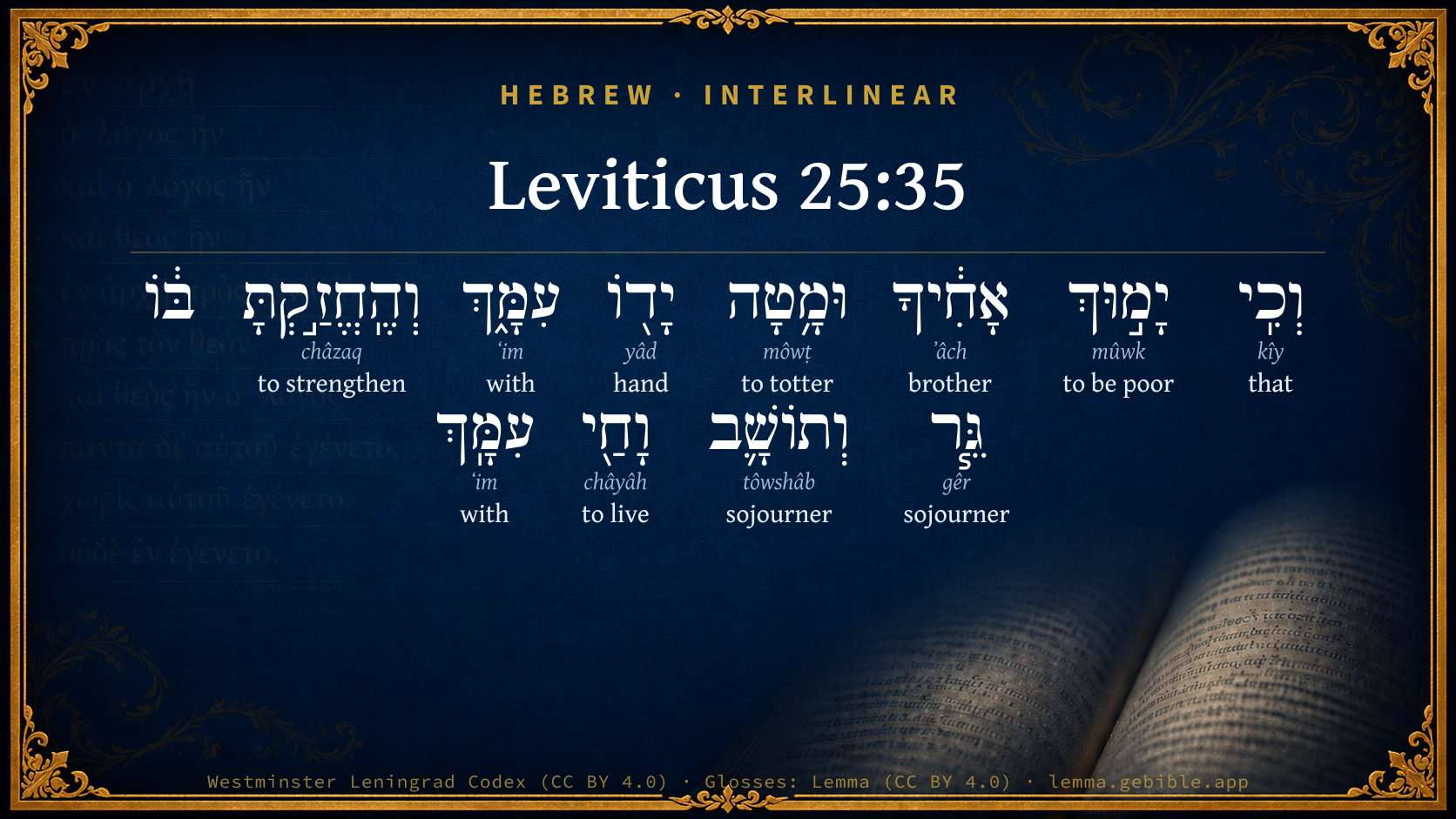
Hebrew (Westminster Leningrad Codex) Leviticus 25:35 appears in the Hebrew Old Testament. The text above is from the Westminster Leningrad Codex. Each word links to its Strong’s number, a concise gloss, and parsing drawn from the Open Scriptures Hebrew Bible morphology. Click any word for its full Brown-Driver-Briggs (BDB) entry.
Download image
Cite this verse

Leviticus 25:35 (World English Bible). Public Domain. Lemma interlinear Bible study tool, https://lemma.gebible.app/v/leviticus/25/35.

Show BibTeX & RIS
BibTeX
RIS
English Translation
"'If your brother has become poor, and his hand can't support him among you; then you shall uphold him. As a stranger and a sojourner he shall live with you.
World English Bible · Public Domain
Highlights
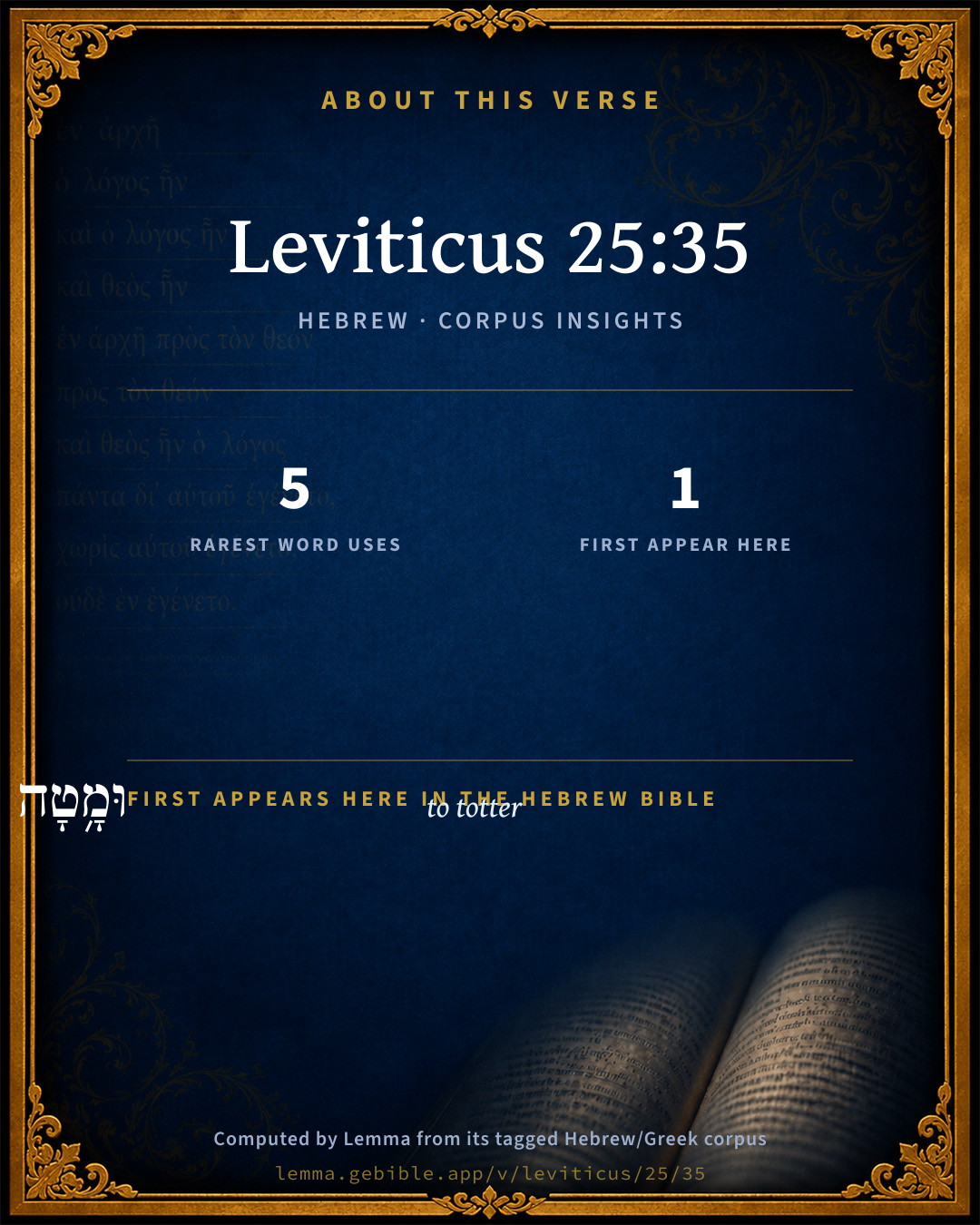
  • 1 first appearance in the Hebrew Bible
Full analysis ↓
Download a study sheet

One document with this verse’s original text, its word-by-word gloss line, the meaning frame, cross-references with their text, attributed commentary, and full source and license credits — printable, and it pastes into notes with its structure intact.

This verse Autodidact and up

Study sheet (.html) Plain text (.txt)

A passage Seminary Student

Up to 50 verses in one chapter. A passage sheet keeps up to 6 commentary sources and 12 cross-references per verse, in the order this page ranks them, and says so on the sheet whenever that leaves anything out. Ask for a single verse and you get the Autodidact verse sheet above.

Everything on this page stays free to read, with no account — the sheet is a download of what is already on screen, not access to it.

Want to remove ads? Support Godless Engineer
Compare translations 3

The same verse in 3 English versions, stacked beneath the original-language interlinear above. Click any original word for its lexicon entry.

Each is an independent rendering of the whole verse — the interlinear is not word-aligned to these translations.

Highlighted words mark where these versions differ — a whole-verse word diff, not a word-by-word alignment.

  • World English Bible Public Domain
    "'If your brother has become poor, and his hand can't support him among you; then you shall uphold him. As a stranger and a sojourner he shall live with you.
  • King James Version Public Domain
    And if thy brother be waxen poor, and fallen in decay with thee; then thou shalt relieve him: yea, though he be a stranger, or a sojourner; that he may live with thee.
  • unfoldingWord Literal Text CC BY-SA 4.0
    And if your brother becomes poor, and his hand wavers with you, then you shall strengthen him; and a sojourner and temporary resident he shall live with you.

unfoldingWord Literal Text — © unfoldingWord, licensed CC BY-SA 4.0. Word-aligned USFM3 via Door43 (git.door43.org/unfoldingWord/en_ult).

Versions to compare (up to 4)

3 of 4 selected

Show all 18 translations

Every available English version of this verse, each an independent rendering of the whole verse.

  • World English Bible Public Domain
    "'If your brother has become poor, and his hand can't support him among you; then you shall uphold him. As a stranger and a sojourner he shall live with you.
  • Berean Standard Bible Public Domain
    Now if your countryman becomes destitute and cannot support himself among you, then you are to help him as you would a foreigner or stranger, so that he can continue to live among you.
  • Majority Standard Bible Public Domain
    Now if your countryman becomes destitute and cannot support himself among you, then you are to help him as you would a foreigner or stranger, so that he can continue to live among you.
  • King James Version Public Domain
    And if thy brother be waxen poor, and fallen in decay with thee; then thou shalt relieve him: yea, though he be a stranger, or a sojourner; that he may live with thee.
  • American Standard Version (1901) Public Domain
    And if thy brother be waxed poor, and his hand fail with thee; then thou shalt uphold him: `as' a stranger and a sojourner shall he live with thee.
  • Revised Version (1885) Public Domain
    And if thy brother be waxen poor, and his hand fail with thee; then thou shalt uphold him: as a stranger and a sojourner shall he live with thee.
  • Geneva Bible (1599) Public Domain
    Moreouer, if thy brother be impouerished, and fallen in decay with thee, thou shalt relieue him, and as a stranger and soiourner, so shall he liue with thee.
  • Douay-Rheims (1899) Public Domain
    If thy brother be impoverished, and weak of hand, and thou receive him as a stranger and sojourner, and he live with thee,
  • Young's Literal Translation Public Domain
    `And when thy brother is become poor, and his hand hath failed with thee, then thou hast kept hold on him, sojourner and settler, and he hath lived with thee;
  • Literal Standard Version CC BY-SA 4.0
    And when your brother has become poor, and his hand has failed with you, then you have kept hold on him, sojourner and settler, and he has lived with you;
  • Unlocked Literal Bible CC BY-SA 4.0
    If your fellow countryman becomes poor, so that he can no longer provide for himself, then you must help him as you would help a foreigner or anyone else living as an outsider among you.
  • unfoldingWord Literal Text CC BY-SA 4.0
    And if your brother becomes poor, and his hand wavers with you, then you shall strengthen him; and a sojourner and temporary resident he shall live with you.
  • Darby Bible Public Domain
    And if thy brother grow poor, and he be fallen into decay beside thee, then thou shalt relieve him, [be he] stranger or sojourner, that he may live beside thee.
  • World Messianic Bible Public Domain
    “‘If your brother has become poor, and his hand can’t support himself among you, then you shall uphold him. He shall live with you like an alien and a temporary resident.
  • Webster's Bible Public Domain
    And if thy brother shall have become poor, and fallen in decay with thee; then thou shalt relieve him: yea, though he may be a stranger, or a sojourner; that he may live with thee.
  • Free Bible Version CC BY-SA 4.0
    If any of your people become poor and can't survive, you must help them in the same way you would help a foreigner or a stranger, so that they can go on living in your neighborhood.
  • Bible in Basic English Public Domain
    And if your brother becomes poor and is not able to make a living, then you are to keep him with you, helping him as you would a man from another country who is living among you.
  • JPS Tanakh (1917) Public Domain
    And if thy brother be waxen poor, and his means fail with thee; then thou shalt uphold him: as a stranger and a settler shall he live with thee.

Literal Standard Version (2020), Covenant Press — licensed CC BY-SA 4.0. Text via the HelloAO Bible API (eBible.org). Unlocked Literal Bible (unfoldingWord) — licensed CC BY-SA 4.0. Text via the HelloAO Bible API (eBible.org). unfoldingWord Literal Text — © unfoldingWord, licensed CC BY-SA 4.0. Word-aligned USFM3 via Door43 (git.door43.org/unfoldingWord/en_ult). Free Bible Version, Dr. Jonathan Gallagher — licensed CC BY-SA 4.0. Text via the HelloAO Bible API (eBible.org).

Word by word

More ways to search: Search by grammar → Find every occurrence → Compare this word →

Practice this passage: Drill this verse → Learn its vocabulary →

יָמ֣וּךְ
mûwk
H4134
“to be poor”
Verb, Qal, Imperfect, 3rd Person, Masculine, Singular
Part of Speech
Verb
Stem
Qal
Form
Imperfect
Person
3rd Person
Gender
Masculine
Number
Singular
Full BDB Definition

Origin: a primitive root

TWOT: 1159

(Qal) to be low, grow poor, be depressed, be poor
  1. וְכִֽי kîy H3588 “and · that” Conjunction + Conjunction
  2. אָחִ֔יךָ ʼâch H251 “brother · your” Noun, Common, Masculine, Singular, Construct + Suffix, Personal, 2nd Person, Masculine, Singular
  3. וּמָ֥טָה môwṭ H4131 “and · to totter” Conjunction + Verb, Qal, Sequential Perfect, 3rd Person, Feminine, Singular
  4. יָד֖וֹ yâd H3027 “hand · his” Noun, Common, Both, Singular, Construct + Suffix, Personal, 3rd Person, Masculine, Singular
  5. עִמָּ֑ךְ ʻim H5973 “with · you” Preposition + Suffix, Personal, 2nd Person, Feminine, Singular
  6. וְהֶֽחֱזַ֣קְתָּ châzaq H2388 “and · to strengthen” Conjunction + Verb, Hiphil, Sequential Perfect, 2nd Person, Masculine, Singular
  7. גֵּ֧ר gêr H1616 “sojourner” Noun, Common, Masculine, Singular, Absolute
  8. וְתוֹשָׁ֛ב tôwshâb H8453 “and · sojourner” Conjunction + Noun, Common, Masculine, Singular, Absolute
  9. וָחַ֖י châyâh H2421 “and · to live” Conjunction + Verb, Qal, Sequential Perfect, 3rd Person, Masculine, Singular
  10. עִמָּֽךְ ʻim H5973 “with · you” Preposition + Suffix, Personal, 2nd Person, Feminine, Singular

About this verse

These counts appear in no published source. They are computed here, from the morphology-tagged text and Lemma’s own curated glosses. What Lemma adds →

12
words
10
distinct lemmas
Pentateuch
section

Notable vocabulary

The rarest word here is יָמ֣וּךְ to be poor H4134 — appearing just 5 times in the whole Hebrew Bible.

First appearance in Scripture

This word makes its first canonical appearance in the Hebrew Bible here:

  • וּמָ֥טָה to totter H4131

Shared distinctive vocabulary

יָמ֣וּךְ to be poor H4134 occurs in 5 verses of the Hebrew Bible. Also found in:

Grammatical profile

  • 4 verbs
  • 4 nouns
  • 3 prepositions
  • 1 conjunction

Verb forms

  • יָמ֣וּךְ Qal · Imperfect
  • וּמָ֥טָה Qal · Sequential Perfect
  • וְהֶֽחֱזַ֣קְתָּ Hiphil · Sequential Perfect
  • וָחַ֖י Qal · Sequential Perfect

Repetition

A word recurs within this verse — often emphatic in Hebrew:

  • עִמָּ֑ךְ with H5973 ×2

Hebrew & Septuagint length

In English translation the verse runs 30 words from the Hebrew and 34 from the Septuagint (LXX English) — closely comparable.

A rough comparison of the two English renderings, which tokenize alike — not a word-level alignment.

Word counts can differ between the Hebrew and the Greek without any difference in meaning — e.g. the Hebrew direct-object marker אֵת has no separate Greek word, and Greek often adds the article ὁ.

Cross-references

29

Topical passages linked to Leviticus 25:35 in the Treasury of Scripture Knowledge — connected by theme and wording, ordered by reader-vote popularity; previews shown in the World English Bible.

  • Deuteronomy 15:7–8 If there be with you a poor man, one of your brothers, within any of your gates in your land which Yahweh your God gives you, you shall not harden your heart, nor shut your hand from your poor brother;
  • Acts 11:29 As any of the disciples had plenty, each determined to send relief to the brothers who lived in Judea;
  • Exodus 23:9 "You shall not oppress an alien, for you know the heart of an alien, seeing you were aliens in the land of Egypt.
  • Leviticus 19:34 The stranger who lives as a foreigner with you shall be to you as the native-born among you, and you shall love him as yourself; for you lived as foreigners in the land of Egypt. I am Yahweh your God.
  • Leviticus 25:25 "'If your brother becomes poor, and sells some of his possessions, then his kinsman who is next to him shall come, and redeem that which his brother has sold.
  • Deuteronomy 10:18–19 He does execute justice for the fatherless and widow, and loves the foreigner, in giving him food and clothing.
  • Luke 6:35 But love your enemies, and do good, and lend, expecting nothing back; and your reward will be great, and you will be children of the Most High; for he is kind toward the unthankful and evil.
  • Deuteronomy 24:14–15 You shall not oppress a hired servant who is poor and needy, whether he be of your brothers, or of your foreigners who are in your land within your gates:
  • Psalms 37:26 All day long he deals graciously, and lends. His seed is blessed.
  • Psalms 41:1 Blessed is he who considers the poor: Yahweh will deliver him in the day of evil.
  • Psalms 112:5 It is well with the man who deals graciously and lends. He will maintain his cause in judgment.
  • Psalms 112:9 He has dispersed, he has given to the poor. His righteousness endures forever. His horn will be exalted with honor.
  • Proverbs 14:31 He who oppresses the poor shows contempt for his Maker, But he who is kind to the needy honors him.
  • 1 John 3:17 But whoever has the world's goods, and sees his brother in need, and closes his heart of compassion against him, how does the love of God remain in him?
  • Proverbs 14:20–21 The poor person is shunned even by his own neighbor, But the rich person has many friends.
  • Proverbs 17:5 Whoever mocks the poor reproaches his Maker. He who is glad at calamity shall not be unpunished.
  • Proverbs 19:17 He who has pity on the poor lends to Yahweh; He will reward him.
  • Matthew 25:35 for I was hungry, and you gave me food to eat; I was thirsty, and you gave me drink; I was a stranger, and you took me in;
  • Mark 14:7 For you always have the poor with you, and whenever you want to, you can do them good; but you will not always have me.
  • John 12:8 For you always have the poor with you, but you don't always have me."
  • Romans 12:13 contributing to the needs of the saints; given to hospitality.
  • Romans 12:18 If it is possible, as much as it is up to you, be at peace with all men.
  • Romans 12:20 Therefore "If your enemy is hungry, feed him. If he is thirsty, give him a drink. For in doing so, you will heap coals of fire on his head."
  • 2 Corinthians 8:9 For you know the grace of our Lord Jesus Christ, that, though he was rich, yet for your sakes he became poor, that you through his poverty might become rich.
  • 2 Corinthians 9:1 It is indeed unnecessary for me to write to you concerning the service to the saints,
  • 2 Corinthians 9:12–15 For this service of giving that you perform not only makes up for lack among the saints, but abounds also through many givings of thanks to God;
  • Galatians 2:10 They only asked us to remember the poor--which very thing I was also zealous to do.
  • Hebrews 13:2 Don't forget to show hospitality to strangers, for in doing so, some have entertained angels without knowing it.
  • James 2:5–6 Listen, my beloved brothers. Didn't God choose those who are poor in this world to be rich in faith, and heirs of the Kingdom which he promised to those who love him?

Cross-references courtesy of OpenBible.info (CC BY 4.0).

Hebrew and Greek witnesses Masoretic Hebrew ↔ Greek Septuagint

The same verse in the two great witnesses to the Old Testament, shown verse-for-verse.

These are two independent witnesses, not word-aligned to each other, and the Septuagint is shown in lemma (dictionary) form.

Hebrew Leviticus 25:35 Masoretic · Westminster Leningrad Codex

וְכִֽי יָמ֣וּךְ אָחִ֔יךָ וּמָ֥טָה יָד֖וֹ עִמָּ֑ךְ וְהֶֽחֱזַ֣קְתָּ בּ֔וֹ גֵּ֧ר וְתוֹשָׁ֛ב וָחַ֖י עִמָּֽךְ

"'If your brother has become poor, and his hand can't support him among you; then you shall uphold him. As a stranger and a sojourner he shall live with you.

World English Bible · Public Domain

Greek LXX Leviticus 25:35 Septuagint · lemma form

ἐάν δέ πένομαι ὁ ἀδελφός σύ καί ἀδυνατέω ὁ χείρ παρά σύ ἀντιλαμβάνω αὐτός ὡς προσήλυτος καί πάροικος καί ζάω ὁ ἀδελφός σύ μετά σύ

And if your brother who is with you become poor, and he fail in resources with you, you shall help him as a stranger and a sojourner, and your brother shall live with you.

LXX2012 (modern English Septuagint) · Public Domain

On this verse, The Cambridge Bible for Schools and Colleges discusses the Septuagint’s reading. Read the note in Commentary ↓

Hebrew: Westminster Leningrad Codex (CC BY 4.0). Greek: Septuagint (public domain); English from LXX2012 (modern English Septuagint) (Public Domain). How the Septuagint differs from the Hebrew →

Targum (Aramaic paraphrase)

2

The Targum is the ancient Jewish Aramaic paraphrase of the Hebrew Scriptures — an interpretive translation, not the Hebrew text itself. Onkelos (literal) and Pseudo-Jonathan (expansive) render the Torah, and Jonathan the Prophets. Coverage is partial: where no permissively-licensed English translation exists for a verse, only the Aramaic is shown. This is verse-level text, not a word-by-word alignment to the Hebrew.

  1. Targum Onkelos Torah (Genesis–Deuteronomy)
    וַאֲרֵי יִתְמַסְכַּן אָחוּךְ וּתְמוּט יְדֵהּ עִמָךְ וְתַתְקַף בֵּהּ דַיַר וְתוֹתָב וִיחֵי עִמָךְ

    (no public-domain English translation for this verse)

    Targum Onkelos — Aramaic: “Onkelos Genesis” (public domain); “Onkelos Exodus” (public domain); “Onkelos Leviticus” (public domain); “Onkelos Numbers” (public domain); “Onkelos Deuteronomy” (public domain). English: “Sefaria Community Translation” (CC0 1.0 (public-domain dedication)); “J.W. Etheridge. The Targums of Onkelos and Jonathan Ben Uzziel on the Pentateuch. London: Longmans, Green, 1862” (public domain). Text via Sefaria.

  2. Targum Pseudo-Jonathan Torah (Genesis–Deuteronomy)
    וַאֲרוּם יִתְמַסְכַּן אָחוּךְ וּתְמוּט יְדֵיהּ עִמָךְ וְתַתְקִיף בֵּיהּ וּתְהַנְיֵיהּ יִדוֹר וְתוֹתָב וְיִתְפַּרְנֵס עִמָךְ

    And if thy brother hath become poor, and his hand wavereth with thee, then thou shalt strengthen and do him good, as a guest and a sojourner he shall be nourished with thee.

    Targum Pseudo-Jonathan — Aramaic: “Targum Jonathan on Genesis” (public domain); “Targum Jonathan on Exodus” (public domain); “Targum Jonathan on Leviticus” (public domain); “Targum Jonathan on Numbers” (public domain); “Targum Jonathan on Deuteronomy” (public domain). English: “The Targum of Jonathan ben Uzziel, trans. J. W. Etheridge, London, 1862” (public domain). Text via Sefaria.

Commentary

Notes on Leviticus 25:35 from classic Christian and Jewish commentators (each source and its license shown beneath its notes). The classic Christian expositions comment on the surrounding passage and are grouped to its opening verse, so a note may address several verses; the Jewish commentaries on the Tanakh (Rashi and others) are per-verse, so they appear only where the commentator wrote on this verse.

Lemma curates 59 commentaries, every one of them public domain or Creative Commons licensed, each selected and text-cleaned for this edition rather than reprinted as found. About our sources →

Ellicott's Commentary for English Readers

(35) And if thy brother be waxen poor.—This part of the jubile laws which relates to the manumission of the Israelites who through poverty are compelled to sell themselves as bondsmen (Lev_25:39-55) is introduced by a pathetic appeal to the benevolence of the people to bestow brotherly help to the poor (Lev_25:35-38).

And fallen in decay with thee.—Literally, and his hand wavered with thee, that is, when it is weak and can no longer render support, or gain a livelihood. As the laws of jubile guard the future interests of the Israelite who is driven by stress of poverty to sell his patrimony, the Lawgiver now points out the duties of each member of the community to the impoverished brother who has to wait till the year of jubile for the restoration of his property, but who in the meantime is unable to support himself.

Then thou shalt relieve him.—Literally, thou shalt lay hold of him. When his hand is thus trembling, it is the duty of every Israelite to support his weak hand, and enable it to gain a livelihood.

Though he be a stranger, or a sojourner.—Better, as a stranger and a sojourner, that is, he is not to be treated like an outcast because he has been compelled by poverty to sell his patrimony, but is to receive the same consideration which strangers and sojourners receive, who, like the unfortunate Israelite, have no landed property. (See Lev_19:33-34.)

A Bible Commentary for English Readers, edited by Charles John Ellicott (1878–1897) — public domain. Text from a community e-Sword module.

Trapp's Complete Commentary

John Trapp

Lev 25:35 And if thy brother be waxen poor, and fallen in decay with thee; then thou shalt relieve him: [yea, though he be] a stranger, or a sojourner; that he may live with thee.

Ver. 35. That he may live with thee,] i.e., Live in good fashion; for a necessitous life is a lifeless life. Thus shall ye say to him that liveth. {1Sa 25:6} So Joh 4:50, "Thy son liveth."

John Trapp, A Commentary or Exposition upon All the Books of the Old and New Testament (1647–1656) — public domain. Text from a community e-Sword module.

The Biblical Illustrator

Joseph S. Exell

Lev_25:35

And if thy brother be waxen poor.

Jewish benevolence

Mr. William Gilbert, describing in Good Words the cases of mendicancy which he saw appear before the Jewish Board of Guardians, tells of a Prussian Jew, quite blind, who was led into the room by a child of one of the lodgers of the house he lived in. He informed the Board that he had been some weeks in England, and was utterly destitute. On being asked how he had contrived to live, he replied that the poor Jews in Petticoat Lane had made a subscription for him, and he had received about eight shillings a week from the pence they had subscribed.

The Biblical Illustrator, edited by Joseph S. Exell (c. 1880s–1900s) — public domain. Text from a community e-Sword module.

Whedon's Commentary on the Bible

Daniel D. Whedon

MERCY TO THE POOR ENJOINED, Lev_25:35-43.

35. Thy brother — Of the seed of Abraham.

Thou shalt relieve him — The singular number here seems to signify an individual obligation to relieve the poor, though systematic relief by the commonwealth is by no means excluded.

That he may live — Bare existence is not here intended, but a happy life. This explains the significance of the terms “life” and “eternal life.” The more abundant life which Jesus Christ came to inspire in the believer, (Joh_10:10, note,) is fulness of joy. The annihilationists, whose fundamental error is that immortality is a gift of grace and not inherent in human nature, take their first false step in their definition of life as mere animate being, and not a blissful existence.

Daniel D. Whedon (gen. ed.), Commentary on the Old and New Testaments (1874–1909) — public domain. Text from a community e-Sword module.

Tyndale Open Study Notes

Tyndale Open Resources

25:35 Impoverished Israelites first looked to family for help (see study note on 25:25). Second, they relied on the community, which was commanded to help them rather than exploit their vulnerability.

Tyndale Open Study Notes — © Tyndale Open Resources, licensed CC BY-SA 4.0. Text via the HelloAO Bible API.

Geneva Bible (1599)

Geneva Bible translators

In Hebrew it is, if his hand shake: meaning, if he stretch forth his hand for help as one in misery.

Geneva Bible (1599) marginal notes — public domain. Text via Bolls.life.

Jamieson, Fausset & Brown

Robert Jamieson, A. R. Fausset & David Brown

if thy brother be waxen poor, . . . relieve him--This was a most benevolent provision for the poor and unfortunate, designed to aid them or alleviate the evils of their condition. Whether a native Israelite or a mere sojourner, his richer neighbor was required to give him food, lodging, and a supply of money without usury. Usury was severely condemned (Psa 15:5; Eze 18:8, Eze 18:17), but the prohibition cannot be considered as applicable to the modern practice of men in business, borrowing and lending at legal rates of interest.

Jamieson, Fausset & Brown — Commentary Critical and Explanatory on the Whole Bible (1871) — public domain (CC PDM 1.0). Text via the HelloAO Bible API.

The Cambridge Bible for Schools and Colleges

gen. ed. J. J. S. Perowne

35. be waxen poor] See on Lev_25:25.

his hand fail with thee] i.e. if he lose his power of self-support by personal effort, and thou art able as a neighbour to help him.

uphold] The text gives the literal sense of the Heb. verb, and the mg., relieve, its application in this context.

as a stranger and a sojourner shall he live with thee] The Heb. rather connects the first words of the clause with that which precedes, and so Dillm. and Driver (with the LXX.) suppose that the two substantives are a later insertion here under the influence of Lev_25:23; Lev_25:47.

35–38. Prohibition of usury in the case of a poor Israelite (H with perhaps a slight admixture of P)

The Cambridge Bible for Schools and Colleges (gen. ed. J. J. S. Perowne; Cambridge University Press, 1878–1918) — public domain. Text from a community e-Sword module.

John Gill's Exposition

And if thy brother be waxen poor,.... An Israelite, as Aben Ezra, be reduced to a low estate, through afflictions in body, or in family, or through losses in trade, or want of business, or through one providence or another:

and fallen in decay with thee; in his worldly substance: or "his hand wavers", or "fails" (p); so that he cannot support himself and his family, has not a sufficiency, or it is not in the power of his hands to do it; and it is not owing to sloth and negligence, but to unavoidable want and necessity:

then thou shalt relieve him; not merely by sympathizing with him, but by communicating to him, and distributing to his necessities; holding him up that he may not utterly fall, and strengthening his hands, that he may have a supply for his present wants:

yea, though he be a stranger or a sojourner; whether a proselyte of righteousness, who is circumcised, and in all things conforms to the true religion; or a proselyte of the gate, who takes it upon him not to worship idols, and eat things that die of themselves, as Jarchi notes:

that he may live with thee; continue in the land of Canaan, and not be obliged to quit it, and be laid under temptations of apostatizing from the true religion professed by him, and so far as he is come into it, which would bring a worse death than corporeal upon him; or that he may have a livelihood in some tolerable manner at least, and even live comfortably and cheerfully.

(p) "et nutaverit manus ejus", Montanus, Vatablus, Fagius; "vacillabit", Junius & Tremellius, Piscator.

John Gill's Exposition of the Whole Bible (1746–1763) — public domain (CC PDM 1.0). Text via the HelloAO Bible API.

Albert Barnes' Notes on the Bible

Rather, And if thy brother (an Israelite) becomes poor and falls into decay with thee, thou shalt assist him and let him live with thee like a resident foreigner. He was not to be regarded as an outcast, but was to be treated with the same respect and consideration as a resident foreigner who, like him, could possess no land, but could accumulate property and live in comfort as a free man. See Lev 16:29 note.

Albert Barnes' Notes on the Bible (1834–1885) — public domain. Text from a community e-Sword/MySword module.

Haydock's Catholic Bible Commentary

And thou. Hebrew, "thou shalt receive him: and of the stranger....(ver. 36,) take no usury." There are two precepts; to relieve those in distress, and not to injury any one. (Calmet)

George Leo Haydock (1774–1849), Haydock's Catholic Family Bible and Commentary, 1859 edition — public domain. Excludes Psalms (Douay-Rheims chapter numbering differs from Protestant) and Deuterocanonical books (Catholic canon only).

Matthew Poole's English Annotations

Fallen in decay, Heb. his hand wavereth, of faileth

or is decayed so that he hath not power to get or keep wealth, as the phrase is, Deu 8:18; as on the contrary, when a man is able, his hand is said to attain and find sufficiency, as here above, Lev 25:26.

Relieve him, Heb. strengthen him, comfort his heart, and strengthen his hand.

A sojourner; understand it of proselytes only, for of other strangers they were permitted to take usury, Deu 23:20.

Matthew Poole's English Annotations on the Holy Bible (1683–1685) — public domain. Text from a community e-Sword/MySword module.

The Pulpit Commentary

Vers. 35-38. Slavery. It is presumed that no Hebrew will become a slave except on the pressure of poverty, and this poverty his brethren are commanded to relieve; but foreseeing that either want of charity on the part of the rich or unthrift on the part of the poor would certainly bring about slavery, the legislator makes regulations so as to soften its character as far as possible. The literal translation of verse 35 is as follows: If thy brother becomes poor, and his hand faileth by thee, thou shalt lay hold of him; a stranger or a sojourner that he may live with thee. The translation of the latter clause adopted by the Authorized Version, yea, though he be a stranger, or a sojourner; that he may live with thee, makes the duty of giving charitable support and loans of money to apply to the case of the stranger and sojourner as well as of the Israelite. The other and more probable rendering confines its application to native Israelites. If thy brother becomes poor, and his hand faileth, thou shalt support him as a stranger or a sojourner, that is, treat him with the forbearance shown to resident foreigners, to whose state he had reduced himself by the loss of his land. The command in verse 36, Take thou no usury of him, or increase, does not bear upon the general question of taking interest for money when lent to wealthy men or companies for business purposes. It simply forbids the taking of interest or increase of a brother Israelite who had become poor. The history of Rome shows how much cruelty and revolution such an injunction may have prevented. The words, or increase, added to usury, forbid the exaction of any greater quantity of food or clothing (a method of evading the law against usury) than that which had been lent. The injunction was transgressed in the time of Nehemiah, when "he rebuked the nobles, and the rulers, and said unto them, Ye exact usury, every one of his brother.... Then held they their peace, and found nothing to answer". (Neh_5:7, Neh_5:8)

Vers. 35-55. The power of slavery was undermined, not at once destroyed, by the Bible.

I IN THE OLD TESTAMENT. It is accepted as a fact, not denounced or approved, but recognized and gradually ameliorated.

1. Hebrew slaves are not to be treated with rigour (verses 43, 53), but as hired servants. How different from the state of slaves in the workshops of Greece and Rome!

2. In the ease of Hebrew slaves, the duration of slavery was not to be perpetual. At the end of six years every slave was to be restored to liberty, and at the end of fifty years at the utmost he was to be replaced in a social position which might equal his master"s (verses 28, 54).

II IN THE NEW TESTAMENT. It is still accepted as a fact. But:

1. A principle is laid down, which, like leaven leavening the whole lump, could not but cause its destruction. "Ye masters... your Master also" (or, as it would be better translated, "your and their Master") "is in heaven; neither is there respect of persons with him". (Eph_6:9) "Ye call me Master and Lord: and say ye well; for so I am. If I then, your Lord and Master, have washed your feet; ye also ought to wash one another"s feet. (For I have given you an example, that ye should do as I have done to you" Joh_13:13-15) "Art thou called being a servant (slave)? care not for it: but if thou mayest be made free, use it rather. For he that is called in the Lord, being a servant (slave), is the Lord"s freeman: likewise also he that is called, being free, is Christ"s servant (slave)". (1Co_7:21, 1Co_7:22) "There is neither... bond nor free: but Christ is all, and in all". (Col_3:11)

2. An example is given. St. Paul thus speaks of Onesimus, the runaway slave, now converted to Christianity: "I beseech thee for my son Onesimus, whom I have begotten in my bonds:... thou therefore receive him, that is, mine own bowels.... For perhaps he therefore departed for a season, that thou shouldest receive him for ever; not now as a servant (slave), but above a servant (slave), a brother beloved, specially to me, but how much more unto thee, both in the flesh, and in the Lord? If thou count me therefore a partner, receive him as myself". (Phm_1:10-17) Contrast the feeling entertained contemporaneously towards slaves in the Roman Empire. "Their growing power was sometimes restrained by legalized murder; they were sold without remorse; they were tortured and beaten and crucified without pity. Even Cicero apologizes to Atticus for being affected by the death of his slave" (Wordsworth, "Church History," chapter 23).

III TEACHING IN THE SECOND CENTURY. "We ought," says Clement of Alexandria, "to treat our slaves as ourselves. They are men as we are; and there is the same God of bond and free; and we ought not to punish our brethren when they sin, but to reprove them. Whatever we do to the lowest and meanest of Christ"s brethren, we do to him" ("Paedag.," page 307, as quoted by Wordsworth).

IV SLOW BUT CERTAIN EXTINCTION OF SLAVERY. There was a long battle to be fought between the selfish and the Christian instinct; but slavery could not coexist with Christianity, and wherever Christianity now stretches, slavery, though it may still linger here and there, is condemned by public sentiment and doomed to extinction.

HOMILIES BY R.M. EDGAR Vers. 1-7The fallow year.

Cf. Deu_31:10-13. We have here a ceremonial appendix to the fourth commandment. The land must have its sabbath as well as man, and so every seventh year was to be fallow year for the ground. The necessity of giving land rest is recognized still in agriculture. Continual cropping impoverishes a soil, and reduces it eventually to barrenness. This was one of the grave charges made by political economists against the slavery of North America, that, in consequence of the inefficiency of slave labour, the land was subjected to a monotonous process of cropping, and in consequence killed. The finest virgin soil was being reduced to wilderness, for the land was allowed neither variety nor rest. This arrangement in Israel, therefore, was economically most wise. But "the sabbath of the fields" had a wider basis than this mere natural one. It was attended by most important religious results.

I THE FALLOW YEAR PROCLAIMED THAT THE LAND BELONGED TO THE LORD. For if the fourth commandment really implies that the people, called from their own work to do God"s work on God"s day, belong to him, and so are under obligation to obey this call, in the very same way the claim that the land should rest proclaims that the land is his. What was thus claimed in Canaan is only part of a still wider claim; for "the earth is the Lord"s, and the fullness thereof; the world, and they that dwell therein. For he hath founded it upon the seas, and established it upon the floods". (Psa_24:1, Psa_24:2) The demand for "a sabbath of rest unto the land" is for "a sabbath for the Lord." He thus stamps the land as his, and had we the clear vision, we might see the "sign manual" of the Lord upon all the world.

II THE FALLOW YEAR CHANGED AGRICULTURAL INTO PASTORAL LIFE. The people of necessity gave greater attention to the rearing and the tending of cattle. It is evident from verse 7 that the care of the cattle and of the beasts of the field was specially contemplated by the arrangement. National life would become in consequence more idyllic. A wholesome change would thus be introduced every seventh year, and the people would morally be improved. The population would become more and more humane, and the whole country profit thereby.

Now, in pastoral countries there is of necessity more time for pensive meditation and thought. Pastoral life is in the interests of reflection. It is a providential aid thereto. Hence we see in the sabbatic year the condition supplied for greater thoughtfulness and reflection. If we compare the blank intellectual condition of agricultural labourers, ground down by ceaseless toil, with the thoughtful, poetic mood often met with among shepherds, we can have no difficulty in recognizing the great moral importance of a pastoral year.

III THE FALLOW YEAR WAS A FINE EXERCISE FOR THE NATIONAL FAITH, For men would naturally ask, "What shall we eat the seventh year?" (verse 20). And to this the Lord made answer, "Then I will command my blessing upon you in the sixth year, and it shall bring forth fruit for three years" (verse 21). For a nation to prepare for this fallow year required great faith in God. The sixth year was a year of "great expectations;" they looked to God to provide for the coming year of rest, and thus were drawn up to an exercise of faith and hope of the most profitable description. Amid our multiplied methods of livelihood we are in danger of losing sight of the Divine hand altogether, and of living a low life of sight. And yet, by periodic returns of hard times and difficulties, the Lord is still calling on us for faith in him, to enable us to serve him. He still desires us to exercise this faith in him, that none of us shall ever suffer real loss in seeking to serve him. "So those who abstain from their labours upon the sabbath," says an old writer in this connection, "it shall never impoverish them, for the blessing of God upon the week-days shall supply all their wants; so the Lord promised, when they shall go up to Jerusalem to serve him at their feasts, that he would keep their land from the incursion of their enemies. (Exo_34:24) We see also, (Jos_5:1, Jos_5:2) when they were circumcised, the Lord struck such a fear and terror into the hearts of the Canaanites, that they durst not touch them, as Simeon and Levi killed the Shechemites when they were newly circumcised. Never man yet got hurt in the service of God; he shall still find the Lord"s protecting hand and blessing in his service.

IV THE FALLOW YEAR BROUGHT INTO PROMINENCE THE GREAT TRUTH ABOUT THE BROTHERHOOD OF MAN. Although the land was to lie fallow, it gave much in the way of spontaneous growth. This became public and common property, so that servant, and maid, and hired servant, and stranger, as well as the rightful owner, "had all things common." In fact, there was, to adopt the modern phraseology, a "commune" established in Canaan so far as the produce of the sabbatic year was concerned. Was this not a recognition of the brotherhood of man, and of the obligation to make some provision for poorer brethren? It was thus the year of charity, when all alike sat at the table of the Divine bounty, and realized thereat their common relation.

It was a similar outcome of the religious spirit which occurred at Pentecost. Then "the multitude of them that believed were of one heart and of one soul: neither said any of them that ought of the things which he possessed was his own; but they had all things common". (Act_4:32) And although the Christian commune did not work well, but broke down speedily, it showed the true tendency of inspired men. The obligation under which they live to do their best for all about them, especially for those of the household of faith, is cheerfully and gladly recognized. And possibly, in the perfect world and sabbath of the spirit, this community of goods will be found workable, the selfish elements which now cause friction having entirely disappeared.

V THE FALLOW YEAR AFFORDED SPECIAL FACILITIES FOR PROMOTING NATIONAL EDUCATION. It is evident from Deu_31:10-13 that the sabbatic year was to be a season of special study of the Law. The Feast of Tabernacles with which it began was to be devoted to the public reading of it. Not only the adults, male and female, but also the children, were to be instructed in it. So that the national desire might very properly find its expression in the words of the Psalm, (Psa_119:19) which celebrates the Divine Law, "I am a stranger in the earth: hide not thy commandments from me." A pilgrim people in extemporized tents applied themselves in the sabbatic year to the study of God"s commandments.

Thus national education was promoted, and this education was of such a character that "the revival of religion" must have resulted if the sabbatic years had been faithfully kept. It would seem from such a passage as Jer_34:14, however, that Israel was not careful about the sabbatic year, and the result was judgment without mercy. (Jer_34:17-22) The institution was most valuable, morally and spiritually, but it was disregarded by an apostatizing people, who came in consequence into an inheritance of judgment rather than of blessing. R.M.E.

Vers. 35-55. Justice and mercy.

The equity of the Mosaic laws has striking illustrations in the words now under review. We see it

I IN THE KINDNESS ENJOINED TOWARDS THE POOR.

1. Their necessities are to be relieved.

(1) Though they be strangers. The stranger "with" the Hebrew, and so, subject to his law, is recognized as a brother (see verses 35, 36).

(2) Usury is not to be taken from the poor. "That thy brother may live." Rights of property must not override those of existence. (Mat_6:25) "That thy brother may live with thee." The hands of the poor are as necessary to the rich as is the wealth of the rich to the poor.

2. The reasons for mercy are edifying.

(1) "I am the Lord your God." I stand in covenant relationship to you. I have a right to require this of thee.

(2) I "brought thee out of the land of Egypt." The remembrance of thy miseries in Egypt should influence thee to consider those of the poor stranger by thee.

(3) I "gave you the land of Canaan." Gratitude to me should move thee. I can yet more gloriously reward thy mercy in giving thee inheritance in the heavenly Canaan.

II IN THE KINDNESS ENJOINED TOWARDS THE SLAVE.

1. The Hebrew must show it.

(1) Not to his brother only, but also towards the stranger.

(2) Yet there is a difference. The Hebrew slave goes out in the jubilee; but the power of a Hebrew master over the stranger is not then removed. This law prefigured the dominion which the righteous will have over the wicked in the morning, viz. of the resurrection. (see Psa_49:14)

(3) The stranger, by becoming a proselyte, might claim the privilege of the Hebrew. So may the wicked, by repentance towards God and faith in the Lord Jesus, become a Christian, and enjoy the privileges of the righteous.

2. The stranger must show it.

(1) The stranger is presumed to be not so merciful as the Hebrew. Privileges of grace should make men generous.

(2) The cruelty of the wicked must be restrained by the laws of the good.

III IN THE DETERMINATION OF THE RANSOM PRICE. In this determination:

1. The rate of wages is an element. The principles of hired service should be remembered by masters in the treatment of slaves.

2. This rate was then multiplied into the years prospective to the jubilee.

(1) This determination of the rate was in favour of the slave; for if the law had not settled it, then it must be settled by agreement, in which case the master would be in a position to drive a hard bargain to the prejudice of the slave. Law should, for the same reason, control the claims of landlords where they prejudice the rights of their tenantry.

(2) In this law there is equity also with respect to the master. Any difference in the value to him of a slave over that of a hired servant is compensated in the risk of life, in which, after the redemption, he has now no pecuniary concern.

IV IN THE DIFFERENCE OF THE LAW RELATING TO A COUNTRY HOUSE AS COMPARED WITH A HOUSE IN A WALLED CITY.

1. The country house returned to the owner of the land.

(1) This house is presumed to be simply a residence. The inconvenience of removal of residence is not formidable.

(2) To a Christian the removal of residence from this world should not be formidable.

2. The house in the walled city did not so return.

(1) Such a house may be presumed to be a place of business. In this case, establishment in a locality is often of great importance. Landlords should consider the interests of their tenants as well as their own.

(2) But within the first twelve months after the sale of a house in a walled city, the owner bad a power of redemption. This was before the business could be said to be established. It gave the seller an opportunity to repent of a bargain which may have been forced upon him by the pressure of a temporary necessity.

(3) What a mercy that the sinner has space for repentance! J.A.M.

Vers. 35-55. The law of personal servitude.

I GENERAL PRINCIPLE, love of our neighbour. Servitude admitted in that early stage of the world, but limited and modified, and its extinction provided for in that principle of love and compassion which was seized and exalted by the gospel. God"s method to subdue and extinguish effects of man"s fall by the vital force of higher motive. Distinction between strangers and fellow-Israelite preserved the covenant, therefore the religion which taught love and saved the stranger.

II LESSON OF UNSELFISHNESS AND UNWORLDLINESS. All servants of the Lord. All property his. The underlying facts of redemption, "bought with a price, therefore glorify God," etc. R.

The Pulpit Commentary (1880–1919), ed. H.D.M. Spence-Jones & Joseph S. Exell — public domain. Text from a community e-Sword module.

John Wesley's Explanatory Notes

A sojourner - Understand it of proselytes only, for of other strangers they were permitted to take usury, Deut. xxiii, 20.

John Wesley, Explanatory Notes Upon the Whole Bible (1754–1765) — public domain. Text via the GEBible commentary corpus.

unfoldingWord translationNotes

Door43 World Missions Community

General Information:

Yahweh continues telling Moses what the people must do.

Do not charge him interest

"Do not make him pay you back more than what you lend him"

translationWords

alien

life

honor

God

brother

profit

Yahweh

Egypt

Canaan

unfoldingWord translationNotes — © Distant Shores Media and the Door43 World Missions Community, licensed CC BY-SA 4.0. Source: git.door43.org/Door43/en_tn.

Rashi

Rabbi Shlomo Yitzchaki (Rashi)

והחזקת בו THOU SHALT RELIEVE HIM — Do not leave him by himself so that he comes down in the world until he finally falls altogether when it will be difficult to give him a lift, but uphold him from the very moment of the failure of his means. To what may this (the differences between whether you assist him at once or whether you wait with your help till he has come down in the world) be compared? To an excessive load on the back of an ass. So long as it is still on the ass’s back, one person is enough to take hold of it (the load) and to keep it (the ass) up, as soon as it has fallen to the ground not even five persons are able to set it on its legs (Sifra, Behar, Section 5 1).

גר ותושב means, even though he be a stranger or a sojourner. And what is a תושב? One who has undertaken not to worship idols (i. e. one who has been converted to the fundamental tenet of Judaism) but eats carrion (does not care for the other commandments of the Torah) (Sifra, Behar, Section 5 1).

Rashi on the Tanakh — English translations: “The Judaica Press complete Tanach with Rashi, translated by A. J. Rosenberg” (CC BY 4.0); “Pentateuch with Rashi's commentary by M. Rosenbaum and A.M. Silbermann, 1929-1934” (public domain); “The Metsudah Tanach series, Lakewood, N.J” (CC BY 4.0); and “The Book of Joshua, Metsudah Publications, 1997” (CC BY 4.0). Text via Sefaria.

Ramban (Nachmanides)

Rabbi Moshe ben Nachman (Ramban / Nachmanides)

THAT HE MAY LIVE WITH THEE. The meaning thereof is that he [i.e., the stranger or settler] that we derive the principle that the saving of life overrides the Sabbath etc., as Ramban continues. shall [be enabled to] live with you, it being a positive commandment to support him, and it is from here [that we deduce] that we are commanded by means of a positive commandment to save life. It is from here too, that the Sages have said: 5:3. Baba Metzia 62 a. “That thy brother may live with thee. This was explained by Ben Peturi: If two people were going on a journey [in the desert], and one of them has a pitcher of water which [contains such an amount that] if he [alone] drinks it, [it would suffice to enable him to] reach an inhabited place, but if both drink from it, both would die. Ben Peturi stated: ‘It is better that both should drink and die, rather than that one should witness the death of his colleague,’ until Rabbi Akiba came and taught: that thy brother may live with thee — thy life takes precedence over the life of thy colleague.”He repeated [the phrase] that thy brother may live with thee, in order to emphasize and stress [that we are not to take from him any interest or increase, as is stated in the first part of that verse]. And the Rabbinical interpretation is as follows: “Return to him the interest, so that he may live with you.” Thus He commanded the return of [previously] stipulated interest, similar to that which He said in the case of robbery, and he shall restore that which he took by robbery. Now Onkelos rendered ‘geir v’thoshav vachai imach’ [generally translated: a stranger and a settler that he may live with thee] as part of the positive commandments [enumerated here, thus meaning:] “he shall sojourn and settle and live with you.”. And the verse continues to explain how you are to uphold him: “he is to sojourn and settle and live with thee.” But according to the Rabbis, as Ramban continues, the sense of the verse is etc. But according to the opinion of our Rabbis in the Gemara, the sense of the verse is as follows: [“And if thy brother be waxen poor …] then thou shalt uphold him, and [thou shalt also uphold] a stranger and a settler, so that each one of them shall live with thee.”

Ramban (Nachmanides) on the Tanakh — English translation: “Commentary on the Torah by Ramban (Nachmanides). Translated and annotated by Charles B. Chavel. New York, Shilo Pub. House, 1971-1976” (CC BY 4.0). Text via Sefaria.

Lesson kit

Teaching starters — assembled from the data on this page, not authored interpretation. Every prompt links to the verse data it draws on. Edit before teaching.

Leviticus, in the Pentateuch, opens this verse with 12 words (10 distinct Hebrew lemmas). Its most distinctive word is mûwk (“to be poor”). A historical commentator’s framing appears above. Read the whole chapter for the surrounding context.

Discussion questions

  1. What does “to be poor” (mûwk) contribute to the verse as a whole?
  2. This is the first place “to totter” appears in Scripture (first appears here). What does its debut here establish?
  3. How does Leviticus 25:25, which shares the word «to be poor», read alongside this verse?
  4. What does the repetition of “with” (2× in this one verse) do in this verse?
  5. The translations on this page render this verse differently — a whole-verse word diff, not a word-by-word alignment. What might account for the different wordings?
  6. «יָמ֣וּךְ» is a Qal Imperfect verb. How does that grammatical form shape the action described?
  7. Compare how Ellicott's Commentary for English Readers and Trapp's Complete Commentary read this verse. Where do they agree or differ?

Things to notice

  • 1 word makes its first canonical appearance in Scripture here.
  • These translations choose different wording for 22 words in this verse.
  • “with” occurs 2× in this single verse.
  • 10 distinct Hebrew lemmas span 12 words in this verse.

Reading settings

Reading text

Shown beneath each verse's original-language words.

Old Testament
Old Testament edition

Read the OT as the Masoretic Hebrew (MT) or the Greek Septuagint (LXX).

English shown for the Greek Septuagint (in the Hebrew ↔ Greek comparison).

Comparing translations? Open the Compare panel on any verse page to stack up to four side by side.