
Nehemiah 3:30

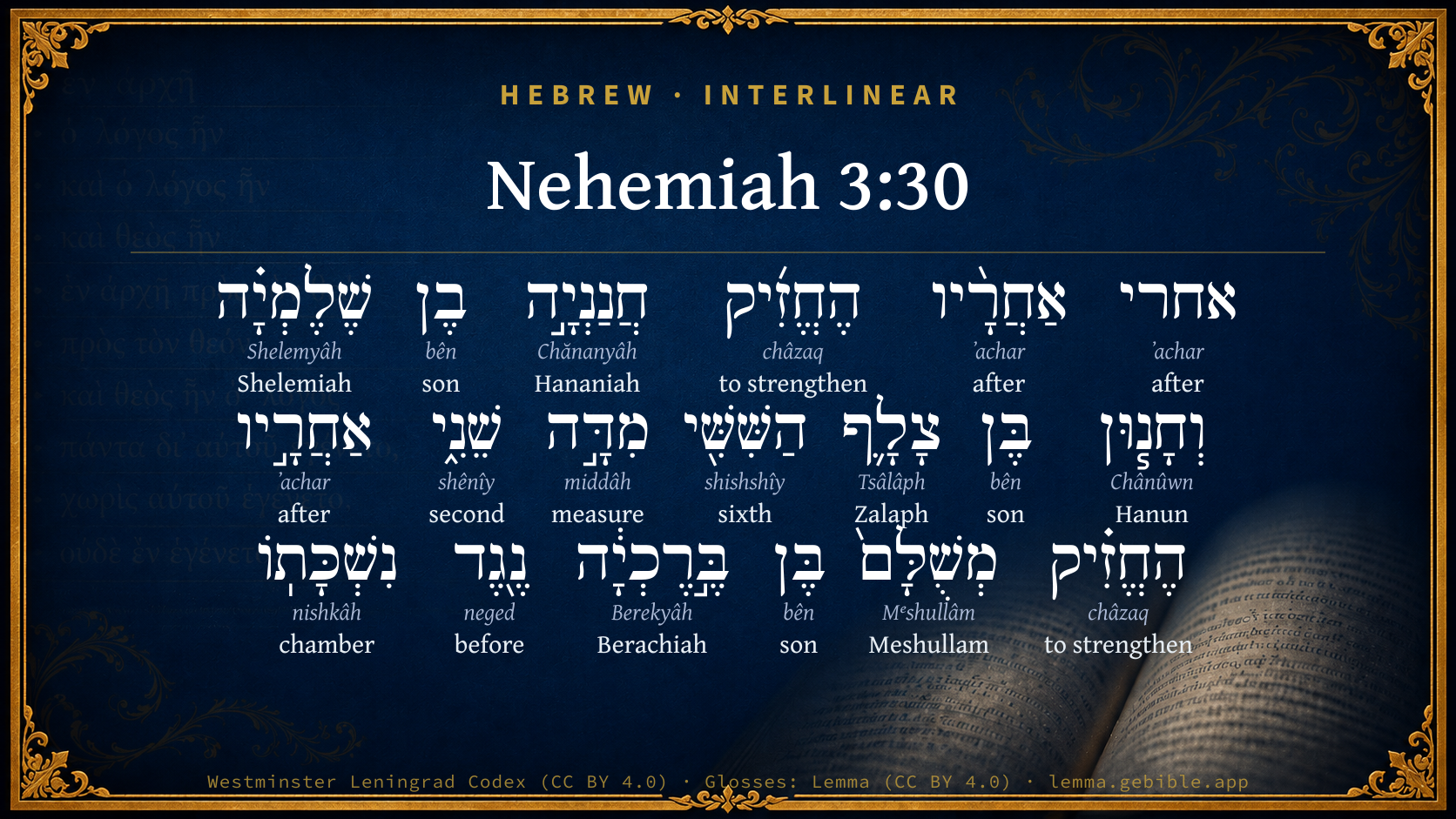
Hebrew (Westminster Leningrad Codex) Nehemiah 3:30 appears in the Hebrew Old Testament. The text above is from the Westminster Leningrad Codex. Each word links to its Strong’s number, a concise gloss, and parsing drawn from the Open Scriptures Hebrew Bible morphology. Click any word for its full Brown-Driver-Briggs (BDB) entry.
Download image
Cite this verse

Nehemiah 3:30 (World English Bible). Public Domain. Lemma interlinear Bible study tool, https://lemma.gebible.app/v/nehemiah/3/30.

Show BibTeX & RIS
BibTeX
RIS
English Translation
After him repaired Hananiah the son of Shelemiah, and Hanun the sixth son of Zalaph, another portion. After him repaired Meshullam the son of Berechiah over against his chamber.
World English Bible · Public Domain
Highlights
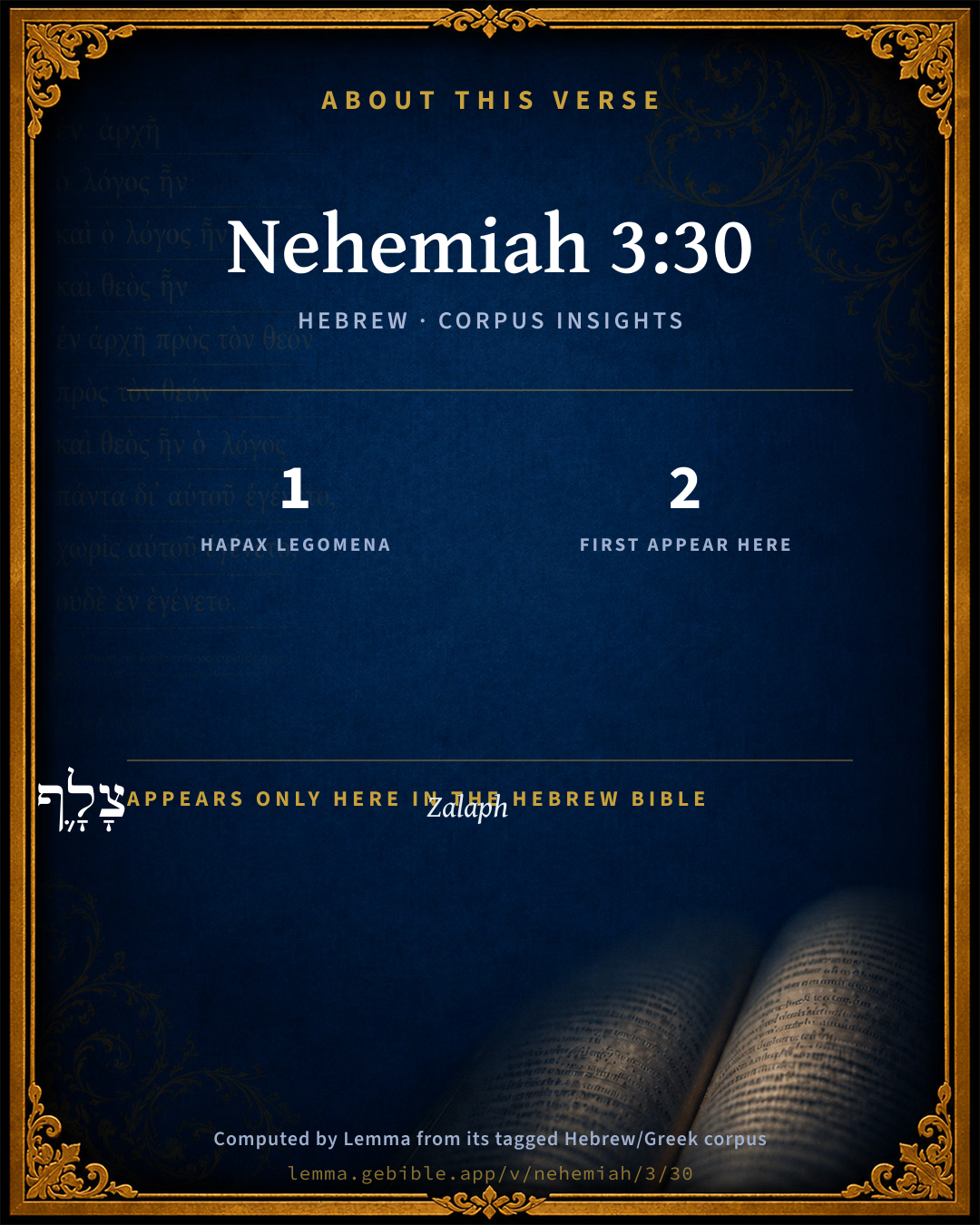
  • 1 hapax legomenon — only here in the Hebrew Bible
  • 2 first appearances in the Hebrew Bible
Full analysis ↓
Download a study sheet

One document with this verse’s original text, its word-by-word gloss line, the meaning frame, cross-references with their text, attributed commentary, and full source and license credits — printable, and it pastes into notes with its structure intact.

This verse Autodidact and up

Study sheet (.html) Plain text (.txt)

A passage Seminary Student

Up to 50 verses in one chapter. A passage sheet keeps up to 6 commentary sources and 12 cross-references per verse, in the order this page ranks them, and says so on the sheet whenever that leaves anything out. Ask for a single verse and you get the Autodidact verse sheet above.

Everything on this page stays free to read, with no account — the sheet is a download of what is already on screen, not access to it.

Want to remove ads? Support Godless Engineer
Compare translations 3

The same verse in 3 English versions, stacked beneath the original-language interlinear above. Click any original word for its lexicon entry.

Each is an independent rendering of the whole verse — the interlinear is not word-aligned to these translations.

Highlighted words mark where these versions differ — a whole-verse word diff, not a word-by-word alignment.

  • World English Bible Public Domain
    After him repaired Hananiah the son of Shelemiah, and Hanun the sixth son of Zalaph, another portion. After him repaired Meshullam the son of Berechiah over against his chamber.
  • King James Version Public Domain
    After him repaired Hananiah the son of Shelemiah, and Hanun the sixth son of Zalaph, another piece. After him repaired Meshullam the son of Berechiah over against his chamber.
  • unfoldingWord Literal Text CC BY-SA 4.0
    After him, Hananiah the son of Shelemiah, with Hanun the sixth son of Zalaph, strengthened a second section. After him, Meshullam the son of Berechiah strengthened in front of his chamber.

unfoldingWord Literal Text — © unfoldingWord, licensed CC BY-SA 4.0. Word-aligned USFM3 via Door43 (git.door43.org/unfoldingWord/en_ult).

Versions to compare (up to 4)

3 of 4 selected

Show all 18 translations

Every available English version of this verse, each an independent rendering of the whole verse.

  • World English Bible Public Domain
    After him repaired Hananiah the son of Shelemiah, and Hanun the sixth son of Zalaph, another portion. After him repaired Meshullam the son of Berechiah over against his chamber.
  • Berean Standard Bible Public Domain
    Next to him, Hananiah son of Shelemiah, as well as Hanun the sixth son of Zalaph, repaired another section. Next to them, Meshullam son of Berechiah made repairs opposite his own quarters.
  • Majority Standard Bible Public Domain
    Next to him, Hananiah son of Shelemiah, as well as Hanun the sixth son of Zalaph, repaired another section. Next to them, Meshullam son of Berechiah made repairs opposite his own quarters.
  • King James Version Public Domain
    After him repaired Hananiah the son of Shelemiah, and Hanun the sixth son of Zalaph, another piece. After him repaired Meshullam the son of Berechiah over against his chamber.
  • American Standard Version (1901) Public Domain
    After him repaired Hananiah the son of Shelemiah, and Hanun the sixth son of Zalaph, another portion. After him repaired Meshullam the son of Berechiah over against his chamber.
  • Revised Version (1885) Public Domain
    After him repaired Hananiah the son of Shelemiah, and Hanun the sixth son of Zalaph, another portion. After him repaired Meshullam the son of Berechiah over against his chamber.
  • Geneva Bible (1599) Public Domain
    After him fortified Hananiah, the sonne of Shelemiah, and Hanun, the sonne of Zalaph, the sixt, another portion after him fortified Meshullam, the sonne of Berechiah, ouer against his chamber.
  • Douay-Rheims (1899) Public Domain
    After him built Hanania the son of Selemia, and Hanun the sixth son of Seleph, another measure: after him built Mosollam the son of Barachias over against his treasury. After him Melcias the goldsmith's son built unto the house of the Nathinites, and of the sellers of small wares, over against the judgment gate, and unto the chamber of the corner.
  • Young's Literal Translation Public Domain
    After him hath Hananiah son of Shelemiah strengthened, and Hanun the sixth son of Zalaph, a second measure; after him hath Meshullam son of Berechiah strengthened, over-against his chamber.
  • Literal Standard Version CC BY-SA 4.0
    After him Hananiah son of Shelemiah has strengthened, and Hanun the sixth son of Zalaph, a second measure; after him Meshullam son of Berechiah has strengthened opposite his chamber.
  • Unlocked Literal Bible CC BY-SA 4.0
    After him Hananiah son of Shelemiah, and Hanun the sixth son of Zalaph, repaired another section. After him Meshullam son of Berechiah repaired opposite his living chambers.
  • unfoldingWord Literal Text CC BY-SA 4.0
    After him, Hananiah the son of Shelemiah, with Hanun the sixth son of Zalaph, strengthened a second section. After him, Meshullam the son of Berechiah strengthened in front of his chamber.
  • Darby Bible Public Domain
    After him repaired Hananiah the son of Shelemiah, and Hanun the sixth son of Zalaph, a second piece. After them repaired Meshullam the son of Berechiah over against his chamber.
  • World Messianic Bible Public Domain
    After him, Hananiah the son of Shelemiah, and Hanun, the sixth son of Zalaph, repaired another portion. After him, Meshullam the son of Berechiah made repairs across from his room.
  • Webster's Bible Public Domain
    After him repaired Hananiah the son of Shelemiah, and Hanun the sixth son of Zalaph, another piece. After him repaired Meshullam the son of Berechiah over against his chamber.
  • Free Bible Version CC BY-SA 4.0
    Next were Hananiah, son of Shelemiah, as well as Hanun, the sixth son of Zalaph, who repaired. Next was Meshullam, son of Berechiah, who made repairs opposite where he lived.
  • Bible in Basic English Public Domain
    After him Hananiah, the son of Shelemiah, and Hanun, the sixth son of Zalaph, were making good another part. After him Meshullam, the son of Berechiah, made good the wall opposite his room.
  • JPS Tanakh (1917) Public Domain
    After him repaired Hananiah the son of Shelemiah, and Hanun the sixth son of Zalaph, another portion. After him repaired Meshullam the son of Berechiah over against his chamber.

Literal Standard Version (2020), Covenant Press — licensed CC BY-SA 4.0. Text via the HelloAO Bible API (eBible.org). Unlocked Literal Bible (unfoldingWord) — licensed CC BY-SA 4.0. Text via the HelloAO Bible API (eBible.org). unfoldingWord Literal Text — © unfoldingWord, licensed CC BY-SA 4.0. Word-aligned USFM3 via Door43 (git.door43.org/unfoldingWord/en_ult). Free Bible Version, Dr. Jonathan Gallagher — licensed CC BY-SA 4.0. Text via the HelloAO Bible API (eBible.org).

Word by word

More ways to search: Search by grammar → Find every occurrence → Compare this word →

Practice this passage: Drill this verse → Learn its vocabulary →

צָלָ֛ף
Tsâlâph
H6764
“Zalaph”
Noun, Proper
Part of Speech
Noun
Type
Proper
Full BDB Definition

Origin: from an unused root of unknown meaning

TWOT: None

Zalaph = "wound" - father of Hanun who assisted in rebuilding the city wall of Jerusalem after the return from exile
  1. אחרי ʼachar H310 “after · me” Preposition + Suffix, Personal, 1st Person, Common, Singular
  2. אַחֲרָ֨יו ʼachar H310 “after · him” Preposition + Suffix, Personal, 3rd Person, Masculine, Singular
  3. הֶחֱזִ֜יק châzaq H2388 “to strengthen” Verb, Hiphil, Perfect, 3rd Person, Masculine, Singular
  4. חֲנַנְיָ֣ה Chănanyâh H2608 “Hananiah” Noun, Proper
  5. בֶן bên H1121 “son of” Noun, Common, Masculine, Singular, Construct
  6. שֶׁלֶמְיָ֗ה Shelemyâh H8018 “Shelemiah” Noun, Proper
  7. וְחָנ֧וּן Chânûwn H2586 “and · Hanun” Conjunction + Noun, Proper
  8. בֶּן bên H1121 “son of” Noun, Common, Masculine, Singular, Construct
  9. הַשִּׁשִּׁ֖י shishshîy H8345 “the · sixth” Particle, Definite Article + Adjective, Ordinal number, Masculine, Singular, Absolute
  10. מִדָּ֣ה middâh H4060 “measure” Noun, Common, Feminine, Singular, Absolute
  11. שֵׁנִ֑י shênîy H8145 “second” Adjective, Ordinal number, Masculine, Singular, Absolute
  12. אַחֲרָ֣יו ʼachar H310 “after · him” Preposition + Suffix, Personal, 3rd Person, Masculine, Singular
  13. הֶחֱזִ֗יק châzaq H2388 “to strengthen” Verb, Hiphil, Perfect, 3rd Person, Masculine, Singular
  14. מְשֻׁלָּם֙ Mᵉshullâm H4918 “Meshullam” Noun, Proper
  15. בֶּן bên H1121 “son of” Noun, Common, Masculine, Singular, Construct
  16. בֶּ֣רֶכְיָ֔ה Berekyâh H1296 “Berachiah” Noun, Proper
  17. נֶ֖גֶד neged H5048 “before” Preposition
  18. נִשְׁכָּתֽוֹ nishkâh H5393 “chamber · his” Noun, Common, Feminine, Singular, Construct + Suffix, Personal, 3rd Person, Masculine, Singular

About this verse

These counts appear in no published source. They are computed here, from the morphology-tagged text and Lemma’s own curated glosses. What Lemma adds →

19
words
14
distinct lemmas
Historical
section

Notable vocabulary

1 hapax legomenon — a word that appears only here in the entire Hebrew Bible:

  • צָלָ֛ף Zalaph H6764

First appearance in Scripture

These words make their first canonical appearance in the Hebrew Bible here:

  • צָלָ֛ף Zalaph H6764
  • נִשְׁכָּתֽוֹ chamber H5393

Shared distinctive vocabulary

נִשְׁכָּתֽוֹ chamber H5393 occurs in 3 verses of the Hebrew Bible. Also found in:

Grammatical profile

  • 2 verbs
  • 11 nouns
  • 2 adjectives
  • 4 prepositions

Verb forms

  • הֶחֱזִ֜יק Hiphil · Perfect
  • הֶחֱזִ֗יק Hiphil · Perfect

Repetition

Words recur within this verse — often emphatic in Hebrew:

  • אחרי after H310 ×3
  • בֶן son H1121 ×3
  • הֶחֱזִ֜יק to strengthen H2388 ×2
Hebrew and Greek witnesses Masoretic Hebrew ↔ Greek Septuagint

The same verse in the two great witnesses to the Old Testament, shown verse-for-verse.

These are two independent witnesses, not word-aligned to each other, and the Septuagint is shown in lemma (dictionary) form.

Hebrew Nehemiah 3:30 Masoretic · Westminster Leningrad Codex

אחרי אַחֲרָ֨יו הֶחֱזִ֜יק חֲנַנְיָ֣ה בֶן שֶׁלֶמְיָ֗ה וְחָנ֧וּן בֶּן צָלָ֛ף הַשִּׁשִּׁ֖י מִדָּ֣ה שֵׁנִ֑י אַחֲרָ֣יו הֶחֱזִ֗יק מְשֻׁלָּם֙ בֶּן בֶּ֣רֶכְיָ֔ה נֶ֖גֶד נִשְׁכָּתֽוֹ

After him repaired Hananiah the son of Shelemiah, and Hanun the sixth son of Zalaph, another portion. After him repaired Meshullam the son of Berechiah over against his chamber.

World English Bible · Public Domain

Greek LXX Structure differs

The Septuagint has no separate book of Nehemiah. Its Greek text is the second half of Esdras B (2 Esdras), chapters 11–23; Ezra is the first half (1–10).

A verse-for-verse comparison isn’t shown here because the chapters and verses don’t line up. Switch to the LXX edition with the MT / LXX toggle above to read the Greek directly.

On this verse, The Cambridge Bible for Schools and Colleges discusses the Septuagint’s reading. Read the note in Commentary ↓

Hebrew: Westminster Leningrad Codex (CC BY 4.0). Greek: Septuagint (public domain); English from a public-domain English Septuagint. How the Septuagint differs from the Hebrew →

Commentary

Notes on Nehemiah 3:30 from classic Christian and Jewish commentators (each source and its license shown beneath its notes). The classic Christian expositions comment on the surrounding passage and are grouped to its opening verse, so a note may address several verses; the Jewish commentaries on the Tanakh (Rashi and others) are per-verse, so they appear only where the commentator wrote on this verse.

Lemma curates 59 commentaries, every one of them public domain or Creative Commons licensed, each selected and text-cleaned for this edition rather than reprinted as found. About our sources →

Trapp's Complete Commentary

John Trapp

Neh 3:30 After him repaired Hananiah the son of Shelemiah, and Hanun the sixth son of Zalaph, another piece. After him repaired Meshullam the son of Berechiah over against his chamber.

Ver. 30. After him repaired Hananiah] Or, After me. Nehemiah, doubtless, did his part, and a large one too, see Neh 4:16, but he omitteth, out of his modesty, to set down how much. In the Hebrew text it is, After me; but in the margin, After him. The reason is given by some to be this, that Nehemiah might most covertly set forth his own work, to avoid all show of vain glory.

And Hanun the sixth son of Zalaph] Not the eldest, but the best of all the brethren. There must be no straining courtesy who shall begin; nor must men fear for their forwardness to be styled seraphical and singular. If Hanun were alone, it was a shame for his brethren to suffer him to be so.

John Trapp, A Commentary or Exposition upon All the Books of the Old and New Testament (1647–1656) — public domain. Text from a community e-Sword module.

Joseph Benson's Commentary

Neh 3:30. And Hanun the sixth son of Zalaph, another piece — It seems his five elder brethren laid not their hands to the work. But in doing that which is good, we need not stay to see our betters go before us.

Joseph Benson's Commentary on the Old and New Testaments (1811–1818) — public domain. Text from a community e-Sword module.

Geneva Bible (1599)

Geneva Bible translators

Meaning the sixth of his sons.

Geneva Bible (1599) marginal notes — public domain. Text via Bolls.life.

The Cambridge Bible for Schools and Colleges

gen. ed. J. J. S. Perowne

30. Hanun the sixth son of Zalaph, … piece] R.V. portion. This particular mention of Hanun as ‘the sixth son’ of Zalaph is noteworthy, since the mention of other names in this chapter is unaccompanied with any detail of description. It is not mentioned in Neh_3:13, where Hanun’s name first occurs; but in this passage it has the support of all the versions. If therefore the word is, as some suppose, a corruption for ‘and the inhabitants of Zanoah’ (Neh_3:13), or a numerical gloss that has accidentally found its way into the text, the error must have arisen in very early times.

Meshullam the son of Berechiah] His name has occurred in Neh_3:4 and it is strange that the words ‘another portion’ are not added in connexion with this second mention of his work. We should naturally expect this tribute to be applied to him rather than to Hanun.

over against his chamber] The word for ‘chamber’ is an unusual form—occurring elsewhere in the O.T. only in Neh_12:44, Neh_13:7—for the ordinary word occurring in Ezr_8:29, where see note. Perhaps it is used here to denote some official residence (LXX. γαζοφυλάκιον, Vulg. gazophylacium). The mention of Meshullam’s ‘chamber’ increases the probability that he was a priest of eminence, if, as the context somewhat suggests, ‘the chamber’ was within the Temple precincts.

The Cambridge Bible for Schools and Colleges (gen. ed. J. J. S. Perowne; Cambridge University Press, 1878–1918) — public domain. Text from a community e-Sword module.

John Gill's Exposition

And between the going up of the corner unto the sheep gate,.... Where the building first began and where it now ended:

repaired the goldsmiths and the merchants; or druggists; which was done at their expense; and so the wall all round, with the gates of it, were rebuilt and repaired, which was all done in fifty two days, Neh 6:15.

Next: Nehemiah Chapter 4

John Gill's Exposition of the Whole Bible (1746–1763) — public domain (CC PDM 1.0). Text via the HelloAO Bible API.

Matthew Poole's English Annotations

Or, chambers; the singular number for the plural.

Matthew Poole's English Annotations on the Holy Bible (1683–1685) — public domain. Text from a community e-Sword/MySword module.

The Pulpit Commentary

After him. The traditional text gives "after me;" and it has been supposed that Nehemiah assigned himself a certain portion of the wall and repaired it, but suppressed his own name through modesty. But, as general superintendent of the whole, (Neh_4:13-23) he could scarcely take any special work; and the argument that might have been founded upon a single occurrence of the expression "after me" is deprived of all force by its double occurrence, here and in ver. 31. Another piece. A Hanun has been mentioned (ver. 13) among the leaders of the working parties, and also a Hananiah (ver. 8); but they were not coupled together; and it may well be questioned whether either is identical with his namesake of this verse. Probably we have here another instance of the incompleteness of our present text of this chapter (see the comment on ver. 11).

The Pulpit Commentary (1880–1919), ed. H.D.M. Spence-Jones & Joseph S. Exell — public domain. Text from a community e-Sword module.

John Wesley's Explanatory Notes

The sixth son of Zalaph - It seems, his five elder brethren, laid not their hands to the work. But in doing that which is good, we need not stay to see our betters go before us.

John Wesley, Explanatory Notes Upon the Whole Bible (1754–1765) — public domain. Text via the GEBible commentary corpus.

Rashi

Rabbi Shlomo Yitzchaki (Rashi)

and Hanun the sixth son of Zalaph Zalaph had many sons, and Hanun was the sixth.

a second measure Heb. מִדָה שֵּׁנִי, like שֵּׁנִית.

his chamber Heb. נִשְּׁכָּתוֹ, like לִשְּׁכָּתוֹ. He had one chamber adjoining the wall.

Rashi on the Tanakh — English translations: “The Judaica Press complete Tanach with Rashi, translated by A. J. Rosenberg” (CC BY 4.0); “Pentateuch with Rashi's commentary by M. Rosenbaum and A.M. Silbermann, 1929-1934” (public domain); “The Metsudah Tanach series, Lakewood, N.J” (CC BY 4.0); and “The Book of Joshua, Metsudah Publications, 1997” (CC BY 4.0). Text via Sefaria.

Lesson kit

Teaching starters — assembled from the data on this page, not authored interpretation. Every prompt links to the verse data it draws on. Edit before teaching.

Nehemiah, in the Historical, opens this verse with 19 words (14 distinct Hebrew lemmas). Its most distinctive word is Tsâlâph (“Zalaph”). A historical commentator’s framing appears above. Read the whole chapter for the surrounding context.

Discussion questions

  1. The word Tsâlâph carries the sense “Zalaph.” How does it shape the verse?
  2. 1 word here appears nowhere else in the Hebrew Bible. Why might the author reach for such rare wording?
  3. 2 words make their first appearance in Scripture here. What does this debut establish?
  4. How does Nehemiah 12:44, which shares the word «chamber», read alongside this verse?
  5. What does the repetition of “after” (3× in this one verse) do in this verse?
  6. These translations render this verse differently; the difference is in the English rendering, not the original. What questions does that raise?
  7. «הֶחֱזִ֜יק» is a Hiphil Perfect verb. How does that grammatical form shape the action described?
  8. Compare how Trapp's Complete Commentary and Joseph Benson's Commentary read this verse. Where do they agree or differ?

Things to notice

  • 1 word in this verse appears nowhere else in the Hebrew Bible.
  • 2 words make their first canonical appearance in Scripture here.
  • These translations choose different wording for 10 words in this verse.
  • “after” occurs 3× in this single verse.
  • 14 distinct Hebrew lemmas span 19 words in this verse.

Reading settings

Reading text

Shown beneath each verse's original-language words.

Old Testament
Old Testament edition

Read the OT as the Masoretic Hebrew (MT) or the Greek Septuagint (LXX).

English shown for the Greek Septuagint (in the Hebrew ↔ Greek comparison).

Comparing translations? Open the Compare panel on any verse page to stack up to four side by side.