Jeremiah 49:24

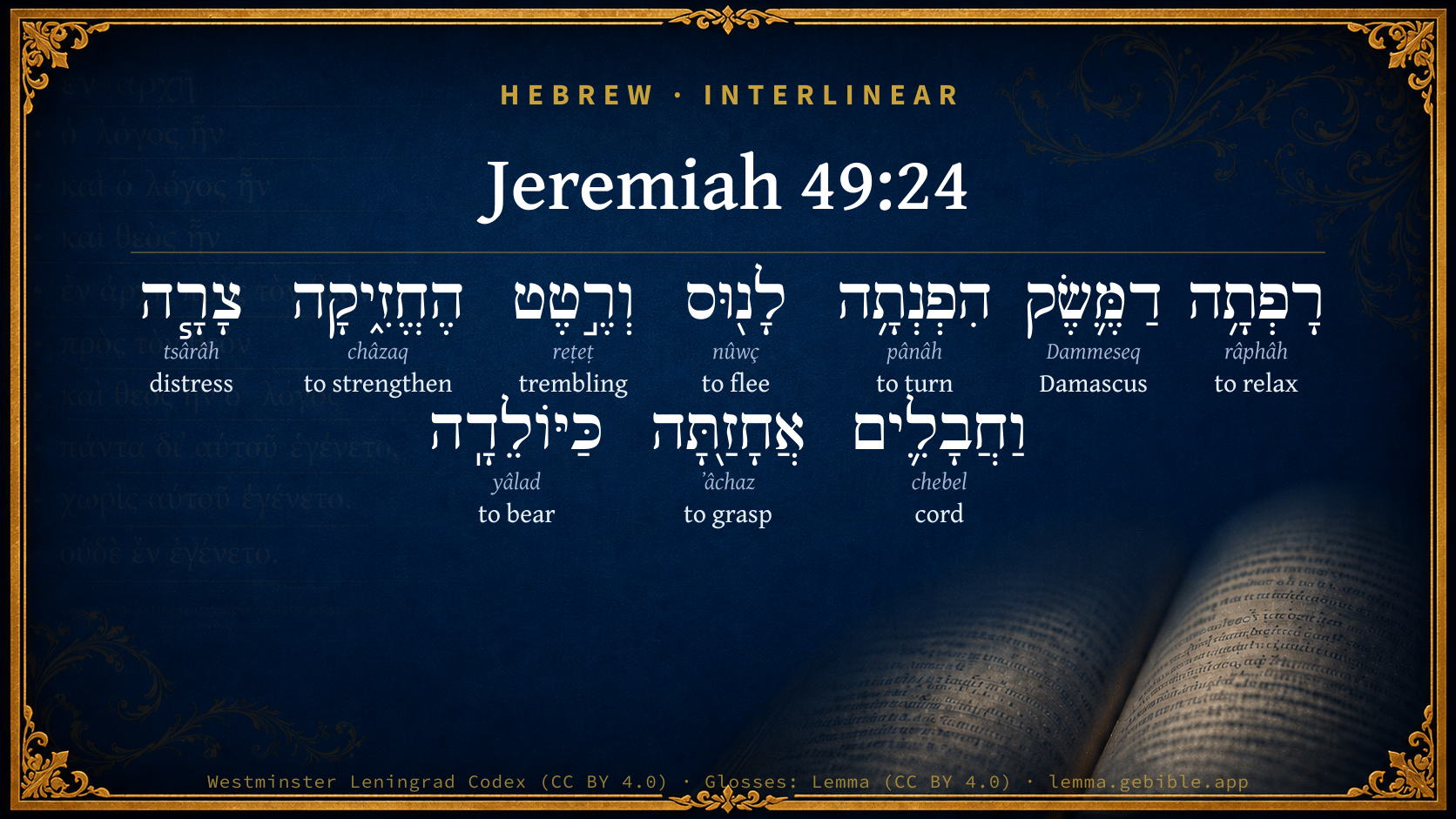
Hebrew (Westminster Leningrad Codex) Jeremiah 49:24 appears in the Hebrew Old Testament. The text above is from the Westminster Leningrad Codex. Each word links to its Strong’s number, a concise gloss, and parsing drawn from the Open Scriptures Hebrew Bible morphology. Click any word for its full Brown-Driver-Briggs (BDB) entry.
Download image
Cite this verse

Jeremiah 49:24 (World English Bible). Public Domain. Lemma interlinear Bible study tool, https://lemma.gebible.app/v/jeremiah/49/24.

Show BibTeX & RIS
BibTeX
RIS
English Translation
Damascus has grown feeble, she turns herself to flee, and trembling has seized on her: anguish and sorrows have taken hold of her, as of a woman in travail.
World English Bible · Public Domain
Highlights
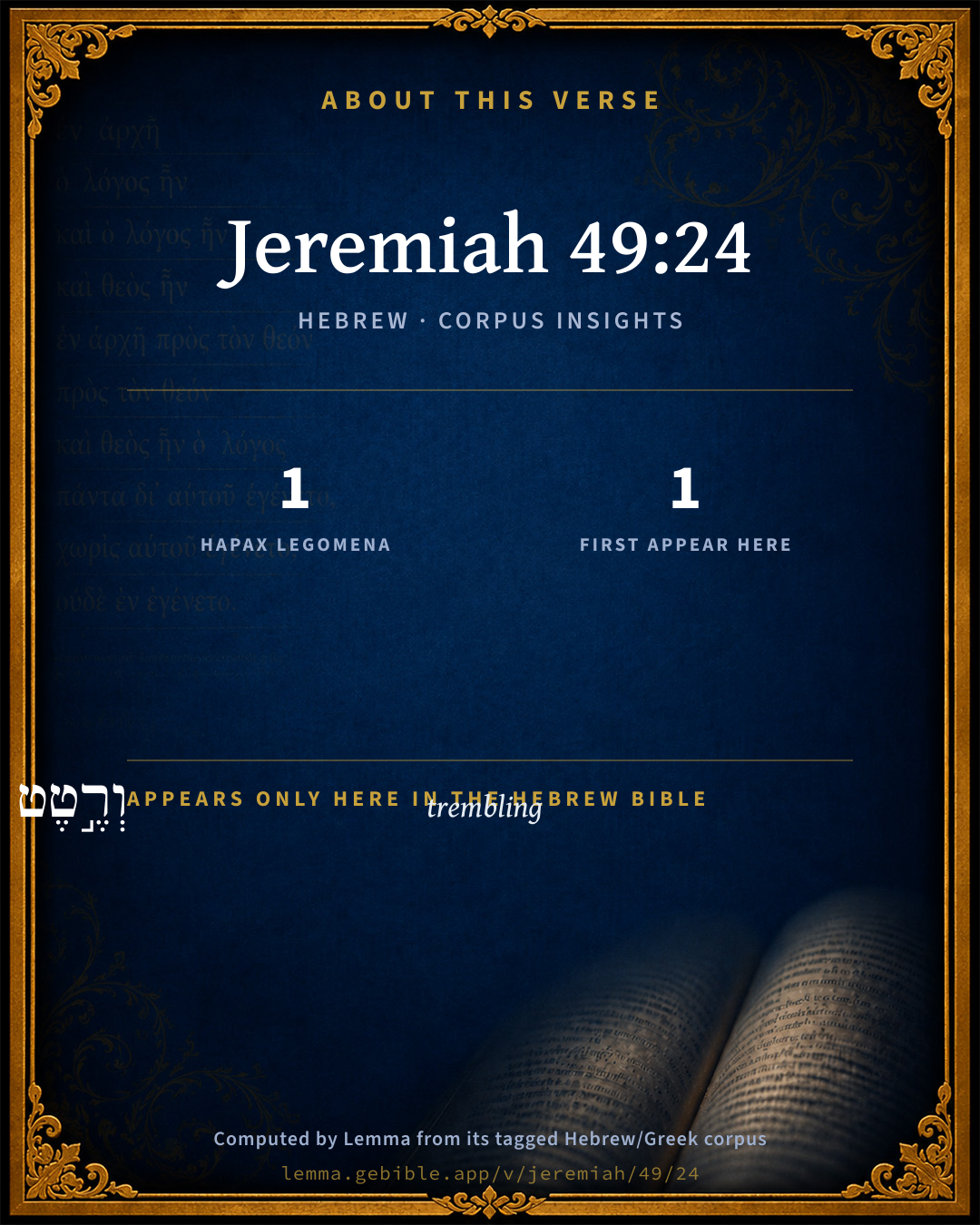
  • 1 hapax legomenon — only here in the Hebrew Bible
  • 1 first appearance in the Hebrew Bible
Full analysis ↓
Download a study sheet

One document with this verse’s original text, its word-by-word gloss line, the meaning frame, cross-references with their text, attributed commentary, and full source and license credits — printable, and it pastes into notes with its structure intact.

This verse Autodidact and up

Study sheet (.html) Plain text (.txt)

A passage Seminary Student

Up to 50 verses in one chapter. A passage sheet keeps up to 6 commentary sources and 12 cross-references per verse, in the order this page ranks them, and says so on the sheet whenever that leaves anything out. Ask for a single verse and you get the Autodidact verse sheet above.

Everything on this page stays free to read, with no account — the sheet is a download of what is already on screen, not access to it.

Want to remove ads? Support Godless Engineer
Compare translations 3

The same verse in 3 English versions, stacked beneath the original-language interlinear above. Click any original word for its lexicon entry.

Each is an independent rendering of the whole verse — the interlinear is not word-aligned to these translations.

Highlighted words mark where these versions differ — a whole-verse word diff, not a word-by-word alignment.

  • World English Bible Public Domain
    Damascus has grown feeble, she turns herself to flee, and trembling has seized on her: anguish and sorrows have taken hold of her, as of a woman in travail.
  • King James Version Public Domain
    Damascus is waxed feeble, and turneth herself to flee, and fear hath seized on her: anguish and sorrows have taken her, as a woman in travail.
  • unfoldingWord Literal Text CC BY-SA 4.0
    Damascus has become very weak. It turns away to flee; terror seizes it. Distress and pain seize it, like the pain of a woman giving birth.

unfoldingWord Literal Text — © unfoldingWord, licensed CC BY-SA 4.0. Word-aligned USFM3 via Door43 (git.door43.org/unfoldingWord/en_ult).

Versions to compare (up to 4)

3 of 4 selected

Show all 18 translations

Every available English version of this verse, each an independent rendering of the whole verse.

  • World English Bible Public Domain
    Damascus has grown feeble, she turns herself to flee, and trembling has seized on her: anguish and sorrows have taken hold of her, as of a woman in travail.
  • Berean Standard Bible Public Domain
    Damascus has become feeble; she has turned to flee. Panic has gripped her; anguish and pain have seized her like a woman in labor.
  • Majority Standard Bible Public Domain
    Damascus has become feeble; she has turned to flee. Panic has gripped her; anguish and pain have seized her like a woman in labor.
  • King James Version Public Domain
    Damascus is waxed feeble, and turneth herself to flee, and fear hath seized on her: anguish and sorrows have taken her, as a woman in travail.
  • American Standard Version (1901) Public Domain
    Damascus is waxed feeble, she turneth herself to flee, and trembling hath seized on her: anguish and sorrows have taken hold of her, as of a woman in travail.
  • Revised Version (1885) Public Domain
    Damascus is waxed feeble, she turneth herself to flee, and trembling hath seized on her: anguish and sorrows have taken hold of her, as of a woman in travail.
  • Geneva Bible (1599) Public Domain
    Damascus is discouraged, and turneth her selfe to flight and feare hath seased her: anguish and sorowes haue taken her as a woman in trauaile.
  • Douay-Rheims (1899) Public Domain
    Damascus is undone, she is put to flight, trembling hath seized on her: anguish and sorrows have taken her as a woman in labour.
  • Young's Literal Translation Public Domain
    Feeble hath been Damascus, She turned to flee, and fear strengthened her, Distress and pangs have seized her, as a travailing woman.
  • Literal Standard Version CC BY-SA 4.0
    Damascus has been feeble, || She turned to flee, and fear strengthened her, || Distress and pangs have seized her, as a travailing woman.
  • Unlocked Literal Bible CC BY-SA 4.0
    Damascus has become very weak. It turns away to flee; terror seizes it. Distress and pain seize it, like the pain of a woman giving birth.
  • unfoldingWord Literal Text CC BY-SA 4.0
    Damascus has become very weak. It turns away to flee; terror seizes it. Distress and pain seize it, like the pain of a woman giving birth.
  • Darby Bible Public Domain
    Damascus is grown feeble: she turneth herself to flee, and terror hath seized on her; trouble and sorrows have taken hold of her as of a woman in travail.
  • World Messianic Bible Public Domain
    Damascus has grown feeble, she turns herself to flee, and trembling has seized her. Anguish and sorrows have taken hold of her, as of a woman in travail.
  • Webster's Bible Public Domain
    Damascus hath become feeble, and turneth herself to flee, and fear hath seized on her: anguish and sorrows have taken her, as a woman in travail.
  • Free Bible Version CC BY-SA 4.0
    The people of Damascus are demoralized—they turn and run away in panic, overcome by pain and anguish like a woman in labor.
  • Bible in Basic English Public Domain
    Damascus has become feeble, she is turned to flight, fear has taken her in its grip: pain and sorrows have come on her, as on a woman in birth-pains.
  • JPS Tanakh (1917) Public Domain
    Damascus is waxed feeble, she turneth herself to flee, and trembling hath seized on her; anguish and pangs have taken hold of her, as of a woman in travail.

Literal Standard Version (2020), Covenant Press — licensed CC BY-SA 4.0. Text via the HelloAO Bible API (eBible.org). Unlocked Literal Bible (unfoldingWord) — licensed CC BY-SA 4.0. Text via the HelloAO Bible API (eBible.org). unfoldingWord Literal Text — © unfoldingWord, licensed CC BY-SA 4.0. Word-aligned USFM3 via Door43 (git.door43.org/unfoldingWord/en_ult). Free Bible Version, Dr. Jonathan Gallagher — licensed CC BY-SA 4.0. Text via the HelloAO Bible API (eBible.org).

Word by word

More ways to search: Search by grammar → Find every occurrence → Compare this word →

Practice this passage: Drill this verse → Learn its vocabulary →

וְרֶ֣טֶט
reṭeṭ
H7374
“and · trembling”
Conjunction + Noun, Common, Masculine, Singular, Absolute
Part of Speech
Conjunction + Noun
Type
Common
Gender
Masculine
Number
Singular
State
Absolute
Full BDB Definition

Origin: from an unused root meaning to tremble

TWOT: 2156a

trembling, panic
  1. רָפְתָ֥ה râphâh H7503 “to relax” Verb, Qal, Perfect, 3rd Person, Feminine, Singular
  2. דַמֶּ֛שֶׂק Dammeseq H1834 “Damascus” Noun, Proper
  3. הִפְנְתָ֥ה pânâh H6437 “to turn” Verb, Hiphil, Perfect, 3rd Person, Feminine, Singular
  4. לָנ֖וּס nûwç H5127 “to flee” Preposition + Verb, Qal, Infinitive Construct
  5. הֶחֱזִ֑יקָה châzaq H2388 “to strengthen” Verb, Hiphil, Perfect, 3rd Person, Feminine, Singular
  6. צָרָ֧ה tsârâh H6869 “distress” Noun, Common, Feminine, Singular, Absolute
  7. וַחֲבָלִ֛ים chebel H2256 “and · cords” Conjunction + Noun, Common, Masculine, Plural, Absolute
  8. אֲחָזַ֖תָּה ʼâchaz H270 “to grasp · her” Verb, Qal, Perfect, 3rd Person, Feminine, Singular + Suffix, Personal, 3rd Person, Feminine, Singular
  9. כַּיּוֹלֵדָֽה yâlad H3205 “like/as the · bearing” Preposition, Determined + Verb, Qal, Participle Active, Feminine, Singular, Absolute

About this verse

These counts appear in no published source. They are computed here, from the morphology-tagged text and Lemma’s own curated glosses. What Lemma adds →

10
words
10
distinct lemmas
Prophets
section

Notable vocabulary

1 hapax legomenon — a word that appears only here in the entire Hebrew Bible:

  • וְרֶ֣טֶט trembling H7374

First appearance in Scripture

This word makes its first canonical appearance in the Hebrew Bible here:

  • וְרֶ֣טֶט trembling H7374

Shared distinctive vocabulary

דַמֶּ֛שֶׂק Damascus H1834 occurs in 40 verses of the Hebrew Bible. Also found in:

Grammatical profile

  • 6 verbs
  • 4 nouns

Verb forms

  • רָפְתָ֥ה Qal · Perfect
  • הִפְנְתָ֥ה Hiphil · Perfect
  • לָנ֖וּס Qal · Infinitive Construct
  • הֶחֱזִ֑יקָה Hiphil · Perfect
  • אֲחָזַ֖תָּה Qal · Perfect
  • כַּיּוֹלֵדָֽה Qal · Participle Active
Hebrew and Greek witnesses Masoretic Hebrew ↔ Greek Septuagint

The same verse in the two great witnesses to the Old Testament, shown verse-for-verse.

These are two independent witnesses, not word-aligned to each other, and the Septuagint is shown in lemma (dictionary) form.

Hebrew Jeremiah 49:24 Masoretic · Westminster Leningrad Codex

רָפְתָ֥ה דַמֶּ֛שֶׂק הִפְנְתָ֥ה לָנ֖וּס וְרֶ֣טֶט הֶחֱזִ֑יקָה צָרָ֧ה וַחֲבָלִ֛ים אֲחָזַ֖תָּה כַּיּוֹלֵדָֽה

Damascus has grown feeble, she turns herself to flee, and trembling has seized on her: anguish and sorrows have taken hold of her, as of a woman in travail.

World English Bible · Public Domain

Greek LXX Structure differs

In the Septuagint, Jeremiah is about an eighth shorter than the Hebrew and arranges its material differently — the Oracles Against the Nations (Hebrew chapters 46–51) appear in the middle of the Greek book, after 25:13. Because the chapter and verse boundaries do not line up, a verse-for-verse comparison with the Hebrew is not shown.

A verse-for-verse comparison isn’t shown here because the chapters and verses don’t line up. Switch to the LXX edition with the MT / LXX toggle above to read the Greek directly.

Hebrew: Westminster Leningrad Codex (CC BY 4.0). Greek: Septuagint (public domain); English from a public-domain English Septuagint. How the Septuagint differs from the Hebrew →

Targum (Aramaic paraphrase)

1

The Targum is the ancient Jewish Aramaic paraphrase of the Hebrew Scriptures — an interpretive translation, not the Hebrew text itself. Onkelos (literal) and Pseudo-Jonathan (expansive) render the Torah, and Jonathan the Prophets. Coverage is partial: where no permissively-licensed English translation exists for a verse, only the Aramaic is shown. This is verse-level text, not a word-by-word alignment to the Hebrew.

  1. Targum Jonathan Prophets (Joshua–Malachi)
    אִתְרַשְׁלוּ יַתְבֵי דַמֶשֶׂק אִתְפְּנִיאוּ לְמֵיעֲרָק וְשִׁפְלוּתָא אֵחַדְתִּינוּן עָקָא וְחֶבְלִין אַחְדוּנוּן הָא כְּחֶבְלִין לְיָלַדְתָּא:

    (no public-domain English translation for this verse)

    Targum Jonathan — Aramaic: “Mikraot Gedolot” (public domain). English: “Sefaria Community Translation” (CC0 1.0 (public-domain dedication)); “London "Chaldee Paraphrase," 1871” (public domain). Text via Sefaria.

Commentary

Notes on Jeremiah 49:24 from classic Christian and Jewish commentators (each source and its license shown beneath its notes). The classic Christian expositions comment on the surrounding passage and are grouped to its opening verse, so a note may address several verses; the Jewish commentaries on the Tanakh (Rashi and others) are per-verse, so they appear only where the commentator wrote on this verse.

Lemma curates 59 commentaries, every one of them public domain or Creative Commons licensed, each selected and text-cleaned for this edition rather than reprinted as found. About our sources →

Trapp's Complete Commentary

John Trapp

Jer 49:24 Damascus is waxed feeble, [and] turneth herself to flee, and fear hath seized on [her]: anguish and sorrows have taken her, as a woman in travail.

Ver. 24. And fear hath seized on her.] Horrorem febrilem apprehendit; { a} she shaketh as in a fit of an ague.

{a} Piscat.

John Trapp, A Commentary or Exposition upon All the Books of the Old and New Testament (1647–1656) — public domain. Text from a community e-Sword module.

Joseph Benson's Commentary

Jer 49:24-27. Damascus is waxed feeble — That is, the inhabitants of Damascus. They have lost their ancient courage and valour; they were wont to be formidable to their enemies, but now they flee before them. Fear, or rather, trembling, or, horror, as רשׂשׂ, properly signifies, hath seized on her, distress and pangs, Hebrew, צרה וחבלים, have taken her, as a woman in travail — Great anguish and sorrow are ordinarily expressed by this similitude in the Scriptures. How is the city of praise — That is, a city of fame and renown; not left — Namely, not spared, or left untouched by the enemy. This is thought to be spoken in the person of the king, or some other inhabitant of Damascus. Therefore her young men — Or, surely her young men, as the particle לכןis rendered Jer 5:2; shall fall in her streets — Or, broad places, as the Hebrew word signifies. A fire shall consume the palaces of Benhadad — The name of several kings of Syria.

Joseph Benson's Commentary on the Old and New Testaments (1811–1818) — public domain. Text from a community e-Sword module.

Geneva Bible (1599)

Geneva Bible translators

When she heard the sudden coming of the enemy.

Geneva Bible (1599) marginal notes — public domain. Text via Bolls.life.

John Calvin's Commentaries

The Prophet goes on with the same subject, for as the kingdom of Syria had flourished, and had been eminent in wealth and power, it was hardly credible that it could so soon be overthrown. This, then, is the reason why the Prophet, according to his usual manner, describes at large the ruin of that kingdom in order to confirm what he said.

He then says, relaxed, or weakened, is Damascus This verb, indeed, sometimes means to cease: he means that she was broken in strength. But under the name of this city, he includes, as it was stated yesterday, the whole kingdom of Syria, which was celebrated for its riches, largeness, and number of men. She turns, he says, to flight By these words he intimates that no safety remained for the Syrians except by fleeing into other countries. And it is a miserable safety when men cannot otherwise secure it than by a voluntary exile. He adds the reason, Trembling has laid hold on her, anguish and pangs have seized her as a woman in travail Whenever this comparison occurs in Scripture, some sudden and unexpected evil is intended. The Prophet then no doubt means that the ruin of Syria would be sudden; and he says this, that it might not trust in its own power, and that others might not think her to be beyond danger, because they saw that it was fortified by the number of its men, and by the abundance of all other things. It now follows, —

John Calvin's Commentaries (1540-1563) — public domain. Text from the Calvin Translation Society English edition (1840s-50s) via the Christian Classics Ethereal Library (ccel.org). Calvin's coverage is partial (roughly two-thirds of the Bible); uncommented books and verses are honest gaps, never fabricated. The 19th-century editor's footnotes and remarks are omitted so the notes are faithfully Calvin's own voice.

John Gill's Exposition

Damascus is waxed feeble,.... Or, "is become remiss" (g); her hands hang down, not being able through fear and fright to lift them up against the enemy; that is, the inhabitants of Damascus, as the Targum:

and turneth herself to flee; instead of going out to meet the enemy, the inhabitants of this city meditated a flight, and turned their backs upon him in order to flee from him, and escape falling into his hands:

and fear hath seized on her: or, "she seized on fear" (h); instead of seizing on arms, and laying hold on them to defend herself with, she seized on that; or however that seized on her, and made her quite unfit to stand up in her own defence:

anguish and sorrows have taken her as a woman in travail; See Gill on Jer 49:22; A phrase often used to express the sudden and inevitable destruction of a people, and their distress and inability to help themselves.

(g) "remissa erit", Junius & Tremellius; "remissa est", Cocceius, Piscator; "remissa facta est", Schmidt. (h) "et apprehendit tremorem", Munster; "et horrorem apprehendit", Schmidt; "et horrorem febrilem prehendet", Junius & Tremellius; "apprehendet", Piscator.

John Gill's Exposition of the Whole Bible (1746–1763) — public domain (CC PDM 1.0). Text via the HelloAO Bible API.

Albert Barnes' Notes on the Bible

And turneth - Omit and. The original is a rapid sequence of unconnected sentences. “Damascus is unnerved; she turned to flee, and a trembling seized her; anguish and writhings took hold of her etc.”

Albert Barnes' Notes on the Bible (1834–1885) — public domain. Text from a community e-Sword/MySword module.

Matthew Poole's English Annotations

Syria, whose head is Damascus, hath lost her old courage and valour; it was wont to be a formidable country to its neighbours, but now they flee before their enemies.

Fear hath seized on her; they are seized, and overpowered by their own fears.

Anguish and sorrows have taken her, as a woman in travail; great sorrows are ordinarily in Scripture expressed by the similitude of the pains of a woman in travail; we have met with it often in this prophecy, Jer 6:24; 22:23; so Psa 48:6; Mic 4:9.

Matthew Poole's English Annotations on the Holy Bible (1683–1685) — public domain. Text from a community e-Sword/MySword module.

The Pulpit Commentary

The fall of Damascus; or, the lovely and the lovable lost.

Here and in Isaiah and Amos we have predictions of the overthrow of Damascus. "The burden of Damascus" says Isaiah. "Behold! Damascus is taken away from being a city, and it shall be a ruinous heap." Jeremiah likens the agitated minds of the multitude of her inhabitants to the unquiet sea still not for one moment. And the cause of that unquietness is their sorrow at the desolations coming on them. And yet she was no mean city. No; she was distinguished indeed. The hearts of men, in all ages of the world, have been drawn to her, and are so still. For she was and is surpassingly lovely. Beautiful for situation, the joy of the whole land around, compared to the Paradise in which our first father was placed by God, and celebrated by every writer, sacred and secular, that has had occasion to speak of her or her history. "It is the oldest city in the world. Its fame begins with the earliest patriarchs and continues to modern times. While other cities of the East have risen and decayed, Damascus is still where and what it was. While Babylon is a heap in the desert, Nineveh buried beneath her mounds, and Tyre a ruin on the seashore, it remains what it is called in the prophecies of Isaiah, "the head of Syria." And ever since, down to our own days, its praise is celebrated. It was "a predestinated capital." Nor is it difficult to explain why its freshness has never Faded through all its series of vicissitudes and wars." Men have ever loved it and love it still. As the traveller from the west climbs up and up the steep passes of the great Lebanon range, and at length nears their eastern side, there, on the summit of a cliff, high up above the plain beneath, he looks down on the city of Damascus. "At the foot of the cliff on which the beholder stands, a river bursts forth from the mountain in which it has had birth. That river, as if in a moment, scatters over the plain, through a circle of thirty miles, the verdure which had hitherto been confined to its single channel. It is like the bursting of a shell, the eruption of a volcano but an eruption, not of death, but of life. Far and wide extends in front the level plain, its horizon bare, its lines of surrounding hills bare, all bare, far away on the road to Palmyra and Bagdad. In the midst of this plain lies at your feet the vast island of deep verdure, walnuts and apricots hanging above, corn and grass below." The river is its life. It is drawn out in watercourses and spread in all directions. For miles around it is a wilderness of gardens gardens with roses among the tangled shrubberies, and with fruit on the branches overhead. Everywhere among the trees the murmur of unseen rivulets is heard. Even in the city, which is in the midst of the garden, the clear rushing of the current is a perpetual refreshment. Every dwelling has its fountain; and at night, when the sun has set behind Mount Lebanon, the lights of the city are seen flashing on the water. All travellers in all ages have paused to feast their eyes on the loveliness of the city as they first behold it from the cliffs of Lebanon. Abana and Pharpar still flash and gleam as they flow along amid her fragrant gardens and by her dark olive groves. Snow-capped Hermon and the rugged range of Lebanon still keep over her their wonted watch and ward. Hence she may well be taken as the symbol of all that is lovely and fair in outward life, all that is bright and beautiful in the moral nature of man. But yet she fell, and she has lost her place amongst the nations forever. Thus she suggests to the thoughtful reader the heart searching truth that the lovely and the lovable may yet be lost those on whom Jesus, looking, loves them, because they are so lovable, may yet miss of the life that is eternal; and he may say, as he did to one of them, "One thing thou lackest." Observe, then

I THERE HAVE BEEN SOULS CHARACTERIZED BY MUCH THAT IS LOVELY AND LOVABLE, AND YET HAVE NOT ENTERED INTO THE KINGDOM OF GOD. Read the history of Orpah. Then there was that young ruler to whom reference has already been made. And the many who flocked around our Saviour when he was here on earth, and whom he likened to the stony ground hearers. They all had much that was excellent and good about them, but they failed to bring forth fruit unto life eternal.

II AND THERE ARE MANY SUCH NOW. Were our Lord amongst us now, he would love them as he did him of whom the Gospel tells. They may be young in years; in the morning of life, fair and comely to look upon, vigorous and strong, well educated, intelligent, bright and clever, cultured themselves and loving refinement and culture in others; they may be possessed of very attractive moral qualities, amiable and kindly, ready to do a kind action and scorning to do a mean one, possessed of and deserving an honourable reputation, of unquestioned veracity, of high honour, modest and pure in word and deed, gentle and courteous in manner, unassuming, thoughtful of the feelings and wishes of others; parents and friends, family and neighbours, all speak well of them, and those who know them best honour and love them most. Now, there are thousands of such as these. They are loved and lovable; they must be so. And as we picture them to ourselves we almost shrink from saying that such may nevertheless miss of the kingdom of God; like Damascus in all that is externally beautiful, and yet, like her, come under the condemnation of God. It seems scarce believable, and yet in the face of God"s Word what can we say? Nicodemus was one such, and yet our Lord told him, "Except a man be born again," etc. We would be as charitable as the Word of God and if we were that would make us far more charitable than the most ofus are but we would not be more so, for that would be to be uncharitable and unfaithful both to God and to the souls of men. And therefore we say that a man may be all that is externally fair and lovable, and yet, like bright beautiful Damascus, come under the condemnation of God; lovely and lovable like him whom Jesus loved, and yet, because lacking the one thing, shut out self shut out from the kingdom of God. And observe

III THIS RULE OF GOD IS NOT ARBITRARY, BUT JUST AND INDISPENSABLE. For all that we have said may coexist along with the will alien from the will of God, the heart not yet truly surrendered to him. It was so in that typical instance of this character to whom we have so often referred. For when brought to the test he refused the will of God. For the proof of our loyalty to God is seen, not in the many things that we are and do which are in keeping with our own inclinations, but in those that we are ready to do when they involve a real taking up of the cross and contradict those inclinations. A cultured, refined disposition may lead us, out of regard to our own self-interest, to do and be that which wins for us the applause and favour of our fellow men. It would be a pain and grief to us to be otherwise. All the commands of the moral law we may have kept from our youth up, and hence conclude, and others even Christ"s disciples may think also, that we lack nothing. And in fact we may lack nothing but that one thing without which all else is vain and useless for our admission into the kingdom of God. But in that kingdom the will of God must be paramount, or it ceases to be the kingdom of God. Suppose one of the heavenly bodies could choose, and did so, to swerve at times from its appointed orbit, and to take a course of its own; the whole universe would be thrown out of order, and confusion and destruction must ensue. Suppose one string of harp, one pipe of organ, instead of giving its proper note, were to resolve to utter a sound different from that which was appointed for it; what jarring discord must result! no true music could such harp or organ give. And so in God"s kingdom, if there be one discordant will, how can the harmony and peace and blessedness of heaven any longer exist? If in our homes the law of the house be violated by any one of its members, how little would such a household deserve the sweet name of home! For the good of all, therefore, and not for any arbitrary reason, one law, one will, must be paramount. It is so in our earthly homes; it must yet more be so in the home of God, the kingdom of heaven. The heart, the will, must be surrendered to God if we are to be at last numbered amongst the inhabitants of God"s eternal home.

IV WHAT, THEN, SHALL WE SAY TO SUCH? Shall we bid you set light store by those varied qualities which draw forth the affection and esteem of your fellow men? Shall we say Care nothing for that which, when Jesus looked upon, even he could not but love? Still less shall we say that all these things are of the nature of sin. On the contrary, we would sayGive God thanks for these things. For, indeed, it is of his great mercy that you have been led to approve of them, and to turn away with disgust and abhorrence from that which is contrary thereto. Why were you made to hear God"s voice? for it was his voice which called you, and his hand which led you to this good choice. Without doubt the parents of that young ruler gave God thanks again and again when they saw the character of their son unfolding and developing in all such high minded, pure, and amiable ways. And when we see the like in our children, do we not, ought we not to, give thanks likewise? What, then, do we say to you but this?

(1) Render thanks to God that he has thus inclined your heart; and then

(2) go on to ask him who has been so good to you thus far that he will be more gracious still, and give you that one thing which yet you lack the new heart, the perfectly surrendered will, the faith in God of which such surrender is the chief expression. Remember that the merchantman who became the happy owner of the pearl of great price was not content with the many goodly pearls after which he had been seeking and which he had already attained, No; but when he saw that pure, all-precious, lustrous pearl, he resolved that that should be his, and hence all was surrendered that he might make it his own. Now, you resemble him in two out of the three great facts of his history. Like him, you have sought and found many goodly pearls. The goodly pearls of moral excellence, virtue, amiability, many things lovely and of good report. You prize these things, as you ought to do. You have sought after them and have found them. And now, again, like that merchantman, there is shown and offered to you that pearl which is more precious than all even the gift of God, which is Jesus Christ, the eternal salvation which comes to us alone through him. Yes, that is offered to you that gift of the regenerated nature, that new heart and right spirit, which they who come to Christ receive. But now, in the third and chief point of all, would that you resembled that merchantman. He was willing to part with all he had for the sake of the pearl of great price. Are you? To persuade hereto we add two words.

1. The first by way of encouragement. That merchant had to part with his goodly pearls for the sake of the one all-precious one. You not only will not have to do this, but they will become more goodly and more indisputably yours than ever if the all-precious one be yours. You will have to renounce none of them, nothing lovely and of good report, nothing wherein there is any virtue or any praise. On the contrary, they shall gain an added lustre from their association with that chief excellence which we would have you win. Like as there is so great difference between a fair landscape on a bright summer"s morn, and that same scene looked upon amid the mists of winter, so shall all that is virtuous and good in us attain to a higher beauty, a more perfect loveliness, by the bright shining of the Sun of righteousness upon them. Apart from him they are cold, dim, vague, uncertain; but in him and through him they become radiant and more beautiful than ever. And not only so, but they are more securely yours; they are far less likely to be lost.

2. By way of warning, let me remind you that on the wedding garment in which we must all be clothed if we would enter in and abate in the festivities of the marriage supper of the Lamb on that garment there shines resplendent but one jewel; it is this pearl of great price. If we have not that, no bedizening of ourselves with such goodly pearls as we may possess, or think we possess, will serve instead. Many will seek, do seek, so to adorn themselves. But all such righteousness is rejected, all such trust refused. Oh, then, to your virtues and other lovely and lovable qualities add this trust in the blessed Saviours Name, which will include in it the heart perfectly surrendered, the will yielded up to him! C.

The Pulpit Commentary (1880–1919), ed. H.D.M. Spence-Jones & Joseph S. Exell — public domain. Text from a community e-Sword module.

Rashi

Rabbi Shlomo Yitzchaki (Rashi)

Damascus become feeble Her hands have become too feeble to wage war.

trembling Heb. רֶטֶט.

Rashi on the Tanakh — English translations: “The Judaica Press complete Tanach with Rashi, translated by A. J. Rosenberg” (CC BY 4.0); “Pentateuch with Rashi's commentary by M. Rosenbaum and A.M. Silbermann, 1929-1934” (public domain); “The Metsudah Tanach series, Lakewood, N.J” (CC BY 4.0); and “The Book of Joshua, Metsudah Publications, 1997” (CC BY 4.0). Text via Sefaria.

Lesson kit

Teaching starters — assembled from the data on this page, not authored interpretation. Every prompt links to the verse data it draws on. Edit before teaching.

Jeremiah, in the Prophets, opens this verse with 10 words (10 distinct Hebrew lemmas). Its most distinctive word is reṭeṭ (“trembling”). A historical commentator’s framing appears above. Read the whole chapter for the surrounding context.

Discussion questions

  1. How does “trembling” (reṭeṭ) shape what this verse is saying?
  2. This verse holds 1 word here found nowhere else in the Hebrew Bible. What might the rare word draw attention to?
  3. The word “trembling” first appears here in Scripture. What is being introduced at this debut?
  4. Genesis 14:15 shares the word «Damascus» with this verse. How do the two illuminate each other?
  5. These translations render this verse differently; the difference is in the English rendering, not the original. What questions does that raise?
  6. The verb «רָפְתָ֥ה» is Qal Perfect. How does its form color the action?
  7. Reading how Trapp's Complete Commentary and Joseph Benson's Commentary read this verse, where do the two commentators agree and where do they part?

Things to notice

  • 1 word in this verse appears nowhere else in the Hebrew Bible.
  • 1 word makes its first canonical appearance in Scripture here.
  • These translations choose different wording for 28 words in this verse.
  • 10 distinct Hebrew lemmas span 10 words in this verse.

Reading settings

Reading text

Shown beneath each verse's original-language words.

Old Testament
Old Testament edition

Read the OT as the Masoretic Hebrew (MT) or the Greek Septuagint (LXX).

English shown for the Greek Septuagint (in the Hebrew ↔ Greek comparison).

Comparing translations? Open the Compare panel on any verse page to stack up to four side by side.