
1 Samuel 17:35

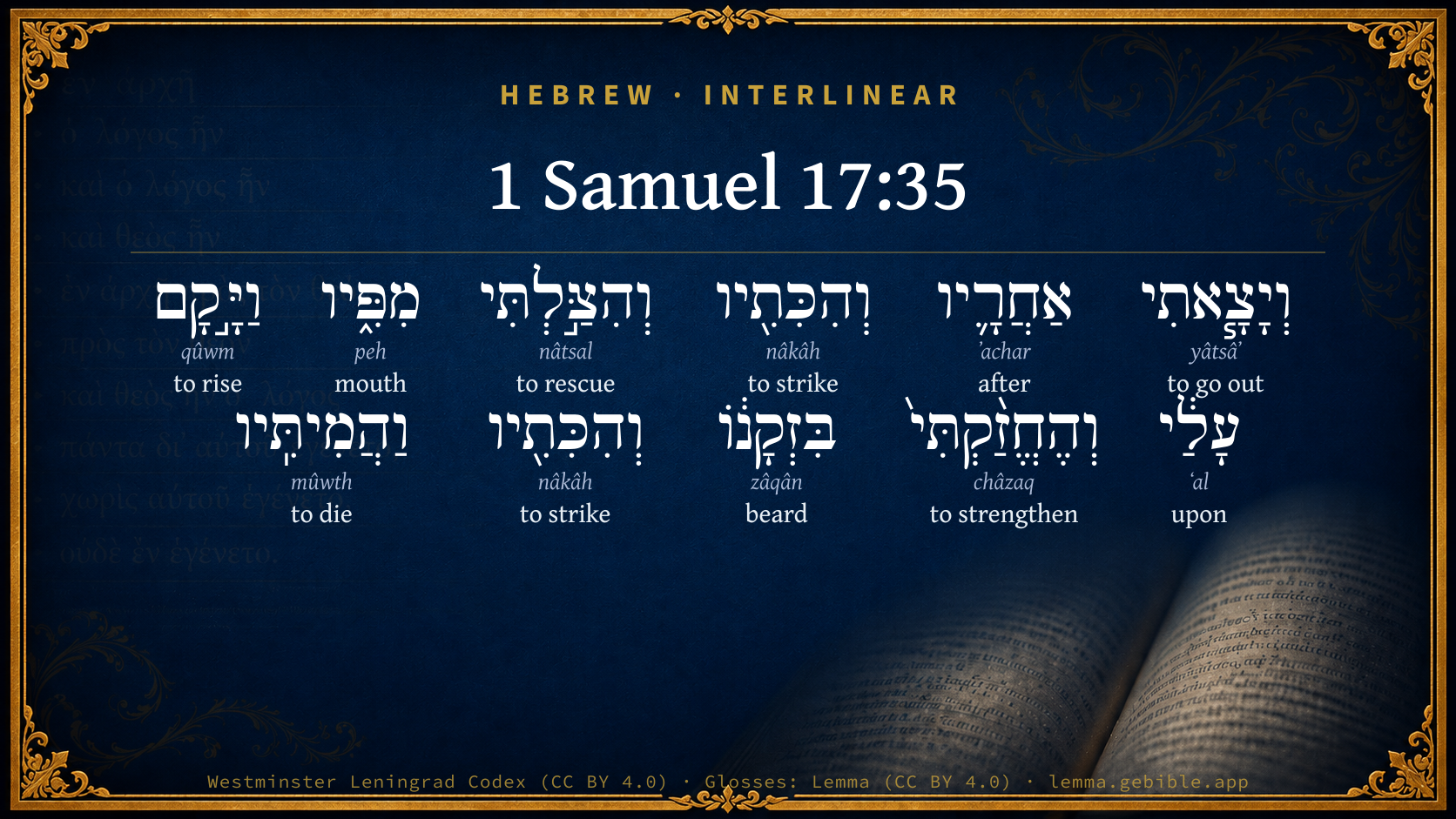
Hebrew (Westminster Leningrad Codex) 1 Samuel 17:35 appears in the Hebrew Old Testament. The text above is from the Westminster Leningrad Codex. Each word links to its Strong’s number, a concise gloss, and parsing drawn from the Open Scriptures Hebrew Bible morphology. Click any word for its full Brown-Driver-Briggs (BDB) entry.
Download image
Cite this verse

1 Samuel 17:35 (World English Bible). Public Domain. Lemma interlinear Bible study tool, https://lemma.gebible.app/v/1-samuel/17/35.

Show BibTeX & RIS
BibTeX
RIS
English Translation
I went out after him, and struck him, and delivered it out of his mouth; and when he arose against me, I caught him by his beard, and struck him, and killed him.
World English Bible · Public Domain
Download a study sheet

One document with this verse’s original text, its word-by-word gloss line, the meaning frame, cross-references with their text, attributed commentary, and full source and license credits — printable, and it pastes into notes with its structure intact.

This verse Autodidact and up

Study sheet (.html) Plain text (.txt)

A passage Seminary Student

Up to 50 verses in one chapter. A passage sheet keeps up to 6 commentary sources and 12 cross-references per verse, in the order this page ranks them, and says so on the sheet whenever that leaves anything out. Ask for a single verse and you get the Autodidact verse sheet above.

Everything on this page stays free to read, with no account — the sheet is a download of what is already on screen, not access to it.

Want to remove ads? Support Godless Engineer
Compare translations 3

The same verse in 3 English versions, stacked beneath the original-language interlinear above. Click any original word for its lexicon entry.

Each is an independent rendering of the whole verse — the interlinear is not word-aligned to these translations.

Highlighted words mark where these versions differ — a whole-verse word diff, not a word-by-word alignment.

  • World English Bible Public Domain
    I went out after him, and struck him, and delivered it out of his mouth; and when he arose against me, I caught him by his beard, and struck him, and killed him.
  • King James Version Public Domain
    And I went out after him, and smote him, and delivered it out of his mouth: and when he arose against me, I caught him by his beard, and smote him, and slew him.
  • unfoldingWord Literal Text CC BY-SA 4.0
    but I have gone out after it and struck it and delivered from its mouth. If it arose against me, then I would seize its beard and strike it and kill it.

unfoldingWord Literal Text — © unfoldingWord, licensed CC BY-SA 4.0. Word-aligned USFM3 via Door43 (git.door43.org/unfoldingWord/en_ult).

Versions to compare (up to 4)

3 of 4 selected

Show all 18 translations

Every available English version of this verse, each an independent rendering of the whole verse.

  • World English Bible Public Domain
    I went out after him, and struck him, and delivered it out of his mouth; and when he arose against me, I caught him by his beard, and struck him, and killed him.
  • Berean Standard Bible Public Domain
    I went after it, struck it down, and delivered the lamb from its mouth. If it reared up against me, I would grab it by its fur, strike it down, and kill it.
  • Majority Standard Bible Public Domain
    I went after it, struck it down, and delivered the lamb from its mouth. If it reared up against me, I would grab it by its fur, strike it down, and kill it.
  • King James Version Public Domain
    And I went out after him, and smote him, and delivered it out of his mouth: and when he arose against me, I caught him by his beard, and smote him, and slew him.
  • American Standard Version (1901) Public Domain
    I went out after him, and smote him, and delivered it out of his mouth; and when he arose against me, I caught him by his beard, and smote him, and slew him.
  • Revised Version (1885) Public Domain
    I went out after him, and smote him, and delivered it out of his mouth: and when he arose against me, I caught him by his beard, and smote him, and slew him.
  • Geneva Bible (1599) Public Domain
    And I went out after him and smote him, and tooke it out of his mouth: and when he arose against me, I caught him by the beard, and smote him, and slue him.
  • Douay-Rheims (1899) Public Domain
    And I pursued after them, and struck them, and delivered it out of their mouth: and they rose up against me, and I caught them by the throat, and I strangled and killed them.
  • Young's Literal Translation Public Domain
    and I have gone out after him, and smitten him, and delivered out of his mouth, and he riseth against me, and I have taken hold on his beard, and smitten him, and put him to death.
  • Literal Standard Version CC BY-SA 4.0
    and I have gone out after him, and struck him, and delivered [it] out of his mouth, and he rises against me, and I have taken hold on his beard, and struck him, and put him to death.
  • Unlocked Literal Bible CC BY-SA 4.0
    I chased after him and attacked him, and rescued it out of his mouth. When he rose up against me, I caught him by his beard, struck him, and killed him.
  • unfoldingWord Literal Text CC BY-SA 4.0
    but I have gone out after it and struck it and delivered from its mouth. If it arose against me, then I would seize its beard and strike it and kill it.
  • Darby Bible Public Domain
    And I went after him, and smote him, and delivered it out of his mouth; and when he arose against me, I seized him by his beard, and smote him, and slew him.
  • World Messianic Bible Public Domain
    I went out after him, struck him, and rescued it out of his mouth. When he arose against me, I caught him by his beard, struck him, and killed him.
  • Webster's Bible Public Domain
    And I went after him, and smote him, and delivered it out of his mouth: and when he arose against me, I caught him by his beard, and smote him, and slew him.
  • Free Bible Version CC BY-SA 4.0
    I would chase after it, knock it down, and save the lamb from its mouth. If it turned to attack me, I would grab its hair, hit it, and kill it.
  • Bible in Basic English Public Domain
    I went out after him, and overcame him, and took it out of his mouth: and if, turning on me, he came at me, I took him by the hair and overcame him and put him to death.
  • JPS Tanakh (1917) Public Domain
    I went out after him, and smote him, and delivered it out of his mouth; and when he arose against me, I caught him by his beard, and smote him, and slew him.

Literal Standard Version (2020), Covenant Press — licensed CC BY-SA 4.0. Text via the HelloAO Bible API (eBible.org). Unlocked Literal Bible (unfoldingWord) — licensed CC BY-SA 4.0. Text via the HelloAO Bible API (eBible.org). unfoldingWord Literal Text — © unfoldingWord, licensed CC BY-SA 4.0. Word-aligned USFM3 via Door43 (git.door43.org/unfoldingWord/en_ult). Free Bible Version, Dr. Jonathan Gallagher — licensed CC BY-SA 4.0. Text via the HelloAO Bible API (eBible.org).

Word by word

More ways to search: Search by grammar → Find every occurrence → Compare this word →

Practice this passage: Drill this verse → Learn its vocabulary →

בִּזְקָנ֔וֹ
zâqân
H2206
“in/at · beard · his”
Preposition + Noun, Common, Both, Singular, Construct + Suffix, Personal, 3rd Person, Masculine, Singular
Part of Speech
Preposition + Noun
Type
Common
Gender
Both
Number
Singular
State
Construct
Full BDB Definition

Origin: from H2204

TWOT: 574a

beard, chin - beard - chin
  1. וְיָצָ֧אתִי yâtsâʼ H3318 “and · to go out” Conjunction + Verb, Qal, Sequential Perfect, 1st Person, Common, Singular
  2. אַחֲרָ֛יו ʼachar H310 “after · him” Preposition + Suffix, Personal, 3rd Person, Masculine, Singular
  3. וְהִכִּתִ֖יו nâkâh H5221 “and · to strike · him” Conjunction + Verb, Hiphil, Sequential Perfect, 1st Person, Common, Singular + Suffix, Personal, 3rd Person, Masculine, Singular
  4. וְהִצַּ֣לְתִּי nâtsal H5337 “and · to rescue” Conjunction + Verb, Hiphil, Sequential Perfect, 1st Person, Common, Singular
  5. מִפִּ֑יו peh H6310 “from · mouth · his” Preposition + Noun, Common, Masculine, Singular, Construct + Suffix, Personal, 3rd Person, Masculine, Singular
  6. וַיָּ֣קָם qûwm H6965 “and · to rise” Conjunction + Verb, Qal, Sequential Imperfect, 3rd Person, Masculine, Singular
  7. עָלַ֔י ʻal H5921 “upon · me” Preposition + Suffix, Personal, 1st Person, Common, Singular
  8. וְהֶחֱזַ֨קְתִּי֙ châzaq H2388 “and · to strengthen” Conjunction + Verb, Hiphil, Sequential Perfect, 1st Person, Common, Singular
  9. וְהִכִּתִ֖יו nâkâh H5221 “and · to strike · him” Conjunction + Verb, Hiphil, Sequential Perfect, 1st Person, Common, Singular + Suffix, Personal, 3rd Person, Masculine, Singular
  10. וַהֲמִיתִּֽיו mûwth H4191 “and · to die · him” Conjunction + Verb, Hiphil, Sequential Perfect, 1st Person, Common, Singular + Suffix, Personal, 3rd Person, Masculine, Singular

About this verse

These counts appear in no published source. They are computed here, from the morphology-tagged text and Lemma’s own curated glosses. What Lemma adds →

11
words
10
distinct lemmas
Historical
section

Notable vocabulary

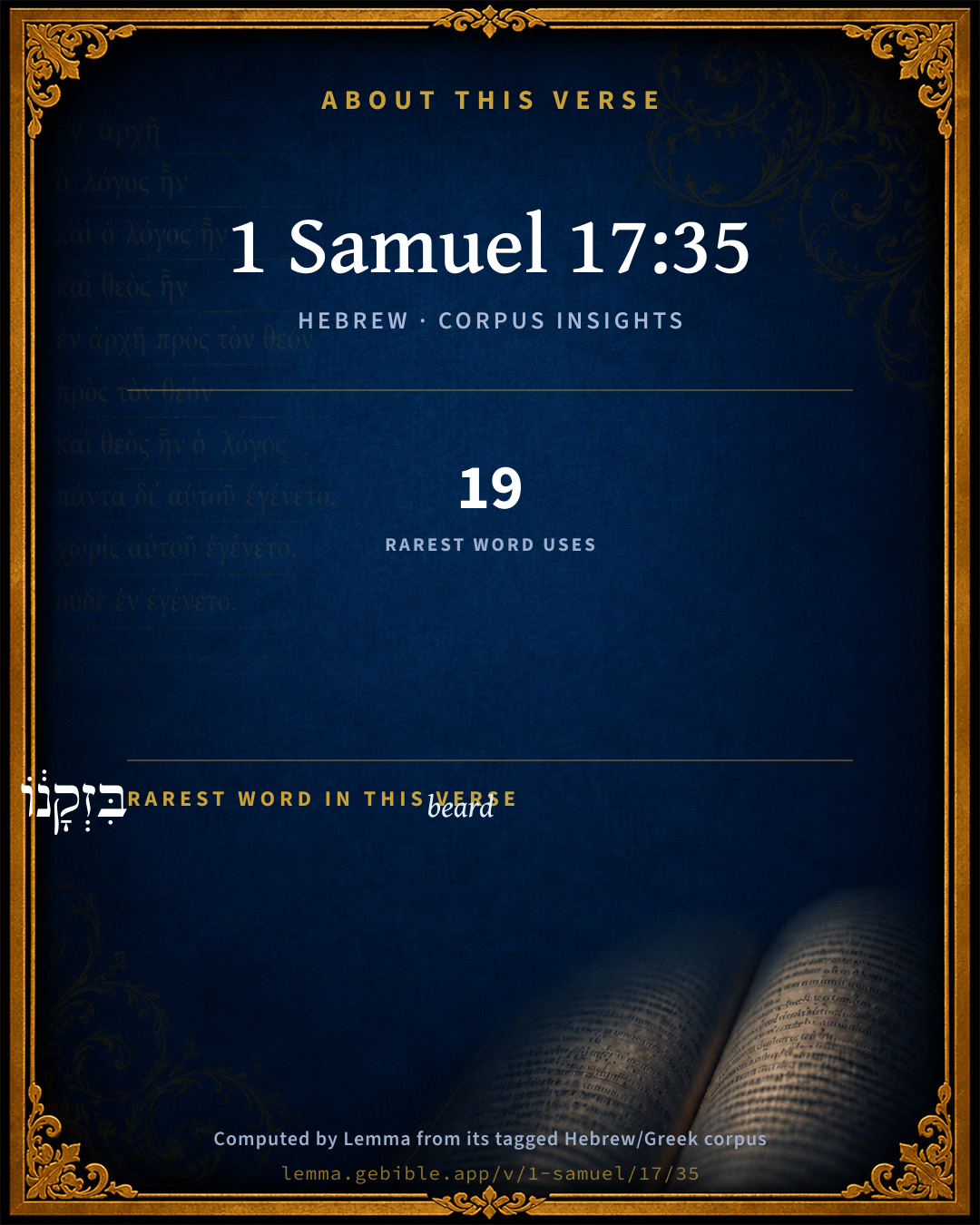
The rarest word here is בִּזְקָנ֔וֹ beard H2206 — appearing just 19 times in the whole Hebrew Bible.

Shared distinctive vocabulary

בִּזְקָנ֔וֹ beard H2206 occurs in 18 verses of the Hebrew Bible. Also found in:

Grammatical profile

  • 7 verbs
  • 2 nouns
  • 2 prepositions

Verb forms

  • וְיָצָ֧אתִי Qal · Sequential Perfect
  • וְהִכִּתִ֖יו Hiphil · Sequential Perfect
  • וְהִצַּ֣לְתִּי Hiphil · Sequential Perfect
  • וַיָּ֣קָם Qal · Sequential Imperfect
  • וְהֶחֱזַ֨קְתִּי֙ Hiphil · Sequential Perfect
  • וְהִכִּתִ֖יו Hiphil · Sequential Perfect
  • וַהֲמִיתִּֽיו Hiphil · Sequential Perfect

Repetition

A word recurs within this verse — often emphatic in Hebrew:

  • וְהִכִּתִ֖יו to strike H5221 ×2

Hebrew & Septuagint length

In English translation the verse runs 33 words from the Hebrew and 37 from the Septuagint (LXX English) — closely comparable.

A rough comparison of the two English renderings, which tokenize alike — not a word-level alignment.

Word counts can differ between the Hebrew and the Greek without any difference in meaning — e.g. the Hebrew direct-object marker אֵת has no separate Greek word, and Greek often adds the article ὁ.

Cross-references

7

Topical passages linked to 1 Samuel 17:35 in the Treasury of Scripture Knowledge — connected by theme and wording, ordered by reader-vote popularity; previews shown in the World English Bible.

  • Amos 3:12 Thus says Yahweh: "As the shepherd rescues out of the mouth of the lion two legs, Or a piece of an ear, So shall the children of Israel be rescued who sit in Samaria on the corner of a couch, And on the silken cushions of a bed."
  • 2 Timothy 4:17–18 But the Lord stood by me, and strengthened me, that through me the message might be fully proclaimed, and that all the Gentiles might hear; and I was delivered out of the mouth of the lion.
  • Judges 14:5–6 Then went Samson down, and his father and his mother, to Timnah, and came to the vineyards of Timnah: and, behold, a young lion roared against him.
  • Psalms 91:13 You will tread on the lion and cobra. You will trample the young lion and the serpent underfoot.
  • Daniel 6:22 My God has sent his angel, and has shut the lions' mouths, and they have not hurt me; because as before him innocence was found in me; and also before you, O king, have I done no hurt.
  • Acts 28:4–6 When the natives saw the creature hanging from his hand, they said one to another, "No doubt this man is a murderer, whom, though he has escaped from the sea, yet Justice has not allowed to live."
  • 2 Samuel 23:20 Benaiah the son of Jehoiada, the son of a valiant man of Kabzeel, who had done mighty deeds, he killed the two [sons of] Ariel of Moab: he went down also and killed a lion in the midst of a pit in time of snow.

Cross-references courtesy of OpenBible.info (CC BY 4.0).

Hebrew and Greek witnesses Masoretic Hebrew ↔ Greek Septuagint

The same verse in the two great witnesses to the Old Testament, shown verse-for-verse.

These are two independent witnesses, not word-aligned to each other, and the Septuagint is shown in lemma (dictionary) form.

Hebrew 1 Samuel 17:35 Masoretic · Westminster Leningrad Codex

וְיָצָ֧אתִי אַחֲרָ֛יו וְהִכִּתִ֖יו וְהִצַּ֣לְתִּי מִפִּ֑יו וַיָּ֣קָם עָלַ֔י וְהֶחֱזַ֨קְתִּי֙ בִּזְקָנ֔וֹ וְהִכִּתִ֖יו וַהֲמִיתִּֽיו

I went out after him, and struck him, and delivered it out of his mouth; and when he arose against me, I caught him by his beard, and struck him, and killed him.

World English Bible · Public Domain

Greek LXX 1 Samuel 17:35 Septuagint · lemma form
then I went forth after him, and struck him, and drew the spoil out of his mouth: and as he rose up against me, then I caught hold of his throat, and struck him, and killed him.

LXX2012 (modern English Septuagint) · Public Domain

Hebrew: Westminster Leningrad Codex (CC BY 4.0). Greek: Septuagint (public domain); English from LXX2012 (modern English Septuagint) (Public Domain). How the Septuagint differs from the Hebrew →

Targum (Aramaic paraphrase)

1

The Targum is the ancient Jewish Aramaic paraphrase of the Hebrew Scriptures — an interpretive translation, not the Hebrew text itself. Onkelos (literal) and Pseudo-Jonathan (expansive) render the Torah, and Jonathan the Prophets. Coverage is partial: where no permissively-licensed English translation exists for a verse, only the Aramaic is shown. This is verse-level text, not a word-by-word alignment to the Hebrew.

  1. Targum Jonathan Prophets (Joshua–Malachi)
    וּנְפָקִית בַּתְרוֹהִי וּמְחִיתֵיהּ וְשֵׁזִיבְתֵיהּ מִפּוּמֵיהּ וְקָם עָלַי וַאֲחָדִית בְּלוֹעֵיהּ וּמְחִיתֵיהּ וּקְטַלְתֵּיהּ:

    (no public-domain English translation for this verse)

    Targum Jonathan — Aramaic: “Mikraot Gedolot” (public domain). English: “Sefaria Community Translation” (CC0 1.0 (public-domain dedication)); “London "Chaldee Paraphrase," 1871” (public domain). Text via Sefaria.

Commentary

Notes on 1 Samuel 17:35 from classic Christian and Jewish commentators (each source and its license shown beneath its notes). The classic Christian expositions comment on the surrounding passage and are grouped to its opening verse, so a note may address several verses; the Jewish commentaries on the Tanakh (Rashi and others) are per-verse, so they appear only where the commentator wrote on this verse.

Lemma curates 59 commentaries, every one of them public domain or Creative Commons licensed, each selected and text-cleaned for this edition rather than reprinted as found. About our sources →

Trapp's Complete Commentary

John Trapp

1Sa 17:35 And I went out after him, and smote him, and delivered [it] out of his mouth: and when he arose against me, I caught [him] by his beard, and smote him, and slew him.

Ver. 35. And delivered it out of his mouth.] So did Christ his darling, the Church, out of the mouth of the lion of hell. If the devil be leo ωρυομενος, {1Pe 5:8} Christ, the Lion of the tribe of Judah, is ο ρυομενος, he that delivereth his from the wrath to come. {1Th 1:10}

I caught him by his beard.] I killed him cominus, fighting with him hand to hand as it were. This was an act of admirable courage in David: what could any Samson or Lysimachus have done more? Leo animalibus omnibus robore, animo et crudelitate antecellit: nec feras tantum, sed homines etiam devorat. Nonnulli quidem multis in locis, vel ducentos equites invidere audeant, {a} i.e., The lion exceedeth all other living creatures in strength, courage, and cruelty: he devoureth not only beasts but men. Some lions in some places have not feared to set upon two hundred horsemen at once, and have slain five or six of them.

{a} Gesner. de Animal.

John Trapp, A Commentary or Exposition upon All the Books of the Old and New Testament (1647–1656) — public domain. Text from a community e-Sword module.

Adam Clarke's Commentary

Verse 35. The slaying of the lion and the bear mentioned here, must have taken place at two different times; perhaps the verse should be read thus: I went out after him, (the lion.) and smote him, &c. And when he (the bear) rose up against me, I caught him by the beard and slew him.

Adam Clarke's Commentary on the Bible (1810–1826) — public domain. Text from a community e-Sword/MySword module.

The Cambridge Bible for Schools and Colleges

gen. ed. J. J. S. Perowne

35. by his bard] Cp. the Homeric epithet of the lion, “well-bearded;” (λὶς ἠϋγένειος: Il. XV. 275); and the Latin proverb “to pluck the beard of a dead lion” (barbam vellere mortuo leoni).

The Cambridge Bible for Schools and Colleges (gen. ed. J. J. S. Perowne; Cambridge University Press, 1878–1918) — public domain. Text from a community e-Sword module.

John Gill's Exposition

And I went out after him,.... Whether a lion or a bear; but mention after being made of his beard, a lion rather is meant:

and smote him; with his fist, or rather with his shepherd's staff:

and delivered it out of his mouth; snatched it out from thence, or obliged him to drop it, by beating him:

and when he arose against me; after he had let go the lamb, threatening to tear him in pieces for attempting to disturb him in his prey, and take it away from him:

I caught him by his beard; such as lions have; hence a lion is often called in Homer (g) , the well-bearded lion. Kimchi thinks the beard with the nether jaw is meant, which David caught hold on:

and smote him, and slew him; tore him to pieces, as Samson did, Jdg 14:5, or slew him with some weapon in his hand.

(g) Iliad. 17. ver. 109. & Iliad. 18. ver. 318.

John Gill's Exposition of the Whole Bible (1746–1763) — public domain (CC PDM 1.0). Text via the HelloAO Bible API.

Albert Barnes' Notes on the Bible

His beard - Put here for his throat, or under jaw; neither lion nor bear has a beard properly speaking.

Albert Barnes' Notes on the Bible (1834–1885) — public domain. Text from a community e-Sword/MySword module.

Haydock's Catholic Bible Commentary

Them. He refers to two events, shewing his fortitude (Calmet) and generous disposition, which rendered him fit for command, as he was not afraid to expose his life to protect his charge. (Haydock) --- The pastoral care is an apprenticeship for the throne to him who is designed to be at the head of the mild flock of men, as hunting with dogs conducts to martial exploits. (Philo in Vita Mosis.) --- He who has overcome the spirit of pride and of carnal pleasures, signified by the lion and the bear, is able also to gain a victory over the devil. (Worthington)

George Leo Haydock (1774–1849), Haydock's Catholic Family Bible and Commentary, 1859 edition — public domain. Excludes Psalms (Douay-Rheims chapter numbering differs from Protestant) and Deuterocanonical books (Catholic canon only).

Matthew Poole's English Annotations

Smote him, to wit, the lion, as appears by his beard; which having particularly mentioned, it was easily understood and believed, that he did the same to the bear; which therefore it was needless to express.

Matthew Poole's English Annotations on the Holy Bible (1683–1685) — public domain. Text from a community e-Sword/MySword module.

Lesson kit

Teaching starters — assembled from the data on this page, not authored interpretation. Every prompt links to the verse data it draws on. Edit before teaching.

1 Samuel, in the Historical, opens this verse with 11 words (10 distinct Hebrew lemmas). Its most distinctive word is zâqân (“beard”). A historical commentator’s framing appears above. Read the whole chapter for the surrounding context.

Discussion questions

  1. What does “beard” (zâqân) contribute to the verse as a whole?
  2. Leviticus 13:29 shares the word «beard» with this verse. How do the two illuminate each other?
  3. “to strike” occurs 2× in this one verse. What is the effect of the repetition?
  4. These translations render this verse differently; the difference is in the English rendering, not the original. What questions does that raise?
  5. The verb «וְיָצָ֧אתִי» is Qal Sequential Perfect. How does its form color the action?
  6. Reading how Trapp's Complete Commentary and Adam Clarke's Commentary read this verse, where do the two commentators agree and where do they part?

Things to notice

Reading settings

Reading text

Shown beneath each verse's original-language words.

Old Testament
Old Testament edition

Read the OT as the Masoretic Hebrew (MT) or the Greek Septuagint (LXX).

English shown for the Greek Septuagint (in the Hebrew ↔ Greek comparison).

Comparing translations? Open the Compare panel on any verse page to stack up to four side by side.