

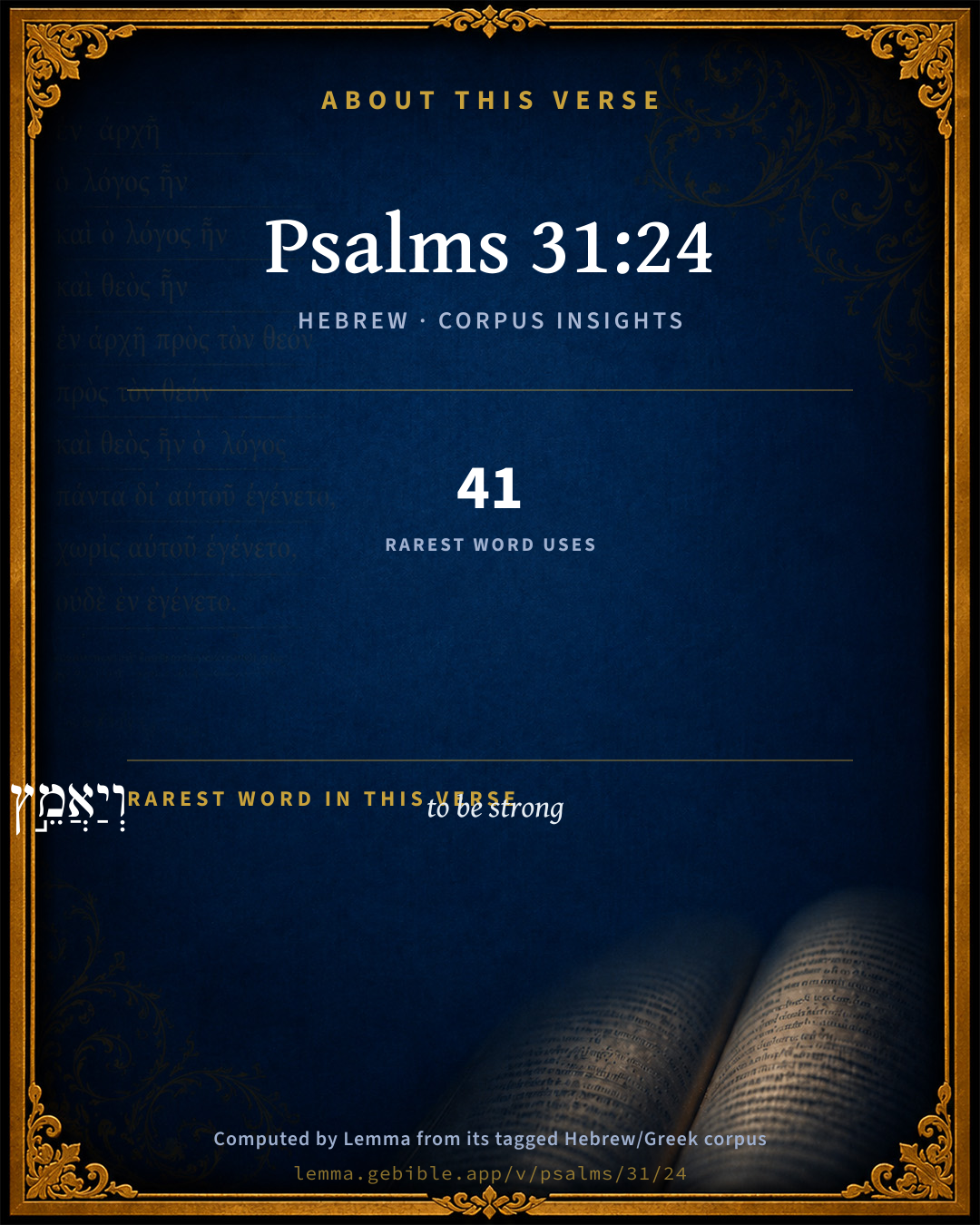
Psalms 31:24

Hebrew (Westminster Leningrad Codex) Psalms 31:24 appears in the Hebrew Old Testament. The text above is from the Westminster Leningrad Codex. Each word links to its Strong’s number, a concise gloss, and parsing drawn from the Open Scriptures Hebrew Bible morphology. Click any word for its full Brown-Driver-Briggs (BDB) entry.
Download image
Cite this verse

Psalms 31:24 (World English Bible). Public Domain. Lemma interlinear Bible study tool, https://lemma.gebible.app/v/psalms/31/24.

Show BibTeX & RIS
BibTeX
RIS
English Translation
Be strong, and let your heart take courage, All you who hope in Yahweh.
World English Bible · Public Domain
Download a study sheet

One document with this verse’s original text, its word-by-word gloss line, the meaning frame, cross-references with their text, attributed commentary, and full source and license credits — printable, and it pastes into notes with its structure intact.

This verse Autodidact and up

Study sheet (.html) Plain text (.txt)

A passage Seminary Student

Up to 50 verses in one chapter. A passage sheet keeps up to 6 commentary sources and 12 cross-references per verse, in the order this page ranks them, and says so on the sheet whenever that leaves anything out. Ask for a single verse and you get the Autodidact verse sheet above.

Everything on this page stays free to read, with no account — the sheet is a download of what is already on screen, not access to it.

Want to remove ads? Support Godless Engineer
Compare translations 3

The same verse in 3 English versions, stacked beneath the original-language interlinear above. Click any original word for its lexicon entry.

Each is an independent rendering of the whole verse — the interlinear is not word-aligned to these translations.

Highlighted words mark where these versions differ — a whole-verse word diff, not a word-by-word alignment.

  • World English Bible Public Domain
    Be strong, and let your heart take courage, All you who hope in Yahweh.
  • King James Version Public Domain
    Be of good courage, and he shall strengthen your heart, all ye that hope in the LORD.
  • unfoldingWord Literal Text CC BY-SA 4.0
    Be firm and let your heart be courageous, all the ones waiting for Yahweh.

unfoldingWord Literal Text — © unfoldingWord, licensed CC BY-SA 4.0. Word-aligned USFM3 via Door43 (git.door43.org/unfoldingWord/en_ult).

Versions to compare (up to 4)

3 of 4 selected

Show all 18 translations

Every available English version of this verse, each an independent rendering of the whole verse.

  • World English Bible Public Domain
    Be strong, and let your heart take courage, All you who hope in Yahweh.
  • Berean Standard Bible Public Domain
    Be strong and courageous, all you who hope in the LORD.
  • Majority Standard Bible Public Domain
    Be strong and courageous, all you who hope in the LORD.
  • King James Version Public Domain
    Be of good courage, and he shall strengthen your heart, all ye that hope in the LORD.
  • American Standard Version (1901) Public Domain
    Be strong, and let your heart take courage, All ye that hope in Jehovah. Psalm 32 `A Psalm' of David. Maschil.
  • Revised Version (1885) Public Domain
    Be strong, and let your heart take courage, all ye that hope in the LORD.
  • Geneva Bible (1599) Public Domain
    All ye that trust in the Lord, be strong, and he shall establish your heart.
  • Douay-Rheims (1899) Public Domain
    O love the Lord, all ye his saints: for the Lord will require truth, and will repay them abundantly that act proudly.
  • Young's Literal Translation Public Domain
    Be strong, and He strengtheneth your heart, All ye who are waiting for Jehovah!
  • Literal Standard Version CC BY-SA 4.0
    Be strong, and He strengthens your heart, || All you who are waiting for YHWH!
  • Unlocked Literal Bible CC BY-SA 4.0
    Be strong and confident, all you who trust in Yahweh for help.
  • unfoldingWord Literal Text CC BY-SA 4.0
    Be firm and let your heart be courageous, all the ones waiting for Yahweh.
  • Darby Bible Public Domain
    Be strong, and let your heart take courage, all ye that hope in Jehovah.
  • World Messianic Bible Public Domain
    Be strong, and let your heart take courage, all you who hope in the LORD.
  • Webster's Bible Public Domain
    \\31:23\\O love the LORD, all ye his saints: for the LORD preserveth the faithful, and plentifully rewardeth the proud doer.
  • Free Bible Version CC BY-SA 4.0
    Be strong and be confident, all you who put your hope in the Lord.
  • Bible in Basic English Public Domain
    Put away fear and let your heart be strong, all you whose hope is in the Lord.
  • JPS Tanakh (1917) Public Domain
    (31-25) Be strong, and let your heart take courage, all ye that wait for the LORD.

Literal Standard Version (2020), Covenant Press — licensed CC BY-SA 4.0. Text via the HelloAO Bible API (eBible.org). Unlocked Literal Bible (unfoldingWord) — licensed CC BY-SA 4.0. Text via the HelloAO Bible API (eBible.org). unfoldingWord Literal Text — © unfoldingWord, licensed CC BY-SA 4.0. Word-aligned USFM3 via Door43 (git.door43.org/unfoldingWord/en_ult). Free Bible Version, Dr. Jonathan Gallagher — licensed CC BY-SA 4.0. Text via the HelloAO Bible API (eBible.org).

Word by word

More ways to search: Search by grammar → Find every occurrence → Compare this word →

Practice this passage: Drill this verse → Learn its vocabulary →

וְיַאֲמֵ֣ץ
ʼâmats
H553
“and · to be strong”
Conjunction + Verb, Hiphil, Imperfect, 3rd Person, Masculine, Singular
Part of Speech
Conjunction + Verb
Stem
Hiphil
Form
Imperfect
Person
3rd Person
Gender
Masculine
Number
Singular
Full BDB Definition

Origin: a primitive root

TWOT: 117

to be strong, alert, courageous, brave, stout, bold, solid, hard - (Qal) to be strong, brave, bold - (Piel) to strengthen, secure (for oneself), harden (heart), make firm, make obstinate, assure - (Hithpael) to be determined, to make oneself alert, strengthen oneself, confirm oneself, persist in, prove superior to - (Hiphil) to exhibit strength, be strong, feel strong
  1. חִ֭זְקוּ châzaq H2388 “strengthen” Verb, Qal, Imperative, 2nd Person, Masculine, Plural
  2. לְבַבְכֶ֑ם lêbâb H3824 “heart · your” Noun, Common, Masculine, Singular, Construct + Suffix, Personal, 2nd Person, Masculine, Plural
  3. כָּל kôl H3605 “all of” Noun, Common, Masculine, Singular, Construct
  4. הַ֝מְיַחֲלִ֗ים yâchal H3176 “the · waiting” Particle, Definite Article + Verb, Piel, Participle Active, Masculine, Plural, Absolute
  5. לַיהוָֽה Yᵉhôvâh H3068 “to/for · LORD” Preposition + Noun, Proper

About this verse

These counts appear in no published source. They are computed here, from the morphology-tagged text and Lemma’s own curated glosses. What Lemma adds →

6
words
6
distinct lemmas
Wisdom
section

Shared distinctive vocabulary

וְיַאֲמֵ֣ץ to be strong H553 occurs in 41 verses of the Hebrew Bible. Also found in:

Grammatical profile

  • 3 verbs
  • 3 nouns

Verb forms

  • חִ֭זְקוּ Qal · Imperative
  • וְיַאֲמֵ֣ץ Hiphil · Imperfect
  • הַ֝מְיַחֲלִ֗ים Piel · Participle Active

Hebrew & Septuagint length

In English translation the verse runs 14 words from the Hebrew and 17 from the Septuagint (LXX English) — closely comparable.

A rough comparison of the two English renderings, which tokenize alike — not a word-level alignment.

Word counts can differ between the Hebrew and the Greek without any difference in meaning — e.g. the Hebrew direct-object marker אֵת has no separate Greek word, and Greek often adds the article ὁ.

Cross-references

11

Topical passages linked to Psalms 31:24 in the Treasury of Scripture Knowledge — connected by theme and wording, ordered by reader-vote popularity; previews shown in the World English Bible.

  • Psalms 27:14 Wait for Yahweh. Be strong, and let your heart take courage. Yes, wait for Yahweh.
  • Psalms 146:5 Happy is he who has the God of Jacob for his help, Whose hope is in Yahweh, his God:
  • Isaiah 35:3–4 Strengthen you the weak hands, and confirm the feeble knees.
  • Colossians 1:11 strengthened with all power, according to the might of his glory, for all endurance and perseverance with joy;
  • Psalms 29:11 Yahweh will give strength to his people. Yahweh will bless his people with peace.
  • Hebrews 12:12–13 Therefore, lift up the hands that hang down and the feeble knees,
  • Psalms 138:3 In the day that I called, you answered me. You encouraged me with strength in my soul.
  • James 5:10–11 Take, brothers, for an example of suffering and of patience, the prophets who spoke in the name of the Lord.
  • Luke 22:31–32 The Lord said, "Simon, Simon, behold, Satan asked to have you, that he might sift you as wheat,
  • Romans 15:12–13 Again, Isaiah says, "There will be the root of Jesse, He who arises to rule over the Gentiles; On him will the Gentiles hope."
  • 1 Peter 1:21 who through him are believers in God, who raised him from the dead, and gave him glory; so that your faith and hope might be in God.

Cross-references courtesy of OpenBible.info (CC BY 4.0).

Hebrew and Greek witnesses Masoretic Hebrew ↔ Greek Septuagint

The same verse in the two great witnesses to the Old Testament, shown verse-for-verse.

You’re reading Greek Psalm 30 (Hebrew Psalm 31). The Septuagint counts the superscription, so verse numbers can differ from the Hebrew — chapter-level alignment, not verse-by-verse. Numbering follows Rahlfs.

These are two independent witnesses, not word-aligned to each other, and the Septuagint is shown in lemma (dictionary) form.

Hebrew Psalms 31:24 Masoretic · Westminster Leningrad Codex

חִ֭זְקוּ וְיַאֲמֵ֣ץ לְבַבְכֶ֑ם כָּל הַ֝מְיַחֲלִ֗ים לַיהוָֽה

Be strong, and let your heart take courage, All you who hope in Yahweh.

World English Bible · Public Domain

Greek LXX Greek Psalm 30:24 Septuagint · lemma form

ἀγαπάω ὁ κύριος πᾶς ὁ ὅσιος αὐτός ὅτι ἀλήθεια ἐκζητέω κύριος καί ἀντι ἀποδίδωμι ὁ περισσῶς ποιέω ὑπερηφανία

Be of good courage, and let your heart be strengthened, all you⌃ that hope in the Lord.

LXX2012 (modern English Septuagint) · Public Domain

On this verse, Adam Clarke's Commentary discusses the Septuagint’s reading. Read the note in Commentary ↓

Hebrew: Westminster Leningrad Codex (CC BY 4.0). Greek: Septuagint (public domain); English from LXX2012 (modern English Septuagint) (Public Domain). How the Septuagint differs from the Hebrew →

Commentary

Notes on Psalms 31:24 from classic Christian and Jewish commentators (each source and its license shown beneath its notes). The classic Christian expositions comment on the surrounding passage and are grouped to its opening verse, so a note may address several verses; the Jewish commentaries on the Tanakh (Rashi and others) are per-verse, so they appear only where the commentator wrote on this verse.

Lemma curates 59 commentaries, every one of them public domain or Creative Commons licensed, each selected and text-cleaned for this edition rather than reprinted as found. About our sources →

Trapp's Complete Commentary

John Trapp

Psa 31:24 Be of good courage, and he shall strengthen your heart, all ye that hope in the LORD.

Ver. 24. Be of good courage, &c.] Bear up, be stout, and steadfast in the faith under trials. See Psa 27:14, with the note. Thus good courage cometh not but from the true love of God, Psa 31:23.

John Trapp, A Commentary or Exposition upon All the Books of the Old and New Testament (1647–1656) — public domain. Text from a community e-Sword module.

The Biblical Illustrator

Joseph S. Exell

Psa_31:24

Be of good courage, and He shall strengthen your heart, all ye that hope in the Lord.

The believers source of strength

Many are almost despairing because of their trials and their temptations. But be our circumstances what they may, here is an antidote to them all.

I. the promise--He shall strengthen your heart. We have duties, many, varied, arduous. Often they are very trying; but this promise is for us. And so in our temptations. These are continually occurring, and we know not how to overcome them. Again this promise is given. But you ask, How am I to attain this strength? Must I always go on sinning? No, for--

1. Faith is one grand means of victory over sin. Walk in the Spirit, and ye shall not fulfil the lusts of the flesh.

2. Watchfulness is another help; taking care to keep away from the occasions and inducements to sin: occupation in what is good and right, storing the mind with Gods truth.

3. Prayer. This must by no means be neglected, the more we pray the stronger we are.

4. In mortifying sin be careful to leave no part remaining. Cut down the tree, but not this only, pull up the roots.

5. Guard your thoughts and desires.

6. If sin has gained power over you, at once--delay not a day--in seeking to subdue it. The longer it is left the greater will be the difficulty. Today, if ye will hear His voice, etc. But in our own strength no one is sufficient for these things; but the grace of God will help us.

II. To whom this promise is made.

All ye that hope in the Lord. Not the sinless, the perfect, but, etc. They are such as put all their trust and confidence in Christ. (J. Marshall, M. A.)

Courage

The word comes from the Latin words, cor and ago, meaning, the heart, and to put in motion. Courage, therefore, means the active heart, or the spirit of the heart. For it is that spirit which enables us to encounter danger without fear, and bear adversity with calmness.

I. WE admire physical courage; but, after all, it is chiefly a constitutional endowment. If a man be full of animal courage, no credit to him; for he has to thank his father and mother for his vigorous body which inspires him to be brave. Physical, or animal courage is not a rare quality. Moral courage is the great thing, that which will inspire you to do right at all costs. It was that which Jesus had and which He helps us to acquire.

II. true courage will never swerve from that which it knows is right. Margaret Wilson, in the days of Charles II., was tied to a post on the shore at the flow of the tide, but offered her life if she would obey the Church. Higher and higher the water rose, but she would not yield, and she died, crying out with her last breath, Christ only is my Master. And many such martyrs there have been. That is moral courage. Dare to follow that which your conscience declares to be the truth; and be a Christian all out, though it may run you into risks of limb and life. It is the coward who is afraid to follow his convictions. Do not be a religious or political turn-coat against the secret conviction of your mind. Toe the mark in every sense in matters of truth and morals, and be brave enough to die rather than do wrong.

III. have you courage to show yourself a Christian? And how many there are who cannot do this. But wily should you fear. Oh, be brave, not cowards. No doubt it does need moral courage to stand against ridicule, but be not jeered from the right.

IV. if you possess true courage, you will not be ashamed of your humble but honourable surroundings. Dont have any false shame. Your hat may be battered, your shawl may be shabby, your coat may be an everyday one, but come up bravely to the house of God, and fear nobody. If the coat is the best God has given you, thank Him for it, and for all He has done for you.

V. let me urge you to have courage to decide for Jesus Christ. (W. Birch.)

Strength for the courageous who hope in the Lord

Note--

I. what is required in the exhortation--good courage. How this is founded on hope. (Rom_8:24; 1Th_5:8). How needful is it--

1. When a mans sins press heavily upon him, and the cares and sorrows of earth weigh him down, how miserable is he if he have not hope.

2. Courage so founded is enduring.

3. And we are made more than conquerors over our spiritual enemies.

II. the promise. He shall strengthen your heart.

1. We are ignorant of our own hearts, and--

2. We are unwilling to know.

3. Hence we cannot strengthen our hearts; the Gospel only can do this.

III. the persons to whom this promise is made,--those who hope in the Lord. Those also distrusting themselves hope for all in Christ. (G. C. Tomlinson.)

Consolation for the troubled

I. believers may have great need of strength from God.

1. David knew this, and from his own experience declares what God will do for His people.

2. There are many trials which the believer shares in common with the men of this world.

3. There are others peculiar to himself. He may be calumniated and despised; deprived of the fellowship of other Christians; cast down by reason of his departures from God, so that he walk in darkness and hath no light.

4. And there are sorrows which come to him through the sins of others. Those near and dear to him living in sin; the wickedness of the world; the divisions of the Church and her cold-heartedness.

II. the hope which the Christian has in God. It does not make him neglect means. It is founded on the Lord Jesus Christ, His death and resurrection and intercession. It implies that his life is free from presumption and that he prays for the Divine blessing.

III. conclusion.

1. Expect trials.

2. Maintain faith.

3. Remember the promises

4. Tell others of Christ. (B. W. Noel.)

The cure for a weak heart

I. an approved company. The text is addressed to--

1. Men of hope. They have not yet entered into possession of their full inheritance; they have a hope which is looking out for something better on before; they have a living hope which peers into the future beyond even the dark river of death, a hope with eyes so bright that it seeth things invisible to others, and gazes upon glories which the unaided human eye has never beheld. Have you this good hope?

2. They hope for good things, for this is implied when the psalmist speaks of those that hope in the Lord, for no man hopes for evil things whose hope is in the Lord.

3. If you are the persons spoken of in the text, this hope of yours is rooted, and grounded, and stablished in the Lord: all ye that hope in the Lord. You have not a hope apart from the ever-blessed Father, Son, and Holy Ghost.

4. Some of them do not get much beyond hope, All ye that hope in the Lord. This passage picks up the hindermost, it seems to come, like the men with the ambulance, to look after the wounded, and carry them on at the same pace as those who march in the fulness of their strength.

II. There is An occasional weakness apparent in many of those that hope in the Lord.

1. It is a dangerous weakness, for it is a weakness of the heart. They lose their courage, their joy departs from them, and they become timorous and fearful.

2. This weakness occurs on many occasions.

(1) In the battle of life.

(2) In times of temptation.

(3) In the midst of great labour for the Lord.

The best of men are but men at the best; and, therefore, who wonders if their heart sometimes faileth them in the day of suffering, in the hour of battle, or under the broiling sun, when they are labouring for their Lord?

3. If this weakness of the heart should continue, it will be very injurious.

(1) At the present time, I believe that it restricts enterprise.

(2) It endangers the success of the best workers.

(3) It pleads many excuses.

III. A seasonable exhortation. I like the way this is put. It is not alone, Be of good courage; there is an and with it: and he shall strengthen your heart. At the same time, the exhortation is not omitted. It does not say, He shall comfort your heart, therefore you need do nothing. They err from the Scriptures who make the grace of God a reason for doing nothing; it is the reason for doing everything.

1. If you want to get out of diffidence, and timidity, and despondency, you must rouse yourselves up. Do not sit still, and rub your eyes, and say, I cannot help it, I must always be dull like this. You must not be so; in the name of God, you are commanded in the text to be of good courage.

2. Do you not think that your God deserves to be trusted? What has He ever done that you should doubt Him?

3. If thou art not of good courage, what will happen to thee? I would not have you deserve the cowards doom, and speak of it as retiring. No, get not into that class; be thou rather like that soldier of Alexander, who was always to the front, and the reason was that he bore about with him what was thought to be an incurable disease, and he suffered so much pain that he did not care whether he lived or died. Alexander took great pains to have him healed, and when he was quite well, he never exposed his precious life to any risk again. Oh, I would rather that you should be stung into courage by excessive pain than that you should be healed into cowardice! Christ ought not to be served by feather-bed soldiers.

IV. A cheering promise. He shall strengthen your heart. God alone can do this.

1. Sometimes by gracious providences.

2. By the kindly fellowship of friends.

3. By a precious promise.

4. Beside all that, God the Holy Spirit has a secret way of strengthening the courage of Gods people, which none of us can explain. Have you never felt it? You may have gone to your bed, sick at heart, weary, and worn, and sad, and you wake in the morning ready for anything. Perhaps, in the middle of the night, you awake, and the visitations of God are manifested to you, and you feel as happy as if everything went the way you would like it to go. Nay, you shall be more happy that everything should cross you than that everything should please you, if it be Gods sweet will. You feel a sudden strengthening of your spirit, so that you are perfectly resigned, satisfied, prepared, and ready. (C. H. Spurgeon.)

.

Psa_32:1-11

The Biblical Illustrator, edited by Joseph S. Exell (c. 1880s–1900s) — public domain. Text from a community e-Sword module.

Joseph Benson's Commentary

Psa 31:24. Be of good courage — Or, be strong, namely, in the Lord, and through confidence in his promises, which will not fail you, as I have found by experience. And he shall strengthen your heart — The God you put your trust in, will, by that trust, impart fortitude and strength to you; all ye that hope in the Lord — That rely on him for grace and glory, and the supply of all your wants. They that hope in the Lord have reason to be of good courage, and to be strengthened; for as nothing truly evil can befall them, so nothing truly good for them shall be withheld from them.

Joseph Benson's Commentary on the Old and New Testaments (1811–1818) — public domain. Text from a community e-Sword module.

J. A. Alexander on Psalms

Joseph Addison Alexander

25. (Psa 31:24). Be strong, and let him confirm your heart, all ye that wait for Jehovah (or hope in him). The idea and the form of expression are the same as in Psa 27:14, except that what the Psalmist there says to himself, or to his own soul, he here says to all that hope in God, or wait for the fulfilment of his promises. See the same description of God's people in Psa 33:18, below.—Be strong in purpose and desire, and he will make you strong in fact. This promise is conveyed under the form of a wish, may he strengthen (or confirm) your heart. See above, on Psa 27:4.

Joseph Addison Alexander, The Psalms Translated and Explained (1850) — public domain. Text from a community e-Sword module.

Geneva Bible (1599)

Geneva Bible translators

Be constant in your vocation, and God will confirm you with heavenly strength.

Geneva Bible (1599) marginal notes — public domain. Text via Bolls.life.

Adam Clarke's Commentary

Verse 24. Be of good courage, and he shall strengthen your heart] In 1Co 16:13, St. Paul says, "Watch ye, stand fast in the faith; quit you like men; be strong:" Γρηγορειτε, στηκετε εν τῃ πιστει, ανδριζεσθε, κραταιουσθε. The latter words he seems to have borrowed from the Septuagint, who translate, "Be of good courage, and he shall strengthen your heart," by Ανδριζεσθε και κραταιουσθω ἡ καρδια ὑμων "Act like men, and your hearts shall be strengthened."

They that hope in God, and are endeavouring to walk carefully before him, may take courage at all times, and expect the fulness of the blessing of the Gospel of peace.

ANALYSIS OF THE THIRTY-FIRST PSALM

This Psalm is composed and mixed of divers affections; for David sometimes prays, sometimes gives thanks; now he complains, now he hopes; at one time fears, at another exults. This vicissitude of affection is six-fold, and it may very well divide the Psalm.

I. With great confidence he prays to God; Ps 31:1-6.

II. He exults for mercy and help received; Ps 31:7; Ps 31:8.

III. He grievously complains of the misery he was in; Ps 31:9-14.

IV. He prays again, upon the strength of God's goodness; Ps 31:15-18.

V. He admires, exults in, and proclaims God's goodness, Ps 31:19-22.

VI. He exhorts others to love God, and be courageous; Ps 31:23-24.

I. In the six first verses he prays to God, and shows his reasons: -

1. That he be never ashamed in his hope: "Let me never be ashamed."

2. That he be delivered, "speedily delivered."

3. That God would be "his rock, and a house of defence, to save him."

4. That God would lead and guide him: "Lead me, and guide me."

5. That God would "pull his feet out of the net which they had laid for him."

The reasons on which he founds his prayer and expectations: -

1. His faith and confidence: "In thee, O Lord I put my trust."

2. The reason of his faith: "Thou art my ROCK and FORTRESS."

3. His deliverance would be to the honour of God: "For thy name's sake."

4. Thou art my strength; exert it in my behalf.

5. I rely upon thee: "Into thy hands I commit my spirit."

6. I expect thee to do for me as thou hast ever done: "Thou hast redeemed me."

7. I rely on thee alone, I seek no vain helps: "I have hated them that regard lying vanities; but I trust in the Lord."

His petition and his reasons are in effect the same; his confidence in God to be his Deliverer, Fortress, Rock, Redeemer, c.

II. He exults for mercy and help already received, and by the experience of that, doubts the less in this: "I will be glad and rejoice in thy mercy." And his reason follows from his experience: 1. "For thou hast considered my trouble." 2. "Thou hast known my soul in adversity." 3. "Thou hast not shut me up into the hand of the enemy." 4. But "hast set my feet in a large room."

III. He prays, and grievously complains of what he suffered within and without.

1. He prays: "Have mercy upon me, O Lord."

2. Then he complains, and his complaint shows the reason of his prayer.

1. Within - at home, he was in a distressed state: "I am in trouble my eye is consumed with grief; my years with sighing; my strength faileth; my bones are consumed."

2. Without - I have no comfort either from friends or enemies.

1. "I was a reproach among all my enemies."

2. My friends stand afar off: "I was a reproach, especially among my neighbours." "A fear to my acquaintance." "They that did see me without fled from me."

3. He shows the greatness of his grief, and the scorn he endured: "I am forgotten as a dead man;" "I am as a broken vessel," vile and useless.

4. I am mocked by the people: "I have heard the slander of many."

5. And the consequence was mischievous. 1. "Fear is on every side." 2. While they conspired, or "took counsel against my life." 3. And their counsel was, "to take away my life." What more could my enemies do, or my friends permit?

IV. After his complaint he comforts himself with his chief reason, the goodness of God. I have trusted in thee, O Lord, and said, Thou art my God. Let them conspire, take counsel, and devise what they can; yet I know, except thou permit them, they are not able to do it. "My times are in thy hand," not in theirs.

He then begins to pray again, and his prayer consists of three parts: 1. Deprecation. 2. Supplication. 3. Imprecation.

1. A deprecation: "Deliver me from the hands of my enemies," c.

2. A supplication: "Make thy face to shine upon thy servant save me." "Let me not be ashamed, for I have called upon thee."

3. An imprecation: 1. "Let the wicked be ashamed, and be silent in the grave." 2. "Let the lying lips be put to silence, which speak grievous things," c.

In this imprecation four arguments are used to enforce it: -

1. The quality of their persons: "They are wicked, impious men."

2. There is no truth in them: "They have lying lips." 1. Their words are false. 2. Their actions are worse: They speak grievous things, and that against the righteous. 3. But their intention is worst of all, for they do it proudly, contemptuously, disdainfully, despitefully all proceeding from a bad heart.

V. In the fifth part he sets out the abundant goodness of the Lord to his people, and exclaims, in holy rapture, "O how great is thy goodness which thou hast laid up for them that fear thee - which thou hast wrought for them that trust in thee before the sons of men!"

This goodness of God is always treasured up and to be had at all times. But observe: 1. It is laid up for none, nor wrought for any one, but them that fear the Lord. 2. And for those who put their trust in him, and acknowledge him, his cause, his people, and his cross, before the sons of men. And the acts of his goodness are here specified: -

1. "Thou shalt hide them in the secret of thy presence from the pride of man."

2. "Thou shalt keep them secretly in a pavilion from the strife of tongues." Upon which consideration he breaks out into praise: 1. "Blessed be the Lord, for he hath showed me his marvellous kindness." 2. He corrects his error, and former mistake: "I said in my haste, (rashly, imprudently,) I am cut off from before thine eyes; nevertheless thou heardest the voice of my supplication."

VI. The last part is an exhortation to the saints: 1. That they love God. 2. That they be of good courage; for he was the same God still, and would be as good to others as he was to him.

1. That they love God, and that for two reasons: - 1. Because the "Lord preserveth the faithful." This is his mercy. 2. That he "plentifully rewardeth the proud doer." This is his justice.

2. That they be of good courage; for then "he shall strengthen your heart, all ye that hope in the Lord." They were not to despair, but keep their hearts firmly fixed in the profession of the truth, which would be a seal of their hope.

Adam Clarke's Commentary on the Bible (1810–1826) — public domain. Text from a community e-Sword/MySword module.

John Calvin's Commentaries

24. Be of good courage. This exhortation is to be understood in the same way as the preceding; for the steadfastness which the Psalmist here enjoins is founded on the love of God of which he had spoken, when renouncing all the enticements of the world, we embrace with our whole hearts the defense and protection which he promises to us. Nor is his exhortation to courage and firmness unnecessary; because, when any one begins to rely on God, he must lay his account with and arm himself for sustaining many assaults from Satan. We are first, then, calmly to commit ourselves to the protection and guardianship of God, and to endeavor to have the experience of his goodness pervading our whole minds. Secondly, thus furnished with steady firmness and unfailing strength, we are to stand prepared to sustain every day new conflicts. As no man, however, is able of himself to sustain these conflicts, David urges us to hope for and ask the spirit of fortitude from God, a matter particularly worthy of our notice. For hence we are taught, that when the Spirit of God puts us in mind of our duty, he examines not what each man’s ability is, nor does he measure men’s services by their own strength, but stimulates us rather to pray and beseech God to correct our defects, as it is he alone who can do this.

John Calvin's Commentaries (1540-1563) — public domain. Text from the Calvin Translation Society English edition (1840s-50s) via the Christian Classics Ethereal Library (ccel.org). Calvin's coverage is partial (roughly two-thirds of the Bible); uncommented books and verses are honest gaps, never fabricated. The 19th-century editor's footnotes and remarks are omitted so the notes are faithfully Calvin's own voice.

Ellicott's Commentary for English Readers

(24) Be of good courage.—Cf. Psa_27:14.

A Bible Commentary for English Readers, edited by Charles John Ellicott (1878–1897) — public domain. Text from a community e-Sword module.

The Cambridge Bible for Schools and Colleges

gen. ed. J. J. S. Perowne

24. Be strong, and let your heart take courage (R.V.), as in Psa_27:14.

all ye that hope in the Lord] Or, wait for. The phrase links this Psalm to Psalms 33. See Psa_31:18; Psa_31:22. Comp. too Psa_33:18 with Psa_31:22.

The Cambridge Bible for Schools and Colleges (gen. ed. J. J. S. Perowne; Cambridge University Press, 1878–1918) — public domain. Text from a community e-Sword module.

John Gill's Exposition

Be of good courage, and he shall strengthen your heart,.... See Gill on Psa 27:14; by this instance of God's wonderful kindness to the psalmist, he would have the saints take heart, and be of good cheer, even in the greatest distresses, since their case cannot be worse than his was; and yet he had deliverance out of it;

all ye that hope in the Lord; for the eye of the Lord is on such, and he takes delight in them, Psa 33:18. The Targum is, "who hope for", or "trust in the word of the Lord"; the essential Word, the promised Messiah.

Next: Psalms Chapter 32

John Gill's Exposition of the Whole Bible (1746–1763) — public domain (CC PDM 1.0). Text via the HelloAO Bible API.

Albert Barnes' Notes on the Bible

Be of good courage - See a similar exhortation at the close of a psalm, in Psa 27:14. Compare the notes at that verse. As the result of all his own experience of the goodness of God, and of His gracious interposition in the time of danger, the psalmist exhorts others to be encouraged, and to feel assured that God would not leave or forsake them.

And he shall strengthen your heart - He will animate you; he will enable you to meet trial and opposition; he will keep you from becoming faint and disheartened.

All ye that hope in the Lord - All that put their trust in him, or all whose expectation is from him. It is a characteristic of true piety that all hope centers in God, or that the soul feels that there is no other ground of hope.

(a) The truly pious man despairs of success in anything else, or from any other quarter, for he feels that God alone can give success.

(b) He does hope in God - in reference to all that is needful for himself as an individual; all that will be for the good of his family; all that will tend to bless the world; all that he desires in heaven. Hope in God cheers him, sustains him, comforts him; makes life happy and prosperous; and makes death calm, serene, triumphant.

Albert Barnes' Notes on the Bible (1834–1885) — public domain. Text from a community e-Sword/MySword module.

Matthew Poole's English Annotations

Be of good courage; or, be strong in the Lord, and by confidence in his promises, which will not fail you; as I have found by experience.

Matthew Poole's English Annotations on the Holy Bible (1683–1685) — public domain. Text from a community e-Sword/MySword module.

The Treasury of David

Charles H. Spurgeon

Ver. 24. Be of good courage. Keep up your spirit, let no craven thoughts blanch your cheek. Fear weakens, courage strengthens. Victory waits upon the banners of the brave. And he shall strengthen your heart. Power from on high shall be given in the most effectual manner by administering force to the fountain of vitality. So far from leaving us, the Lord will draw very near to us in our adversity, and put his own power into us. All ye that hope in the Lord. Every one of you, lift up your heads and sing for joy of heart. God is faithful, and does not fail even his little children who do but hope, wherefore then should we be afraid?

Ver. 24. Be of good courage. Christian courage may thus be described. It is the undaunted audacity of a sanctified heart in adventuring upon difficulties and undergoing hardships for a good cause upon the call of God. The genus, the common nature of it is an undaunted audacity. This animosity, as some phrase it, is common both unto men and to some brutes. The lion is said to be the strongest among beasts, that turneth not away from any. Pr 30:30. And there is an elegant description of the war horse in regard of boldness. Job 39:19, etc. And this boldness that is in brutes is spoken of as a piece of this same courage that God is pleased to give to men. Eze 3:9. This is the Lord's promise "As an adamant harder than flint have I made thy forehead." The word "harder" is the same in the Hebrew that is here in my text fortiorem petra the rock that is not afraid of any weather, summer or winter, sun and showers, heat and cold, frost and snow; it blushes not, shrinks not, it changes not its complexion, it is still the same. Such a like thing is courage, in the common nature of it. Secondly, consider the subject, it is the heart, the castle where courage commands and exerciseth military discipline; (shall I so say) it's within the bosom, it is the soul of a valiant soldier. Some conceive our English word courage to be derived from cordis actio, the very acting of the heart. A valiant man is described 2Sa 17:10 for to be a man whose heart is as the heart of a lion. And sometimes the original translated courageous, as Am 2:16, may most properly be rendered a man of heart. Beloved, valour doth not consist in a piercing eye, in a terrible look, in big words; but it consists in the mettle, the vigour that is within the bosom. Sometimes a coward may dwell at the sign of a roaring voice and of a stern countenance; whereas true fortitude may be found within his breast whose outward deportment promises little or nothing in that kind. Thirdly, note the qualification of this same subject; I said a sanctified heart; for I am not now speaking of fortitude as a moral virtue, whereof heathens that have not God are capable, and for which many among them that are not Christians, have been worthily commended. But I am now discoursing of courage as a virtue theological, as a gracious qualification, put upon the people of God by special covenant. And there are three things that do characterize it, and which do distinguish it from the moral virtue of fortitude. (1) The root, whence it ariseth; (2) the rule, whereby it is directed; (3) the end, to which it is referred. The root, whence it ariseth, is love to God: all the saints of God that love the Lord be of good courage. The love of Christ constraineth me to make these bold and brave adventures, saith the apostle. 2Co 5:14. The rule, whereby it is directed, is the word of God what the Lord hath pleased to leave on record for a Christian's guidance in holy pages. 1Ch 22:12-13. "Only the Lord give thee wisdom and understanding, and give thee charge concerning Israel, that thou mayest keep the law of the Lord thy God. Then shalt thou prosper, if thou takest heed to fulfil the statutes and judgments which the Lord charged Moses with concerning Israel: be strong, and of good courage; dread not, nor be dismayed." Be a man of mettle, but let thy mettle be according to my mind, according to this rule. And the end, to which it refers, is God. For every sanctified man being a self denying and a God advancing man, his God is his centre, wherein his actings, his undertakings rest; and his soul is not, yea, it cannot be satisfied but in God. Simeon Ash's "Sermon preached before the Commanders of the Military Forces of the renowned Citie of London, 1642."

Ver. 24. Be of good courage. Shall I hint some of the weighty services that are charged upon all our consciences? The work of mortification, to pick out our eyes, to chop off our hands, to cut off our feet; do you think that a milksop, a man that is not a man of a stout spirit, will do this? Now to massacre fleshly lusts, is (as it were) for a man to mangle and dismember his own body; it is a work painful and grievous, as for a man to cut off his own feet, to chop off his own hands, and to pick out his own eyes, as Christ and the apostle Paul do express it. Besides this, there are in Christian's bosoms strongholds to be battered, fortifications to be demolished; there are high hills and mountains that must be levelled with the ground; there are trenches to be made, valleys to be filled. O beloved, I may not mention the hills that lie before us in heaven way, which we must climb up, and craggy rocks that we must get over; and without courage certainly the work put upon our hands will not be discharged. There are also the walls of Jerusalem to be repaired, and the temple to be edified again. If Nehemiah had not been a man of a brave spirit he would never have gone through stitch with that church work, those weighty services which he did undertake. How this is applicable to us for the present time, the time of our begun reformation, I speak not, but rather do refer it to your considerations. I beseech you to read Ne 4:17-18, "They which builded on the wall, and they that bare burdens, with those that laded, every one with one of his hands wrought in the work, and with the other hand held a weapon. For the builders, every one had his sword girded by his side, and so builded, and he that sounded the trumpet was by me." While they were at work, they were all ready for war. Simeon Ash.

Ver. 24. And he shall strengthen your heart. Put thou thyself forth in a way of bold adventure for him, and his providence shall be sweetly exercised for thy good. A worthy commander, how careful he is of a brave blade, a man that will fight at a cannon's mouth! Doth he hear from him that a bone is broken? Send for the bone setter. Is he like to bleed to death? Call for the surgeon; let him post away to prevent that peril. Doth he grow weaker and weaker? Is there anything in the camp that may restore his spirit? withhold nothing; nothing is too good, too costly; would he eat gold he should have it. Thus it is with God. Oh, what letters of commendation doth he give in manifestation of his own love to them in Pergamos upon this very ground. "Thou, saith the Lord, thou hast held forth my name, and not denied it, even in those days wherein Antipas was my faithful martyr, who was slain among you, where Satan dwelleth!" thou didst fight for Christ in the cave where the devil commanded; thou didst stand and appear for him when other men did lose heart and courage. Here is a man that God will own; such a one shall have God's heart and hand to do him honour, to yield him comfort. And therefore I appeal to your consciences, is not this courage worth the having? worth the seeking? Simeon Ash.

Ver. 24. Holy courage. Its excellences, difficulties, encouragements, and triumphs.

Charles H. Spurgeon's The Treasury of David (1869–1885) — public domain. Psalms only. Text from a community e-Sword/MySword module.

The Pulpit Commentary

Be of good courage. (see the comment on Psa_27:14) And he (i.e. God) shall strengthen your heart. "To those who have it shall be given." If they did their best to "be of good courage" when danger and difficulty assailed them, then God would give them supernatural aid, strengthening their hearts with his gracious favour. All ye that hope in the Lord; literally, all ye that hope for the Lord; i.e. that hope for his help that wait on him, (see Job_14:14; and comp. Psa_33:18, Psa_33:22) and look to him as your Deliverer.

The Pulpit Commentary (1880–1919), ed. H.D.M. Spence-Jones & Joseph S. Exell — public domain. Text from a community e-Sword module.

Rashi

Rabbi Shlomo Yitzchaki (Rashi)

The Lord guards those who believe in His salvation and rely on Him.

with a bowstring Heb. יתר (with measure for measure and with exactitude, like an arrow on a bowstring. Not in all editions.) Or, יתר can be interpreted as a rope for a rope, a line for a line. Another interpretation: יתר is an expression of haughtiness, as (in Isa. 15:7): “Because of the haughtiness (יתרה) with which they acted.”

Rashi on the Tanakh — English translations: “The Judaica Press complete Tanach with Rashi, translated by A. J. Rosenberg” (CC BY 4.0); “Pentateuch with Rashi's commentary by M. Rosenbaum and A.M. Silbermann, 1929-1934” (public domain); “The Metsudah Tanach series, Lakewood, N.J” (CC BY 4.0); and “The Book of Joshua, Metsudah Publications, 1997” (CC BY 4.0). Text via Sefaria.

Lesson kit

Teaching starters — assembled from the data on this page, not authored interpretation. Every prompt links to the verse data it draws on. Edit before teaching.

Psalms, in the Wisdom, opens this verse with 6 words (6 distinct Hebrew lemmas). Its most distinctive word is ʼâmats (“to be strong”). A historical commentator’s framing appears above. Read the whole chapter for the surrounding context.

Discussion questions

  1. What does “to be strong” (ʼâmats) contribute to the verse as a whole?
  2. Genesis 25:23 shares the word «to be strong» with this verse. How do the two illuminate each other?
  3. These translations render this verse differently; the difference is in the English rendering, not the original. What questions does that raise?
  4. The verb «חִ֭זְקוּ» is Qal Imperative. How does its form color the action?
  5. Reading how Trapp's Complete Commentary and The Biblical Illustrator read this verse, where do the two commentators agree and where do they part?

Things to notice

Reading settings

Reading text

Shown beneath each verse's original-language words.

Old Testament
Old Testament edition

Read the OT as the Masoretic Hebrew (MT) or the Greek Septuagint (LXX).

English shown for the Greek Septuagint (in the Hebrew ↔ Greek comparison).

Comparing translations? Open the Compare panel on any verse page to stack up to four side by side.